Introduction: Unlocking Sustainable Growth on Amazon
In the hyper-competitive Amazon marketplace, escalating traffic costs have placed immense pressure on sellers, creating significant challenges in managing Click-Through Rate (CTR) and Conversion Rate (CVR). While paid advertising can deliver a short-term lift, the foundation of long-term profitability is mastering organic traffic. Achieving high organic rankings translates to greater visibility, reduced dependency on ad spend, and a more sustainable business model. This is the core of Amazon Search Engine Optimization (SEO), a discipline fundamentally different from its traditional web counterpart. Whereas Google SEO prioritizes information retrieval, Amazon’s A9 algorithm is a commercial engine singularly focused on one outcome: driving a purchase.
In practice, many brands still default to a narrow view of this challenge. When performance slips, internal conversations often gravitate toward “more traffic” or “better-looking titles and images” as the assumed solution. For example, we’ve seen established brands with strong recognition in their category conclude that underperformance must be caused by an un-optimized title or a main image that “doesn’t look premium enough.” Budgets then get funneled into copy rewrites and visual “beautification,” while the real structural issues—like missing detail content or weak trust-building elements—remain untouched. The result is predictable: advertising becomes more expensive, CTR may improve slightly, but CVR and overall organic momentum do not substantially change.
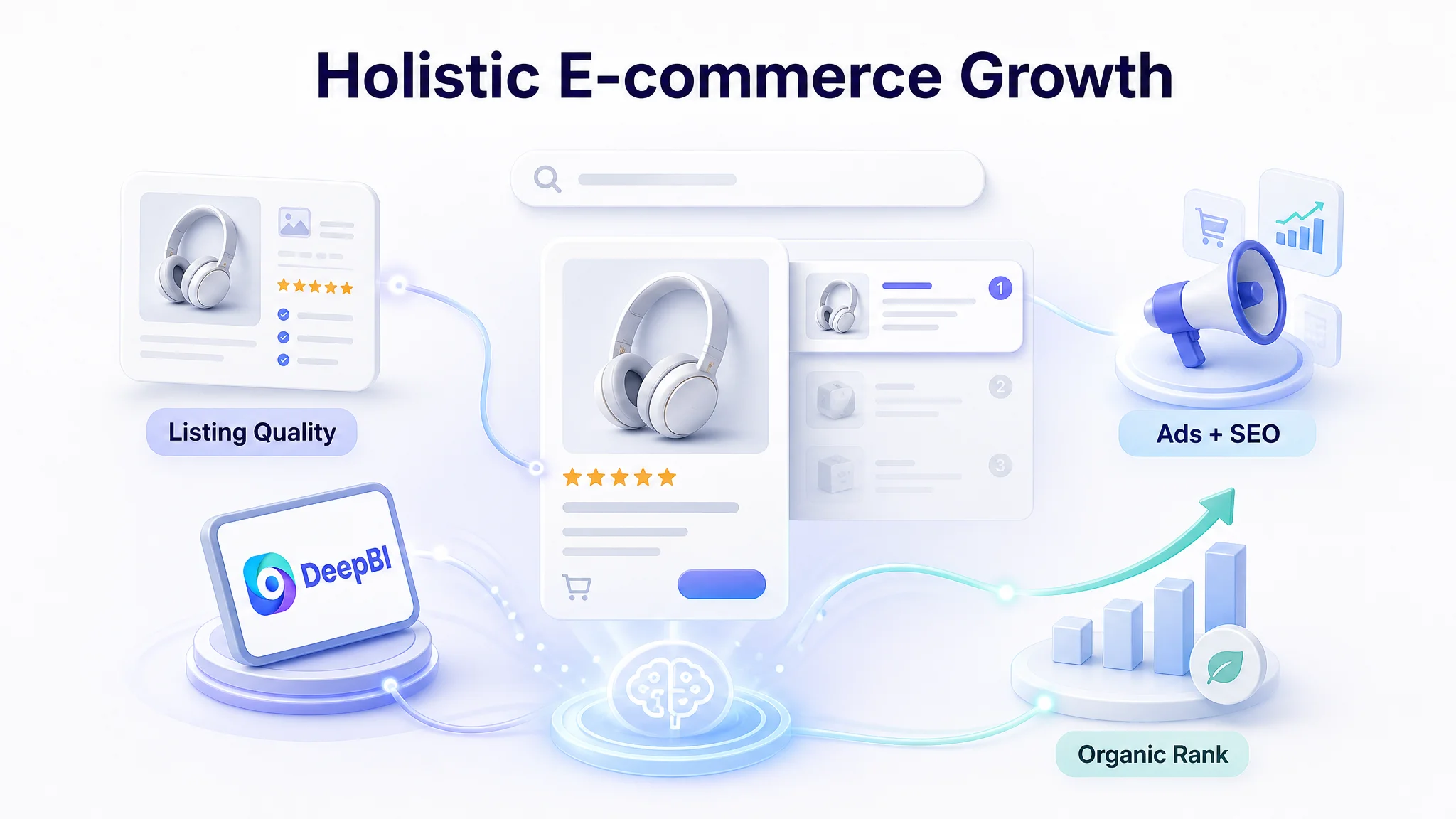
Success on Amazon is not achieved through isolated tactics but through a holistic strategy where listing quality, advertising performance, and organic rank are treated as deeply interconnected components. High-quality listings with compelling visuals and relevant keywords not only improve CVR but also enhance the effectiveness of ad campaigns. In turn, the stable sales velocity and positive performance data generated by well-managed advertising can significantly boost a product's natural search ranking. This creates a powerful growth flywheel that lowers the Total Advertising Cost of Sale (TACoS). The era of simple copywriting adjustments and aesthetic image updates is over; today's environment demands precise, data-driven collaboration between all elements of an Amazon presence.
This guide provides a comprehensive framework for developing and executing a strategy to dominate organic search. To navigate this complexity, modern sellers need a system that unifies these moving parts. A solution like DeepBI becomes essential in this context. As an AI-powered, end-to-end system, DeepBI is designed to break down traditional operational silos by integrating diagnosis, strategic planning, content production, and delivery into a single, intelligent optimization loop. By connecting every action to measurable performance metrics, it transforms listing management from a series of disconnected tasks into a core driver of commercial growth.
Foundational Pillar: Optimizing Your Product Listings for Organic Visibility
Your product listing is the single most critical asset for driving organic traffic. It must simultaneously convince Amazon’s A9 algorithm of its relevance and persuade human shoppers to convert. A successful listing excels across several core components: comprehensive keyword integration, a compelling title, benefit-driven bullet points, high-quality visuals, competitive pricing, and a strong foundation of positive customer reviews. Each element directly influences your sales velocity and Best Sellers Rank (BSR), which are key inputs for organic placement.
However, manually optimizing these elements is often a process of guesswork, leading to slow iteration cycles and uncertain outcomes. It’s common for teams to fixate on the most visible parts of the listing—typically the title and main image—because they appear to be the “obvious levers.” In one case, a well-known brand in the arts & crafts category had already built strong recognition offline, yet a specific variant of its product was consistently underperforming a very similar benchmark listing in the same family. Internally, the narrative quickly solidified around two assumptions: the title must be under-optimized for the main keyword, and the main image must look less attractive than the benchmark. Weeks of work went into adding more keywords and asking designers to “upgrade” the visuals. When this didn’t close the performance gap, it became clear that intuition alone was not enough.
The critical challenge is to move from subjective improvements to a data-driven strategy. This requires a systematic approach to identifying the right competitors, diagnosing specific weaknesses, generating superior content, and deploying it efficiently.
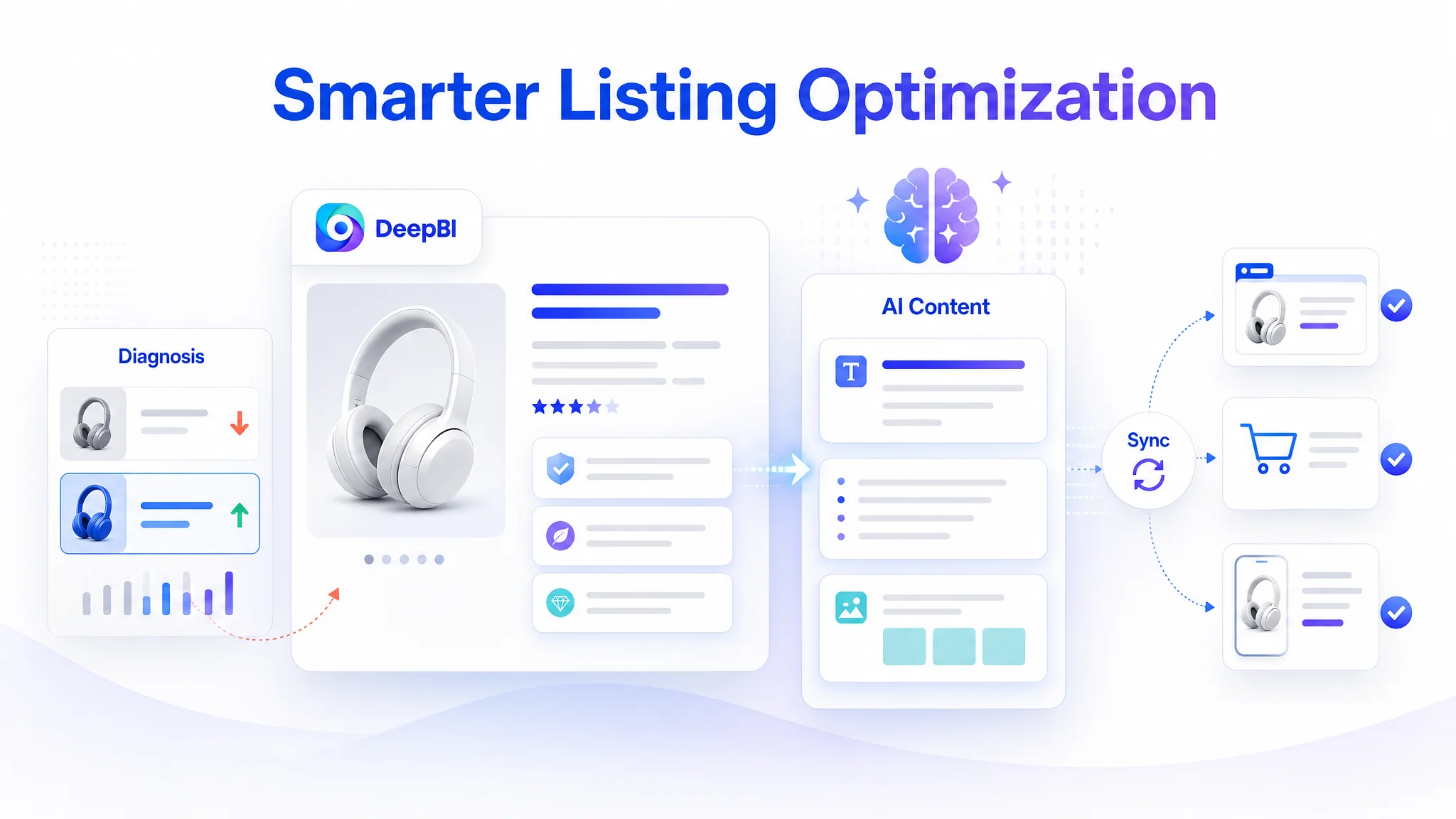
This is where an integrated system provides a decisive advantage. DeepBI’s Listing module begins with Intelligent Scoring and Diagnosis, which automatically identifies high-performing competitor ASINs and benchmarks your listing against them. The system generates a multi-dimensional analysis covering main images, title structure, bullet points, A+ Content, and review quality to pinpoint exact areas for improvement.
In the arts & crafts example above, this kind of quantified comparison revealed something the team had not expected: the title and main image were not the real problem. When the listing was scored across title, main image, bullets, detail/A+ content, and reviews against a close benchmark, the total gap was significant—but almost all of it came from a single missing piece: there was no A+ or detail content at all, while the benchmark had a fully developed detail section. Title and bullets were roughly comparable, and the main image even scored slightly higher. The brand had been optimizing where it was already reasonably strong, while the only truly decisive weakness—a lack of a trust- and education-building detail layer—remained untouched. This shift from “we need a better title and prettier image” to “we are structurally disqualified by missing A+ content in a trust-heavy category” is precisely the kind of reframing that a structured diagnosis can provide.
Based on this diagnosis, DeepBI’s AI-powered Content Generation creates optimized assets, including titles, bullet points, and images. This is not a generic AI tool. The system operates on a principle of "product entity consistency," ensuring that AI-generated visuals never alter the product's material, color, or design. This feature helps mitigate the risk of negative reviews arising from a mismatch between the image and the product. In the case above, this meant focusing visuals on clearly proving the core product benefit (for instance, showing actual texture and application scenes) rather than reinventing the product’s appearance. Finally, the One-click Application feature uses the Amazon SP-API to sync all optimized content directly to your listing in seconds, collapsing a manual process that once took dozens of minutes and closing the loop from analysis to execution.
Strategic Acceleration: Leveraging Amazon Ads for Organic Growth
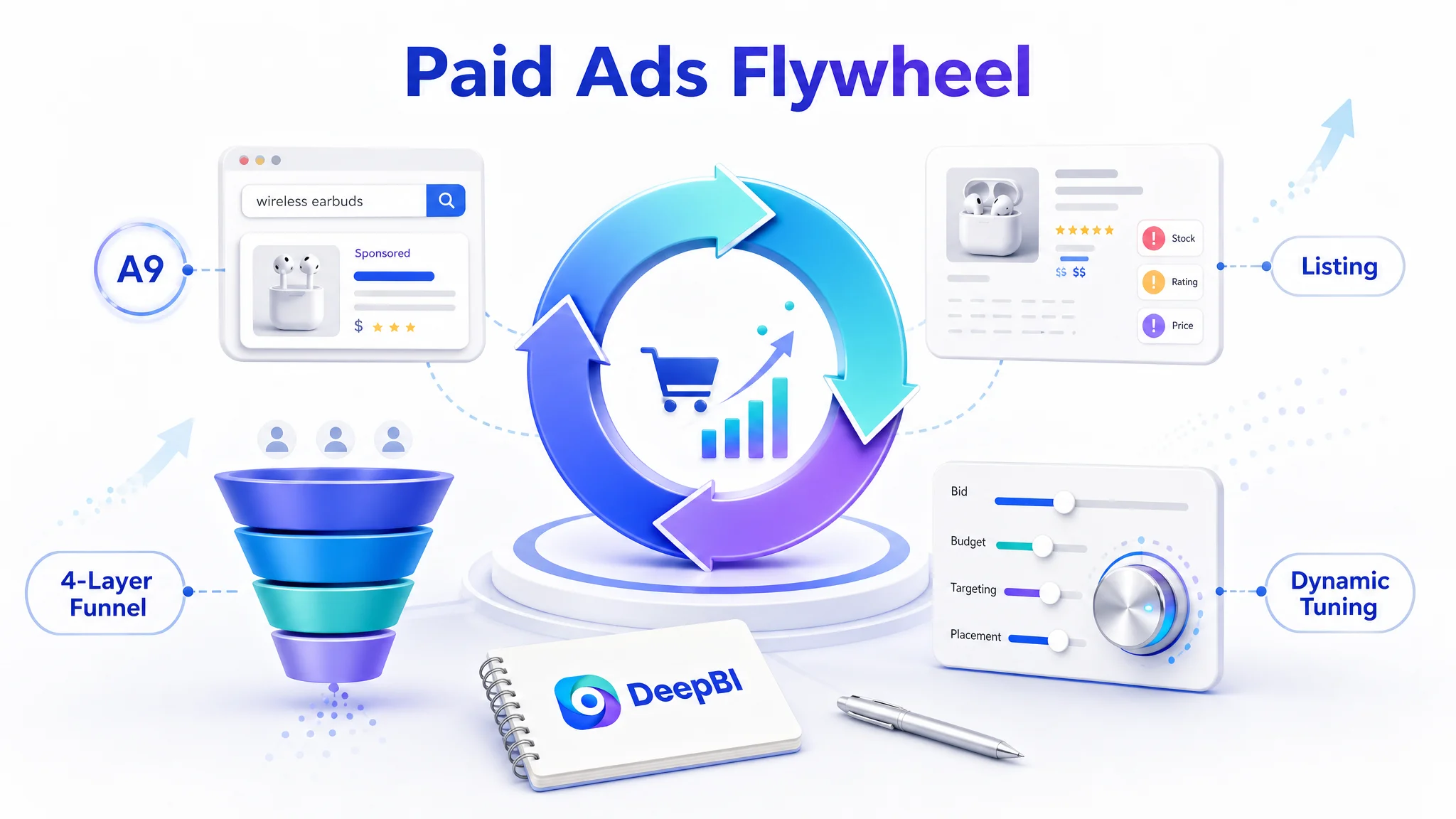
Paid advertising on Amazon is more than a direct sales channel; it is a powerful catalyst for long-term organic growth. The key is to leverage Sponsored Products (SP) campaigns to initiate the Amazon Flywheel Effect. By driving sales through targeted ads, you signal product relevance to the A9 algorithm. This increased sales velocity boosts your organic ranking, which in turn generates more organic sales, creating a self-reinforcing cycle of growth.
The strategy begins with identifying and dominating high-value keywords. Use ad campaigns to pinpoint terms with the highest conversion rates and then invest aggressively, particularly in Top of Search (TOS) placements. While this may temporarily increase your Advertising Cost of Sales (ACoS), the goal is strategic: maximizing immediate sales volume on crucial keywords sends the strongest possible signal to Amazon, directly improving your organic position for those terms. This approach shifts the focus from minimizing ACoS to investing in sustainable organic visibility.
Where many teams go wrong is in treating ads as a universal fix for listing problems. When CVR is poor, the immediate impulse is often to increase budgets or expand keyword coverage to “push more traffic.” In the acrylic paint example mentioned earlier, this kind of thinking had already taken hold: costs on core generic keywords were rising, CTR was modest but acceptable, and yet conversion lagged behind a close benchmark listing. The internal conclusion was that the answer must be “more or better traffic,” when in reality the detail page lacked the trust and education layer the category implicitly required. Without addressing the listing constraint, incremental ad spend could only raise costs, not significantly improve overall performance.
Executing this strategy at scale requires sophisticated management. DeepBI’s Four-Layer Traffic Funnel Model provides a framework to strategically manage campaigns, from discovering new keyword opportunities to scaling the high-converting campaigns that most effectively drive sales velocity. To maintain momentum, DeepBI’s Dynamic Parameter Adjustment Mechanism automatically optimizes bids and budgets daily based on performance. This ensures your ad spend is continuously allocated to maximize sales and fuel the organic growth flywheel. By tracking the correlation between ad performance and organic rank lift, you can systematically turn ad spend into a durable competitive advantage—provided the traffic you buy is landing on a listing that has had its real constraints identified and addressed.
Sustained Dominance: Nurturing Organic Traffic for Long-Term Profitability
Achieving a high organic rank is not a one-time victory but an ongoing campaign that requires a holistic and data-driven strategy. Sustained dominance hinges on continuous optimization across your entire Amazon presence, from keyword management to operational excellence. This process starts with vigilant keyword monitoring, constantly refining your listings to capture emerging search trends and defend your position.
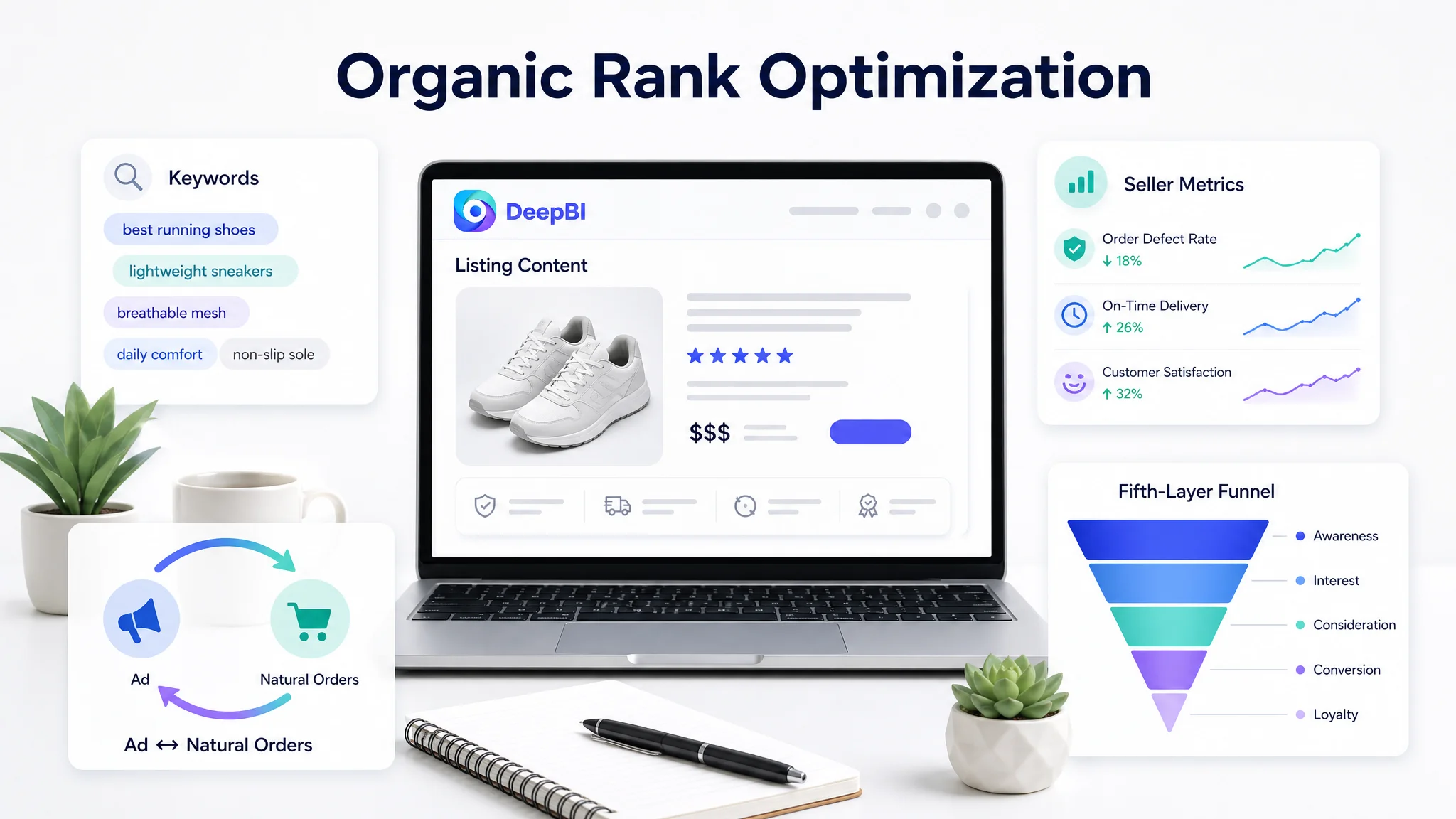
Beyond your listing content, Amazon’s A9 algorithm heavily favors sellers who provide a reliable customer experience. Maintaining excellent seller performance metrics is non-negotiable. Consistently keeping your Order Defect Rate under 1%, Late Shipment Rate below 4%, and Pre-fulfillment Cancel Rate under 2.5% signals to Amazon that you are a trustworthy partner, which is rewarded with better organic visibility. This foundation can be amplified with strategic promotions and deals to boost sales velocity, further improving your ranking. Leveraging Brand Registry for A+ Content is also critical for enhancing the customer experience and increasing your conversion rate (CVR).
The experience of brands in visually driven, trust-heavy categories illustrates how important this deeper layer of content is for long-term stability. In categories where buyers care about texture, finish, surface compatibility, safety, or other nuanced attributes, a bare-bones detail page forces shoppers to guess. Even if a product has strong offline reputation and acceptable reviews, a lack of structured A+ content—such as application scenes, clear spec explanations, and brand credibility modules—can create a persistent conversion drag. Over time, this drag shows up as a stubborn gap in sales velocity versus better-built benchmark listings, which in turn translates into weaker organic rank and a higher dependence on paid traffic to maintain volume.
To effectively manage these variables, sellers need robust analytics. DeepBI provides the tools to dissect organic performance, understand ranking fluctuations, and identify optimization targets. Its Fifth-Layer Funnel strategy helps you identify high-value keywords from advertising data and establish dedicated campaigns to reinforce Top of Search placement. This creates a powerful feedback loop where ad success fuels organic growth, ultimately enabling you to optimize for a lower Total ACoS (TACoS) and increase the proportion of natural orders for long-term, sustainable profitability. Just as importantly, the diagnostic capabilities help ensure you are reinforcing the right parts of your funnel—prioritizing the single most limiting constraint in your listing rather than spreading effort evenly across elements that are already competitive.
Conclusion: Achieving Sustainable Amazon Success with a Unified Strategy
Achieving lasting success on Amazon is not a matter of isolated tactics but the result of a continuous, interconnected strategy. The path to sustainable organic growth lies in the powerful synergy between data-driven listing optimization, strategic advertising, and direct ranking efforts. When these components work in concert, paid advertising data is converted into stronger organic rankings, creating a virtuous cycle that lowers your Total Advertising Cost of Sales (TACoS) over time.
This unified approach marks a critical shift away from traditional, fragmented operations where diagnosis, planning, and execution are disconnected. Instead of relying on subjective experience, sellers can now leverage a data-driven evidence chain to guide every decision. In real-world scenarios, this often means discovering that the loudest internal theories—such as “we just need a better title” or “our main image is the issue”—are not where the biggest structural gaps actually are. A quantified comparison against true benchmarks can reveal that a single missing layer, like A+ content in a category where buyers demand visual proof and brand reassurance, is doing more to hold back growth than any amount of keyword tweaks or design polish.
The long-term benefits are clear: reduced dependency on paid traffic, increased profitability, and enduring brand loyalty.
In the increasingly competitive e-commerce landscape, tools like DeepBI are no longer a luxury but a necessity. By integrating the entire optimization loop from market health checks to one-click execution, DeepBI empowers sellers to move from intuition-based guesses to precision-targeted actions. It helps teams re-order their priorities around the constraints that matter most, rather than the ones that are most visible. This is the future of Amazon selling—where every decision is validated by data, securing a decisive competitive advantage for brands poised for long-term growth.