In the hyper-competitive Amazon marketplace, sellers constantly navigate the dual pressures of Click-Through Rate (CTR) and Conversion Rate (CVR). While both are critical, CTR is the first and most significant hurdle. It represents the percentage of shoppers who see your product in the search results and are compelled enough to click on it. A low CTR means that even a superior product with a high conversion potential will remain invisible, lost among countless competitors and failing to generate the traffic needed for sales velocity and improved Best Sellers Rank (BSR).
The challenge is that many sellers still view their listing assets, particularly the main image, as simple aesthetic displays. This perspective is outdated and costly. In today's market, your visual assets must function as a core commercial engine, meticulously engineered to attract attention and drive clicks. A powerful main image acts as a 'click driver,' pulling customers from a crowded search results page onto your product detail page.
In practice, many seemingly “good enough” listings are quietly capped by weak click drivers. For example, we’ve seen jewelry sellers whose pages looked polished—high-quality visuals, solid reviews, complete A+—yet their CTR lagged behind a slightly less “pretty” competitor. When we dug in, the competitor’s main image and title simply did a better job answering the first questions buyers have in search results (What is it? Is it safe? Roughly what size?), so more shoppers clicked them first. The underlying product wasn’t better—its ability to win the click was.
 This guide provides a strategic framework for transforming your product listing from a passive showcase into an active driver of traffic. We will break down the essential elements that influence your CTR and provide actionable, data-informed strategies to optimize them, ensuring every component of your listing works to capture shopper interest and win the click.
Understanding Amazon CTR: The Gateway to Sales
Click-Through Rate (CTR) is one of the most critical performance indicators for any Amazon business. It measures the percentage of shoppers who see your product in search results and are compelled enough to click on it. A strong CTR is the first step in the customer journey, acting as the gateway to your product detail page and, ultimately, to a sale.
What is Amazon CTR?
Amazon CTR is calculated with a simple formula:
CTR = (Total Clicks / Total Impressions) * 100
For example, if your product appears in search results 10,000 times (impressions) and receives 50 clicks, your CTR would be 0.5%.
It's important to distinguish between two types of CTR:
- Organic CTR: This measures clicks from unpaid, natural search results. You can track this data in the Search Query Performance report within Brand Analytics. A high organic CTR often signals strong product relevance and customer trust.
- Paid CTR: This measures clicks from your Pay-Per-Click (PPC) advertising campaigns. This data is available in the Amazon Advertising Campaign Manager.
In real operations, sellers often mix these two in their diagnosis. We frequently see teams looking only at ad CTR inside Campaign Manager, decide “our creatives are fine,” and overlook the fact that organic CTR on the same ASIN is materially lower than direct competitors for the same keywords. That gap is usually a sign that something in the listing’s default “search card” (main image + title + price + rating) is not compelling enough when ads are not artificially boosting visibility.
Why Amazon CTR Matters for Your Business
Your listing's CTR is more than just a vanity metric; it directly influences your store's visibility and profitability.
- Impact on Organic Rankings: Amazon's algorithm rewards engagement. A higher CTR signals to Amazon that your listing is highly relevant and appealing to customers for specific keywords. This can lead to improved organic search rankings, driving more free traffic to your page.
- Advertising Performance: In the world of Amazon PPC, CTR is a key factor in your ad's quality score. A higher CTR can lead to better ad placements and a lower Cost-Per-Click (CPC), making your advertising budget more efficient and improving your overall ACoS (Advertising Cost of Sale).
- Increased Sales: A higher CTR means more potential customers are visiting your product detail page. This increased traffic is the essential first step to boosting conversions and growing your sales volume.
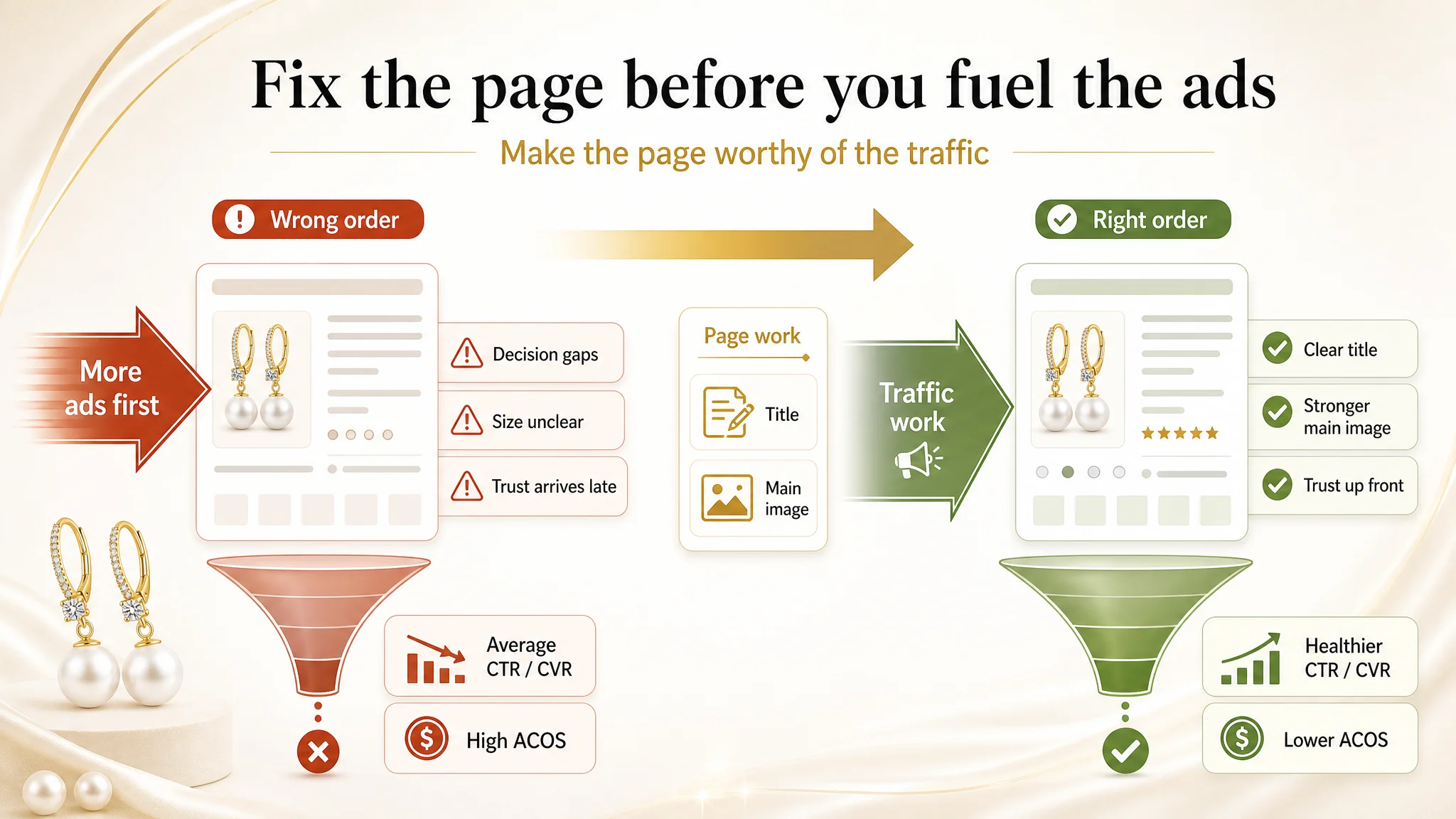
A common pattern in real stores is that teams try to solve flat sales purely with more traffic: more ad campaigns, more keywords, higher bids. But if your CTR is structurally weaker than a benchmark competitor for the same query, you are essentially paying to show a less clickable offer next to a more clickable one. One jewelry seller, for instance, kept scaling Sponsored Products on “pearl earrings” until ACoS became uncomfortable, only to realize later that their title and image in the search results weren’t answering critical concerns like “hypoallergenic” and “size clarity” as clearly as a nearby competitor. As soon as the search card was fixed, both CTR and downstream efficiency improved without changing the core product.
 Decoding a "Good" Amazon CTR: Benchmarks and Context
Defining a single "good" Click-Through Rate on Amazon is challenging, as performance is highly contextual. While industry discussions often place a healthy PPC CTR above 0.5%, this figure is far from universal. A more concrete diagnostic threshold can be seen in performance analysis tools, where an organic CTR below 0.35% is often flagged as a critical issue, suggesting the main image fails to provide a compelling "visual hook" in crowded search results.
However, treating any single number as an absolute target is a strategic error. A truly "good" CTR is relative and fluctuates significantly based on several key factors:
- Product Category: Niche, high-consideration products will naturally have different CTR patterns than everyday consumables.
- Competition: A listing in a saturated market will face more pressure on CTR than one in an emerging category.
- Price Point: Premium-priced items may attract fewer, but more qualified, clicks compared to budget alternatives.
- Seasonality: Demand shifts throughout the year can cause CTR to rise and fall independent of your listing quality.
The most effective way to evaluate your performance is to benchmark against your own historical data and your direct competitors. Track your ASIN’s CTR trend over a 7-14 day period after implementing changes to see a clear cause-and-effect. More importantly, identify a top-performing, highly similar "benchmark competitor." Your primary goal should be to meet or exceed their CTR, as this is the truest measure of your competitiveness within your specific market segment.
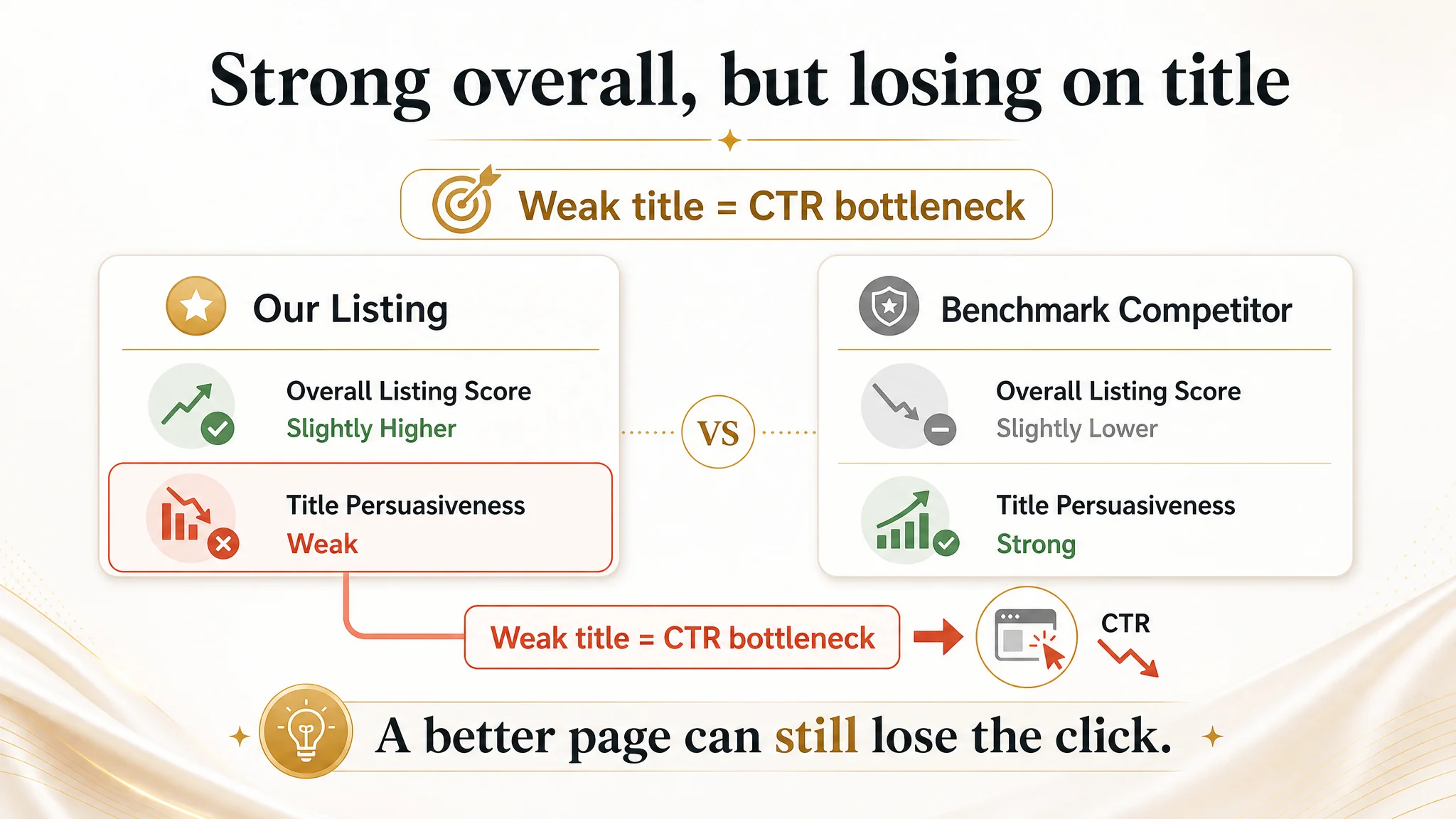
In practice, this means going beyond global “good vs bad” averages and looking at pairs of products that compete for the same intent. In one US jewelry category, a seller’s listing score was actually higher overall than a key competitor’s, and their reviews were clearly stronger. Yet when we compared organic CTR on core queries, they trailed the competitor. The reason: the benchmark’s title surfaced “Hypoallergenic” and a clear size range right at the front, while the seller’s title buried those points behind repeated material terms. To Amazon’s shoppers, the competitor simply appeared more relevant and safer in the search results, and that nuance was fully reflected in CTR, despite the seller’s “better” page on paper.
 Core Strategies to Elevate Your Amazon Listing CTR
Optimize Your Product Images for Maximum Impact
Your main image is the single most critical factor for earning a click in crowded search results. It must be high-resolution, on a pure white background, and clearly showcase the product. Supplement this with lifestyle images, infographics, and videos to demonstrate value and use cases. To avoid the "AI hallucinations" common with generic tools that can lead to product-image mismatches and negative reviews, leverage specialized systems. DeepBI's AI image generation acts as an automated visual production system, using a "Product DNA" map to lock in your product's authentic features. This allows it to generate multiple, compelling visual options that are optimized for CTR while guaranteeing product accuracy.
Beyond technical quality, each image should answer a distinct buying question instead of repeating the same “beauty shot.” In the pearl drop earrings case mentioned earlier, the seller’s main image set was elegant and scored well visually, but several slots repeated similar lifestyle angles on silk backgrounds. What was missing in the sequence were hard decision points: a clear side view that explicitly communicates secure lever-back design, a dedicated size diagram, and a clean variant overview. Once those images were rebuilt so that the sequence moved from “design → security → size → variants → giftability/service,” shoppers arriving from search understood the product faster and with fewer doubts—making each impression more likely to turn into a click and, later, a purchase.
Craft Compelling and Keyword-Rich Product Titles
A strong title must serve both Amazon's algorithm and human psychology. It needs primary keywords for discoverability while also communicating key benefits to entice a click. A proven structure includes your brand name, a key differentiator or benefit, the product type, and essential specifications. DeepBI’s optimization engine accelerates this process by analyzing top-performing competitors to generate structured, actionable recommendations. It helps you prioritize the most impactful keywords and craft a title that is both SEO-friendly and conversion-focused, eliminating ineffective filler words.
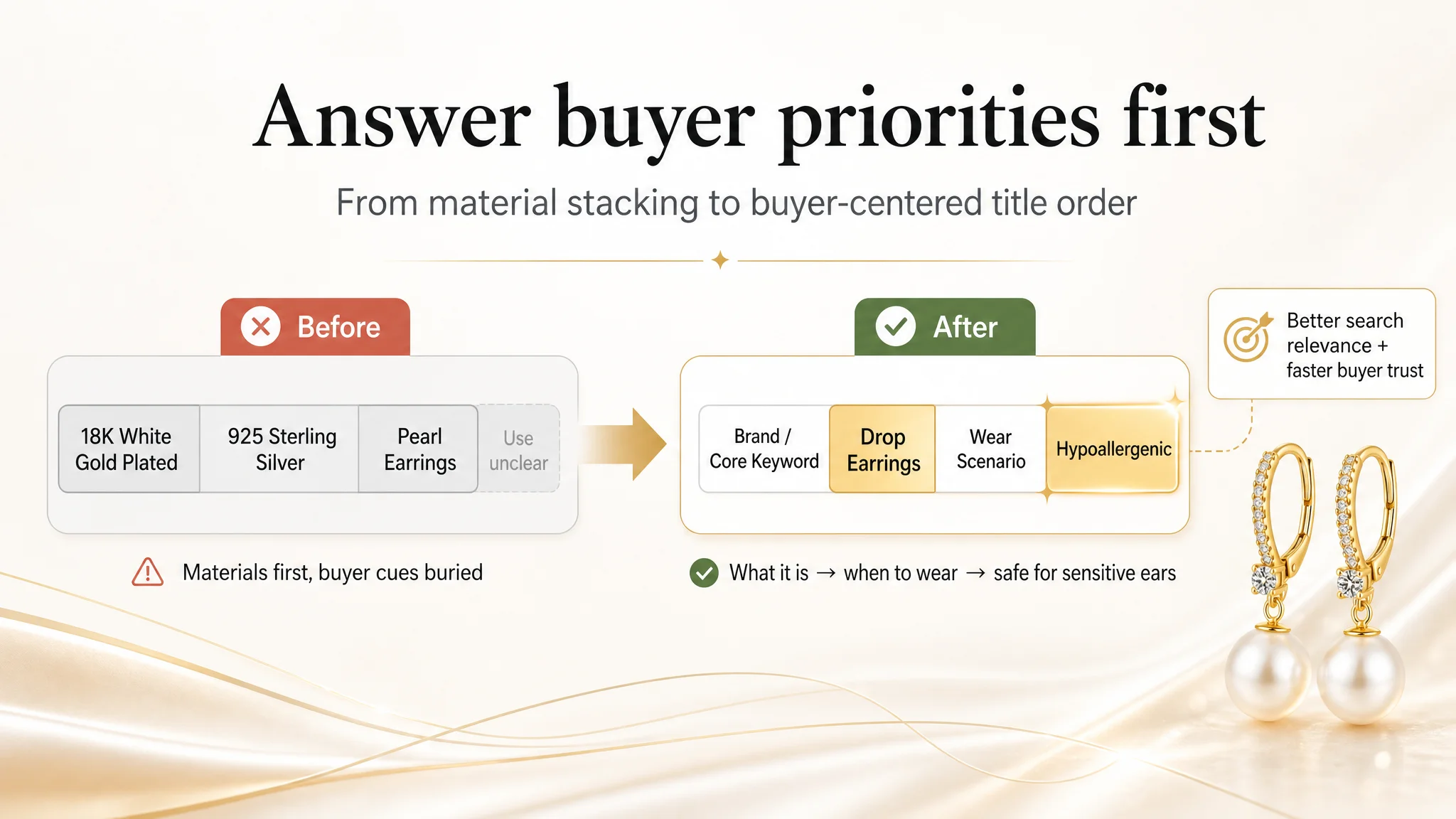
Real-world data repeatedly shows that small shifts in title logic can change CTR meaningfully. In the jewelry example, the seller’s original title overloaded material descriptors (“18k White Gold Plated, 925 Sterling Silver” repeated) while burying the core shape and use-case. It also failed to surface “Hypoallergenic,” despite serving a sensitive-ears audience. The competitor, by contrast, led with brand, core keyword, size range and “Hypoallergenic,” which immediately aligned with the way buyers scan search results. After reworking the title to prioritize “pearl drop earrings,” outcome (“dainty jewelry for women”), and “hypoallergenic” ahead of redundant material repetition, the listing started to attract more qualified clicks from shoppers who had already seen exactly what they cared about in the search snippet.
 Enhance Bullet Points and Product Descriptions
Once a shopper clicks, your bullet points and description must quickly validate their choice. Structure your bullet points using a "Pain Point - Solution" framework. Instead of just listing a feature like "10000mAh battery," frame it as a benefit: "All-Day Power: The 10000mAh battery ends travel anxiety, keeping you connected on the go." This approach directly addresses customer needs. Further down the page, use A+ Content to tell your brand story, compare products, and build deeper trust, which reinforces the value proposition and supports the entire listing's performance.
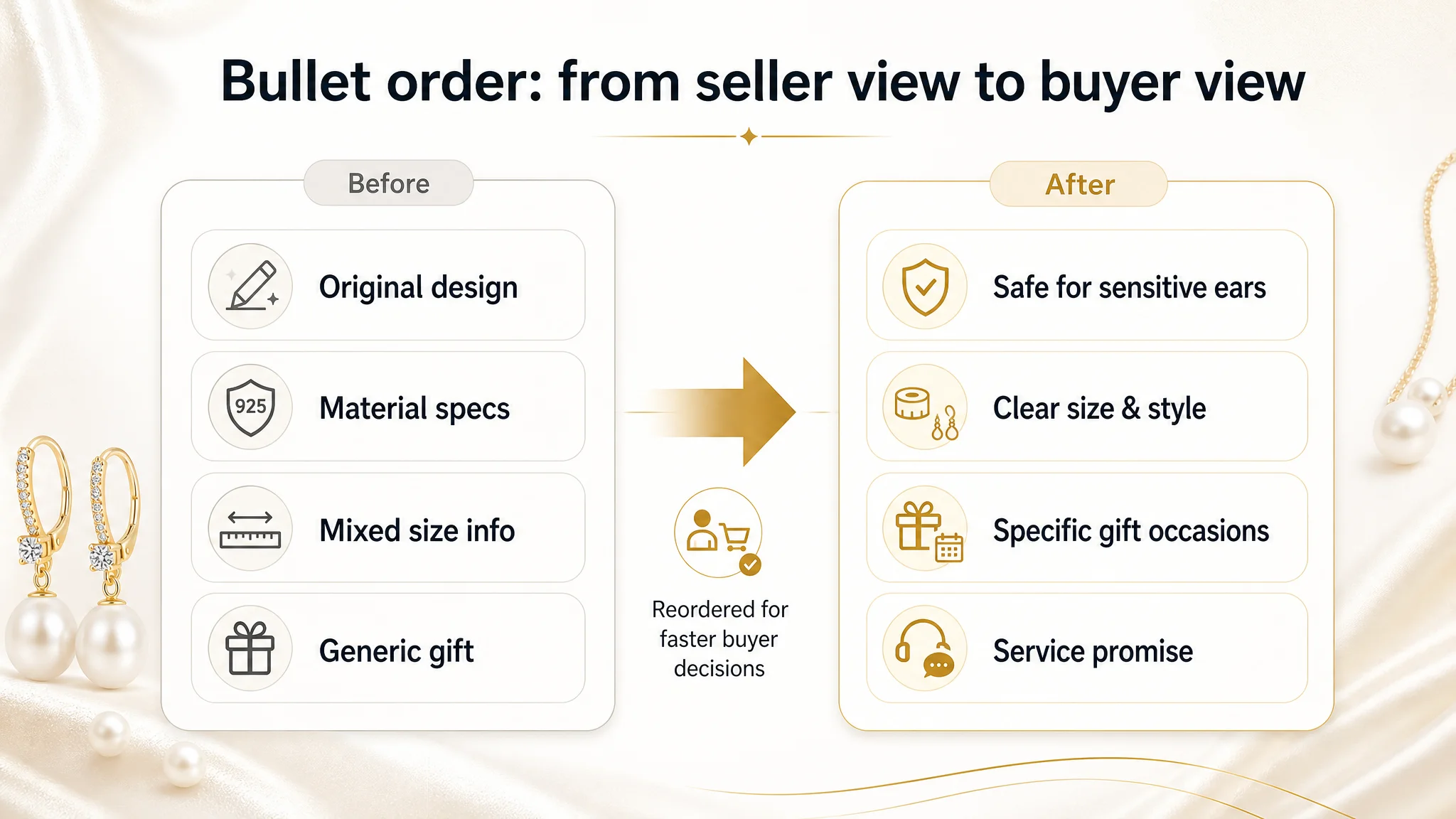
Operationally, many listings technically “have” bullet points but lack the buying logic behind them. In the pearl earrings case, both the seller and competitor had similar bullet scores, yet the competitor opened with size and comfort (“Large Pearl Earrings,” clear mention of sensitive ears), while the seller opened with design and stone quality. The information was not wrong—it was just sequenced around what the seller was proud of rather than what the buyer worried about first. After bullets were restructured to move “premium quality for sensitive ears” and precise specs (pearl size and total length) into early bullets, and to separate gift scenarios and service into their own points, users arriving from search found their key questions answered faster. This kind of post-click reassurance supports CTR indirectly as well, because satisfied buyers are more likely to leave reviews and less likely to bounce back to the search page.
 Leverage Customer Reviews and Ratings Effectively
Social proof is a powerful CTR driver. A high star rating and a substantial volume of reviews build immediate trust. While the exact threshold varies by category, a rating below 4.3 stars can often lead to a noticeable decrease in clicks. Focus on earning positive reviews through excellent products and customer service. To understand your competitive standing, DeepBI's diagnostic tools can analyze your review structure—including star distribution and volume—against key competitors. This identifies whether customer sentiment is a weak point impacting your listing's click-worthiness.
It’s easy to assume that “strong reviews = no CTR issue,” but that assumption can hide structural problems. In the jewelry case, the seller actually had a better review profile than the benchmark competitor (higher rating, more reviews) and still saw weaker performance in traffic efficiency. Because star rating and count were not the bottleneck, shoppers’ decisions in search appeared to be swayed more by clarity on safety and size than by raw review metrics. This underlines an important operational lesson: reviews help, but they cannot fully compensate if the search-facing elements (image, title, price) do not immediately align with core purchase filters in that category.
Strategic Pricing and Promotions
Price is a primary decision-making factor on Amazon, and visible coupons, deals, or "Limited time deal" badges are powerful magnets for clicks. Your pricing strategy must strike a careful balance between market attractiveness and profitability. When benchmarking your listing, ensure you are comparing against similarly priced competitors to draw relevant conclusions. Effective competitive analysis tools implicitly guide this by filtering out irrelevant price brackets, helping you position your product to win the click without sacrificing your margins.
In high-consideration categories, we often see sellers under-estimate how much a small price misalignment can depress CTR when combined with unclear value communication. For instance, a slightly higher-priced listing can still win the click if the main image and title strongly highlight premium materials, hypoallergenic claims, or gift-ready packaging. But if those differentiators are buried, shoppers scan the row of search results and simply default to the cheaper, clearer offer. When diagnosing your CTR alongside price, always ask: “Does my search card justify my price at a glance?” In the jewelry case, once safety, size and giftability were made more explicit visually and textually, the listing had more room to sustain a price that reflected its true positioning.
Boosting CTR Through Amazon Advertising Optimization
Your Amazon Sponsored Products campaigns are a direct lever for improving click-through rates. A high CTR on your ads not only drives immediate traffic but also signals relevance to Amazon's algorithm, which can positively impact your overall visibility. Success hinges on presenting the most relevant ad to the right shopper at the right time.
This starts with optimizing your ad creative. Your main product image, headline, and copy must be compelling and directly address the search terms you are targeting. Ensure your visuals are high-quality and your headline captures the primary benefit. Simultaneously, refine your keyword strategy by focusing on high-intent search terms and diligently using negative keywords to prevent your ads from showing for irrelevant queries. This precision ensures your ad spend is directed toward shoppers most likely to click, protecting both your budget and your CTR.
Strategic bidding is also crucial for gaining visibility in competitive ad placements. However, manual adjustments can be time-consuming and reactive. To maintain optimal performance, automated systems can provide a significant advantage. For instance, DeepBI's dynamic parameter adjustment mechanism can automatically fine-tune bids and budgets daily for your Amazon Sponsored Products campaigns. By analyzing recent performance data, it optimizes for CTR and other key metrics, ensuring your ads are consistently positioned to capture clicks efficiently and drive down your ACoS.
What often gets overlooked is that ads invariably amplify whatever strengths or weaknesses your listing already has. In the jewelry earrings example, the seller kept adding new campaigns and tuning bids under the assumption that “ads refinement” would unlock better results. Traffic did increase, but ACOS remained stubborn because the search-facing signals (title and image sequence) weren’t tightly aligned with what shoppers cared about most. In effect, the campaigns were pouring more budget into a page that did not yet “deserve” that scale. Only after the listing’s decision logic was repaired—notably around safety, size, and variant clarity—did ad traffic start to behave like an efficient growth lever rather than a blunt instrument.
 Measuring and Iterating on CTR Improvements with DeepBI
Optimizing your Click-Through Rate is not a one-time fix; it's a continuous cycle of analysis, implementation, and measurement. Traditional workflows often fail here, creating disconnected stages for diagnosis, content creation, and performance tracking. This makes iterative improvement slow, inefficient, and reliant on guesswork.
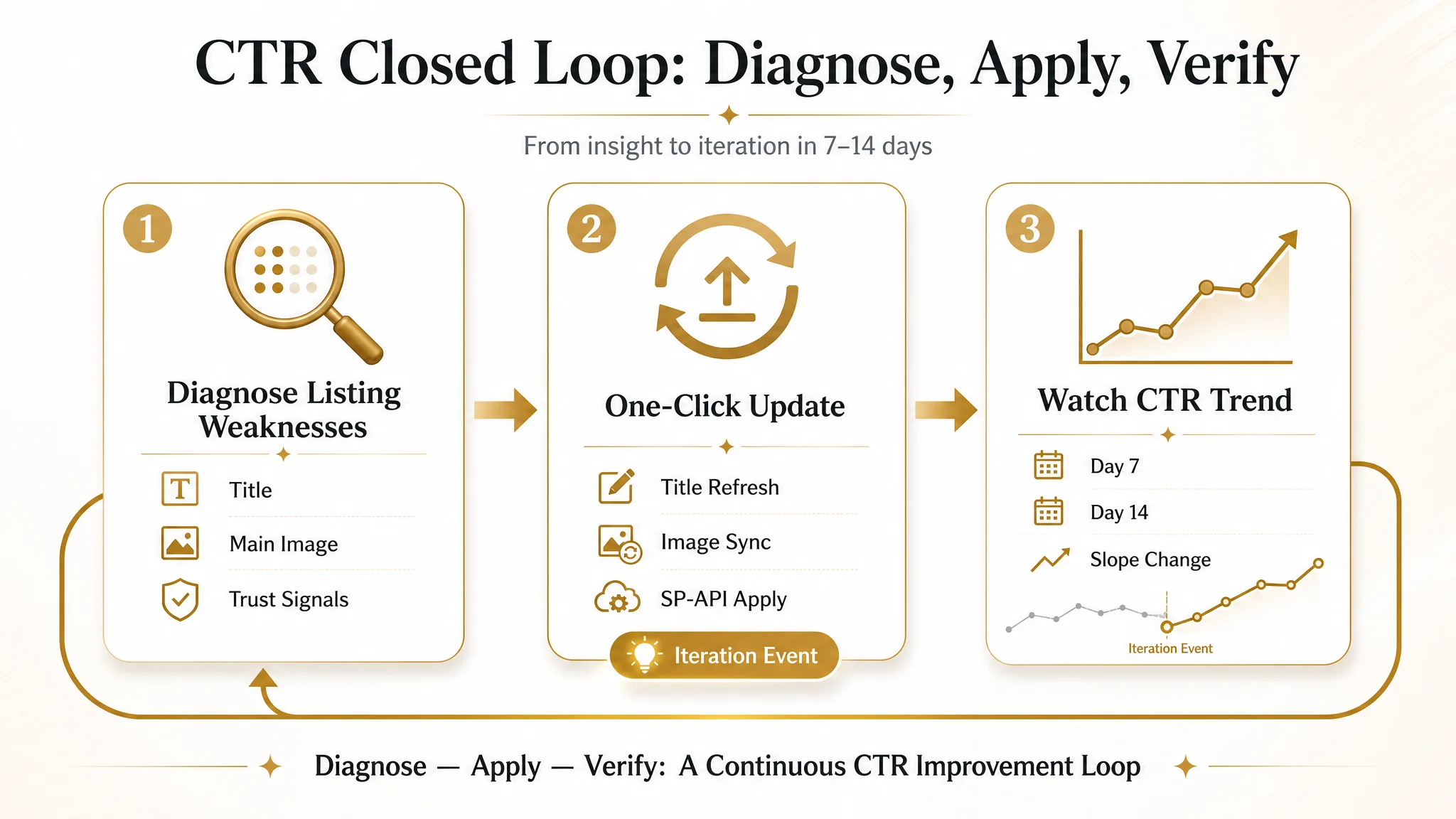
DeepBI transforms this process with an end-to-end intelligent optimization system that creates a closed feedback loop. It starts with a comprehensive diagnosis that functions as an "automated market health check." The system analyzes your listing across key dimensions—main image, title, bullet points, and A+ content—and cross-validates its findings with your actual advertising data like impressions, clicks, and CTR to pinpoint specific weaknesses.
On real accounts, this kind of diagnosis often reveals imbalances that are not obvious from surface metrics. In the pearl earrings case, the overall listing score was slightly higher than the benchmark competitor’s, but the breakdown showed a weak title dimension and an image set that over-invested in repeated lifestyle shots while under-serving rational questions. At the same time, ad reports confirmed that traffic volume was already sufficient. That evidence chain made it clear that further ad expansion would not fix the core issue; restructuring the visible listing elements was the priority.
Once an optimized strategy is generated, implementation is seamless. Instead of a manual upload process that takes dozens of minutes, DeepBI uses the Amazon SP-API for a one-click application that syncs new content in seconds. Crucially, after the update, the system automatically marks a "visual iteration event point" in your advertising reports. This allows you to precisely measure the impact of your changes by observing how the ASIN's CTR slope evolves over the subsequent 7-14 days. This data-driven cycle of diagnosis, application, and measurement turns listing evolution into a predictable, quantifiable process for sustained growth.
In situations like the jewelry case, that 7–14 day window after restructuring the title and images becomes the proof point: if CTR and related engagement metrics start to trend upward from the event marker while ad structure stays largely constant, you know the change came from the listing, not from luck or seasonal noise. Over time, stacking these controlled iterations builds a track record of which types of search-card changes reliably move your CTR in the right direction.
 Conclusion: Sustained Growth Through CTR Optimization
Mastering your Click-Through Rate is not a one-time project but a continuous discipline essential for long-term success on Amazon. The era of relying on subjective aesthetics or guesswork is over. Thriving in today's competitive marketplace requires a fundamental shift from "blind trial and error" to a data-driven methodology built on a clear evidence chain. Without diagnosis, there can be no effective optimization.
Adopting this approach transforms listing management from a reactive task into a predictable, scientific process. Each change to your main image, title, or price is a hypothesis to be tested, with CTR as the primary metric of success. This creates a powerful business feedback loop: you deploy an optimized element, measure its real-world impact on traffic, and use that data to inform the next iteration.
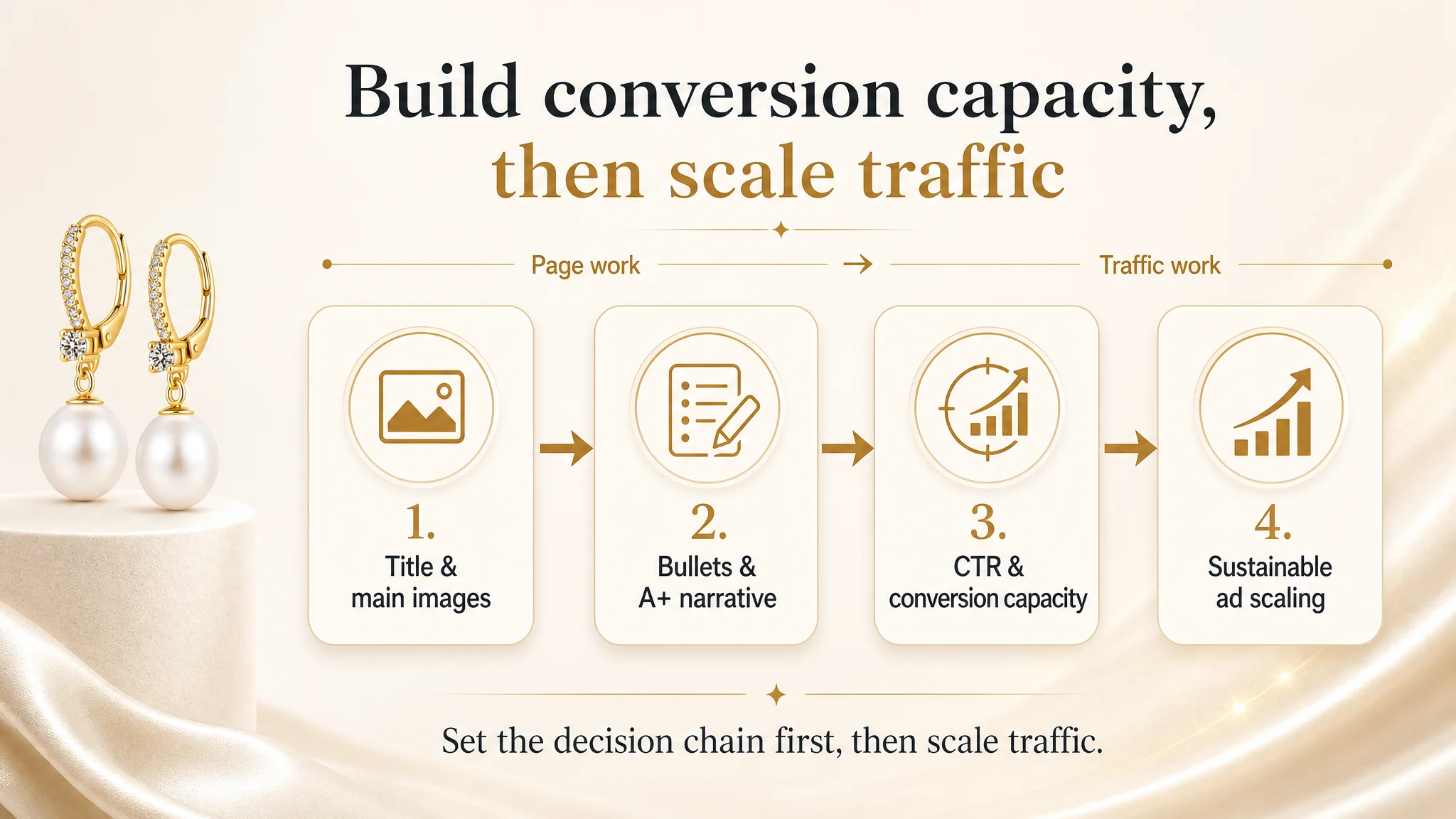
Real operating experience shows that many “nice-looking” listings with strong reviews and complete modules still hide structural ceilings on their ability to attract and convert traffic. In the jewelry earrings case, the turning point came when the team stopped assuming ads and reviews would naturally solve everything, and instead asked a simple question: “At its current state, does this page actually deserve more traffic?” Once the title, images, bullets, and A+ were re-ordered around the buyer’s true decision path—safety, size, variants, giftability—both CTR and conversion capacity began to unlock.
By treating optimization as a dynamic, ongoing cycle, you move from simply having a listing to engineering a core business engine that consistently attracts qualified buyers. This commitment to data-driven evolution is what separates stagnant listings from those that achieve sustainable, profitable growth.