

The Evolving Landscape of Amazon Listings
The Amazon marketplace has evolved into a highly competitive arena where rising traffic costs create significant pressure on sellers to maximize performance. In this environment of intense "stock competition," brands face a dual anxiety over both Click-Through Rate (CTR) and Conversion Rate (CVR). With millions of sellers and an ever-expanding catalog of products, simply having a presence is no longer enough. Listings with low-performing main images and uninspired copy struggle to stand out, effectively becoming invisible in a sea of competitors.
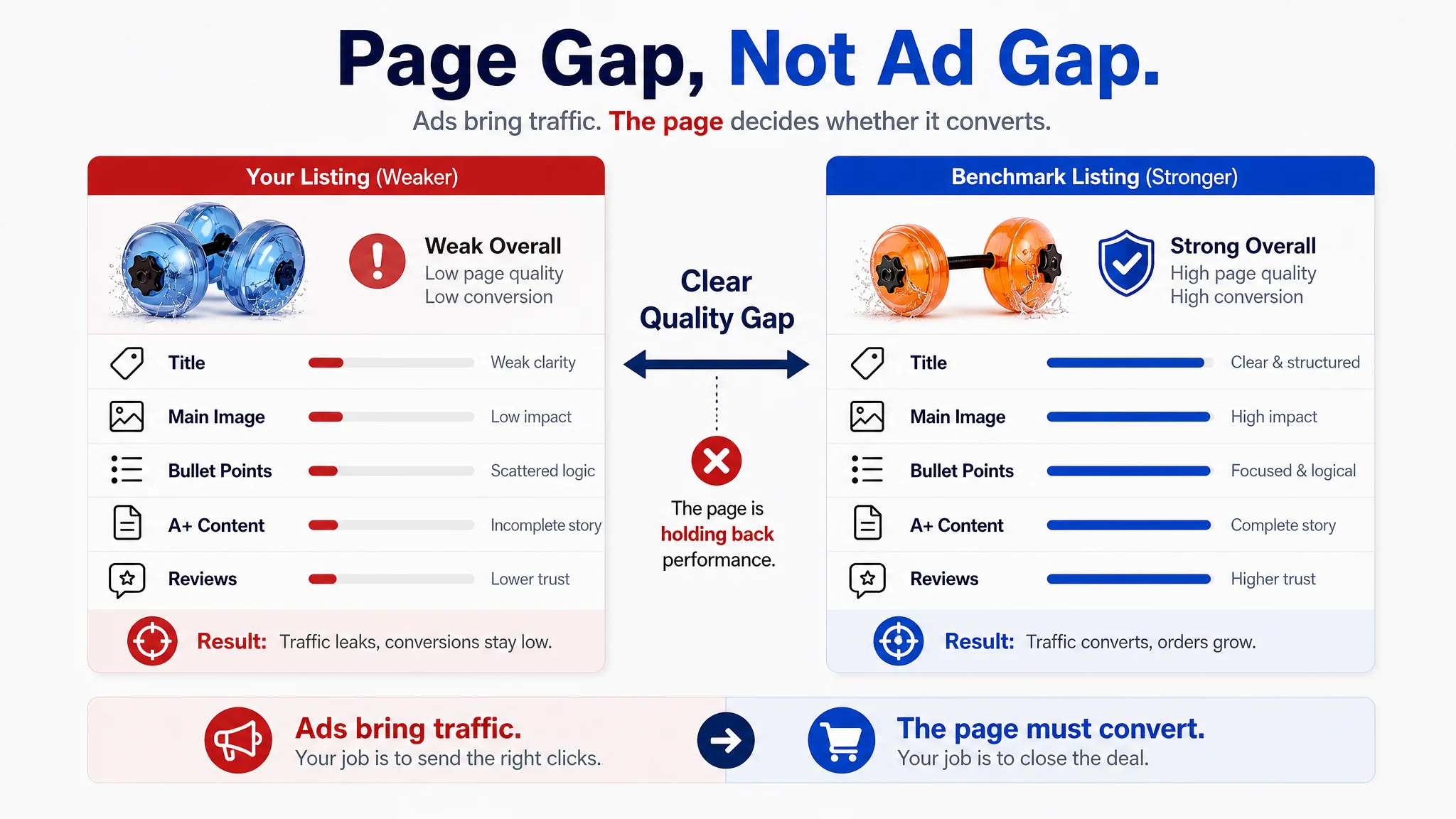
This isn’t just a theoretical risk. In a recent fitness category case on Amazon Germany, a seller operating a water-filled dumbbell set believed their biggest problem was “expensive ads that don’t work.” They kept rotating creatives and tweaking campaigns, yet orders refused to grow in line with traffic. Only when their listing was benchmarked against a strong competitor did it become clear that the issue was structural: a weak title, underwhelming main images, fragmented bullet logic, and incomplete A+ storytelling. Ads were dutifully sending traffic; the page simply could not convert it.

To achieve visibility and drive sales, a product listing must serve two masters: the Amazon algorithm and the human shopper. The algorithm prioritizes products that demonstrate high relevance and a strong history of converting clicks into sales. For customers, the listing is the digital storefront—it must be compelling, informative, and trustworthy. Consequently, the function of listing content has shifted dramatically. Visual assets and copy are no longer just for aesthetic display; they are the core commercial engine that powers discovery and purchase decisions.
This dynamic requires a strategic move away from subjective, one-time updates. Relying on personal taste often results in listings that are visually appealing but fail to sell because they lack quantitative, data-driven support. In the water dumbbell example, the team’s internal narrative was “our images look cheap; our ads need better visuals,” so they stayed in a loop of ad-side tweaks. Only after a structured audit revealed an 18-point gap in page quality versus a benchmark competitor—driven by unclear title logic, missing weight parameters, and low-trust visuals—did they understand that their subjective “nice-looking” assets were misaligned with how buyers actually decide.
Success today demands continuous, precise optimization aimed at producing measurable improvements in key performance indicators. The question is not “do we like our listing?” but “can we prove that each element—title, main image, bullets, A+, reviews—moves CTR and CVR in the right direction?”
Manual Listing Creation: Challenges and Bottlenecks
For many Amazon sellers, the traditional approach to creating and optimizing product listings is a major operational bottleneck. The process is inherently time-consuming, from initial research to final implementation. Manually performing comprehensive keyword research and competitive analysis can consume tens of operational hours, and the results are often skewed by subjective judgments or flawed by "survivor bias"—emulating top sellers without accounting for critical differences in product, price, or audience.
The water dumbbell seller’s initial approach is a textbook example of this. They tried to “learn from the winner” by copying structural elements they saw on a leading competitor’s page: similar scene shots, similar bullet themes, similar A+ modules. However, without systematic diagnosis, they missed the nuances that actually influenced conversion. Their title became a loose collection of fitness-related phrases rather than a clear decision statement. Their main image struggled to reproduce the benchmark’s combination of high-contrast silhouette and technical trust cues. The result was a listing that looked roughly inspired by the category leader but still scored significantly lower when each dimension—title, main image, bullets, A+, reviews—was objectively evaluated.
This inefficiency extends directly to content creation. Crafting compelling titles, bullet points, and descriptions for each product requires significant effort, and the risk of human error and inconsistency grows with every SKU. For sellers managing large catalogs, this presents a formidable scalability challenge, consuming extensive human resources and creating delays in market response.
Even the final step of applying updates is fraught with friction. A seemingly simple task like updating product images involves a tedious sequence of downloading, renaming, and uploading files one by one—a process that can take up to 30 minutes per listing. In the German fitness case, the team had already cycled through multiple versions of main images and A+ modules, each requiring manual upload and coordination with ad campaigns. Yet they still lacked a clean way to isolate which specific change improved or hurt performance.
These manual workflows not only drain resources but also make it nearly impossible to establish a clear causal link between a specific listing change and its impact on key metrics like Click-Through Rate (CTR) or Conversion Rate (CVR), leaving optimization efforts disconnected from measurable business results. The seller kept asking, “Did this new image reduce ACOS?” but could not tie any single change to the observed outcomes. That uncertainty is precisely what modern AI-driven workflows are designed to eliminate.
The Rise of AI in Amazon Content Generation
Artificial intelligence has evolved from a theoretical concept into a powerful commercial engine, and its impact on e-commerce is undeniable. At the forefront is generative AI, a category of algorithms trained on massive datasets to produce original, human-like content. These advanced models can generate everything from compelling marketing copy to photorealistic images, fundamentally changing how digital assets are created and optimized.
For Amazon sellers, this technology offers a direct path to enhancing every component of a product listing. AI-driven systems can now automate the entire content workflow, from initial market diagnosis and competitor analysis to the final production of titles, bullet points, A+ content, and imagery. Instead of acting as a simple creative tool prone to "hallucinations," specialized e-commerce AI functions as an automated production system. It translates complex market data and strategic goals into executable instructions for generating content designed to improve key performance indicators like Click-Through Rate (CTR) and Conversion Rate (CVR).
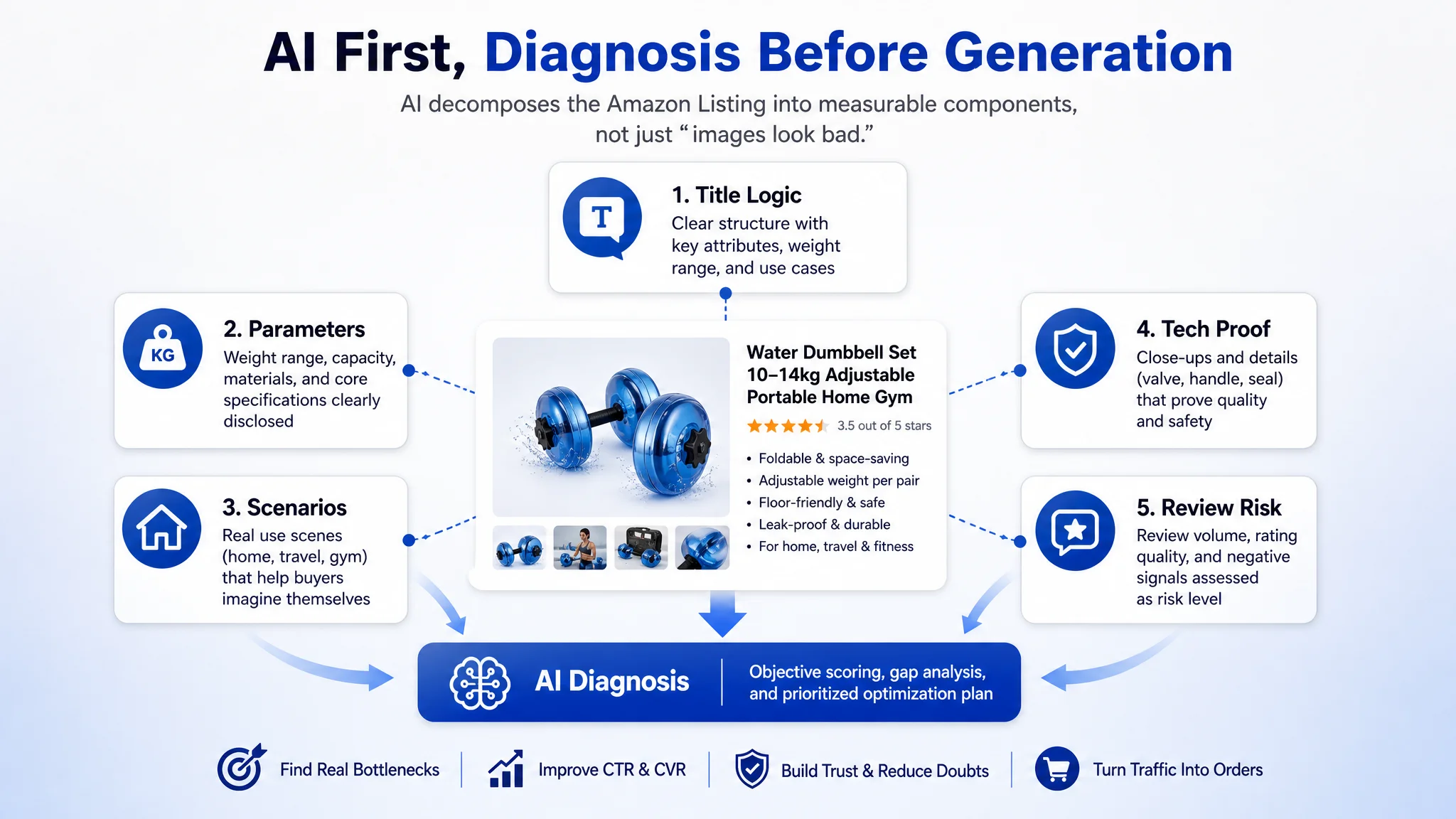
In the water dumbbell case, this difference was tangible. Rather than asking a designer to “make the images more attractive,” the AI-led diagnosis decomposed the listing into measurable components: title structure, parameter disclosure, scenario coverage, technical detail clarity, and review risk. It surfaced specific gaps—such as missing weight ranges in the title, underused travel scenarios in imagery, and A+ modules overly focused on operational steps instead of lifestyle benefits. On top of this diagnosis, a generative AI engine could then craft a new title that followed the category’s proven pattern (core product term → key attributes → concrete parameters → usage scenario), propose a main image system aligned with buyer psychology, and generate bullet points with a clear “pain → solution → scenario” logic.
The primary benefits are speed, scalability, and data-driven accuracy. Repetitive tasks that once consumed hours, such as manual image uploads, can be reduced to seconds. This allows sellers to manage and optimize large catalogs with unprecedented efficiency. Furthermore, by operating on data rather than subjective opinion, AI helps eliminate human error and ensures that generated visuals remain true to the physical product, reducing the risk of costly returns and negative reviews.
In the German listing, AI constraints like “entity consistency” ensured that newly generated imagery—showing folded dumbbells in a suitcase, macro shots of the anti-leak valve, or home-fitness scenarios—still reflected the real product’s materials, colors, and physical form. That balance between creativity and truthfulness is critical: the goal is not just to create appealing visuals, but to create accurate, persuasive visuals that align with what buyers actually receive.
DeepBI's AI-Powered Listing Optimization: A Strategic Advantage
DeepBI elevates Amazon listing optimization from a subjective, time-consuming process into a data-driven strategic advantage. The platform begins by performing an automated market health check, using distributed data crawling and multi-dimensional semantic analysis to benchmark your ASIN against top-performing competitors. It delivers a quantitative audit across five core dimensions—main images, titles, bullet points, A+ content, and Voice of the Customer (VoC) data—to pinpoint specific weaknesses impacting your KPIs.
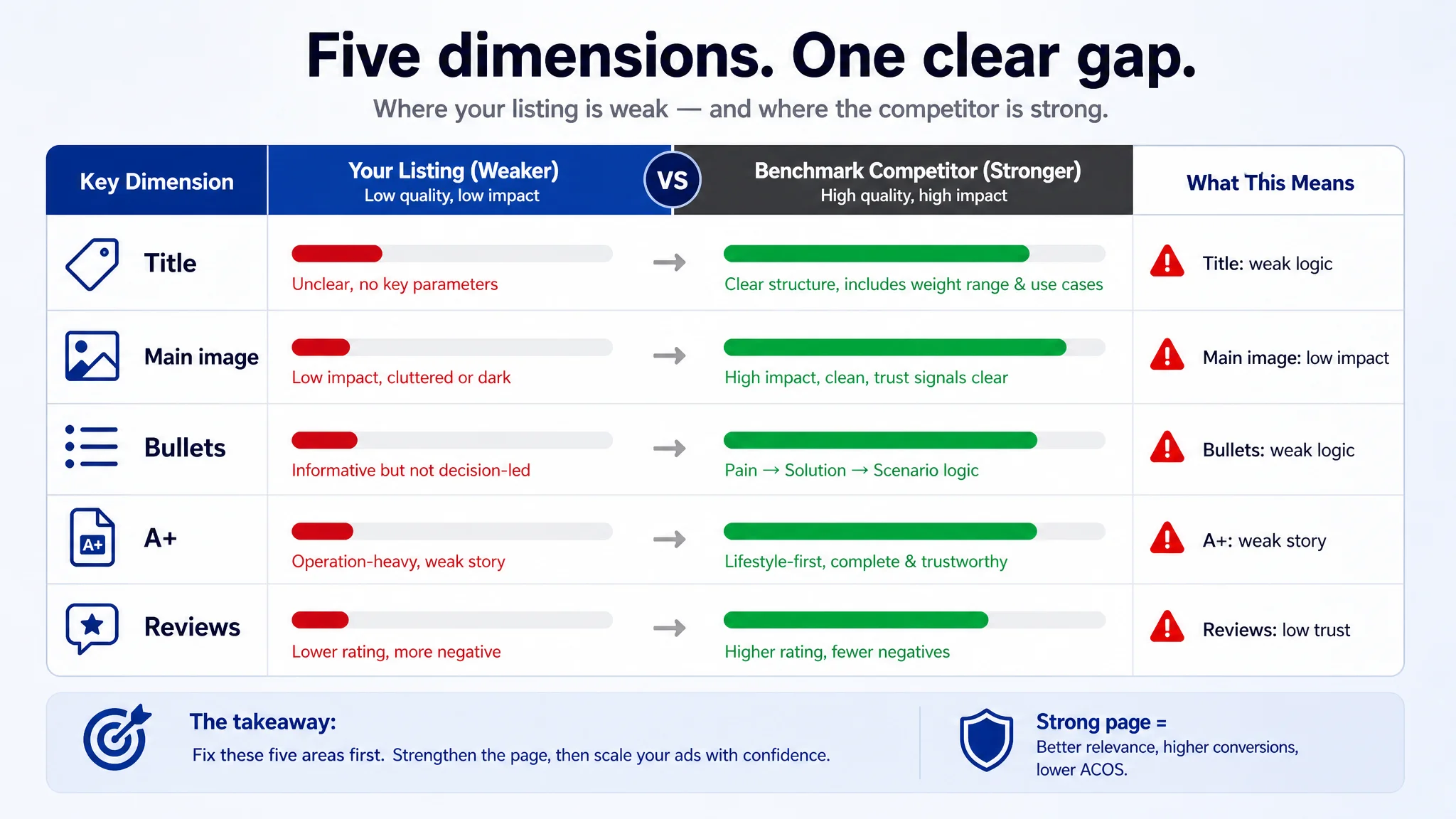
In the water dumbbell scenario, this audit translated into a concrete scorecard: a 61/100 listing facing a 79/100 benchmark competitor, with a notable gap in titles, main images, A+ modules, and review trust. Rather than a vague “your page could be better,” the seller saw exactly where they lagged. Titles scored roughly half of the competitor’s points, largely because they lacked weight parameters and structured decision logic. Main images underperformed due to low first-glance impact and insufficient technical annotations. A+ content failed to deliver a coherent narrative around portability, safety, and lifestyle use. Reviews signaled a severe trust deficit: a heavy concentration of negative feedback on the first page, compared with the competitor’s compact, strongly positive profile.
This diagnosis fuels a multi-agent AI that generates structured, actionable optimization strategies prioritized by their potential impact on CTR and CVR. Instead of vague advice, DeepBI provides concrete, executable instructions. For instance, a goal like “highlight portability and safe floor use” becomes a detailed creative brief: redesign the secondary image as a suitcase flat lay with a folded dumbbell taking a small fraction of space; add a split-frame comparison visualizing water dumbbells versus rusty iron weights, with clear icons indicating floor protection. For copy, “clarify weight range” becomes a directive to add specific per-ball and per-pair weight parameters into the title and bullet points, aligning with how buyers in that niche filter options.
Based on a core "product DNA map," the AI then generates multiple options for all listing assets, including main images, A+ content, and SEO-focused text, allowing you to preview the front-end effect. In the DE fitness listing, this meant alternative title formulations, different A+ module sequences (e.g., whether to lead with foldability or safety), and several visual concepts for home and travel scenes—all grounded in the product’s real specs and the category’s conversion patterns.
Finally, DeepBI ensures seamless execution. Through deep integration with Amazon's SP-API, you can compare new and old versions side-by-side and synchronize the fully optimized listing with a single click, directly accelerating your listing update cycle. For the water dumbbell seller, this replaced a manually orchestrated, error-prone rollout with a controlled test-and-learn process, where each update could be introduced, monitored, and iterated with far less operational friction.
The Impact of Effective AI-Generated Listings on Amazon Performance
High-quality, AI-generated listings function as a core commercial engine, moving beyond subjective aesthetics to drive measurable improvements in key performance indicators. The primary goal is to ensure every modification translates directly into a higher Click-Through Rate (CTR) and Conversion Rate (CVR). AI systems achieve this by establishing a clear cause-and-effect relationship, diagnosing issues like a low CTR (e.g., below 0.35%) as a failure of the main image's "visual hook," or a low CVR as a trust deficit within the A+ content.
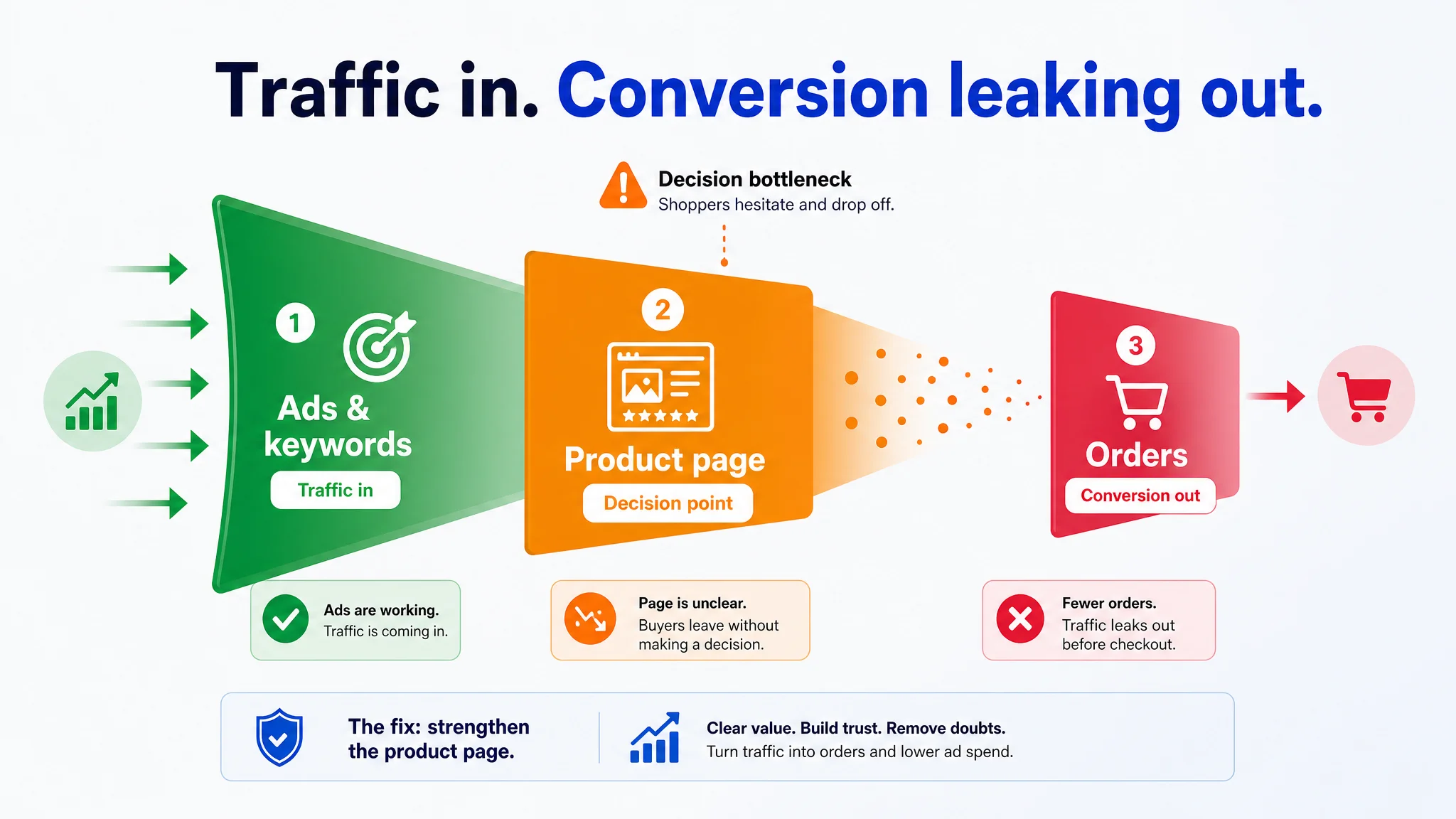
The German fitness listing exemplifies this cause-and-effect chain. Before optimization, the seller perceived “high ACOS” as an ad problem. DeepBI’s diagnosis reframed it as a listing conversion problem: the main image lacked a compelling visual hook in a saturated search landscape; the title did not expose weight parameters, making the offer harder to assess at a glance; A+ content over-emphasized “how to fill water” and under-emphasized “why this product fits your life”; and reviews front-loaded risk by surfacing a high proportion of negative experiences. Under these conditions, ads were doing their job—delivering clicks—but those clicks encountered a page that failed to convert interest into confidence.
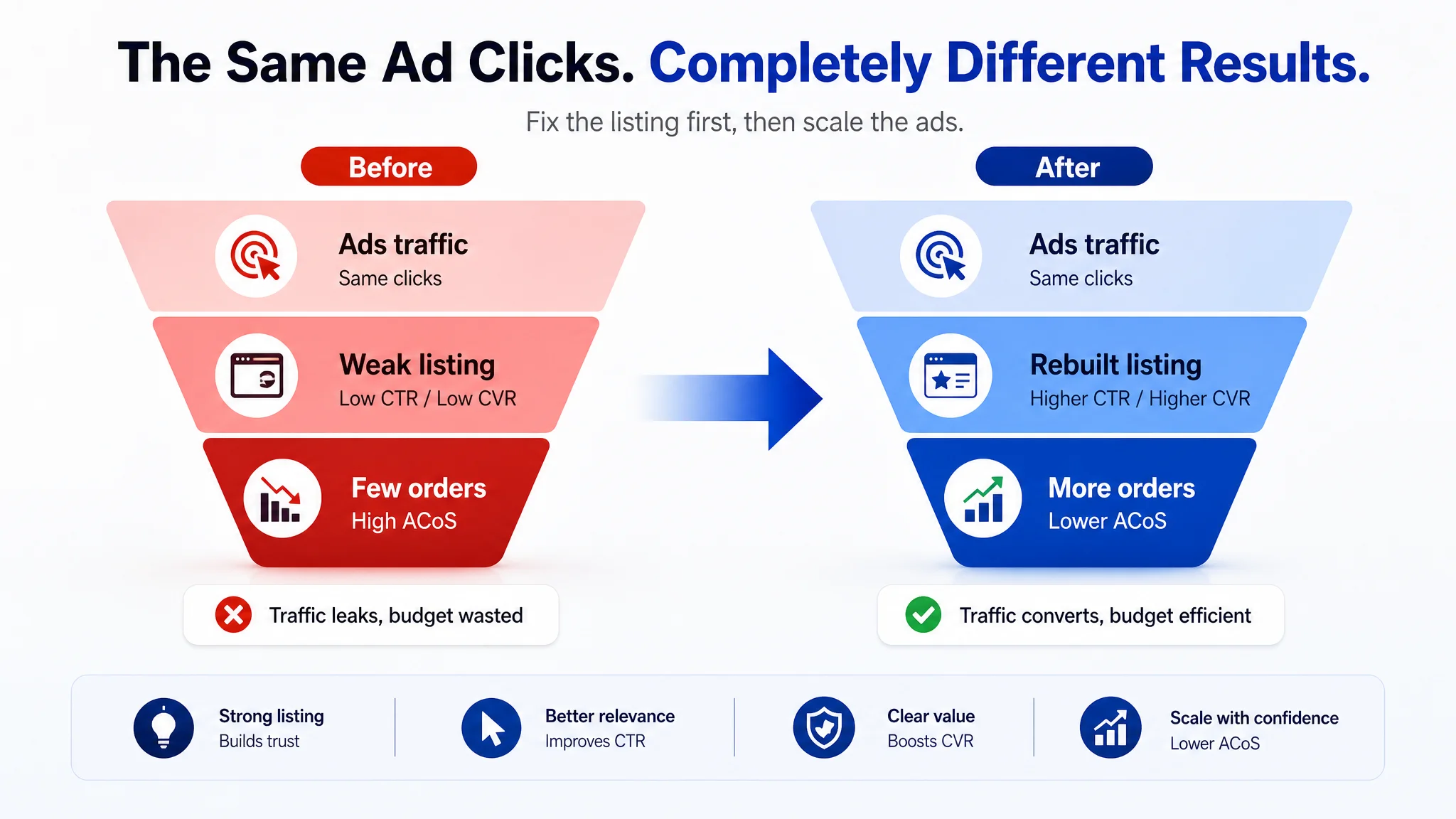
Once AI-guided changes were implemented—restructured title, scenario-rich imagery, A+ modules aligned with buyer questions, and clearer technical proof points—traffic quality did not suddenly change, but traffic productivity did. CTR could now improve because the search-result thumbnail told a clearer and more enticing story. CVR had room to recover because visitors were met with a more professional, logically sequenced page that reduced ambiguity and fear. The same ad campaigns that previously “felt inefficient” began to produce more predictable, controllable outcomes, demonstrating how listing-side fixes can turn stagnant traffic into useful traffic.
This optimization creates a powerful synergy with your advertising efforts. When traffic from Sponsored Products campaigns lands on a highly-relevant, persuasive page, conversion rates increase. This directly improves your Advertising Cost of Sales (ACoS) and overall ad ROI, as each click is more likely to result in a purchase. In the water dumbbell case, DeepBI explicitly chose not to push further ad scaling until the listing’s conversion structure was repaired, precisely because every incremental euro of spend was otherwise destined for a leaky funnel.
Furthermore, the improved CVR and customer engagement send strong positive signals to Amazon's search algorithm. This boosts your product's organic ranking, leading to a greater share of natural orders and increased sales velocity. The process creates a data-driven feedback loop: AI uses advertising data to inform listing optimizations, and you can verify the impact by tracking changes in CTR and CVR after an update is published. For the DE fitness seller, this meant moving from “we think the new images help” to “we can see how the new image set affects CTR vs the old one, holding campaigns steady.” This transforms visual and text assets into tangible conversion improvements, stronger organic presence, and healthier long-term profitability.
Best Practices for Leveraging AI in Listing Content
Adopting AI for content generation is not about replacing human strategy but augmenting it. To unlock its full potential, view AI as a highly efficient co-pilot that requires clear direction. The quality of AI-generated content is directly proportional to the quality of the inputs and constraints you provide.
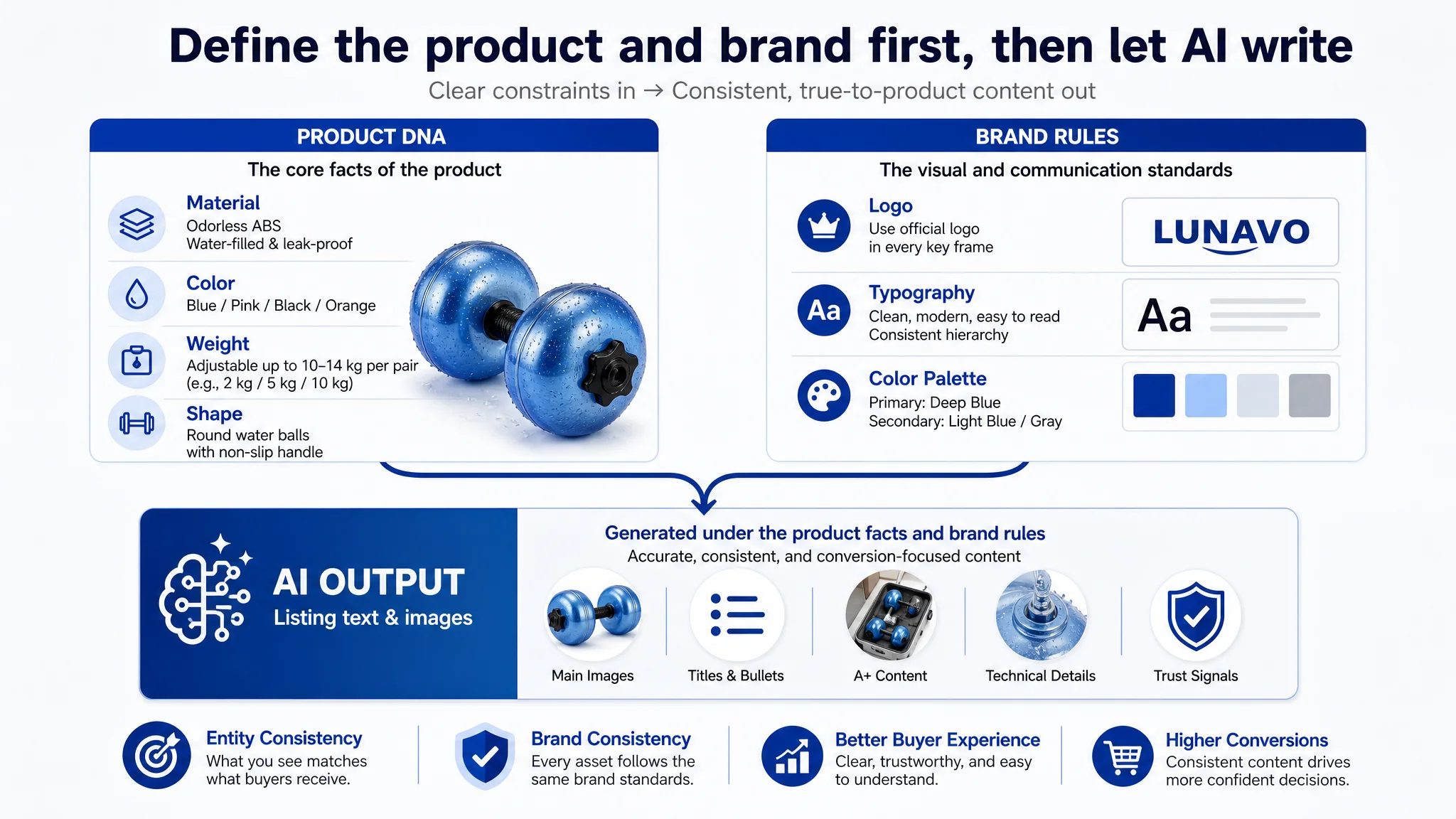
First, establish a clear and accurate "Product DNA" for the AI. This foundational dataset should define the product's unchangeable attributes—material, physical design, color, and dimensions. This practice of enforcing 'product entity consistency' is critical for preventing the AI from generating misleading content that could lead to customer returns and negative reviews. In the water dumbbell project, this meant specifying exact weight ranges, materials like odorless ABS, realistic color options, and physical properties such as foldability and valve design. Without these constraints, the risk would be to create beautiful but inaccurate scenes—e.g., implying weight ranges or colors the product does not actually offer.
Similarly, provide strict brand guidelines, including logos, fonts, and color palettes, to ensure every output aligns with your established brand identity. In the DE fitness listing, a consistent visual language across the main image, A+ modules, and brand story elements helped reposition the product from “generic gadget” to “considered home-fitness tool,” even though the underlying physical item had not changed.
Second, treat AI-generated content as a powerful first draft, not a final product. Always conduct a human review to verify factual accuracy, tone, and strategic alignment before publishing. In the water dumbbell case, AI recommended an optimized title structure and bullet-point flow, but human operators ensured phrasing matched local language expectations, regulatory requirements, and category nuances in the German marketplace.
After launching new content, the process isn't over. Continuously monitor key performance indicators (KPIs) like Click-Through Rate (CTR) and Conversion Rate (CVR). Use this performance data to validate the AI's suggestions and inform the next cycle of iteration, creating a data-driven feedback loop where your strategic oversight guides the AI's tactical execution. The DE fitness team, for example, could test variations of the travel-focused imagery or re-order A+ modules based on observed scroll depth and engagement patterns.
Finally, remember that AI works best when paired with sound business judgment. The water dumbbell seller’s most important shift was not just adopting new content, but adopting a new decision rule: “We do not scale traffic until the page deserves it.” That mindset—prioritizing listing conversion health before aggressive ad spend—turned AI from a mere content generator into a strategic partner.
Conclusion: Future-Proofing Your Amazon Business with DeepBI
The era of relying on subjective guesswork and disconnected workflows for Amazon listing optimization is over. Manual processes, plagued by vague feedback and a disconnect between analysis and execution, consistently fail to unlock a product's true market potential. This approach leaves critical performance metrics like Click-Through Rate (CTR) and Conversion Rate (CVR) to chance.
The German water dumbbell case illustrates this vividly. For a long time, the seller treated rising ACOS as an advertising issue, endlessly tuning bids and creatives while a structurally weak listing quietly consumed every click. Only when an AI-driven diagnosis exposed clear gaps in title logic, main image impact, A+ storytelling, and review trust did the team realize that the page—not the campaigns—was the primary bottleneck. Ads had been amplifying defects as readily as they might have amplified strengths.
DeepBI provides the definitive solution, moving beyond generic AI tools to offer an end-to-end intelligent optimization system built specifically for Amazon's ecosystem. By integrating diagnosis, planning, production, and delivery into a single, data-driven workflow, DeepBI transforms ambiguous suggestions like "improve texture" into precise, machine-executable instructions for elements like composition and lighting. This ensures every modification is engineered to produce a measurable uplift in performance.
Embracing this technology allows sellers to turn listing optimization from an occasional project into a dynamic, continuous process. The DE fitness seller’s journey—from “we just need better ads” to “we must first repair our listing’s decision logic”—is emblematic of the mindset shift required to compete in today’s marketplace. By adopting a platform that makes diagnosis objective and execution simple, you can convert your visual assets into a powerful engine for sustained growth.
To secure a lasting competitive advantage and turn data into profit, it's time to make AI the core of your Amazon strategy. [Contact us to learn how DeepBI can become your intelligent decision-making brain].