

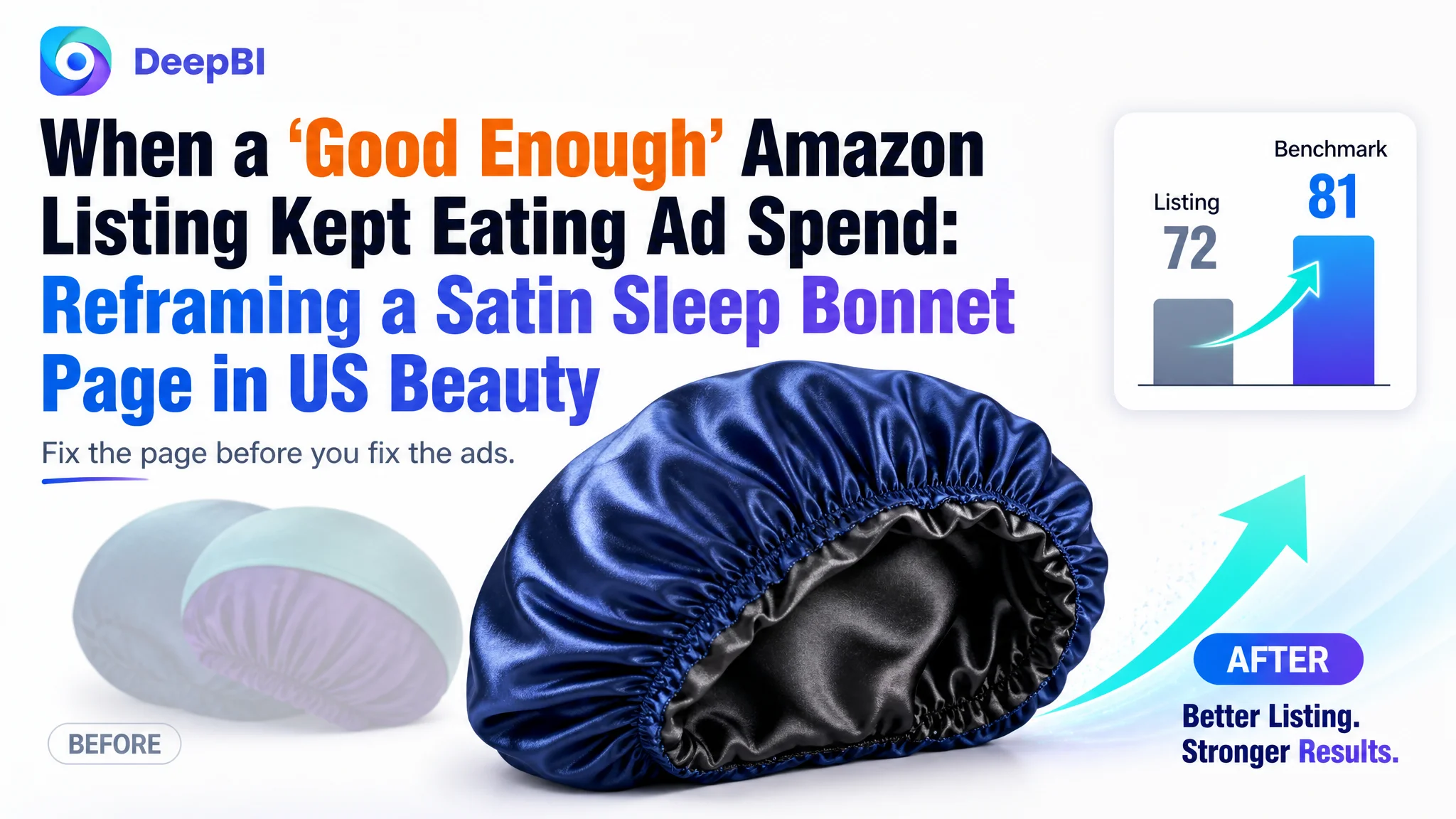
For this Amazon seller in the US satin sleep-bonnet category, the pressure didn’t start with a collapsing product. Ads were running, reviews looked healthy, and the Listing didn’t look “bad” by traditional standards. Yet, ad costs were getting harder to control and every push in Amazon ads felt like pouring more budget into a page that refused to fully convert.
The team’s first instinct was familiar: they treated it as an advertising problem. They tried to refine keywords, tweak bids, and adjust budgets, assuming better traffic structure would solve the issue. DeepBI’s diagnosis pointed elsewhere. Against a directly comparable benchmark Listing, the page’s total score lagged by 9 points (72 vs. 81), with the biggest gaps not in traffic but in how the Amazon Listing itself communicated value, trust, and results.
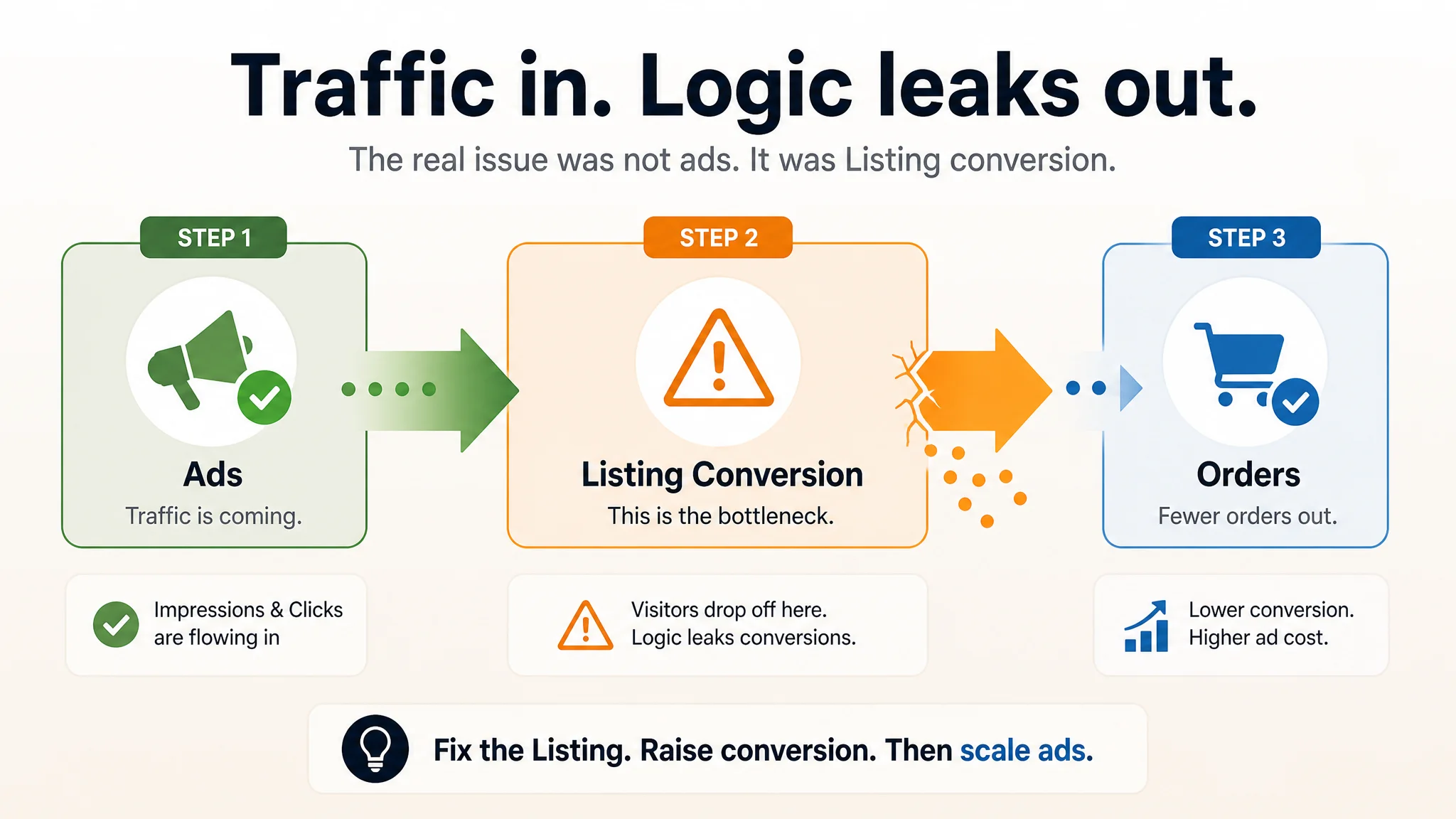
What DeepBI uncovered was a Listing whose main image and A+ visuals worked “okay,” but whose title, bullet points, and detail-page story failed to build a complete hair-care promise. The later optimization therefore shifted away from “fixing ads” toward rebuilding the page’s conversion capacity: a reorganized title around core keywords and pain points, bullet points that followed a problem–solution–result logic, and visuals that finally made anti-frizz results, material structure, and fit visibly obvious. For other Amazon sellers, this case is a reminder that a 4.4-star product with decent visuals can still be the bottleneck—and that before scaling traffic, it’s essential to ask whether the product page deserves the traffic it’s getting.
Amazon Ads Were Not Failing. The Listing Was Consuming the Traffic.
From the seller’s perspective, nothing screamed “crisis.”
- The product is a satin-lined sleep bonnet on Amazon US, a typical hair-protection accessory in beauty/personal care.
- Review metrics were healthy: 4.4 stars with 986 reviews, very close to the benchmark’s 4.4 stars and 1188 reviews.
- Negative-review exposure on the first page was even slightly lower than the benchmark.
Under that surface, however, ad efficiency was under pressure. Paid traffic was there, but orders weren’t scaling in proportion to spend. The team interpreted this as a classic advertising efficiency issue: maybe keywords weren’t refined enough, maybe bids weren’t precise enough, maybe the campaign structure needed another round of segmentation.
DeepBI’s scoring made a different story visible.
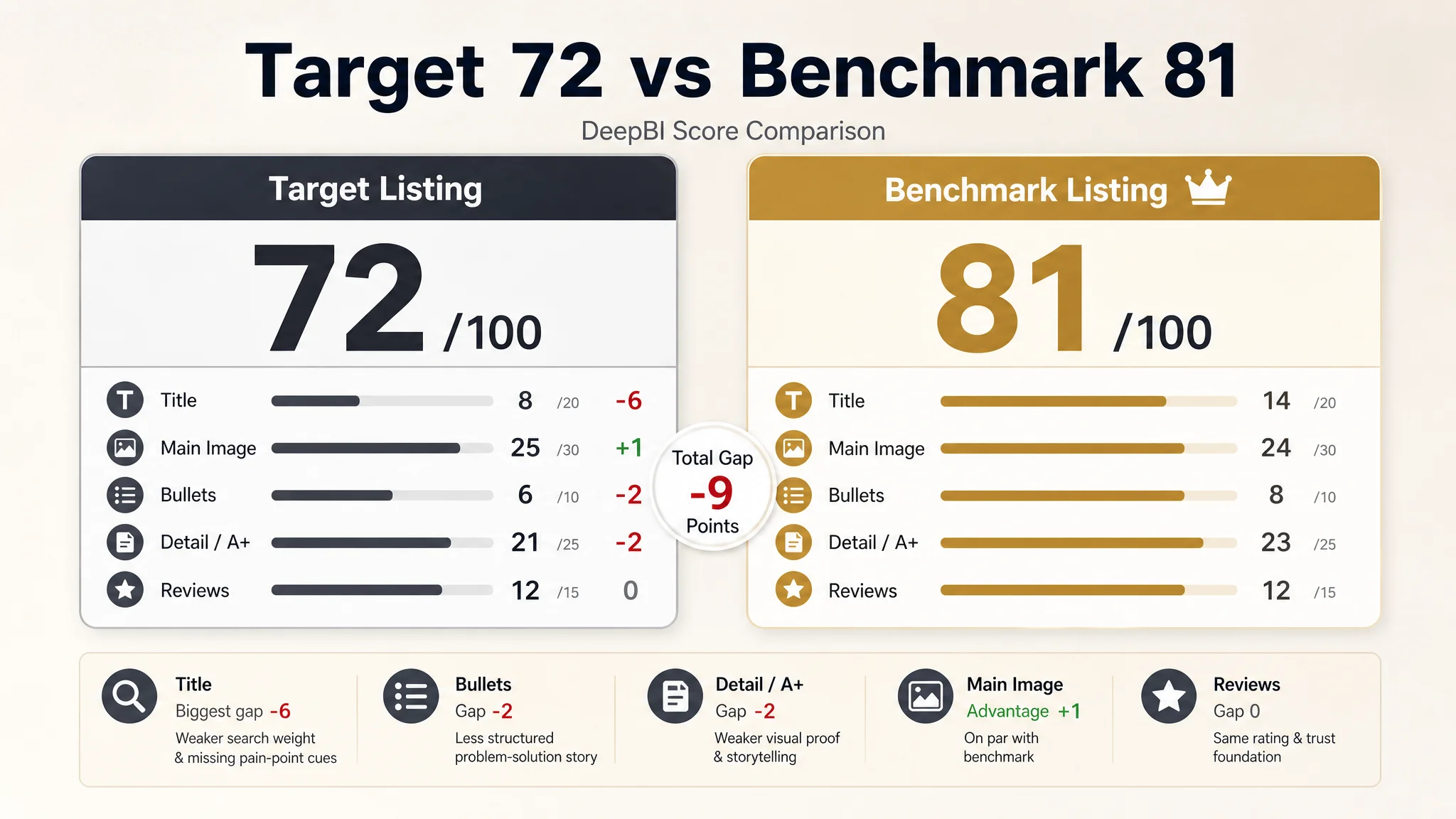
- The target Listing’s total score: 72/100
- Benchmark Listing’s total score: 81/100
- Gap: –9 points
Breaking down the score:
- Title: 8 vs. 14 (–6)
- Main image: 25 vs. 24 (+1)
- Bullet points: 6 vs. 8 (–2)
- Detail/A+ content: 21 vs. 23 (–2)
- Reviews: 12 vs. 12 (0)
In other words, the biggest gap wasn’t the visuals the team thought looked “fine.” The main-image dimension was actually on par, even slightly ahead. The real leak sat in how the Listing structured the buying decision: title relevance and weight, bullet-point logic, and detail-page persuasion.
“The real problem was not that ads failed to bring traffic. It was that the page could not convert the traffic.”
Once this was visible, it no longer made sense to keep pressing the ad throttle first.
The Real Constraint Was Listing Conversion Capacity
DeepBI’s core judgment: this ASIN didn’t lack traffic; it lacked a persuasive sales story at the page level.
The Listing was positioned in a high-intent, high-competition hair-protection subcategory, where buyers:
- know what a satin bonnet is
- already compare multiple Listings on search results
- are willing to pay more if they believe hair-protection results will be better
In that environment, the benchmark’s 81-point Listing did three things the 72-point page didn’t:
1. Clarified who the product is for and what outcome it delivers, directly in the title.
2. Turned bullet points into a clear “problem → solution → result” chain.
3. Used A+ visuals to show, not just tell, outcome differences and material logic.
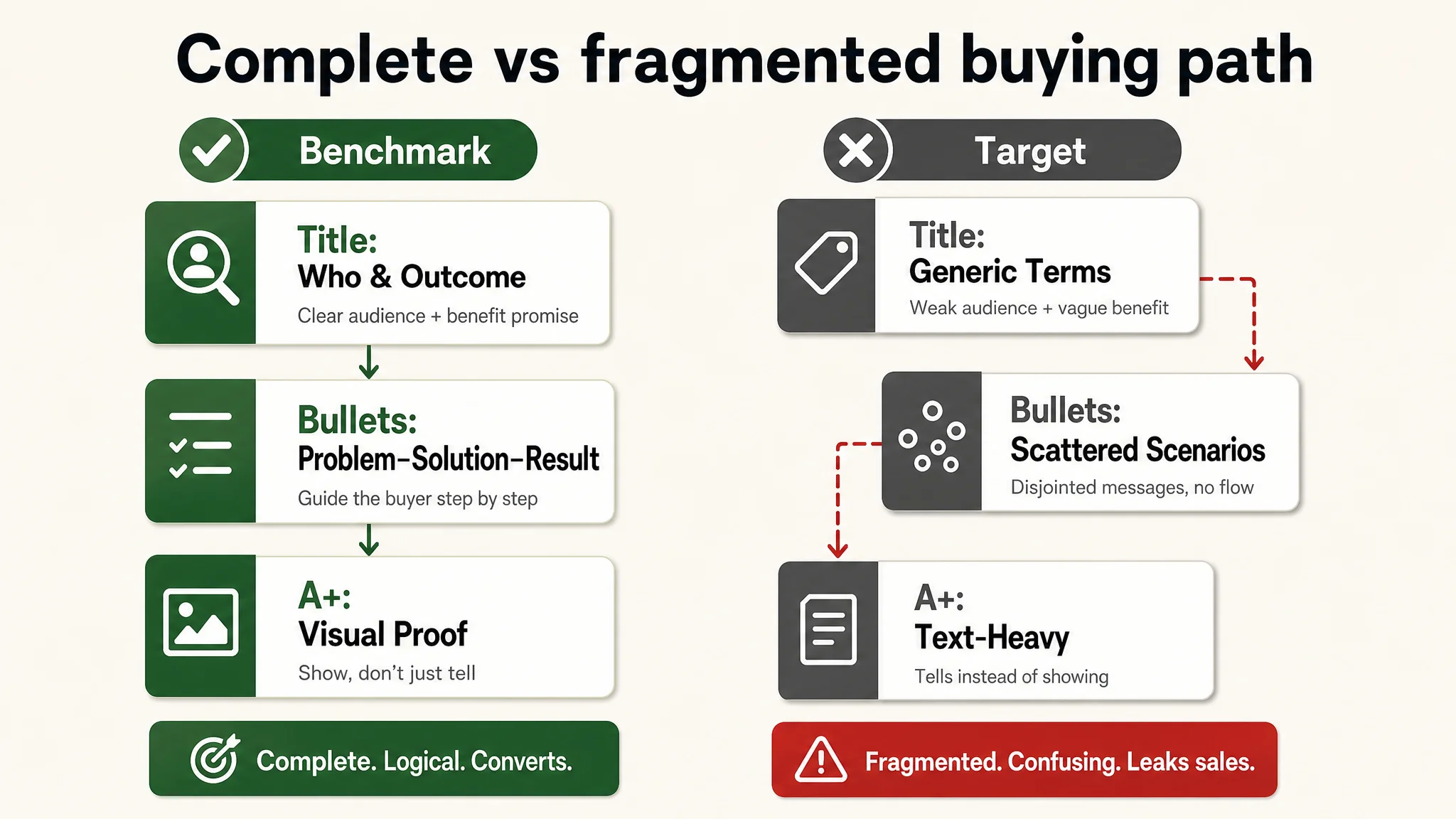
The seller’s page, by contrast, fragmented this logic:
- The title diluted the core product term and didn’t clearly promise specific hair outcomes.
- The bullet points scattered attention across multiple scenarios without a strong hair-result promise.
- The detail page described benefits in text but didn’t visually prove “before/after” or material structure.
In operational terms, every dollar of Amazon ads was being sent into a page that was only partially capable of turning visits into orders. Under these conditions, continuing to optimize campaigns first would only amplify the page’s weaknesses.
Where the Original Diagnosis Went Wrong
The team’s misdiagnosis followed a pattern many Amazon sellers will recognize:
- Symptom: Ad costs were rising; ACOS was harder to bring down; orders did not scale in line with impressions and clicks.
- Assumed cause: Advertising configuration—keywords, bids, placements—must be the problem.
- Response: More cycles spent on keyword mining, bid adjustments, and campaign restructuring.
That diagnosis made sense in an earlier stage when Listings could perform moderately and ads still had room to yield. But in a mature, competitive category like satin sleep bonnets, once core keywords are already covered and ad structures are reasonably sound, further tweaking provides diminishing returns if the page itself doesn’t convert marginal traffic.
DeepBI’s scoring and benchmark comparison exposed the structural issue:
- Title underweighted the core product term and missed critical long-tail signals.
- Bullet points did not align with the strongest purchase motivations in the category.
- Detail-page visuals didn’t present a clear evidence chain for the claimed benefits.
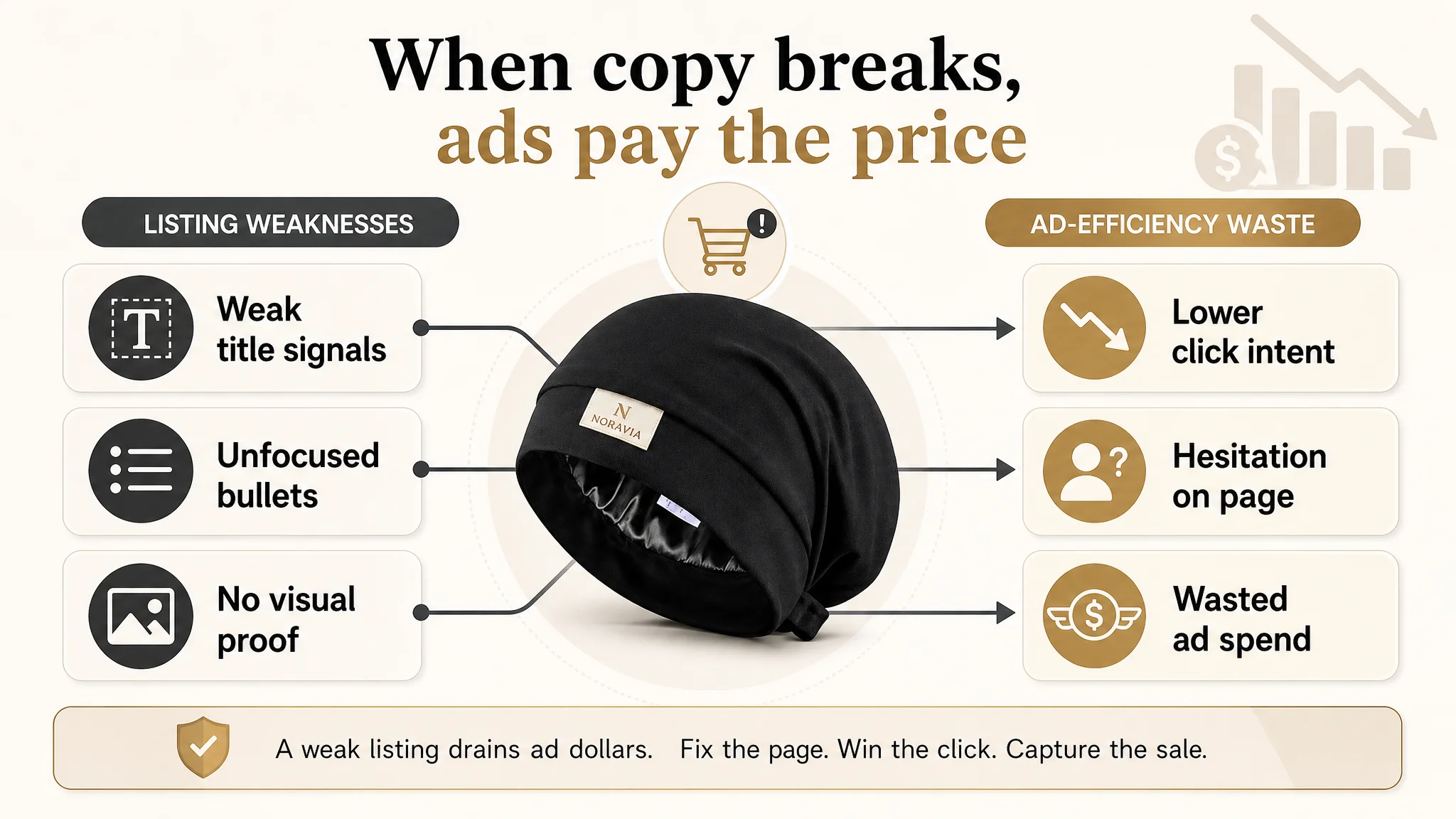
The seller had been treating ads as the main lever while leaving the Listing to “good enough.” In a marketplace where Listing conversion directly determines ad efficiency, that assumption became the bottleneck.
This Product Page Did Not Lack Traffic. It Lacked a Clear Title Logic.
The title diluted search weight and missed key buyer cues
In Amazon search, especially for beauty accessories, the title is both:
- a primary A9 signal (what the product is understood to be), and
- a compact promise of outcome and fit (why this specific product is right for this buyer).
DeepBI’s comparison showed:
- The target title put “2pcs” at the very front.
- This did highlight quantity and value, but at a cost: it reduced relative weight on “Bonnet”, the core product term.
- The benchmark title led with brand + core product word (“Satin Hair Bonnet for Sleeping”), keeping the core search term in the most important position.
- The benchmark also inserted “No Frizzy for Curls Care” directly into the title, naming a specific pain point for a specific audience (curly hair users).
- It included “Dreadlocks Cap” as a long-tail keyword, expanding search coverage into a clearly defined sub-audience.
The target Listing’s title, by contrast:
- Focused on more generic descriptions
- Did not explicitly call out curl care, anti-frizz, or dreadlocks/braids coverage in a structured way
- Read more like a list of functions than a high-intent promise
The result: narrower search coverage and weaker click intent from prime audiences (curly, braided, and dreadlocks users) who are actively searching for a solution to frizz, breakage, and morning tangles.
The reframed title: from generic function list to buyer-focused promise
DeepBI recommended a title structure that pulls learning from the benchmark while staying within the product’s real attributes:
2 Pack Silk Satin Sleep Hair Bonnet for Sleeping, Adjustable Strap Non-Slip Night Cap for Curly Hair, Silk Hair Wrap for Women Men, Anti-Frizz Sleeping Cap for Braids and Dreadlocks (Black)
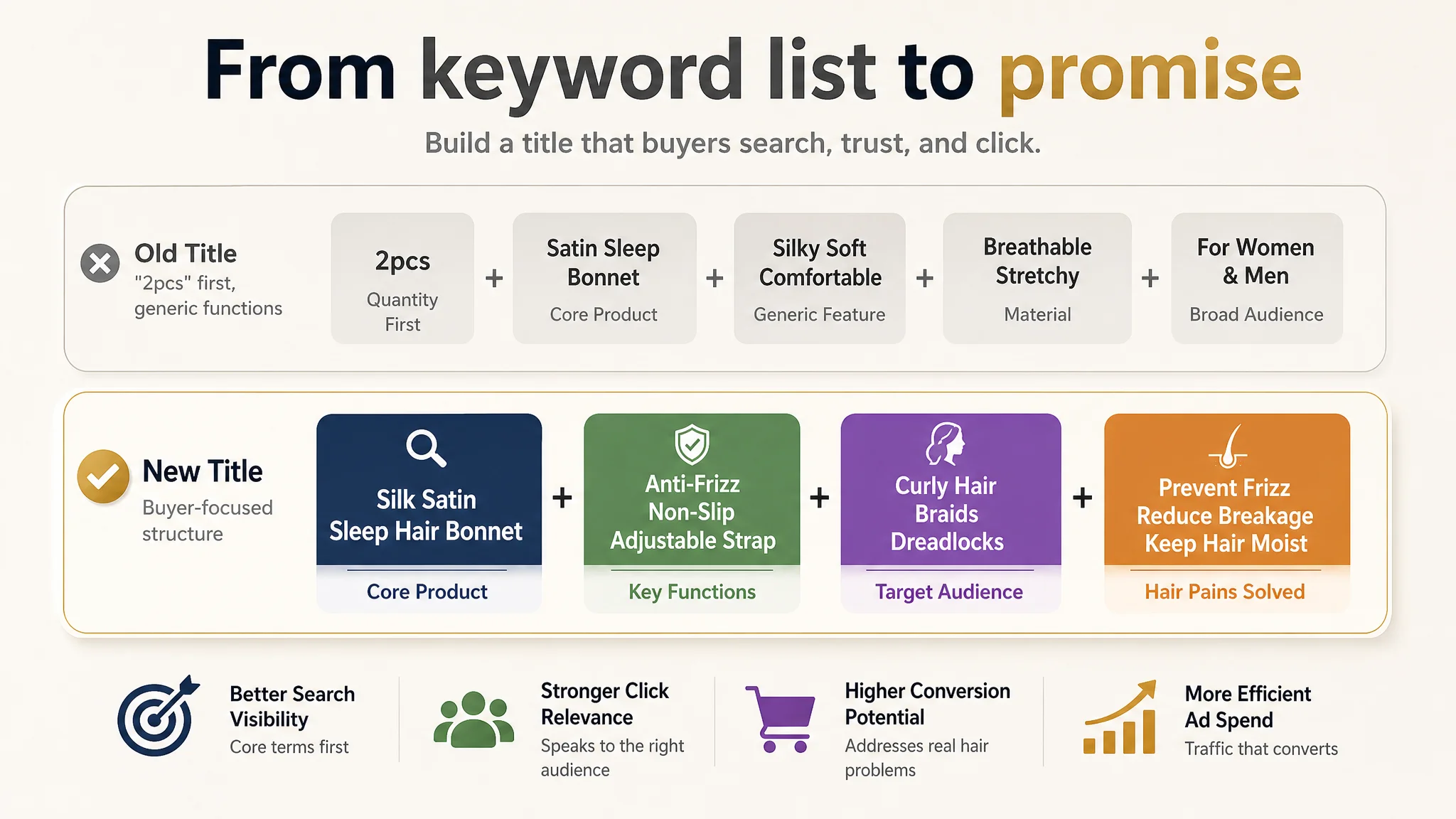
The logic behind this reconstruction:
- Core search term up front:
- “Sleep Hair Bonnet for Sleeping” anchors the Listing clearly in the main search space.
- Value communicated without overshadowing:
- “2 Pack” is kept visible but no longer displaces the core product term from the first position.
- Explicit pain-point language:
- “Non-Slip” addresses a common objection (“will it stay on overnight?”).
- “Anti-Frizz” speaks directly to hair-result expectations.
- Audience expansion via long-tail keywords:
- “Curly Hair,” “Braids,” and “Dreadlocks” precisely tag key sub-segments.
The title stops acting like a loose feature checklist and starts functioning as a conversion-oriented search asset, narrowing the gap to the 14-point benchmark score.
The Bullet Points Had Information, but Not a Buying Logic
DeepBI’s scoring gave the bullet-point dimension 6 vs. 8, a smaller numeric gap than the title but still critical in category context.
The benchmark: problem → solution → result
Benchmark bullet points consistently followed a pattern:
- Start from a concrete hair problem or concern
- Present a specific design/material solution
- End with a promised outcome (easier mornings, softer curls, reduced frizz)
For example:
- “Enhanced Hair Protection… reduces frizz and retains hair moisture, making your mornings easier…”
- “Ultimate Comfort… silky-smooth interior, cotton exterior for breathability…”
- “Adjustable Fit… stays in place for all head sizes…”
This transforms each bullet from a feature announcement into a mini decision path. A buyer scanning the page can very quickly answer:
- Will this bonnet protect my hairstyle?
- Will it feel comfortable and breathable?
- Will it stay on my head overnight?
- Will it look acceptable enough to wear outside?
- Will it last?
The target Listing: scattered focus and under-leveraged core motives
The seller’s original bullet points:
- Described general functions (protection, comfort, multiple scenes)
- Included some subjective impressions and multi-scenario mentions (e.g., yoga)
- Highlighted design and cleaning convenience
The issue was not that these points were wrong. It was that they weren’t aligned tightly enough with the core hair-care purchase motives:
- Protecting curls and natural hair from frizz and breakage
- Keeping moisture locked in
- Ensuring the bonnet stays in place without discomfort
- Being acceptable for indoor and possibly outdoor wear
- Offering durable use as a long-term hair-care tool
DeepBI’s optimization therefore restructured each bullet to build a consistent, buyer-relevant logic.
Rebuilding bullet points around real buyer decisions
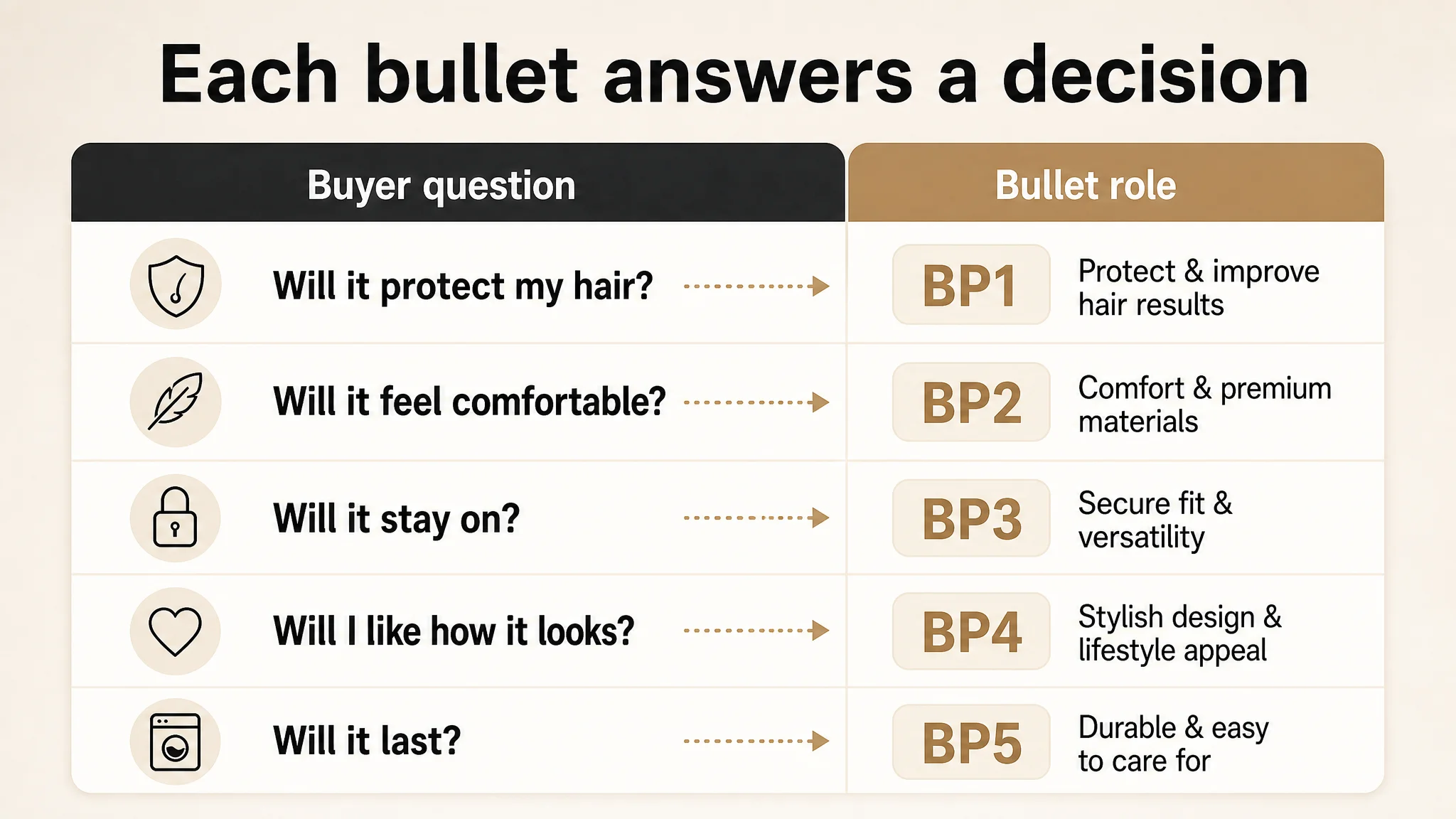
Each bullet was reframed with a clear role:
1. Maximized Hair Protection
- Focus: frizz reduction, breakage prevention, moisture retention, and morning manageability.
- Outcome: “manageable, silky, and tangle-free hair every morning.”
1. Ultimate Comfort & Breathability
- Focus: how it feels on the skin and whether it overheats.
- Outcome: soft curls overnight without discomfort.
1. Versatile & Secure Fit
- Focus: non-slip performance not only at night but across multiple daily routines (bathing, makeup, yoga).
- Outcome: “stays securely in place… travel companion… practical solution no matter where you are.”
1. Chic & Fashionable Design
- Focus: beanie-like styling, indoor/outdoor acceptability, multiple colors.
- Outcome: it is not just a functional item; it’s a wearable accessory.
1. Durable & Easy Maintenance
- Focus: reusability, washing behavior, eco-friendly positioning vs. disposable nets.
- Outcome: positions the bonnet as a long-term hair-care investment, not a cheap consumable.
These bullets transform the text block from a neutral feature list into a structured buying logic, improving the Listing’s capacity to turn ad-driven visits into orders.
This Detail Page Didn’t Lack Modules. It Lacked a Visual Evidence Chain.
DeepBI’s detail-page scoring: 21 vs. 23. Only a 2-point gap, but in a high-intent category, those 2 points represent missing conversion modules that matter.
The target A+: functional but under-leveraging the category’s proof expectations
Current A+ modules include:
- Main visual/selling-point image
- Elasticity/fit visual
- Material-detail shot
- Multi-color/scene images (gender-inclusive)
- Care instructions
- Multi-angle product displays
In isolation, that sounds like a solid structure. In practice, however, the page:
- Describes benefits but rarely proves them visually
- Focuses heavily on general function and material
- Lacks emotional or lifestyle elevation beyond the functional level
The benchmark A+: more modules, but more importantly, more decision logic
The benchmark’s A+ contains around 10 core modules, including:
- Brand main visual
- Clear “before/after” hair comparison
- Size/fit guidance
- Material-structure diagrams
- Multi-scene usage (yoga, work, sleep)
- Family/emotional imagery
- Fashion pairing and styling visuals
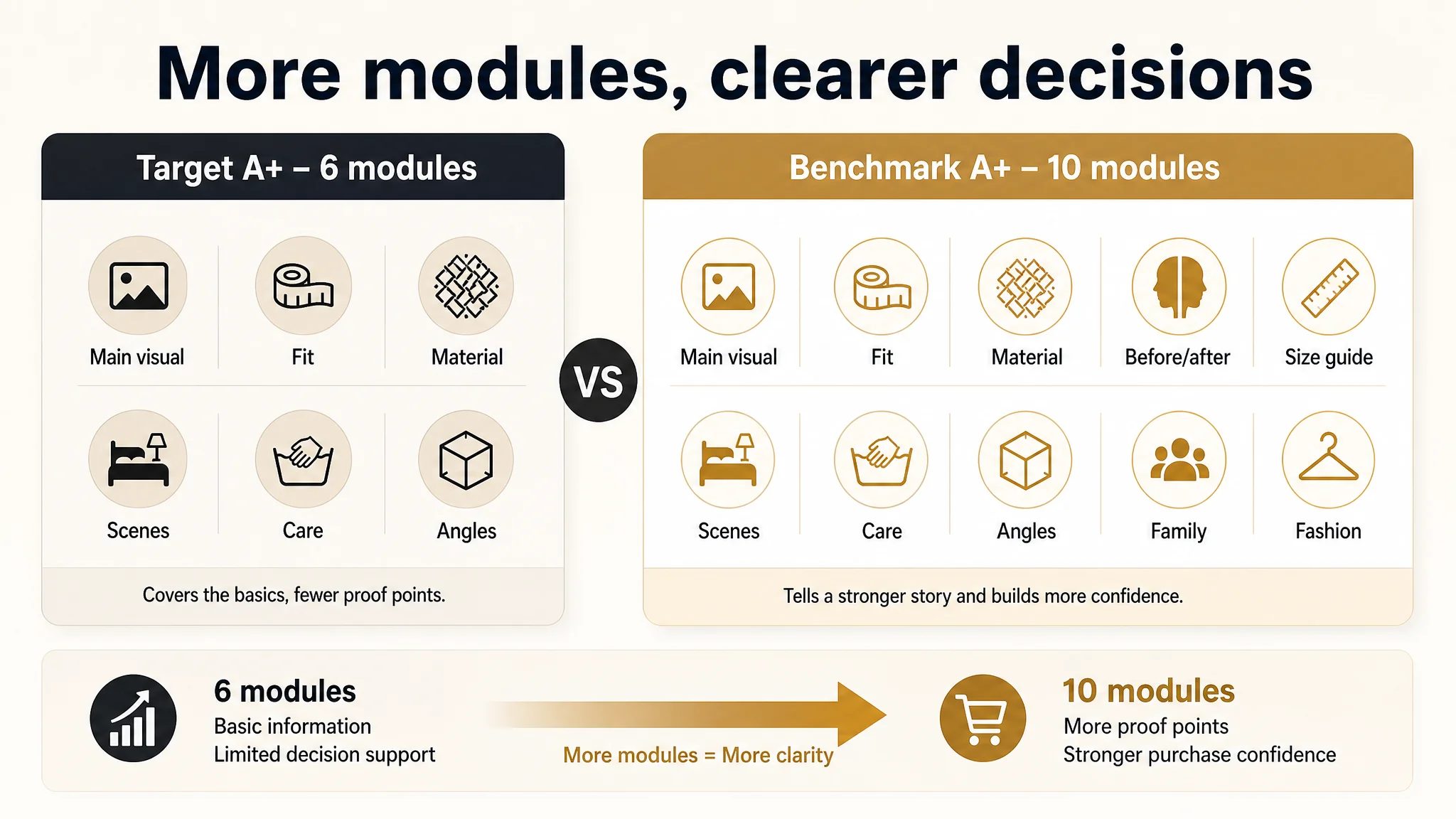
This structure does three critical jobs:
1. Visually prove effect
- Before/after hair images make “reduces frizz” tangible.
1. Reduce fit and usage risk
- Size and different hair-volume photos directly address “will it fit?” concerns.
1. Elevate from product to lifestyle
- Family and fashion modules recast the bonnet as a lifestyle symbol, not just a utility cap.
Why this gap mattered for conversion
In hair-protection categories, buyers don’t want to read long text explaining “protect hair.” They want to see:
- What happens if they don’t use anything (bedhead, frizz).
- What their hair can look like if they use this bonnet consistently.
- How the inside satin lining and outer material actually work together.
- That people with similar hair types and volumes use it successfully.
DeepBI’s judgment was that the page’s missing visual evidence chain meant:
- A buyer could like the idea but still doubt the real-world effect.
- More ad traffic would not fix that hesitation.
- Without visual proof, the A+ couldn’t pull hesitant visitors across the line.
Before Ads Could Work Again, the Page Had to Convert
Given these findings, DeepBI’s decision path was clear:
1. Do not prioritize more ad tuning first.
- Further ad optimization under a constrained Listing would continue to inflate TACOS without systematically lifting CVR.
1. Repair the Listing’s conversion logic before scaling traffic.
- Focus on title, bullet points, and A+ visuals as the foundation of both organic and paid efficiency.
Key Listing changes DeepBI prioritized
1. Title: restore search logic and clarify promise
- Reweighted “Sleep Hair Bonnet” toward the front of the title.
- Kept “2 Pack” visible but subordinate to the core product term.
- Inserted “Non-Slip” and “Anti-Frizz” to directly answer use concerns.
- Expanded hair-type coverage to curly hair, braids, and dreadlocks.
Business effect: stronger keyword relevance, better clickability from high-intent hair-care audiences, and a tighter alignment between what the buyer searches and what the title promises.
2. Bullet points: from fragmented information to decision path
- Rebuilt each point around a hair-care problem and clear outcome.
- Anchored copy in specific hair-result language (frizz, moisture, breakage, morning manageability).
- Integrated comfort, breathability, style, and durability as supporting pillars, not noise.
Business effect: clearer understanding for visitors of why this bonnet is a credible long-term hair-protection solution worth paying for, increasing the chance that ad clicks convert.
3. Main-image set: elevate from “ecommerce quick-sell” to high-end care
DeepBI flagged that some of the existing image styles (“ecommerce fast-sell” feel) could erode trust among quality- and sustainability-focused female users in a higher-ticket context.
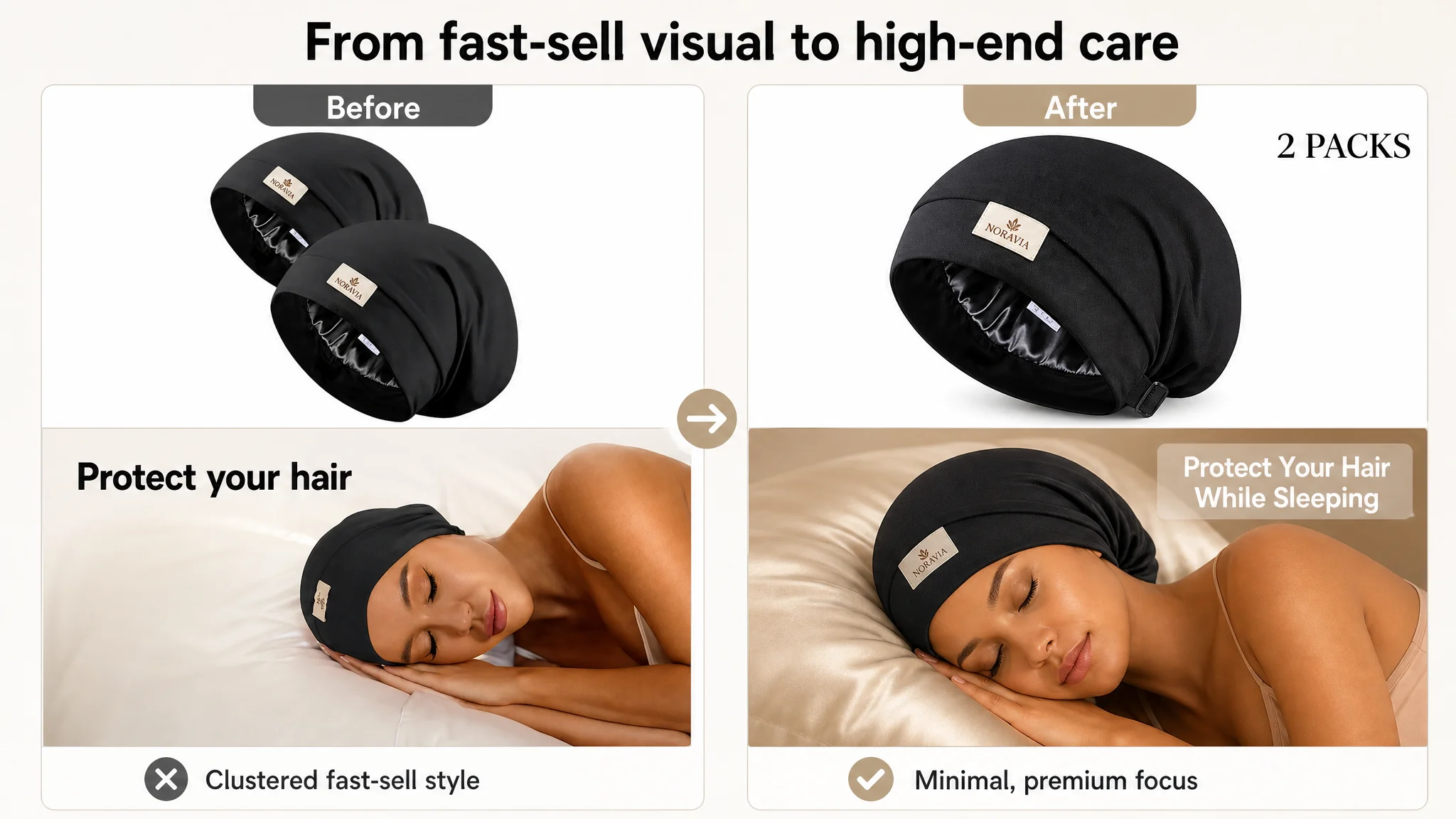
The optimization direction:
- Main product shot:
- Single bonnet centered, ~75% of frame, 45° side view to show volume and structure, clean white background, soft ring lighting, clear “2 PACKS” text in a restrained, serif font.
- Lifestyle sleep image:
- Model lying on a neutral, high-thread-count pillow, warm soft light, minimal text (“Protect Your Hair While Sleeping”), projecting a high-end, calming sleep environment.
- Material macro shot:
- Close-up of inner satin vs. outer fabric, annotated with simple labels like “Outer: Modal” and “Inside: Silky Satin” to build technical trust.
- Adjustable strap detail:
- Focused shot of the adjustment mechanism, with a small inset showing extended strap and approximate sizing guidelines.
- Hair result / before–after:
- Split layout showing frizzy vs. smooth hair with supporting icons (“Prevent Frizz,” “Reduce Breakage,” “Keep Moisture”).
Business effect: higher click-through on search results through a more premium and trustworthy visual impression; better on-page reassurance that the bonnet can deliver on its claims.
4. Detail/A+ modules: from descriptive to evidence-based
DeepBI recommended a restructured A+ flow:
1. Opening hero:
- Model wearing the bonnet, clean white background, bold headline “Silk Satin Lined Sleep Cap,” subheadline “Ultimate Hair Protection & Frizz Control.”
1. Pain-point comparison:
- “SAY GOODBYE TO BEDHEAD” before/after visual with consistent lighting and subtle color adjustments for perceived hair health.
1. Material breakdown:
- One image dedicated to showing the double-layer structure, with zoom-in bubbles on knit outer layer, satin inner lining, adjustable strap, and wide-edge design.
1. Fit & hair-volume compatibility:
- Side-by-side models representing short/mid hair, long curls, and heavy braids, all wearing the same cap, annotated as “Fits All Hair Volumes.”
1. Multi-scene usage:
- Vertical three-panel layout showing yoga, work-from-home, and sleep scenarios, each with different cap colors.
1. Adjustment detail:
- Macro shot of hands adjusting the strap, with “Adjustable for a Perfect Fit” as a direct response to fit anxiety.
1. Care & trust:
- Warm, human-focused shot illustrating softness and care instructions, with standard washing icons.
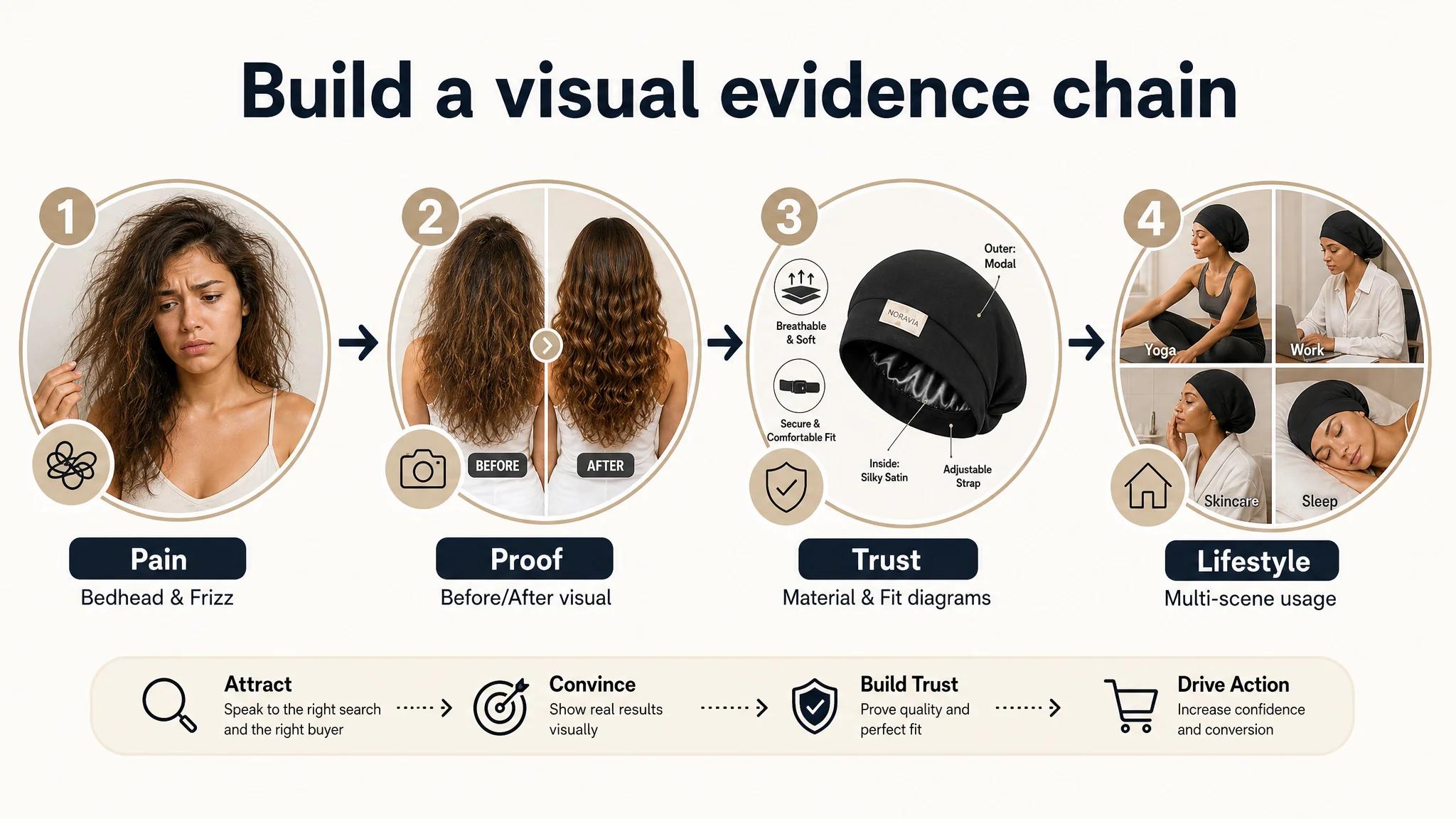
Business effect: the A+ no longer just “decorates” the Listing; it now functions as a visual argument that systematically removes doubts: effectiveness, comfort, fit, usage breadth, and durability.
How the Page’s Sales Logic Began to Recover
DeepBI’s approach does not rely on invented “dramatic” numbers when they aren’t available. Instead, the impact is tracked in operating state changes:
- Listing conversion capacity improved:
- The page now walks the buyer through a clearer, more credible hair-care story.
- Ads became more productive:
- The same or slightly improved ad traffic no longer lands on a weak logical structure; CVR has room to recover.
- Traffic structure risk decreased:
- As Listing quality rises, organic conversion can stabilize, reducing overdependence on paid traffic.
- Operational volatility decreases:
- With less waste on unproductive clicks, ACOS becomes more controllable; the team has more predictable outcomes when adjusting budgets.
Perhaps more importantly, the customer’s understanding changed:
- They saw that Amazon ads cannot fix a page that doesn’t fully persuade.
- They recognized that Listing quality is the foundation of ad efficiency, not a cosmetic layer.
- They experienced how title, main image, bullet points, and A+ must work together to support both organic and paid traffic.
“Advertising does not only amplify advantages. It can also amplify a page’s existing defects.”
Once the Listing stopped leaking conversions, ad optimization once again became a meaningful lever, not a desperate attempt to offset structural weaknesses.
What Other Amazon Sellers Can Take from This Case
This case is not about a dramatic turnaround from a failed product. It’s about a moderately good Listing in a mature category that quietly capped the upside of Amazon ads.
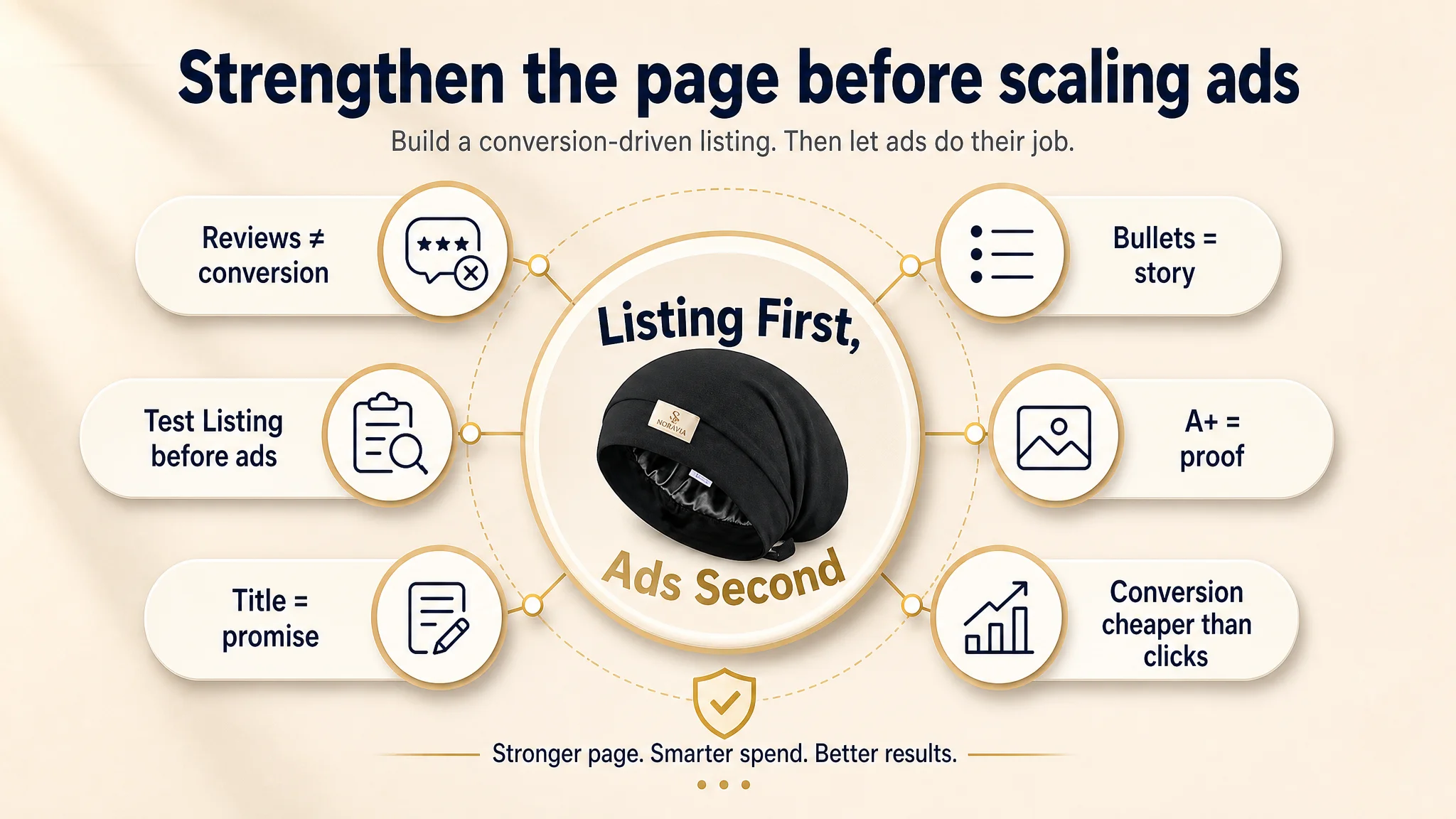
Key takeaways for other Amazon sellers:
1. Healthy reviews do not guarantee healthy conversion.
- A 4.4-star product with nearly 1000 reviews can still underperform if title, bullets, and A+ do not align with category decision logic.
1. If ads feel “stuck,” test the Listing first.
- When ACOS is hard to push down despite stable traffic, revisit your Amazon product page’s ability to convert both organic and paid traffic.
1. Title is not just about stuffing keywords.
- It must clearly establish the product type, audience, key outcome, and major pain-point solutions in a structured way.
1. Bullet points must tell a story, not just list features.
- Problem → solution → result is a practical lens for restructuring bullet points in any category.
1. A+ should build a visual evidence chain.
- Especially in “effect” categories (hair care, skincare, cleaning), text alone won’t fully convince; buyers expect before/after, material explanation, fit proof, and lifestyle context.
1. Fixing Listing conversion is often cheaper than endlessly tuning ads.
- Once conversion improves, each incremental ad dollar has more impact, and the store’s dependence on paid traffic can gradually ease.
DeepBI’s role in this case was not to push another optimization checklist, but to shift the seller’s judgment: from “we must fine-tune ads more” to “our Amazon Listing itself is the current ceiling.” For sellers facing rising ad costs and plateauing orders, that shift in judgment can be the most valuable optimization of all.