

This case comes from an Amazon seller in the US home-decor category, selling a three-panel framed canvas print of Van Gogh-style art. On the surface, nothing looked “broken”: ratings were 4.9 stars, the bullet points were well written, and the main images didn’t seem worse than competitors’. Yet in advertising data and overall sell-through, the Listing kept losing ground to a leading benchmark in the same niche.
The seller’s first reaction was familiar: assume this was an Amazon ads problem. They tried to push harder on keywords, bids, and budgets, believing that higher exposure would eventually translate into more orders, especially with such a strong review score. But the gap with the benchmark Listing kept widening. DeepBI’s diagnosis showed that the real bottleneck wasn’t on the traffic side at all—it was in the Listing’s core conversion capacity, especially a completely missing A+ visual story and an only partially competitive title and image system.
Once the conversation shifted from “why can’t we get cheaper clicks?” to “what exactly happens after the click on this product page?”, the optimization path changed. DeepBI guided the team to rebuild the page around three pillars: a more precise Amazon title structure, a bullet-point set aligned with category decision logic, and, most critically, a gallery-level A+ and image system that could visually prove quality and fit across scenarios. The outcome was not a flashy “hack,” but a different way of running this ASIN: ads started to feed into a page with real selling power instead of leaking traffic.
For other Amazon sellers, the value of this case is straightforward: a high rating and “nice” copy do not guarantee a healthy Listing. When a benchmark Listing combines strong reviews, well-structured images, and a complete A+ story, any gaps in your content directly translate into higher ACOS and lower CVR—even if your bullets read better. Before blaming Amazon ads, it’s worth asking whether your product page really deserves the traffic you’re paying for.
Amazon Ads Were Not Failing. The Page Was Consuming the Traffic.
From the seller’s perspective, the business pressure looked like an ads problem.
They were in a competitive wall-art niche on Amazon US, pushing a framed three-panel Van Gogh reproduction for home and office decor. The product’s surface signals were excellent:
- Rating: 4.9 stars
- Zero visible negative reviews
- Clean, emotionally engaging bullet points
- Main images that, at a glance, did not seem lower quality than the benchmark
Yet a comparable high-performing Listing in the same niche was clearly winning:
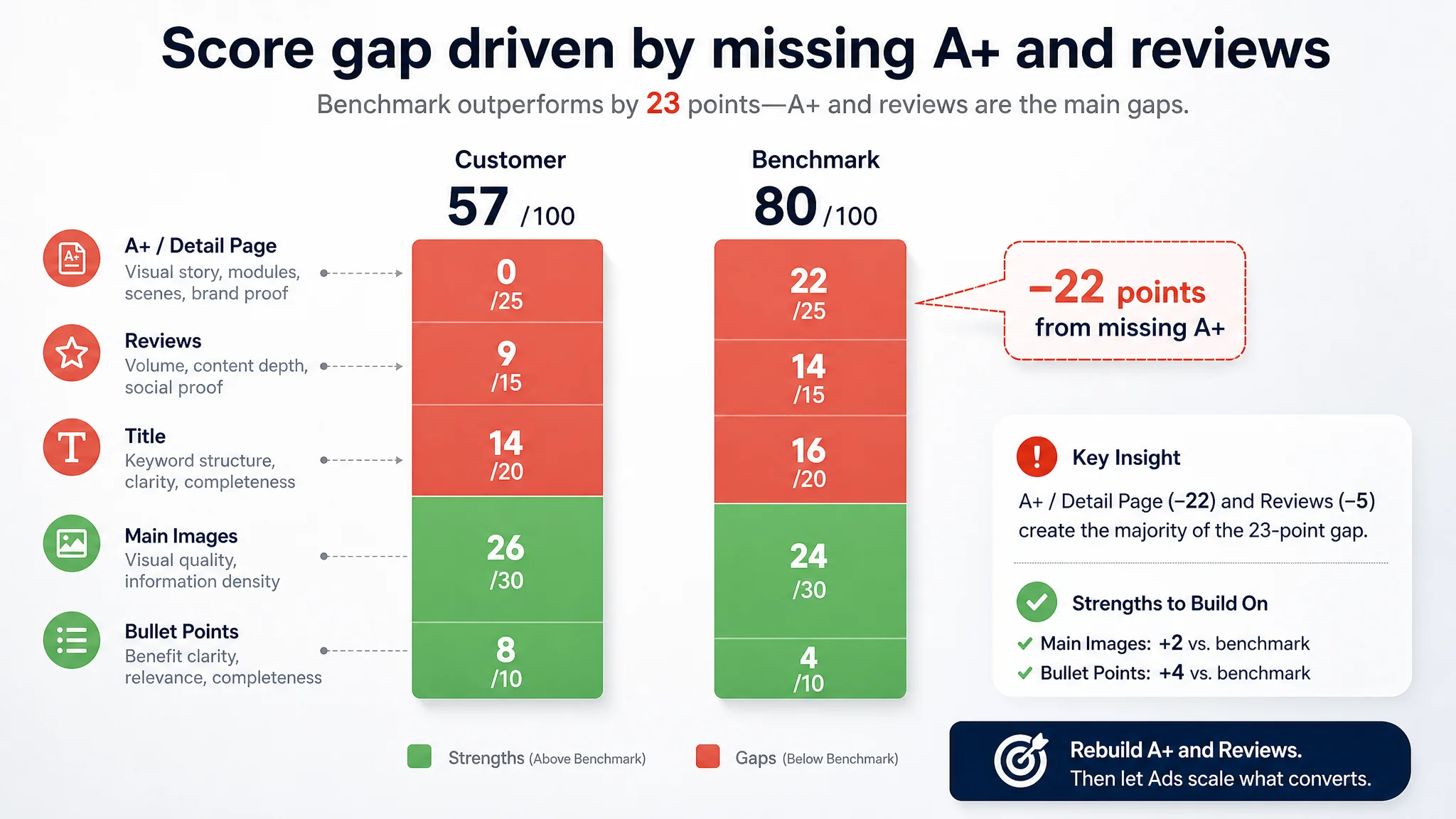
- Overall Listing score: 80/100 vs. the customer’s 57/100
- Much higher review volume (301 vs. 44) and rich review content
- A filled-out A+ section with multiple real scenes, process visuals, and brand story
The seller felt the core issue was “insufficient traffic and rising ACOS,” and their instinct was to fine-tune Amazon ads: splitting campaigns, adjusting bids, expanding keywords. But the underlying pattern didn’t move enough. Traffic could be forced up for a while; efficiency wouldn’t follow.
“The real problem was not that ads failed to bring traffic. It was that the page could not convert the traffic.”
In DeepBI’s view, the Listing had entered a dangerous state: it looked “good enough” to the human eye, but fell far short when measured against the actual decision logic of Amazon shoppers in this category.
The Real Constraint Was Listing Conversion Capacity
DeepBI’s Listing scoring made the constraint painfully clear. Against a single well-chosen benchmark Listing in the same Van Gogh wall-art niche, the page scored:
- Customer Listing: 57 / 100
- Benchmark Listing: 80 / 100
- Gap: –23 points
Broken down by dimension:
- Title: Customer: 14, Benchmark: 16, Max: 20, Gap: –2
- Main Images: Customer: 26, Benchmark: 24, Max: 30, Gap: +2
- Bullet Points: Customer: 8, Benchmark: 4, Max: 10, Gap: +4
- A+ / Detail Page: Customer: 0, Benchmark: 22, Max: 25, Gap: –22
- Reviews: Customer: 9, Benchmark: 14, Max: 15, Gap: –5
Two striking facts jump out:
1. The page was not weak everywhere.
- Main images were slightly ahead on pure scoring.
- Bullet points were more sophisticated than the benchmark’s.
1. But the A+ / detail-page dimension was a black hole: 0 vs. 22.
- The customer had no A+ modules in place.
- The benchmark had a full image-based story, from gallery scenes to craft process, materials, and brand narrative.
In other words, the seller was trying to win an ads-driven battle with a product page that literally had no visual backbone below the fold.
DeepBI’s judgment: in this situation, Listing conversion—especially A+ content and decision-support visuals—was the real bottleneck, not ad structure.
What the Seller Originally Misdiagnosed
The seller’s initial reading of the situation contained three common assumptions:
1. “Our reviews are excellent, so trust is not the problem.”
- 4.9 stars and 0% visible negative reviews are indeed strong.
- But with only 44 reviews vs. the benchmark’s 301, the page lacked scale and “social proof weight.”
- On Amazon, volume and content depth of reviews often matter more than a near-perfect score.
1. “Our bullets are more emotional and professional than competitors’, so content is not the problem.”
- Bullet points emphasized artistic value, visual impact, safety (“non-toxic, odorless”), and durability (“fade-resistant”).
- They used a problem–solution structure that, on paper, beats the benchmark’s rather dry parameter listing.
- The team concluded: “Our copy is already strong; we should focus on getting more exposure.”
1. “Images are okay; if anything, we just need ‘nicer’ photos.”
- The seller saw several scenes, some lifestyle context, and assumed they were within the category norm.
- No one systematically compared image roles, information density, and scene logic vs. a benchmark.
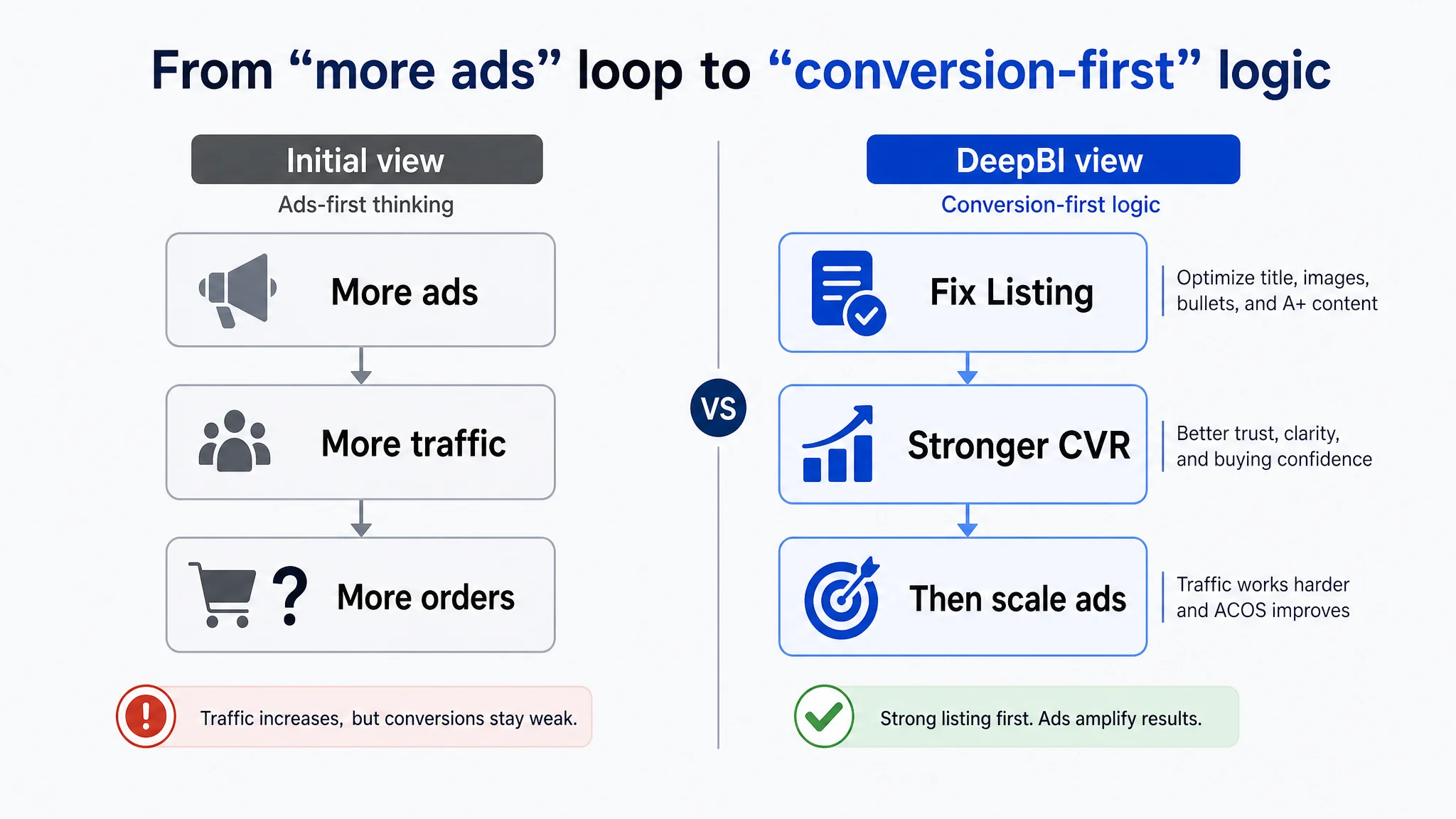
This led to a skewed optimization loop:
- Keep spending time in Amazon Ads Manager.
- Try to unlock more search terms and impressions.
- Hope the strong rating and “good content” will convert once traffic arrives.
The problem: this logic treats ads as the primary lever and the Listing as a static given—which might have worked years ago in lower-competition environments, but breaks once a strong benchmark exists with a full visual and A+ system.
Why Traditional Amazon Ad Optimization Could Not Fix This
DeepBI’s analysis tied Listing quality back to ads performance in a simple but unforgiving way:
- If CTR is acceptable but CVR is weak, adding more traffic just burns budget faster.
- If the page has structural trust gaps, ads amplify those gaps. Every click is another user discovering what is missing.
Here, the visible risk points included:
- A+ content missing entirely
- No gallery-type module to simulate a “real” art-gallery environment.
- No micro-level canvas and frame detail shots to prove “HD Giclee” quality.
- No material or frame-structure breakdown to justify price and reassure about durability.
- Review structure lagging behind benchmark
- Fewer total reviews and far less review content on the first page.
- The benchmark showed diverse geographies and detailed narratives; the customer Listing couldn’t match the same depth of authenticity.
Even if ACOS looked high and ads felt “inefficient,” adjusting bids or campaign architecture couldn’t address these conversion leaks. The more aggressively the seller pushed traffic, the more these structural weaknesses were exposed.
“Advertising does not only amplify advantages. It can also amplify a page’s existing defects.”
For DeepBI, the decision was clear: stop treating this as an ads problem and treat it as a Listing conversion problem first.
This Product Page Did Not Lack Information. It Lacked a Visual Buying Logic.
One of the easiest traps for Amazon teams is to equate “having information” with “having a persuasive path.”
In this case:
- The bullet points already covered:
- Artistic value and visual impact
- Printing method and canvas quality
- Safety (non-toxic, odorless)
- Durability (fade-resistant)
- Installation convenience and scenarios
- The title contained:
- Brand
- Core product type (canvas wall art)
- Subject (“Starry Night”)
- Sizes and colors
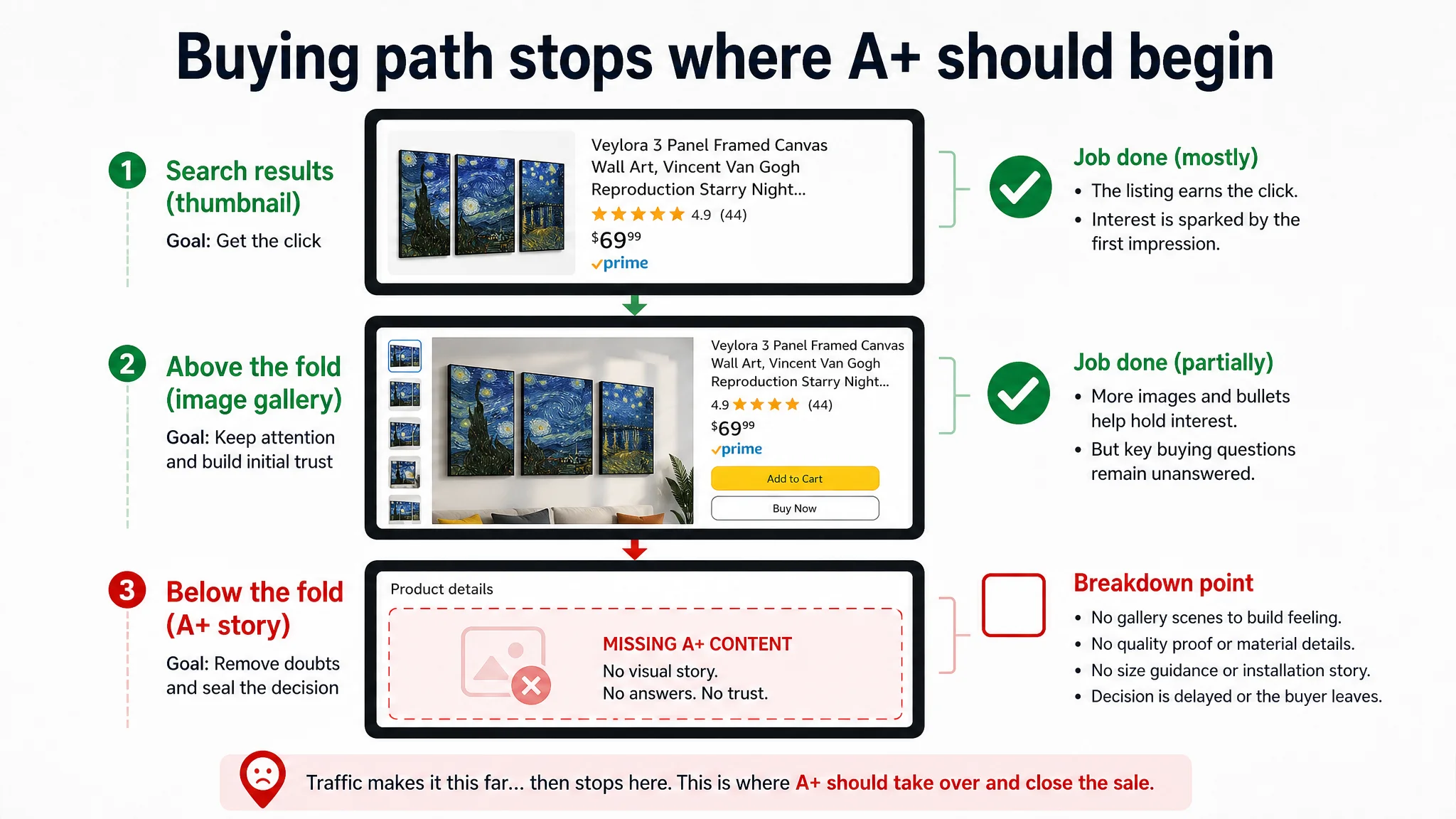
On paper, information density was not the issue. The real issue was how that information surfaced in the actual Amazon buying journey:
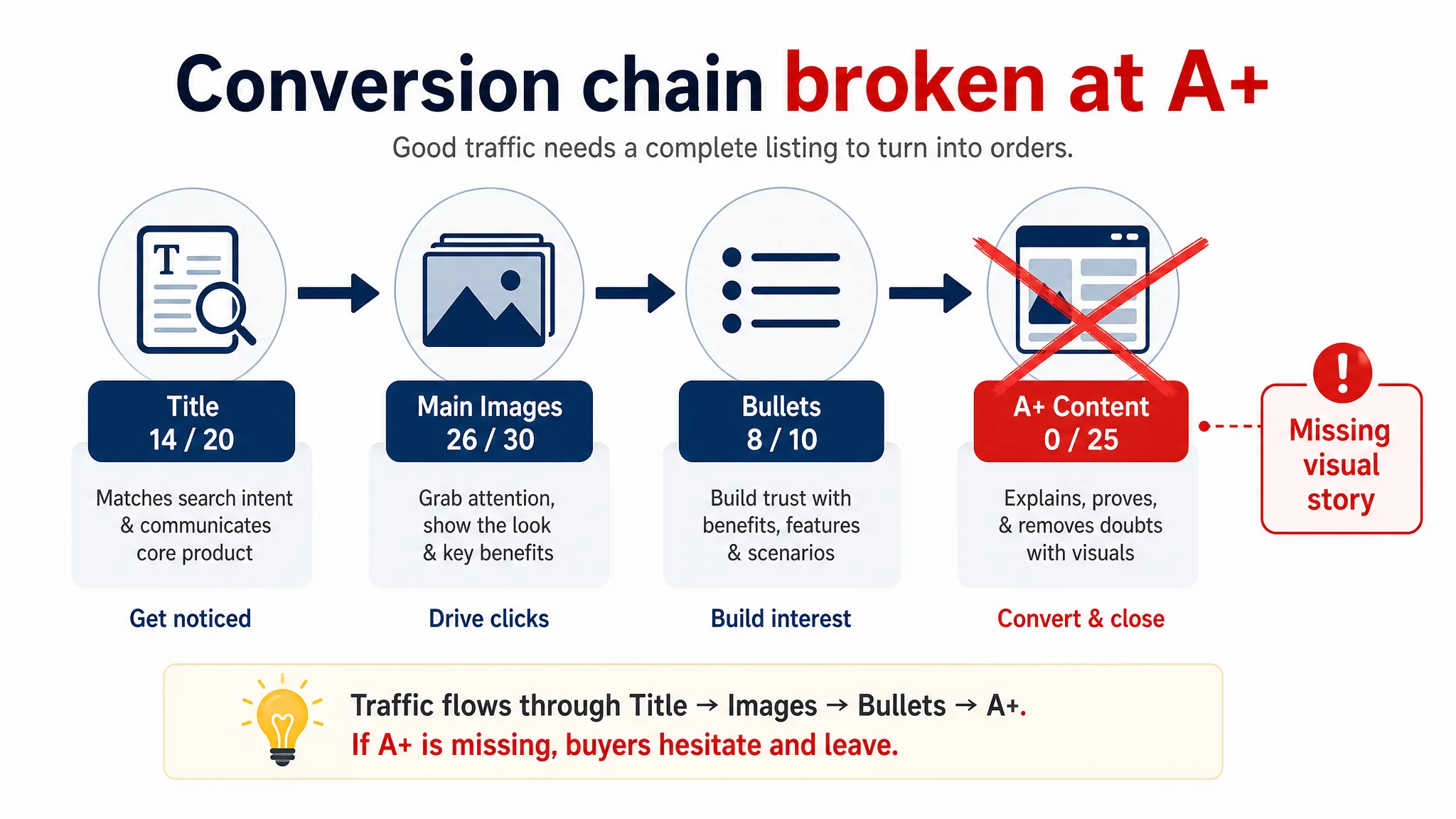
1. Search results / thumbnails
- The main images conveyed “general wall art at home,” but not a clear, instant reason to click.
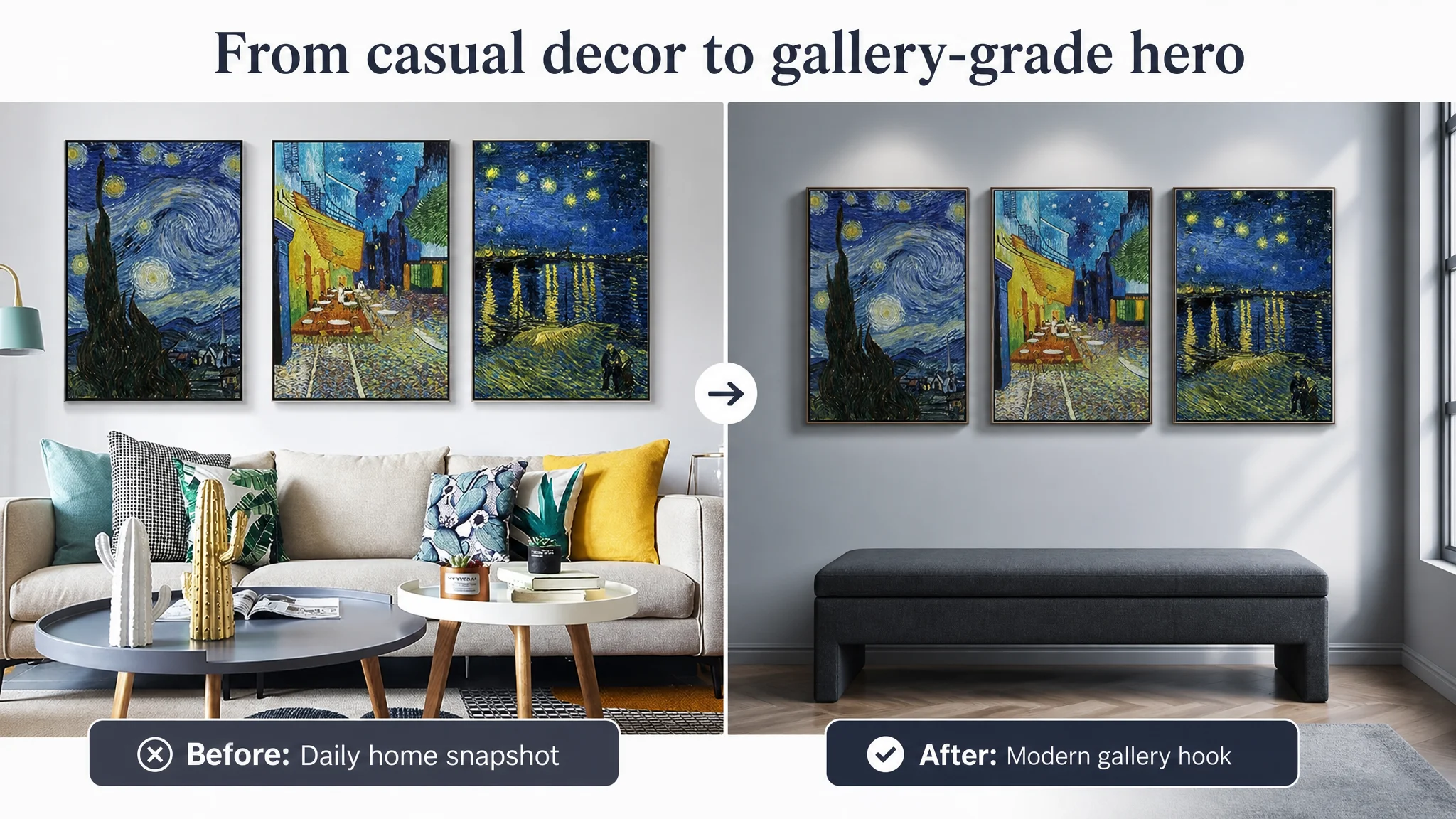
- Background elements were cluttered; the setting felt like casual “daily home” rather than “curated gallery.”
- There was no strong gallery-style or design-forward hook to differentiate the product.
1. Above-the-fold on the product page
- Some lifestyle images existed, but visual hierarchy and scene differentiation were weak.
- Many scenes overlapped in mood and layout, creating the feeling of repetition rather than a guided tour of use cases and product strengths.
1. Below-the-fold (A+ / detail content)
- This was the biggest gap: no A+ at all.
- In a category where the benchmark Listing uses an entire A+ to stage the product as gallery-grade art, missing this block cut off a huge part of the decision logic.
Ultimately, the customer Listing had words but lacked a structured, visual argument—the kind that makes a user unconsciously say, “Yes, this fits my living room; yes, the quality looks worth the price; yes, installation looks easy.”
How DeepBI Identified the Root Cause: The A+ Black Hole
DeepBI’s scoring did not just flag a low number; it described where and why that number was lost.
For the A+ / detail page dimension, the contrast was stark:
- Customer Listing
- No A+ modules.
- No structured image or text blocks to continue the story after the main images.
- No brand story, no parameter transparency, no expectation management.
- Benchmark Listing
- Multiple real-life room scenes (modern living room, minimalist sofa background) establishing spatial fit.
- “Process-chain visualisation” of canvas printing and framing, building trust in craft and materials.
- Brand story visuals, clear parameters (size, thickness, materials), and even risk disclaimers (color variance, size reminders).
DeepBI’s judgment:
- The –22 point gap in A+ was the largest single deficit in the entire Listing.
- This gap directly affected CVR and trust, which in turn made ads look inefficient.
- With the main-image dimension already relatively strong and bullet points competitive, incremental gains in those areas could not compensate for a zero A+.
In other words, trying to fix ads without fixing A+ would be like polishing the steering wheel of a car with no engine.
Why DeepBI Did Not Keep Tuning the Ads First
From a business-risk standpoint, DeepBI prioritized the following:
1. Avoid letting ads amplify a conversion leak
- Each additional dollar spent on ads was driving traffic into a page that had no serious visual trust layer below the fold.
- Continuing to tune ads first would mostly adjust the cost of acquiring clicks—not the page’s ability to turn clicks into orders.
1. Base ad decisions on a “deserving” Listing
- Before scaling, the team needed to answer: “Does this current product page deserve more traffic?”
- With a 57/100 score and a zero in A+, the honest answer was no.
1. Protect long-term ACOS and TACOS health
- In home decor, organic ranking and repeat purchase intent are heavily tied to conversion history and review dynamics.
- If ads keep feeding a weak-conversion page, TACOS drifts upward and organic momentum stalls.
- Fixing Listing conversion first gives every ad-impression a better chance to contribute to long-term, compounding gains.
So the priority stack shifted:
- First: Repair the conversion foundation—title, visual system, and especially A+.
- Then: Let ads test and scale once the page can genuinely convert.
Rebuilding the Title: From Overlong “Canvas Wall Art” to Clear, Weighted Search Logic
The title dimension gap was small on paper (14 vs. 16), but still meaningful in search behavior.
DeepBI reframed the title logic:
- The benchmark led with brand + “Framed” + core subject.
- The customer’s original title included brand, subject, type (“Canvas Wall Art”), colors, and size—but was too long and diluted core keywords.
The recommended direction:
“[Brand] 3 Panel Framed Canvas Wall Art, Vincent Van Gogh Painting Reproduction Starry Night Over The Rhone & Cafe Terrace at Night Prints for Home Office Decor, 16" x 24" x 3 Pieces”
Key decisions behind this structure:
- Include the artist’s full name “Vincent Van Gogh”, not just “Van Gogh,” to align with high-frequency search behavior in art decor.
- Consolidate redundant terms like repeated “Wall Art,” freeing space for quality-signaling words such as “Framed” or “Giclee Prints.”
- Move size into a clean, non-truncated tail, clearly stating “16" x 24" x 3 Pieces” to reduce mis-buy risk and post-purchase friction.
The goal was not cosmetic polish; it was to align the title with how Amazon shoppers search, and how the algorithm interprets brand + subject + format + use-scene.
The Bullet Points Had Information—but DeepBI Tightened Their Buying Logic
Paradoxically, the customer’s bullet points already outscored the benchmark’s. But DeepBI still saw room to translate them into more directly monetizable decision steps.
1. Lead with a named value proposition, not just description
Suggested first bullet:
【Stunning Artistic Masterpiece】Experience high-definition giclee printing on premium canvas that captures rich, vibrant colors. This Van Gogh-inspired wall art adds a sophisticated, artistic touch to any space, making it a thoughtful and classic gift for friends, relatives, and art lovers.
This does three jobs at once:
- Names the value (“Stunning Artistic Masterpiece”).
- Proves quality (“high-definition giclee printing,” “premium canvas,” “rich, vibrant colors”).
- Injects gifting motivation (friends, relatives, art lovers) that the benchmark already leveraged.
2. Turn materials and safety into an explicit trust layer
【Premium PS Framed Art】The artwork is mounted in a high-quality PS lightweight frame that is moisture-proof and odorless. This non-toxic construction ensures it is safe for all environments, including baby nurseries and children's rooms, providing a durable and elegant black finish.
This mirrors the benchmark’s “moisture-proof, no smell, safe for children” message—but with more explicit framing of safety and use-scenarios, directly addressing a typical buyer concern for framed art in kids’ spaces.
3. Use size as a pre-emptive return-reduction tool
【Perfect Size & Craftsmanship】Art Image Size: 12x16 inch (Please adjust to your actual size). Each piece is stretched and framed with precision, featuring a lightweight yet sturdy design that ensures a professional gallery-quality look for your home gallery.
Here the purpose is operational: make size and craftsmanship explicit to reduce returns from “not what I expected”.
4. Merge installation, packaging, and risk disclaimer into a single closing reassurance
【Ready to Hang & Secure Packaging】Equipped with strong hooks and including hanging nails, this artwork is ready for immediate display. Each item is protected with a plastic bag and reinforced packaging to ensure safety during transit. (Note: Colors may vary slightly due to different monitor settings.)
This absorbs the benchmark’s packaging and color-disclaimer logic and turns it into a combined “easy to use + safe to receive + realistic expectations” bullet.
5. Expand scenario coverage for both keywords and imagination
【Versatile Wall Decoration】A perfect wall decor for living rooms, bedrooms, kitchens, offices, hotels, dining rooms, bathrooms, and bars. This exquisite piece complements various interior styles, transforming any blank wall into an eye-catching focal point.
This mirrors the benchmark’s long list of rooms but expresses it in a cleaner structure, serving both keyword coverage and mental visualization.
The net effect: bullets no longer just “sound good”; they become precise responses to category-specific risks and motivations.
The Main Image Was Not Just a Visual Issue. It Failed to Create a Reason to Click.
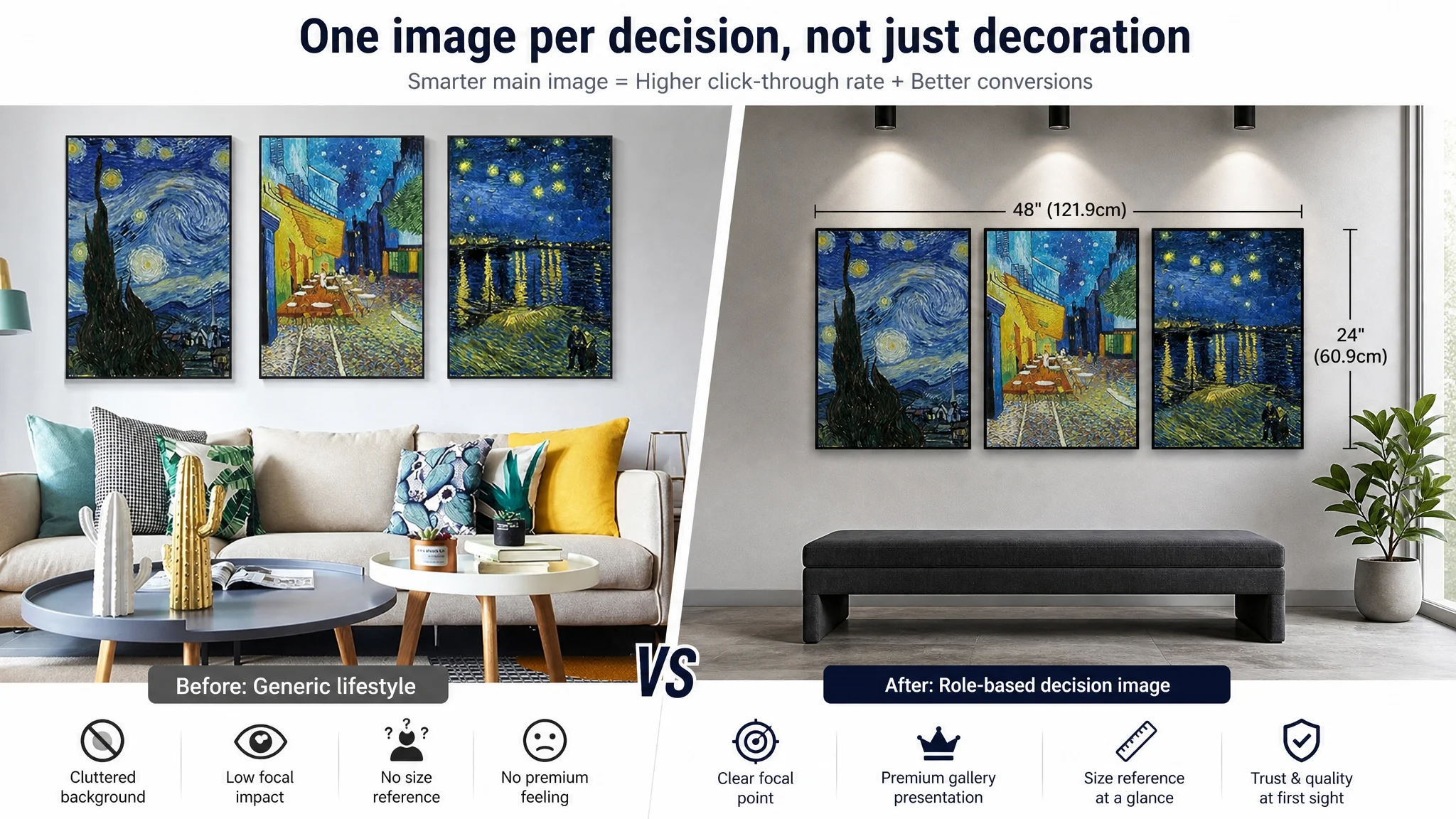
On the main-image side, DeepBI’s scoring suggested the customer was not far behind. But when looking at how each image contributed to the decision journey, several conceptual issues emerged:
- Background clutter blurred the focus on the art.
- Scenes felt like generic “home snapshots,” not curated design statements.
- Angles and lighting did not fully support a “gallery-grade” positioning.
DeepBI’s optimization logic here was not “make it prettier”; it was “make each image serve a specific decision node.”
Examples of suggested transformations:
Elevate the hero scene to “modern gallery” rather than “casual living room”
- Center the three-panel set in the upper half of the frame.
- Use a calm, light-cool gray wall and a simple dark-gray fabric bench.
- Simulate soft daylight coming from a right-side window.
- Remove pillows and other distracting decor.
- Add subtle shadows around the frames to increase hanging realism.
This creates a clean, gallery-like hero shot that says “designed art piece,” not “random wall decoration.”
Use angled shots to convey depth and lighting professionalism
- Show the group of three panels at a 45-degree angle, from left to center.
- Add three minimalist black spotlights above, casting directed light cones.
- Use a warm, creamy plaster-textured background and a single mid-height green plant.
- Slightly blur the background to bring focus to brushstroke and frame detail.
Now the image supports a higher perceived price point and professional interior design relevance.
Turn one slot into a “structure and material” visual spec sheet
- Single panel occupying ~65% of the frame.
- 45-degree side angle to show frame thickness.
- Strong directional light from upper left, highlighting texture.
- Dark matte gray background, no furniture.
- Clean vertical labels on the right: “Moisture-proof backboard,” “PS frame,” “Giclee canvas,” etc.
This image becomes visual proof of product build quality, rather than just another scene.
Make size comprehension a first-page visual, not a line in the copy
- Show the triptych above a standard three-seat sofa.
- Use dashed lines, labels like “16" x 24" x 3 panels,” and a sofa-length reference.
- Clean, bright room; no heavy shadows.
This directly attacks the “I can’t visualize how big this will be” friction, which is a major source of returns and hesitation in wall art.
Before Ads Could Work Again, the Page Had to Convert
Once DeepBI laid out the gaps vs. the benchmark, the optimization logic became sequential:
1. Establish gallery-level hero and lifestyle images
- Clear, uncluttered, and differentiated scenes (living room, bedroom, office, stairway, etc.).
- Use angles and lighting that signal “design-conscious” and “gallery-grade.”
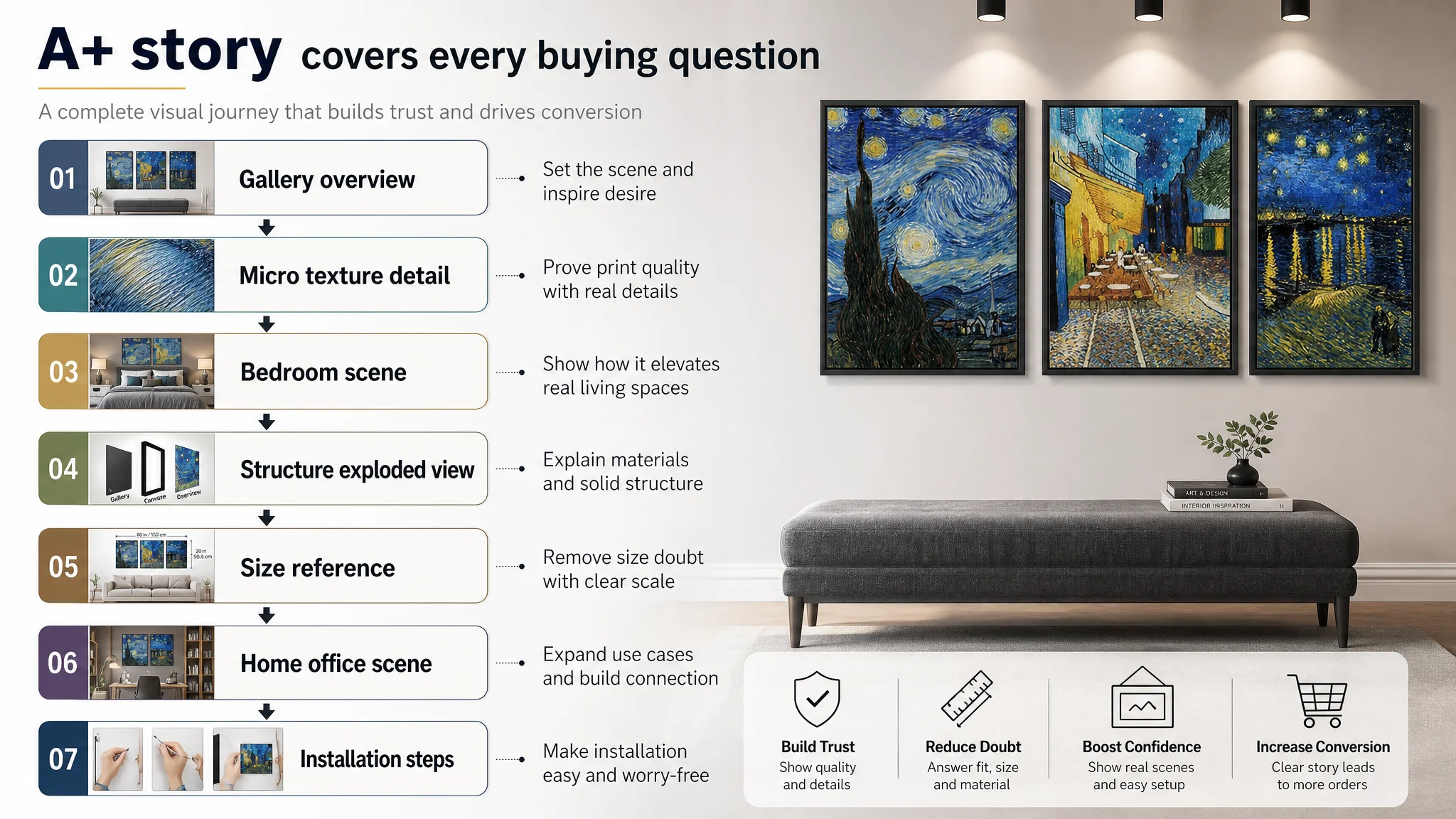
1. Build a complete A+ story around six functions
DeepBI’s recommended A+ modules were structured to mirror the category’s decision curve:
- Opening module: gallery-style overall view—three panels on a marble-textured wall with directional lighting.
- Micro-detail module: macro shot of canvas texture and brushstroke reproduction, highlighting HD Giclee print.
- Bedroom scene: reinforcing “Impressionism aesthetic” and emotional comfort in a calm, deep-blue bedroom.
- Structure-exploded view: backboard, PS frame, canvas separated, visually explaining “lightweight and sturdy.”
- Size reference: above-sofa scale with explicit dimensions and sofa-length markers.
- Home-office scene: tying into “Home Office Decor” positioning.
- Installation steps: four easy steps with real hands showing “Easy to hang.”
Each module answered a specific concern: “Does it look premium?”, “Is print quality sharp?”, “Will it actually fit my wall?”, “Is it easy to hang?”, “Can I trust the structure?”
1. Refine title and bullet points in line with the new visual logic
- Once the images and A+ mapped to specific claims (HD printing, PS frame, moisture-proof, easy installation, size), the text could echo the same narrative with clarity and consistency.
1. Then re-open the ads throttle
- With a rebuilt conversion foundation, search and display campaigns would be feeding into a page capable of monetizing the traffic.
- ACOS had a realistic path to improve not just through bid control, but through CVR gains and stronger organic ranking over time.
How the Seller’s Understanding Changed
After going through this process, the seller’s mindset shifted in several ways:
- From “ads are too expensive” to “our Listing was not yet worthy of the traffic we were buying.”
- From “we just need more reviews and nicer photos” to “we need a complete decision logic: title + main images + bullets + A+ working as one system.”
- From “our bullets are better than competitors’, so content is not the issue” to “the absence of A+ and structured visuals is a decisive handicap, regardless of copy quality.”
Operationally, the changes meant:
- Listing conversion capacity improved: the page could now visually demonstrate quality, fit, and ease-of-use—critical for home-decor buyers.
- Ad traffic became useful again: each click had a higher probability of turning into an order, and ACOS had room to decline from the conversion side, not just through bid cuts.
- Organic and paid traffic could reinforce each other: better CVR supports better ranking, which in turn reduces dependence on paid clicks.
For Amazon sellers in similar categories—art, decor, furniture, lifestyle products—the takeaway is sharp:
- A strong rating and good bullet writing are not enough when you’re facing a benchmark with a full visual and A+ story.
- Listing conversion is not a cosmetic layer; it is the engine that determines whether your ads are a growth lever or a cost sink.
- Before asking how to scale ads, ask whether your Amazon product page gives buyers a concrete, visual, and believable reason to say “yes” faster than the benchmark they’re comparing you to.