Executive Summary
Client: US-based outdoor backpack manufacturer and Amazon seller
Industry: Outdoor Recreation & Sports Equipment
Challenge: Unsustainable advertising costs (58.57% ACOS)
Solution: DeepBI AI-Powered Amazon Advertising Management Platform
Timeline: 4-week live performance period (November 14 - December 11, 2025)
Key Results
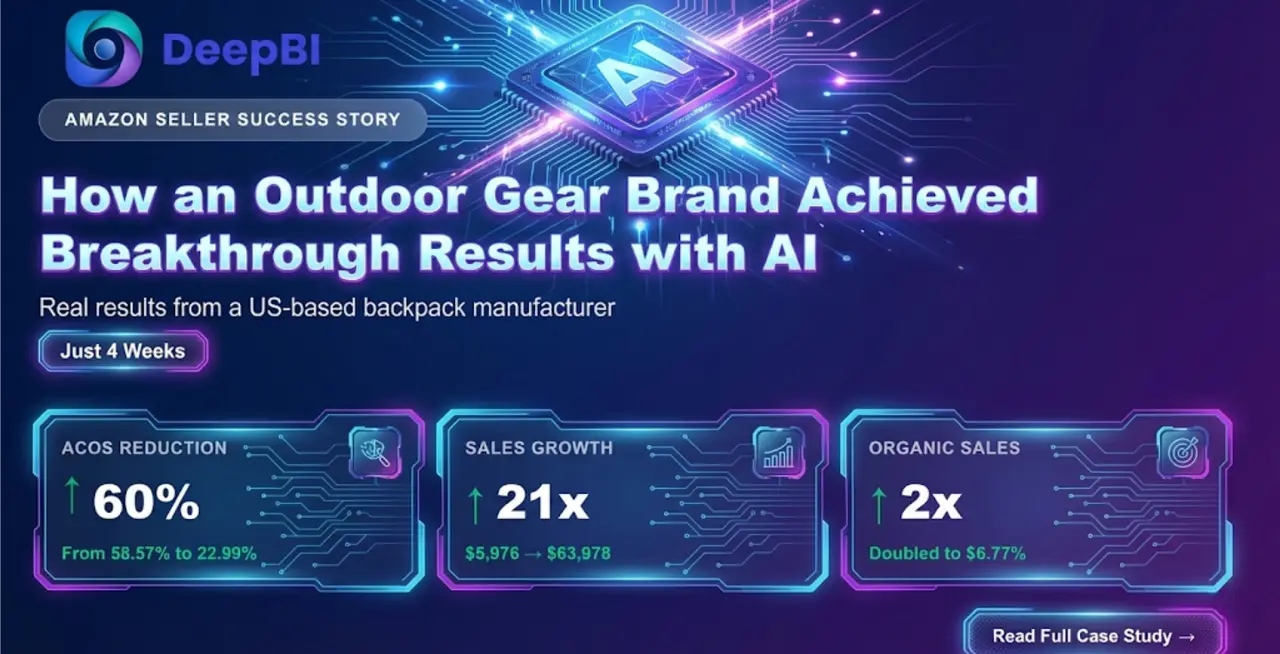
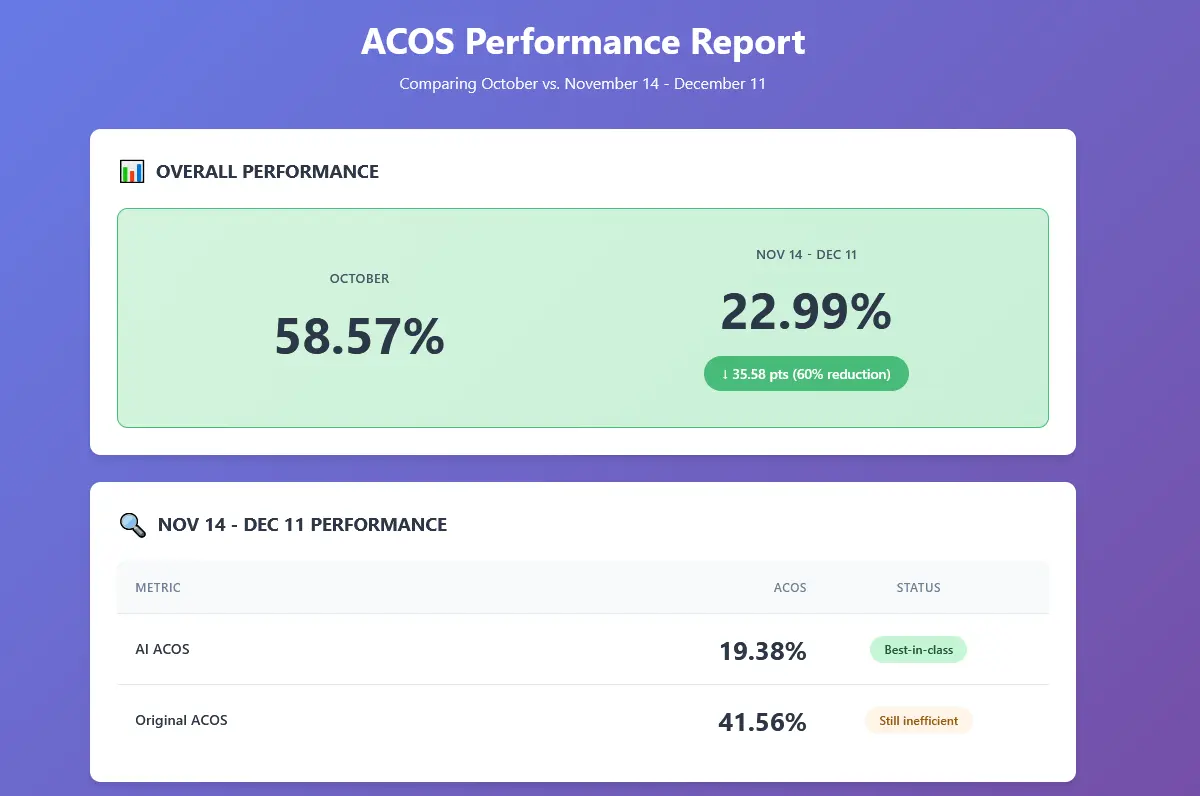
- ACOS reduced from 58.57% to 22.99% (60% improvement)
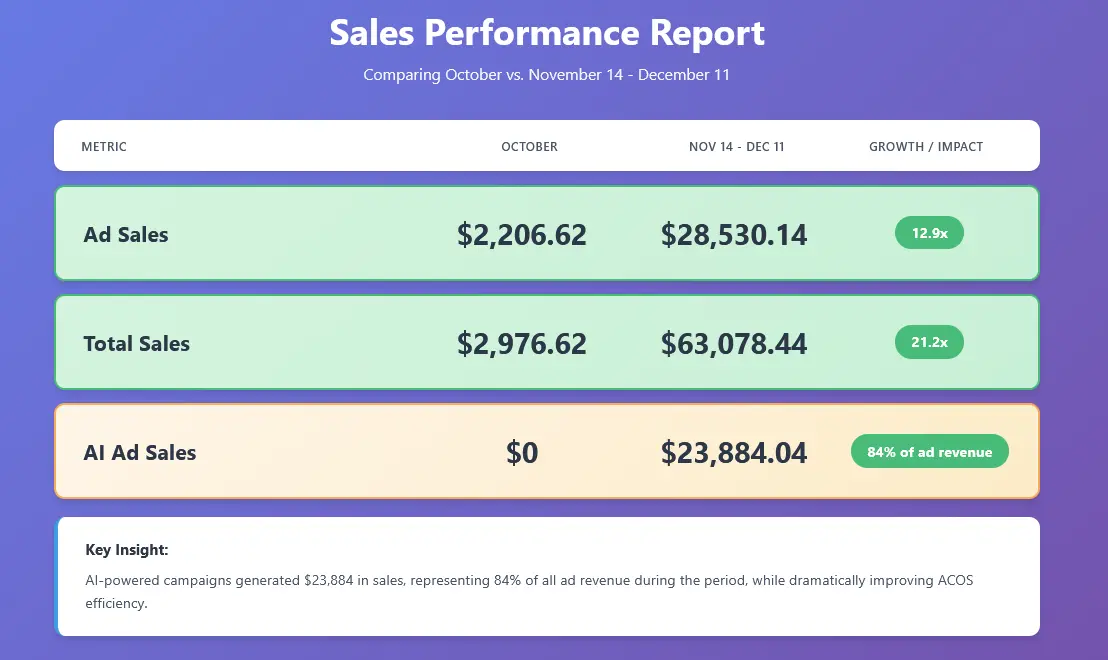
- Total sales increased 21x ($2,976 → $63,078)
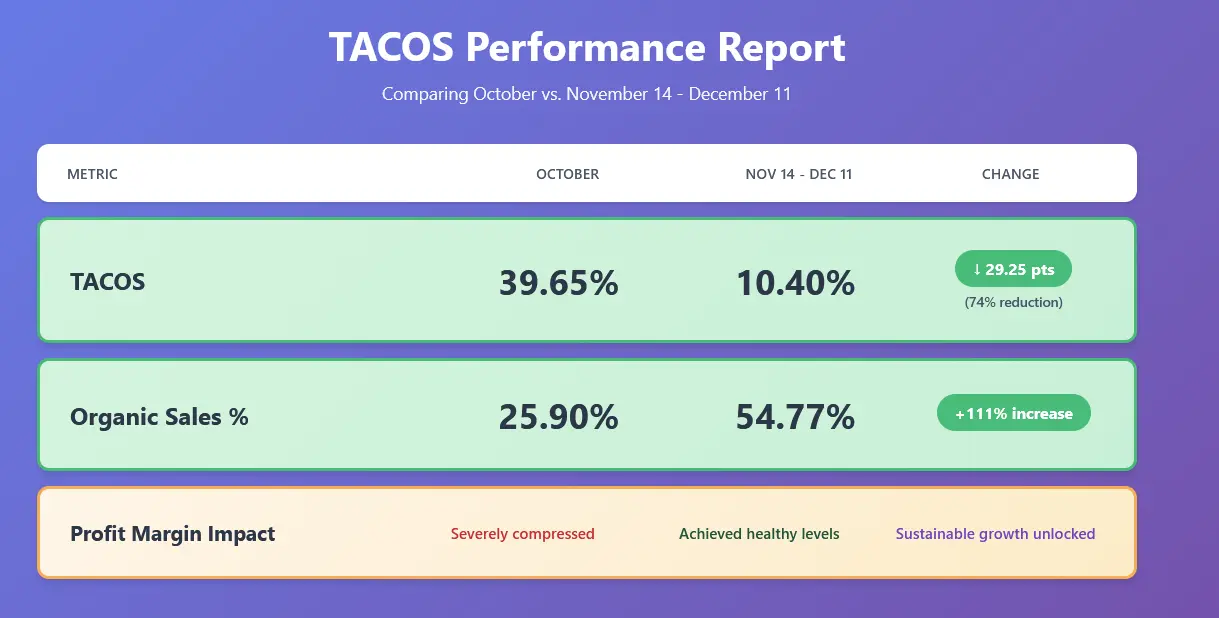
- Organic sales ratio doubled (25.9% → 54.77%)
- TACOS dropped from 39.65% to 10.40% (healthier profit margins)
- AI campaigns delivered 19.38% ACOS vs. 41.56% for original campaigns
Client Background & Challenge
Company Profile
A vertically-integrated outdoor gear manufacturer operating on Amazon with:
- In-house R&D and production capabilities
- Direct-to-consumer sales model
- Strong product quality and competitive pricing
- Primary category: Outdoor backpacks and gear
The Problem
Despite having excellent products, the client lacked the operational infrastructure to effectively communicate value to Amazon's algorithms. Advertising was managed inconsistently, leading to:
- Severely inefficient ad spend
- Wasted resources on non-converting traffic
- Missed opportunities for organic ranking growth
Proof of Inefficiency
Pre-implementation metrics (October 2025):
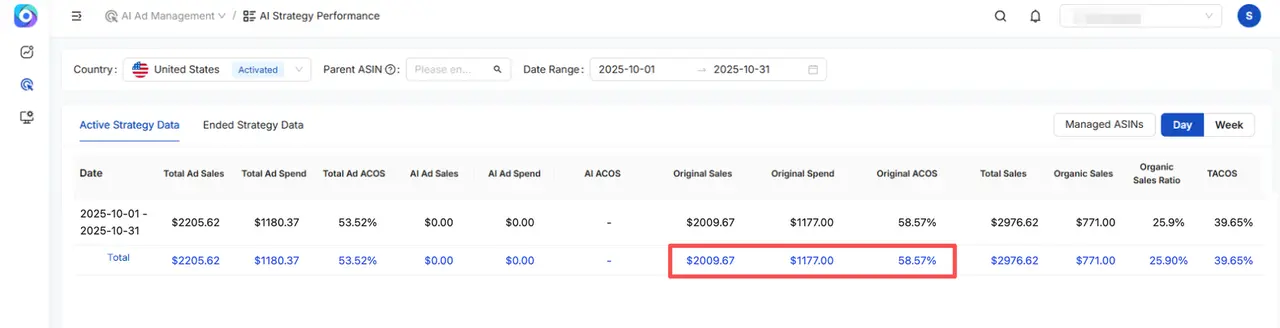
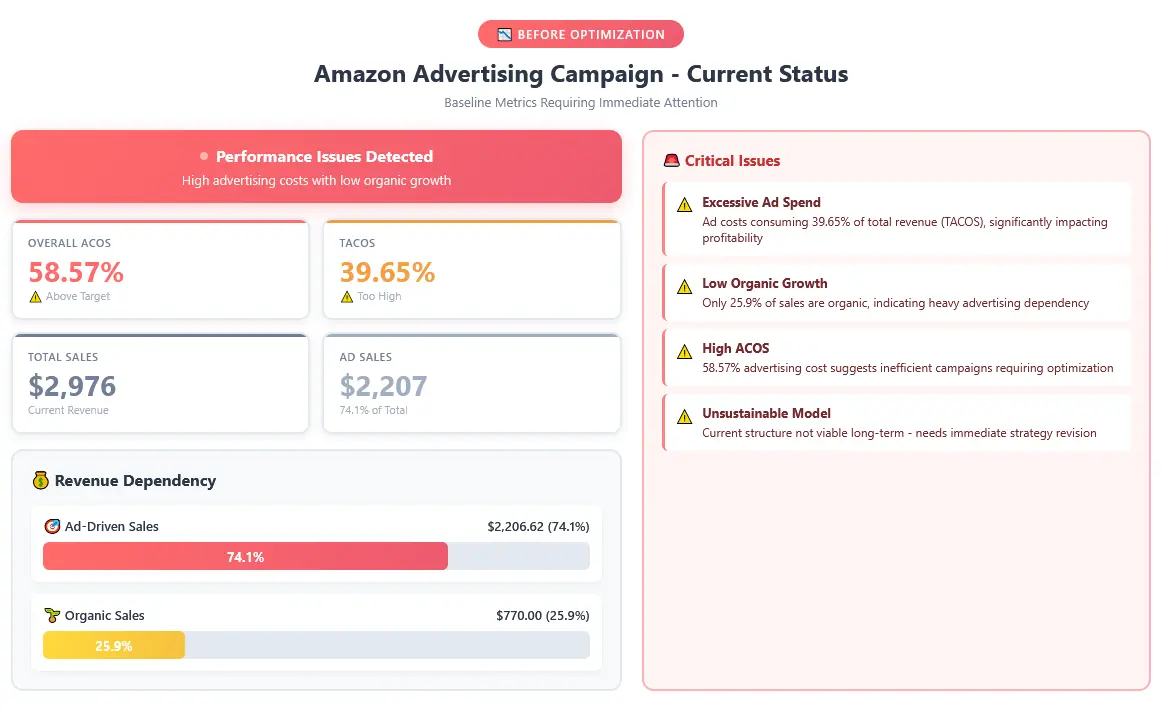
Bottom Line Impact With nearly 60% of ad revenue consumed by advertising costs and weak organic traffic, profitability was severely compromised. The client needed a stable, intelligent solution that could optimize campaigns 24/7 without constant human intervention.
Solution: DeepBI AI Advertising Platform
On November 15, the seller implemented DeepBI's fully managed advertising system. This was not a switch to another optimization tool—it was a transition from manually managing individual campaigns to operating a unified, system-level traffic framework designed specifically for Amazon's marketplace dynamics.
Rather than reacting to performance reports or making periodic manual adjustments, DeepBI continuously orchestrates bids, budgets, and targeting automatically, adapting to changes in conversion behavior, competition, and inventory conditions as they occur.
At its core, DeepBI functions as a closed-loop control system. Every advertising action generates performance feedback, and that feedback directly informs the next decision—creating a self-reinforcing optimization cycle focused on efficiency and scalable growth.
Core Architecture: The Five-Layer Traffic Funnel
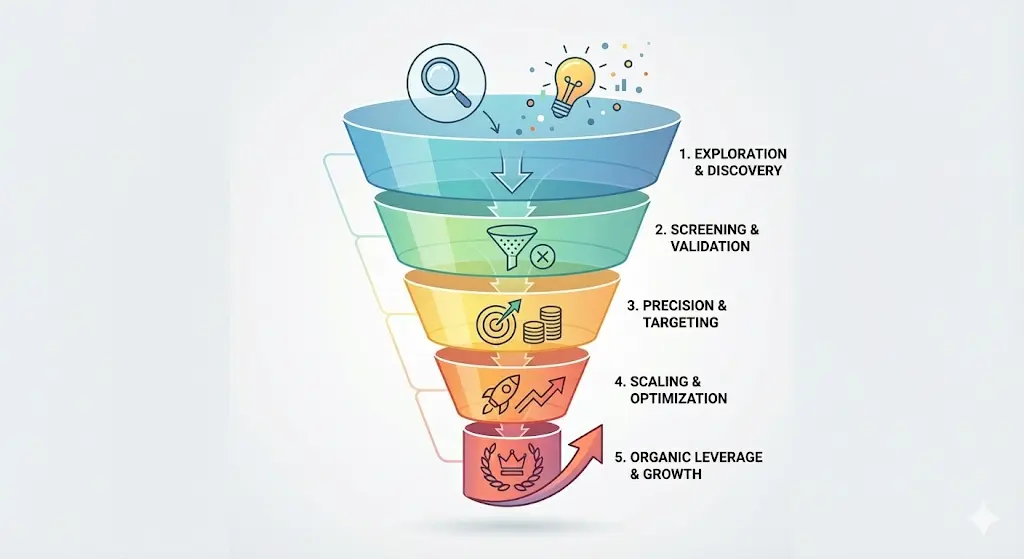
DeepBI does not optimize legacy campaign structures. Instead, it creates new AI campaigns which follow the five-layer traffic funnel system where every click has a defined role and every target is evaluated within a broader system. This model is specifically designed for Amazon's marketplace dynamics, leveraging SP-ASIN ads as "keyword growth drivers" to overcome keyword traffic concentration.
Smart acceleration for proven traffic:
Listings with conversion history get fast-tracked. Keywords and ASINs with historical conversions skip exploration and advance directly to Layer 2 (Initial Screening) or Layer 3 (Precision Targeting), while Layer 1 focuses exclusively on discovering fresh, untapped traffic opportunities.
This eliminates redundant testing of already-proven traffic, accelerating your scale while maintaining precision. New products still benefit from the complete validation funnel.
Layer 1 – Exploration & Discovery
The system continuously discovers new converting opportunities through SP-AUTO (automatic ads) and SP-ASIN (ASIN-targeted) campaigns, capturing "Order-Generating Keywords" and "Order-Generating ASINs"—targets that generate actual orders, not just clicks.
Layer 2 – Screening & Validation
Traffic is filtered and validated using broad match and phrase match keywords and expanded targeting ASINs, supported by data-driven, automated negative keyword controls. Inefficient or irrelevant traffic is identified early and prevented from scaling, forming the first line of defense for ACoS.
Layer 3 – Precision & Targeting
High-converting targets that pass validation—exact match keywords and exact targeting ASINs—are further validated by AI proprietary model. The system identifies the top 10-20% of stable high-potential targets using metrics like conversion rate, user path, and purchase cycle, graduating these to the next layer. The remaining 80–90% stay at low exposure, but when they convert, they deliver great returns and are automatically promoted to the next layer for scaling
Example:
Long-tail keywords with very low ACoS aren't abandoned. They maintain ultra-low cost exposure. When they do convert, they deliver exceptionally high ROI. AI captures these hidden opportunities at minimal spend, and once performance improves, they're instantly promoted and scaled automatically.
Layer 4 – Scaling & Optimization
These proven high-potential targets are dynamically scaled with increased budgets and AI-driven bid adjustments. The system features dynamic demotion/promotion between layers based on real-time performance.
Layer 5 – Organic Leverage & Growth
Select high-value keywords from the fully validated "high-conversion keyword vault" are strategically pushed into Top of Search (TOS) placements through independent campaigns. By dominating these prime ad slots with superior CTR and CVR, the system triggers Amazon's ranking algorithms (like Cosmo) to accelerate organic ranking improvements, unlocking compounding organic sales growth and significantly lowering TACOS—achieving an ad order to natural order ratio of 1:3 or higher.
This layered structure ensures that discovery, efficiency, scale, and organic growth are managed independently but optimized together through a closed-loop control system where data flows in real-time across layers, forming a dynamic traffic ecosystem that enables repeatable, sustainable automated growth.
How the System Makes Decisions
The system makes decisions by analyzing each keyword and ASIN in detail, using 200–300 quantitative metrics with two-decimal precision. This removes the guesswork and unclear picture that humans often face when making decisions on their own.
Some of the key metrics include:
- ✅ Impression control
- ✅ Control ACoS (target-based precision adjustments)
- ✅ Budget allocation (daily dynamic allocation)
- ✅ Keyword/ASIN evaluation (identifying "beatable" targets)
- ✅ Keyword/ASIN elimination (identifying ineffective traffic)
- ✅ SKU elimination (locating low-efficiency child ASINs)
These are just a few of the metrics the system tracks—every decision is supported by 200-300 data points to maximize efficiency and profitability.
Decision-Making Process: The 58+ Strategy Framework
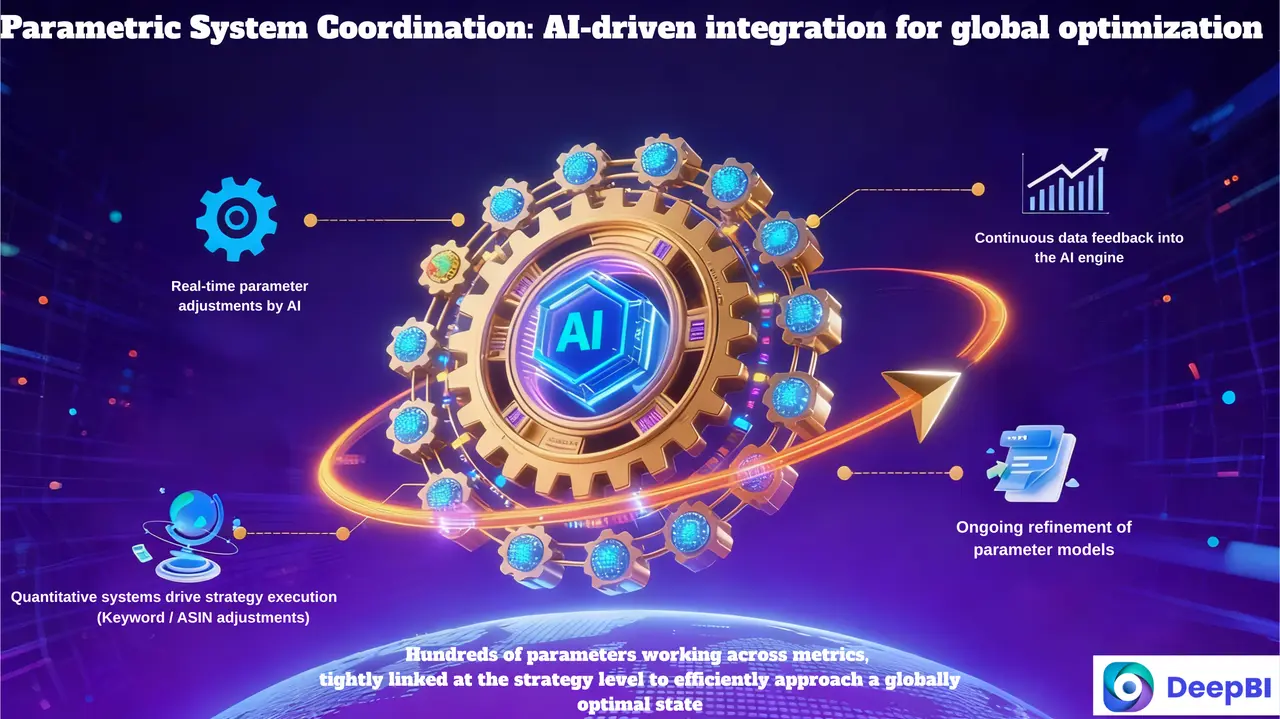
Decisions are not isolated but governed by a parameterized system synergy where 58+ strategies (each with 3-7 core parameters) mutually constrain and iteratively link. The system doesn't make single-variable decisions but optimizes across all constraints simultaneously.
Bidding and Target Management Logic
Bidding decisions are executed through incremental, cent-level adjustments rather than large bid swings. AI adjusts bids with $0.01 precision, ensuring optimal performance without overspending.
Each adjustment accounts for multiple factors, including short-, mid-, and weekly performance trends, while guided by 58+ interlinked strategies, like placement efficiency, inventory constraints, and conversion behavior.
Target management is governed by a multi-strategy decision network that automatically promotes, pauses, or demotes keywords and product targets based on multi-factor 200-300 performance metrics. No single metric determines scale—targets must demonstrate sustained efficiency within the broader scale.
Risk Controls and Adaptive Safeguards
Automation does not come at the expense of control. The system operates within defined financial and operational guardrails to limit downside risk.
Campaigns are reduced to a minimal observational budget ($3 per day) when performance degrades. Inventory-aware logic automatically pauses bids when stock levels ended, and sudden efficiency drops trigger immediate demotion of affected targets.
During peak demand periods, AI adapts to capture available demand while maintaining long-term efficiency thresholds. Once volatility subsides, optimization objectives automatically return to baseline.
Why This Matters
This system-level orchestration—rather than isolated bid adjustments or campaign tweaks—is what allowed the account to scale efficiently while maintaining control over cost.
Results: Week-by-Week Performance
Week 1 (November 14-20, 2025): Learning & Validation Phase
During the initial onboarding week, AI campaigns began generating sales while demonstrating superior efficiency:
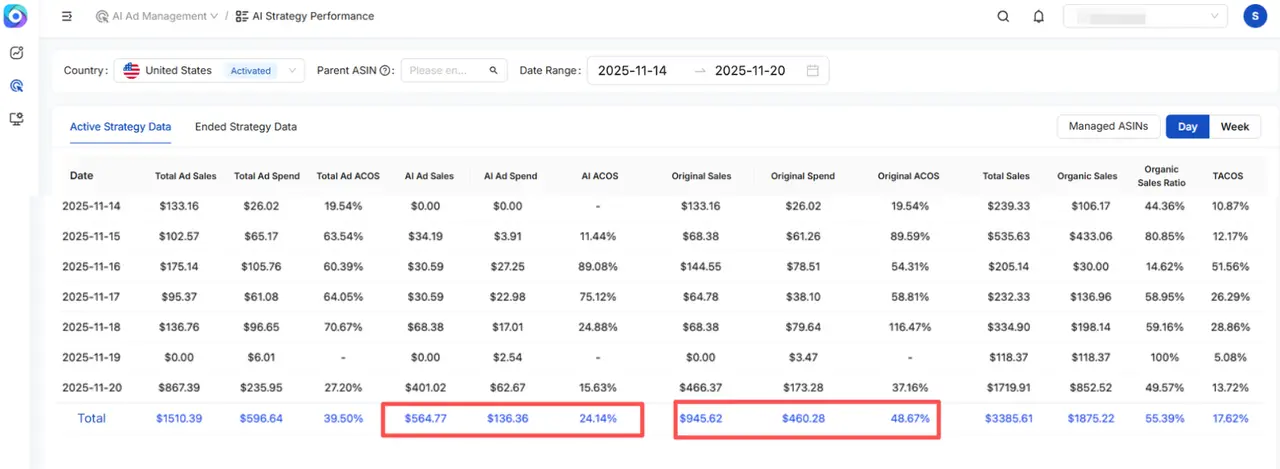
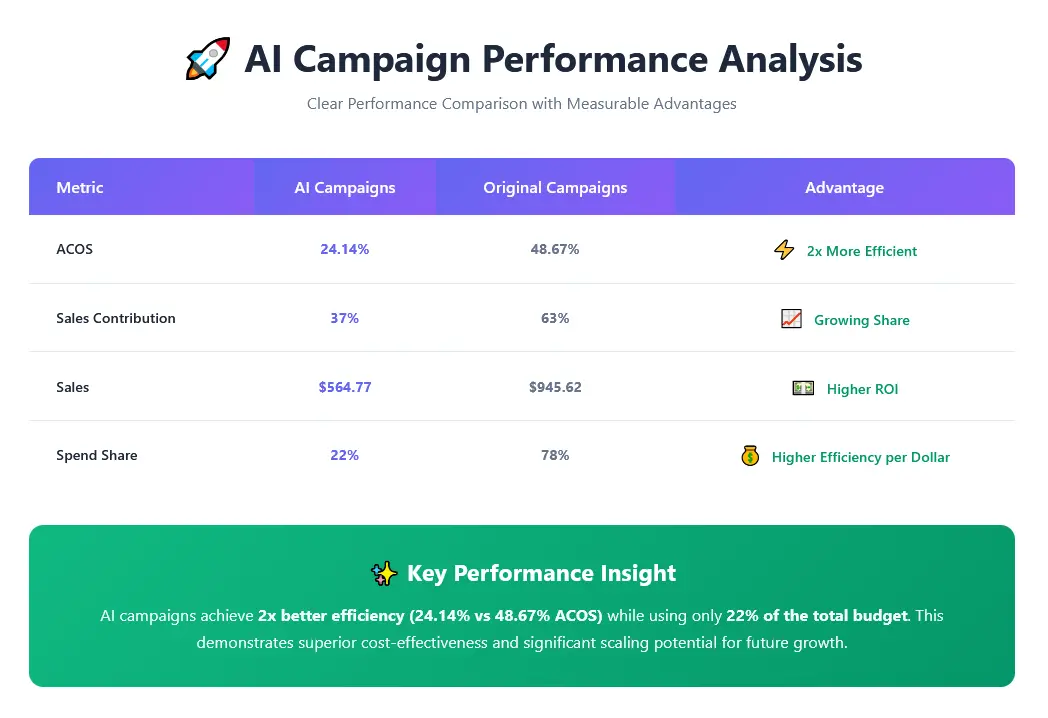
Note: Even in the learning phase, AI campaigns achieved half the ACOS of existing campaigns, proving the algorithm's ability to identify high-converting traffic.
Week 2 (November 21-27, 2025): Black Friday Surge & AI-Driven Performance
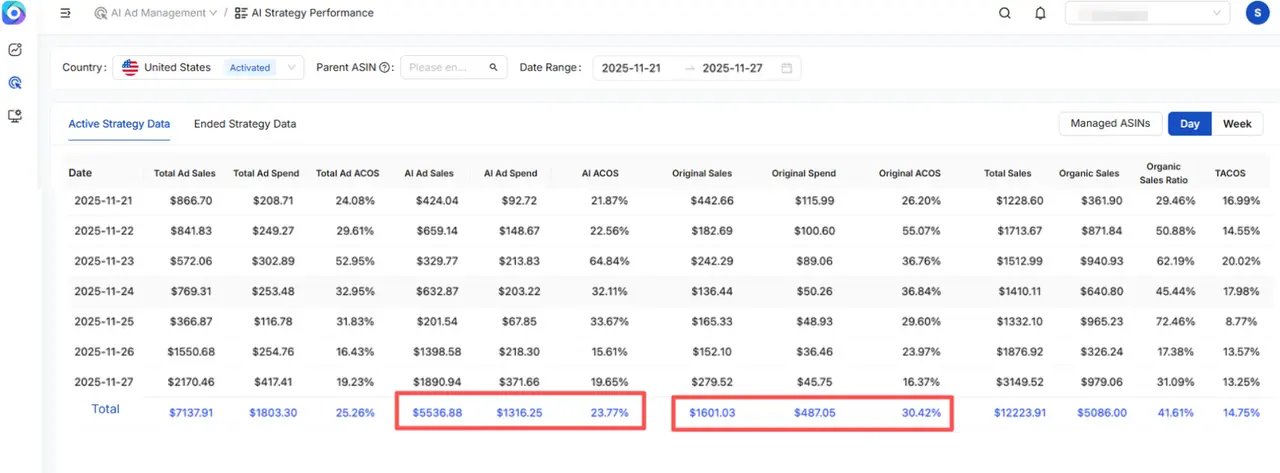
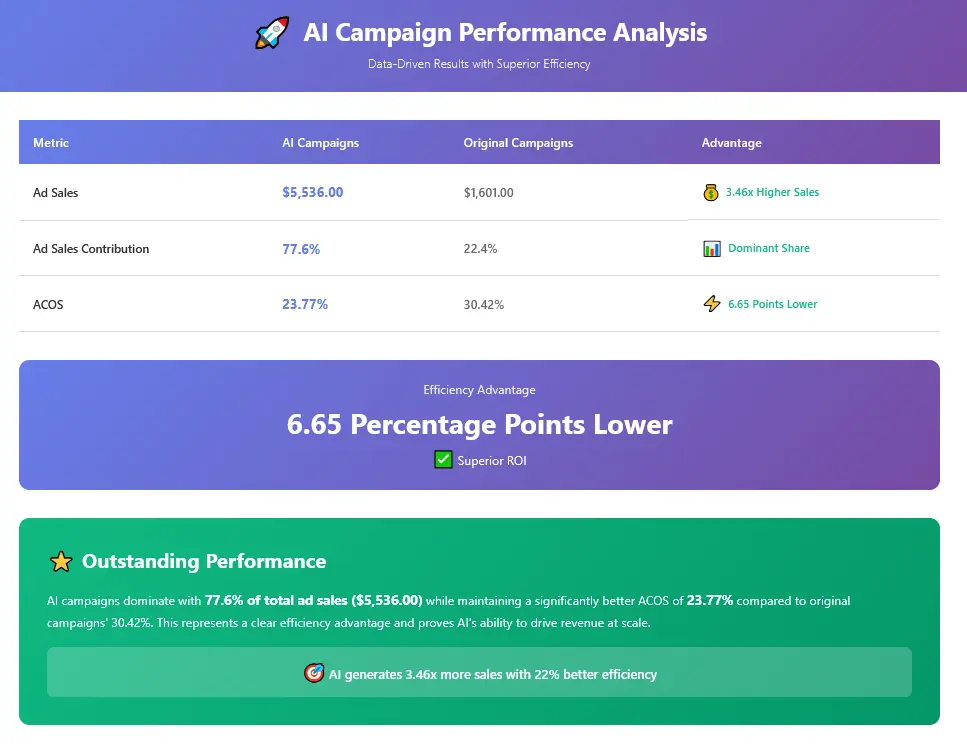
During Amazon's Black Friday promotional period, AI campaigns became the primary sales driver:
Client Feedback:
"Wow, AI has become my advertising backbone!"
Notable Daily Performance:
- November 22: AI ACOS 22.56% vs. Original 55.07% (32+ point advantage)
- November 26: AI ACOS 15.61% vs. Original 23.97%
Outcome: AI successfully handled the high-stakes Black Friday period, maintaining cost discipline while scaling revenue dramatically.
Week 3 (November 28 - December 4, 2025): Peak Efficiency
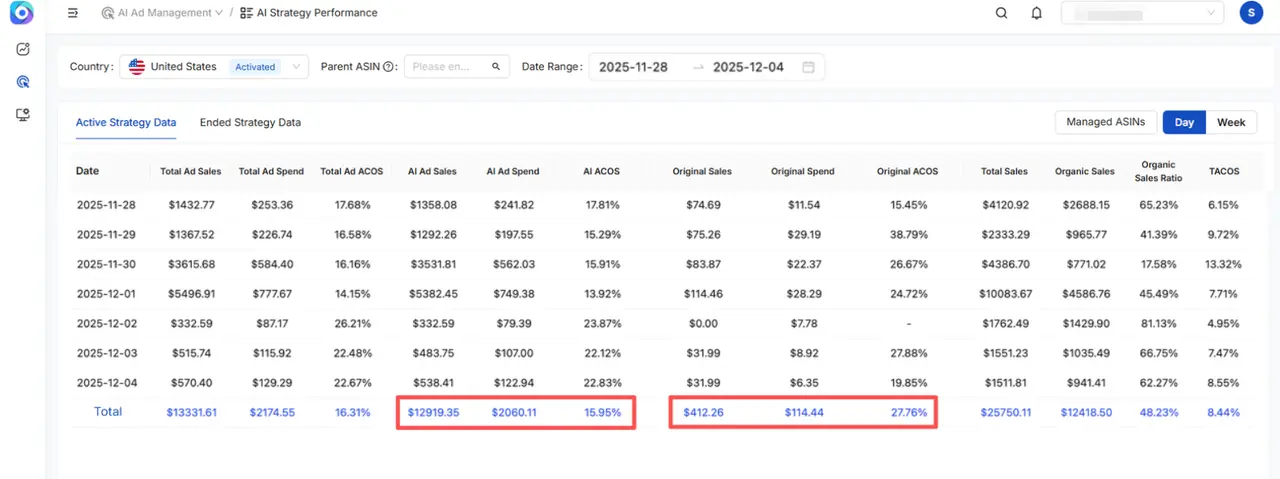
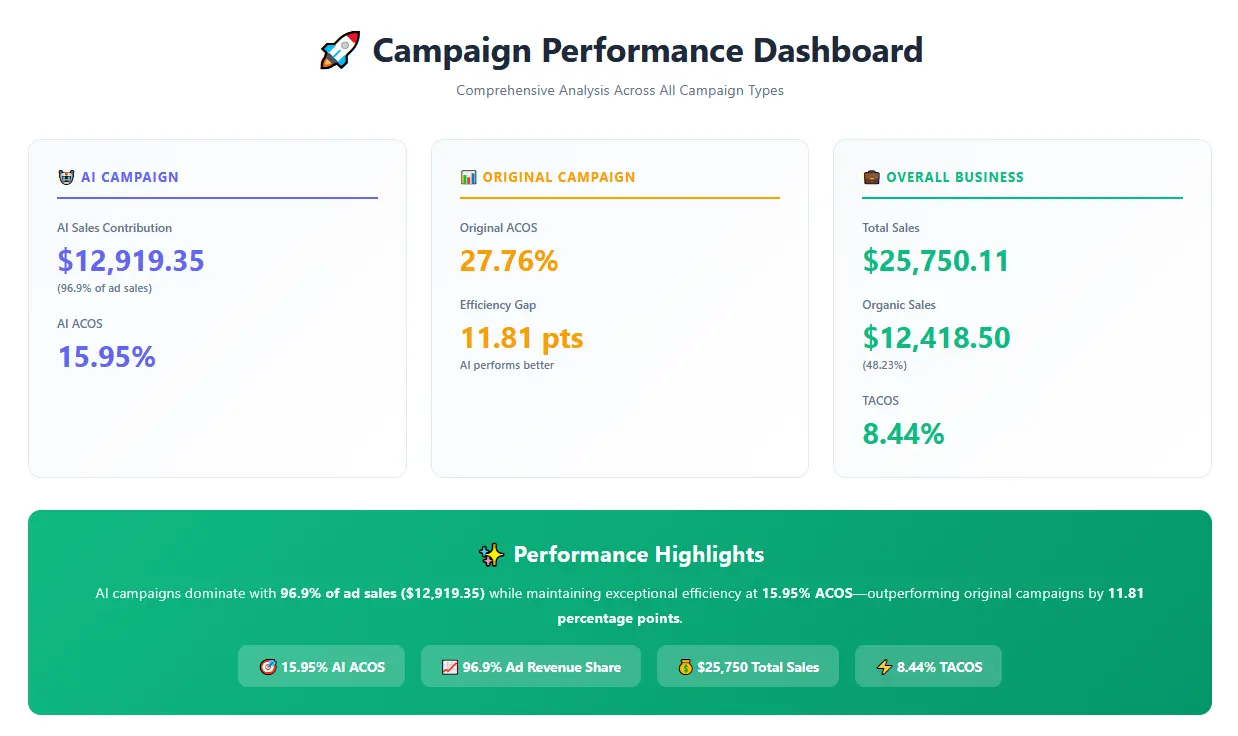
The third week showcased the system's full potential:
Client Feedback:
"Hope every day can be this happy!"
Breakthrough Achievement: AI campaigns now handled virtually all advertising, with ACOS under 16% while organic traffic surged to nearly half of total sales.
Week 4 (December 5-11, 2025): Post-Promotion Stability
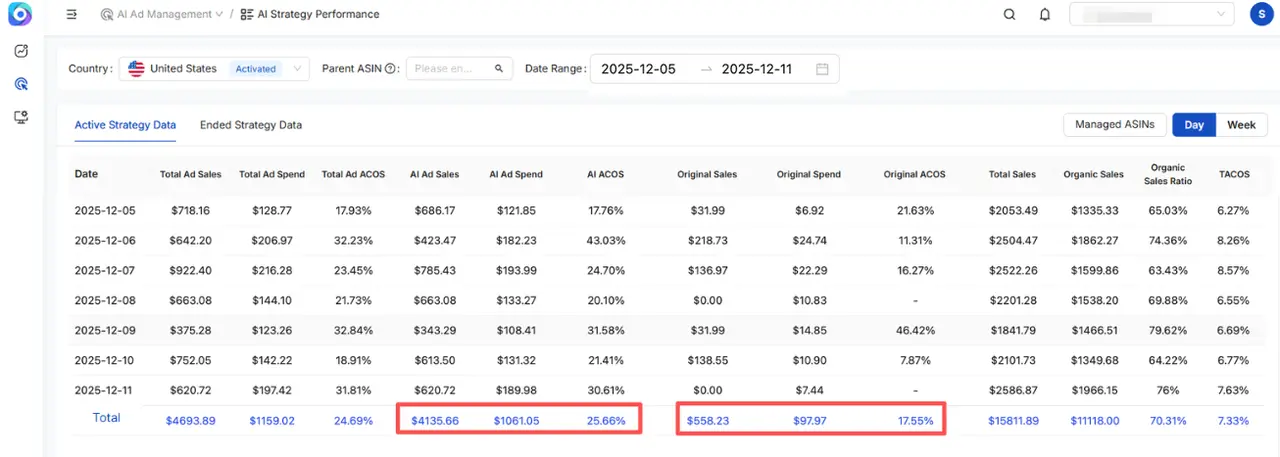
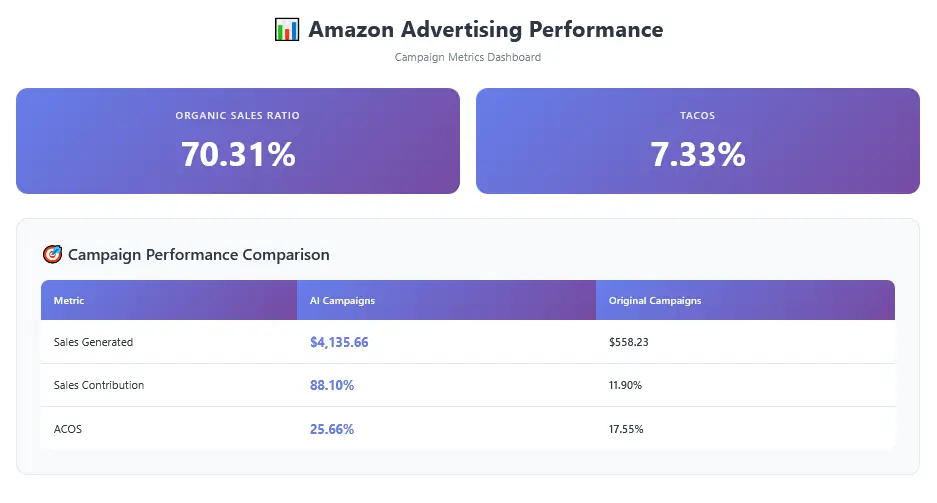
After Black Friday ended, the system demonstrated resilience during market adjustment:
Key Observation:
While ACOS increased slightly post-promotion (normal market behavior), the AI maintained:
- Dominant ad sales share (88%+)
- Healthy overall TACOS (7.33%)
- Strong organic traffic momentum
- Stable performance vs. volatile original campaigns
Note: The original campaigns showed a lower ACOS due to minimal sales, whereas AI campaigns efficiently managed the majority of revenue.
Client Feedback:
"This is earning money!"
Overall Impact: Before vs. After Comparison
Advertising Efficiency Transformation
Revenue Growth
Business Health Metrics
The Transformation: From "Cost Burden" to "Growth Engine"
Value #1: Quantifiable Cost Reduction & Revenue Growth
DeepBI delivered measurable ROI within weeks through its intelligent algorithm:
- Reduced wasted ad spend by 60% (ACOS: 58.57% → 22.99%)
- Enabled 21x sales growth while maintaining profitability
- Proved the "lower cost, higher revenue" promise with hard data
Value #2: Operational Certainty & Stability
The AI system eliminated human operational risk:
- 24/7 autonomous optimization
- Consistent strategy execution across market conditions
- Freed the client to focus on product development and supply chain
- Delivered reliable performance during Black Friday peak demand
Value #3: Sustainable Growth Model
The most profound impact was on business fundamentals:
- TACOS 39.65% → 10.40%: Released 29+ points of margin back to the bottom line
- Organic sales 25.9% → 54.77%: Built self-sustaining traffic momentum
- Created a healthy flywheel:
AI wins Top of Search→ Higher rankings → More organic sales → Improved profitability
Client Testimonial:
"I've never had a more reliable starting point than this."
Why This Matters: Lessons for Amazon Sellers
1. Product Excellence Needs Distribution Excellence
This manufacturer had world-class products but struggled to translate that into profitable Amazon sales. The right technology partner bridged that gap.
2. The Algorithmic Imperative
Amazon is an algorithm-driven marketplace. Long-term success comes from shaping how the algorithm evaluates relevance, conversion, and revenue—not from optimizing individual metrics in isolation. DeepBI is engineered for this purpose, systematically aligning traffic, bidding, and placement decisions to produce favorable outcomes and sustainable growth.
3. Human Operations Have Limits
Managing Amazon campaigns involves tracking hundreds of performance signals across keywords and ASINs. Even experienced teams can struggle to keep up with all the moving parts and react quickly enough. DeepBI's 58+ strategy network monitors 200–300 key metrics on every single keyword and ASIN and makes ongoing adjustments automatically, handling the day-to-day optimization so campaigns stay efficient, responsive, and profitable—without adding extra work for your team.
4. The Organic Traffic Multiplier
By securing Top of Search placements on high-value keywords, DeepBI amplifies ranking signals, turning each dollar of ad spend into sustained organic traffic and high-margin growth beyond paid campaigns.
5. Peak Season Readiness
Black Friday demonstrated that with the right system, peak demand periods become profit accelerators rather than efficiency breakdowns. The AI's pre-emptive logic and constraint-based safeguards turned volatility into opportunity.
6. The Manufacturer's Dilemma Solved
Vertically-integrated manufacturers often struggle with the "last mile" of algorithmic distribution. This case proves that production excellence combined with algorithmic distribution excellence creates unbeatable competitive advantage.
Conclusion: The Future of Amazon Advertising
For this outdoor gear manufacturer, DeepBI served as more than just a software tool—it became the strategic bridge that converted product-side advantages into market-side victories.
In the increasingly competitive landscape of Amazon selling, intelligent automation has become essential infrastructure for sellers who want to:
- Reduce costs through precision targeting
- Increase efficiency with 24/7 optimization
- Focus on core competencies (product, brand, supply chain)
- Build sustainable growth through organic momentum
This case study proves that manufacturers with strong products but weak operational resources can achieve transformational results by partnering with best-in-class advertising intelligence platform.
Learn more
Contact DeepBI for a consultation
Email: support@deepbi.com
Case study data covers October 2025 through December 11, 2025. Client identity protected for confidentiality.