The Strategic Imperative of A+ Content on Amazon
In the hyper-competitive Amazon marketplace, a standard product description is no longer enough to capture customer attention and drive sales. A+ Content has evolved from an optional feature into a critical component of a successful product listing. It provides a powerful platform for brand storytelling, detailed product education, and competitive differentiation, all of which directly influence key performance metrics from traffic to conversion.
Beyond Basic Product Descriptions: Why A+ Matters
A+ Content elevates a product detail page from a simple transactional space into a rich, branded experience. While basic descriptions are limited to plain text, A+ Content allows sellers to deploy a suite of modules—including high-quality images, comparison charts, and detailed text layouts. This multimedia approach enables you to demonstrate product features visually, articulate your brand's unique value, and guide customers through a compelling story. By moving beyond a simple list of features, you can proactively answer customer questions, showcase use cases, and create a memorable impression that sets your product apart from competitors who rely on standard templates.
The Direct Impact on Conversion and Customer Trust
The ultimate goal of A+ Content is to increase conversion rates (CVR) by building customer trust. This trust, however, is fragile and depends on a single, critical principle: authenticity. Content that misrepresents the product—by altering its material, color, or design—may be visually stunning but inevitably leads to a "product-image mismatch." This discrepancy is a primary driver of negative reviews, customer returns, and long-term damage to brand credibility.
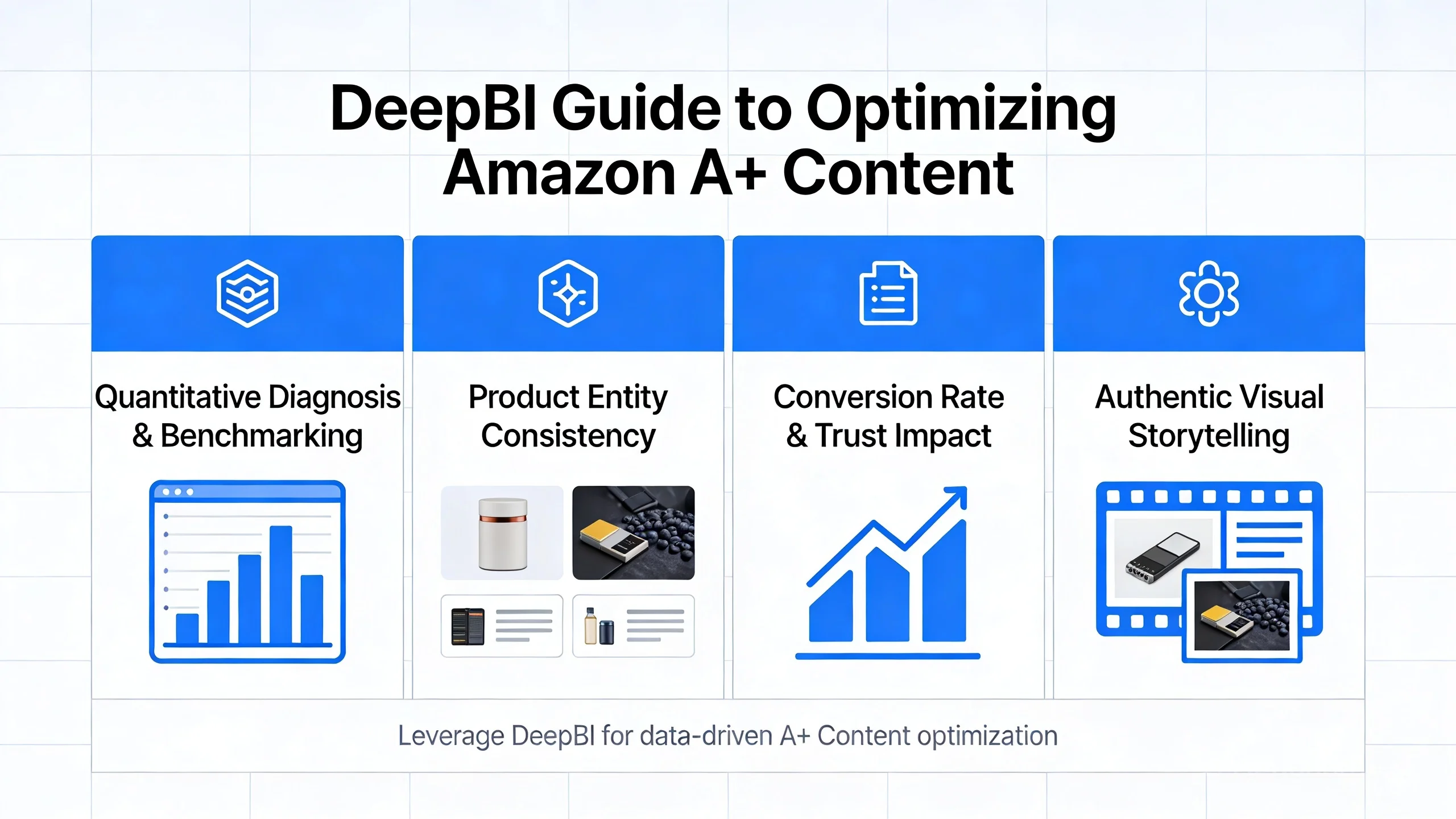
Therefore, the highest principle of optimization is maintaining "product entity consistency." Every image and description within your A+ Content must be an accurate reflection of the physical item. By ensuring that what customers see is exactly what they get, you build foundational trust. This confidence reduces purchase hesitation, directly boosts CVR, and fosters the positive customer experiences that fuel better reviews and a healthier sales velocity.
DeepBI's Approach to A+ Content Optimization: Diagnosis and Benchmarking
Effective A+ Content transforms visual assets from mere aesthetic displays into a commercial engine that drives clicks (CTR) and conversions (CVR). However, traditional optimization often relies on subjective feedback, making it difficult to quantify the impact of visual changes. DeepBI shifts this paradigm by introducing a quantitative method for diagnosing weaknesses and benchmarking performance improvements.
Identifying A+ Content Gaps and Opportunities
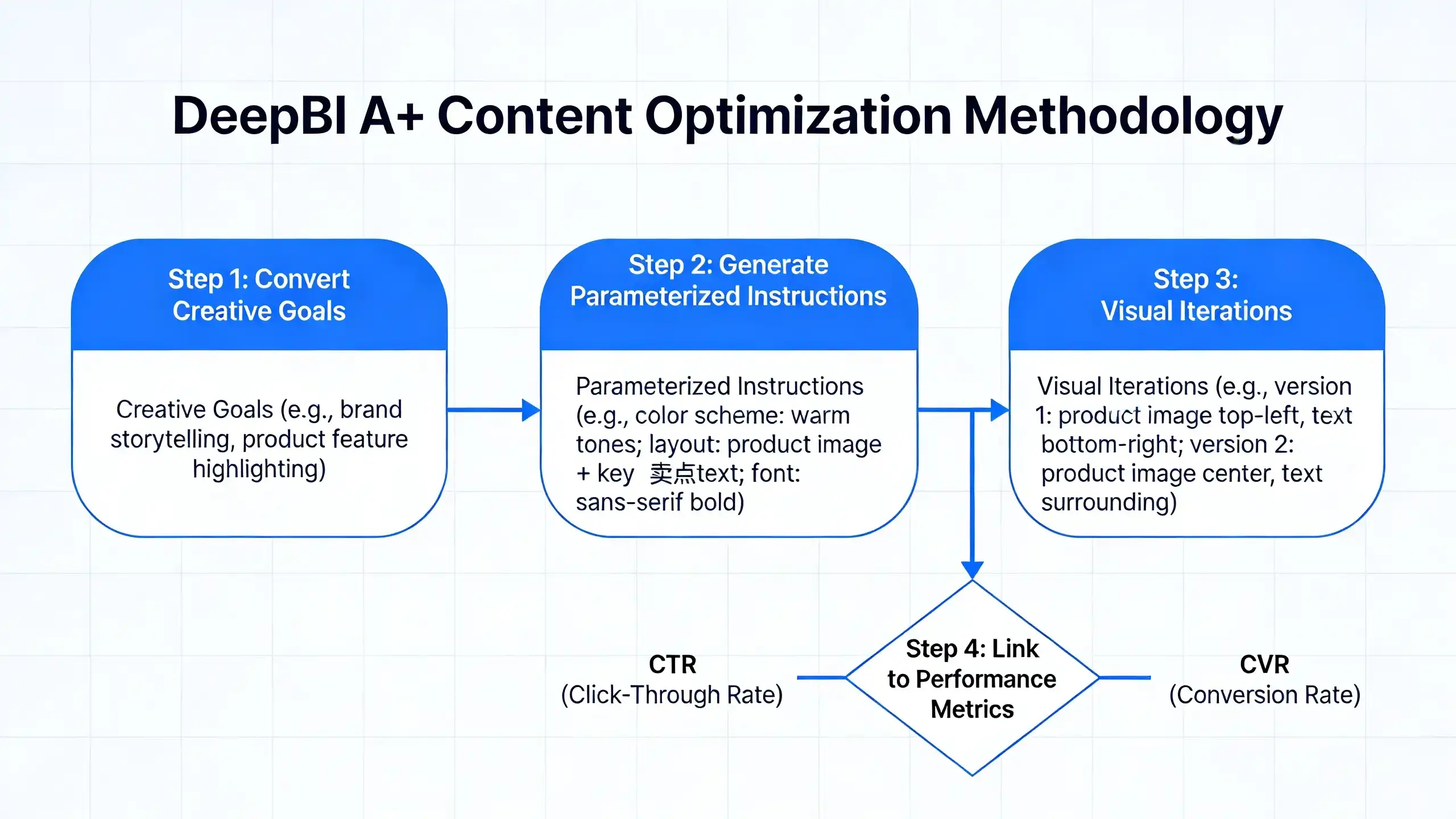
The first step in data-informed optimization is to move beyond ambiguous suggestions. Where manual analysis might yield vague feedback like "improve the texture" or "highlight battery life," DeepBI provides precise, parameterized instructions. It deconstructs creative goals into engineered directives that specify elements like composition, camera angle, light distribution, and scene components.
For example, instead of a generic prompt, the system generates a detailed instruction: "Adjust the image to feature the product centered at 60% scale with a 45-degree side view. Use a warm-toned background and place a high-visual-impact infographic in the bottom-left corner with a 4.5:1 text-to-detail ratio to communicate '12-hour ultra-long journey'." This process turns abstract strategy into concrete, executable tasks for designers or AI tools.
Competitive Analysis and Best Practices with DeepBI
Quantifying the business impact of visual updates is a primary challenge for sellers. DeepBI solves this by creating a direct feedback mechanism between content changes and advertising performance. When a new A+ content module or image is published, the system automatically marks a "visual iteration event point" within your DeepBI advertising reports.
This marker allows you to clearly observe how changes to your A+ content affect your ASIN's Click-Through Rate (CTR) and other key metrics in the following 7–14 days. By linking execution to measurement, you can replace subjective judgment with an empirical approach, building a repository of best practices based on what demonstrably works for your products and audience.
Crafting High-Converting A+ Content Modules
Effective A+ Content is not a single block of information but a collection of strategic modules, each designed to address a specific customer need and guide them toward a purchase. Optimizing each component individually can significantly lift overall engagement and conversion rates.
Visual Storytelling: Optimizing Images and Videos
Visuals must do more than just display the product; they must tell an authentic and compelling story. Relying on general-purpose AI tools for creative visuals is risky, as they are prone to "AI hallucinations" that may generate images inconsistent with the actual product, thereby eroding customer trust. A superior approach is to use an automated visual production system strictly constrained by the product's core attributes, or its "Product DNA." This ensures every image and video is a faithful representation of the product's features, use cases, and quality. This methodology translates business strategy into executable design blueprints, guaranteeing the brand consistency and product authenticity crucial for improving CVR.
Compelling Copy: Structuring Text for Engagement and SEO
Text in A+ Content should be scannable, persuasive, and optimized for search. A powerful technique is to deconstruct the content into logical modules, each with a clear purpose. For instance, bullet points can be restructured from a simple feature list into a compelling "pain point-solution" format. This self-contained structure directly addresses customer problems and presents your product as the definitive answer, making the value proposition immediately clear. This approach not only enhances readability but also strategically embeds relevant keywords in a natural, solution-oriented context, improving your listing's visibility.
Leveraging Comparison Charts and Brand Story Modules
Comparison charts are a high-impact tool for simplifying a buyer's decision-making process. Use them to clearly differentiate your product from competitors or to showcase variations within your own product line, guiding customers toward the best option for their needs. This reduces purchase friction and can be an effective upselling tool. Meanwhile, Brand Story modules build a deeper, emotional connection with shoppers. Use this space to communicate your brand's mission, values, and heritage. A compelling brand narrative differentiates you from commodity sellers, fosters loyalty, and can justify a premium price point.
Adherence to Amazon's A+ Content Guidelines
Creating compelling A+ Content is only half the battle; ensuring it meets Amazon's strict guidelines is critical to getting it published and preventing negative business outcomes. Non-compliance can lead to immediate content rejection, delaying your listing updates and impacting your go-to-market speed.
Prohibited Content: What to Avoid
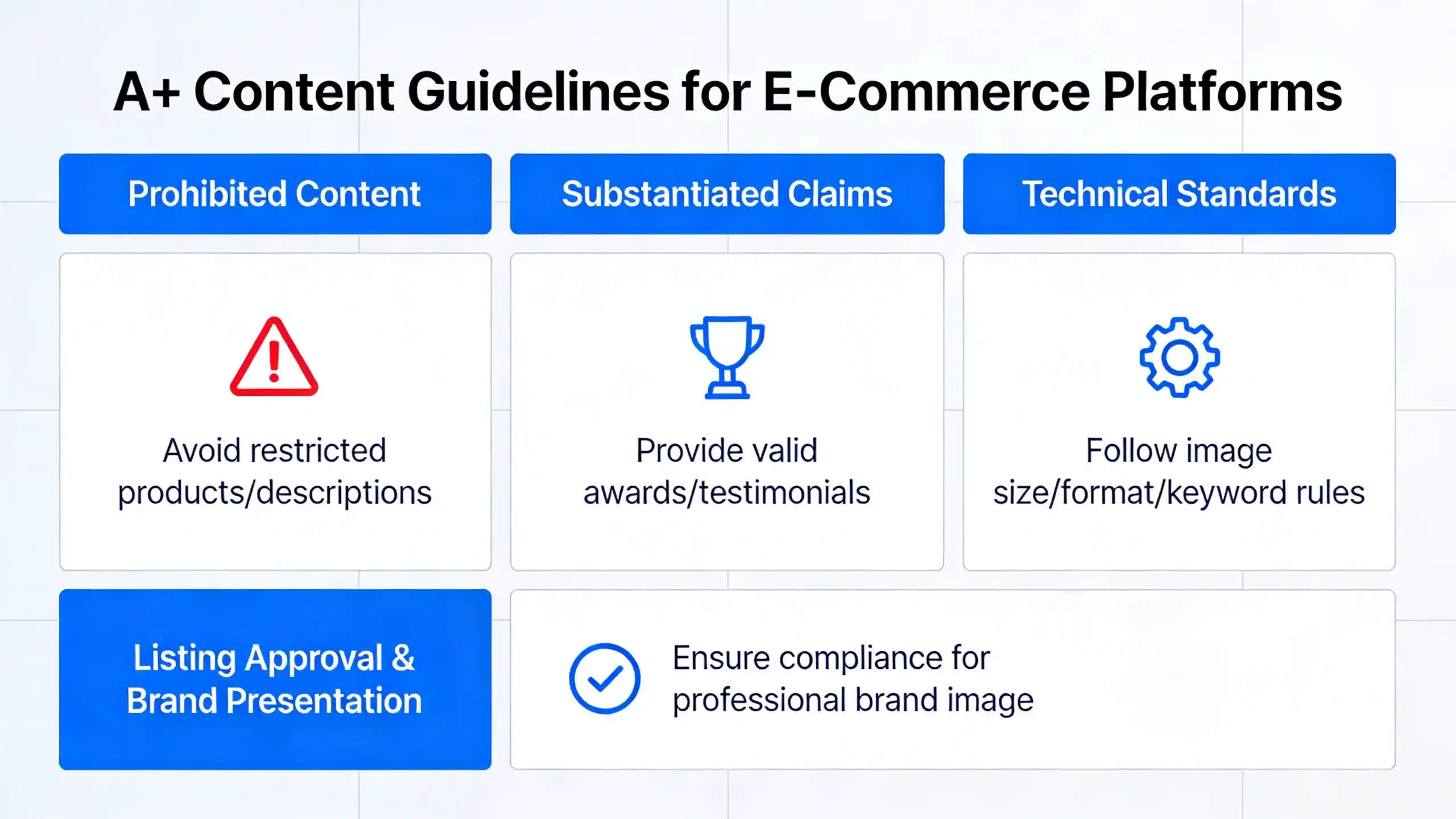
Amazon's platform automatically blocks content that violates its mandatory standards. To avoid rejection, steer clear of including:
- Pricing, promotional information, or time-sensitive language (e.g., "on sale," "best price").
- Links or directions to external websites or other purchasing channels.
- Customer reviews, quotes from third-party sources, or editorial content without proper verification.
- Guarantees or warranties beyond what is offered through Amazon.
- Any content that misrepresents the product, as this can lead to negative customer reviews, increased return rates, and damage to your brand's reputation.
Substantiating Claims: Awards, Certifications, and Testimonials
All claims made within your A+ Content must be truthful and verifiable. If you reference awards or certifications, you must include the date they were awarded and the name of the issuing body. Vague claims like "award-winning" without substantiation will be rejected. Similarly, any testimonials or endorsements must come from well-known publications or public figures and require clear attribution, including the author and publication. This transparency builds trust with customers and ensures compliance with Amazon's policies against misleading information.
Formatting Best Practices for Readability and Compliance
Beyond prohibited content, your A+ modules must adhere to technical and brand standards. Amazon enforces specific requirements for image dimensions, resolution, and file types. Furthermore, maintaining brand consistency is crucial. Strictly adhere to your established brand identity system, including logos, fonts, and color schemes, to present a professional and unified brand front. Using clear headings, concise text, and a logical flow of modules not only improves readability and customer experience but also helps your content pass Amazon's review process more smoothly.
Measuring and Iterating A+ Content Performance
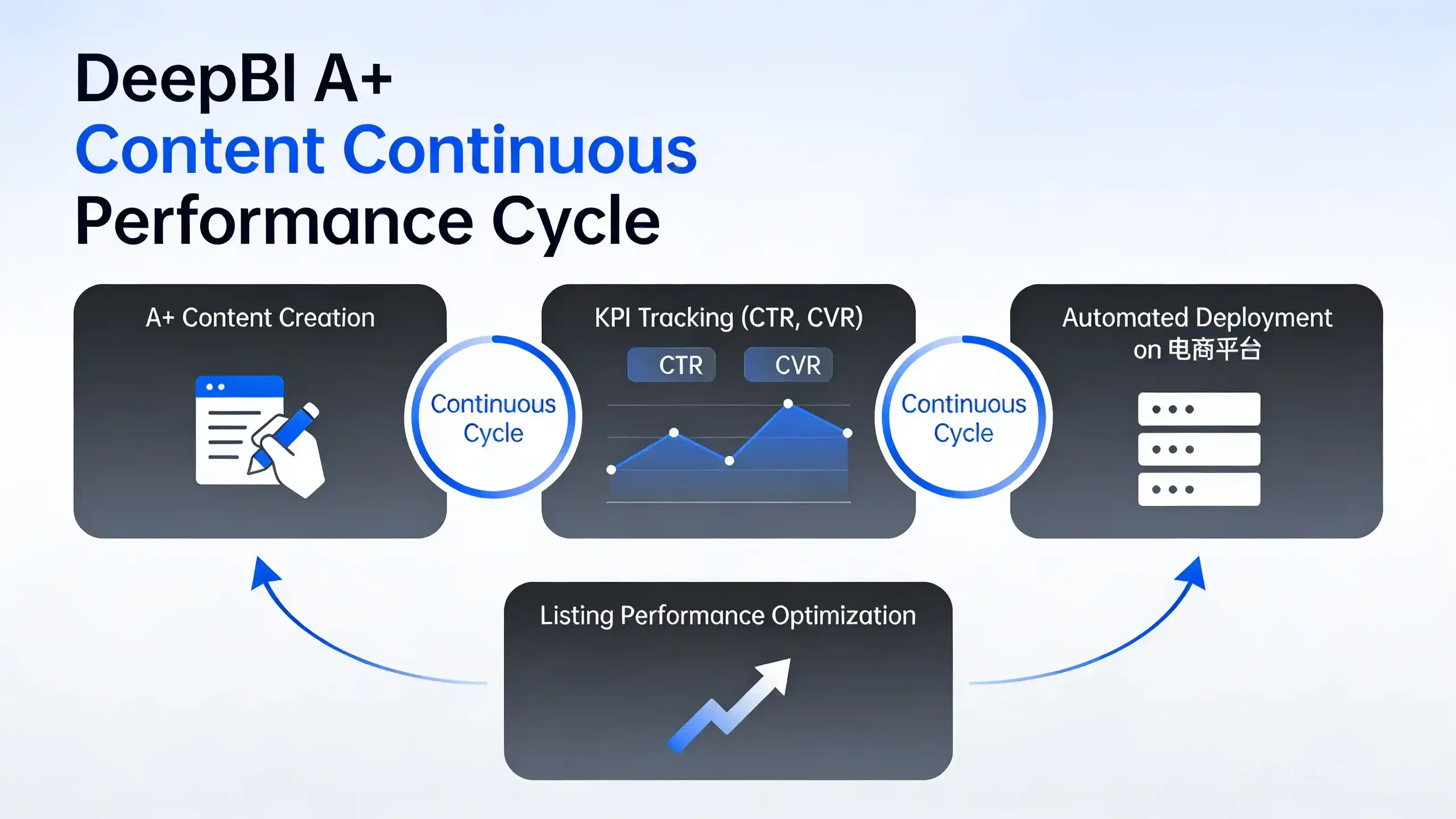
Creating and publishing A+ Content is not the end of the optimization journey; it is the beginning of an iterative performance cycle. To truly enhance product performance, you must measure the impact of your content and refine it based on performance data. This process of continuous improvement is what separates top-performing listings from the rest.
Key Metrics for A+ Content Success
The effectiveness of A+ Content is not subjective. It can be quantified by tracking its influence on key performance indicators (KPIs). The primary goal is to determine if your new content modules are improving customer engagement and driving sales. The most critical metrics to monitor before and after a content update include:
- Conversion Rate (CVR): A primary indicator of whether your A+ Content is effectively communicating value and persuading customers to purchase.
- Click-Through Rate (CTR): While more associated with main images and titles, enhanced content can contribute to brand recall and influence repeat traffic and related product clicks.
- Unit Session Percentage: This metric, closely related to CVR, shows the percentage of sessions that resulted in a sale, providing a clear view of your listing's persuasive power.
DeepBI's Role in Performance Monitoring and Iteration
DeepBI refines the optimization process into a structured, closed-loop system of "diagnosis to delivery." After you publish new visual assets, the system automatically tags the event within your advertising and business reports. This function allows you to precisely correlate content changes with shifts in metrics like CTR and CVR, providing clear evidence of what is working.
Furthermore, rapid iteration is impossible when deployment is a bottleneck. The traditional manual process—downloading assets, renaming files, and uploading them one by one in Seller Central—can take over 30 minutes and introduces security risks. DeepBI’s One-Click Apply module automates this entire workflow using the official SP-API. This reduces a time-consuming operation to mere seconds, eliminating process friction and enabling you to test and deploy optimized content at a pace that matches market demands.
Integrating A+ Content with Your Overall Amazon Strategy
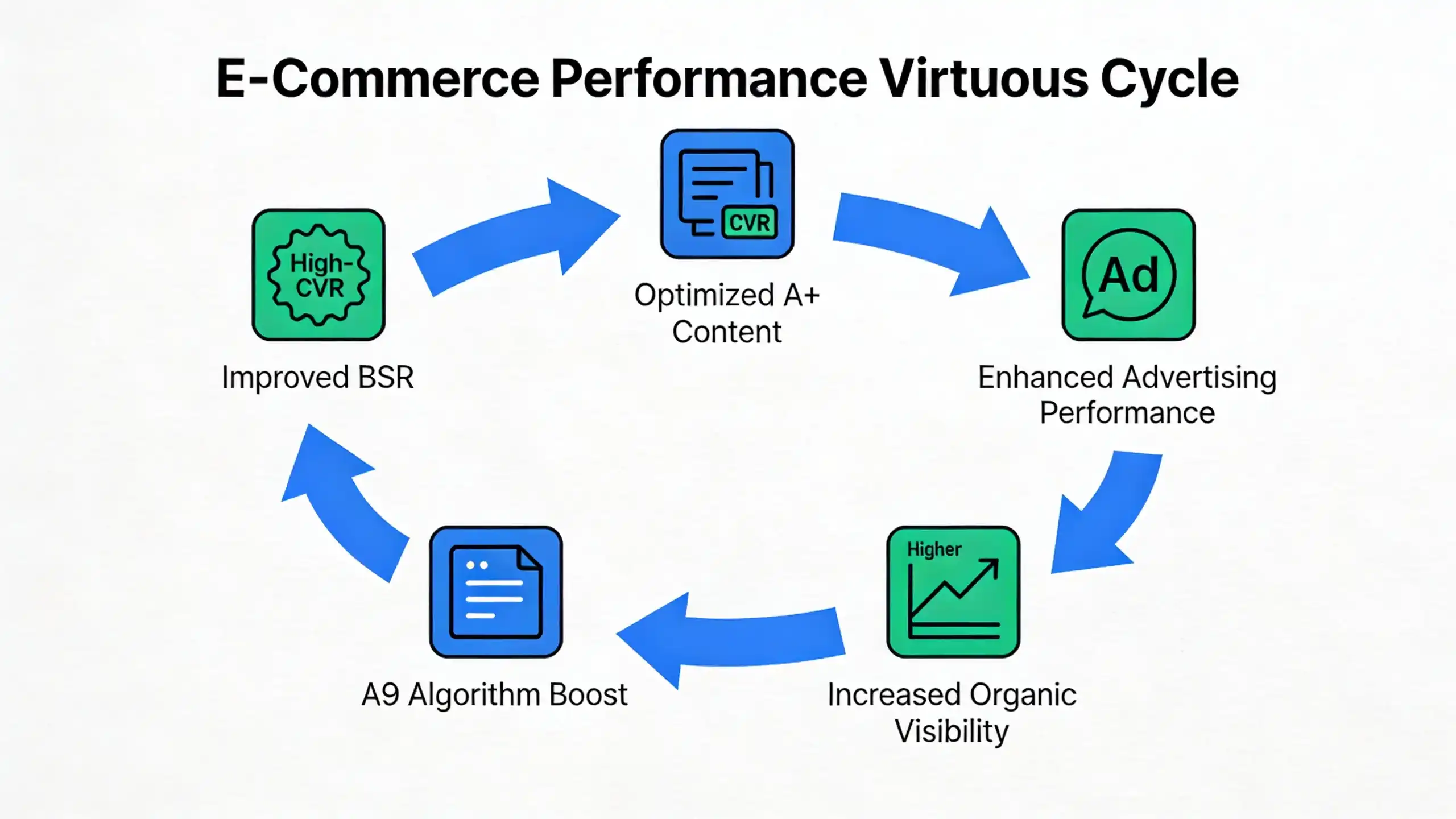
Optimized A+ Content does not function in isolation; it creates powerful synergistic effects across your entire Amazon presence. Viewing A+ Content as a standalone creative exercise misses its primary function as a strategic driver of conversion, which directly impacts both paid advertising performance and organic search visibility. By unifying your content, advertising, and SEO strategies, you can unlock a virtuous cycle of growth.
A+ Content's Synergy with Advertising Performance
High-quality A+ Content is essential for maximizing the return on your advertising spend. When a customer clicks on your Sponsored Products or Sponsored Brands ad, they are sent to your product detail page. At this critical moment, a compelling A+ layout acts as your final, most persuasive salesperson. By effectively communicating value, addressing potential purchase barriers, and showcasing the product's benefits, A+ Content significantly increases the page's conversion rate (CVR).
A higher CVR on ad-driven traffic sends a strong positive signal to Amazon's advertising algorithm, which can lead to a lower Advertising Cost of Sale (ACoS) as your ads become more profitable per click. Furthermore, by analyzing ad campaign data, sellers can identify which features or benefits resonate most with customers. These insights can then be used to refine A+ Content, creating a performance-driven cycle of ongoing improvement.
Boosting Organic Visibility Through Enhanced A+ Content
Your product's organic ranking on Amazon is heavily influenced by its sales velocity. Because A+ Content improves CVR, it directly translates into more sales from the same amount of traffic. This increase in sales velocity can improve your product's Best Sellers Rank (BSR) and signal to Amazon's A9 algorithm that your listing is highly relevant and satisfying to customers.
As the algorithm rewards your product with higher organic search positions, you receive more visibility and "free" traffic. This additional organic traffic, when met with a high-converting A+ page, generates even more sales. This positive feedback loop—where better content drives sales, which in turn drives a higher ranking and more traffic—is fundamental to achieving sustainable growth. Integrating A+ Content optimization into your core SEO strategy is therefore essential.
Future-Proofing Your A+ Content Strategy
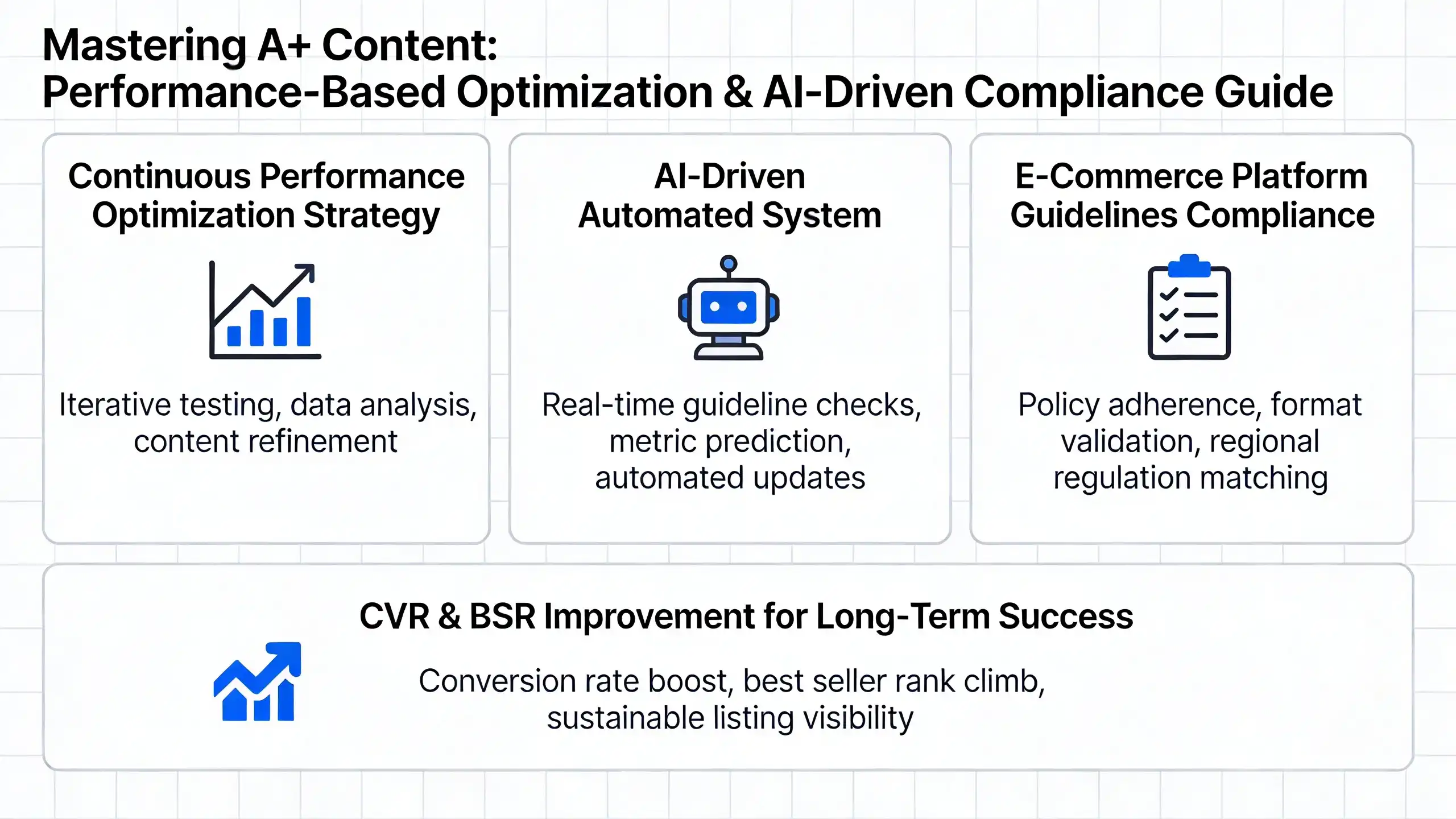
Mastering A+ Content is not a one-time project but a continuous process of optimization. To maintain a competitive edge, your strategy must be agile and forward-looking, prepared to adapt to both market shifts and platform evolution. Long-term success lies in moving beyond static content creation and embracing a dynamic, performance-based approach.
Continuous monitoring is non-negotiable. Amazon’s guidelines—from image pixel dimensions to title character limits—are subject to change, and non-compliance can lead to listing suppression. Beyond compliance, you must constantly analyze performance data to understand how your content impacts key metrics like Conversion Rate (CVR) and Best Seller Rank (BSR).
This is where intelligent automation becomes a strategic asset. The goal is to build an end-to-end optimization system that unifies market diagnosis, content planning, production, and performance analysis. Rather than relying on simple scoring tools, a future-proof strategy leverages an automated market health check system. This approach is not about creative whims; it is an automated production process driven by rigorous data, constrained by business strategy, and executed by AI. By embedding principles of data authenticity and product consistency into this system, you ensure your A+ Content remains effective, compliant, and powerful for years to come.