Understanding Amazon CTR: The Gateway to Sales
On Amazon, getting shoppers to notice your product is only the first step. The critical next step is convincing them to click. This is where Click-Through Rate (CTR) becomes a pivotal metric, acting as the primary gateway between visibility and sales.
What is Click-Through Rate (CTR)?
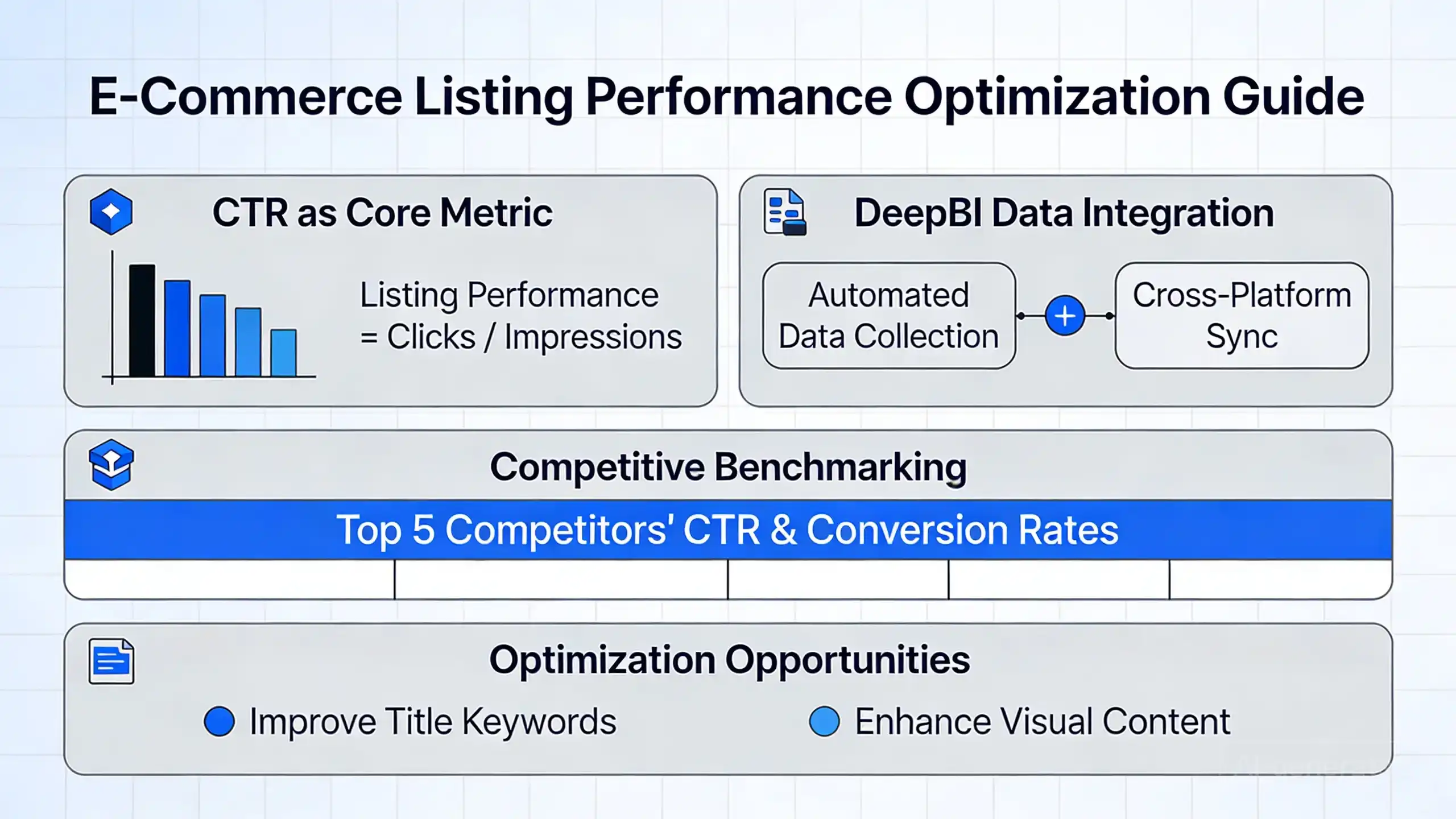
Click-Through Rate is a simple yet powerful metric that measures the effectiveness of your product listing at capturing shopper interest. It is calculated by dividing the total number of clicks your listing receives by the total number of times it was shown (impressions).
CTR = (Total Clicks / Total Impressions) x 100%
A higher percentage indicates that your listing's main image, title, price, and review rating are compelling enough to make shoppers want to learn more.
Why Amazon CTR is a Critical Metric
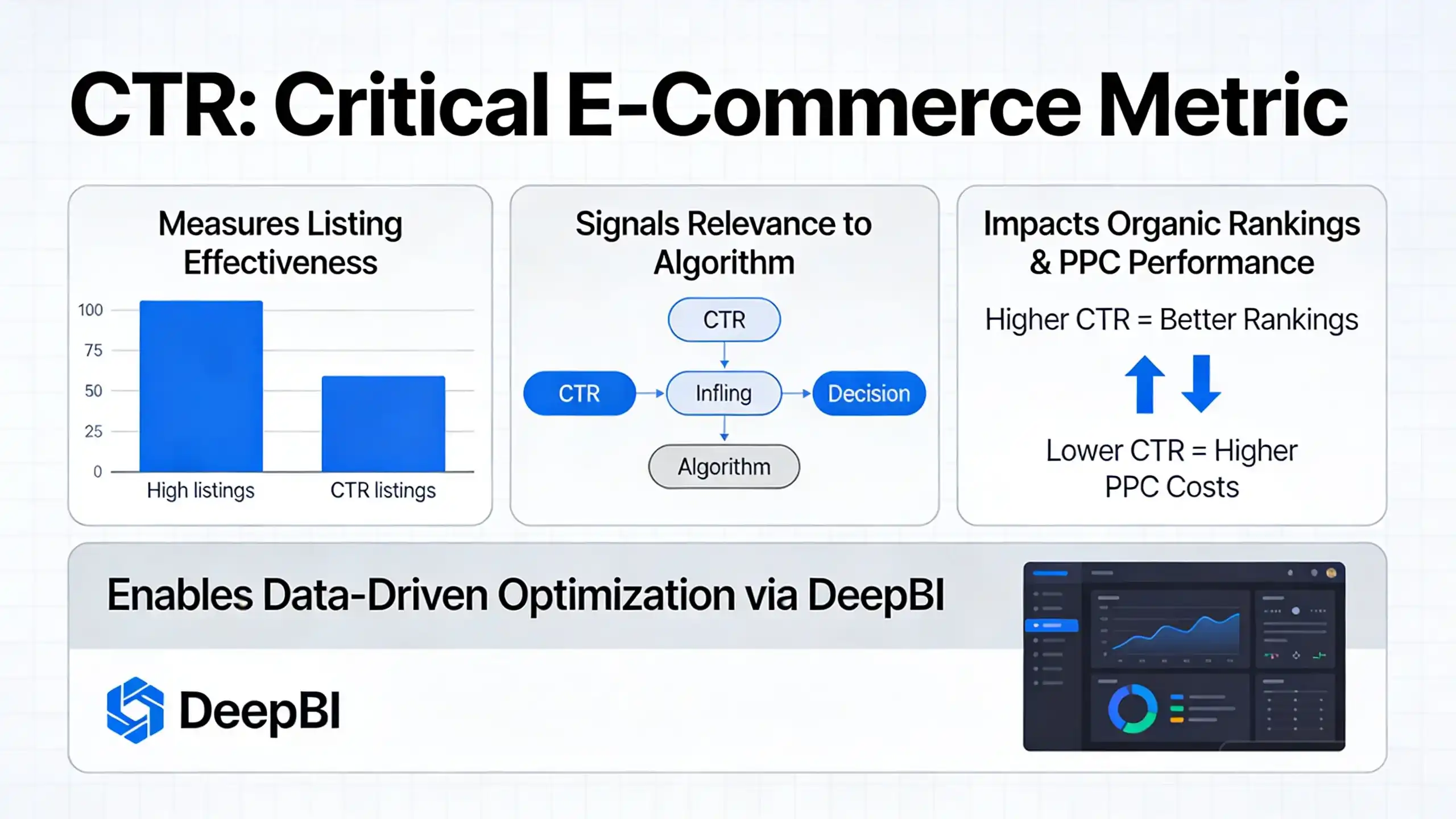
Beyond a simple performance indicator, CTR is a direct signal to Amazon about your product's relevance and appeal. In the hierarchy of Amazon metrics, CTR is arguably second only to the final conversion rate. A strong CTR tells Amazon’s algorithm that when your product is shown to customers, they find it to be a compelling match for their search. This validation is fundamental to gaining traction and momentum in the marketplace. It transforms your listing's visual and textual elements from mere 'aesthetic displays' into a 'core commercial engine' that actively drives traffic.
How CTR Impacts Organic Rankings and PPC Performance
CTR has a significant and direct influence on both your organic visibility and the efficiency of your advertising campaigns.
- Organic Rankings: Amazon's A9 algorithm prioritizes products that shoppers are more likely to click on and purchase. A higher CTR signals that your product is highly relevant to specific search queries, which can boost your organic ranking. This creates a powerful positive feedback loop: better ranking leads to more impressions, which, with a strong CTR, results in more clicks and sales, further solidifying your position.
- PPC Performance: In Pay-Per-Click (PPC) advertising, CTR is a key factor in determining your ad's performance and cost. A high CTR can lead to a better ad placement and a lower Cost-Per-Click (CPC), stretching your advertising budget further. Conversely, a low CTR signals to Amazon that your ad is not relevant, which can result in fewer impressions and higher costs.
Traditionally, optimizing the visual elements that drive CTR has relied on subjective judgment, making it difficult to quantify the business impact. However, advanced systems like DeepBI create a data-driven feedback loop. When a new image is published, the system automatically tags this event in your ad reports. This allows you to directly observe the impact on your ASIN's CTR over the following 7-14 days, moving your optimization strategy from guesswork to a quantifiable, data-driven process.
 Calculating and Benchmarking Your Amazon CTR
To optimize your listing's performance, you first need to understand how to measure and evaluate it. Click-Through Rate is the primary KPI for gauging how effectively your product captures shopper attention in search results.
The Formula: How Amazon CTR is Calculated
Click-Through Rate measures the percentage of shoppers who see your product and proceed to click on it. The calculation is simple and universal:
CTR = (Total Clicks / Total Impressions) x 100%
A higher CTR indicates that your main image, title, price, and review rating are successfully compelling customers to learn more, directly impacting your traffic and sales potential.
Where to Find Your CTR Data on Amazon
Amazon provides CTR data across several different reports, which can make it challenging to get a complete picture of your performance. You can find your metrics in these key locations:
- PPC CTR: Your advertising CTR is located in the Amazon Advertising Campaign Manager for all sponsored campaigns.
- Organic CTR: Your organic search CTR is available within the Search Query Performance Report and Brand Analytics dashboards.
Manually pulling and consolidating these reports is time-consuming. This is why advanced analytics platforms are critical; they connect to your store's SP-API to unify this data automatically.
What Constitutes a "Good" Amazon CTR?
While performance varies significantly by category, general benchmarks can provide a starting point. A PPC CTR between 0.3% and 0.5% is often considered acceptable, while a strong organic CTR might be 2-3% or higher.
However, these figures are meaningless without context. A seller might discover their CTR is consistently below the category average, signaling an urgent need for optimization. Instead of relying on generic benchmarks, tools like DeepBI function as an automated market health check. By integrating data from all sources, DeepBI provides a unified diagnostic view, benchmarking your performance against direct competitors in your specific market to reveal true optimization opportunities.
 Optimizing Your Listing Content for Higher CTR
Every element of your listing visible on the search results page is a lever for improving your Click-Through Rate (CTR). Optimizing these components is not just about aesthetics; it's about strategically persuading a shopper to choose your product over a competitor's.
Crafting Compelling Titles and Bullet Points
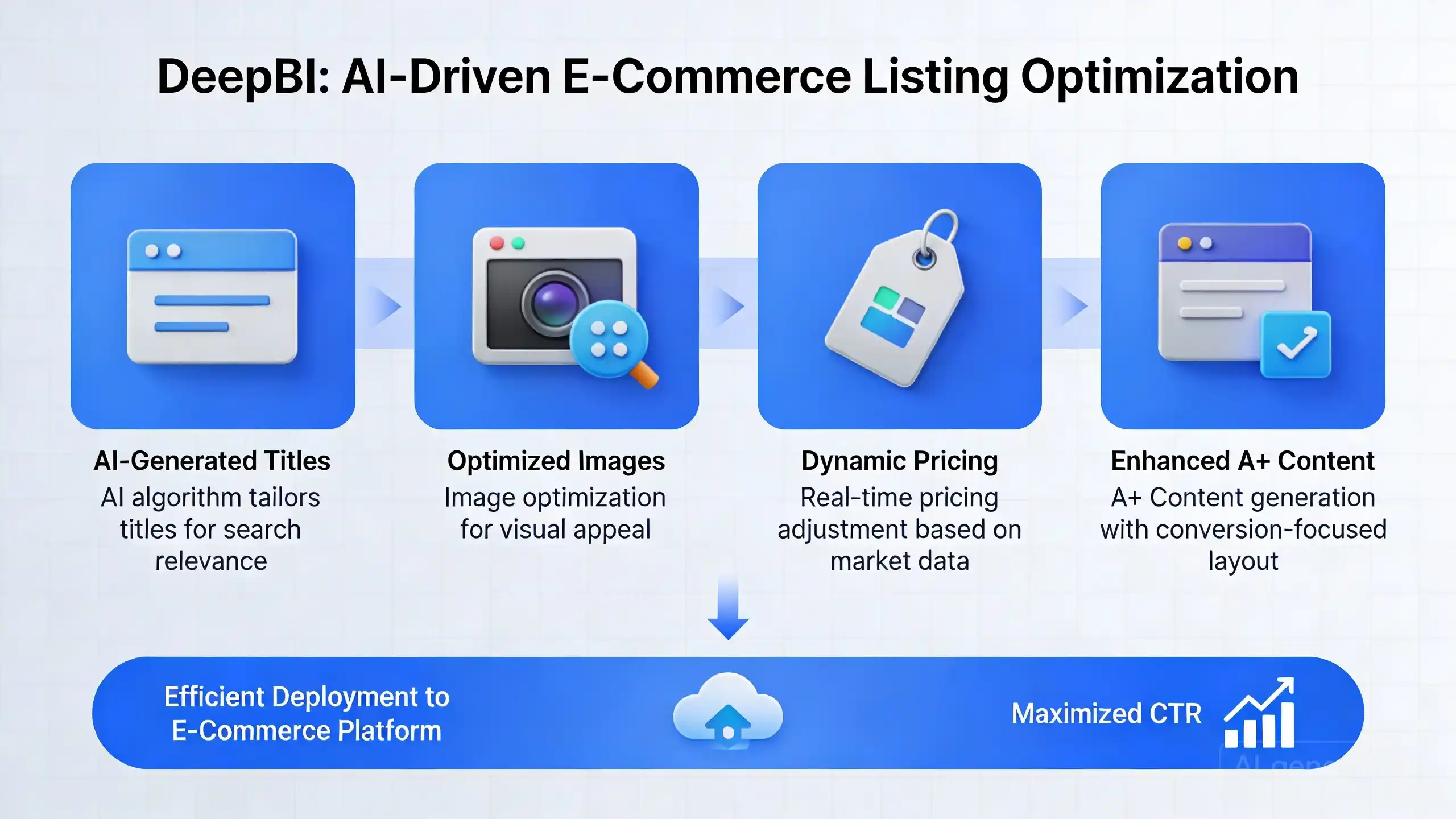
Your title and bullet points are your primary textual pitch. A high-CTR title immediately answers a shopper's search query with relevant keywords while also highlighting a unique selling proposition (USP). Front-load the most critical information, as mobile views often truncate longer titles. Bullet points should be scannable, benefit-driven, and reinforce the value promised in the title. Tools like DeepBI's ModuleListing can intelligently score your existing text, benchmark it against top-performing competitors, and leverage AI to generate optimized versions that are engineered to attract clicks.
The Power of Your Main Image: Visuals That Convert
The main image is arguably the single most important factor influencing CTR. It must be high-quality, clear, and instantly communicate the product's purpose and value. When choosing your visual approach, consider a balanced perspective. High-quality renderings are excellent for products where precise control over visual elements is paramount or for showcasing variations. However, for products where authenticity and texture are key selling points, high-quality real product photography can build greater trust. A hybrid strategy often proves most effective.
Advanced tools can now automate visual production, but this introduces risks. General-purpose AI can create "hallucinations" that alter a product's design, leading to customer complaints about "image-product mismatch." DeepBI mitigates this by first creating a "Product DNA" map, ensuring its AI generation adheres strictly to the principle of 'product entity consistency.' This allows for powerful visual optimization without sacrificing authenticity.
Strategic Pricing: The Psychological Edge
Price is a powerful signal. A price that is significantly higher or lower than the competition can deter clicks before a shopper even considers your product's features. Employ psychological pricing strategies, such as ending prices in .99, to create a perception of value. More importantly, conduct continuous competitive analysis to ensure your pricing is aligned with market expectations for your product category and quality, making it an attractive proposition in a crowded search result.
Leveraging A+ Content and Enhanced Brand Content
While A+ Content is not directly visible on the search results page, its presence is often indicated and signals a professional, trustworthy brand. Shoppers who recognize this may be more inclined to click, anticipating a more detailed and credible product page. Optimizing your A+ Content is therefore an indirect but valuable way to enhance your listing's overall appeal. DeepBI can diagnose and help generate compelling A+ layouts, and its one-click application via the Amazon SP-API allows you to deploy all these listing updates—from titles to images to A+ content—in seconds, drastically reducing your listing optimization cycle time.
 Boosting CTR in Your Amazon Advertising Campaigns
A high Click-Through Rate (CTR) in your Amazon advertising campaigns is a powerful signal to Amazon's algorithm that your ads are relevant and engaging. This relevance is rewarded with better ad placements, a higher impression share, and often a lower Advertising Cost of Sales (ACoS). Achieving a high CTR requires a multi-faceted approach that combines precise targeting, compelling creative, and strategic bidding.
Keyword and ASIN Targeting for Ad Relevance
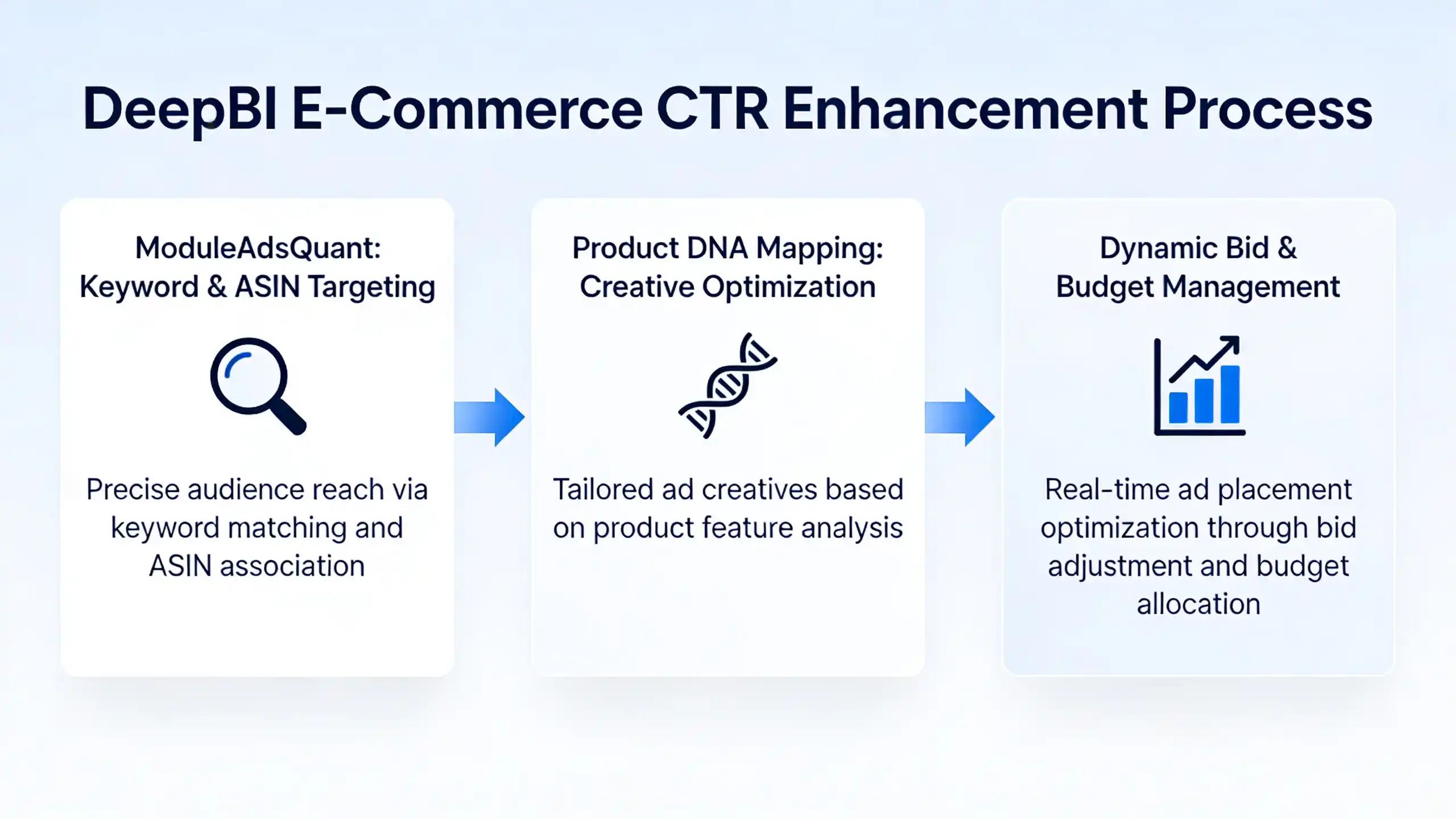
The foundation of a high CTR is showing your ads to the right shoppers. This begins with meticulous keyword and ASIN targeting. Focus on highly relevant, long-tail keywords that signal strong purchase intent. Similarly, in your product targeting campaigns, select competitor ASINs where your product has a distinct advantage in price, features, or review rating. To streamline this process, advanced tools can identify high-potential targets that manual research might miss. For instance, DeepBI's ModuleAdsQuant utilizes a four-layer traffic funnel model—exploring, filtering, refining, and scaling—to systematically uncover and prioritize keywords and ASINs with the highest probability of converting, ensuring your ad spend is directed at the most interested audiences.
Ad Copy and Creative Optimization
Your ad creative is what earns the click. While general-purpose AI tools can generate images, they risk creating a "product-image mismatch" by altering key features, which can lead to negative reviews and returns. A more robust solution is an automated visual production system constrained by business rules. DeepBI establishes a "Product DNA" map for each item, setting a hard constraint that ensures all AI-generated visuals remain authentic to the physical product. This system translates vague goals like "improve texture" into precise, engineered instructions for the AI, detailing parameters like composition, camera angle, and lighting. After an image is updated, the system automatically tracks the impact on CTR within ad reports, creating a data-driven feedback loop for continuous improvement.
Bid Management and Budget Allocation
Strategic bid management directly influences your ad's visibility and, consequently, its CTR. Ads appearing at the Top of Search naturally attract more clicks. However, simply increasing bids isn't a sustainable strategy. The goal is to win optimal placements at an efficient cost. This requires continuous monitoring and adjustment based on performance data. To manage this complexity, platforms like DeepBI offer dynamic parameter adjustment for bids and budgets. This capability allows the system to automatically optimize your bidding strategy in real-time, helping you secure high-CTR placements during peak traffic periods while conserving your budget when competition is less intense, thereby maximizing your return on ad spend.
 Driving Organic CTR Through Search Visibility
A high-performing listing can still fail if it’s never seen. Driving organic click-through rates begins with securing prominent placement in search results, a process that requires a sophisticated, data-driven approach to both search engine optimization and advertising.
Improving Search Ranking for Key Terms
Your product's position on the search results page is a primary driver of its visibility and, by extension, its organic CTR. To rank higher, you must move beyond subjective keyword choices and guesswork. A strategy rooted in "precision targeting" rather than "groping in the dark" is essential. This involves rigorous keyword research and continuous SEO optimization to ensure your listing is indexed and ranked for the most relevant, high-intent search terms. By focusing on the keywords that your target audience actually uses, you increase the likelihood of appearing in front of motivated buyers, directly improving your potential for clicks.
The Synergy Between Ads and Organic Performance
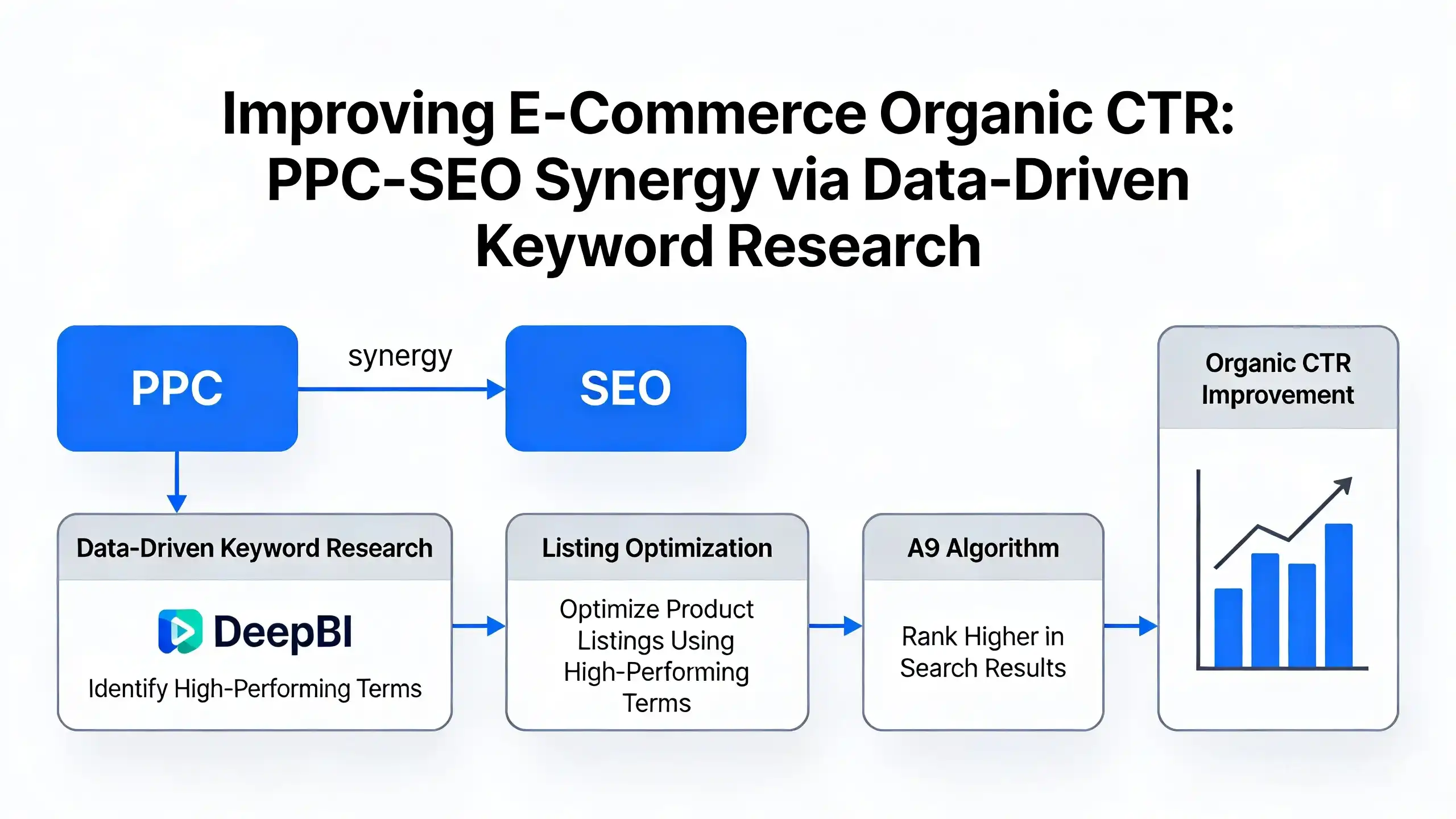
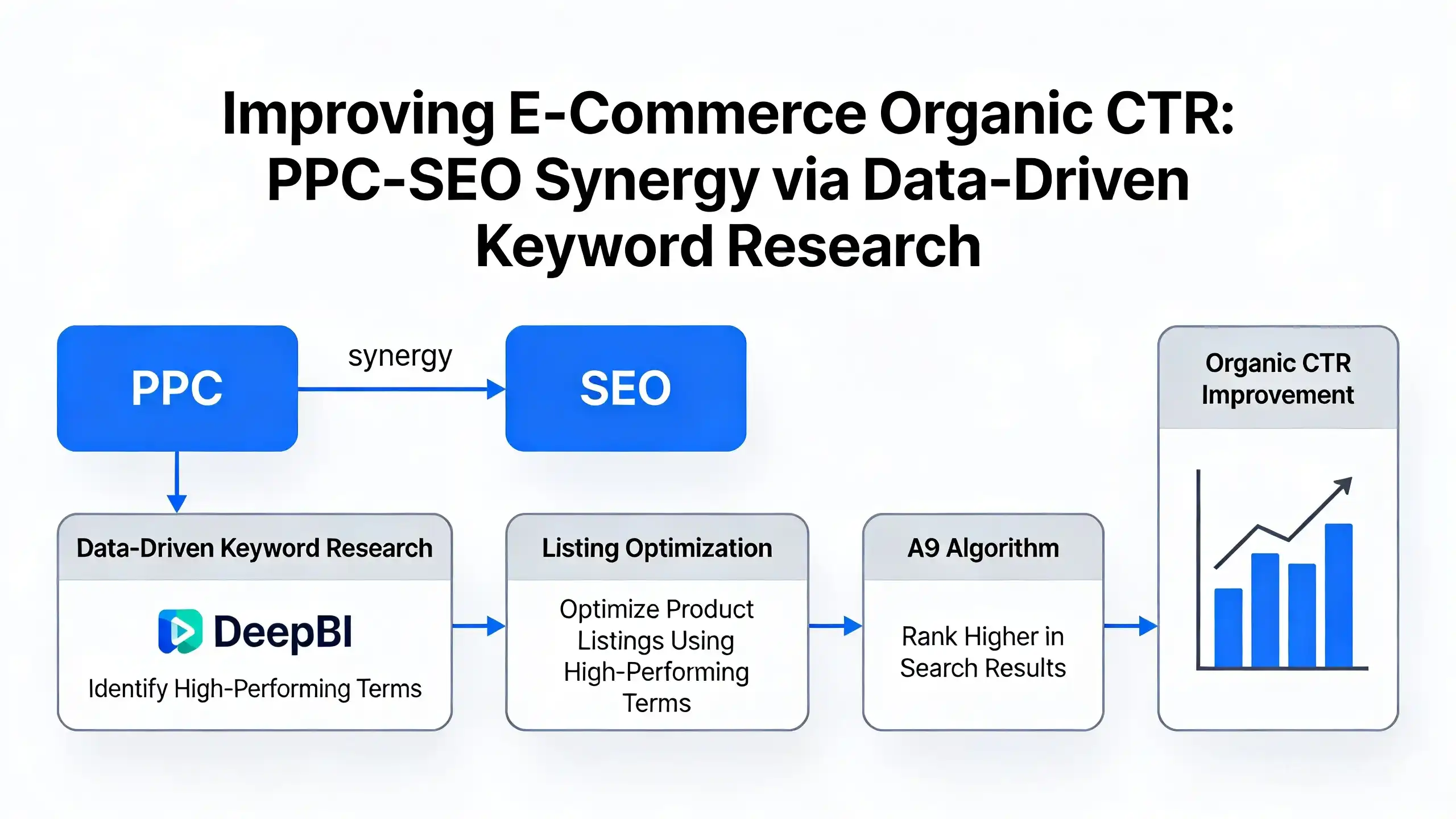
Paid and organic performance on Amazon are deeply interconnected. A successful PPC campaign does more than generate immediate sales; it creates a positive feedback loop that boosts your organic presence. Increased sales velocity and traffic from ads signal relevance and authority to Amazon's A9 algorithm, which often rewards the listing with a higher organic search ranking. This improved visibility naturally enhances your organic CTR.
Advanced analytics platforms can weaponize this synergy. For example, DeepBI’s ModuleOrganicTraffic uses a fifth-layer funnel analysis to sift through your advertising data, pinpointing the exact keywords that deliver both high CTR and high conversion rates (CVR). By re-integrating these proven, high-performance keywords into your organic SEO strategy—from your title to your backend search terms—you create a data-driven cycle that systematically elevates organic rank and boosts your overall organic CTR.
 DeepBI: Your Partner in Amazon CTR Optimization
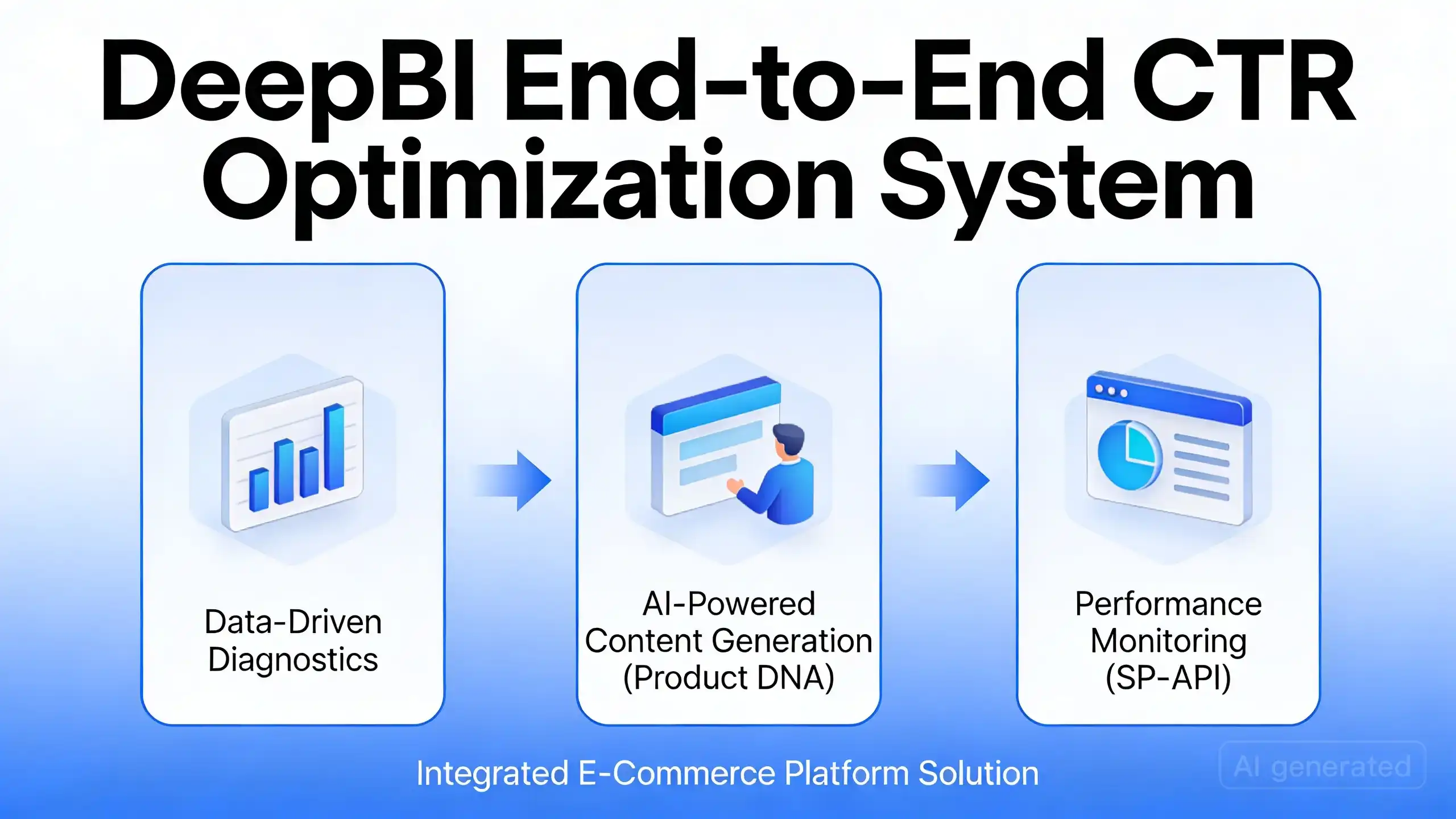
Optimizing your Click-Through Rate requires more than just intuition; it demands a systematic approach that connects diagnostics, content creation, and performance analysis. DeepBI provides an end-to-end intelligent optimization system, breaking down the traditional silos between these stages to create a seamless workflow for boosting your listing's performance.
Data-Driven Diagnostics and Benchmarking
Before you can improve your CTR, you must accurately identify your listing's weaknesses. DeepBI moves beyond vague assessments by providing a data-driven diagnosis of your entire product listing. The platform intelligently scores each element—from the main image to the bullet points—and benchmarks them against top-performing competitors in your category. This analysis pinpoints the exact components that are suppressing your CTR, allowing you to focus your optimization efforts where they will have the greatest impact.
AI-Powered Content Generation and Optimization
Once weaknesses are identified, DeepBI leverages AI to generate high-performance content. Unlike general-purpose AI tools that risk "hallucinations" and product inaccuracies, DeepBI operates as an automated visual production system. It establishes a "Product DNA" map to ensure every AI-generated image remains true to the physical product, mitigating the risk of negative reviews and returns. Instead of offering subjective advice, the system uses precise, parameterized instructions for composition, lighting, and camera angles to create multiple optimized content schemes for your title, images, and A+ Content, allowing you to compare and select the best option.
Integrated Performance Monitoring and Strategy Execution
DeepBI closes the loop by integrating content deployment with performance tracking. Instead of a manual upload process that can take dozens of minutes, optimized listing content can be applied with a single click via the Amazon SP-API, syncing the changes in seconds. Once an update is live, the system automatically marks a "visual iteration event point" in your advertising reports. This allows you to clearly monitor the direct impact of your changes on CTR over the following 7-14 days, creating a powerful data feedback loop for continuous, quantifiable improvement.
 Conclusion: Sustained Growth Through CTR Excellence
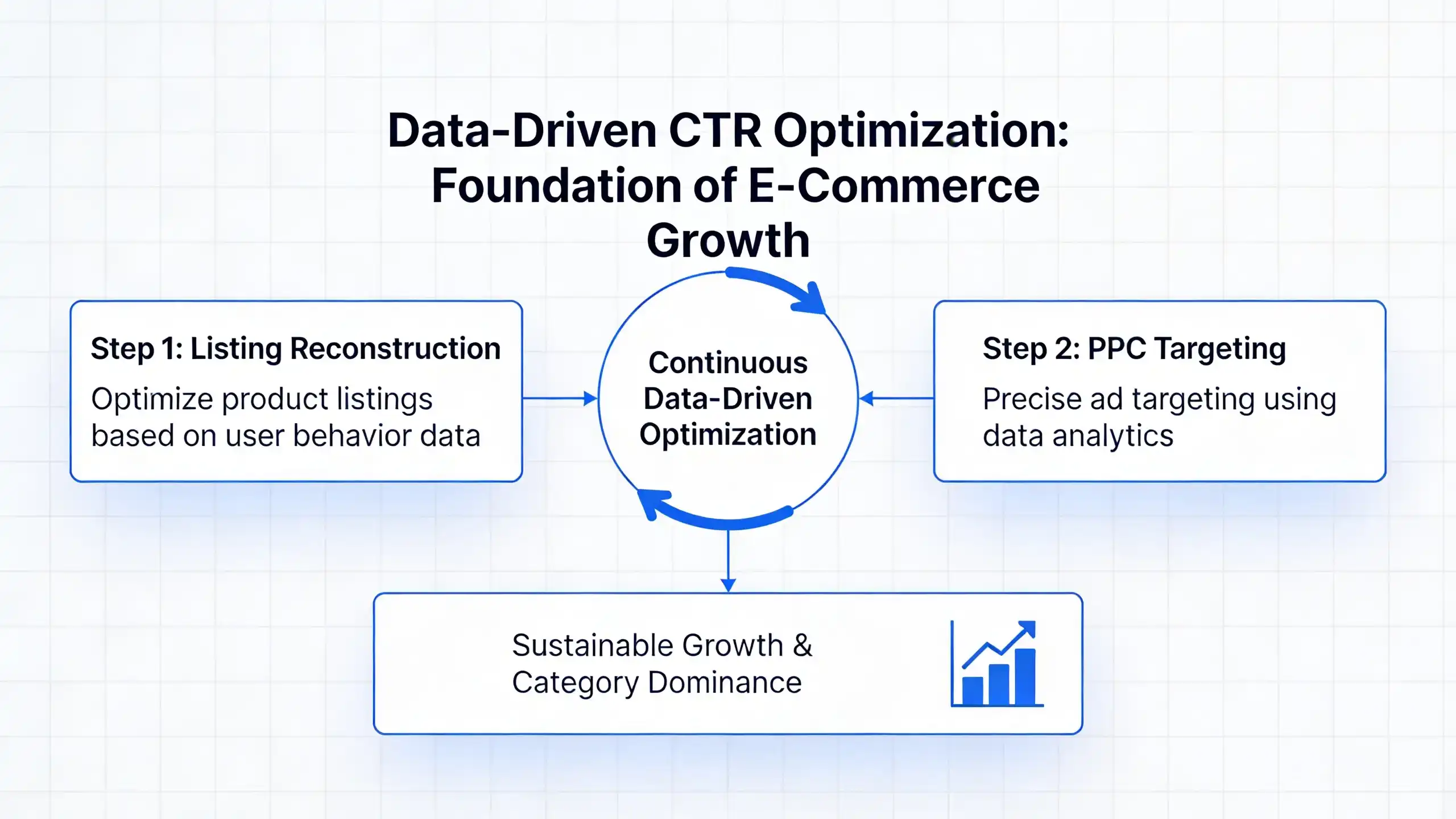
Mastering your Click-Through Rate is not just an optimization task; it is the foundational pillar of sustainable growth on Amazon. A high CTR signals relevance to both customers and the A9 algorithm, directly fueling your sales velocity, improving your Best Seller Rank (BSR), and lowering your advertising costs. It is the first and most critical step in converting a browser into a buyer.
Throughout this guide, we've explored the key strategies, from the structured reconstruction of your listing's text and visuals—including the main image, title, and bullet points—to the precise targeting of your PPC campaigns. However, in a competitive marketplace, sporadic adjustments are not enough. True excellence comes from a continuous, data-driven optimization cycle. The most successful sellers move beyond guesswork, adopting an end-to-end intelligent system that breaks down the silos between diagnosis, planning, and delivery. By leveraging advanced analytics, you can transform raw data into actionable insights, ensuring every decision is calculated to maximize your CTR. This commitment to data-informed optimization is the key to unlocking consistent traffic, higher conversions, and long-term dominance in your category.