Why Campaign Structure is Your Foundation for Amazon Success
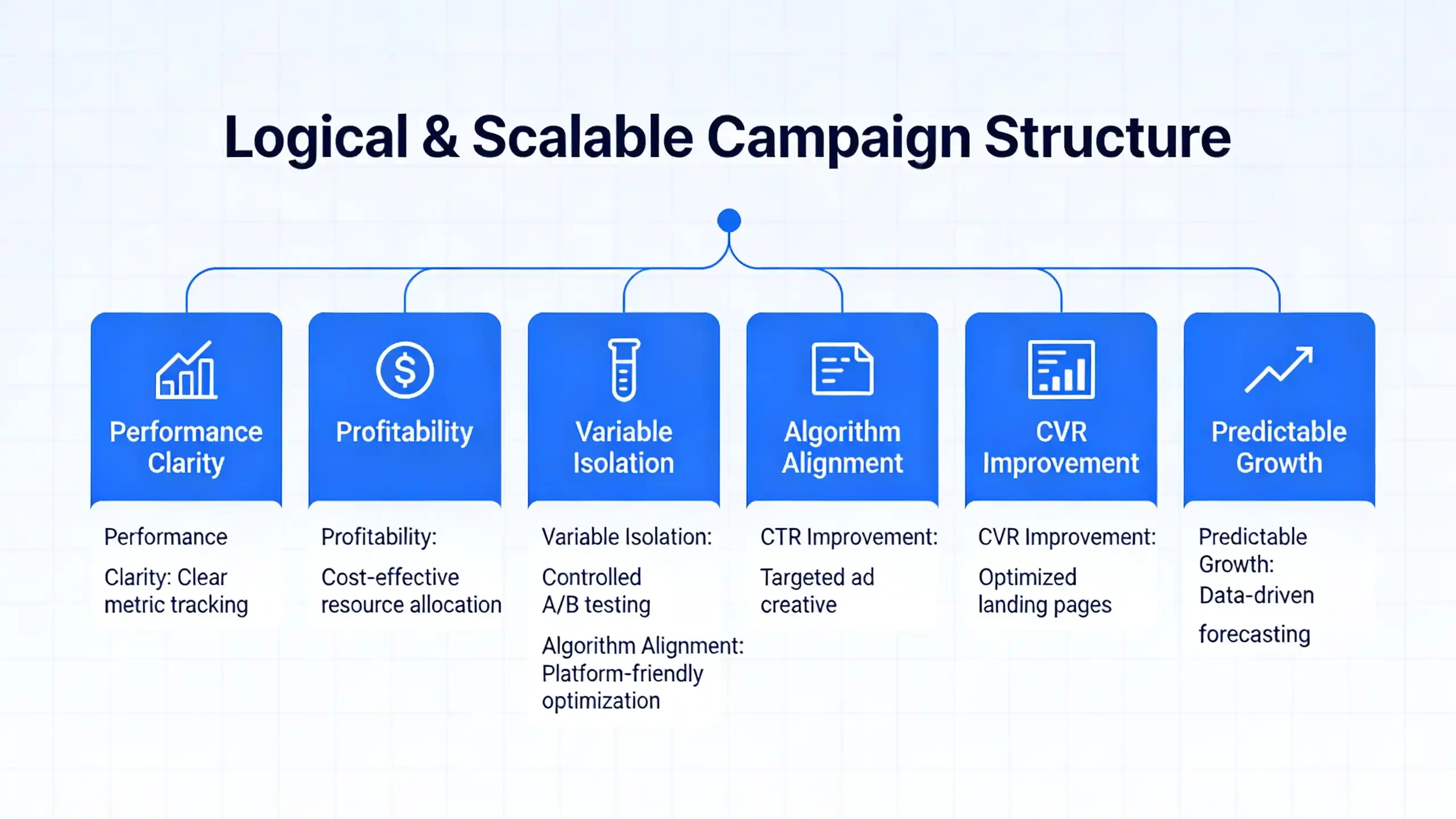
Many sellers obsess over keyword selection and bid management, but these efforts are wasted without a solid foundation: a logical and scalable campaign structure. This architecture is not merely an organizational tool; it is the single most critical factor determining the clarity of your performance data and your ability to optimize for profitability. Without a deliberate structure, your advertising data becomes a tangled mess, making it impossible to accurately assess ACoS or CVR for specific targeting strategies.
A well-designed structure, however, isolates variables and creates clear pathways for traffic. It allows you to funnel shoppers from broad discovery campaigns to highly specific, conversion-focused ones, giving you precise control over budget allocation and bidding. This clarity is essential for scaling your operations without introducing chaos.
Ultimately, a strong campaign structure aligns your goals with Amazon's. The algorithm is designed to maximize revenue by providing a relevant, seamless shopping experience. When your campaigns are structured to show the right product for the right search query, you achieve higher Click-Through Rates (CTR) and Conversion Rates (CVR). This signals relevance to Amazon, which can lead to better ad placements and a more favorable advertising flywheel effect, transforming your ad spend from a cost center into a predictable engine for growth.
 Foundational Principles of Effective Amazon PPC Structure
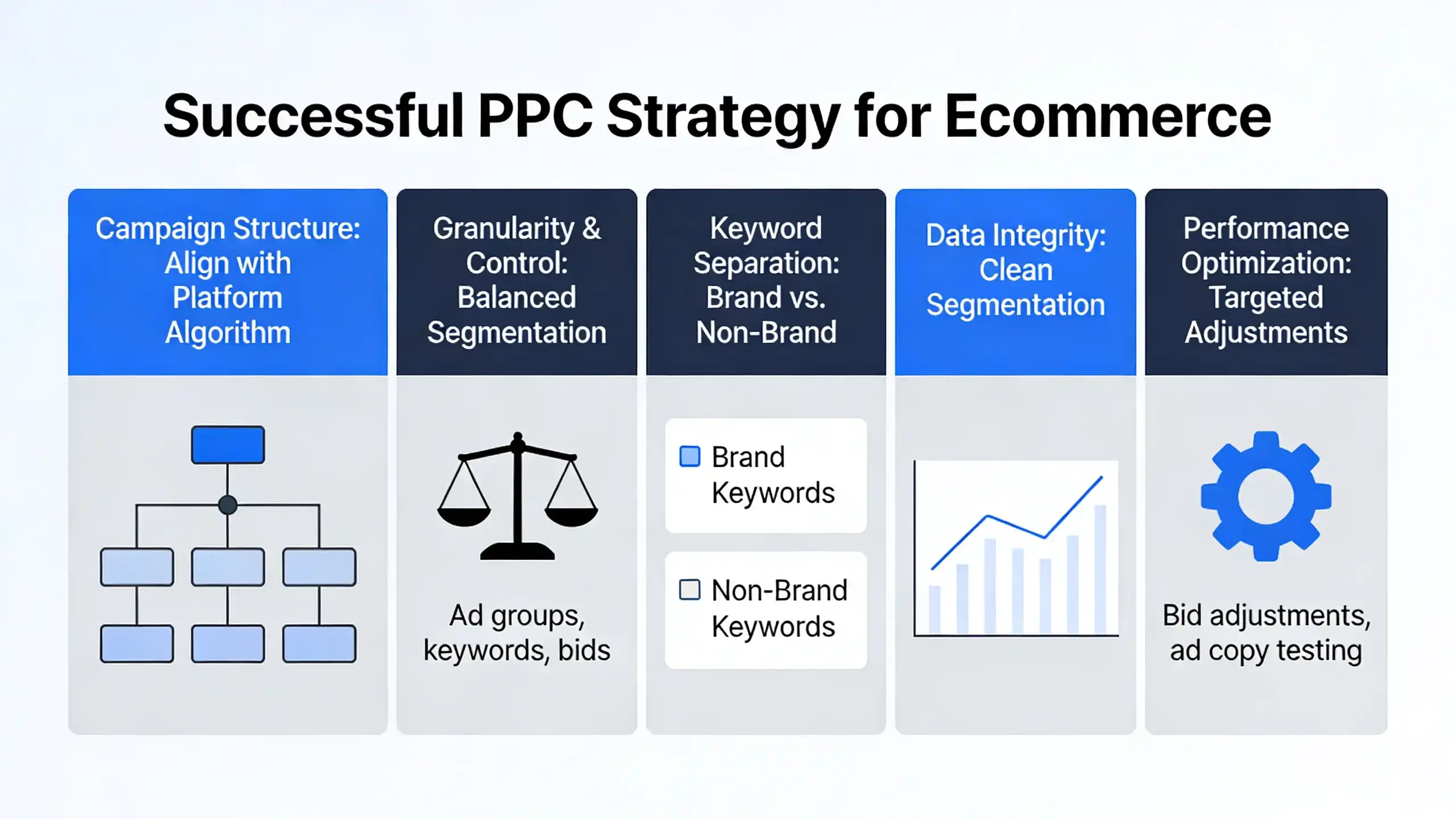
A successful PPC strategy is built on a robust campaign structure that aligns with Amazon's core logic. Without a solid foundation, even the most aggressive bidding strategies will fail to deliver a positive return. Understanding these foundational principles is the first step toward building a profitable advertising engine.
Understanding Amazon's Algorithm: The Two Core Objectives
At its heart, Amazon's advertising algorithm is driven by two primary objectives: delivering the best possible shopper experience and maximizing its own revenue. For sellers, this means your campaigns must be structured to prove your product is both highly relevant and likely to convert. A logical structure helps the algorithm quickly match your ads to the most relevant customer searches, rewarding you with better placements and potentially lower costs per click. Aligning your strategy with Amazon's goals is not just good practice; it's essential for long-term success.
The Granularity Spectrum: Balancing Control and Complexity
There is no single "best" campaign structure; the optimal approach exists on a spectrum of granularity. A highly granular structure, such as single-keyword ad groups, offers maximum control over bids and ad copy but demands significant management effort. Conversely, a more consolidated structure is easier to manage but sacrifices precision, as bids and performance data are averaged across multiple search terms. The right balance depends on your specific goals, the size of your catalog, and your team's capacity for managing complexity.
Data Integrity: The Imperative of Separating Brand vs. Non-Brand Campaigns
Maintaining clean data is critical for accurate performance measurement and optimization. The most common and costly mistake is mixing branded and non-branded search terms within the same campaign. Branded keywords inherently have higher click-through rates (CTR) and conversion rates (CVR), leading to a deceptively low ACoS. When mixed with non-branded terms, this data pollution makes it impossible to assess the true cost of acquiring new customers. By separating them into distinct campaigns, you gain clear visibility into brand defense costs versus new customer acquisition efforts, enabling smarter budget allocation.
 Essential Campaign Structuring Models for Amazon Ads
Effective campaign structures are not just about organization; they are strategic frameworks designed to maximize control, data clarity, and return on ad spend (ROAS). Moving beyond a disorganized approach, sellers can adopt proven models that align with specific business goals, from discovering new customer search terms to dominating a niche for a flagship product.
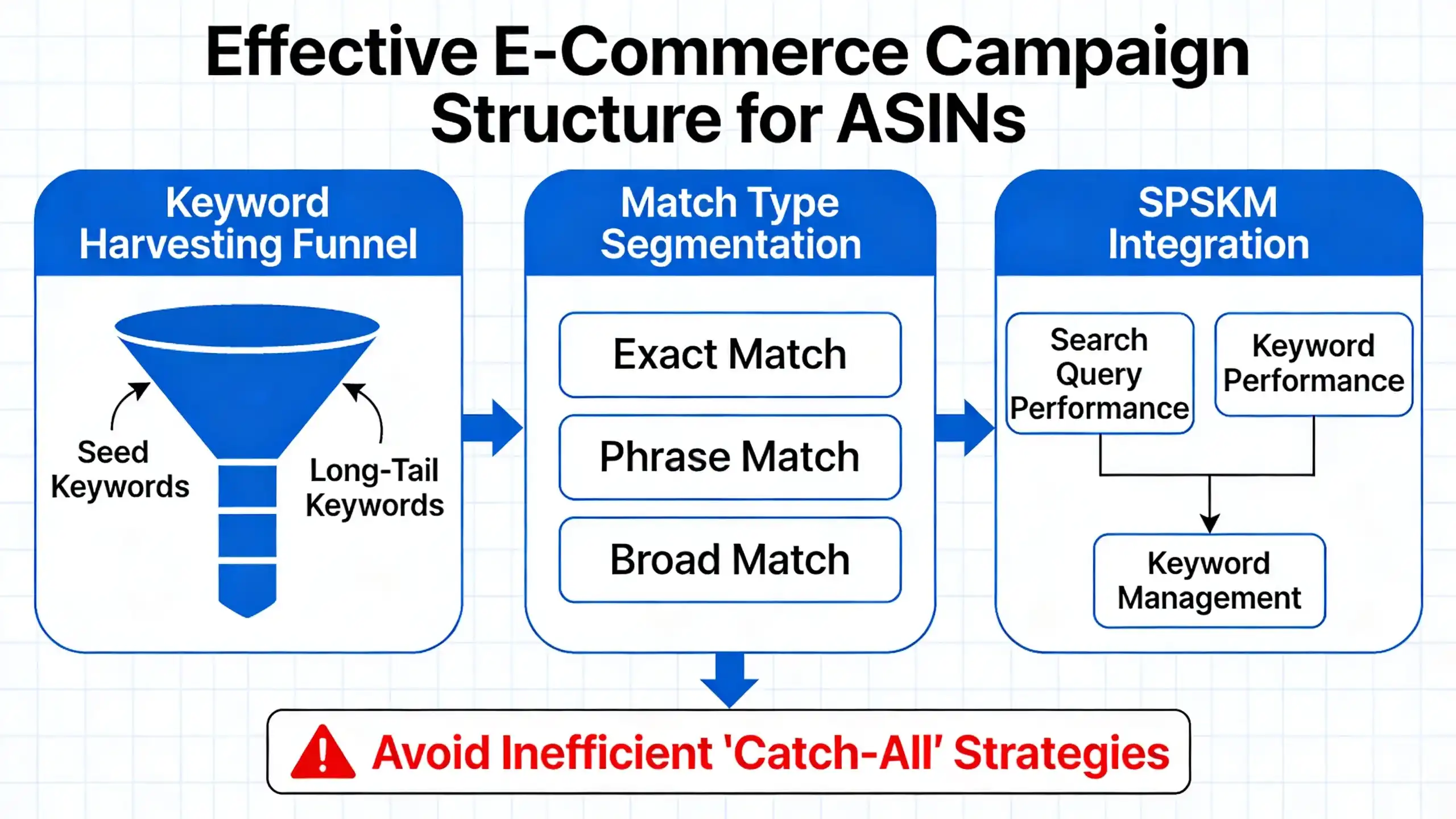
The Keyword Harvesting Funnel: Source and Destination Campaigns
One of the most powerful and fundamental structures is the keyword harvesting funnel. This model treats campaigns as a system for discovery and refinement, moving keywords from broad exploration to precise, profitable targeting.
- Source (Discovery) Campaigns: These are typically Automatic, Broad Match, or Phrase Match campaigns. Their primary goal is not immediate profitability but to cast a wide net and discover how customers are searching for your products. They act as your R&D department, unearthing new, high-intent keywords and search patterns directly from real shopper behavior.
- Destination (Precision) Campaigns: Once a search term in a source campaign proves to generate clicks and conversions, it is "harvested." This means you create a new target for that exact keyword within a dedicated Exact Match campaign. Here, the goal shifts to maximizing performance. With a proven term in an exact match campaign, you can set aggressive, precise bids to win top placement and scale conversions efficiently, confident that the budget is being spent on a term with a history of success.
Match Type Segmentation: Precision Bidding and Budget Control
A common mistake is to mix broad, phrase, and exact match keywords within the same ad group. This creates a data fog that makes optimization nearly impossible. The solution is rigorous match type segmentation, separating each type into its own campaign or, at a minimum, its own ad group.
The benefits are immediate and significant:
- Clear Performance Data: You can see precisely how each match type performs. Broad match terms will naturally have a lower click-through rate (CTR) and conversion rate (CVR) than exact match terms. Separating them allows you to evaluate their performance against appropriate benchmarks.
- Accurate Bid Management: A $1.00 bid on a broad match keyword has vastly different implications than a $1.00 bid on an exact match keyword. Segmentation allows you to set bids that reflect the distinct value and conversion potential of each match type, improving ACoS.
- Independent Budget Allocation: It prevents high-traffic, lower-intent broad match keywords from consuming the entire budget before your high-conversion, exact match keywords have a chance to perform.
Product-Centric Structures: Single Product, Single Keyword (SPSKM) and Product-Specific Campaigns
For high-priority ASINs, new product launches, or defending a market-leading product, a more granular, product-centric approach is required. The Single Product, Single Keyword (SPSKM) campaign is the most focused version of this strategy.
In this model, a single campaign contains only one ad group, which targets a single keyword and advertises only one product. This hyper-specific structure provides the ultimate level of control. It allows you to tailor the bid perfectly to the value of that specific keyword for that specific product. Performance data is unambiguous, making it easy to assess profitability and make decisive optimization choices. While more labor-intensive to set up, this structure is unparalleled for maximizing visibility and sales on your most important product-keyword combinations.
Avoiding "Catch-All" Pitfalls: The Dangers of Undifferentiated Campaigns
The opposite of a structured, strategic approach is the "catch-all" campaign. This involves grouping dozens or even hundreds of dissimilar products into a single ad group with a long list of keywords. While seemingly efficient to set up, these structures are a primary driver of wasted ad spend and poor results.
These undifferentiated campaigns fail because they break the fundamental rule of relevance:
- Poor Product-Keyword Association: Amazon's algorithm may show a completely irrelevant product from the ad group for a given search term, leading to a near-zero CTR and wasted impressions.
- Obscured Performance Data: With so many variables, it's impossible to know what's working. A single profitable keyword might be hidden within a sea of wasteful ones, and a high-performing product's success is averaged out by dozens of underperformers.
- Lack of Bid Control: A single bid is applied to all keywords and products, making it impossible to bid competitively for valuable terms or reduce spend on unprofitable ones. This inevitably leads to a high ACoS and stunted growth potential.
 Advanced Optimization Strategies with DeepBI
While a well-designed campaign structure is foundational, its long-term success hinges on continuous, data-driven optimization. Manual adjustments are time-consuming and often reactive. DeepBI introduces a suite of automated modules that execute advanced strategies, turning your campaign structure into a dynamic, self-optimizing growth engine.
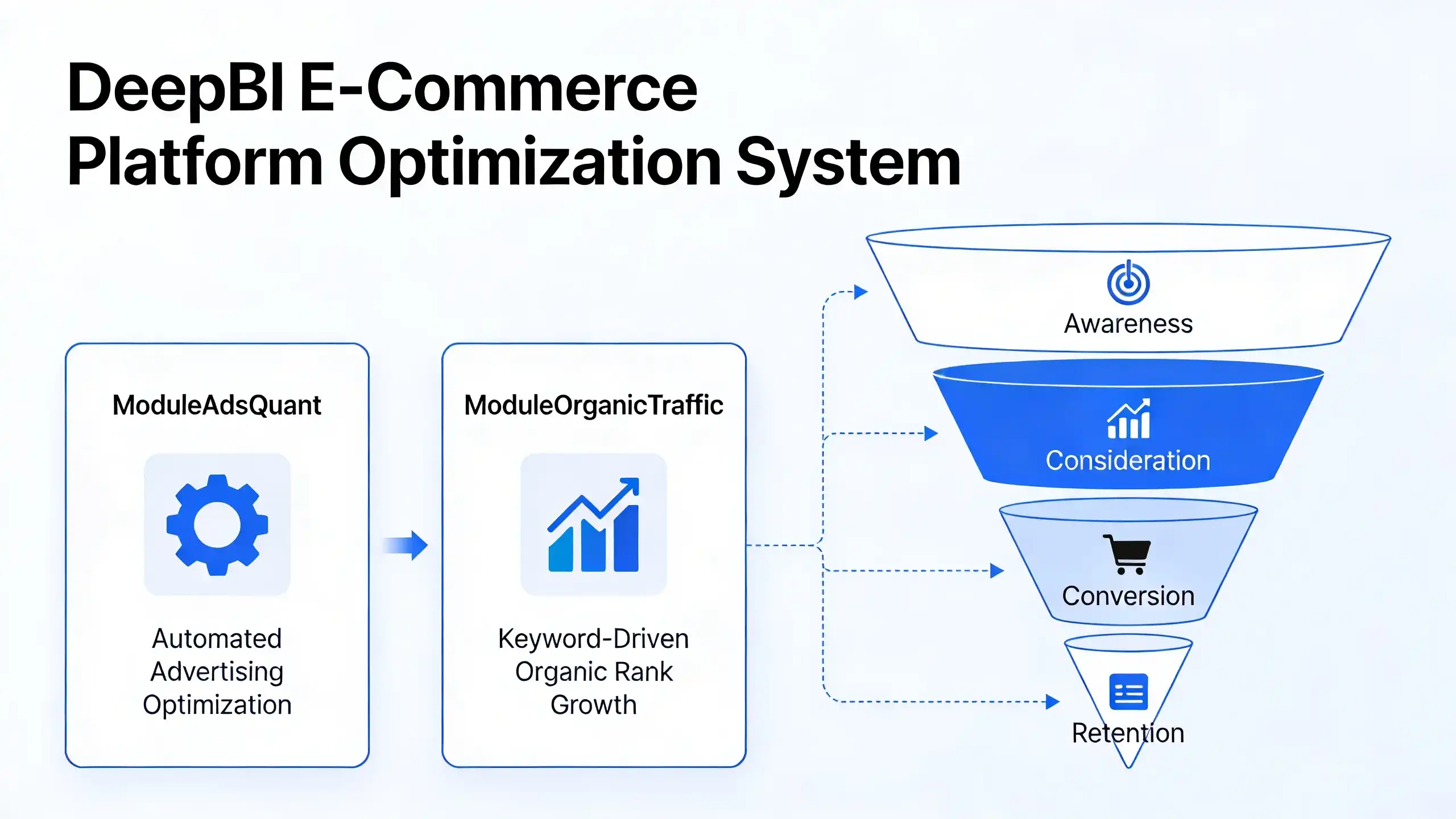
Leveraging DeepBI's Four-Layer Traffic Funnel for Ads Quant
Effective advertising requires a systematic approach to traffic management. DeepBI's ModuleAdsQuant implements a sophisticated four-layer funnel to guide ad spend from broad discovery to profitable scaling.
- Explore: This initial layer uses broad match and auto campaigns to discover a wide range of customer search terms and relevant ASINs, maximizing reach.
- Filter: As data accumulates, the system filters for keywords and targets that meet preliminary performance thresholds, identifying potential winners while cutting spend on non-performers.
- Precise: High-potential keywords are moved into precise targeting campaigns (e.g., Exact Match) to capture high-intent traffic, focusing on maximizing Conversion Rate (CVR) and lowering ACoS.
- Scale: For proven, profitable keywords, this layer focuses on stabilizing and scaling ad spend to dominate the ad slot, maximize impression share, and drive consistent sales volume.
Dynamic Bid and Budget Management for Sustained Performance
Static bids and budgets lead to missed opportunities and wasted spend. To maintain peak performance, campaigns require constant adjustments based on market dynamics and performance data. DeepBI’s ModuleAdsQuant automates this critical task. The system performs daily analyses of recent performance metrics—including clicks, conversions, spend, and ACoS—to make intelligent, automated adjustments to bids and budgets. This ensures your campaigns remain optimized without manual micromanagement and prevents overreactions to short-term data fluctuations.
Bridging Ads and Organic: DeepBI's Fifth Layer for Natural Rank Growth
Paid advertising and organic ranking share a powerful symbiotic relationship. Strong ad performance, particularly for strategic keywords, can significantly boost organic visibility and Best Seller Rank (BSR). DeepBI operationalizes this synergy with its ModuleOrganicTraffic, which acts as a "fifth layer" to the advertising funnel.
This module systematically screens your advertising data to identify keywords with high Click-Through Rates (CTR), Conversion Rates (CVR), and order values. It then uses this intelligence to inform targeted campaigns aimed at securing and defending Top of Search placements. This reinforcement strategy not only maximizes ad profitability but also signals relevance to Amazon's algorithm, driving sustainable growth in your product's natural rank.
 Common Mistakes in Campaign Structure and How to Avoid Them
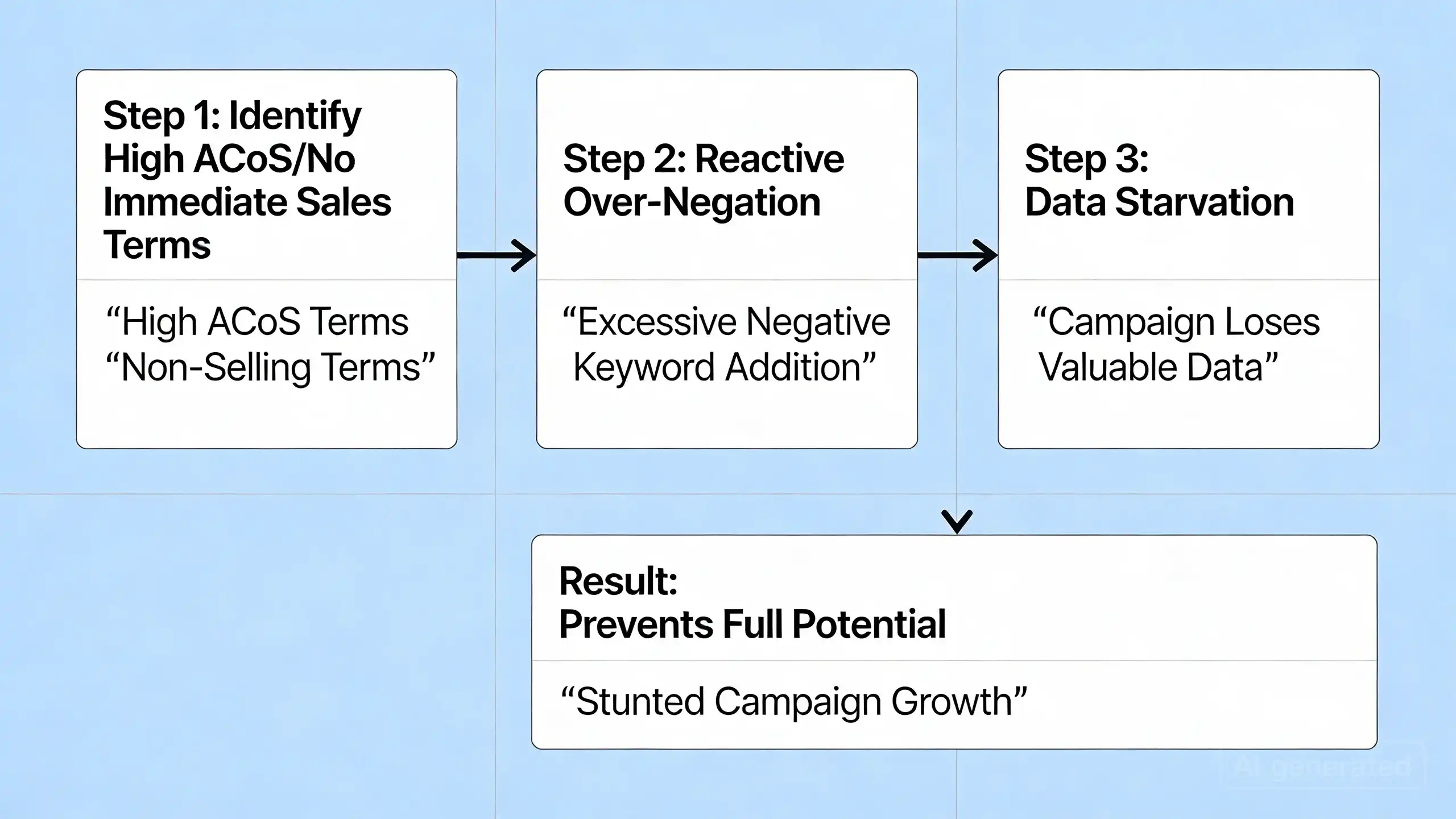
Effective use of negative keywords is a hallmark of a sophisticated PPC strategy, yet their misuse is one of the most common and costly errors sellers make. Many managers fall into the trap of making reactive, data-poor decisions that inadvertently harm campaign performance.
A prevalent mistake is immediately negating any search term with a high Advertising Cost of Sale (ACoS). While seemingly logical, this action can be counterproductive. A keyword with a high ACoS might still be driving substantial sales volume, contributing to organic rank, or providing valuable market intelligence. Instead of a knee-jerk negation, analyze the term's overall contribution to your business goals. It may be more effective to adjust the bid or move the term to a campaign with different performance targets.
Similarly, negating keywords that have high spend but no sales can be premature. This pattern doesn't always indicate a bad keyword; it could signal a problem with your product listing's conversion rate (CVR), pricing, or a need for more data collection time. Cutting these terms too quickly can choke off valuable traffic before you've identified the true root cause of underperformance. The most dangerous habit is over-negating, where any term without an immediate sale is blocked. This starves your campaigns of the data needed for discovery and optimization, effectively preventing them from ever reaching their full potential.
 Conclusion: Building a Resilient and Profitable Amazon PPC Ecosystem
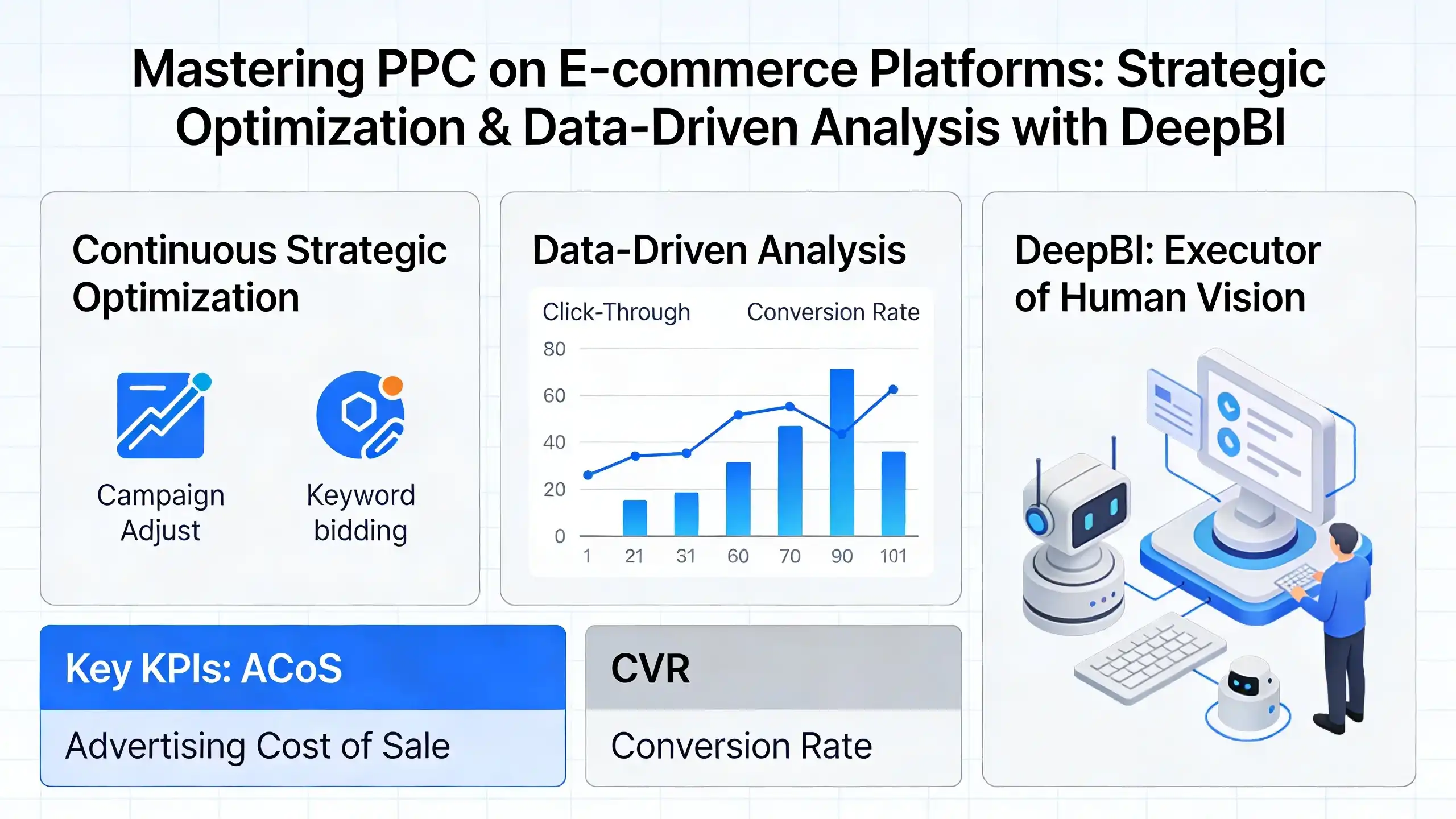
Mastering Amazon PPC requires moving beyond simple bid management to architecting a resilient, data-driven advertising ecosystem. A logical and granular campaign structure is the essential foundation, but it is only the starting point. The true driver of long-term profitability lies in a relentless cycle of performance analysis and strategic optimization. This continuous process of refining targeting, adjusting bids, and reallocating budgets based on hard data is what separates top-tier sellers from the rest, directly impacting critical KPIs like ACoS, CVR, and overall market share.
This is where advanced tools become a strategic imperative. DeepBI empowers sellers by providing the analytical depth and automation needed to execute sophisticated strategies at scale. It transforms complex performance data into clear, actionable insights, allowing you to manage your campaigns with precision. Crucially, the goal is not to replace the strategist. We firmly believe that AI should not override human decision-making. Instead, DeepBI acts as a powerful executor for your vision, enabling you to translate your business goals into flawless campaign execution. This synergy between human intellect and AI efficiency is the ultimate key to building a dominant and profitable presence on Amazon.
Continuous optimization remains essential because Amazon rankings, shopper expectations, and competitive pressure keep changing.