

Introductio
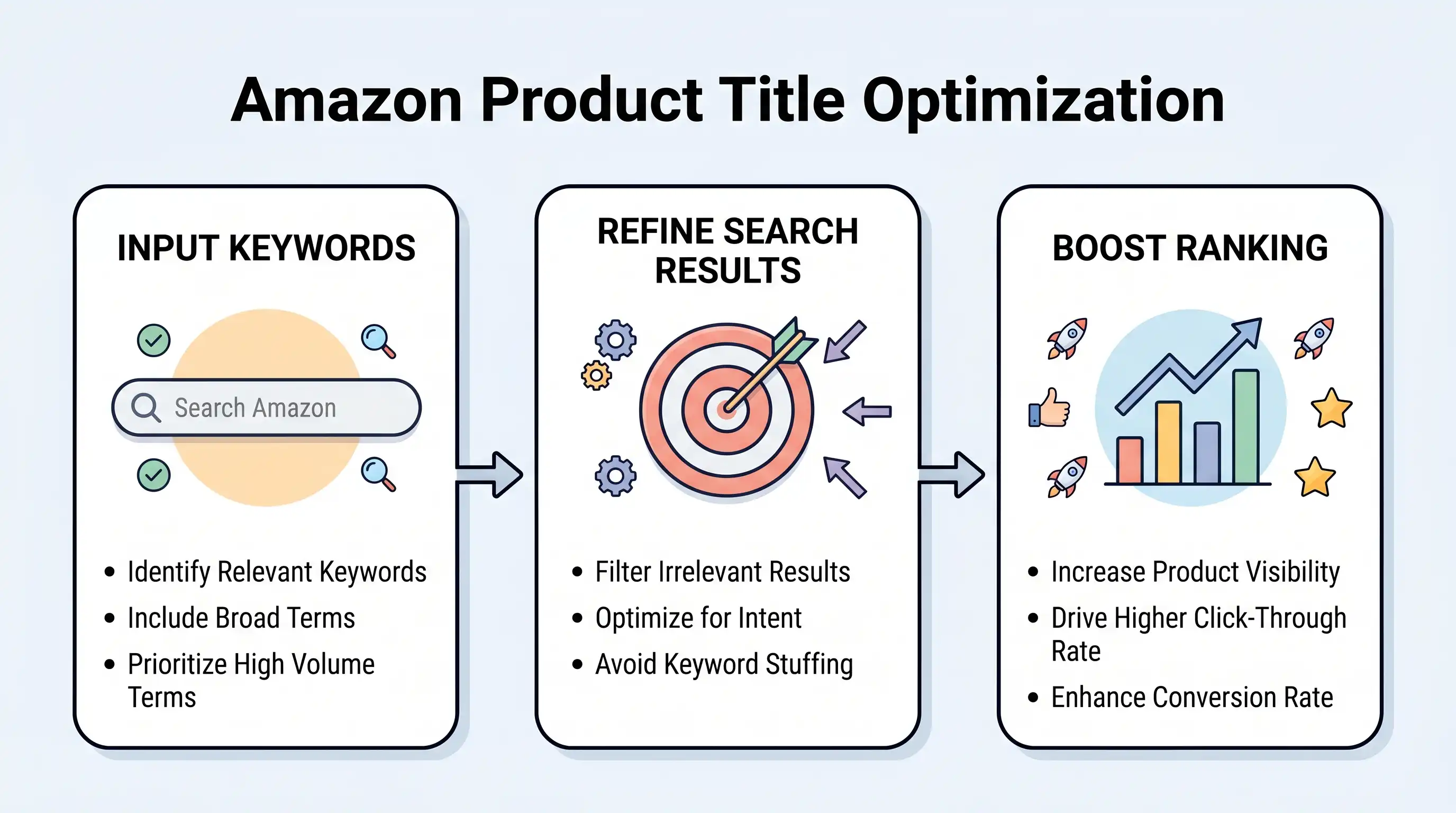
On Amazon, your product title is more than just a name; it's the single most critical element for customer discovery and conversion. It is the primary driver of search visibility, the main factor in a shopper’s decision to click, and the foundation upon which your entire listing performance is built. A well-crafted title can dramatically improve your Best Sellers Rank (BSR) and click-through rate (CTR), while a poorly constructed one ensures your product remains buried deep within search results, invisible to potential buyers.
The core challenge for sellers isn't a lack of information, but an overabundance of generic, often contradictory, advice. Amazon’s official guidelines provide a baseline, but best practices vary dramatically between categories. A title structure that dominates the Home & Kitchen category could be completely ineffective in Electronics or Apparel. This forces many brands into a cycle of inefficient trial-and-error, wasting time and ad spend on title variations that fail to gain traction. Relying on subjective aesthetic preferences or simply mimicking a single competitor without understanding the underlying data is a recipe for stagnant growth.
To break this cycle and achieve sustainable success, sellers must transition from speculation to a data-driven strategy. This requires a structured process that analyzes what is currently winning in your specific market niche. This is precisely where specialized analytics platforms become indispensable.
DeepBI provides sellers with an engineered path to title optimization, transforming the process from an art into a science. Instead of offering one-size-fits-all rules, DeepBI functions as an operational decision system that performs a deep, quantitative analysis of your listing against top-performing competitors. The platform diagnoses specific weaknesses impacting your CTR, cross-validates findings with business data, and delivers a clear, evidence-based strategy for improvement. By leveraging competitive benchmarking and eliminating subjective bias, DeepBI empowers you to craft titles that are not just compliant, but are strategically designed to capture attention, drive clicks, and maximize sales velocity on the world's most competitive marketplace.
What are Amazon’s best practices for Amazon product titles?
Amazon’s primary goal for product titles is straightforward: provide customers with enough essential information to make a purchase decision based on the title alone. A well-crafted title not only complies with platform rules, preventing listing suppression, but also serves as your most powerful tool for earning clicks from the search results page. Adhering to these best practices is the first step in any methodical optimization of your product's visibility and click-through rate (CTR).
The foundational structure for most categories follows a clear formula:
Brand + Model/Name + Product Nouns (what it is) + Key Attributes (material, key feature, quantity)
For example, a title like "Anker PowerCore 10000 Portable Charger, Ultra-Compact 10000mAh Power Bank" effectively communicates the brand, model, product type, and a critical specification. This structure helps Amazon’s A10 algorithm correctly index your product while giving customers the core details they need instantly.
When dealing with products that have variations (like size or color), it's crucial to differentiate between parent and child ASIN titles. The parent title should be general and not include any variation-specific details. The specific attributes, such as "Red" or "Size 10," must only appear in the titles of the corresponding child listings. This prevents customer confusion and ensures a smooth experience on the product detail page.
To maintain a clean and trustworthy marketplace, Amazon enforces several strict rules for titles:
Capitalize the first letter of each word (Title Case). Do not use all caps.
Use numerals for numbers. Write "2" instead of "two."
Abbreviate standard measurements. Use "in" for inches, "oz" for ounces, and "lb" for pounds.
Do not include promotional phrases. Avoid subjective or time-sensitive claims like "Best Seller," "Highest Quality," "Free Shipping," or "Sale."
Never include your seller name. The brand name is required, but your merchant name is prohibited.
Avoid decorative characters and symbols. Do not use characters like ~, !, *, or emojis.
Respect character limits. These vary by category, so always check the specific style guide for your product type. Exceeding the limit can lead to your product being suppressed from search results.
By following these guidelines, you create a title that is optimized for both the Amazon algorithm and human shoppers, establishing a solid foundation for discoverability and conversion.
What are DeepBI’s best practices for Amazon product titles?
Navigating Amazon's product title guidelines can be frustrating. Style guides recommend one length, inventory file templates suggest another, and top-performing listings often seem to break the rules entirely. At DeepBI, we cut through this ambiguity by focusing on what the data shows drives performance. Our best practices are rooted in continuous analysis of channel requirements and competitive landscapes, ensuring your titles are optimized for both the A10 algorithm and human shoppers.
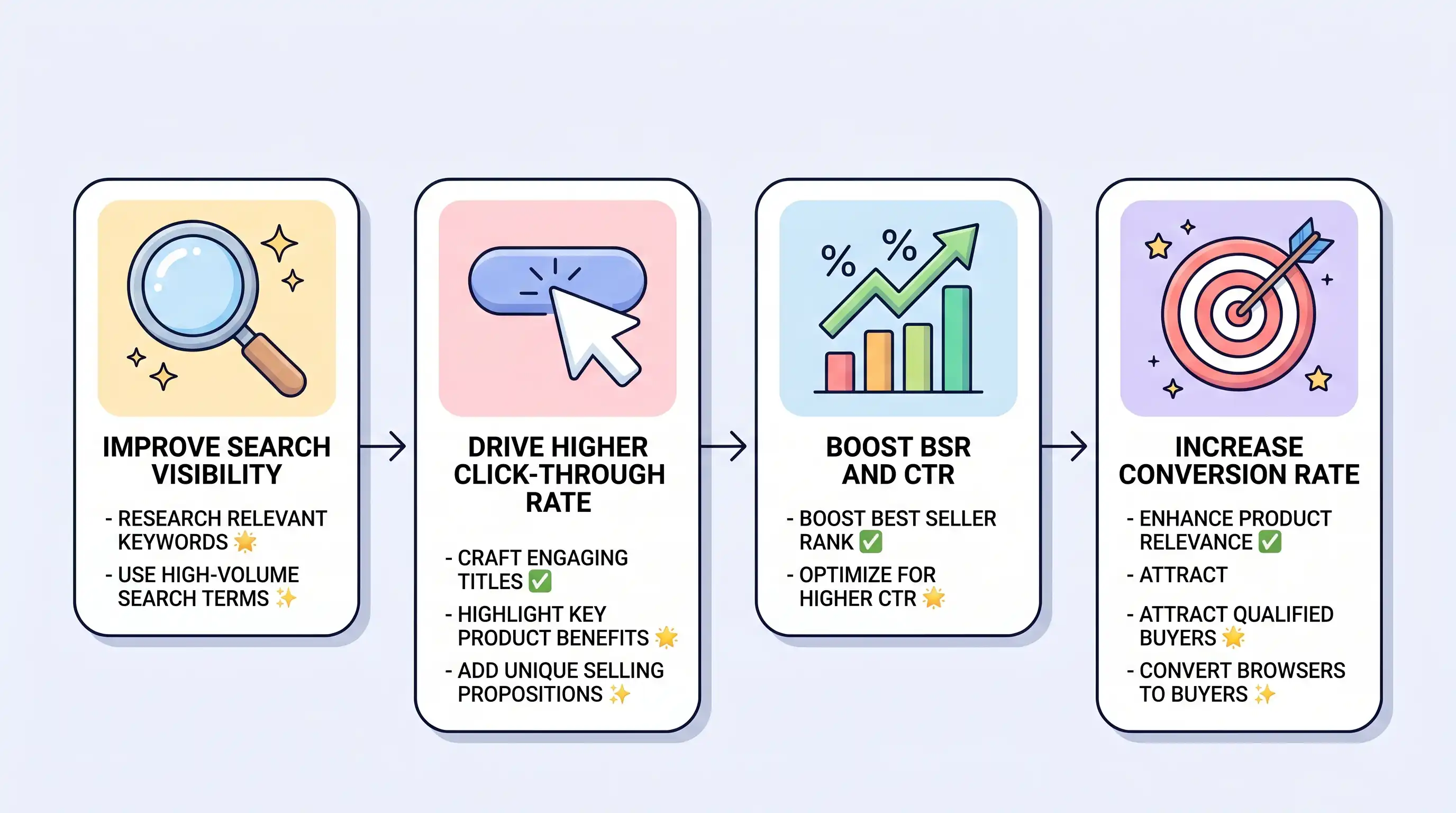
While Amazon allows for up to 200 characters in many categories, our analysis indicates that titles under 150 characters generally yield a better Click-Through Rate (CTR), especially on mobile devices where longer titles are truncated. The goal is to be descriptive and keyword-rich without sacrificing clarity, which is essential for capturing a shopper's initial interest.
Here is our recommended structure for a high-performing title:
Brand Name First (Usually): Start with your brand name to build recognition. The main exception is for category-dominant brands (like Huggies or Pampers) where the product type might lead. If you're unsure which placement drives higher CTR, this is a prime candidate for A/B testing.
Core Product & Key Features: Immediately follow with your main product name and its most compelling adjective or feature (e.g., "Reversible Sherpa Fleece Blanket").
Essential Attributes: Include critical information like material, key dimensions, color, and quantity. Use standard, abbreviated measurements (e.g., "in," "oz," "GB") to conserve space and maintain readability.
Use Title Case: Capitalize the first letter of each word. This is standard practice on the platform and significantly improves scannability on a crowded search results page.
Crucially, avoid overloading your title. It is not the place for every feature, promotional messaging ("Sale," "Best"), or extensive keyword variations. This detailed information belongs in your bullet points and A+ Content, where shoppers expect to find it. A cluttered title can overwhelm customers and harm your CTR.
This framework provides a strong starting point, but true optimization requires a more granular, competitive approach. This is where DeepBI’s diagnostic capabilities become essential. Our platform conducts a quantitative audit of your listing, scoring your title against the top-performing ASINs in your category. This multi-dimensional diagnosis pinpoints specific weaknesses, such as suboptimal keyword placement or poor structure, that are suppressing your visibility and CTR. Instead of offering generic advice, DeepBI provides a clear, data-backed path for systematic optimization, allowing you to emulate the successful patterns of market leaders and directly improve your listing's performance metrics.
Listing products on Amazon with DeepBI.
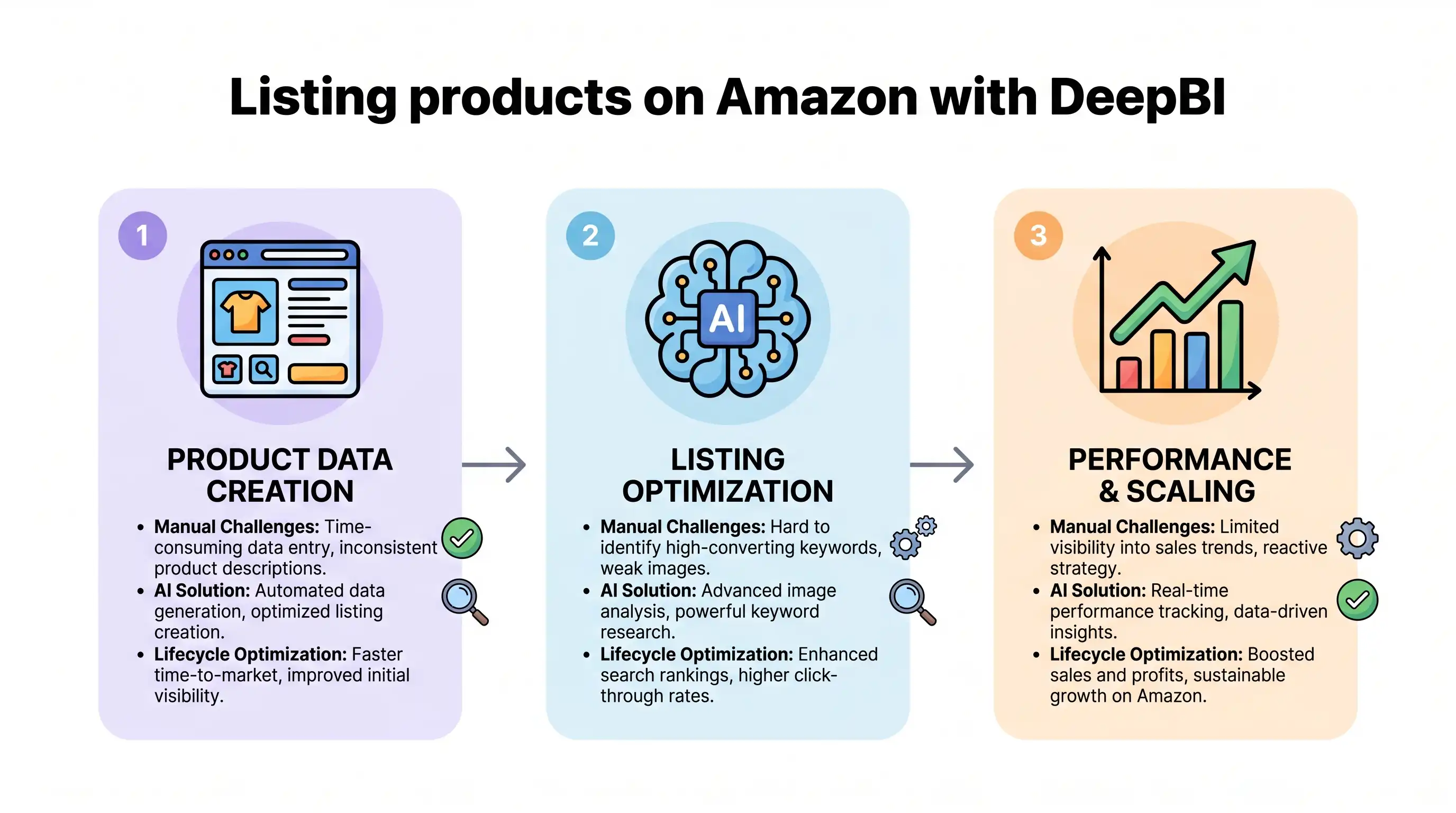
While a perfect product title is the gateway to earning a click, it's the quality of the entire product detail page that secures the conversion. Crafting a cohesive listing—from the main image and bullet points to the A+ Content—that consistently outperforms competitors is a complex, data-intensive task. Relying on intuition and manual adjustments often leads to inconsistent results, wasted ad spend, and a direct negative impact on key metrics like Click-Through Rate (CTR) and Conversion Rate (CVR).
DeepBI is an AI-powered growth platform engineered specifically to help sellers master their e-commerce operations on Amazon. It transforms listing management from a reactive, guesswork-driven process into a proactive strategy for market leadership. The platform provides a full-service feed management solution that addresses the entire lifecycle of a product listing, from initial creation to continuous optimization.
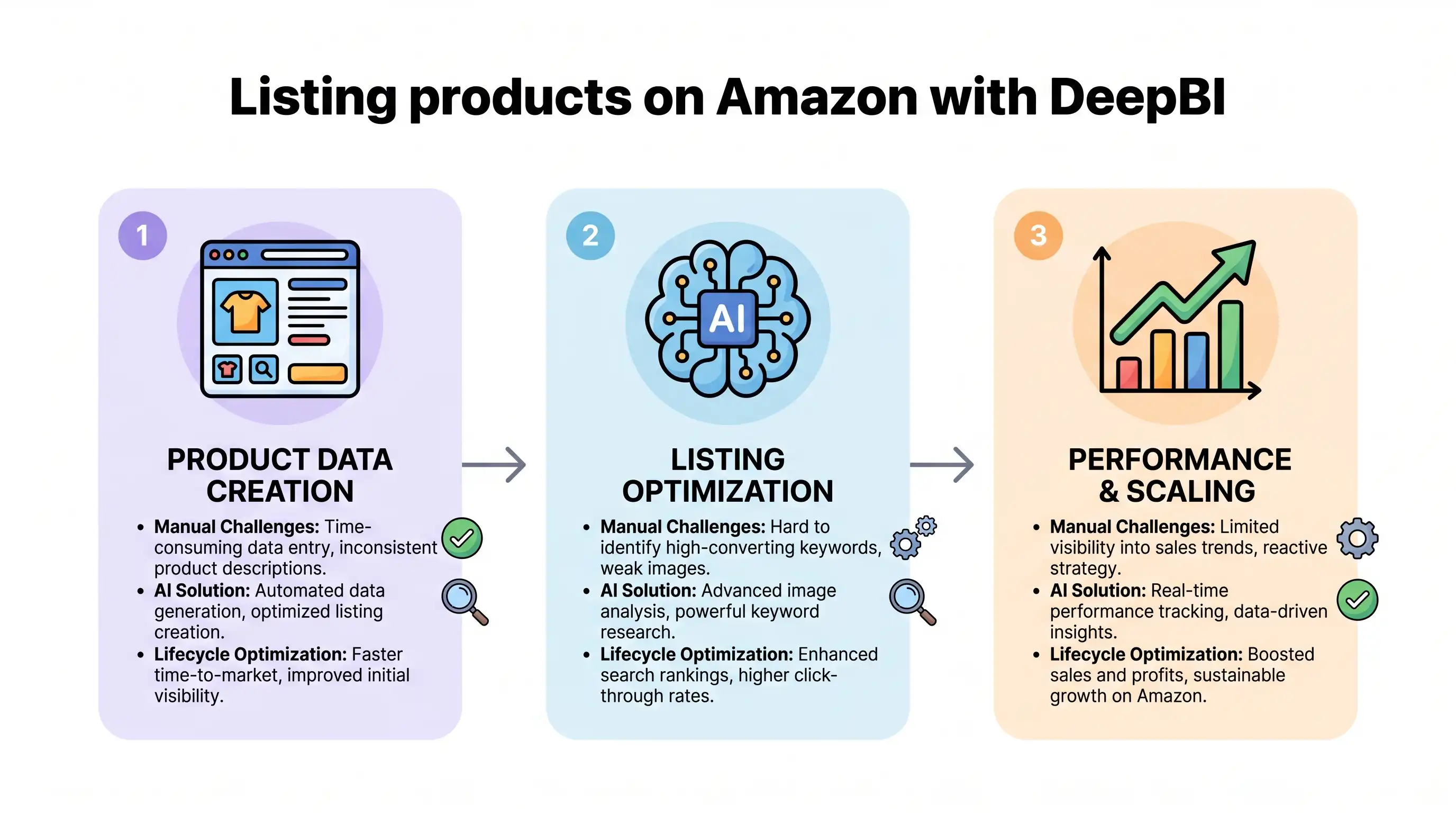
At the core of DeepBI are its advanced AI content and image generation capabilities. The system analyzes market data to produce a complete set of high-conversion assets tailored to your product, including:
SEO-driven product titles
Benefit-oriented bullet points
High-impact main and secondary images
Engaging A+ Content modules
This approach ensures every element of your listing works in concert to attract and convert shoppers. However, the true breakthrough lies in execution. DeepBI features a one-click application function that integrates directly with the Amazon Selling Partner API (SP-API). This allows you to automatically upload and update all your AI-generated content and images directly to your Seller Central account. This seamless connection streamlines the entire "analyze → generate → launch" workflow, dramatically reducing listing cycle time and eliminating the manual errors that can compromise your optimization efforts. It provides a complete, closed-loop system for methodical improvement, ensuring your products are always presented in the most competitive way possible.