TL;DR - Key Takeaways
Bridging the critical gap between digital assets and immediate commercial value requires a precise, data-driven approach to Amazon A+ Content. As the marketplace evolves toward 2026, mastering this feature is no longer optional for serious sellers. Here are the core strategies to maximize your listing performance:
- Maximized Conversions and Sales: Implementing Premium A+ Content can yield up to a 20% boost in conversion rates. This dramatic CVR improvement inherently strengthens your Best Sellers Rank (BSR) and optimizes ad spend by lowering your overall Advertising Cost of Sales (ACoS).
- High-Quality Visuals for Brand Trust: Visual optimization directly impacts the consumer trust funnel. Whenever your listing CVR dips below the critical 7% threshold, immediate visual upgrades—such as deploying localized lifestyle environments tailored to specific global marketplaces—are essential to rebuild brand credibility and secure the purchase.
- Strategic Planning and Integration: A+ Content must operate in sync with your broader Amazon traffic strategy. For instance, if your CTR falls below the 0.35% benchmark, tightly aligning your primary images with your A+ modules ensures that every incoming click is captured and nurtured through a cohesive, highly engaging narrative.
- Performance Monitoring and Rapid Execution: Transitioning from simple content creation to a complete operational decision-execution system guarantees that optimization results take effect immediately. Continuous diagnostic monitoring allows brands to pinpoint exact performance gaps and deploy targeted visual fixes without delay.
- Streamlined Listing Cycle Time: For multi-SKU sellers managing hundreds of listings, industrializing visual iteration is paramount. By leveraging automated batch uploads and integrated workflow operations, large-scale brands can drastically reduce listing cycle time, free up valuable human resources, and maintain consistent visual standards globally.
What is Amazon A+ Content?
Definition and Evolution of A+ Content
Originally launched as Enhanced Brand Content (EBC), A+ Content has evolved from a basic formatting upgrade into a critical mechanism for driving sales and conversions on Amazon. It empowers brand-registered sellers to replace standard plain-text descriptions with rich, multimedia storytelling. By allowing brands to visually communicate product value propositions, A+ Content fundamentally shifts how buyers interact with the product detail page. This evolution directly impacts bottom-line metrics, helping sellers defend their BSR (Best Sellers Rank) and aggressively improve CVR (Conversion Rate) by keeping shoppers engaged longer and addressing pre-purchase objections through visual context. Access to this powerful feature remains an exclusive advantage for sellers officially enrolled in the Amazon Brand Registry.
Types of A+ Content and Features
Sellers can leverage three distinct tiers of A+ Content to optimize their product listings:
- Basic A+ Content: This tier provides standard modules combining text and images, allowing sellers to highlight specific product features cleanly. Key elements include standard comparison charts, which are highly effective at retaining traffic within a brand's catalog and indirectly lowering ACoS by preventing cross-shopping.
- Premium A+ Content: Also known as A++ Content, this tier offers an elite, mobile-optimized experience. Features include expansive full-width modules, high-definition videos, interactive hover hotspots, and advanced Q&A sections. Premium A+ drastically elevates the visual impact of the product detail page, directly maximizing CVR for high-ticket or complex items.
- Brand Story Modules: Positioned above the core A+ descriptions, this carousel-style feature focuses entirely on emotional branding. It enables sellers to share their brand's heritage, values, and entire product line, fostering brand loyalty while simultaneously decreasing the listing cycle time for newly launched ASINs cross-promoted within the module.
Eligibility and Access Requirements
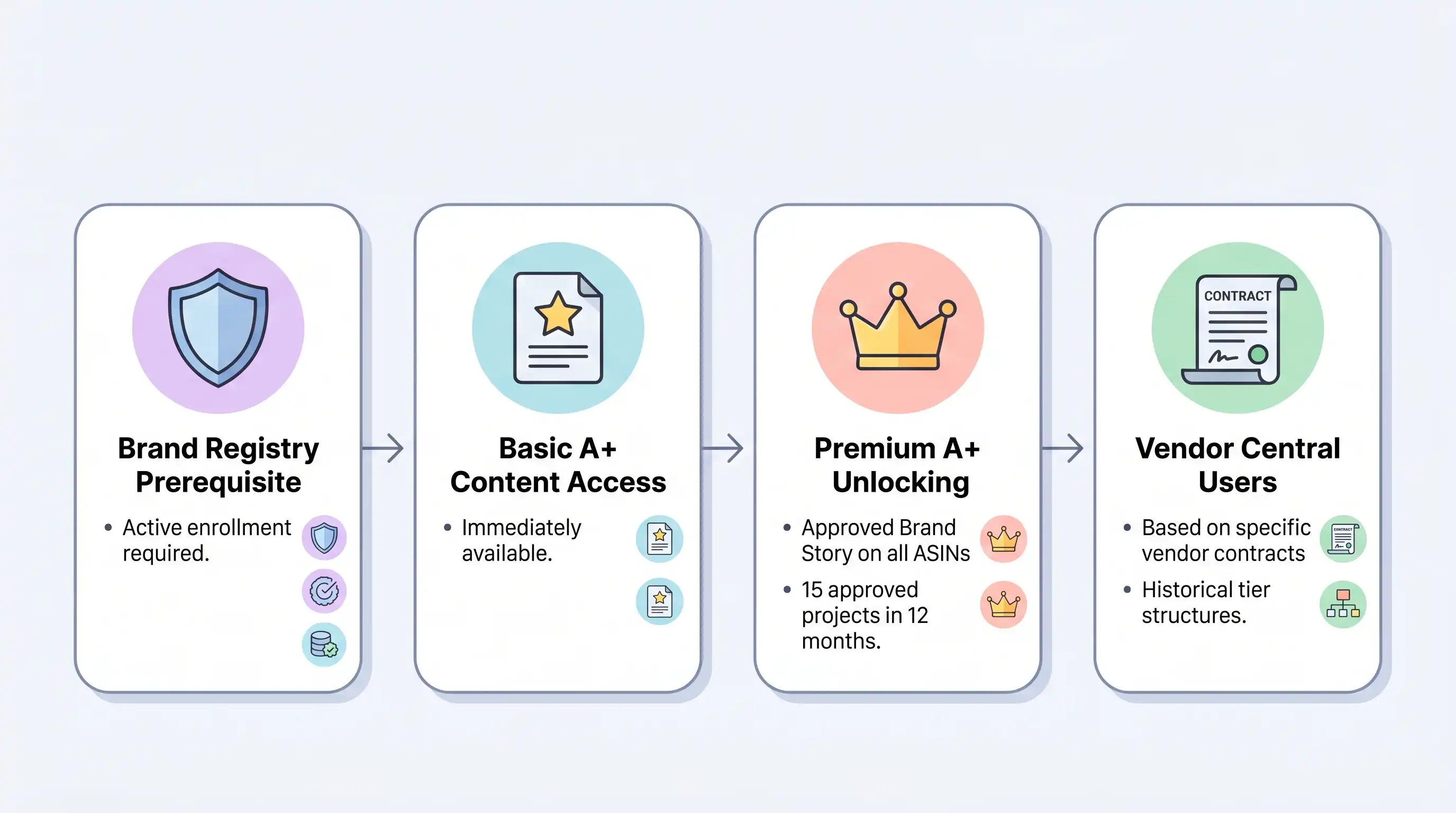
The foundational prerequisite for accessing any tier of A+ Content is active enrollment in the Amazon Brand Registry. While Basic A+ and Brand Story features are immediately available to registered brands, unlocking Premium A+ Content requires meeting specific, data-driven thresholds. Sellers must have published an approved Brand Story across all eligible ASINs within their catalog. Furthermore, they must have a minimum number of approved A+ Content projects (historically set at 15) successfully submitted within the past 12 months. Meeting these criteria automatically grants access to Premium modules, though specific ASIN limits may apply based on overall catalog size. Finally, Vendor Central users experience a slightly differentiated access structure; while brand registered third-party sellers can unlock these features through performance metrics, vendors often navigate access based on their specific vendor contracts and historical tier structures. Meeting these rigid requirements ensures that only committed brands deploy the highest-converting assets on the platform.
Benefits of Amazon A+ Content
Sales and Conversion Improvements
Sellers competing in saturated markets often encounter escalating traffic costs and immense pressure on their click-through rate (CTR) and conversion rate (CVR). A primary root cause of depressed CVR is the failure of standard text descriptions to accurately articulate Unique Selling Propositions (USPs). Amazon A+ Content modules resolve this by providing a one-to-one, high-certainty mapping of product features to exact buyer needs. By eliminating subjective aesthetic errors and standardizing visual information, these modules clarify USPs and are heavily favored by Amazon's algorithm. The business impact is concrete and measurable: implementing basic A+ Content can generate potential sales increases of up to 8%, while utilizing Premium A+ Content can drive potential sales increases of 20%+. Furthermore, by accurately setting buyer expectations through clear visual data, sellers achieve a notable reduction in return rates, directly protecting their operational profit margins.
Enhanced Brand Identity and Customer Trust
When product listings lack brand differentiation, shoppers quickly abandon the page for competitors, negatively impacting overall engagement metrics. The solution lies in leveraging Brand Story modules, which foster a deep emotional connection and establish undeniable brand authority. Through detailed explanations and compelling visual storytelling, sellers transition from blind trial-and-error tactics to a data-evidence chain that systematically builds customer trust. This rich media format dramatically increases shopper dwell time and customer engagement on the listing. When buyers spend more time interacting with high-quality visual assets, they gain a comprehensive understanding of the product's value proposition. This full-funnel logical alignment ensures that the customer's expectations precisely match the physical item they receive, acting as a highly effective mechanism to reduce returns and solidify long-term brand equity.
Impact on Rankings and Advertising Efficiency
A fundamental operational challenge for sellers is managing inflated advertising costs against stagnant organic velocity. A+ Content acts as a powerful catalyst for Amazon's core ranking signals by directly supporting overall conversion rate, review count accumulation, and deep user engagement. As we look toward the landscape of 2026 and 2026, incorporating robust video content into A+ modules has shifted from optional to strictly necessary for maintaining Best Sellers Rank (BSR) in highly competitive categories. By translating complex operational decisions into a standardized optimization path, high-converting A+ listings drastically improve advertising efficiency. When the CVR rises due to superior on-page engagement, the overall cost-per-acquisition drops, enabling sellers to systematically lower their Advertising Cost of Sales (ACoS) across targeted PPC campaigns. Ultimately, this optimization drastically improves the operational efficiency ratio, maximizing the return on every advertising dollar spent while accelerating the listing cycle time to profitability.
How to Create Amazon A+ Content
Step-by-Step Content Development
- Feature Diagnosis and Analysis: Begin by evaluating core product features utilizing Amazon’s Content Manager or advanced analytics tools like DeepBI. Ensure that any gap diagnosis relies strictly on the objective comparison of your product's visible attributes against competitors' visible advantages, leveraging business data cross-validation to inform strategies that optimize BSR.
- Visual and Copy Execution: Prioritize high-quality visuals and compelling copy. Content creation workflows must describe specifications confirmed exclusively by actual visible attributes in the base imagery. Strict adherence to Amazon guidelines ensures content compliance and protects the listing’s baseline CVR.
- Submission and Performance Monitoring: Ensure timely submission of all approved assets to avoid seasonal delays. Following deployment, rigorously monitor post-launch performance, specifically tracking shifts in CTR and CVR to measure the direct commercial impact of the newly applied content.
Design Best Practices
- Authentic Visual Representation: Maintain absolute originality without misrepresenting the item. During complex background migration and lighting reconstruction, AI visual evaluation must never rely on subjective assumptions. It is strictly prohibited to fabricate non-existent product defects or invent factual parameters. Systems must never alter the product's inherent attributes, including its true material, color, and industrial design.
- Interactive and Mobile-Optimized Formats: Prioritize mobile optimization to capture peak traffic effectively. Incorporate interactive elements, such as videos and visual hotspots, to clearly demonstrate complex features. This strategic visual performance directly addresses buyer hesitation, effectively reducing return rates while boosting CVR.
- Strict Media Compliance: Adhere completely to Amazon’s media restrictions and community guidelines. Utilize sophisticated algorithms featuring powerful blacklisted word interception to prevent non-compliant terminology from jeopardizing the listing status.
Tools and Resources for Content Creation
- Amazon’s Content Manager: Rely on this native portal as your fundamental starting point for structuring layouts, uploading visual assets, and publishing standardized A+ modules across the brand portfolio.
- DeepBI AI Content & Image Generation: Implement DeepBI as a powerful third-party tool that leverages AI to generate high-conversion main images, detail images, A+ content, titles, and bullet points. By ensuring visual assets align perfectly with actual product features, it creates a unified text-and-image listing. This structured approach provides quantitative data that targets the correct optimization vectors, replacing guesswork with precision to drive immediate improvements in CTR and CVR.
- DeepBI One-Click Application: Leverage DeepBI's capability to dramatically streamline operational workflows by automating the tedious processes of competitor scouting, manual scoring, and pain-point mining. The tool enables one-click synchronization of diagnostic scores, optimization suggestions, AI-generated images, A+ content, titles, and bullet points directly to Amazon listings via SP-API. This reduction in manual effort significantly accelerates the "analyze → generate → launch" cycle, lowering overall ACoS and drastically shortening your listing cycle time.
A+ Content Best Practices
Content Optimization and Testing
Deploying A+ Content effectively requires strategic resource allocation rather than a blanket approach. Sellers should prioritize applying advanced modules to current best-sellers to defend market share, followed closely by complex products that require detailed visual explanation to overcome buyer hesitation. Additionally, A+ Content serves as a primary tactical mechanism to rescue ASINs experiencing a low CVR despite maintaining a healthy CTR. To maximize the return on creative investment, sellers must continuously monitor performance metrics in Seller Central and systematically A/B test different visual layouts and copy variations to determine what drives the highest conversions. To eliminate the guesswork from this testing phase, sellers can leverage DeepBI's intelligent scoring system. Powered by distributed data crawling and multi-dimensional semantic benchmarking, DeepBI accurately identifies top competitor benchmarks within your specific category. The system provides a comprehensive listing score that rigorously evaluates the main image, title, bullet points, A+ Content, and user feedback through multi-dimensional diagnosis. By quantifying these key conversion factors, the platform pinpoints exact structural and semantic weaknesses directly related to your CTR and CVR. This continuous cross-validation of business data ensures that your optimization efforts are precise, reducing your listing cycle time and directly influencing your product's BSR trajectory.
Compliance and Quality Control
[Image: A conceptual illustration of Amazon A+ Content modules, showing various design elements like text blocks, image carousels, and comparison tables, positioned near Compliance and Quality Control]
Even the most highly optimized A+ Content will fail to yield an improved CVR if it is suppressed due to marketplace violations. Maintaining absolute adherence to Amazon’s content policies is critical to sustaining sales momentum. Sellers must emphasize strict originality in their visual assets while actively avoiding media restrictions, such as embedding prohibited promotional text, unfounded warranty claims, or external company links inside image files. Furthermore, the deployment of duplicate content across varied product lines or the submission of low-quality, poorly cropped images will degrade the shopper experience and likely trigger rejection by Amazon's automated compliance filters. To prevent frustrating delays in your listing cycle time, implement a robust internal review and approval process. Every specific module, text block, and lifestyle image must undergo rigorous quality control prior to submission to ensure it aligns with Amazon’s technical thresholds. This proactive compliance strategy prevents sudden A+ Content takedowns, protects your advertising ACoS from wasted spend on unoptimized listings, and ensures steady, uninterrupted marketplace growth.
Amazon A+ Content Examples and Case Studies
Successful A+ Content Implementations
When Amazon sellers face escalating traffic costs and dual anxieties over low Conversion Rates (CVR) and Click-Through Rates (CTR), upgrading listing assets becomes a critical profitability lever. Identifying a deficiency in CTR alongside low main image scores, or a drop in CVR tied to weak detail page storytelling, requires immediate strategic intervention. By translating abstract commercial strategies into 1:1 precise directives for high-fidelity AI image generation, sellers can systematically resolve these bottlenecks. Successful sellers are actively transforming their product listings by enhancing product images, deepening brand storytelling, and incorporating rich video modules to capture shopper attention. Real-world applications demonstrate the profound impact of these strategic enhancements on core performance metrics. For instance, replacing unoptimized, text-heavy descriptions with visually engaging premium modules often yields extraordinary results, with historical data showing sales jumps of over 300% for unoptimized brands. Specific implementations have directly driven baseline KPI improvements across the board. Brand X increased conversions by 15% simply by restructuring its comparison charts and deploying lifestyle photography. Similarly, Vendor Y reduced return rates by 20% by utilizing detailed visual storytelling and video modules to clearly demonstrate product scale and functionality, thereby setting accurate customer expectations and protecting their Best Sellers Rank (BSR).
Common Mistakes to Avoid
While deploying enhanced visual assets seamlessly through Amazon's official encrypted SP-API helps accelerate your listing cycle time, structural errors in content creation can severely damage your CVR and inflate your Advertising Cost of Sales (ACoS). To safeguard long-term profitability, sellers must rigorously avoid several well-documented pitfalls:
- Duplicating Content: Copying the exact text from the standard bullet points directly into the premium modules provides no additive value to the shopper and wastes valuable real estate that should be utilized for comprehensive brand storytelling.
- Using Low-Quality Media: Uploading pixelated, poorly lit, or improperly sized images destroys brand trust and immediately depresses conversion rates.
- Ignoring Performance Data: Failing to analyze A/B testing results and user engagement metrics leads to blind optimization, preventing sellers from identifying exactly which layout variants actually drive CVR improvements.
- Neglecting Mobile Preview: Because a massive share of Amazon traffic originates from mobile applications, failing to verify module layouts on smaller screens causes severe readability issues and drives immediate shopper drop-off.
To sustain high performance, sellers must emphasize strict platform compliance to prevent sudden listing suppression. Additionally, implementing a regular media quality review ensures that all visual assets maintain optimal resolution, adhere to Amazon guidelines, and continuously support maximum sales velocity.
A+ Content Optimization Tips for 2026
When Amazon sellers rely on subjective aesthetics for listing modifications, they often fall into the trap of survival bias in competitor selection. To achieve scalable growth and escape visual homogeneity, brand owners must utilize quantitative gap perception and diagnostic radar systems to refine their A+ Content.
Leverage Video and Interactive Modules
In 2026, static visuals are no longer sufficient to sustain top-tier CVR. Sellers must emphasize high-quality, original, and mobile-optimized videos within their premium modules. By deploying interactive hotspots, brands allow shoppers to explore granular product features directly from their smartphone screens. This elevated engagement effectively answers critical buyer questions prior to checkout, which directly reduces return rates and protects your overall BSR. Instead of remaining stuck in outdated design patterns, technical sellers focused on operational efficiency should ensure every video and interactive element highlights unique value propositions. This dynamic approach repairs the fragmented traffic funnel, ensuring that shoppers seamlessly transition from passive viewers to active buyers without bouncing to competing listings.
Monitor and Adjust Based on Performance Data
Continuous refinement driven by hard data separates top-performing listings from stagnant ones. Brand owners must meticulously track key metrics, particularly unit session percentage, to evaluate how effectively the A+ Content converts inbound traffic. Utilizing an intelligent scoring system acts as a frontline diagnostic radar, helping lock in customized benchmarking against direct competitors. Integrate customer feedback and granular sales analytics to identify exactly which modules cause conversion drops. Sellers must prioritize updating content periodically to capitalize on seasonal trends and rapid market shifts. Establishing a clear attribution pipeline ensures that performance gaps identified in your metrics translate seamlessly into targeted design updates. This strict reliance on data guarantees that every visual modification directly supports a higher CVR and prevents blind, subjective alterations.
Integrate with Broader Amazon Strategy
A+ Content must function as a cohesive element within a holistic Amazon framework rather than an isolated design asset. Aligning your detailed brand content directly with PPC campaigns ensures that the visual messaging strictly matches the ad targeting, ultimately lowering ACoS and boosting overall CTR. When A+ Content consistently reinforces the primary search intent, it heavily supports organic rankings and compresses the listing cycle time for new product launches. Furthermore, strategically placing trust-endorsement modules within the detail page directly influences review generation and strengthens repeat purchase metrics. This seamless integration maximizes ROI, establishes formidable brand authority, and creates a highly optimized conversion path that scales predictably across your entire catalog.
Amazon Brand Registry Requirements for A+ Content
Eligibility Criteria
To leverage rich visual assets that drive CVR and improve BSR, sellers must first meet strict platform prerequisites. The foundational requirement for accessing these advanced listing optimization tools is active enrollment in Amazon’s Brand Registry (version 2.0). Without this verified trademark status, your catalog remains locked out of the visual modules necessary to lower ACoS through higher conversion efficiency. Beyond basic brand registration, unlocking maximum visual capabilities requires a cohesive catalog strategy. A critical eligibility mandate involves the Brand Story feature. To qualify for advanced content tiers, sellers must have all product ASINs equipped with a published Brand Story module. This establishes a consistent brand narrative across your storefront before Amazon grants access to higher-tier visual real estate. Furthermore, securing premium access requires sellers to meet specific minimum project approval standards. Amazon tracks the volume and quality of your previously published A+ project submissions. Maintaining a history of high-quality, compliant visual content ensures you pass the threshold for these upgraded privileges. Passing this threshold directly impacts how efficiently you can accelerate your listing cycle time for future product launches.
Submission and Approval Process
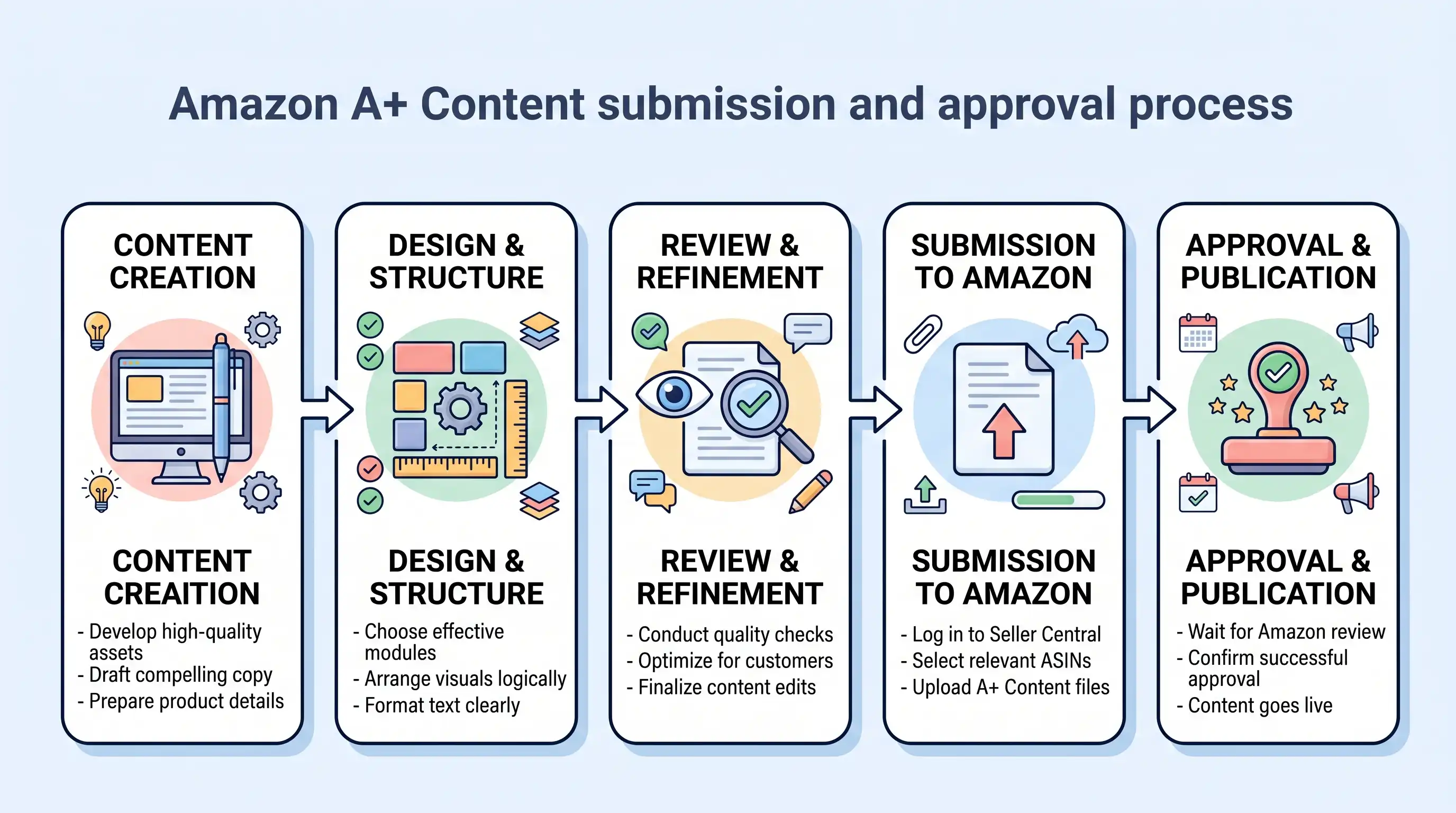
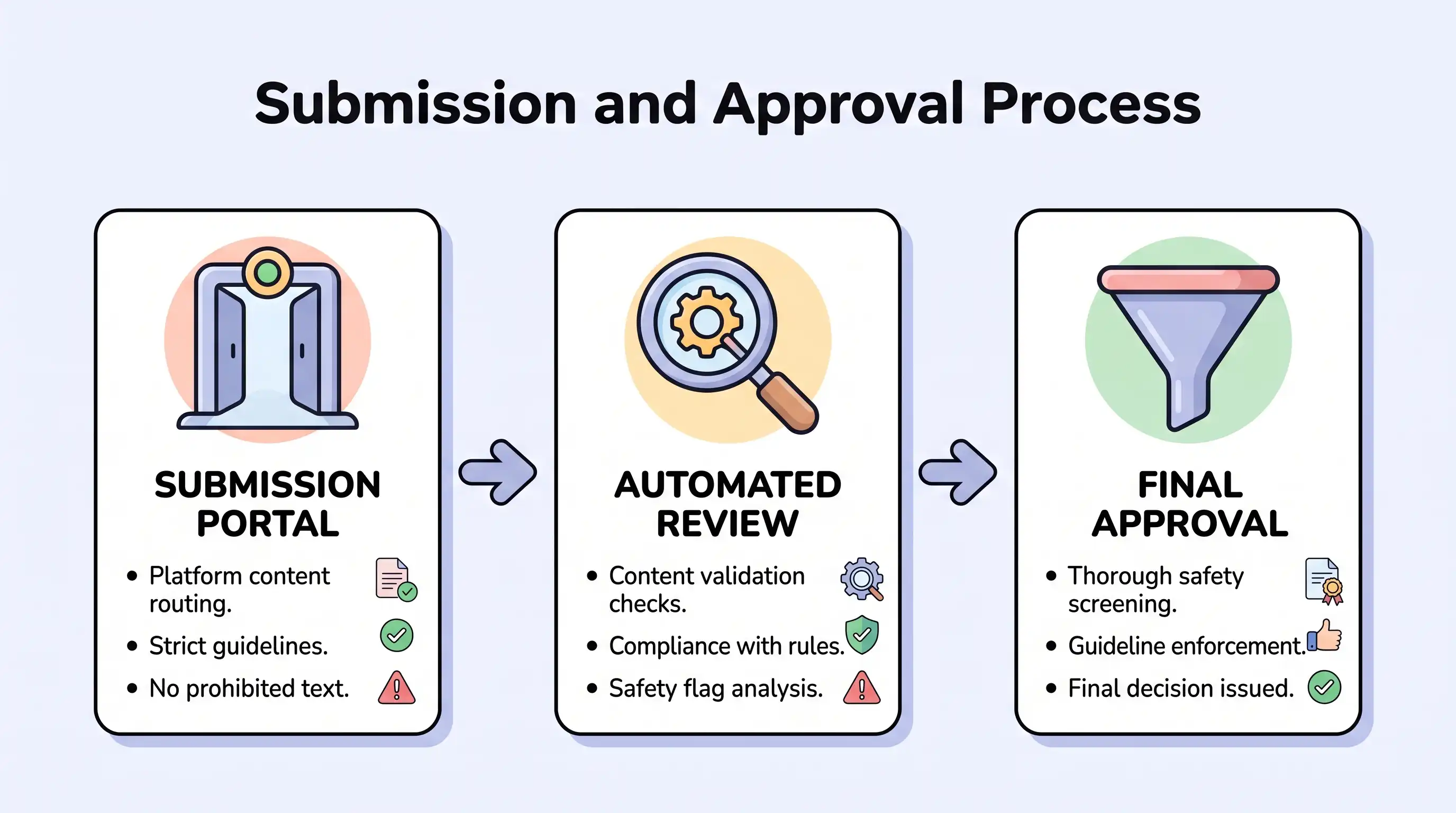
Once eligibility is secured, the execution phase begins through dedicated platform portals. Brands must route their submissions via Seller Central or, for first-party wholesale relationships, Vendor Central. Navigating these portals efficiently is key to minimizing your overall listing cycle time and maintaining operational momentum. Strict adherence to Amazon’s content guidelines is mandatory during this stage. The platform’s automated and manual review systems strictly evaluate submissions against key compliance metrics, automatically filtering out:
- Prohibited promotional text or time-sensitive pricing information
- Unverified warranty claims or restricted category keywords
- Non-compliant image ratios and low-resolution graphics
Failure to adhere to these parameters will result in immediate rejection, disrupting your product launch timeline and delaying potential CVR improvements. Under normal operational conditions, the typical review process requires two business days. However, complex visual modules may occasionally require extended scrutiny. If a submission is flagged for non-compliance, it returns to a draft state with specific rejection notes. You must emphasize prompt revisions the moment a notification arrives. Addressing flagged issues within hours rather than days accelerates the final approval loop. Faster publication translates immediately to enhanced customer trust, higher CTR from search results when paired with strong primary images, and a more robust foundation for dominating your target category BSR.
Measuring and Maximizing A+ Content Performance
Key Metrics to Track
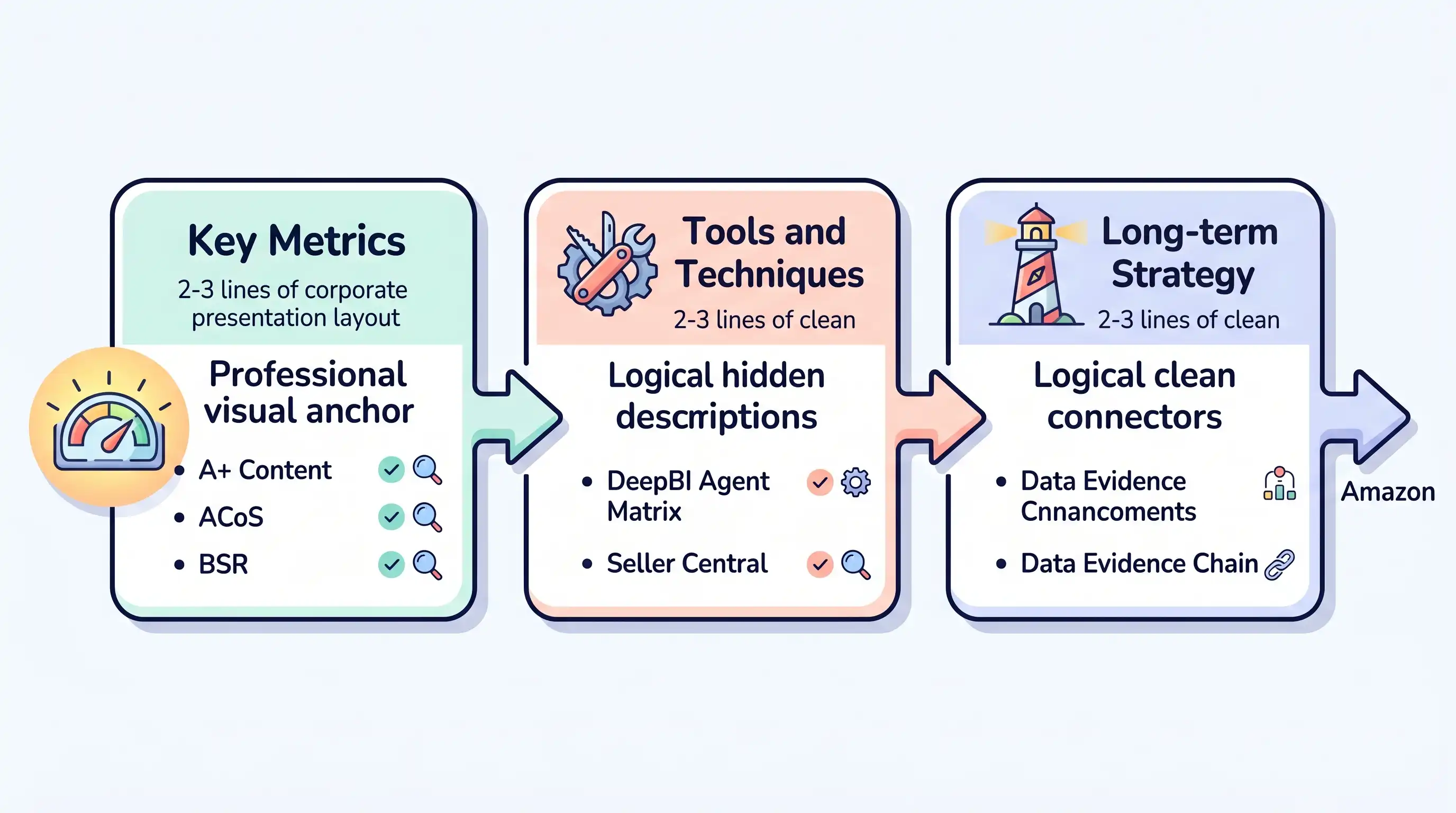
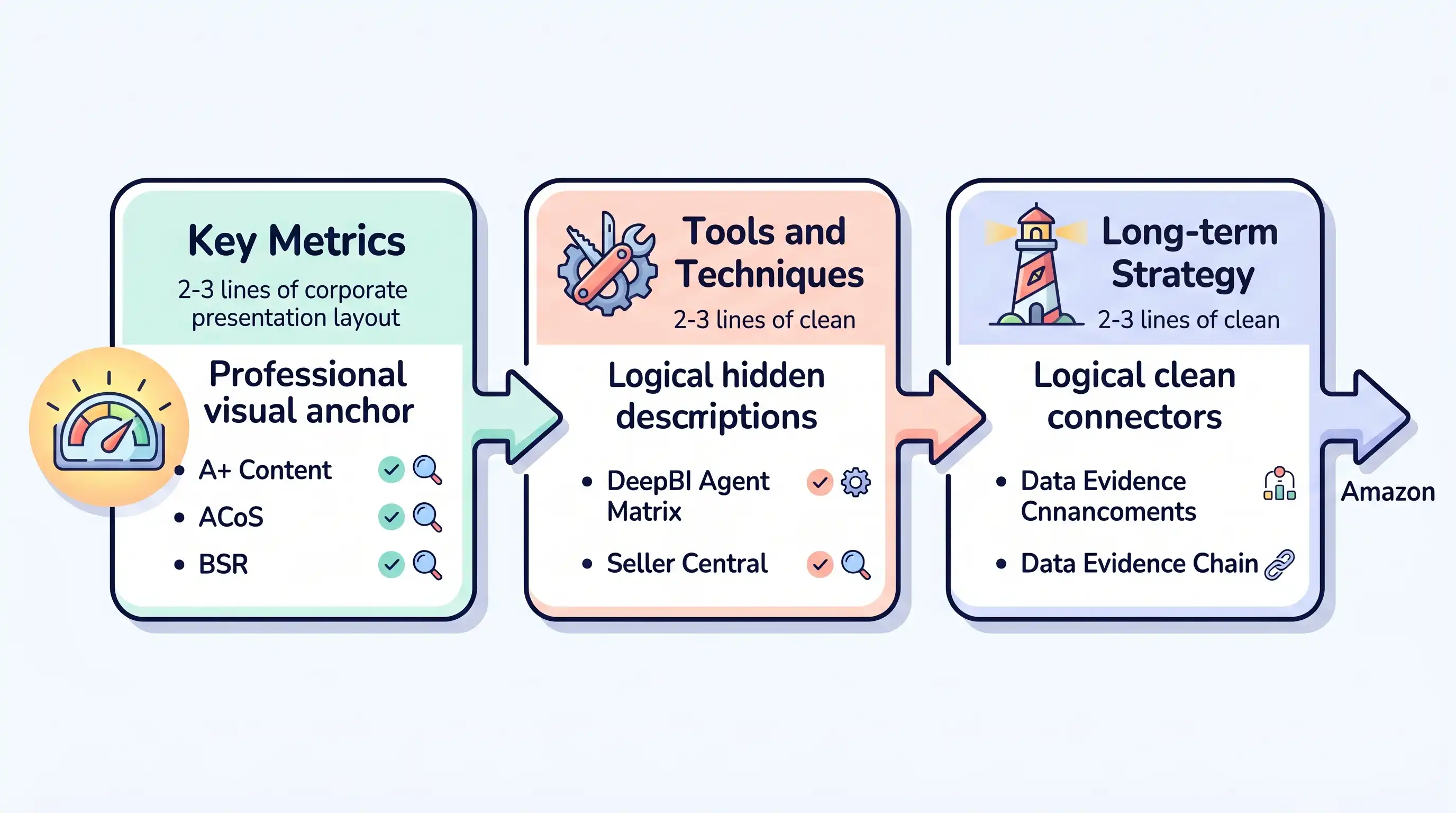
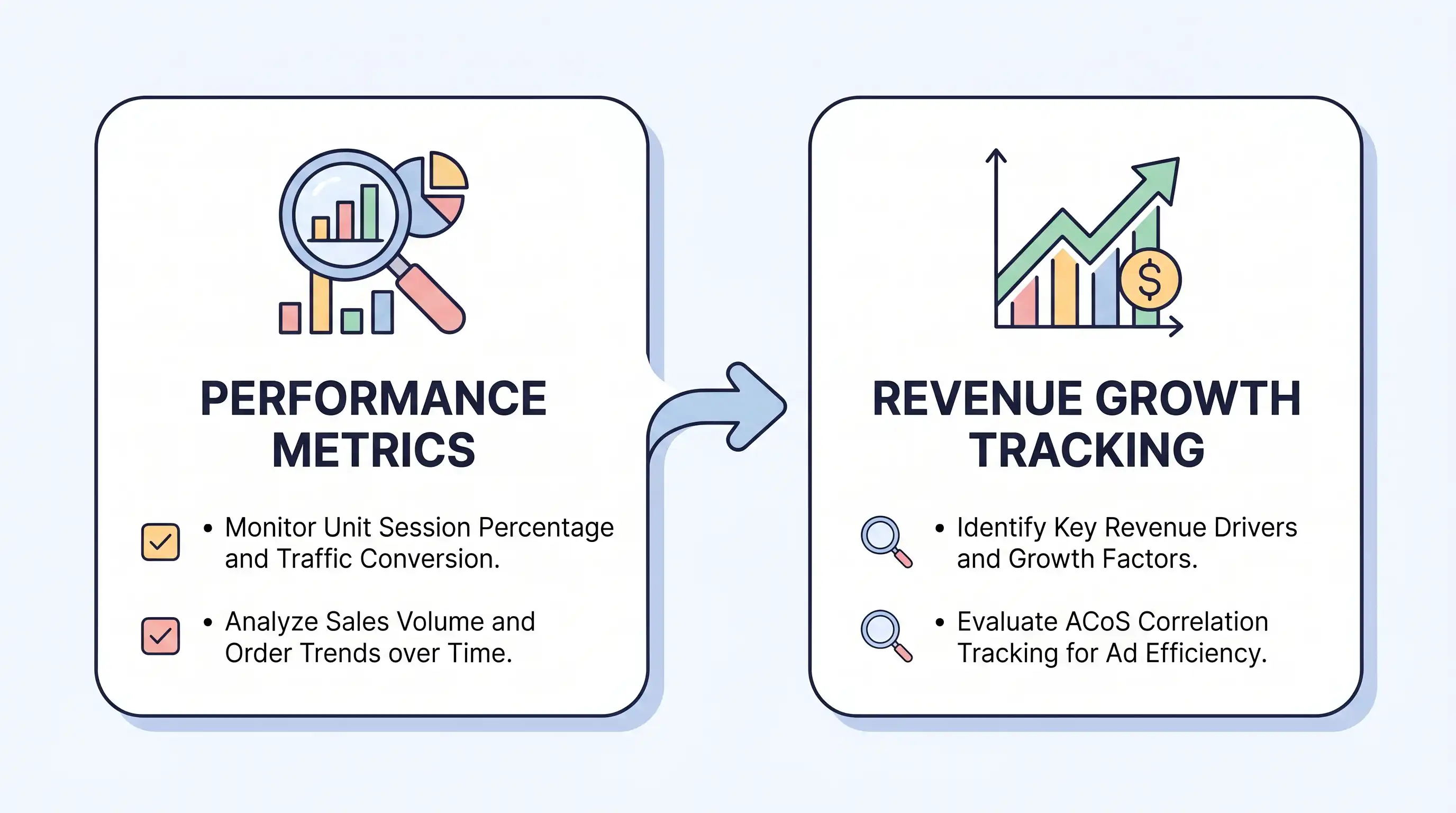
- Unit Session Percentage and Sales Volume Analytics: Focus explicitly on how unit session percentage shifts after deploying new A+ Content. Tracking this primary indicator alongside overall sales volume reveals whether the enhanced visual information structure is successfully converting traffic into tangible revenue, ultimately driving positive BSR movement.
- Revenue and ACoS Correlation Tracking: Evaluate revenue growth against advertising spend. High-performing A+ Content natively boosts CVR, which mathematically reduces ACoS by maximizing the return on every paid click directed to the listing.
- Customer Review Quality Indexing: Customer review quality operates as a vital lagging indicator of content alignment. Analyzing review sentiment ensures that the visual presentation accurately sets product expectations, thereby minimizing negative feedback and protecting long-term BSR stability.
Tools and Techniques for Optimization
- Seller Central Analytics and Native A/B Testing: Rely on Amazon's built-in framework to conduct rigorous split testing on A+ Content modules. Isolating specific imagery and text variations enables precise measurement of their direct impact on CTR and CVR.
- DeepBI Professional Agent Collaboration Matrix: This multi-agent collaboration system translates raw scoring results into highly actionable strategies and instructions. It comprehensively covers both persuasive copywriting and visual storytelling—including composition, presentation, and information structure. By generating engineering-standard execution plans, this matrix fundamentally minimizes human interpretation errors and dramatically accelerates the listing cycle time.
- DeepBI Listing Intelligent Scoring and Dynamic Competitor Benchmarking System: Operating as a primary diagnostic radar, this architecture simplifies content testing and management. It utilizes an automated competitor search and filtering funnel, governed by strict data collection, rigid similarity constraints, and multi-modal AI analysis. This setup enables quick adaptation to market changes and customer preferences by providing data-driven insights for the continuous refinement of listings.
- Data Evidence Chain Construction: The core value of DeepBI lies in establishing a continuous data evidence chain, guaranteeing that ongoing A+ Content optimization remains entirely empirical and insulated from subjective bias.
Long-term Strategy for Continual Improvement
- Amazon Evolving Requirements Monitoring: Advise staying informed about Amazon’s evolving structural and technical guidelines. Proactive compliance guards against unexpected listing suppressions and maintains an uninterrupted listing cycle time.
- Comprehensive Brand Architecture Integration: Integrating A+ Content into overall branding initiatives cultivates a cohesive omnichannel customer experience. Sustained consistency in visual storytelling reinforces brand equity, driving organic traffic retention and elevating CVR.
- Original Media Asset Deployment: Focusing strictly on high-quality, original media secures a sustained competitive advantage. Premium, proprietary imagery structured through rigorous data analysis ensures the listing continuously outperforms saturated market benchmarks.
Conclusion: Mastering Amazon A+ Content in 2026
A+ Content remains an absolute necessity for brands operating in highly competitive Amazon categories. The direct impact on your listing CVR makes it a non-negotiable asset for long-term growth and profitability. By replacing standard text descriptions with rich, formatted layouts, sellers fundamentally upgrade their brand storytelling capabilities. This elevated visual presentation captures shopper attention and drives them toward a decisive purchase, effectively lowering ACoS by maximizing the efficiency of your paid traffic. Furthermore, the strategic placement of backend keywords and structured text within A+ modules rigorously supports Amazon SEO, ensuring broader indexation and ultimately improving your product's BSR.
Launching these enhanced descriptions is only the initial step of the optimization lifecycle. To maintain market dominance in 2026, brands must commit to continuous monitoring and aggressive iterative testing. Tracking core performance metrics allows you to refine layouts based on actual shopper behavior rather than assumptions. Sellers must proactively leverage innovative modules, utilizing advanced comparison charts, high-definition graphics, and dynamic displays that retain user attention. Embracing this high-quality visual content is critical for establishing unshakeable brand authority. Shoppers consistently equate premium aesthetics with superior product quality, making your visual strategy a primary driver of consumer trust. Mastering A+ Content requires merging a data-driven approach with compelling design. By aligning visual assets with strict search optimization practices, you create a robust catalog ecosystem that captures and converts traffic efficiently. Prioritize shrinking your listing cycle time while consistently updating modules to reflect seasonal trends and new feature releases. The sellers who actively monitor, test, and refine their visual storytelling will secure higher CTR and CVR, outperform rivals in keyword rankings, and solidify lasting market share.