

How Amazon's Algorithm Actually Operates
To master Amazon SEO, you must first understand that you are operating on a platform with a dual identity: it is both a massive retail store and a powerful product search engine. For sellers, visibility is the prerequisite for sales. If your product doesn't appear on the first page of search results, it might as well be invisible. This visibility is governed by Amazon's proprietary search algorithm, commonly known as A9.
The A9 algorithm has one primary objective: to maximize revenue per customer by showing them the products they are most likely to purchase. This makes it fundamentally different from a search engine like Google. While Google’s algorithm heavily weighs external authority signals like backlinks to determine relevance and rank, Amazon’s algorithm is overwhelmingly focused on conversion. A sale is the ultimate vote of confidence.
A9 continuously analyzes a vast set of data points to predict which products will convert best for any given search query. The key metrics it prioritizes include:
- Conversion Rate (CVR): The percentage of visitors who purchase after viewing your listing. This is arguably the most critical ranking factor.
- Sales Velocity: The volume and speed of your sales over a recent period. Strong, consistent sales signal a popular product.
- Click-Through Rate (CTR): The percentage of shoppers who click on your product after seeing it in the search results. A high CTR indicates your main image, title, and price are compelling.
- Keyword Relevance: How well the keywords in your title, bullet points, and backend search terms match the customer's query.
- Customer Experience: Factors like positive reviews, low return rates, and maintaining stock are crucial for long-term ranking health.
While the algorithm is complex, the most influential factors—the visual and text assets that drive CTR and CVR—are entirely within your control. Historically, optimizing these elements relied on a designer's subjective aesthetic, leading to visuals that were "good-looking" but not necessarily "good-selling."
This is where a data-driven approach becomes a competitive necessity. Your product visuals and copy must be treated as a core commercial engine, not just a beautiful display. Advanced systems like DeepBI's multi-dimensional diagnosis engine analyze listings by breaking them down into logical modules, from the main image to A+ Content. Instead of offering vague advice, this approach provides precise, engineering-like instructions for improving everything from image composition to lighting. It transforms dry product features like "10000mAh" into compelling, three-part value statements that combine the selling point, data support, and a solution to the customer's pain point, directly fueling a higher conversion rate. By aligning your creative assets with the data-backed principles of conversion, you speak the language of the A9 algorithm and drive sustainable ranking growth.
Keyword Research Is the Foundation
Attempting to launch or optimize an Amazon product without rigorous keyword research is like navigating a ship without a compass. You are "flying blind," wasting ad spend on irrelevant traffic, and leaving your product undiscoverable to the very customers ready to buy. The foundation of any successful Amazon SEO strategy is not just finding keywords, but finding the right keywords that align with customer intent.
The most common mistake is prioritizing high search volume over high purchase intent. A generic, high-volume term might boost impressions but will likely result in a low Click-Through Rate (CTR) and an even lower Conversion Rate (CVR), ultimately harming your ACoS and profitability. The goal is to connect with shoppers at every stage of their journey. This involves clustering keywords by intent:
- Discovery Keywords: Broader terms a customer might use when first exploring a category (e.g., "kitchen organization").
- Consideration Keywords: More specific phrases that include features or use cases (e.g., "airtight glass food storage containers").
- Purchase-Ready Keywords: Long-tail, highly specific terms indicating an immediate need to buy (e.g., "BPA-free 10-piece container set with locking lids").
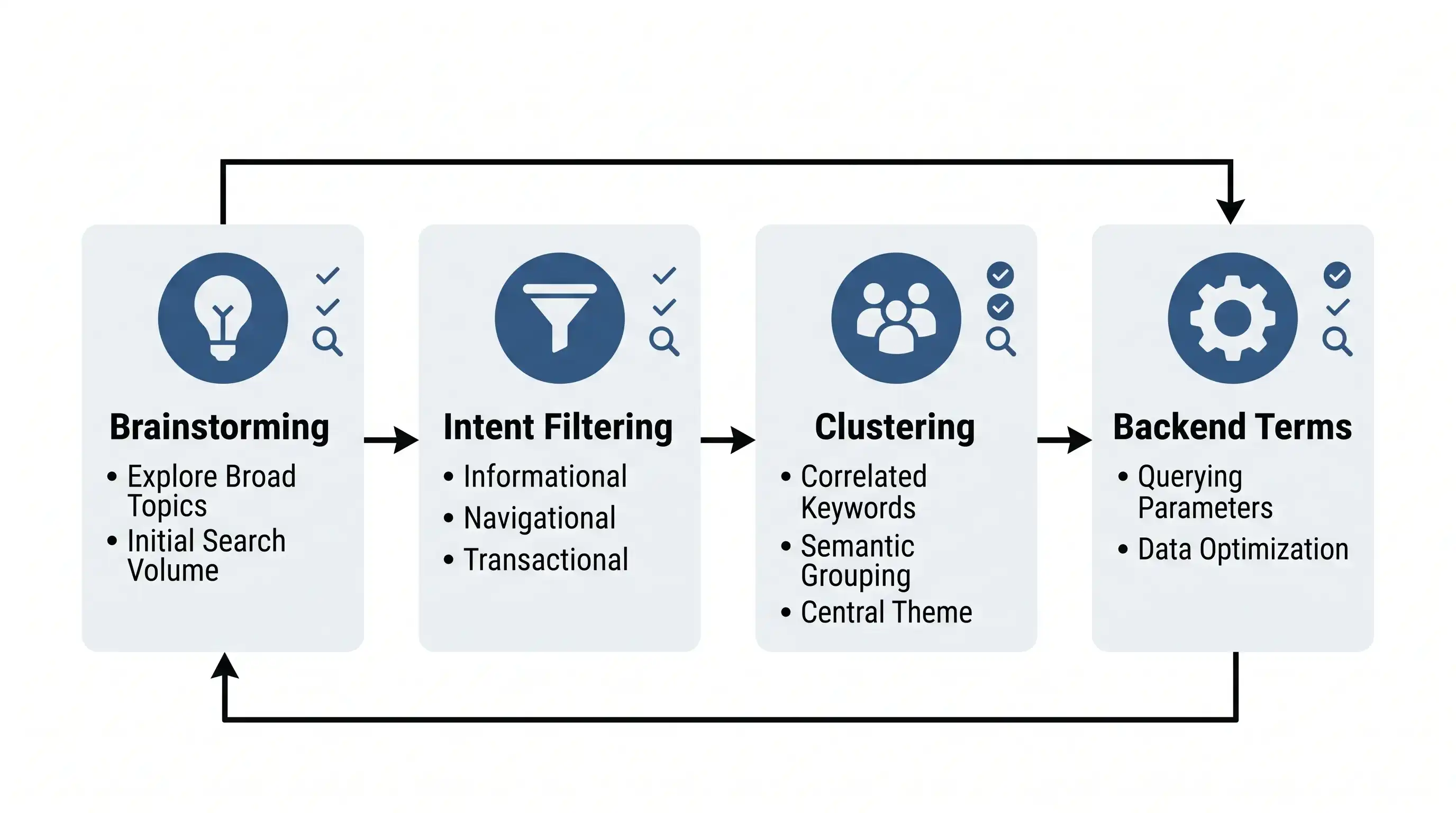
Beyond the visible parts of your listing, the backend search term fields are a strategic asset. This is the ideal place to include common misspellings, synonyms, and relevant foreign-language terms (like Spanish keywords for the US market) without cluttering your customer-facing copy.
However, simply compiling a list of keywords is not enough. To truly dominate a niche, you must understand the competitive landscape. Manually analyzing top sellers can lead to flawed conclusions, as you may be copying a strategy without understanding the underlying data. This is where advanced analytics provide a critical edge. Platforms like DeepBI enable multi-dimensional semantic benchmarking, moving beyond simple keyword matching to analyze the contextual relevance and purchase intent behind search queries. By conducting deep competitor benchmarking, you can deconstruct which keywords your rivals are actually ranking for and converting on, uncovering high-opportunity terms you may have missed. This data-driven approach transforms your keyword strategy from guesswork into a precise, targeted plan. Remember, keyword optimization is not a one-time setup; it's an iterative cycle of research, implementation, monitoring, and refinement to maintain and improve your Best Sellers Rank (BSR).
Layering SEO Into Your Listing - Without Overdoing It
The most effective Amazon listings strike a delicate balance: they must be perfectly optimized for the A9 search algorithm while also being persuasive and readable for human customers. A listing that ranks high but fails to convert is a wasted effort. True optimization involves weaving your keywords into a compelling narrative that drives both visibility and sales velocity. Every component, from the title to the A+ Content, must serve this dual purpose of attracting algorithms and converting shoppers.
Title Tips
Your product title is the most heavily weighted element for keyword relevance in Amazon's algorithm. The goal is to be descriptive and keyword-rich without sounding robotic or stuffed with jargon.
- Lead with Relevancy: Always place your most important, highest-volume keyword phrase at the very beginning of the title.
- Follow a Proven Formula: A reliable structure is: [Brand Name] + [Main Keyword Phrase] + [Key Benefit or Feature] + [Product Type/Use Case/Size/Color].
- Optimize for Mobile: Keep titles under 200 characters. This prevents your title from being cut off on mobile devices, where a significant portion of Amazon traffic originates.
- Prioritize Clarity: Avoid using all caps, special symbols like ™ or ©, and subjective promotional terms such as "Best Seller" or "High Quality." Focus on clear, descriptive language that sets accurate customer expectations.
Bullet Point Strategy
Your bullet points are your product's elevator pitch. Most shoppers skim this section to quickly grasp the key benefits before committing to reading the full description. This makes them a critical area for improving your conversion rate (CVR).
- Lead with the Benefit: Start each bullet point with a capitalized, benefit-oriented phrase that grabs the shopper's attention.
- Structure for Impact: Move beyond simply listing dry specifications. A high-converting approach uses a three-part structure: Selling Point + Data Support + Pain Point Solution. For instance, instead of a flat feature like "10000mAh," transform it into a compelling benefit: "ULTRA-EFFICIENT POWER: Features a 10000mAh power core to completely eliminate your low-battery anxiety during travel." This reframes a technical detail into a clear customer value proposition.
- Use the Full Space: Maximize the available character count for each bullet point. Use this space to elaborate on key features, present different use cases, and naturally incorporate secondary keywords. This provides richer information for both the A9 algorithm and highly interested shoppers.
The product description, images, and A+ Content are your primary tools for closing the sale. Their ability to boost your conversion rate directly impacts your sales velocity, which is a powerful ranking signal. Visual assets, in particular, should be treated as a core business engine for driving both click-through rate (CTR) from search results and on-page CVR. High-quality lifestyle images and infographics make your product more tangible and desirable. Furthermore, when building A+ Content, using descriptive alt-text for your images provides another opportunity for keyword indexing.
AI tools like DeepBI can streamline the creation of these high-converting assets. Instead of relying on subjective creative choices, DeepBI establishes "Visual Logic Reasoning," translating data from top-performing keywords into visual elements engineered to sell. It acts as a disciplined executor, ensuring product accuracy while transforming basic parameters into compelling, benefit-driven copy for titles and bullet points that resonate with human shoppers and satisfy the A9 algorithm.
Ongoing SEO Tuning: Why Optimization Is Never Done
One of the most costly misconceptions on Amazon is treating listing optimization as a "set it and forget it" task. Launching a product is the beginning, not the end, of your SEO efforts. To maintain and improve your Best Seller Rank (BSR) and sales velocity, you must treat optimization as a continuous cycle of analysis, refinement, and deployment. The Amazon marketplace is a highly dynamic environment where standing still is equivalent to moving backward.
Three primary forces make regular SEO audits—ideally every 3 to 6 months—a competitive necessity:
- Evolving Consumer Search Behavior: The keywords and phrases shoppers use to find products change with seasons, trends, and emerging needs. A keyword that drove a high conversion rate (CVR) six months ago may be losing search volume to a new, more specific long-tail variant that your listing isn't indexed for.
- Constant Competitor Activity: Your rivals are not idle. They are constantly testing new images to improve click-through rates (CTR), refining bullet points to boost CVR, and adjusting pricing strategies. If their listings improve while yours remains static, the A10 algorithm will take notice and reward their efforts with higher rankings at your expense.
- Amazon Algorithm Updates: Amazon’s A10 algorithm is perpetually being tweaked to enhance the customer experience. Factors that carry significant ranking weight today might be less important tomorrow, while new signals emerge. Continuous optimization ensures your listing remains aligned with current best practices.
A regular optimization cycle involves more than just swapping a few keywords. It requires a comprehensive audit of your keyword indexing, a deep dive into performance metrics, and a critical review of all content. The goal is to identify and eliminate friction points that are suppressing your CVR and costing you sales.
However, the effectiveness of this recurring process hinges on the quality of the changes you make. Vague directives like “make the image look better” are recipes for inconsistent results, as they rely on subjective judgment rather than data. A data-driven approach transforms this. Instead of guesswork, you can work with precise, engineering-style instructions for visual improvements. A simple feature like “10000mAh” is reframed into a compelling, three-part value proposition: a core benefit (“Ultra-Efficient”), supported by data (“10000mAh Power Core”), that solves a customer pain point (“Ending low-battery anxiety on the go”). This structured approach is designed to systematically lift your listing's CVR, turning a routine update into a powerful conversion event.
Common SEO Pitfalls That Kill Ranking Momentum
Achieving a high rank on Amazon is a significant milestone, but maintaining it requires vigilance against common, self-inflicted errors that can erase your progress overnight. Sustaining sales velocity depends on avoiding these critical pitfalls that directly undermine your SEO efforts.
- Keyword Stuffing: Jamming your title, bullets, and description with a repetitive, awkward string of keywords is an outdated tactic that now does more harm than good. It creates a poor customer experience, making your listing look spammy and untrustworthy. Amazon's A9 algorithm prioritizes readability and conversions; an unreadable title will sink your Click-Through Rate (CTR) and CVR, signaling to the algorithm that your product is a poor match for customer searches.
- Overlooking Backend Search Terms: Many sellers focus exclusively on customer-facing text and completely ignore the backend search term fields. This is a critical mistake. These hidden fields are indexed by Amazon and provide a dedicated space to target synonyms, long-tail keywords, common misspellings, and even competitor terms without cluttering your primary copy. Leaving them blank is equivalent to giving up free, relevant traffic.
- Subpar Visuals and Generic A+ Content: Your product imagery and A+ Content are your most powerful conversion tools.
- Poor-Quality Images: Low-resolution, poorly lit, or irrelevant images kill customer interest and trust. Optimizing visuals requires moving beyond vague advice and adopting precise, engineering-like directives that specify the ideal "composition, camera angle, and light distribution" to best showcase your product's features and benefits.
- Wasted A+ Content: A blank or generic A+ section is a massive missed opportunity. Instead of viewing it as a single long image, a high-converting page is structured into logical modules that address the customer journey, such as an introduction, core selling points, and pain point resolutions. This is where you transform dry specs into compelling benefits. For example, a simple parameter like "10000mAh" becomes a powerful value statement: "Super-Efficient Power (selling point) with a 10000mAh Core (data) to End Your Low-Battery Anxiety (pain point solved)."
- Running Out of Stock: A stockout is one of the fastest ways to destroy your ranking momentum. When your product becomes unavailable, your sales velocity plummets to zero. Amazon's algorithm heavily penalizes listings that cannot reliably fulfill orders, and your Best Seller Rank (BSR) will drop precipitously. Regaining your previous position can be a long and expensive process.
- Ignoring Performance Metrics and Competitors: Amazon SEO is not a "set it and forget it" activity. If you aren't regularly monitoring your listing's performance metrics (sessions, CTR, CVR) and keeping an eye on competitor strategy shifts, your ranking will inevitably decay. The market is constantly changing, and failing to adapt to new trends or competitive threats will leave you behind.
Conclusion
Navigating the Amazon marketplace successfully requires treating Search Engine Optimization not as a one-time task, but as the foundational infrastructure for your entire sales operation. It is the critical bridge that connects your excellent products to the right shoppers who are actively searching for them. On Amazon, visibility is never given; it is earned through a deliberate, data-informed strategy that aligns your listings with both the A9 algorithm's ranking factors and the customer's deepest needs.
The hard truth is that even a superior product will fail to gain traction if it remains invisible. Without a robust SEO strategy, sellers are left to blind trial and error, hoping for discovery rather than engineering it. This is where a systematic approach transforms your efforts from guesswork into a clear, data-driven process. By meticulously researching keywords, crafting compelling titles and bullet points, and leveraging A+ Content, you eliminate the ambiguity between your product's value and the customer's perception. This precision ensures that when a shopper lands on your page, the value proposition is instantly clear, building trust and removing friction from the path to purchase.
Ultimately, great SEO is the engine of compounding growth. It directly impacts key performance indicators across the board—improving click-through rates (CTR) by matching search intent, boosting conversion rates (CVR) with persuasive and informative content, and lowering advertising costs (ACoS) through higher organic relevance. Each sale driven by strong SEO improves your sales velocity and Best Seller Rank (BSR), which in turn signals to Amazon to rank you even higher. This creates a powerful, self-reinforcing flywheel that builds momentum, solidifies your market position, and drives sustainable, long-term profitability.
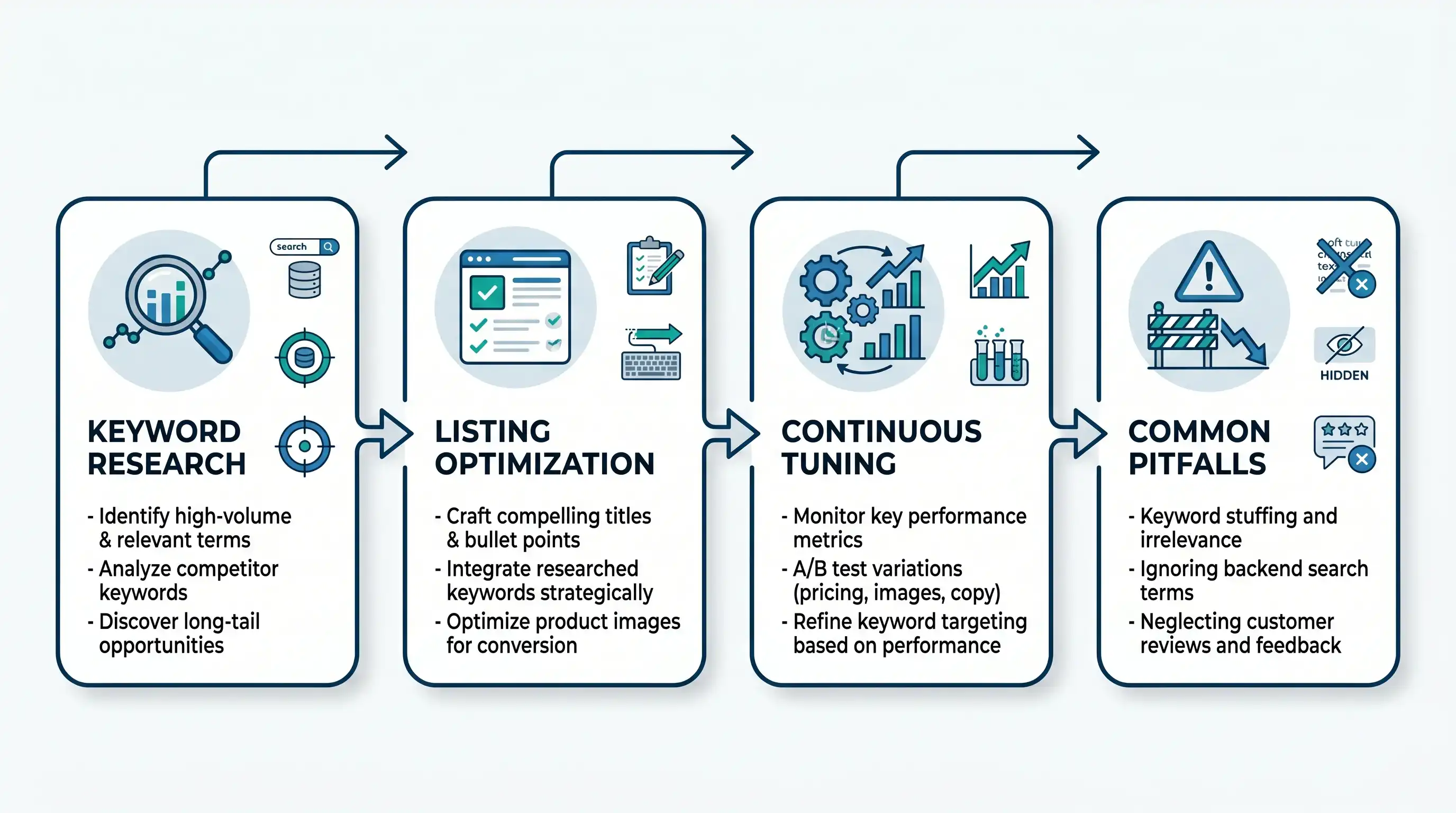
Amazon SEO FAQs
How long does it take to see Amazon SEO results?
You can typically expect to see initial changes in ranking and traffic within 4 to 8 weeks. However, the timeline is highly dependent on several factors. Products with high sales velocity in less competitive niches will see results faster. Conversely, in a crowded market, it will take longer to gain traction. Consistent inventory levels are also critical; going out of stock will halt and reverse any SEO progress you've made.
What's the difference between Amazon SEO and Google SEO?
The primary difference lies in user intent and the core focus of the algorithm. Google SEO prioritizes content relevance, authority, and backlinks to answer user queries, which are often informational. Amazon SEO is entirely focused on commercial intent. The A9 algorithm prioritizes metrics that signal a high likelihood of a sale, such as click-through rate (CTR), conversion rate (CVR), and overall sales velocity. On Amazon, conversion is king.
What are the most important Amazon ranking factors?
The most critical factors are a blend of relevance and performance. Keyword relevance in your title, bullet points, and backend search terms tells Amazon what your product is. After that, performance metrics take over:
- Click-Through Rate (CTR): How often shoppers click your product after seeing it in search results.
- Conversion Rate (CVR): The percentage of visitors who purchase after landing on your page.
- Sales Velocity: The volume and speed of your sales over time.
- Customer Experience: Positive reviews, high ratings, and a low return rate send strong signals of a quality product.
Should I target high-volume or long-tail keywords?
A successful strategy requires both. High-volume, broad keywords are essential for driving maximum visibility and traffic to your listing. However, long-tail keywords (phrases of three or more words) are crucial for driving conversions. They capture shoppers with a more specific, high-purchase intent. A balanced mix ensures you attract a wide audience while converting the most qualified buyers.
Do images and A+ Content directly impact SEO?
They have a powerful indirect impact. While the A9 algorithm doesn't "see" the quality of an image, high-quality visuals and compelling A+ Content significantly improve user engagement. This leads to a higher CTR from search results and a better CVR on the product page—two of the most important ranking factors. Additionally, the alt-text fields for images within A+ Content are indexed by Amazon, offering another opportunity to place relevant keywords.
How often should I update my product listings?
Amazon SEO is not a one-time task. The market is constantly changing. You should plan to review and optimize your listings every 3 to 6 months. Monitor your performance data, keep an eye on competitor strategies, and stay updated on customer search trends. If you notice a dip in your CTR, CVR, or keyword rankings, it's time for a refresh.
Can I do Amazon SEO without running ads?
Yes, you can achieve organic ranking without paid advertising, but the process will be significantly slower. Organic SEO builds the essential, long-term foundation for your listing. However, Amazon Ads (PPC) act as an accelerator. They drive immediate traffic and sales, which boosts your sales velocity and conversion data. These are powerful positive signals to the A9 algorithm that can rapidly improve your organic rank.
What's the risk of keyword stuffing?
Keyword stuffing is a detrimental practice that harms your listing in multiple ways. First, it makes your title and bullet points unreadable and spammy, which destroys customer trust and lowers your conversion rate. Second, Amazon's algorithm is sophisticated enough to recognize and penalize this manipulative tactic, which can lead to suppressed rankings. Always prioritize clear, persuasive copy written for humans, not just algorithms.
How do backend keywords help my SEO?
Backend keywords are a crucial tool for expanding your search visibility without cluttering your customer-facing content. This hidden field is the ideal place to include synonyms, common misspellings, translations, and secondary long-tail phrases that didn't fit naturally into your title or bullet points. It allows Amazon to index your product for a much wider array of relevant search queries.
What is the number one mistake sellers make with Amazon SEO?
The biggest mistake is treating SEO as a "set it and forget it" activity. The Amazon marketplace is dynamic, with competitors, customer behavior, and the algorithm itself constantly evolving. Effective SEO requires an ongoing cycle of research, implementation, monitoring performance data, and continuous optimization to maintain and improve your rank and sales.
Ready to Turn Amazon SEO Into Your Growth Engine?
Achieving a top rank on Amazon is not a matter of luck; it's the direct result of a deliberate, data-informed strategy. For the platform's most successful brands, sophisticated SEO is the backbone of their growth, consistently driving visibility, traffic, and sales. Conversely, an under-optimized listing is more than just a missed opportunity—it's a constant drain on your business, leading to suppressed rankings, diminished click-through rates (CTR), and lost revenue every single day.
The challenge is that manual optimization is often fragmented and subjective. Sellers fall into diagnostic traps like "survivor bias," where they emulate the top bestseller without realizing their product, price point, or audience is completely different. This leads to a flawed strategy from the very beginning. The gap between a good idea and effective execution is vast, leaving teams to guess at what visuals or copy will actually improve conversion rates (CVR).
This is where DeepBI transforms your approach. We partner with brands to turn their product listings into high-performance, revenue-driving assets. Our full-link optimization system eliminates the guesswork by integrating diagnosis, strategy, and execution into a single, automated, closed-loop process. We move your operations from subjective intuition to algorithmic precision.
Our system doesn't just offer vague advice. Instead of treating your detail page as a single image, we structurally analyze it across six key modules to pinpoint weaknesses. We transform dry product features like "10000mAh" into compelling, three-part value propositions: "Ultra-Efficient (Benefit) + 10000mAh Power Core (Data) + Say Goodbye to Low-Battery Anxiety (Pain Point Solved)." Most importantly, we translate these strategic insights into precise, executable commands for content creation, while our "Product Entity Consistency" principle ensures that all optimizations are true to your product, preventing the kind of "image vs. reality" discrepancies that lead to devastating negative reviews.
Let us show you how to build listings that are truly retail-ready—designed to rank, engage, and convert. We will review your product catalog, share actionable insights, and map out the precise steps to elevate your brand on Amazon.