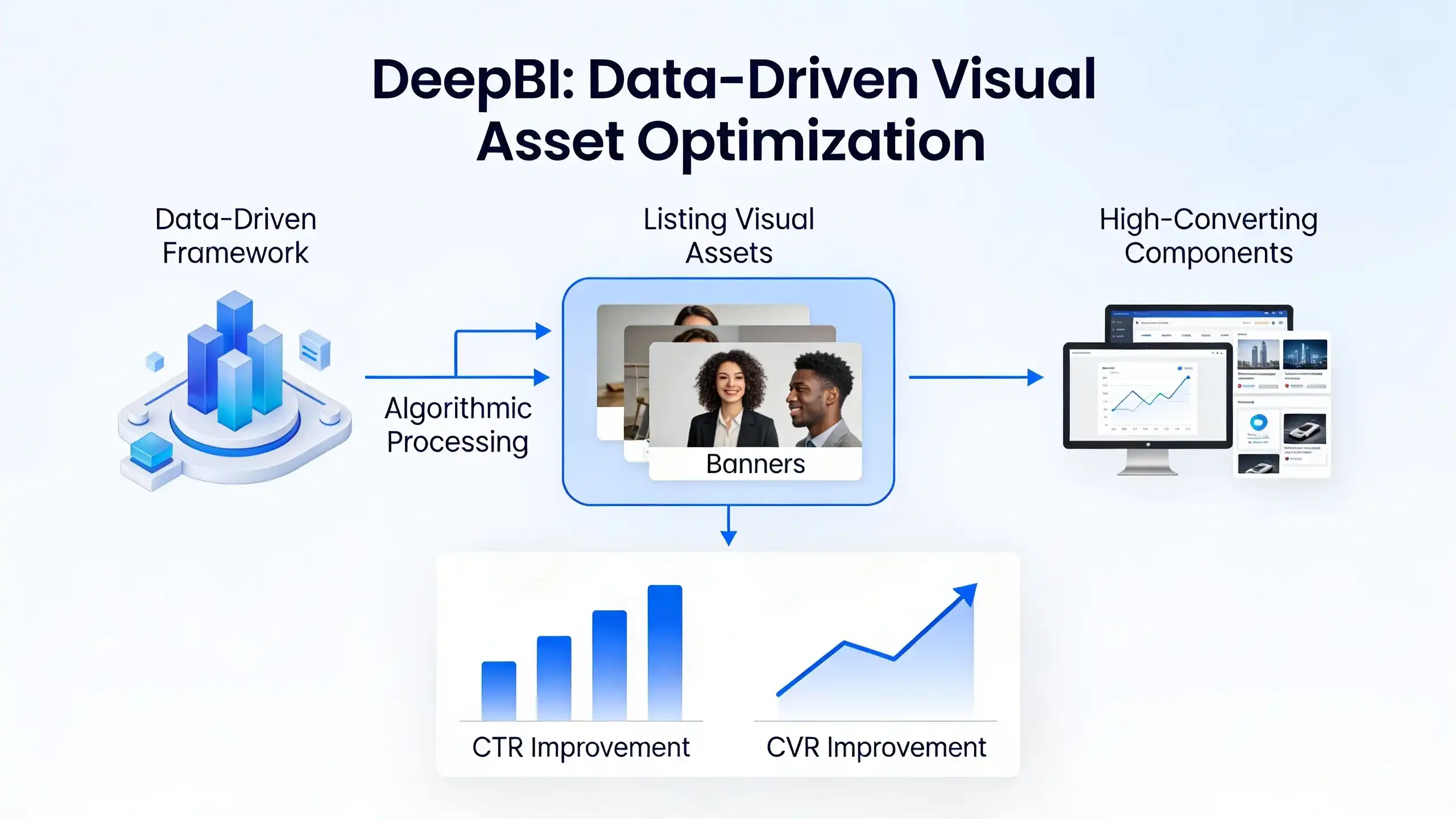
In the hyper-competitive Amazon marketplace, rising traffic costs and the constant pressure to improve key metrics create a dual anxiety for sellers. For too long, optimizing visual assets has been a game of guesswork, relying on a designer's subjective aesthetic. This often results in a listing that looks appealing but fails to improve the bottom line. The reality is that your visual assets, particularly the main image, are no longer just for show; they are a core commercial engine designed to drive a higher Click-Through Rate (CTR) and pull customers away from an endless scroll of competitors.
This is where a data-driven strategy becomes essential. Instead of relying on intuition, what if you could translate high-converting search terms and performance data directly into precise visual instructions? This is the principle behind DeepBI's "Visual Logic Reasoning"—a system built to eliminate uncertainty and consistently generate listings that drive sales. This guide will walk you through how to move beyond subjective tweaks and leverage a data-first approach to build a powerful feedback loop: a better listing attracts more precise traffic, leading to healthier, long-term growth.
一、The Foundation of Amazon Success: Main Images and CTR
In the competitive Amazon marketplace, visual assets have evolved from simple product showcases into the core engine driving commercial performance. Your main image and the Click-Through Rate (CTR) it generates are the foundational pillars of this engine, directly influencing traffic, ranking, and ultimately, sales.
Why Your Main Image is the Gateway to Conversions
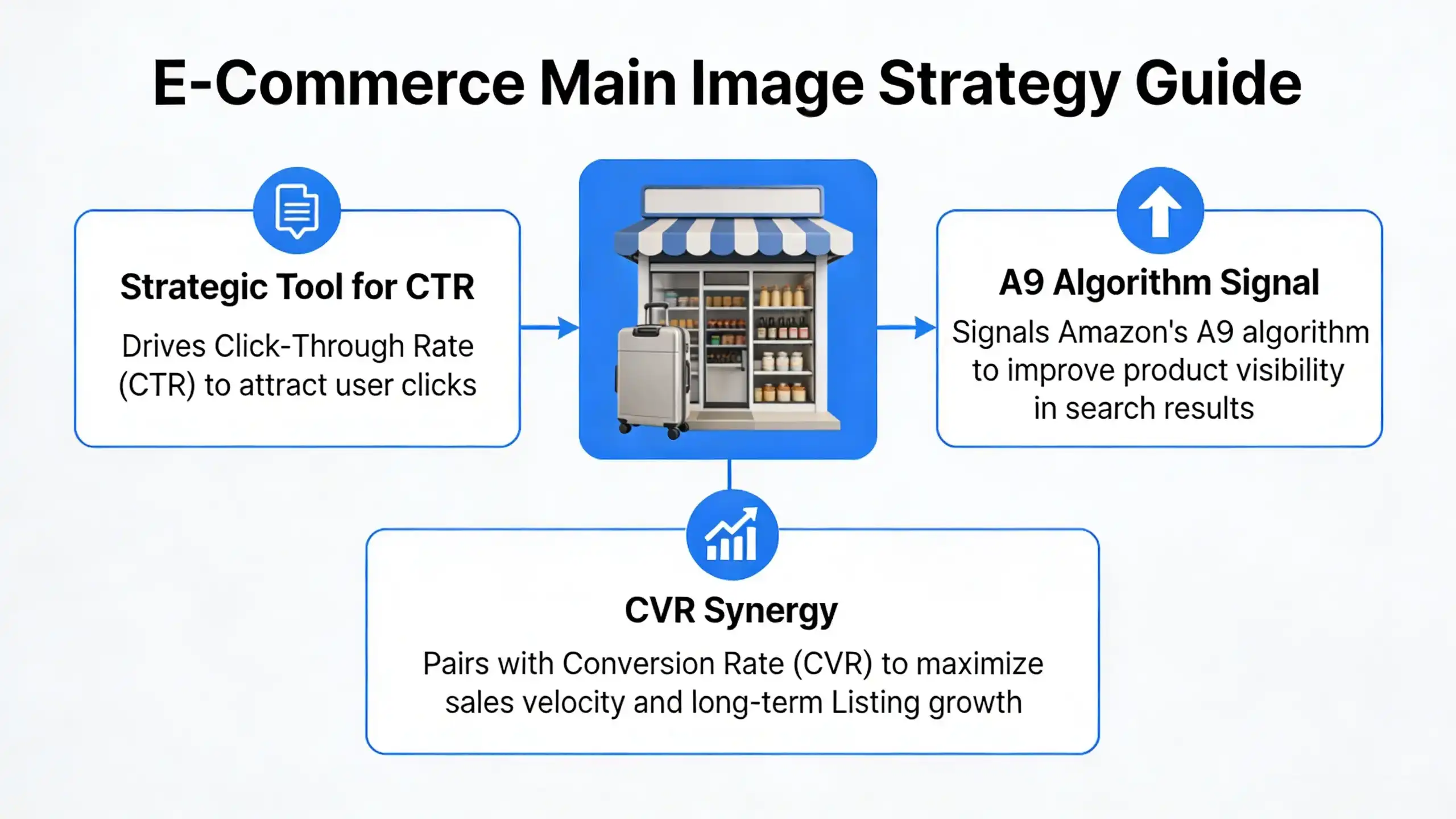
On a crowded search results page, your main image is the single most critical asset for capturing a shopper's attention. It's the first, and often only, opportunity to make an impression and earn a click. The function of this image is not merely aesthetic; it is a strategic tool designed to drive clicks (CTR) and initiate the conversion process. A compelling main image instantly communicates your product's value proposition, differentiates it from competitors, and persuades the customer that your listing is worth exploring further.
Understanding Click-Through Rate (CTR) and Its Broader Impact
Click-Through Rate (CTR) is the percentage of shoppers who click on your product after seeing it in search results. This metric is a powerful signal to Amazon's A9 algorithm. A higher CTR indicates that your product is highly relevant to the customer's search query. In response, Amazon may reward your listing with improved organic rankings and greater visibility. This creates a positive feedback loop: better visibility leads to more impressions, which, with a strong main image, can generate an even higher CTR and more traffic.
Beyond CTR: The Interplay with Conversion Rate (CVR) and Sales Velocity
While a high CTR is essential for driving traffic, it is only half the battle. To achieve sustainable growth, that traffic must convert into sales. This is measured by the Conversion Rate (CVR)—the percentage of visitors who make a purchase. A high CTR paired with a low CVR signals a disconnect between your main image's promise and the reality of your product detail page, leading to wasted ad spend and potentially harming your ranking over time. The ultimate goal is to maximize sales velocity, which is achieved when a high CTR works in tandem with a strong CVR. This powerful combination is what Amazon's algorithm rewards most, fueling a cycle of healthy, long-term growth.
二、Amazon's Guidelines and Strategic Visual Storytelling
Your main image is the single most critical visual asset for driving click-through rate (CTR) on Amazon. However, before you can optimize for clicks, you must first ensure strict compliance with Amazon's technical requirements to avoid having your listing suppressed.
Adhering to Amazon's Technical and Compliance Requirements
Amazon enforces a clear set of rules for main images to maintain a consistent and professional customer experience. Failure to comply will result in your listing being hidden from search results, effectively halting your sales. Key requirements include:
- Pure White Background: The background must be RGB (255, 255, 255).
- Product Focus: The product itself must occupy at least 85% of the image frame.
- Clean Image: No additional text, logos, watermarks, or inset graphics are permitted.
- High Resolution: Images should be at least 1,000 pixels on the longest side to enable the zoom feature, which is crucial for customer evaluation and conversion.
Meeting these standards is the non-negotiable first step. It ensures your product remains visible and eligible for sale.
Leveraging Visual Storytelling and Product Focus
Compliance is just the baseline; strategic optimization is what drives performance. A powerful main image goes beyond simply showing the product—it tells a story and communicates value in a fraction of a second. Instead of relying on vague artistic direction, effective optimization uses precise parameters to achieve a specific business goal.
This means moving from ambiguous goals like "make it look premium" to actionable instructions focusing on composition, lighting, and camera angles that best highlight the product's primary benefit. Your main image should be instantly recognizable and clearly answer the customer's initial question: "What is this and why do I need it?" A well-composed, high-clarity image that showcases the product in its best light will capture attention, improve CTR, and give you a competitive edge in crowded search results.
三、DeepBI: Your Partner in Data-Driven Listing Optimization
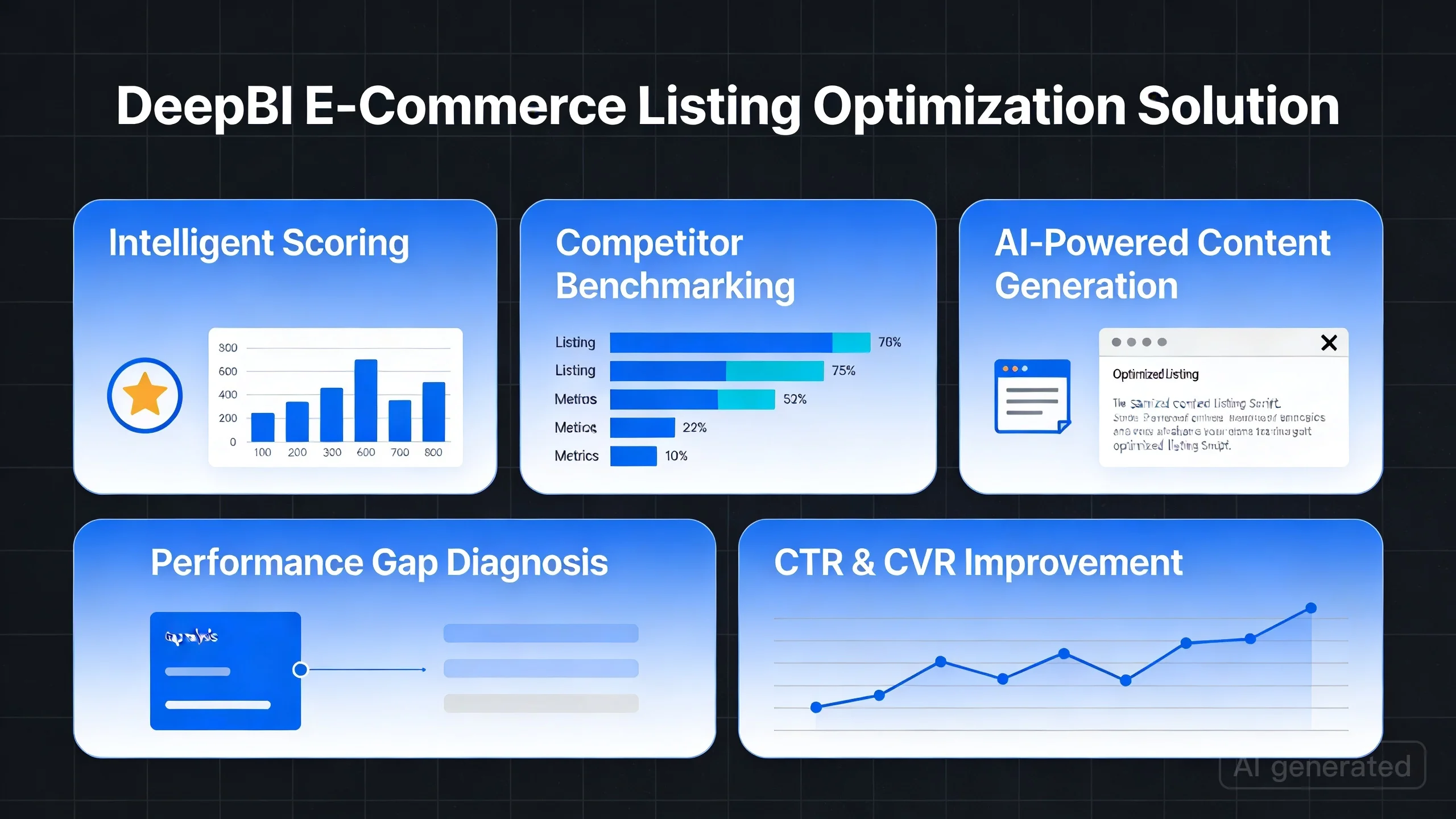
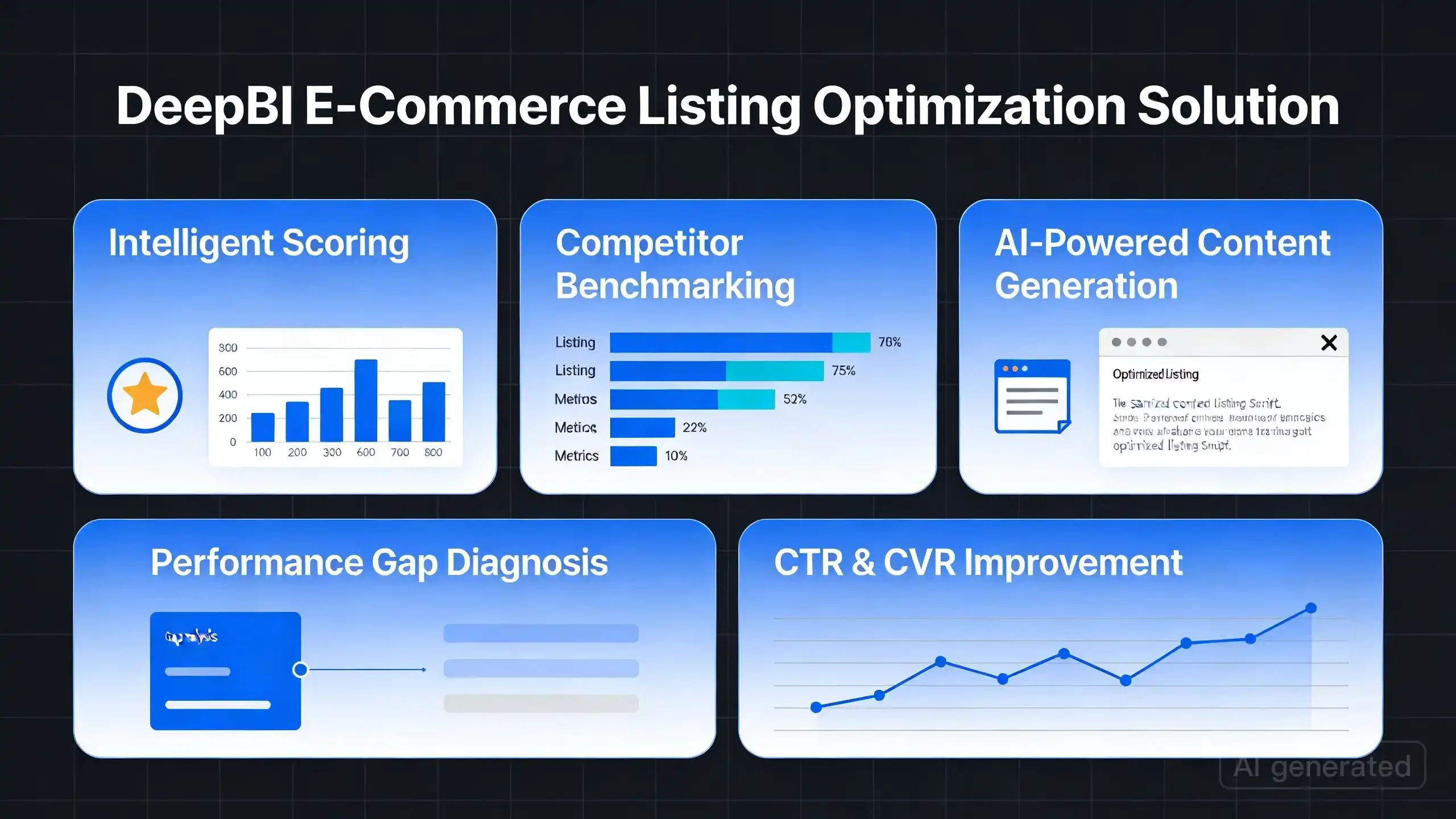
DeepBI transforms listing optimization from a subjective art into a data-driven science. By moving beyond guesswork, our platform provides a systematic, end-to-end solution to diagnose weaknesses, benchmark against the best, and generate high-performance content that directly impacts your Amazon KPIs.
Intelligent Scoring and Competitor Benchmarking
Effective optimization begins with an accurate diagnosis. DeepBI employs distributed data crawling and multi-dimensional semantic matching to identify your true competitors, not just those with similar keywords. It then conducts a comprehensive audit of your listing, assigning a multi-dimensional score across critical elements: main image, title, bullet points, A+ content, and customer review signals. This score isn't an arbitrary grade; it's a direct benchmark against the top-performing ASINs in your category, providing a clear, quantitative measure of where you stand and what excellence looks like.
Multi-Dimensional Diagnosis for Performance Gaps
With a benchmark in place, DeepBI quantifies the specific factors impacting your key performance indicators. The platform pinpoints weaknesses that suppress your Click-Through Rate (CTR) and Conversion Rate (CVR), translating your listing score into a clear performance gap analysis. Instead of vague feedback, you receive a prioritized list of issues, showing exactly how elements like a suboptimal main image are hurting your CTR or how weak bullet points are failing to drive conversions, allowing you to focus your efforts where they will yield the greatest return.
AI-Powered Content and Image Generation
DeepBI translates diagnostic insights into executable assets. Its multi-agent AI collaboration moves beyond generic advice, generating precise, engineering-like instructions for visual and text content. For images, this means defining specific composition, lighting, and camera angles designed to maximize CTR. For text, it transforms dry product features like "10000mAh" into a compelling, three-part value statement: "Ultra-Efficient (Benefit) + 10000mAh Power Core (Data) + End Your Travel Power Anxiety (Pain Point Solved)." Crucially, this AI is not a freeform creative tool; it is strictly constrained by your product's "DNA" to ensure 100% factual accuracy, preventing the "AI hallucinations" that lead to poor reviews and returns.
四、Optimizing Key Listing Elements for Maximum Impact
Beyond the main image, your product title, bullet points, and A+ Content are critical assets for driving both traffic and conversions. A poorly optimized title will fail to attract clicks (low CTR), while unpersuasive copy will lose the sale (low CVR). The key is to structure each element to satisfy both Amazon's search algorithm and the customer's need for clear, compelling information.
Crafting High-Impact Titles
Your product title is the first line of engagement and a primary driver of search visibility. A high-impact title balances keyword relevance with human readability. The optimal structure typically follows a clear formula: Brand Name + Primary Keyword Phrase + 1-2 Key Features/Benefits + Critical Specifiers (e.g., Size, Color, Quantity). This format ensures your most important keywords are indexed by Amazon's A9 algorithm while immediately communicating your product's core value to the shopper. Prioritize clarity and place the most crucial information at the beginning, as titles are often truncated on mobile devices.
Developing Compelling Bullet Points and A+ Content
Once a shopper clicks, your bullet points and A+ Content must work together to convert that interest into a purchase. Move beyond listing dry technical specifications and instead translate features into tangible customer benefits.
- Bullet Points: Instead of stating a parameter like "10000mAh," reframe it using a three-part structure: Selling Point + Data Support + Pain Point Solution. For example: "All-Day Power (Selling Point) with a 10000mAh Core (Data) to End Battery Anxiety on Your Travels (Solution)." This approach connects the feature directly to a user's needs, significantly boosting its persuasive power and CVR.
- A+ Content: Use this space to tell your brand story and visually address customer questions. Treat the A+ section not as a single long image, but as a series of strategic modules: an introduction, a core selling point deep-dive, a pain point resolution showcase, and comparison charts. This structured, modular approach guides the customer through a logical narrative, making the information easier to digest and more effective at building purchase confidence.
五、Implementing and Iterating: The DeepBI Advantage
Effective optimization requires not only generating superior content but also deploying and refining it efficiently. DeepBI bridges the gap between analysis and execution, transforming your optimization strategy into a seamless, data-driven cycle that minimizes friction and maximizes impact on key performance indicators like Click-Through Rate (CTR) and Conversion Rate (CVR).
Seamless One-Click Application via SP-API
The final step of transferring optimized assets to your Amazon listing is often a source of manual error and inefficiency. DeepBI eliminates this friction with its one-click application module. Using Amazon's official Selling Partner API (SP-API), this feature creates a secure and automated channel directly to your Seller Central account.
With a single command, you can sync all your approved optimizations—including AI-generated images, A+ content modules, revised titles, and value-driven bullet points—directly to the listing. This automated delivery engine transforms a cumbersome process into a streamlined "analyze → generate → launch" workflow. It not only drastically reduces manual effort and eliminates copy-paste errors but also shortens the entire listing update cycle, ensuring your strategic improvements go live with speed and precision.
Continuous Monitoring and Refinement
Listing optimization is not a one-time fix; it's an ongoing process of iterative improvement. DeepBI is built to support this continuous loop by de-risking the update process. Before committing any changes, the platform allows you to conduct a side-by-side comparison of the new, optimized version against the current live version.
This crucial quality assurance step provides decision safety, allowing you to visually confirm that every change aligns with your optimization goals. Once a new version is launched, you can monitor its performance impact on metrics like BSR and CVR. This data then feeds back into the diagnostic engine, creating a virtuous cycle where each iteration is more informed than the last, driving sustained growth and competitive advantage.
六、Conclusion: Elevate Your Amazon Listings with DeepBI
In today's competitive Amazon landscape, your listing's visual assets—especially the main image—are no longer just for aesthetic appeal; they are the core engine driving your Click-Through Rate (CTR) and Conversion Rate (CVR). Relying on subjective design choices and guesswork is a high-risk strategy that often fails to produce consistent commercial results.
DeepBI fundamentally transforms this process, replacing ambiguous creative direction with a data-driven, algorithmic framework. By establishing "visual logic reasoning," our system translates high-performing advertising data and winning search terms into precise, actionable optimization instructions for every component of your listing. This systematic approach moves your strategy from hoping for a "good-looking" image to engineering a "high-converting" one.
The result is a powerful, automated closed loop where better listings attract more qualified traffic, leading to improved CTR and CVR. This virtuous cycle not only boosts sales but also fosters healthier long-term growth. Stop guessing what works and start building a decisive competitive advantage. Elevate your Amazon business by embracing the power of data with DeepBI.