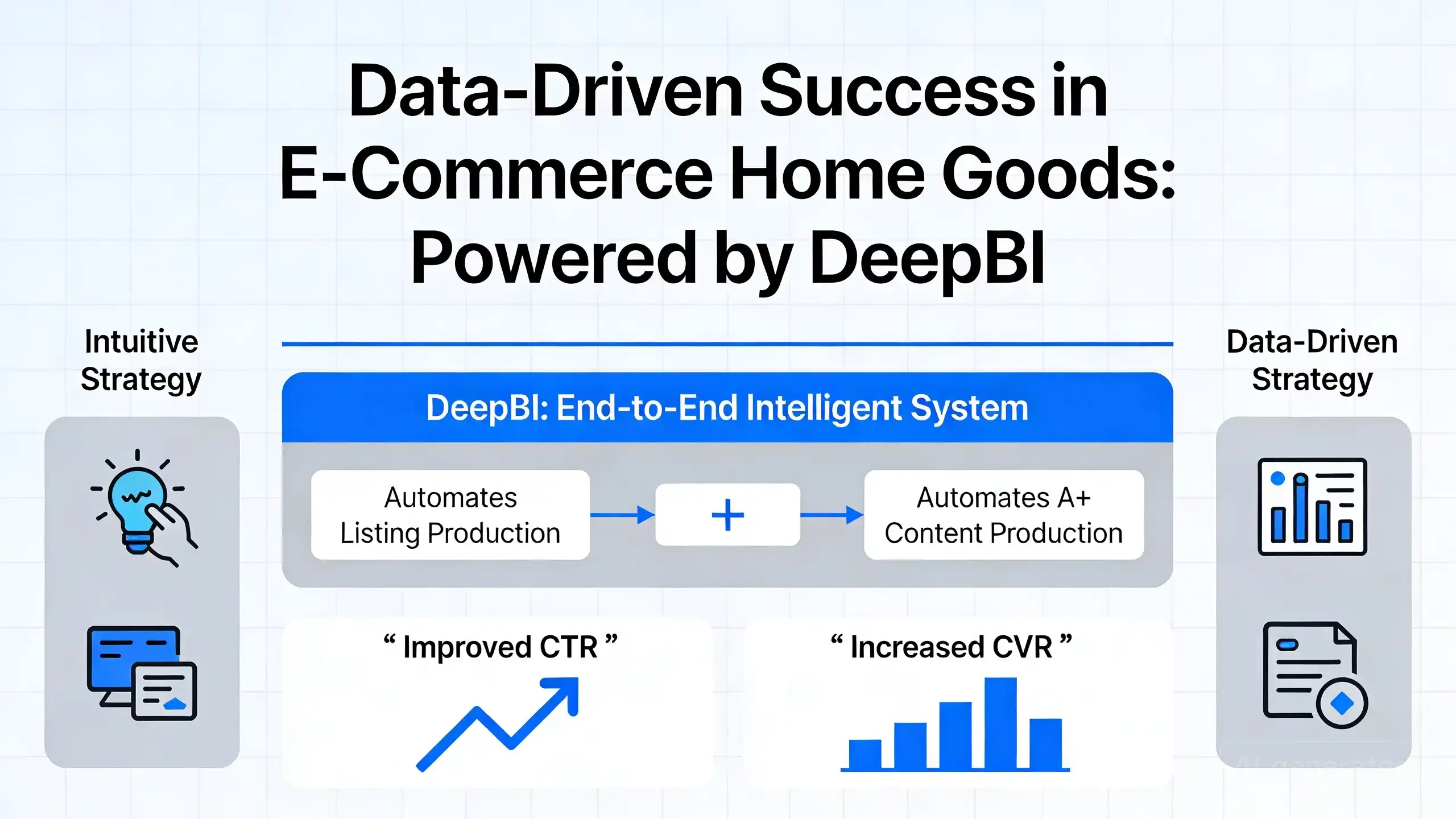
The Imperative of Amazon Listing Optimization for Home Goods
In the hyper-competitive Amazon marketplace, a fully optimized product listing is no longer an advantage—it is a fundamental requirement for survival, especially in the home goods category. Unlike other product niches, home goods purchases are deeply personal and often involve higher price points. Customers are not just buying an item; they are investing in their living space. This elevates the importance of visual appeal, comprehensive descriptions, and, most critically, customer trust. For larger items like furniture or decor, shoppers rely entirely on the listing to make a confident decision, and any discrepancy between the image and the product can lead to damaging negative reviews and returns.
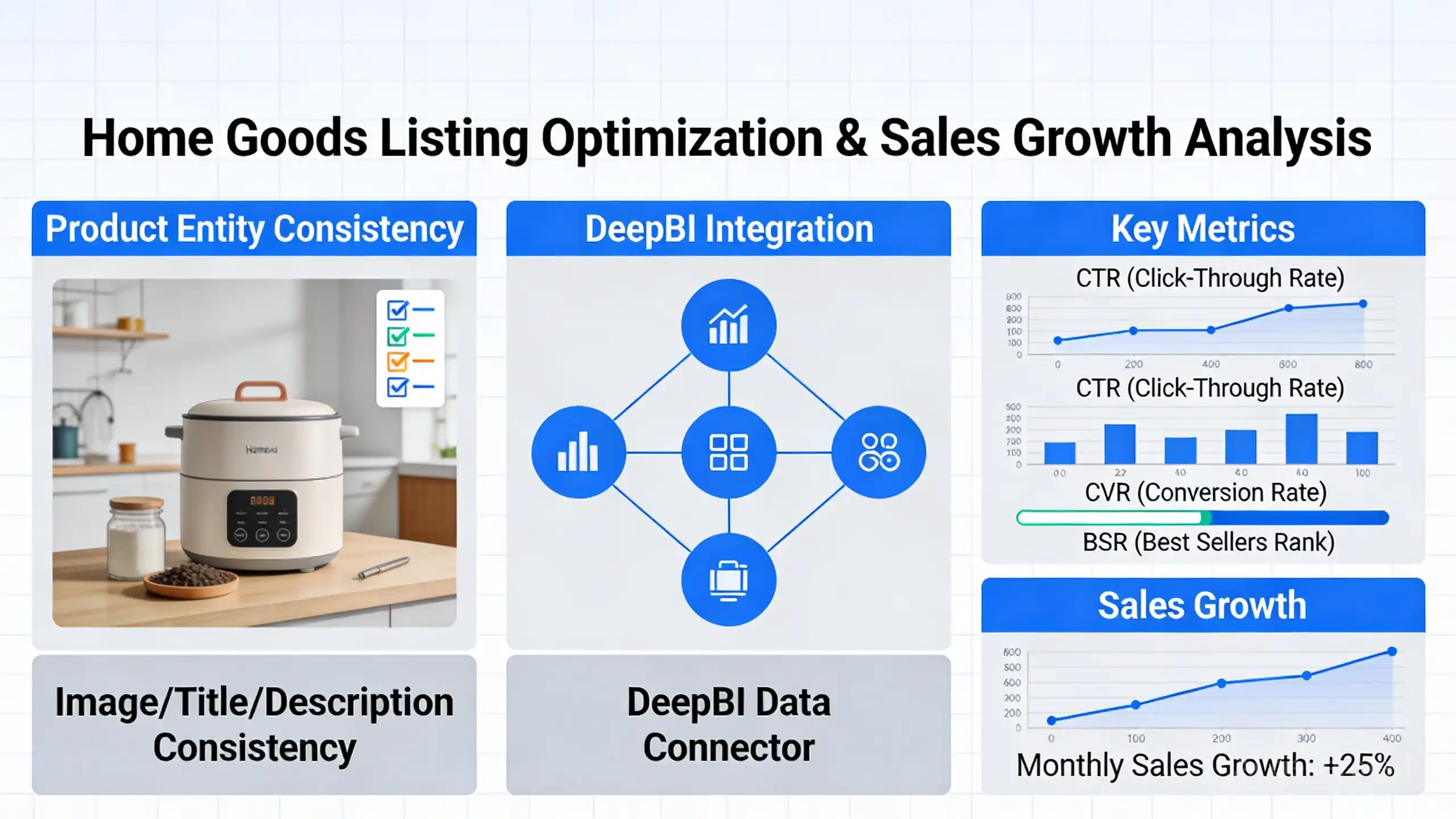
The primary challenge lies in balancing compelling visuals with absolute product accuracy. While AI tools can generate stunning lifestyle images, general-purpose platforms often produce "AI hallucinations" that alter a product's material, color, or design. This creates a critical image-product mismatch, a primary driver of customer dissatisfaction. The principle of 'product entity consistency' must be paramount; visual enhancements should never compromise the authenticity of the core product.
This is where a data-driven approach becomes indispensable. Success is no longer based on subjective aesthetic judgment but on quantifiable performance. Modern optimization moves beyond speculation, using sophisticated tools like DeepBI to connect every listing change directly to business metrics. By tracking the impact of a new main image on Click-Through Rate (CTR) or a revised bullet point on Conversion Rate (CVR), sellers can finally close the loop between action and result, ensuring every effort contributes directly to sales growth and an improved Best Seller Rank (BSR).
Understanding the Amazon Ecosystem: Algorithms and Customer Behavior
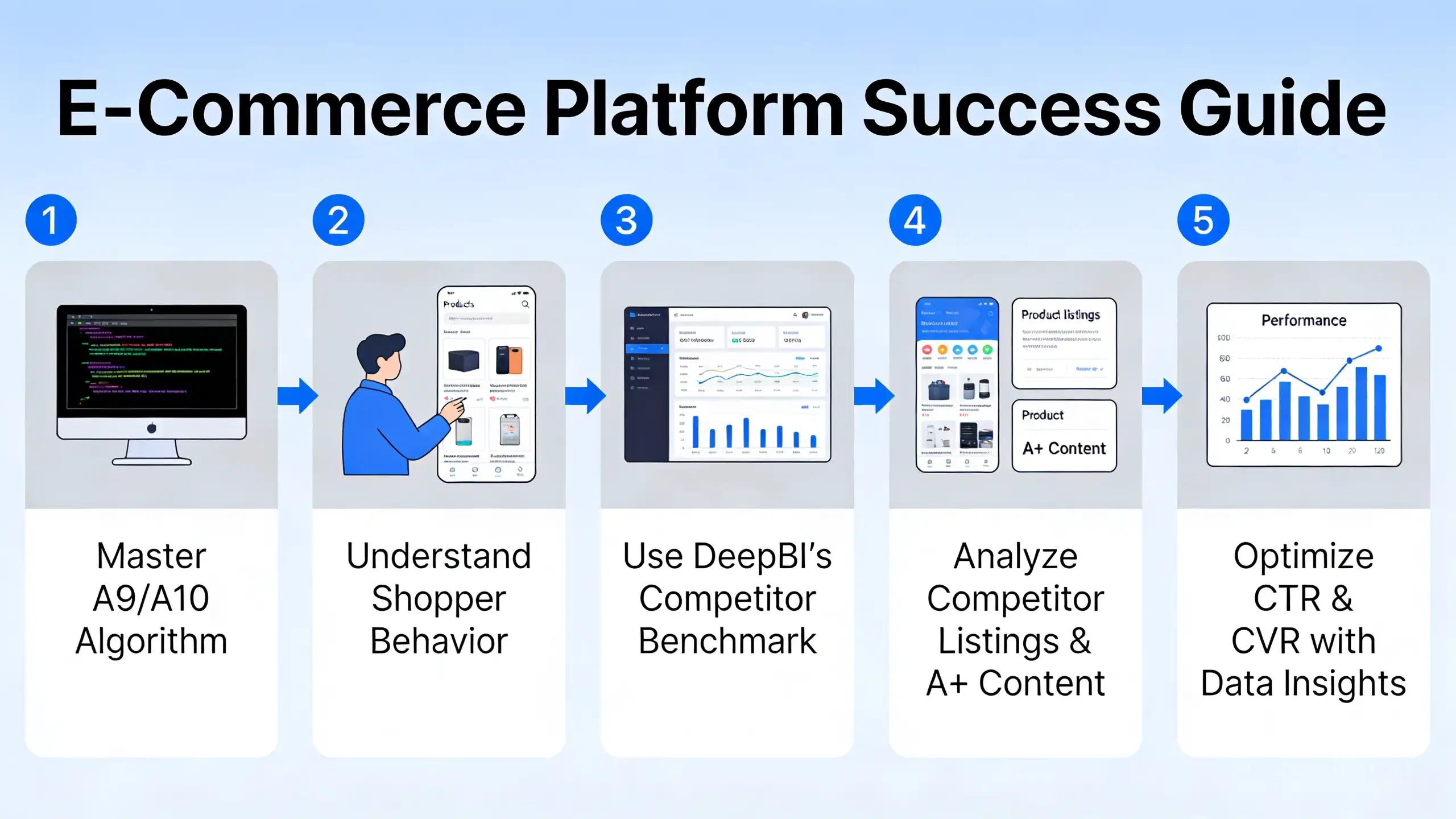
Success on Amazon requires mastering two interconnected forces: its ranking algorithm and shopper behavior. Without a clear understanding of both, sellers often struggle to identify effective strategies. Amazon's A9/A10 algorithm is not just a search engine; it is a conversion engine designed to prioritize products that are most likely to sell. While relevant keywords provide initial discoverability, the algorithm heavily weighs performance metrics like Click-Through Rate (CTR) and Conversion Rate (CVR) to determine ranking. A listing that consistently attracts clicks and converts them into sales will naturally climb the search results page.
For home goods, the customer journey is highly visual and comparative. A buyer typically starts with a search term, scans the main images for appealing designs, and then explores listings with high ratings. They compare product details, A+ Content, and reviews before making a purchase. Each step of this journey generates the performance data that informs the product's rank.
To optimize effectively, you need a benchmark for excellence. Diagnosis is therefore critical before any optimization can begin. DeepBI’s Competitor Benchmark feature acts as an automated market analysis system, evaluating the visual and textual elements of top-performing competitor ASINs. By identifying what drives their success, you gain a data-backed standard to guide your own listing enhancements, replacing speculation with a precision-targeted strategy.
Crafting High-Converting Listings: Core Elements for Home Goods
A high-converting Amazon listing is a carefully engineered asset where every component works in concert to attract, inform, and persuade. For home goods, where aesthetics and function are paramount, mastering these elements is non-negotiable for driving sales and improving Best Seller Rank (BSR).
Optimizing Product Titles
Your title is the first, and often only, text a customer reads in search results. A well-structured title directly impacts click-through rates (CTR) and search relevance. For home goods, follow a clear formula: [Brand Name] [Primary Keyword/Product Type] - [Key Material/Feature], [Key Benefit], [Size/Color/Count]. This format immediately tells shoppers what the product is, who makes it, and why they should care, aligning with Amazon's A9 algorithm and customer search patterns.
Compelling Bullet Points
Bullet points are your opportunity to sell the benefits, not just list features. Use this space to answer the customer's primary question: "What's in it for me?" Frame each point around a key benefit or a solution to a common problem. For a set of kitchen knives, instead of "High-carbon steel," write "Effortless Slicing with Rust-Resistant High-Carbon Steel Blades." Weave in secondary keywords naturally to expand search visibility while highlighting unique selling propositions and practical use cases.
Engaging Product Descriptions
The product description is where you build trust and handle final objections. For home goods, this means providing comprehensive details that shoppers can't physically inspect. Clearly state materials, exact dimensions, weight, care instructions, and assembly requirements. Use this space to tell a short story about the product's value in the customer's home, creating an emotional connection that supports the purchase decision.
High-Quality Images and Videos
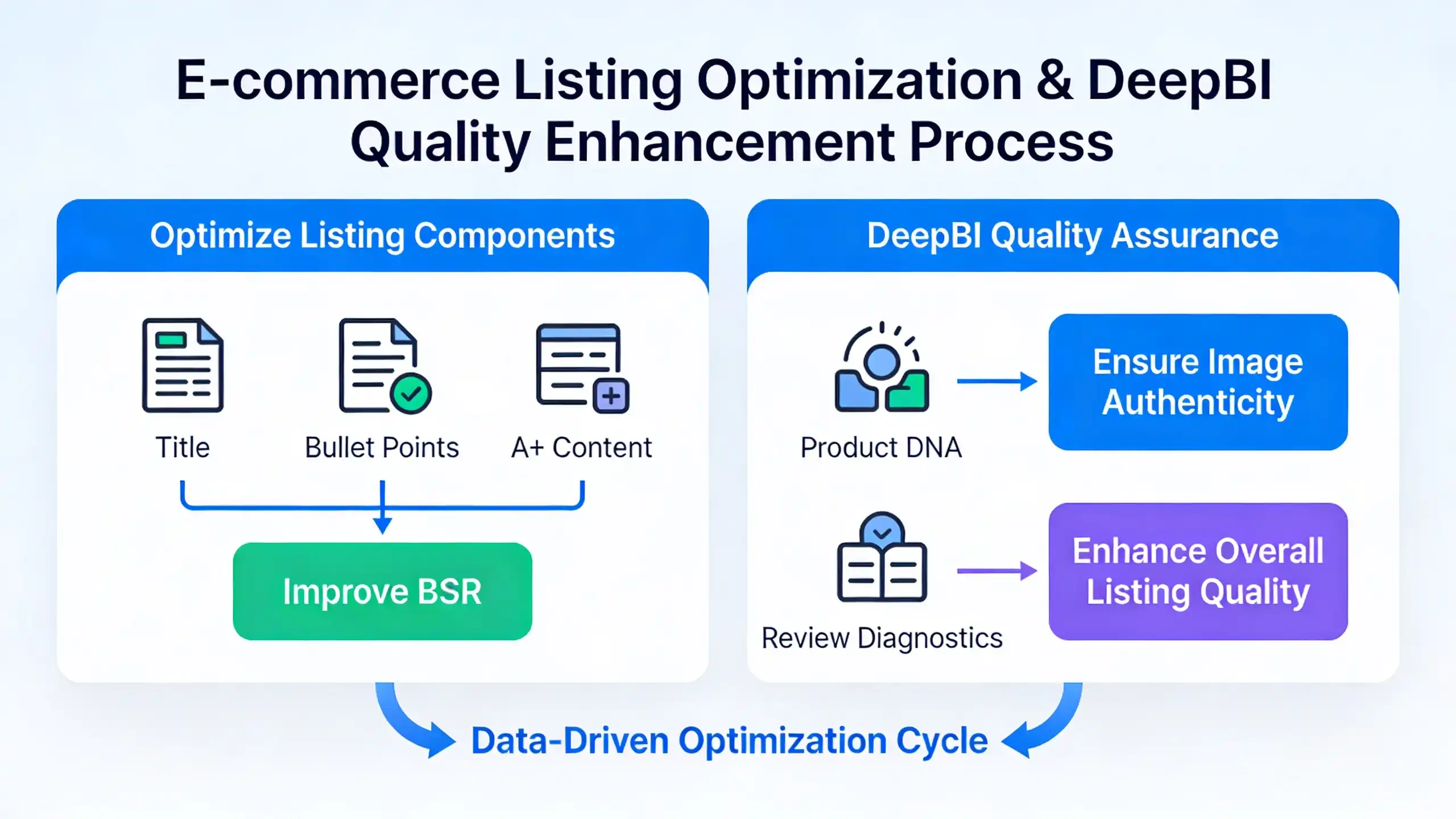
In e-commerce, images are the product. For home goods, customers rely on visuals to assess quality, style, and fit. Your image stack should include a pure-white background main image, lifestyle shots showing the product in a realistic home setting, detail shots highlighting materials and craftsmanship, and infographics with dimensions. However, generic AI image tools risk creating "product-image mismatches," leading to negative reviews and returns. DeepBI's AI generation avoids this by first building a "Product DNA" map, which acts as an ultimate constraint to ensure every generated image is authentic to the physical product, preventing AI hallucinations and protecting your brand's integrity.
A+ Content (Enhanced Brand Content)
For brand-registered sellers, A+ Content is a powerful tool to increase conversion rates. Use its rich media modules to tell your brand story, visually break down complex features, and showcase your product in aspirational settings. Comparison charts are particularly effective in this section, allowing you to cross-sell other products in your catalog and guide customers to the best choice for their needs, preventing analysis paralysis.
Customer Reviews and Ratings
Reviews are the ultimate form of social proof on Amazon and a primary driver of conversion. A high rating and a significant volume of positive reviews build immediate credibility. While DeepBI does not offer review management services, its diagnostic engine analyzes customer reviews and ratings as a key input for its listing quality score. It identifies patterns in negative feedback on the first page to inform optimization strategies, ensuring your listing directly addresses customer concerns.
Data-Driven Optimization with DeepBI: Beyond Guesswork
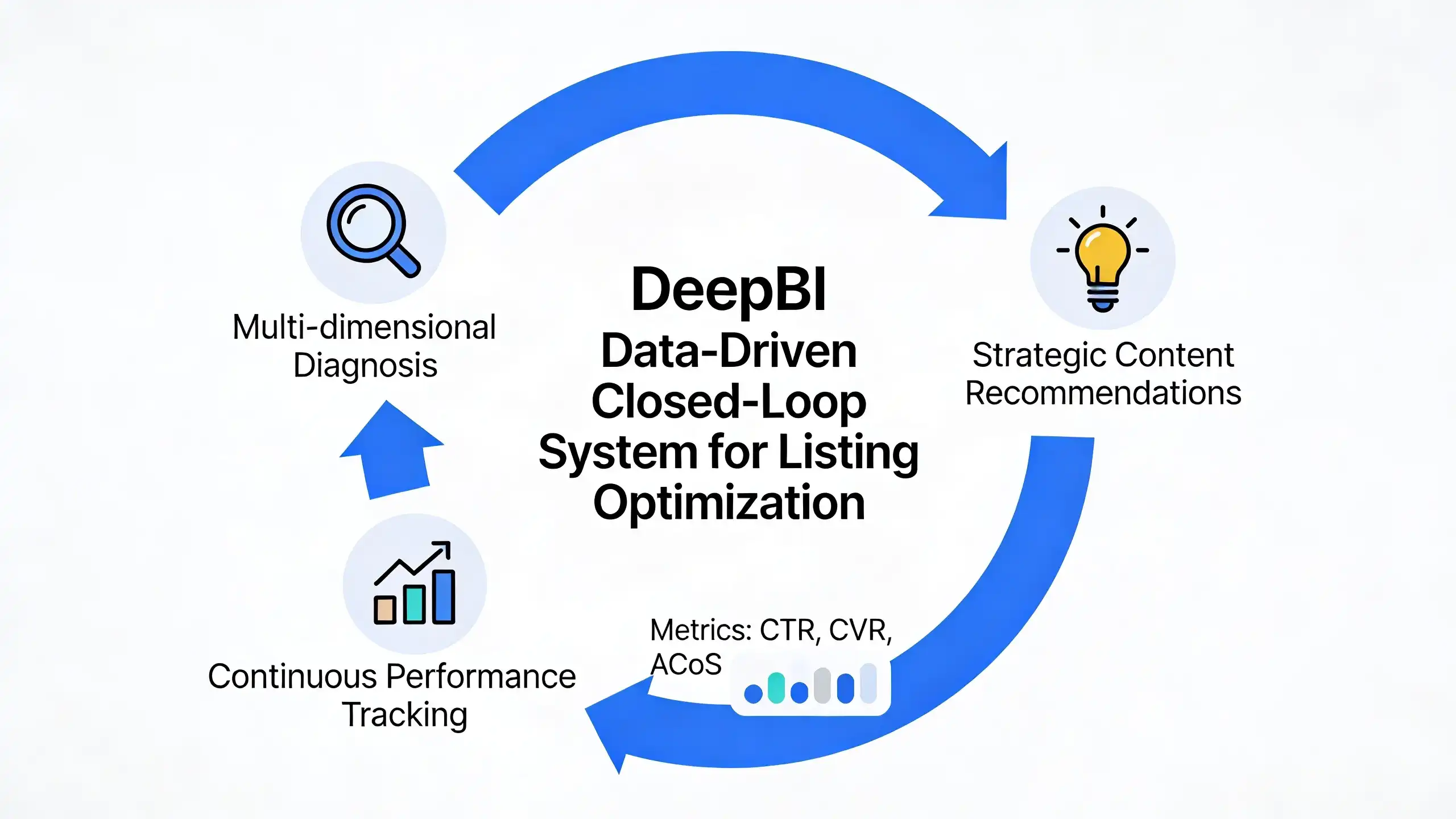
Effective listing optimization moves beyond subjective "best practices" and into the realm of data science. Relying on intuition alone leads to inconsistent results and wasted effort. DeepBI transforms this process by creating a closed-loop system that progresses from quantitative diagnosis to automated execution and performance tracking.
Multi-Dimensional Listing Diagnosis
Instead of manual, piecemeal analysis, DeepBI performs a comprehensive, multi-dimensional audit of your entire listing. Its Intelligent Scoring feature uses semantic matching to benchmark every critical element—main image, title, bullet points, A+ Content, and user reviews—against top-performing competitors. This process quantifies key conversion factors, pinpointing the specific weaknesses in your content that are depressing your Click-Through Rate (CTR) and Conversion Rate (CVR). It provides a clear, data-backed starting point for any optimization effort.
Strategic Optimization Recommendations
A diagnosis is only useful if it leads to clear action. DeepBI translates its findings into precise, executable strategies for both visual and textual content. It replaces vague feedback like "improve the image texture" with engineered instructions containing specific parameters for composition, camera angles, and lighting. For text, it can deconstruct A+ pages into logical modules for restructuring or reframe bullet points into a compelling "pain point-solution" format, ensuring every word is designed to convert.
The "Four-Dimensional Test Metric System" for Continuous Improvement
Optimization is not a one-time fix but an iterative cycle. DeepBI facilitates this with a systematic framework for testing and validation. This approach ensures that every change is measured against key performance indicators, creating a powerful data feedback loop.
After an optimized image or text is published, the system automatically tracks its impact on your advertising reports. This allows you to directly observe how changes affect your ASIN's CTR and ACoS in the following 7-14 days, connecting creative execution to business results and ensuring continuous, data-driven improvement.
Streamlining Implementation: DeepBI's One-Click Advantage
Even the most powerful listing optimizations are worthless until they are live. The final step—manually updating titles, bullet points, images, and A+ Content in Seller Central—is often a significant bottleneck that creates delays and introduces the risk of human error. This friction between analysis and execution slows your ability to adapt to market trends and negatively impacts your listing cycle time.
DeepBI eliminates this critical delay with its "One-Click Application" feature. By integrating directly and securely with Amazon's official Selling Partner API (SP-API), the platform breaks down the silos between diagnosis, content generation, and delivery. This allows you to synchronize all optimized assets—from AI-generated images and A+ layouts to revised titles and bullet points—directly to your Amazon listings. The system transforms what was once a 30-minute manual upload into a task completed in seconds.
This creates a seamless, end-to-end workflow from initial analysis to final launch. To ensure quality and provide a crucial safety net, DeepBI also includes version comparison and filtering capabilities. This allows your team to confidently review all proposed changes before publishing, ensuring every update improves your listing's performance without compromising quality or brand consistency.

Conclusion: Sustained Growth in the Home Goods Niche
Thriving in the competitive Amazon home goods market requires a decisive shift from intuition-based adjustments to a rigorous, data-driven optimization strategy. The most effective approach is grounded in the principle of 'product entity consistency,' ensuring that every enhancement—from keywords to A+ Content—accurately reflects and elevates the core attributes of your product. This means moving beyond manual analysis and fragmented workflows.
The future of listing optimization lies in end-to-end intelligent systems that break down the silos between diagnosis, planning, content production, and final application. Tools like DeepBI embody this shift, functioning not as a simple 'AI drawing board' for creative ideas, but as an 'automated visual production system' driven by market data and constrained by business strategy. By translating complex competitor analysis into precise, AI-executable instructions, these platforms empower teams to automate the tactical work of content generation. This frees up valuable resources to focus on core strategic decisions, directly accelerating listing cycle times and improving key performance indicators like CTR and CVR for sustained, profitable growth.