

The Critical Role of Titles and Images in Amazon Electronics Sales
Why Listing Content Matters for Electronics
On the crowded Amazon marketplace, your product title and main image serve as your digital storefront. They are the first, and often only, chance to capture a potential buyer's attention from a sea of competitors. For electronics, this first impression is paramount. Customers rely heavily on visuals to verify product specifications, compatibility, and design details. An inaccurate image—for instance, one generated by a general AI that alters a port configuration or button layout—can lead to a critical "product-image mismatch." This discrepancy inevitably results in negative reviews, increased return rates, and lasting damage to your brand's credibility, highlighting the need for visuals that are completely authentic to the product's physical structure.
Impact on Click-Through Rate (CTR) and Conversion Rate (CVR)
Optimized titles and images are not merely for aesthetic appeal; they function as a core commercial engine that directly drives clicks (CTR) and conversions (CVR). A clear, keyword-rich title paired with a compelling main image entices shoppers to click on your product from the search results page, boosting your CTR. Once on the listing, a gallery of high-quality, informative images and a descriptive title work in tandem to build trust and answer questions, persuading the visitor to make a purchase and increasing your CVR.
Historically, measuring the direct business impact of a visual update has been difficult, often relying on subjective judgment. However, by creating a data feedback loop that links image updates to advertising performance, sellers can now quantify the effect. This allows you to track how changes to your visuals specifically impact CTR over the following weeks, transforming optimization from guesswork into a data-driven strategy.
 Crafting High-Impact Titles for Electronics Listings
A product title is often the first point of contact a customer has with your product on Amazon. For electronics, a category defined by specifications and compatibility, a well-crafted title is critical for attracting clicks, conveying value, and driving conversions. It must be optimized for both Amazon's A9 search algorithm and human readability.
Understanding Amazon's Title Requirements and Best Practices
Amazon maintains specific guidelines to ensure a consistent customer experience. For electronics, sellers must adhere to character limits, which are typically around 200 characters, though this can vary by sub-category. Key requirements include:
- Brand First: The title must begin with the brand name.
- Capitalization: Use title case (capitalizing the first letter of each word), not all caps.
- No Promotional Language: Avoid subjective or promotional phrases like "Best Seller," "Hot Item," or "Free Shipping."
- Use Numerals: Write numbers as digits (e.g., "2" instead of "two").
- Forbidden Characters: Do not use special characters like ~, !, *, or $.
Following these rules is non-negotiable and is the foundation for avoiding listing suppression and ensuring search eligibility.
Keyword Integration and SEO for Electronics Titles
Effective titles are rich with relevant keywords that match customer search queries. Your keyword strategy should incorporate a mix of terms that define the product and its use cases.
- Core Keywords: These identify the product itself (e.g., "Wireless Earbuds," "4K Monitor," "Portable Power Bank").
- Attribute Keywords: These specify key features and technical specs (e.g., "Bluetooth 5.3," "144Hz Refresh Rate," "20000mAh," "USB-C").
- Compatibility Keywords: These are crucial for electronics and help customers confirm the product works with their existing devices (e.g., "for iPhone 15," "compatible with MacBook Pro," "works with Alexa").
Thorough keyword research helps align your title with real-world search behavior, directly impacting your product's visibility and Click-Through Rate (CTR).
Structuring Titles for Clarity and Conversion
While keyword density is important for search, a title that is just a string of keywords will confuse and deter human buyers. The optimal structure balances SEO with clarity. A proven formula for electronics is:
[Brand Name] + [Model/Series] + [Key Feature] + [Product Type] + [Compatibility/Color/Size]
For example: Anker PowerCore III 10K Wireless Portable Charger with Qi-Certified 10W Wireless Charging and 18W USB-C Fast Charging for iPhone 14/14 Pro
This structure presents the most critical information logically, allowing a shopper to quickly qualify the product, which can significantly improve CVR.
Leveraging DeepBI for Title Optimization
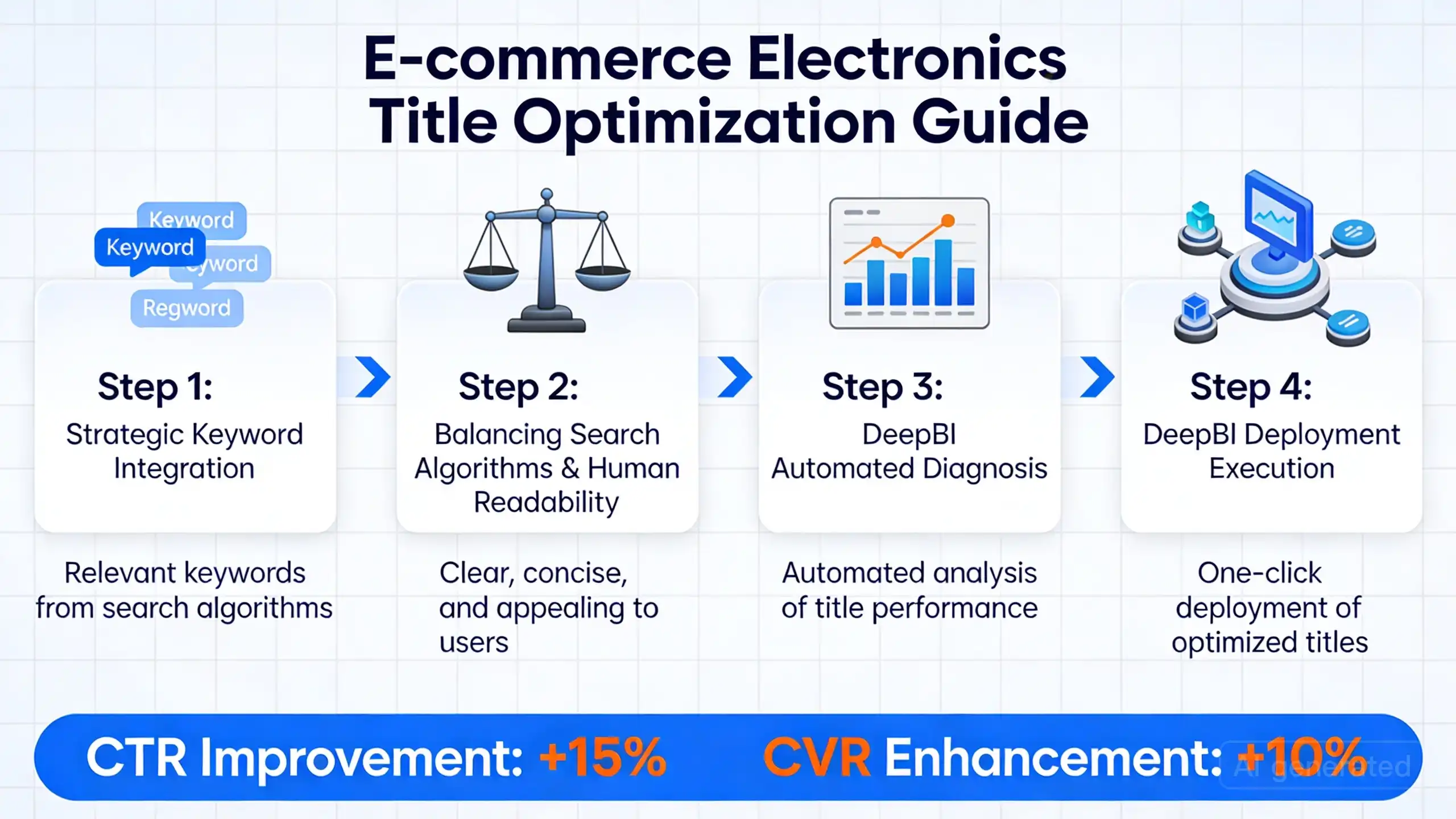
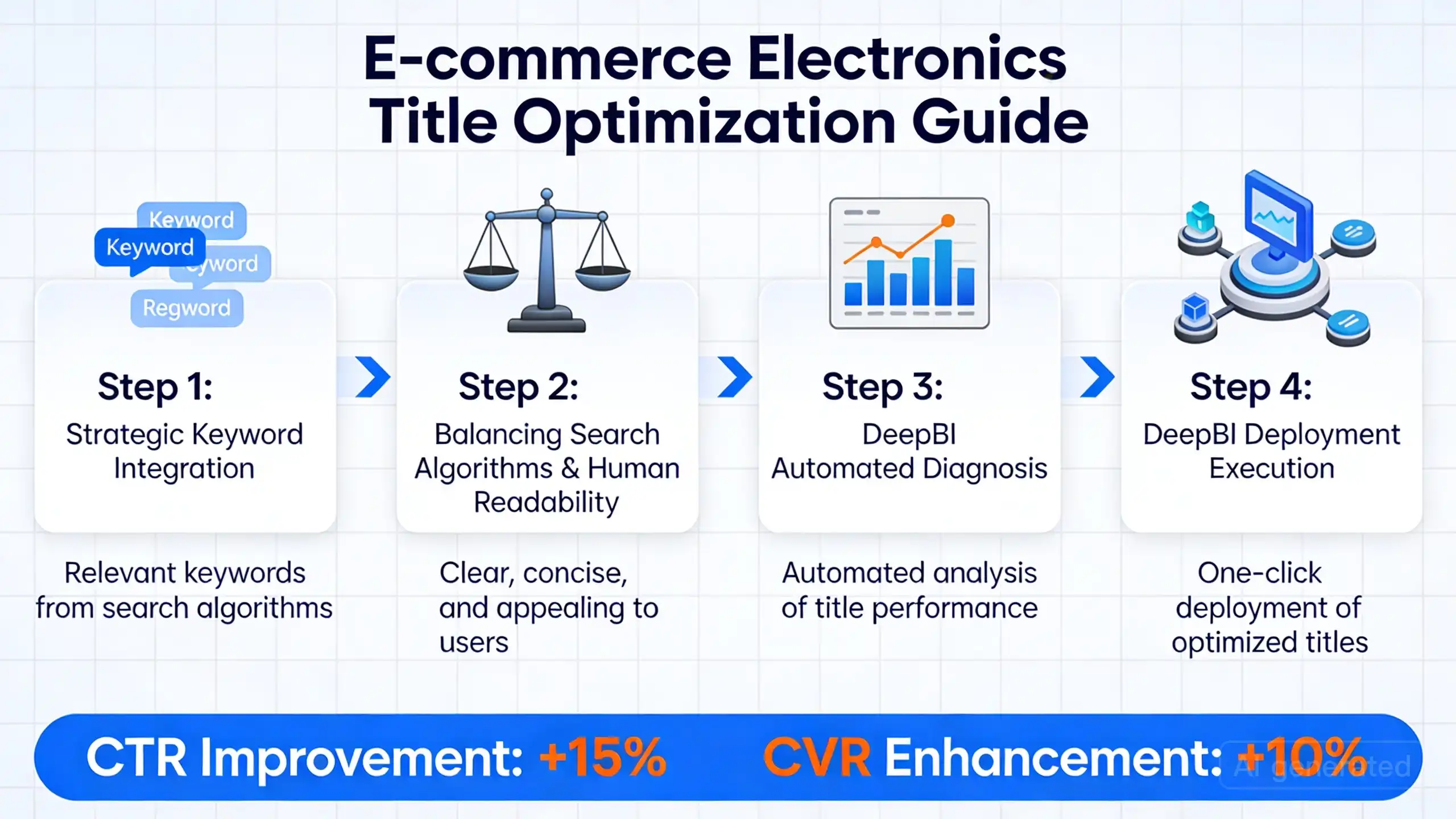
Manually creating and testing optimized titles across a large catalog is a significant operational drain. DeepBI automates this entire workflow, transforming it from a guessing game into a data-driven process. The system provides an end-to-end solution from diagnosis to deployment.
First, DeepBI's intelligent scoring module performs a quantitative audit of your existing titles, benchmarking them against top-performing competitors. Based on this diagnosis, it generates concrete optimization strategies for both SEO and conversion. The AI engine then produces multiple title variations tailored to your product's unique DNA. Finally, leveraging official SP-API integration, DeepBI allows you to apply the chosen title to your listing with a single click. This automated "diagnosis to delivery" loop reduces the listing update cycle from minutes to seconds, eliminates manual error, and ensures your titles are continuously optimized for peak performance.
 Mastering Product Images for Electronics Listings
High-quality visuals are non-negotiable in the competitive electronics category, directly influencing Click-Through Rate (CTR) and Conversion Rate (CVR). Images must not only attract but also accurately inform, building trust and reducing returns.
Amazon's Core Image Requirements for Electronics
Amazon enforces strict guidelines for the main "hero" image to ensure a consistent customer experience. The product must be shown on a pure white background (RGB 255, 255, 255), fill at least 85% of the frame, and be free of any additional text, logos, watermarks, or inset images. Adherence is mandatory for listing compliance and visibility.
Strategic Use of Main Images
Your main image is your primary tool for capturing attention in search results. It must be a crisp, high-resolution, professional photograph of the product itself. Ensure the lighting is excellent and the product is shown clearly, as this single image is the most critical factor in a customer's decision to click on your listing.
Beyond the Main Image: Supporting Visuals and Videos
To drive conversions, supplement the main image with a comprehensive visual narrative. Aim for at least six images and one video. Use this space for:
- Lifestyle Images: Show the electronic device in its intended environment.
- Infographics: Call out key technical specifications like battery life, connectivity, or processing power.
- Scale Images: Help customers visualize the product's actual size.
- 360° Views & Videos: Demonstrate functionality, unboxing, or setup to answer questions and manage expectations.
Technical Specifications for High-Quality Images
For optimal quality and functionality, images should be at least 1000 pixels on the longest side, with 1600 pixels recommended to enable Amazon's zoom feature. Use sRGB color mode and save files in accepted formats like JPEG, TIFF, or PNG.
DeepBI's Role in Image Generation and Optimization
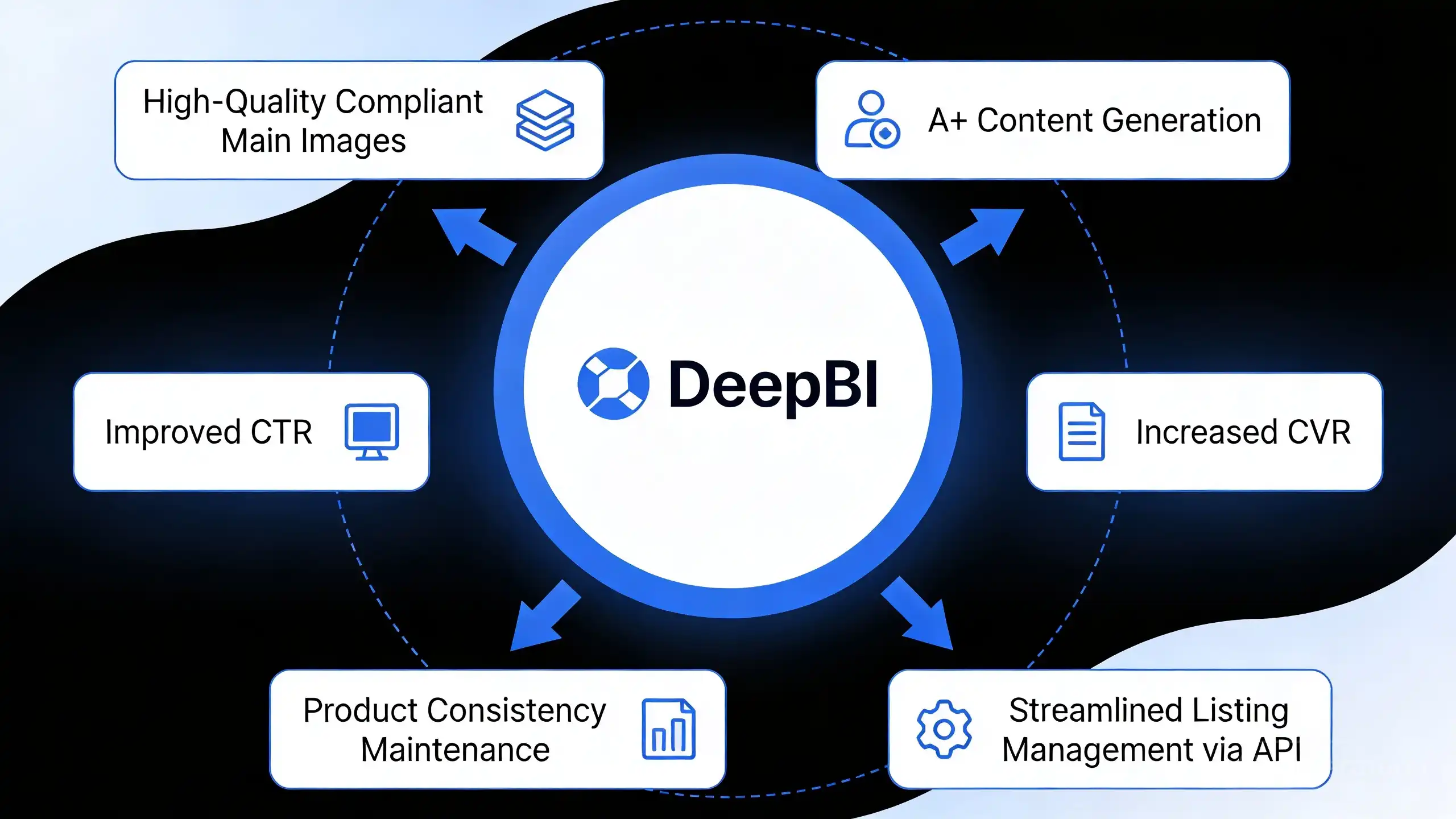
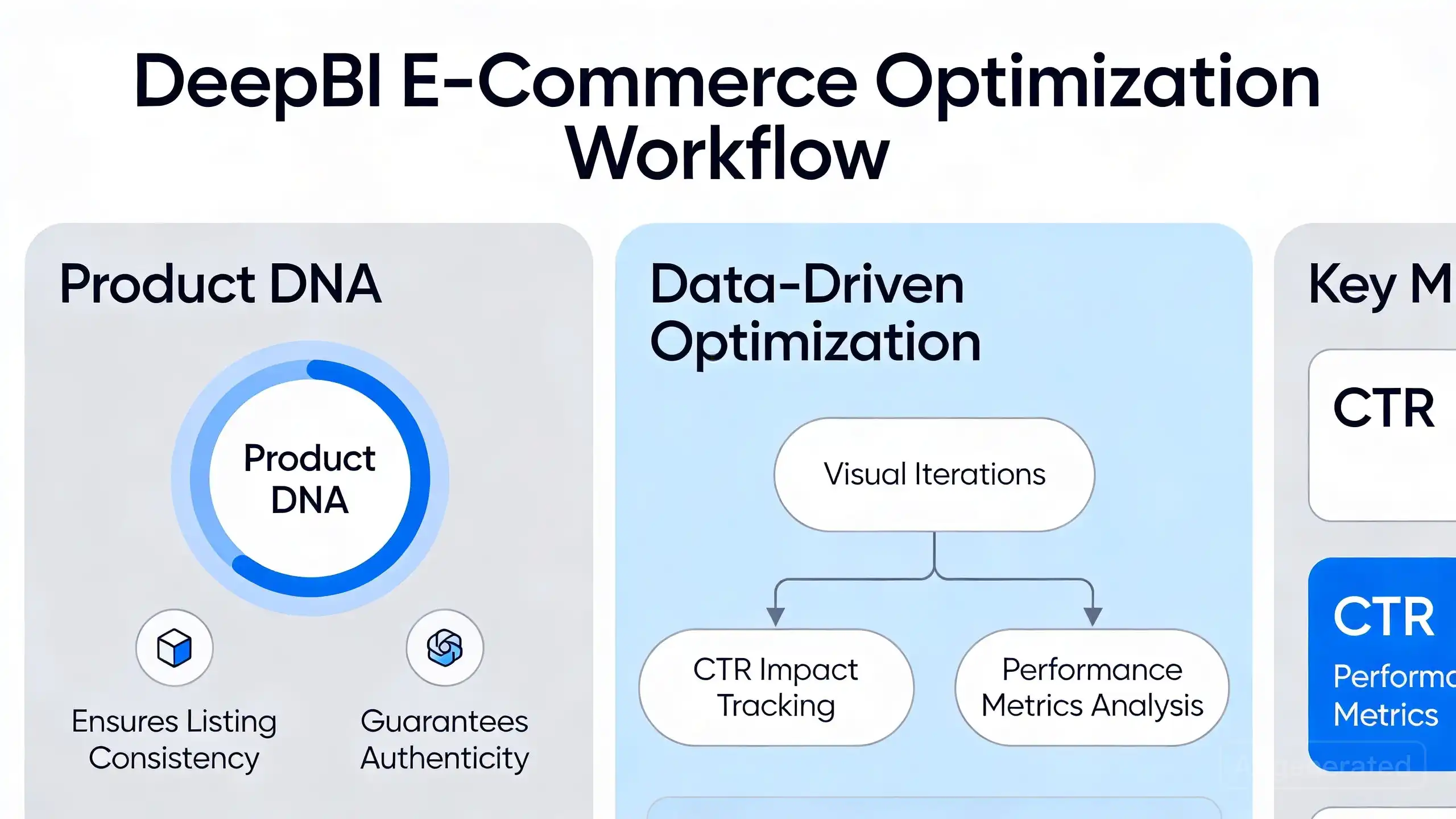
DeepBI transforms image optimization from a manual task into an integrated, AI-driven process. The platform diagnoses and scores your current visuals against competitors, then generates optimized main images, detail shots, and A+ content. Unlike general-purpose AI tools that risk "hallucinations" and product mismatches, DeepBI operates as a constrained production system. It establishes a "Product DNA" map to enforce strict entity consistency, ensuring AI never alters the product's core design, material, or color. This mitigates the risk of negative reviews from visual inaccuracies. Finally, optimized images can be applied to your listing in seconds via API, a process that manually takes dozens of minutes.
 Advanced Strategies for Title and Image Synergy
Effective Amazon listings depend on the seamless synergy between your product title and images. The title makes a promise, and the images must visually confirm it. When these elements are aligned and continuously refined with data, they work together to build trust, improve click-through rates (CTR), and drive conversions.
Ensuring Consistency Across All Listing Elements
For electronics, precision is paramount. A title that claims a specific feature, like a "Thunderbolt 4 port," must be supported by a main or secondary image that clearly shows it. Any discrepancy can lead to customer confusion, negative reviews, and costly returns. This risk is amplified when using general-purpose AI tools, which can introduce "AI hallucinations" that alter a product's physical structure.
To prevent this, a system must enforce product authenticity. DeepBI addresses this by first constructing a detailed "Product DNA" map for each item. This map acts as the ultimate constraint for all visual generation, ensuring that every AI-produced image is a faithful representation of the actual product, mitigating the post-sale risks associated with visual inaccuracies.
Analyzing Performance and Iterating with DeepBI
Optimizing titles and images should not rely on subjective judgment. True improvement comes from data-driven iteration. Instead of guessing which image performs best, a systematic approach is needed to measure impact.
DeepBI facilitates this by creating a closed feedback loop. When a new image is applied to a listing, the system automatically marks a "visual iteration event point" in the ad reports. This allows you to directly observe how the ASIN's Click-Through Rate (CTR) and other KPIs change in the 7-14 days following the update. This process transforms optimization from a guessing game into a quantifiable, repeatable strategy, connecting diagnosis, production, and performance measurement in a single workflow.
Common Pitfalls and How to Avoid Them
Sellers often encounter several recurring issues when optimizing titles and images for electronics. By understanding them, you can implement more effective solutions.
- Pitfall: Product Inauthenticity. Using generic AI tools that create visuals misaligned with the actual product.
- Solution: Use a constrained production system that prioritizes product accuracy. DeepBI's "Product DNA" framework ensures that AI-generated visuals are authentic, preventing customer dissatisfaction.
- Pitfall: Slow Iteration Cycles. Manual processes for downloading, renaming, and uploading images can take over 30 minutes, discouraging frequent optimization.
- Solution: Leverage automation. DeepBI's one-click application syncs new content via API in seconds, enabling you to test and iterate on your listings rapidly.
- Pitfall: Lack of Performance Data. Making changes without a clear way to measure their impact on CTR or CVR.
- Solution: Implement a data feedback loop. Use tools that link content changes directly to advertising performance reports, allowing you to validate the effectiveness of your optimizations.
 Conclusion: Driving Electronics Sales Through Optimized Listings
In the hyper-competitive Amazon electronics marketplace, success is no longer a matter of chance but a result of systematic optimization. Mastering both keyword-rich titles for discoverability and compelling, high-fidelity images for conversion is the foundational formula for capturing customer attention and driving sales. However, moving beyond subjective tweaks to a truly data-driven strategy is what separates top performers from the rest.
The long-term benefit of this approach is a continuous improvement cycle where every change is a measurable experiment. Instead of guessing, sellers can now directly correlate listing updates to performance metrics like Click-Through Rate (CTR), creating a powerful feedback loop.
This is where a platform like DeepBI becomes indispensable. It transforms listing optimization from a manual, time-consuming task into a streamlined, strategic function. By converting ambiguous goals into precise, AI-executable instructions and using "Product DNA" to ensure authenticity, DeepBI mitigates risk while maximizing impact. It functions as an automated market health check system, enabling sellers to deploy and track optimizations with unprecedented speed and data-backed confidence. For electronics brands aiming for sustained growth, embracing this level of intelligent automation is the definitive path to securing a competitive edge. image