Introduction: Decoding High ACoS on Amazon
For Amazon sellers, Advertising Cost of Sale (ACoS) is a critical, often unforgiving, metric. Calculated as total ad spend divided by total ad revenue, it represents the direct cost of acquiring a sale through advertising. A high ACoS can quickly erode profit margins, turning seemingly successful campaigns into financial drains. While many factors contribute to this, including intense competition and inefficient keyword targeting, the root cause often lies deeper within the product listing itself—specifically, in low Click-Through Rates (CTR) and Conversion Rates (CVR).
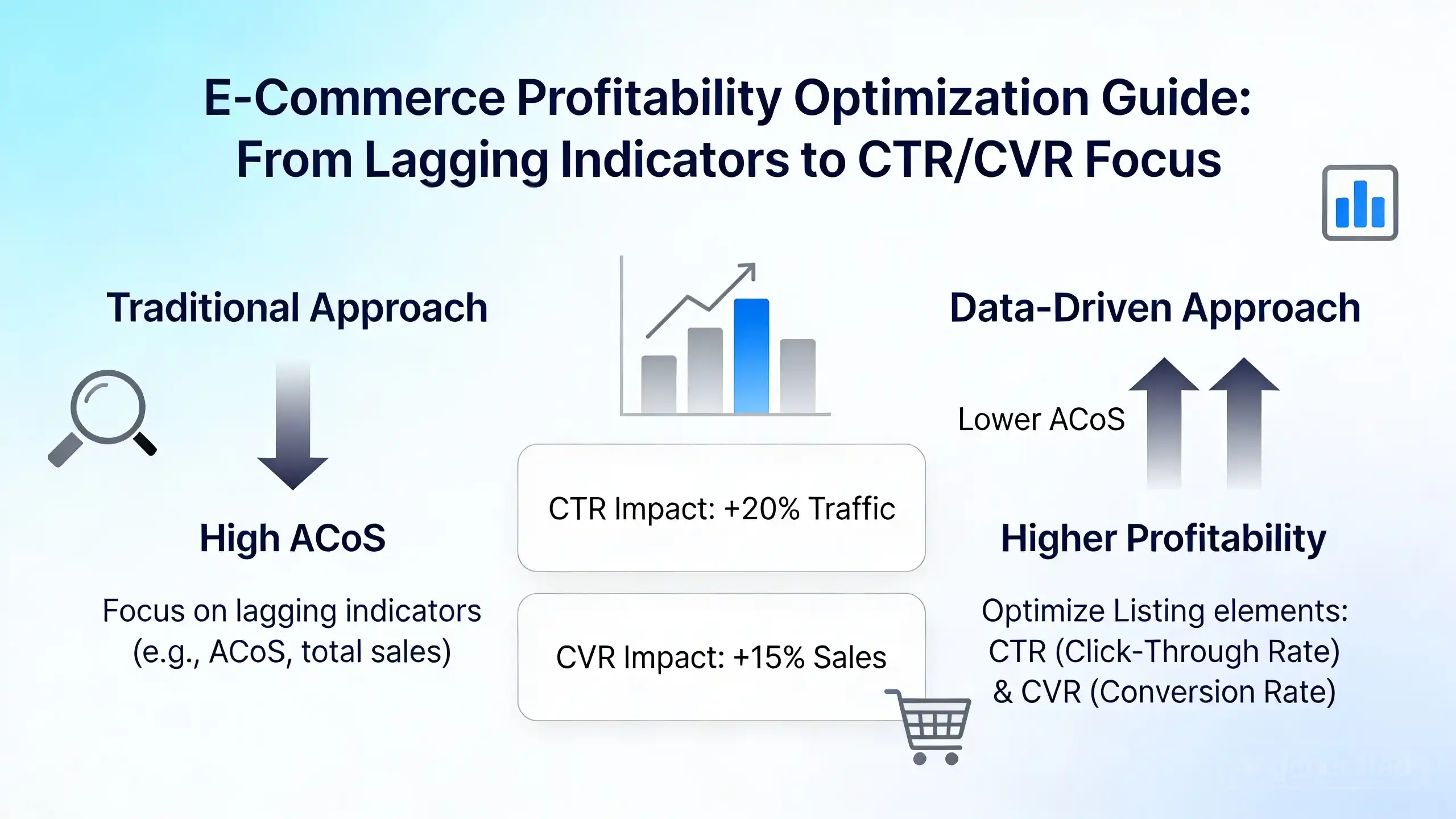
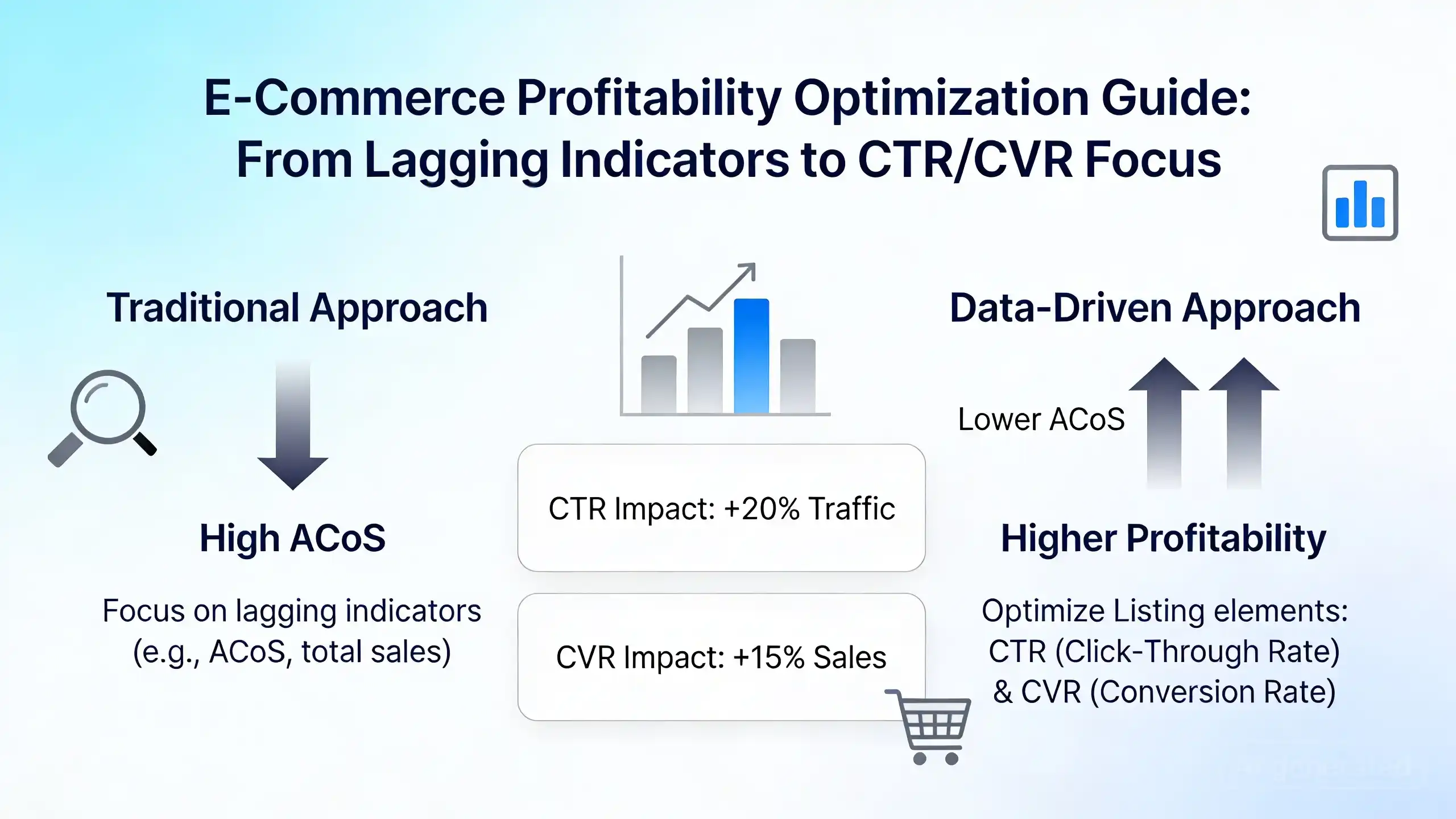
The fundamental challenge with managing ACoS is that it's a lagging indicator. It tells you the result of money already spent and actions already taken. By the time you identify a high ACoS, the budget is gone, and the opportunity is lost. To proactively control advertising profitability, top sellers shift their focus to the leading indicators they can directly influence before and during a campaign.
These leading indicators are the core drivers of ad performance: the ability of your listing to attract clicks (CTR) and convert those clicks into sales (CVR). Traditionally, optimizing these elements, especially visual assets like images and A+ Content, has been a disconnected process reliant on subjective aesthetic judgments. This article will introduce nine winning strategies that move beyond guesswork, transforming your listing elements from mere displays into a core commercial engine. We will explore how to apply a data-driven feedback loop to systematically improve CTR and CVR, thereby lowering your ACoS and boosting overall profitability.
 Understanding Your ACoS Landscape: Foundations for Optimization
Effective ACoS optimization begins not with frantic bid adjustments, but with a clear understanding of your financial baseline and performance drivers. Before implementing advanced strategies, you must establish your profitability thresholds and learn to read the signals that predict future advertising performance. This foundational knowledge transforms ACoS from a confusing metric into a powerful lever for profitable growth.
Calculate Your Break-Even ACoS
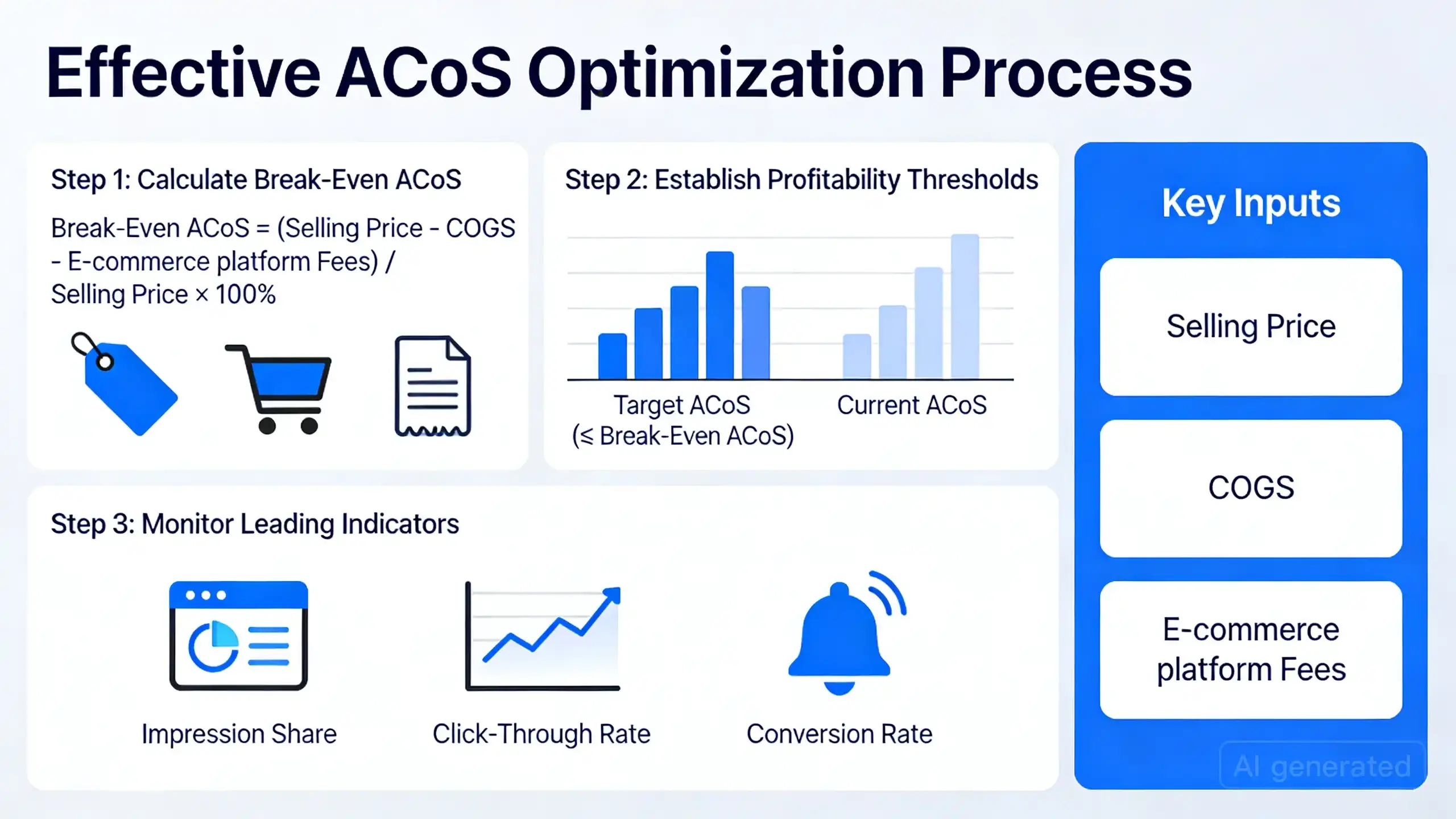
Your break-even ACoS is the highest ACoS you can sustain on a product without losing money on each sale. It represents your profitability ceiling. Knowing this number is non-negotiable for setting realistic campaign goals, whether you're aiming for aggressive growth or maximum profit.
To calculate it, use the following formula which isolates your pre-advertising profit margin:
Break-Even ACoS = [(Selling Price – COGS – Amazon Fees) ÷ Selling Price] × 100
- Selling Price: The final price a customer pays for your product.
- COGS (Cost of Goods Sold): All costs to get your product ready for sale, including manufacturing, shipping, and import duties.
- Amazon Fees: This includes referral fees, FBA fulfillment fees, and any other variable costs charged by Amazon per sale.
Calculating this for each product provides a clear, data-backed target. Any ACoS below this break-even point is profitable, while anything above it results in a loss on ad-driven sales.
Identify Leading Indicators for ACoS
ACoS is a lagging indicator; it tells you the result of past performance. To manage it proactively, you must focus on the leading indicators that influence it. By monitoring these metrics, you can anticipate changes in ACoS and make adjustments before your ad spend becomes inefficient.
Key leading indicators include:
- Click-Through Rate (CTR): A high CTR indicates your ad creative and main image are compelling to shoppers. Improving CTR often leads to a higher quality score and lower Cost Per Click (CPC), directly reducing ACoS.
- Conversion Rate (CVR): This measures how many clicks turn into sales. A strong CVR means your product detail page is effective. Increasing your CVR is one of the most powerful ways to lower ACoS, as you generate more sales from the same ad spend.
- Cost Per Click (CPC): This is a direct component of your ad spend. Monitoring CPC helps you understand bidding dynamics and the immediate cost of traffic.
- Impression Share: This shows your ad's visibility compared to competitors. A sudden drop might signal increased competition, which could drive up bids and negatively impact your ACoS if left unchecked.
 Pillar 1: Precision Targeting & Bid Management (Ads Quant)
Effective advertising moves from 'groping in the dark' to 'precision targeting'. This pillar focuses on the quantitative levers you can pull to eliminate wasted spend and direct your budget toward conversions. By mastering these data-driven strategies, you can achieve significant, measurable improvements in your ACoS.
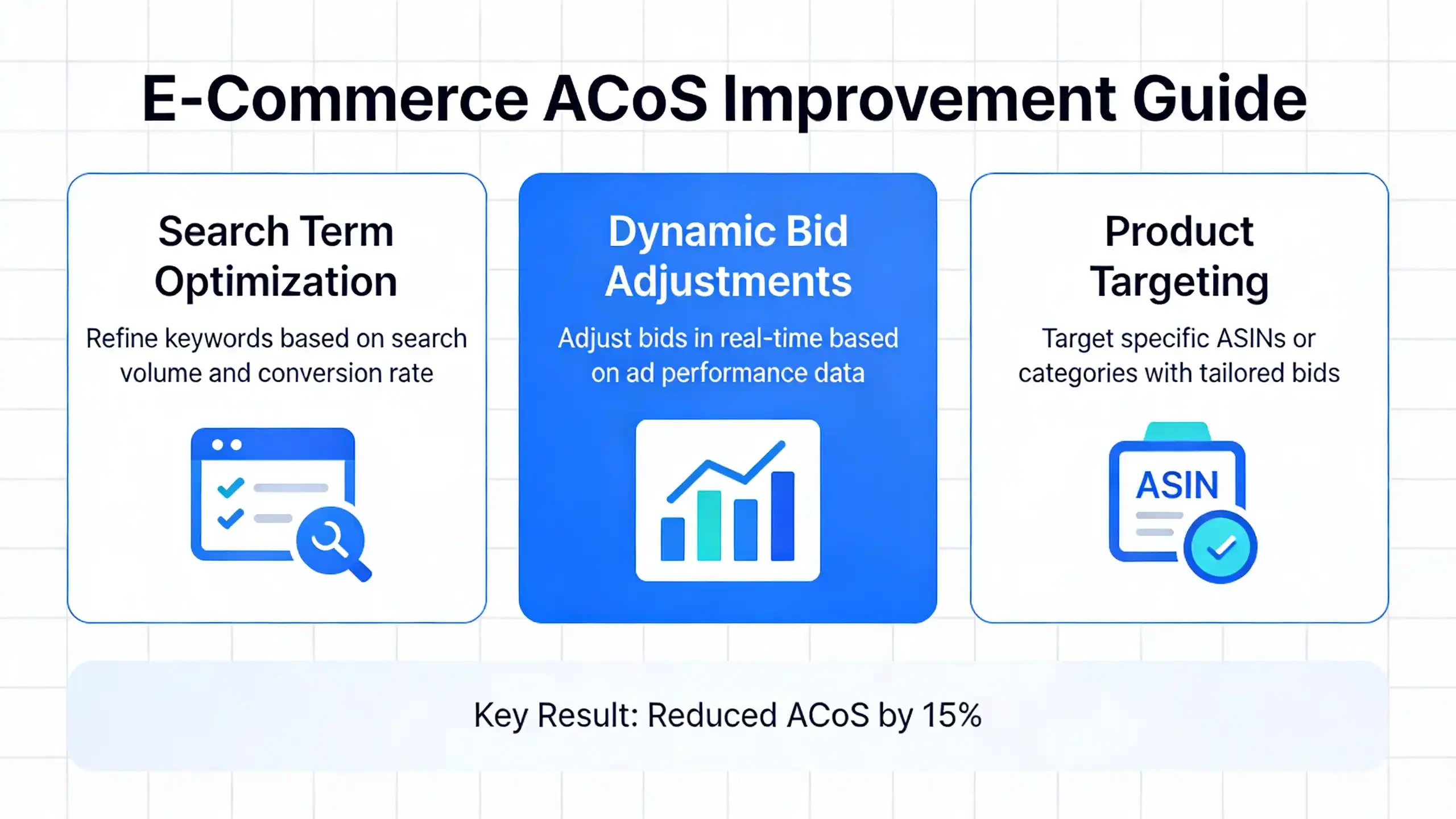
Strategy 1: Aggressive Search Term Optimization
The foundation of ad efficiency is ensuring your budget is spent only on relevant customer searches. This requires a disciplined analysis of your Search Term Report to identify what’s working and what isn’t.
- Eliminate Irrelevant Traffic: Scrutinize the report for search terms that are clearly unrelated or have high clicks but zero conversions. Add these as negative phrase or negative exact keywords to immediately stop wasting money on them.
- Isolate Top Performers: Identify the exact customer search terms that generate consistent sales at a profitable ACoS. Move these high-value terms into their own exact match campaigns where you can control their budget and bids with greater precision.
- Continuous Refinement: This is not a one-time task. Regular, aggressive optimization of your search terms can reduce ACoS by 10-20% within 30 days by systematically channeling funds from non-performing clicks to proven converters.
Strategy 2: Optimize Bids Based on Performance
Setting the right bid ensures you pay a competitive price for a click without destroying your profit margin. Instead of a "set it and forget it" approach, adjust bids dynamically based on real-world results.
- Use Dynamic Bidding: Leverage Amazon’s "down only" or "up and down" bidding strategies to allow the algorithm to adjust your bids in real-time based on the likelihood of a conversion.
- Adjust for Profitability: Manually fine-tune your bids based on performance metrics. Lower bids on keywords with a high ACoS to improve profitability. Conversely, consider increasing bids on keywords with a low ACoS and high conversion rate (CVR) to capture more sales.
- Factor in Placements: Analyze performance by placement and use bid adjustments to bid more competitively for high-value slots like "Top of Search," which often yield a higher click-through rate (CTR) and CVR.
Strategy 3: Leverage Product Targeting
Go beyond keywords to capture highly motivated shoppers directly on product detail pages. Product targeting allows you to place your ads on specific ASINs or within entire product categories, opening up new avenues for growth.
- ASIN Targeting: Strategically target the product pages of direct competitors to intercept their customers. You can also target complementary products (e.g., advertising a phone case on the page of a popular smartphone) to drive relevant cross-sales.
- Category Targeting: Reach a broader audience by targeting entire categories relevant to your product. You can refine this by price, brand, or star rating to ensure your ad is shown to the most qualified shoppers within that category.
 Pillar 2: Enhancing Listing Performance (Listing Module)
Driving traffic to a product detail page is only half the battle. If the listing fails to convert visitors into buyers, your advertising spend is wasted, causing ACoS to skyrocket. This pillar focuses on optimizing the on-page elements that directly influence customer purchase decisions and conversion rates.
Strategy 4: Improve Product Detail Page Conversion Rate (CVR)
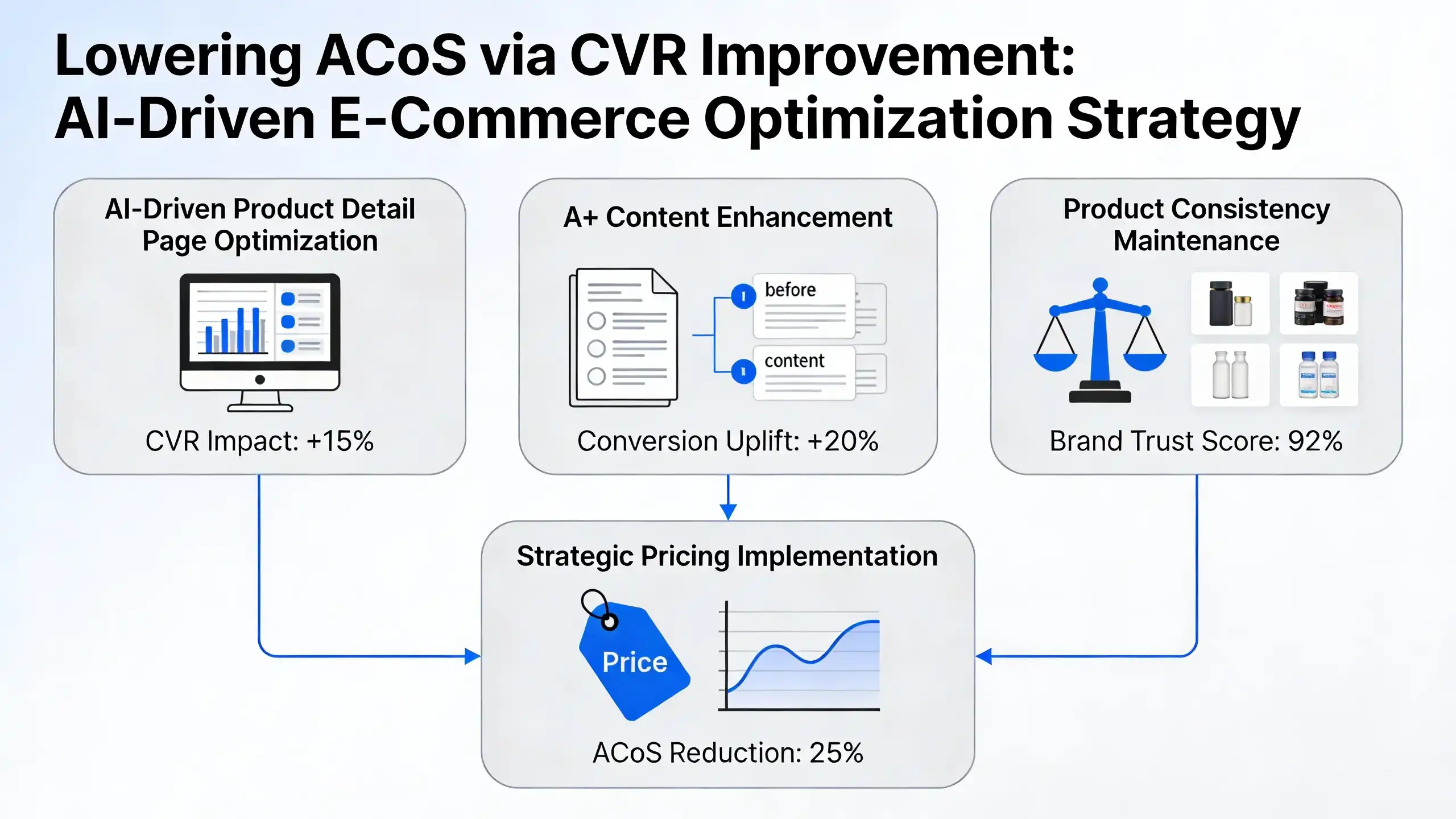
A high CVR is fundamental to a low ACoS. Every element on your product detail page—from the main image to customer reviews—must work together to build trust and drive sales. High-quality images, benefit-driven bullet points, and compelling A+ Content are critical.
However, generic advice like "improve image quality" is not actionable. Modern optimization tools move beyond ambiguity by translating strategic goals into precise, AI-executable instructions. For instance, a vague goal like "show long battery life" becomes a specific directive: "create a bottom-left infographic with a 4.5:1 text-to-detail ratio for '12-hour ultra-long journey'." Crucially, this process must enforce "product entity consistency," ensuring AI enhances scenes and backgrounds without altering the product's actual material or design. This prevents the "image-product mismatch" that leads to destructive negative reviews and a collapsing CVR.
Strategy 5: Optimize Product Pricing
Pricing directly impacts both perceived value and conversion rate. While it’s tempting to compete by offering the lowest price, this can erode margins and damage brand perception. The optimal price point balances market competitiveness with profitability.
Effective pricing strategy requires continuous analysis of competitor offerings and market trends. Instead of engaging in a race to the bottom, consider using strategic promotions, coupons, or product bundles to increase perceived value. These tactics can stimulate sales and improve your CVR without sacrificing your product's core price integrity. A well-calibrated price makes your advertising more effective, as each click is more likely to result in a profitable sale, thereby lowering your overall ACoS.
 Pillar 3: Strategic Campaign Management (Ads Quant & Organic Traffic)
Effective advertising goes beyond keywords and bids; it requires sophisticated campaign management that optimizes timing, structure, and its interplay with organic traffic. This pillar focuses on advanced strategies to ensure every ad dollar is invested for maximum impact on both immediate sales and long-term brand presence.
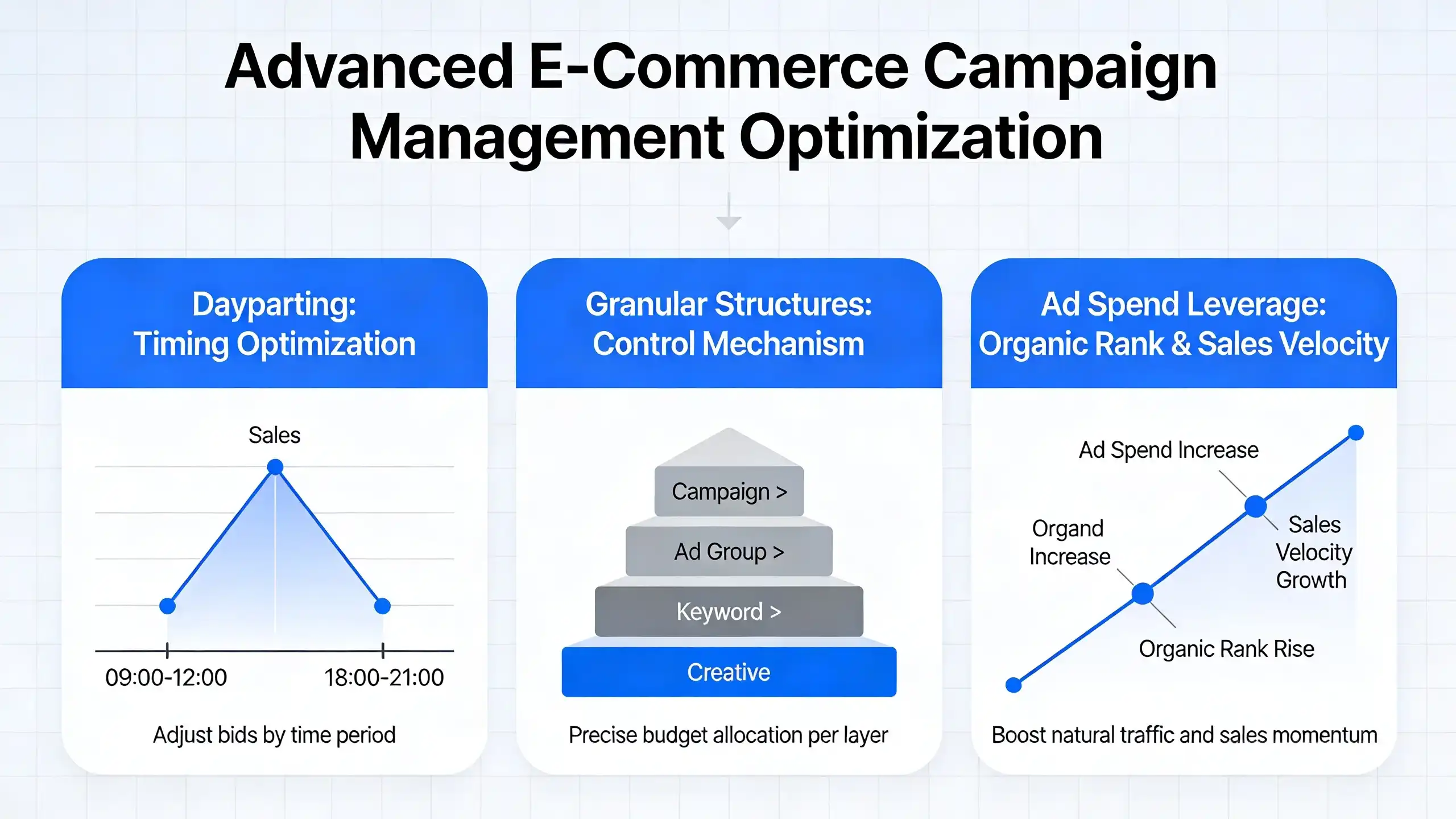
Strategy 6: Implement Dayparting and Budget Timing
Dayparting is the practice of scheduling your ads to run only during specific hours of the day or days of the week. By analyzing your campaign performance data, you can identify peak conversion periods when shoppers are most active and likely to purchase. Instead of running ads 24/7, you can allocate your budget to these high-value windows, ensuring maximum visibility when it matters most. This data-driven approach prevents wasted ad spend during low-traffic, low-conversion hours, directly lowering your ACoS by focusing resources on proven opportunities.
Strategy 7: Utilize Campaign Structure for Granularity
A granular campaign structure provides the control necessary for precise optimization. By creating highly specific campaigns—such as single-keyword ad groups (SKAGs) or campaigns dedicated to a single product variation—you can isolate variables and manage performance with greater accuracy. This structure allows you to set precise bids and allocate budgets based on the exact performance of a keyword or product, rather than broad averages. Implementing clear naming conventions for campaigns and ad groups is crucial for managing this complexity. Granularity ensures that high-performing targets receive the investment they deserve, improving overall campaign efficiency and ACoS.
Strategy 8: Drive Organic Rank with Strategic Ad Spend
Paid advertising and organic ranking are not separate channels; they are deeply interconnected. A successful ad campaign drives sales, which increases your sales velocity—a critical factor in Amazon's search algorithm. This boost can significantly improve your product's organic ranking over time. The key is to identify high-performing keywords from your ad reports and use them to inform your organic SEO strategy. This synergy creates a powerful flywheel effect where paid traffic enhances organic visibility, ultimately reducing your reliance on ads and lowering your Total ACoS (TACOS). Advanced tools can identify high-CTR and high-CVR keywords from ad data, helping you create targeted campaigns to dominate Top of Search and accelerate this dual growth.
 Pillar 4: Continuous Monitoring & Adaptation (Ads Quant & Listing)
Achieving your target ACoS is a milestone, not a final destination. The Amazon marketplace is a dynamic environment where competitor strategies, customer search behavior, and platform algorithms constantly evolve. Sustained profitability requires a commitment to continuous monitoring and agile adaptation, transforming optimization from a one-time project into an ongoing business process.
Strategy 9: Regular Performance Review and Iteration
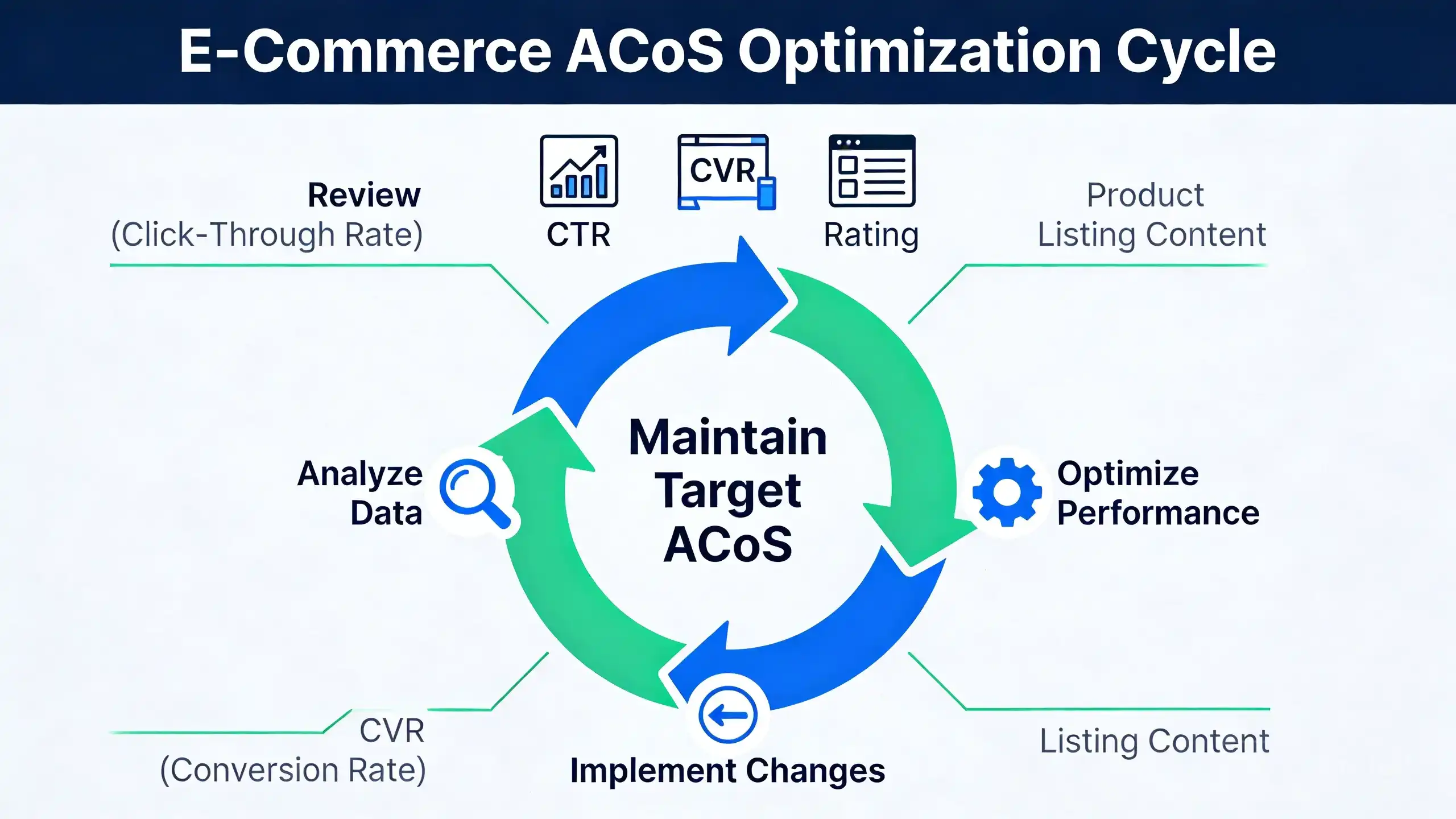
The core of effective ACoS management lies in a disciplined, iterative cycle: test, analyze, and adjust. This means moving beyond simply looking at the final ACoS number and digging into the leading indicators that drive it, such as Click-Through Rate (CTR), Conversion Rate (CVR), and individual keyword performance. A sudden drop in CVR, for example, could signal a new competitor with a more compelling offer or a negative shift in customer reviews that needs immediate attention.
To execute this effectively, you must establish a regular cadence for performance reviews—whether weekly or bi-weekly—to analyze campaign data and identify trends. The goal is to make informed, incremental adjustments rather than drastic, reactive changes. This data-driven approach turns optimization into a systematic process. By connecting the stages of performance diagnosis, strategic planning, and rapid execution, you can eliminate operational guesswork. This ensures your advertising spend and listing content are continuously refined to adapt to market realities, protecting your ACoS and enhancing overall commercial performance.
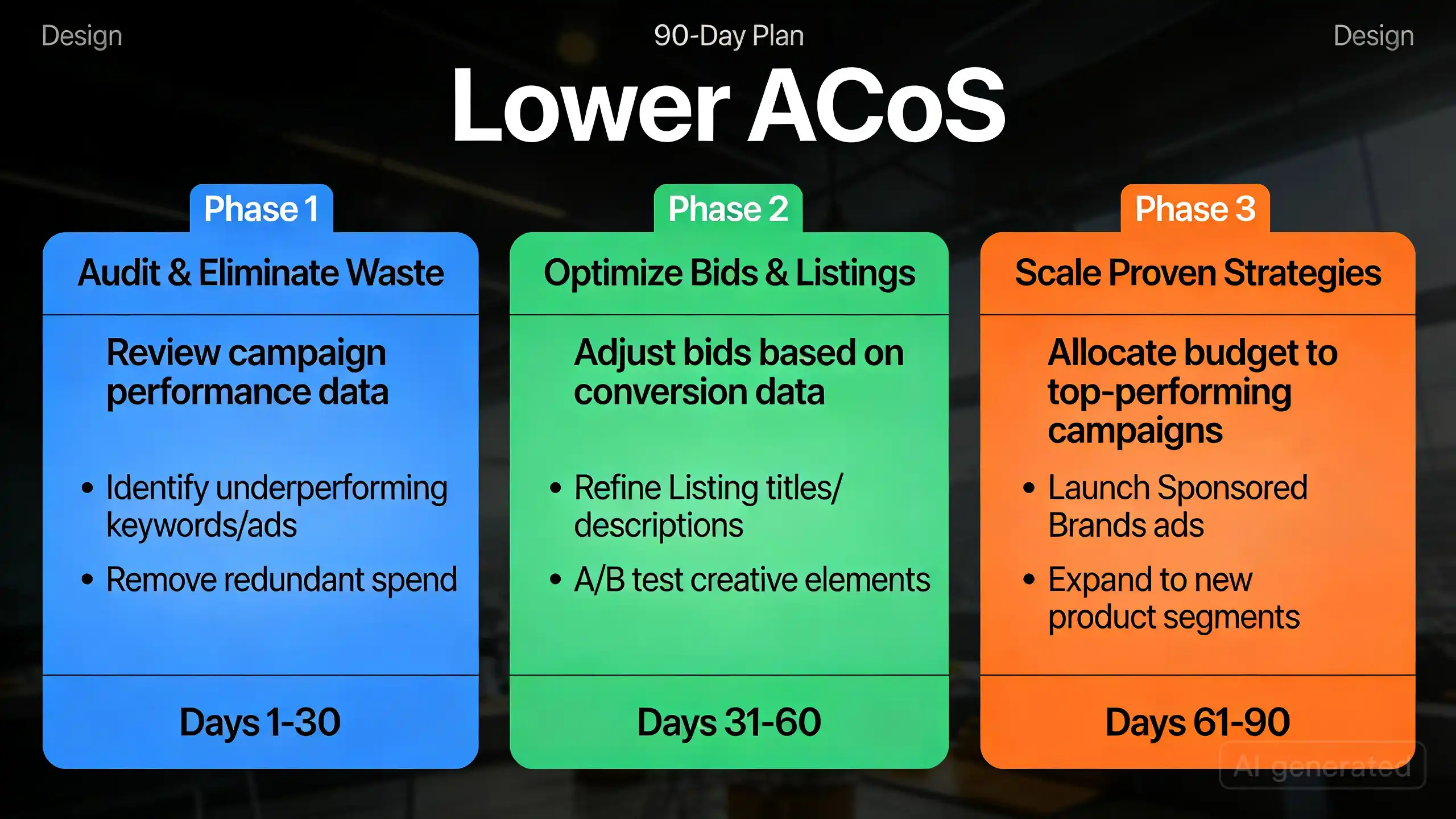
 Implementing a 90-Day ACoS Reduction Plan
Lowering your ACoS is a marathon, not a sprint. A structured 90-day plan provides the discipline to diagnose issues, implement changes, and measure results effectively. Success depends on patience and consistent, data-driven action rather than sporadic adjustments. This phased approach builds momentum and creates sustainable profitability.
- Days 1-30: Foundation and Diagnosis
The first month is dedicated to a deep audit and establishing a clean foundation. The goal is to stop wasteful spending and understand your baseline performance. Key actions include conducting a full campaign audit to find bleeding keywords, restructuring campaigns for better control, and implementing a robust negative keyword strategy to immediately eliminate irrelevant ad impressions. This phase sets the stage for all future optimizations.
- Days 31-60: Active Optimization and Testing
With a clear baseline, the second month focuses on iterative improvement. Here, you will test hypotheses and refine targeting based on the data gathered in phase one. Key actions involve methodically adjusting keyword bids—increasing for profitable terms and decreasing for marginal ones—and A/B testing ad copy and listing images to improve your Click-Through Rate (CTR) and Conversion Rate (CVR).
- Days 61-90: Scaling and Refinement
The final month is about scaling what works and solidifying your gains. The objective is to intelligently increase investment in proven strategies. Key actions include gradually increasing budgets for campaigns that have consistently met your target ACoS, expanding successful targeting into new ad types like Sponsored Brands, and refining your bidding rules to maintain efficiency as you scale.
 Conclusion: Mastering ACoS for Sustainable Amazon Success
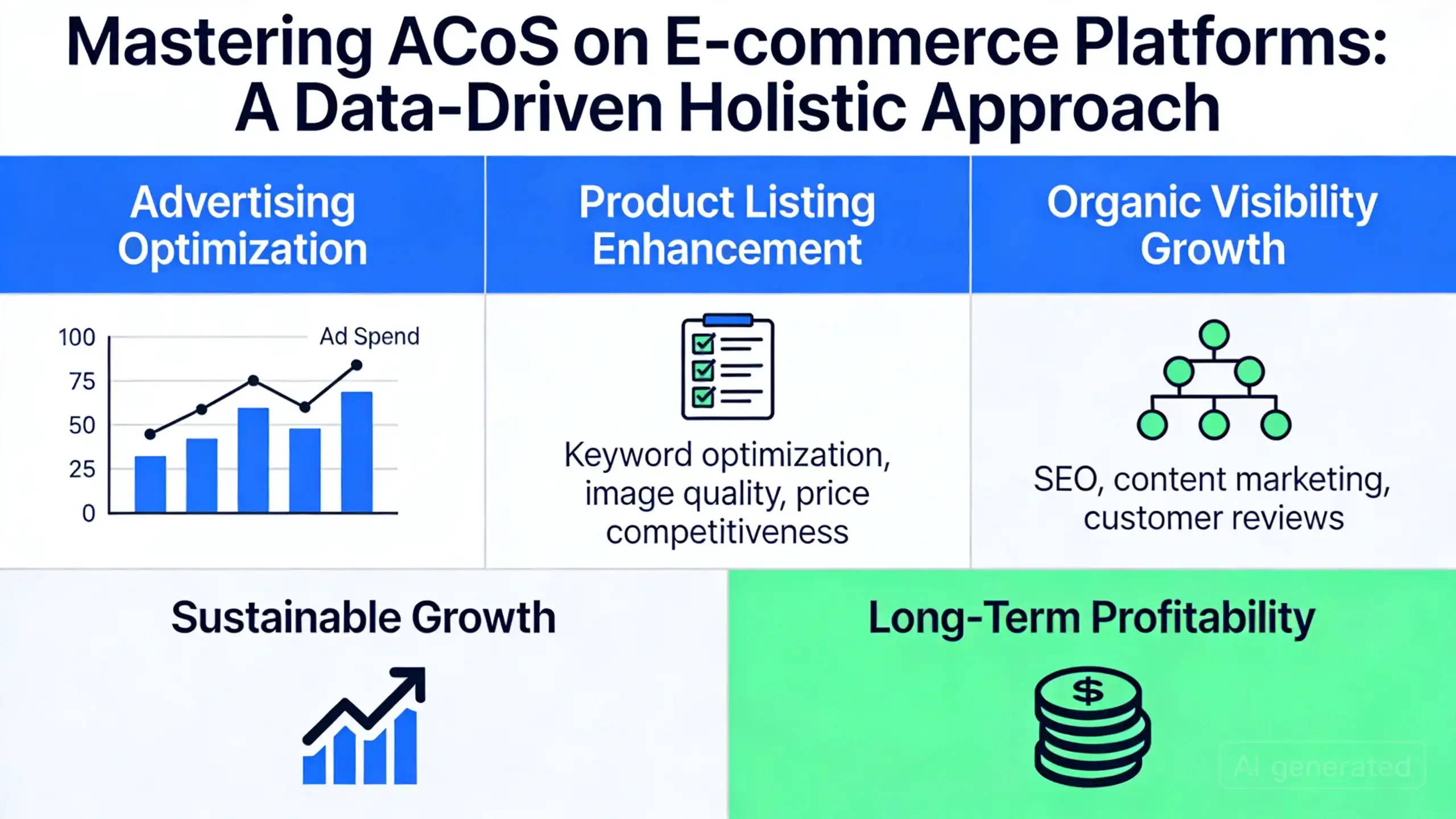
Mastering Amazon ACoS is not a one-time fix but a continuous strategic discipline. The nine strategies detailed in this guide underscore a critical truth: effective ACoS management extends far beyond simple bid adjustments. It requires a holistic approach that recognizes the deep interplay between your advertising campaigns, the conversion power of your product listings, and your organic search visibility. Each element directly influences the others, creating a flywheel effect where improvements in one area, like enhancing listing images to boost CVR, naturally lower the ACoS of your ad campaigns.
Success hinges on moving from reactive tweaks to a proactive, data-driven methodology. By consistently analyzing performance data and treating optimization as an end-to-end process—from keyword diagnosis to creative delivery—you break down operational silos and make smarter decisions. Ultimately, viewing ACoS not as an isolated ad metric but as a comprehensive indicator of your market health is the key to unlocking sustainable growth and long-term profitability on the competitive Amazon marketplace.