Understanding Amazon's Self-Interested Algorithm
To master Amazon's organic traffic, one must first understand the platform's core motivation: it is a highly efficient, commercially driven marketplace. The A9 algorithm and its successors are not neutral search engines; their primary objective is to maximize revenue per customer. This is achieved by prioritizing products that are most likely to satisfy a shopper's intent and result in a purchase. Every ranking factor is a signal that contributes to this fundamental goal.
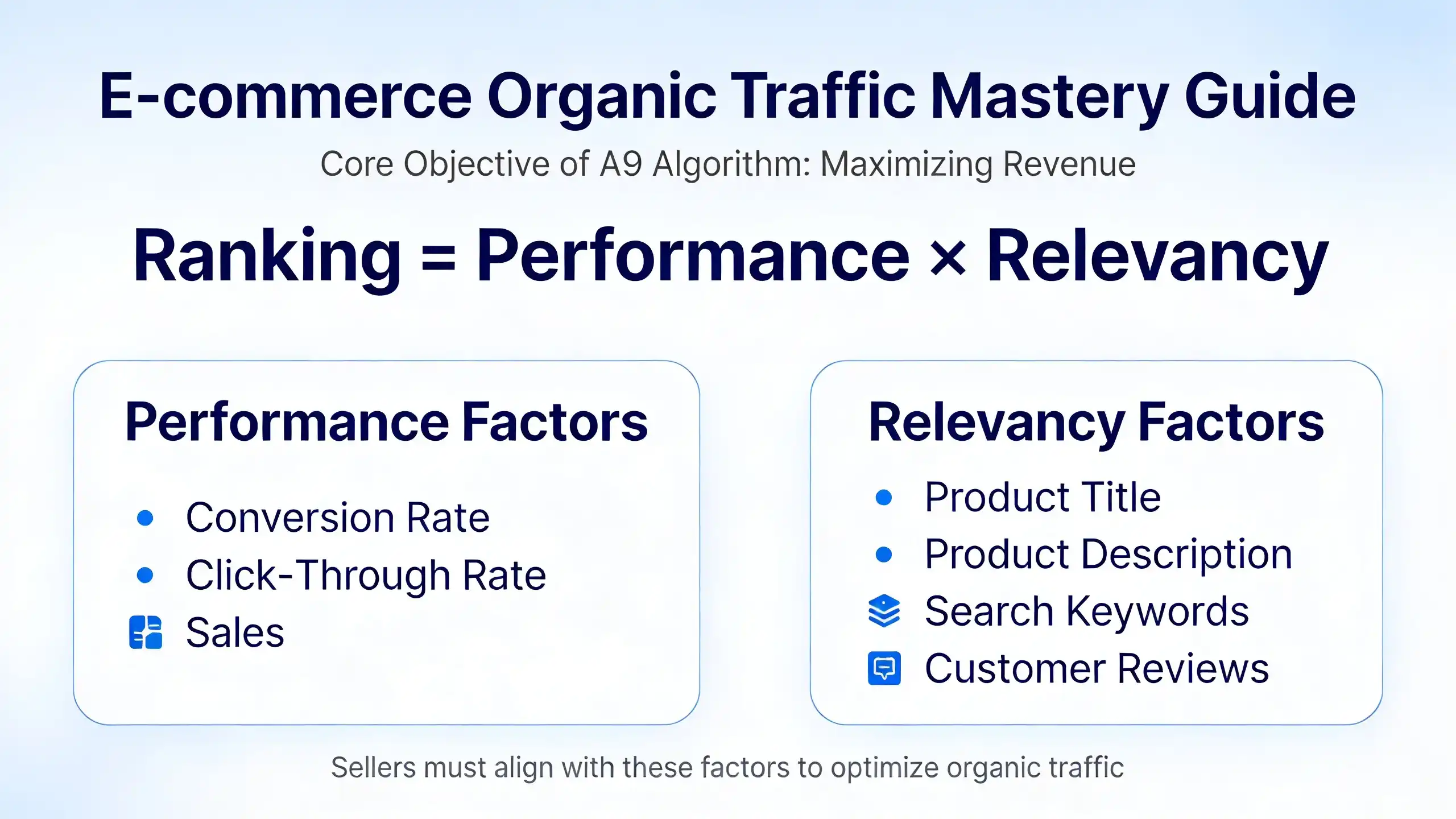
The algorithm's logic can be simplified into a core formula: Ranking = Performance × Relevancy.
- Relevancy is about matching your product to a customer's search query. This is determined by the keywords in your title, bullet points, description, and backend search terms. If your product isn't relevant, it won't be considered.
- Performance is about proving your product will convert. Once a customer clicks, how likely are they to buy? Amazon measures this through historical sales velocity, conversion rate (CVR), customer reviews, competitive pricing, and shipping speed (where FBA provides a significant advantage).
These performance metrics are not arbitrary; they serve as direct proxies for customer satisfaction and profitability. A product with a high conversion rate, positive reviews, and fast shipping is one that pleases customers and generates revenue for Amazon. By aligning your strategy with these signals, you are not attempting to manipulate the algorithm but rather partnering with it to achieve a shared objective.
 Deconstructing Organic Rank: Beyond BSR
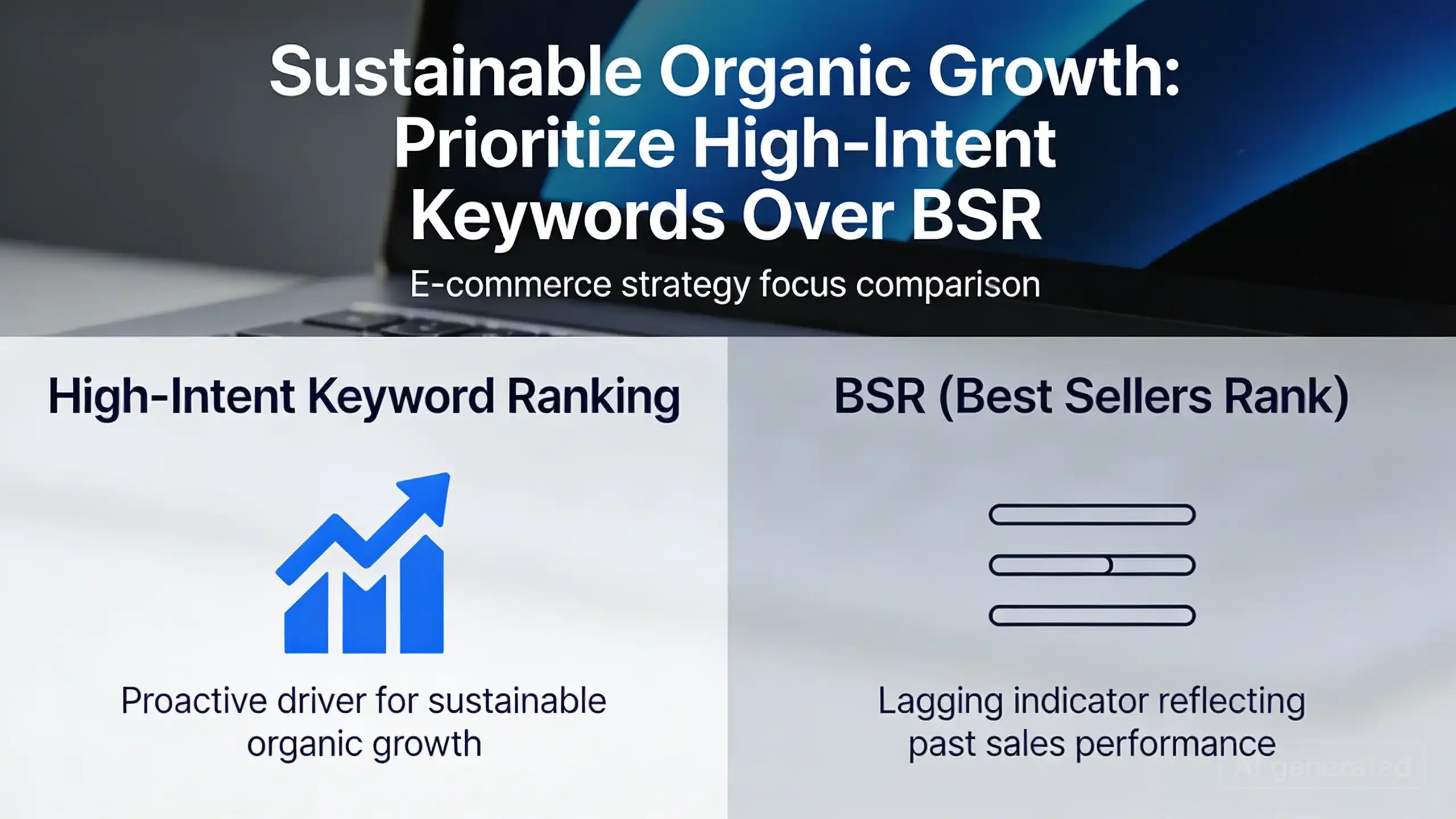
Many sellers fixate on their Best Seller Rank (BSR), viewing it as the ultimate measure of success. While a low BSR is a desirable outcome, treating it as a direct lever for improving organic search visibility is a common and costly mistake. Strategically, it is crucial to recognize that BSR is a lagging indicator of past success, not a proactive tool for future growth.
BSR simply reflects a product's recent sales volume relative to others within the same category. A surge in sales—whether from a promotion, advertising, or external traffic—will temporarily improve your BSR. However, this rank is the result of strong performance, not the cause of visibility in customer searches.
True organic visibility is determined by keyword ranking—your product's specific position in the search results for a given query, such as "waterproof hiking backpack." Each relevant keyword represents a distinct path to a potential buyer. Sustainable organic growth is not achieved by chasing the BSR badge but by systematically identifying and improving your rank for high-intent keywords. As your keyword rankings climb, you attract more qualified traffic, leading to higher conversion rates and increased sales. This sales velocity is what ultimately lowers your BSR. By focusing on keyword performance, a healthy BSR will follow as a natural consequence.
 The Foundation: Optimizing Your Listing for Relevancy and Conversion (ModuleListing)
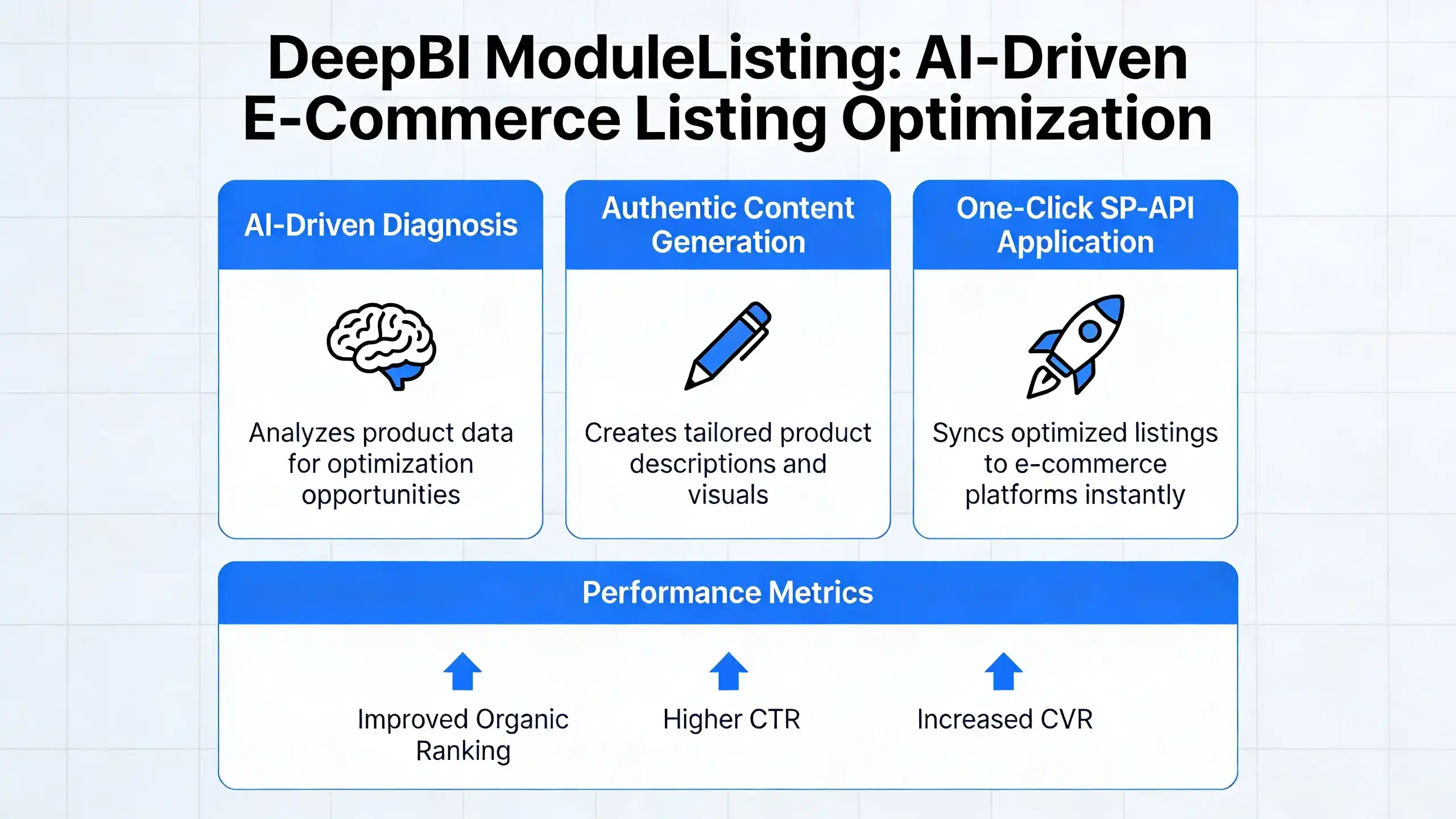
Your product listing is the bedrock of your organic ranking, directly influencing both relevancy and conversion. Amazon's algorithm scans your listing to determine its relevance for customer searches, while shoppers use its content to make a purchase decision. Excelling at both is non-negotiable for achieving top organic placement. This requires strategic keyword integration in your title, bullet points, and backend search terms; compelling visuals that improve Click-Through Rate (CTR); benefit-driven copy that boosts Conversion Rate (CVR); and rich A+ Content that tells a complete product story.
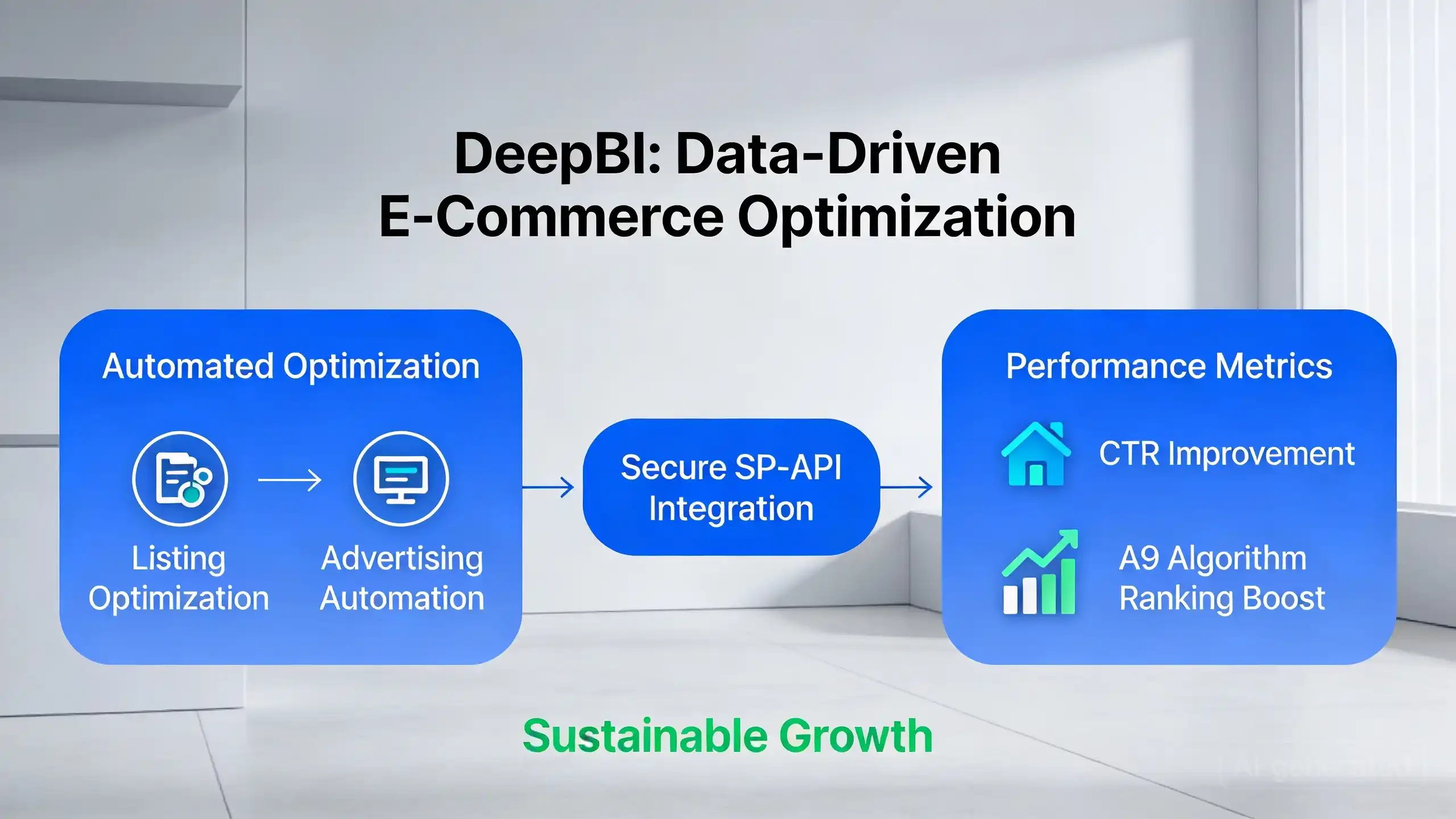
However, manually optimizing these elements is often slow, subjective, and disconnected from performance data. DeepBI’s ModuleListing is engineered to eliminate this friction. The process starts with an intelligent diagnosis, which scores your listing and benchmarks it against top-performing competitors to instantly identify weaknesses. From there, its AI content generation capabilities create SEO-optimized copy and, crucially, authentic visuals. Unlike general-purpose AI that can "hallucinate" inaccurate images, DeepBI builds a "Product DNA" map to ensure every visual is true to the physical product, mitigating post-sale risks.
Finally, DeepBI transforms execution. Instead of a manual upload process that can take dozens of minutes, its one-click application uses the Amazon SP-API to sync all approved content in seconds. The system then closes the loop by tracking the impact of these changes on your key performance indicators, allowing you to connect optimization efforts directly to metrics like CTR.
 Accelerating Organic Growth with Strategic Advertising (ModuleAdsQuant)
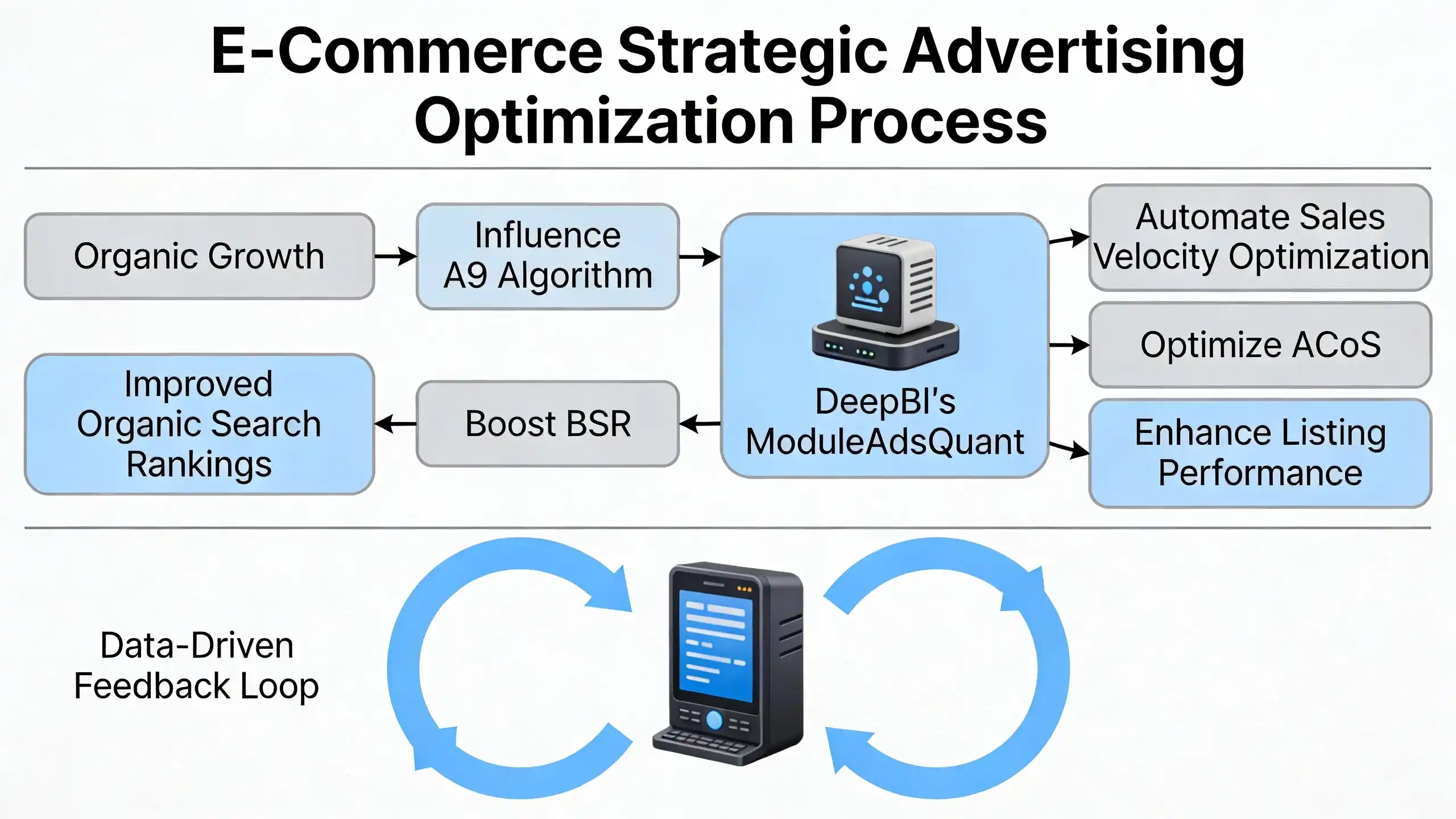
Strategic advertising on Amazon is not merely about generating immediate sales; it is a powerful catalyst for long-term organic growth. Ad-driven sales contribute directly to your product's sales velocity and history, which are critical performance signals for the A9 algorithm. A consistent stream of sales, even if initiated by ads, signals to the algorithm that your product is relevant and popular, leading to improved organic search rankings and a better Best Seller Rank (BSR).
Beyond driving sales, advertising is your most effective tool for keyword discovery. By structuring campaigns with broad, phrase, and exact match types, you can systematically uncover the high-converting search terms that customers are actually using. This data is invaluable for optimizing your listing's title, bullet points, and backend search terms to attract more organic traffic.
This is where a structured approach, powered by DeepBI's ModuleAdsQuant, creates a decisive advantage. The module implements a four-layer traffic funnel model to manage ad spend with maximum efficiency:
- Exploration: Discovers new opportunities with broad match and product targeting.
- Initial Screening: Filters for relevance using phrase match.
- Precision: Capitalizes on proven keywords with exact match campaigns.
- Scaling: Aggressively targets high-performing keywords to maximize sales.
ModuleAdsQuant automates this entire process with dynamic parameter adjustment, continuously optimizing bids and budgets to hit your target ACoS while driving the sales velocity needed to boost organic rank. This creates a data-driven feedback loop where ad insights and performance directly fuel organic visibility, building a sustainable growth flywheel for your brand.
 Sustaining Organic Dominance: The DeepBI Organic Traffic Strategy (ModuleOrganicTraffic)
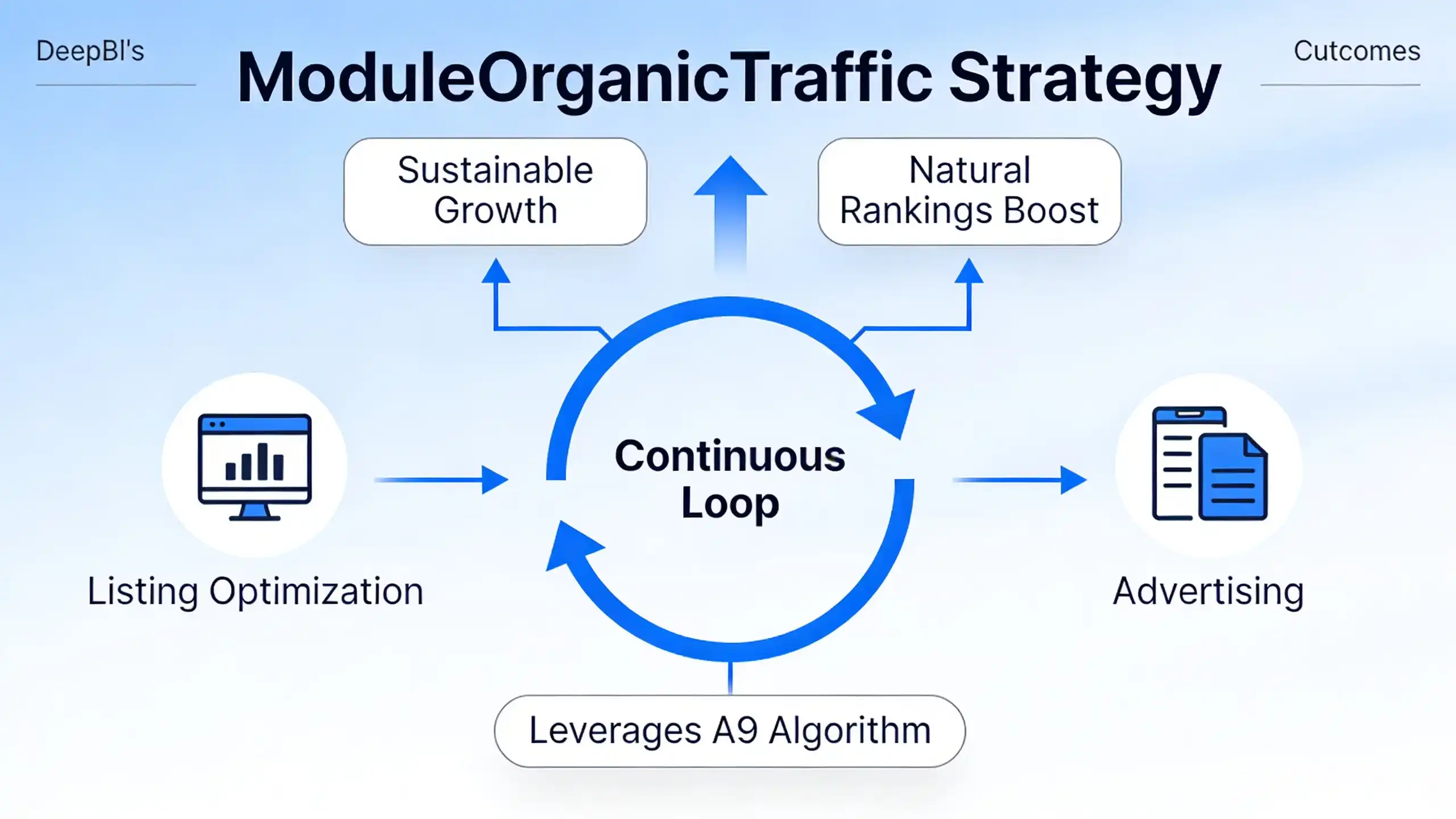
Sustainable organic growth is achieved not by treating listing optimization and advertising as separate tasks, but by integrating them into a single, powerful flywheel. Many sellers face a frustrating paradox: a product with excellent sales velocity and strong reviews that still fails to rank for high-value keywords. This is often a case where a product's "deserved rank" is suppressed by poor relevancy. Your product has earned the performance credentials, but without the right keyword signals in your listing, Amazon’s algorithm cannot connect that performance to the customer's search.
This is where DeepBI’s ModuleOrganicTraffic strategy creates a fifth layer to your growth funnel, transforming ad spend into a long-term asset. The process is a continuous, analytics-driven loop:
- Keyword Screening: We analyze advertising data to identify your highest-performing keywords—those with superior Click-Through Rates (CTR), Conversion Rates (CVR), and order values.
- Top of Search Reinforcement: These proven keywords are then targeted with dedicated campaigns designed to achieve and hold Top of Search positions, maximizing visibility and sales velocity for those specific terms.
This integrated approach delivers powerful dual growth: immediate sales from hyper-targeted ads and a sustained lift in natural rankings as the A9 algorithm rewards the increased performance. The entire system is continuously refined by monitoring key metrics like keyword rankings, organic sales volume, Total ACoS (TACOS), and the natural order percentage, ensuring your brand achieves and maintains profitable market dominance.
 The Role of DeepBI in Your Organic Growth Journey
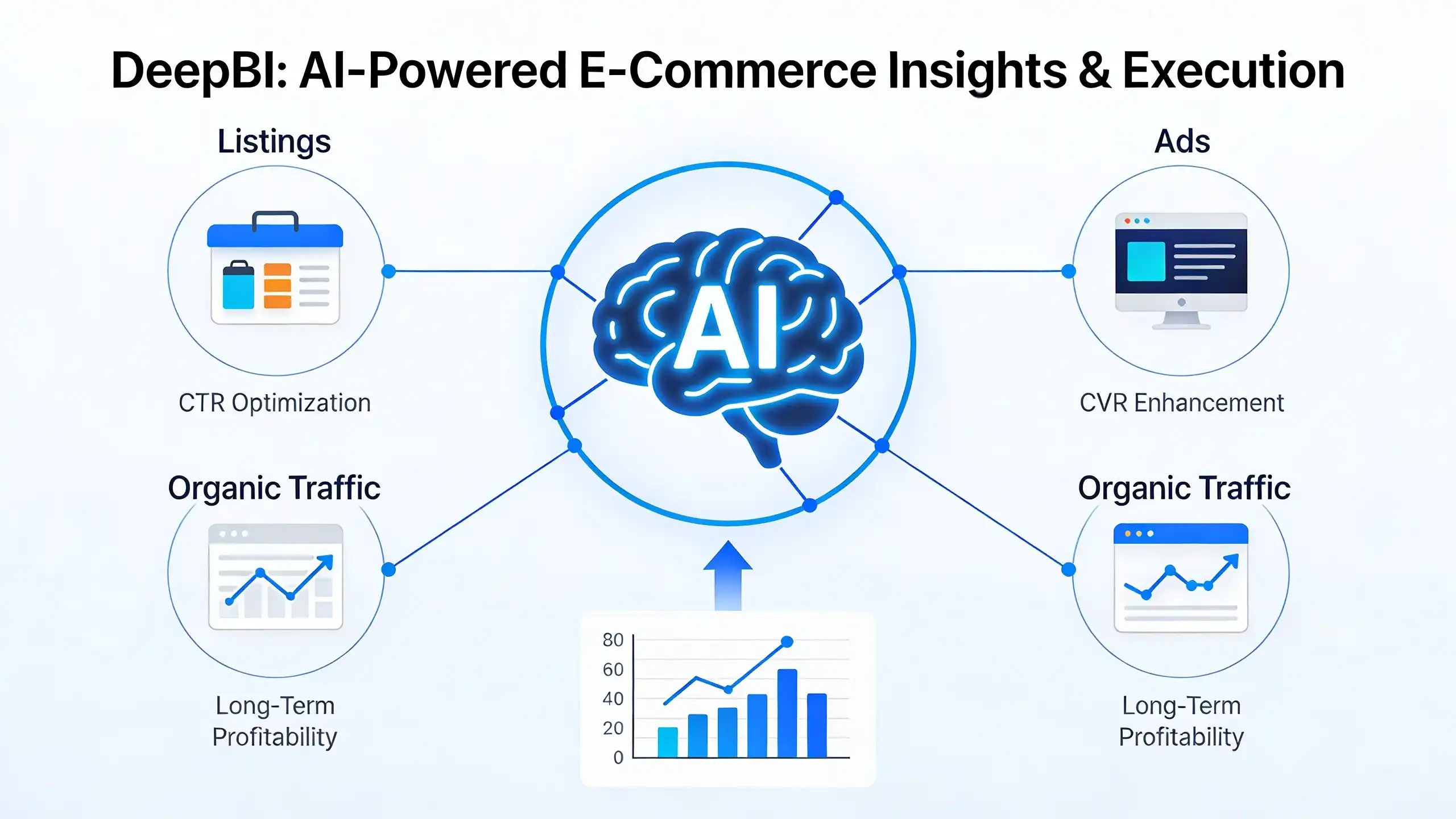
Mastering Amazon's organic traffic is not about guesswork; it requires a systematic, data-driven methodology. This is where DeepBI provides a decisive advantage. As an AI-powered system designed exclusively for Amazon, DeepBI integrates the critical pillars of your business—Listings, Ads, and Organic Traffic—into a single, intelligent platform.
Traditionally, sellers face a disconnected process where diagnosis, strategy, production, and optimization operate in silos. This leads to inefficiencies, subjective decisions, and missed opportunities. DeepBI breaks down these barriers by creating an end-to-end, integrated system. It moves your operations from guesswork to precision targeting, ensuring that every action is informed by data.
The platform translates high-level strategic goals into precise, AI-executable instructions. Instead of vague feedback like "improve the main image," DeepBI generates specific parameters for composition, lighting, and camera angles that are proven to drive higher CTR and CVR. This ensures that your data-driven insights are executed with accuracy, eliminating the risks of human error and subjective interpretation. By connecting diagnosis directly to execution and optimization, DeepBI empowers you to shift from experience-based gambles to an analytical model built for stable, long-term profitability.
 Conclusion: Sustainable Growth Through Data-Driven Organic Strategy
Mastering Amazon's organic landscape is not a matter of finding a single secret tactic but of building a sustainable, data-driven growth engine. The A9 algorithm fundamentally rewards products that deliver a superior customer experience, which requires a holistic strategy. Lasting success is found in the powerful synergy between meticulous listing optimization, which drives conversion, and strategic advertising, which generates crucial initial traffic and sales velocity. Together, these elements create a positive feedback loop that steadily improves organic ranking and builds long-term brand equity.
However, managing this complex interplay manually is inefficient and prone to error. The path forward is to shift from intuition-based decisions to a data-centric operational model, where adopting a sophisticated toolset becomes a competitive necessity. Platforms like DeepBI empower sellers to execute this advanced strategy with precision and security. By automating time-consuming listing updates, operating through the secure SP-API to mitigate account risks, and automatically correlating actions—like an image update—to performance metrics such as Click-Through Rate (CTR), they transform abstract goals into measurable outcomes. For sellers serious about scalable and defensible growth, embracing a data-driven organic strategy is the essential foundation for future success.