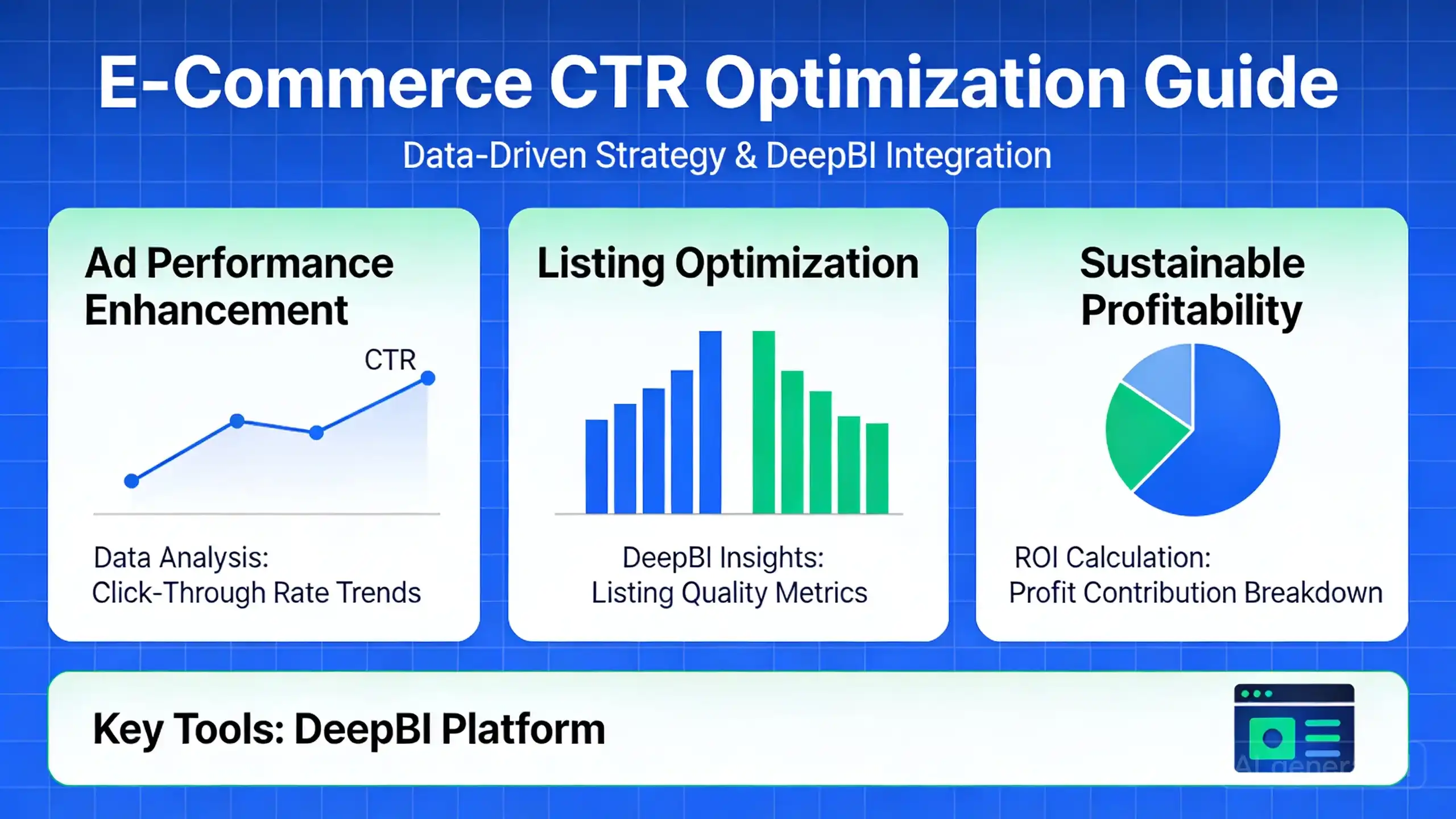
Introduction: The Critical Role of Click-Through Rate in Amazon Advertising
For many Amazon sellers, Click-Through Rate (CTR) is a passive indicator in an advertising report. This perspective is a costly mistake. In the competitive Amazon marketplace, CTR is not a secondary metric; it is a primary lever for advertising efficiency and sales velocity. It represents the customer's first "yes," transforming a passive impression into an active engagement. A high CTR signals to Amazon's algorithm that your product is highly relevant to a customer's search, which can lead to better ad placements, increased visibility, and a lower Advertising Cost of Sale (ACoS).
The core challenge has always been improving CTR in a systematic way. Sellers invest heavily in new product images and updated copy, but the process often relies on subjective judgment, making it difficult to quantify the impact of these changes on business metrics. When you launch a new main image, can you prove it drove the subsequent lift in traffic and sales?
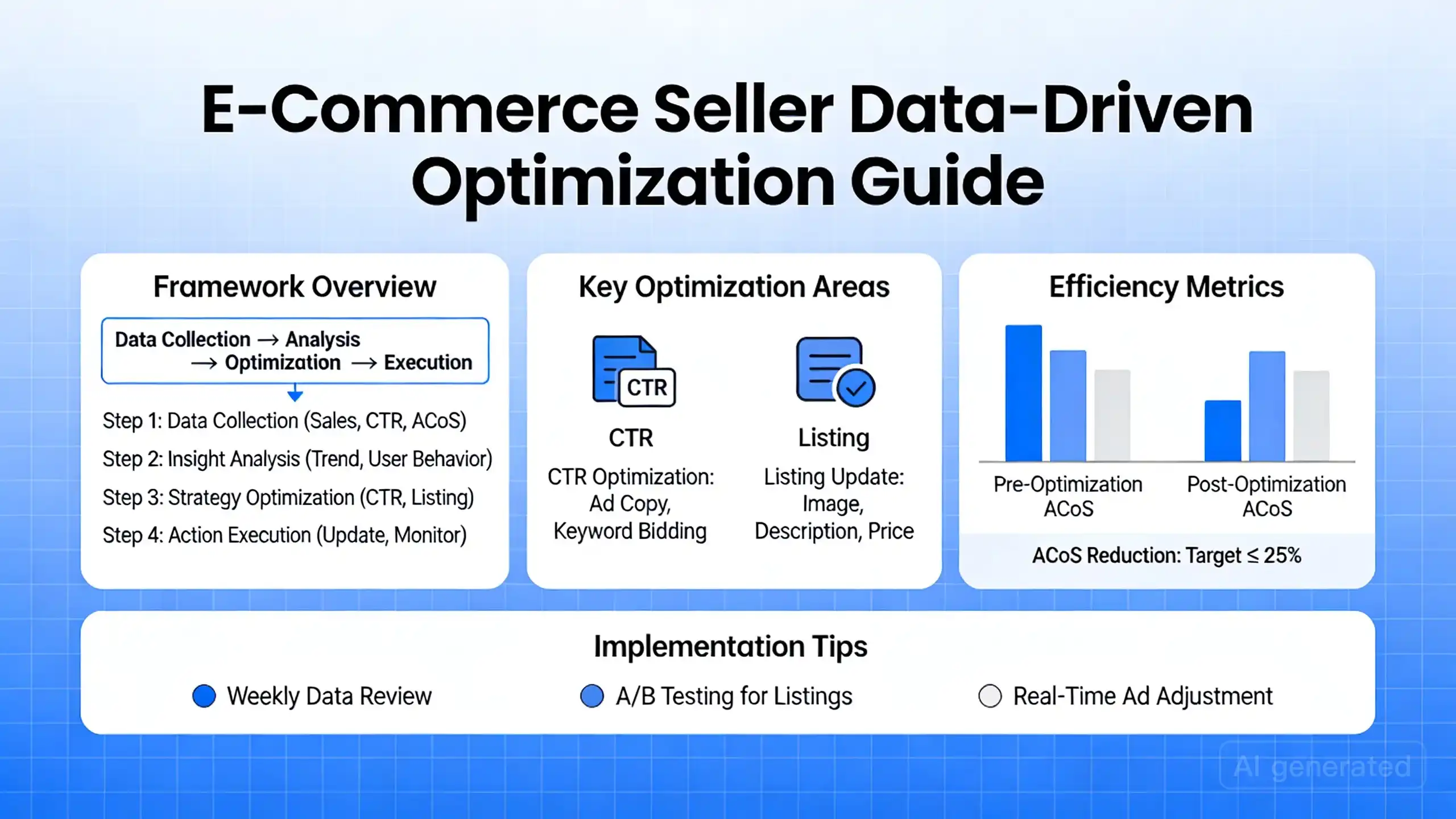
This guide provides a new framework for mastering your CTR. We will move beyond guesswork and introduce a data-driven approach to optimization. You will learn how to build a closed-loop system where advertising data directly informs your creative strategy. We will demonstrate how to precisely track the impact of every listing update on your CTR, turning visual assets and product titles from aesthetic choices into a core commercial engine that drives clicks, conversions, and profitability. It is time to stop guessing and start engineering predictable growth.
 Understanding Amazon Click-Through Rate (CTR)
In the Amazon ecosystem, Click-Through Rate (CTR) is a foundational metric that measures the immediate appeal and relevance of your ads. It represents the percentage of shoppers who see your ad (an impression) and are interested enough to click on it. The calculation is straightforward: (Total Clicks ÷ Total Impressions) × 100%.
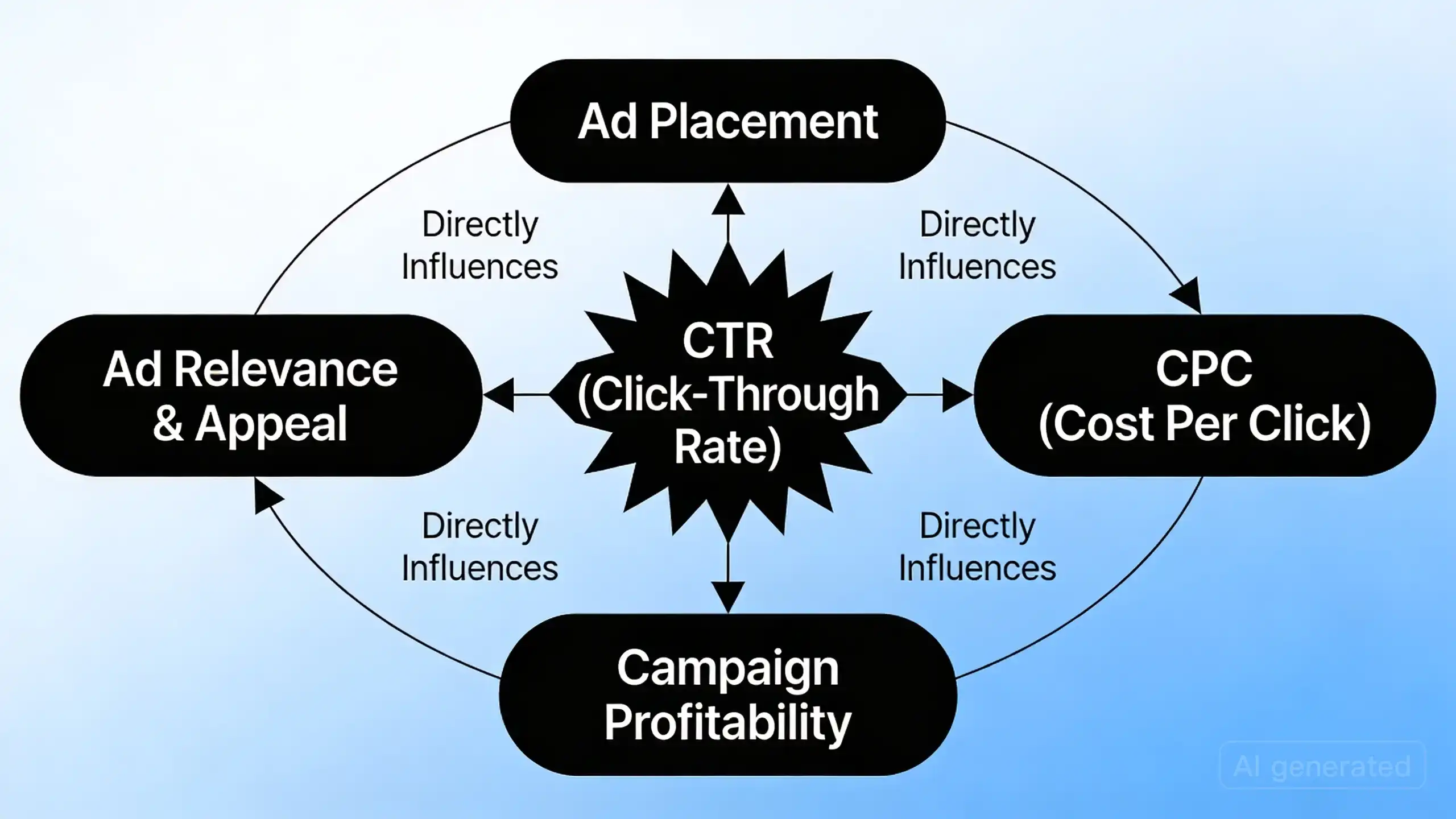
While the formula is simple, its impact on your advertising performance is profound. CTR is a primary indicator that Amazon's algorithm uses to evaluate the relevance of your ad to a customer's search query. A high CTR signals that your product and ad creative are a strong match for what shoppers are seeking. In response, Amazon's system tends to reward your ads with better placements—potentially higher on the search results page—and often a lower Cost-Per-Click (CPC).
Conversely, a low CTR suggests a disconnect. It tells the algorithm that your ad is not resonating with the audience, which can lead to diminished visibility and progressively higher CPCs as you are forced to bid more aggressively for placement. Therefore, a strong CTR is a direct lever for improving your ad campaign's efficiency and overall profitability.
 What Constitutes a "Good" Amazon CTR? Benchmarking and Context
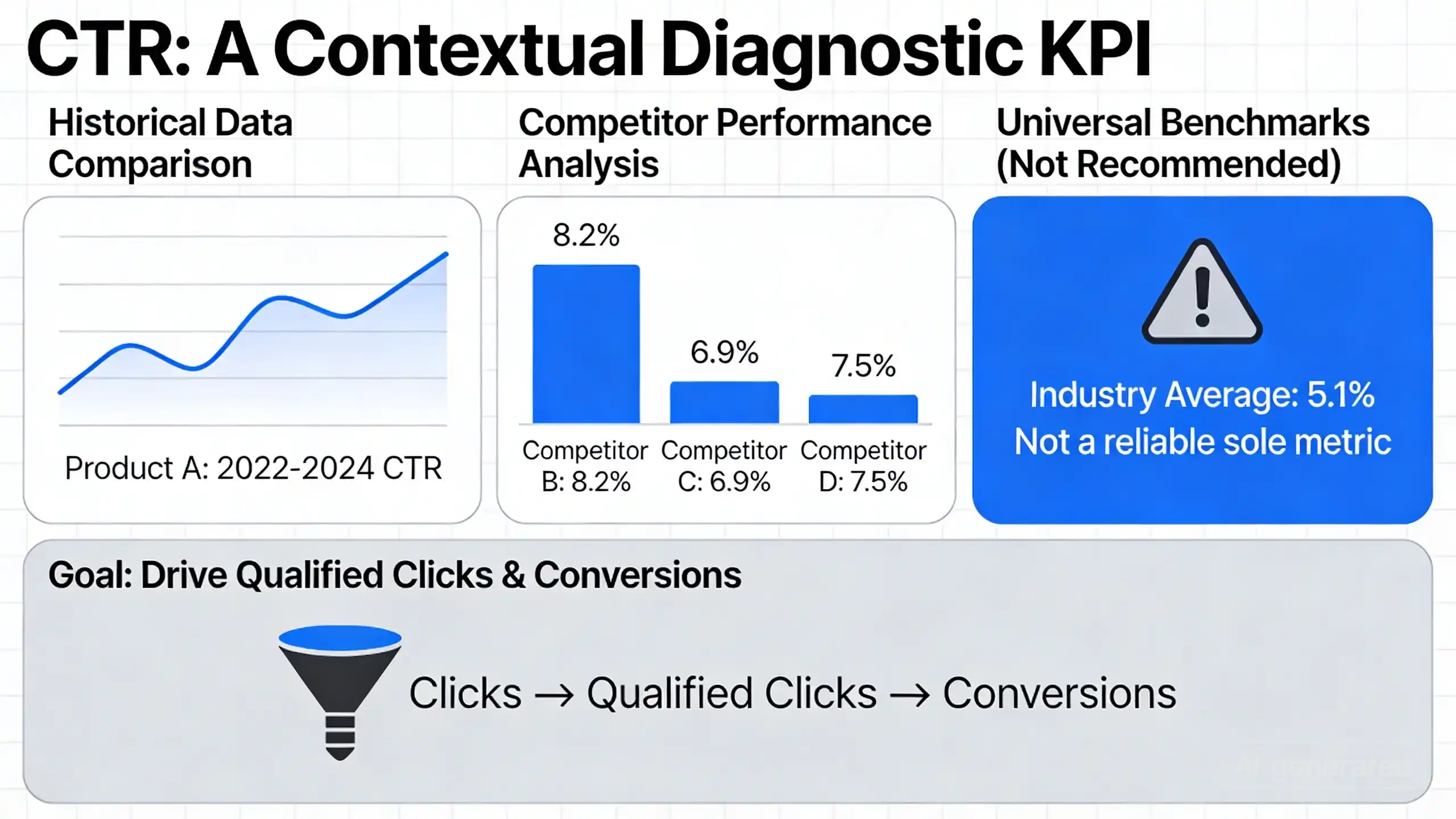
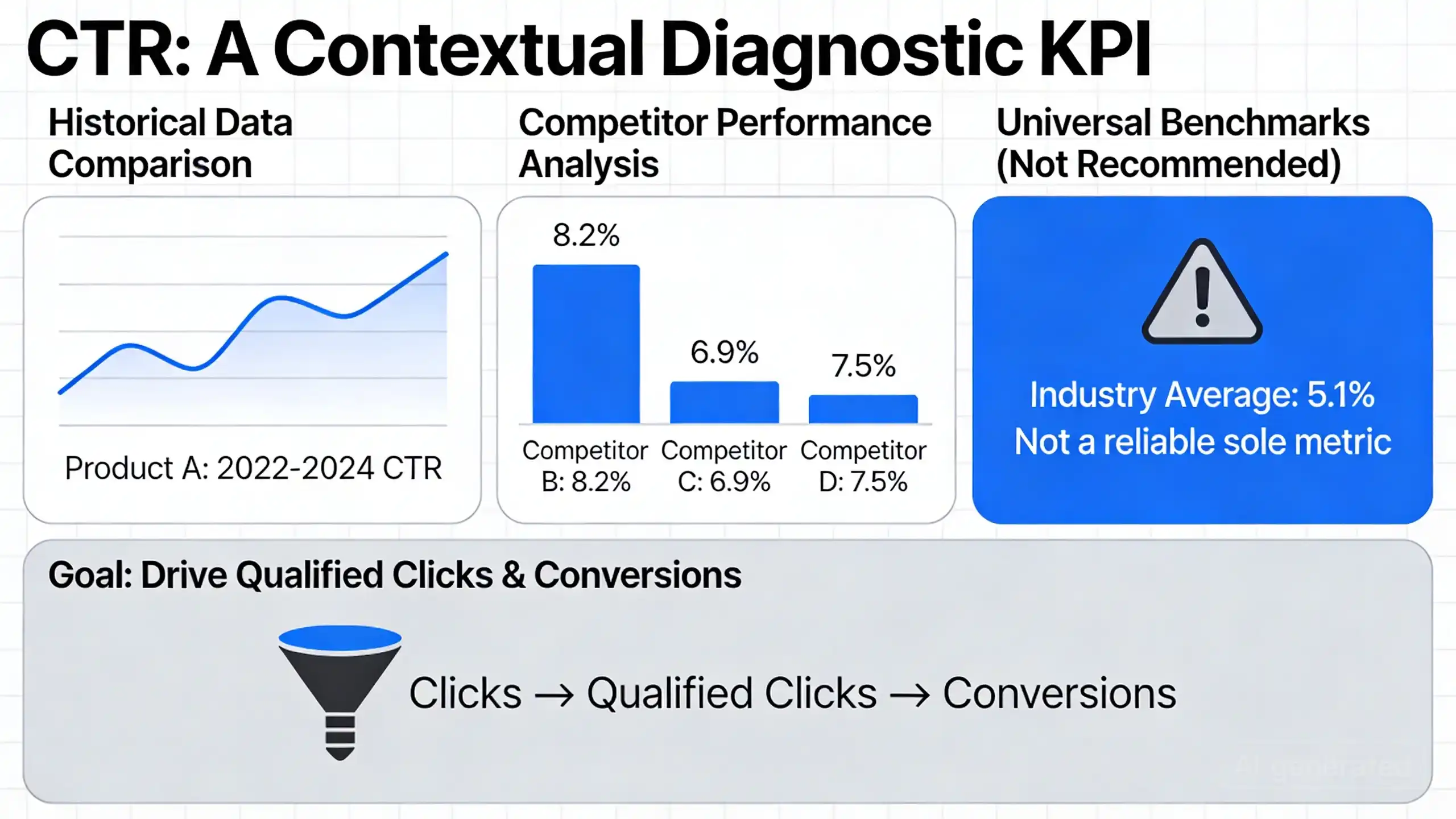
One of the most common questions sellers ask is, "What is a good Click-Through Rate for my ads?" The answer is that no single number applies to everyone. A "good" CTR is highly contextual and serves as a vital diagnostic KPI for your ad's relevance and appeal, but it must be evaluated within its specific environment.
While benchmarks can provide a general sense of direction, they are not universal targets. Across many categories, a CTR for Sponsored Products ads often falls in the 0.3% to 0.6% range. Sponsored Brands, with their more prominent placements and creative flexibility, may see higher rates. However, treating these figures as absolute goals is a strategic error, as the actual performance of your ads is influenced by a multitude of dynamic factors.
- Product Category: Niche, high-consideration products in categories like industrial tools will have different CTR expectations than impulse-buy items in the grocery category.
- Ad Type and Placement: An ad at the top of search results will almost always have a higher CTR than one on a product detail page or at the bottom of the search results.
- Competition: In a highly saturated market with numerous similar listings, achieving a high CTR is significantly more challenging.
- Seasonality: Major sales events like Prime Day or the Q4 holiday season can dramatically inflate or alter typical click-through behavior.
- Price Point: A product's price can influence a shopper's willingness to click, with higher-priced items often requiring more compelling ad copy and creative to earn the click.
Ultimately, the most important benchmark is your own historical data. A "good" CTR is one that improves over time and outperforms your direct competitors on your most critical keywords. The goal is not to chase an abstract industry average but to continuously optimize for more qualified, high-intent clicks that drive conversions for your specific products.
 The Interplay of CTR, Conversion Rate (CVR), and ACoS: A Practical Relationship
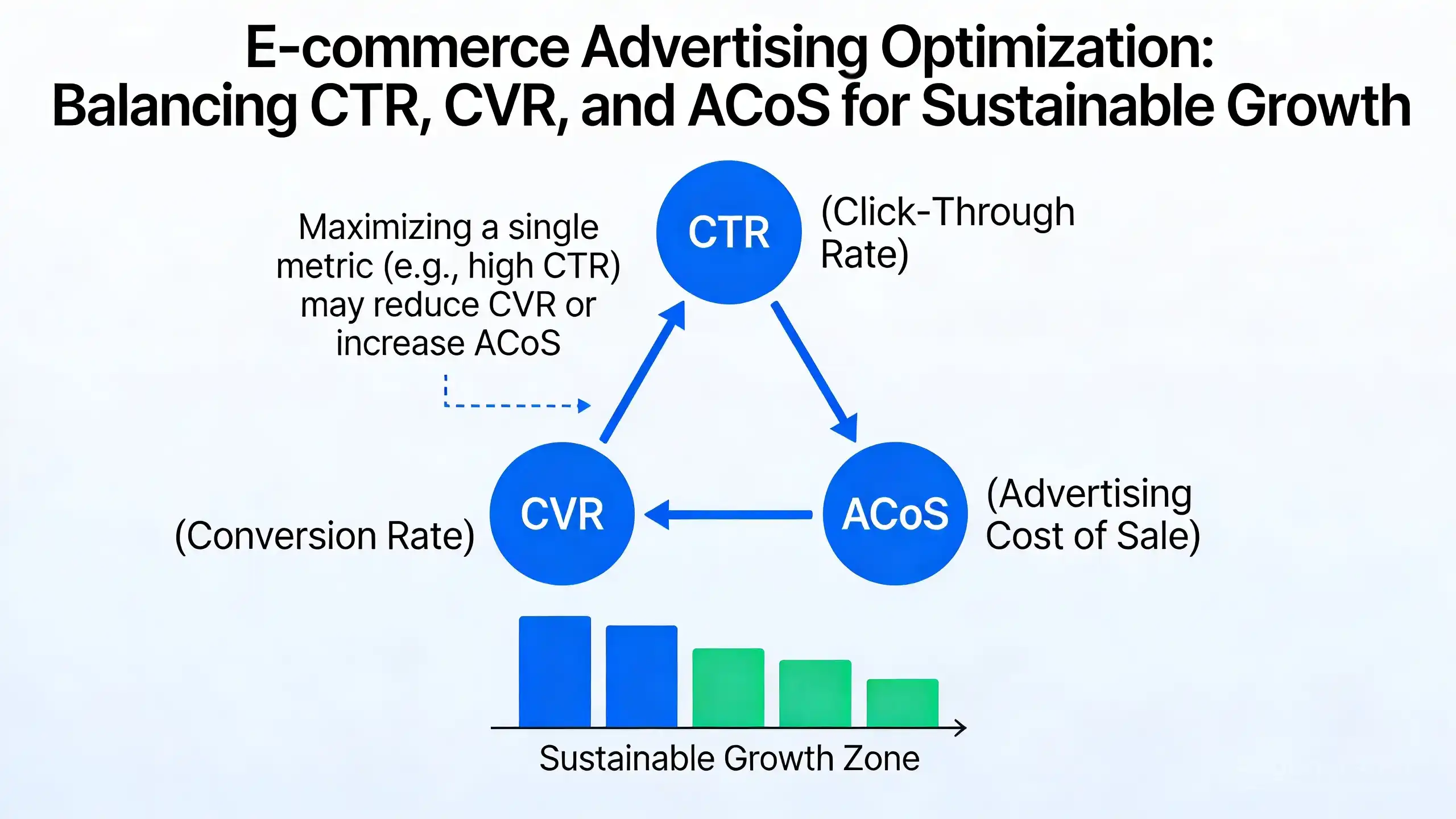
While a high Click-Through Rate (CTR) is a strong indicator of ad relevance and creative appeal, it is only one part of the performance puzzle. To truly understand and optimize your Amazon advertising, you must analyze CTR in conjunction with two other critical metrics: Conversion Rate (CVR) and Advertising Cost of Sale (ACoS).
- Conversion Rate (CVR) measures the percentage of shoppers who purchase your product after clicking on your ad. It is the ultimate test of your product detail page's effectiveness—from your images and copy to your price and reviews.
- Advertising Cost of Sale (ACoS) represents your ad spend as a percentage of the revenue generated from those ads. It is the primary measure of your campaign's direct profitability.
These three metrics are locked in a practical relationship where optimizing one can directly affect the others. A high CTR paired with a low CVR signals a critical disconnect: your ad successfully attracts clicks, but the landing page fails to convert them, leading to wasted ad spend and a high ACoS. Conversely, a low CTR with a high CVR indicates a missed opportunity: your product is highly desirable to those who see it, but your ad is not compelling enough to attract a wider audience. The goal is not to maximize a single metric in isolation but to achieve a strategic balance that drives profitable, sustainable growth.
 Diagnosing Low CTR: Identifying the Root Causes with Signal-Based Analysis
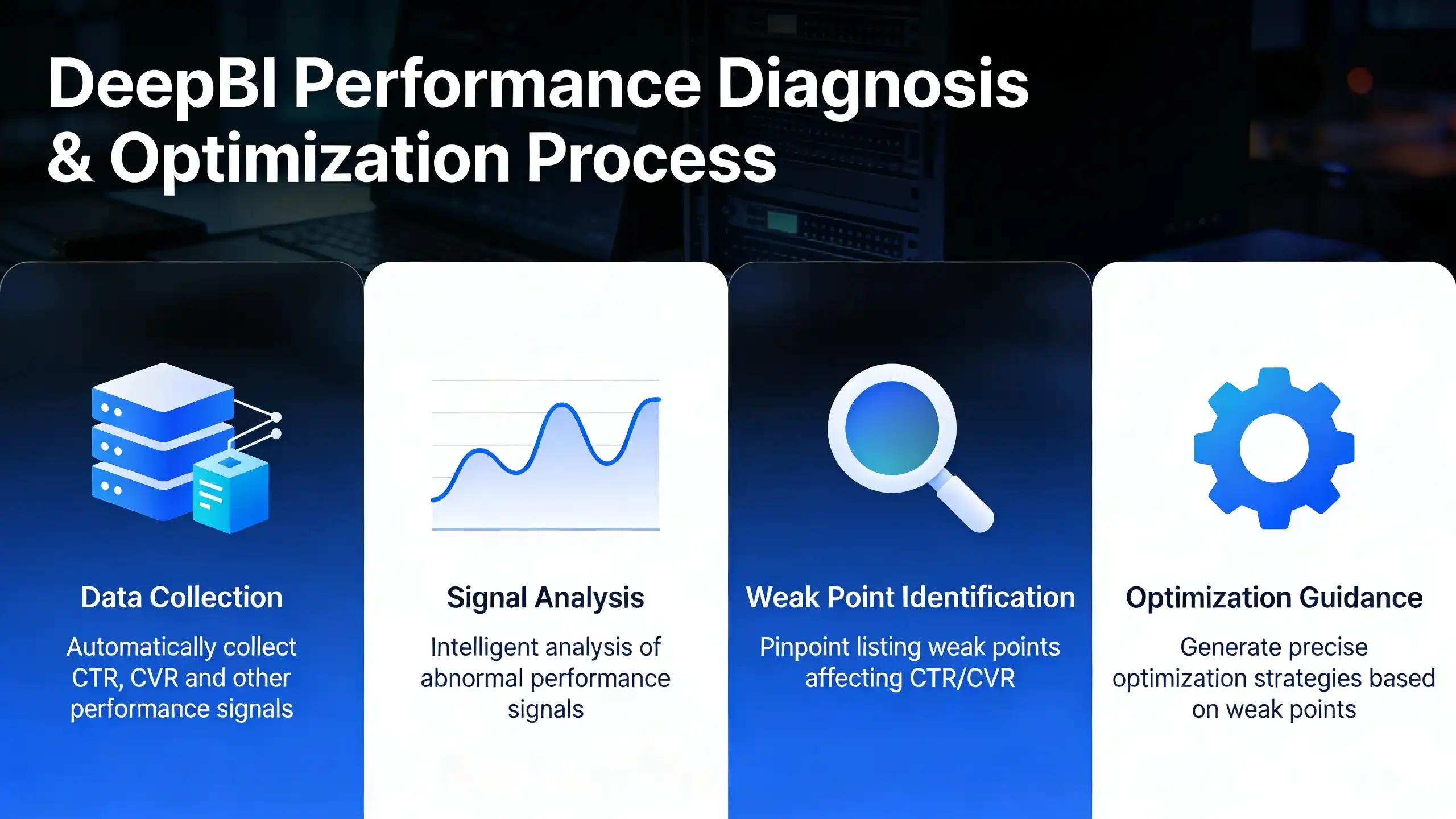
Effective optimization begins with accurate diagnosis. Instead of guessing what is wrong with your ads, you can move from speculation to precision targeting by analyzing key performance signals. A low Click-Through Rate (CTR) is a symptom, but the underlying cause can only be identified by looking at CTR in conjunction with your Conversion Rate (CVR). This signal-based framework helps you pinpoint the root problem and prioritize your next move.
We can break down the diagnosis into two primary scenarios.
- Low CTR + Low CVR: This combination signals a fundamental relevance problem. Your ad is being shown to shoppers who have no intention of buying your product. The root cause often lies in poor keyword selection, incorrect audience targeting, or a fundamental mismatch between your product offer and the customer's search intent. You are attracting the wrong traffic, and consequently, they neither click nor buy.
- Low CTR + High CVR: This pairing indicates a presentation problem. Your product is highly relevant to the audience—proven by the strong conversion rate from the few who do click—but your ad creative fails to capture their attention. The issue is likely an unappealing main image, a confusing or weak title, or uncompetitive pricing cues visible in the search results. Your offer is right, but your first impression is wrong.
Interpreting these signals correctly is crucial for focusing your optimization efforts. Instead of randomly changing elements, you can confidently address either your targeting strategy or your creative assets. DeepBI’s multi-dimensional diagnosis capability automates this analysis, evaluating factors affecting both CTR and CVR to identify listing weak points. By processing your performance data, the system helps you determine whether you have a relevance or presentation issue, allowing you to build a targeted and effective optimization plan.
 Strategic Pillars for Improving Amazon Ad CTR
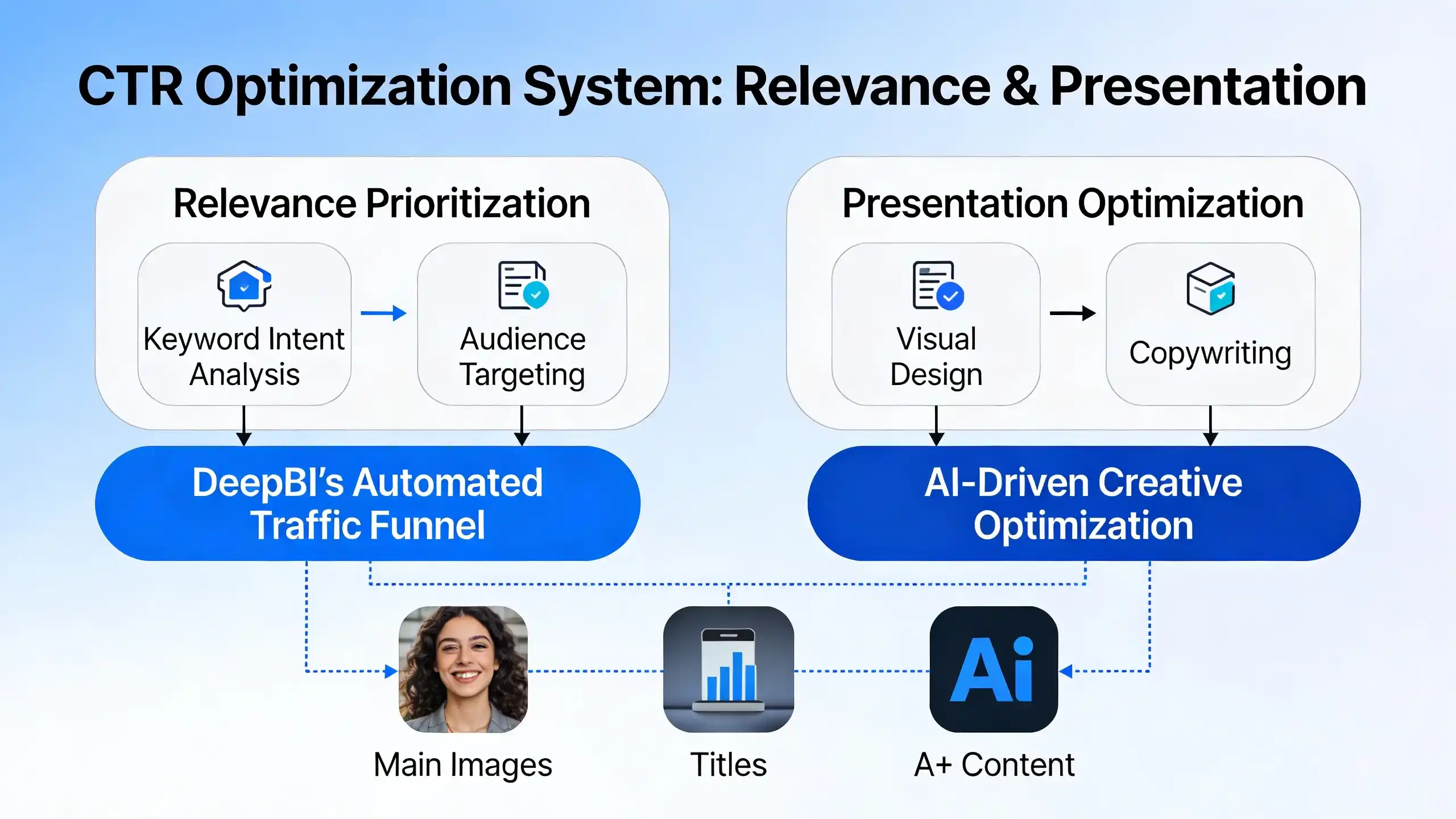
Improving your ad Click-Through Rate (CTR) is not about a single trick; it is a systematic process built on two core pillars. First, you must ensure your ads are shown to the right audience. Second, you must make your ad creative compelling enough to earn their click. Attempting to optimize presentation before fixing relevance is like decorating a store that is located in the wrong city—a waste of resources.
Pillar 1: Prioritize Relevance (Fixing Keyword Intent and Targeting)
The foundation of a high CTR is relevance. If your product appears in search results for unrelated queries, you accumulate impressions from shoppers who will never click, which drives your CTR down and wastes ad spend. Achieving relevance requires a multi-faceted approach.
This process starts with deep keyword research focused on customer intent, not just traffic volume. This means identifying the precise phrases a motivated buyer would use and aligning your ad groups accordingly. This strategy must be paired with aggressive use of negative keywords to filter out irrelevant searches that drain your budget. Beyond keywords, you must refine your targeting to focus on specific ASINs and categories that attract highly qualified audiences. Finally, the offer itself must align; your product must be a genuinely logical and competitive solution for the targeted keyword or audience.
This continuous process of refinement can be complex. DeepBI’s four-layer traffic funnel model—spanning exploration, initial screening, precision, and scaling—is designed to automate this task. It systematically identifies and refines keyword and ASIN targets, ensuring your ads consistently reach the most relevant shoppers while filtering out low-quality traffic, which directly improves the CTR driven by audience relevance.
Pillar 2: Optimize Presentation (Enhancing Visuals and Copy)
Once your ads are reaching the right audience, the next challenge is to make them stand out and earn the click. This is where the art and science of presentation come into play.
The main image is the single highest-leverage driver of CTR, especially on mobile devices where titles are often truncated. A high-quality, clear product shot, a compelling lifestyle image, or a graphic that highlights a key benefit can dramatically increase click-worthiness. This must be supported by a concise, keyword-rich title that front-loads the most critical information. Finally, clear price cues, promotions, and visible Amazon badges like "Best Seller" create trust and urgency, further encouraging a click.
However, using AI to generate these assets can be risky. General-purpose AI tools can produce "hallucinations" that alter a product's appearance, leading to a product-image mismatch, negative reviews, and returns. DeepBI solves this by first creating a "Product DNA" map, which acts as a constraint on all visual creation to ensure authenticity. Instead of vague suggestions like "improve texture," DeepBI uses precise, parameterized instructions for composition, lighting, and camera angles to guide its AI. This transforms creative optimization from a subjective guessing game into an engineered process, creating optimized main images, titles, and A+ content that are both compelling and true to the product.
 Leveraging DeepBI for Advanced CTR Optimization
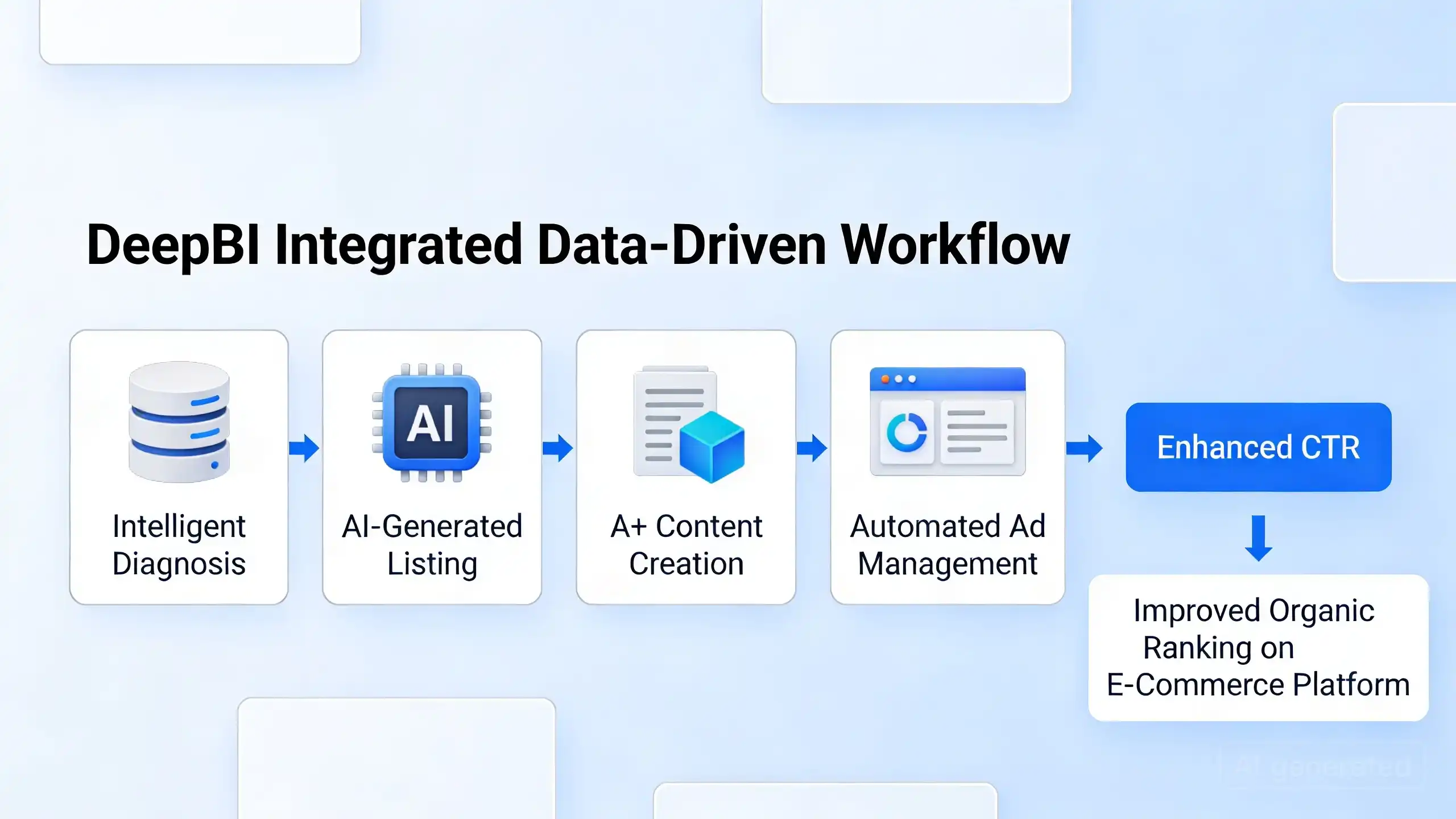
Effective CTR optimization requires more than isolated tweaks; it demands an integrated, end-to-end system. DeepBI provides this by connecting diagnostics, content generation, ad management, and performance measurement into a single, automated workflow.
The process begins with intelligent diagnosis. Instead of offering vague advice, DeepBI benchmarks your listing against high-performing competitors and provides precise, engineered instructions for improvement, detailing parameters like composition and lighting. From there, its AI-powered content generation creates optimized main images, titles, and A+ content. Crucially, this is not a general-purpose AI prone to "hallucinations." DeepBI builds a "Product DNA" map to constrain the AI, ensuring all generated visuals are authentic to the product and mitigating the risk of returns from inaccurate images.
Once your listing is optimized, DeepBI's AdsQuant module ensures it reaches the right audience through a four-layer traffic funnel for precision keyword and ASIN targeting, coupled with automated daily bid and budget adjustments. Deploying these updates is seamless; what was once a 30-minute manual upload becomes a one-click, seconds-long synchronization via the Amazon SP-API.
This creates a powerful synergy. High-quality listing content improves ad relevance, which boosts CTR. The resulting increase in conversions signals to Amazon's algorithm that your product is a strong performer, positively influencing your organic ranking. DeepBI closes the loop by automatically tracking the impact of these changes, allowing you to see exactly how a new main image affects your CTR in the 7–14 days after implementation. This approach transforms optimization from guesswork into a data-driven science.
 Measuring, Iterating, and Sustaining CTR Improvements
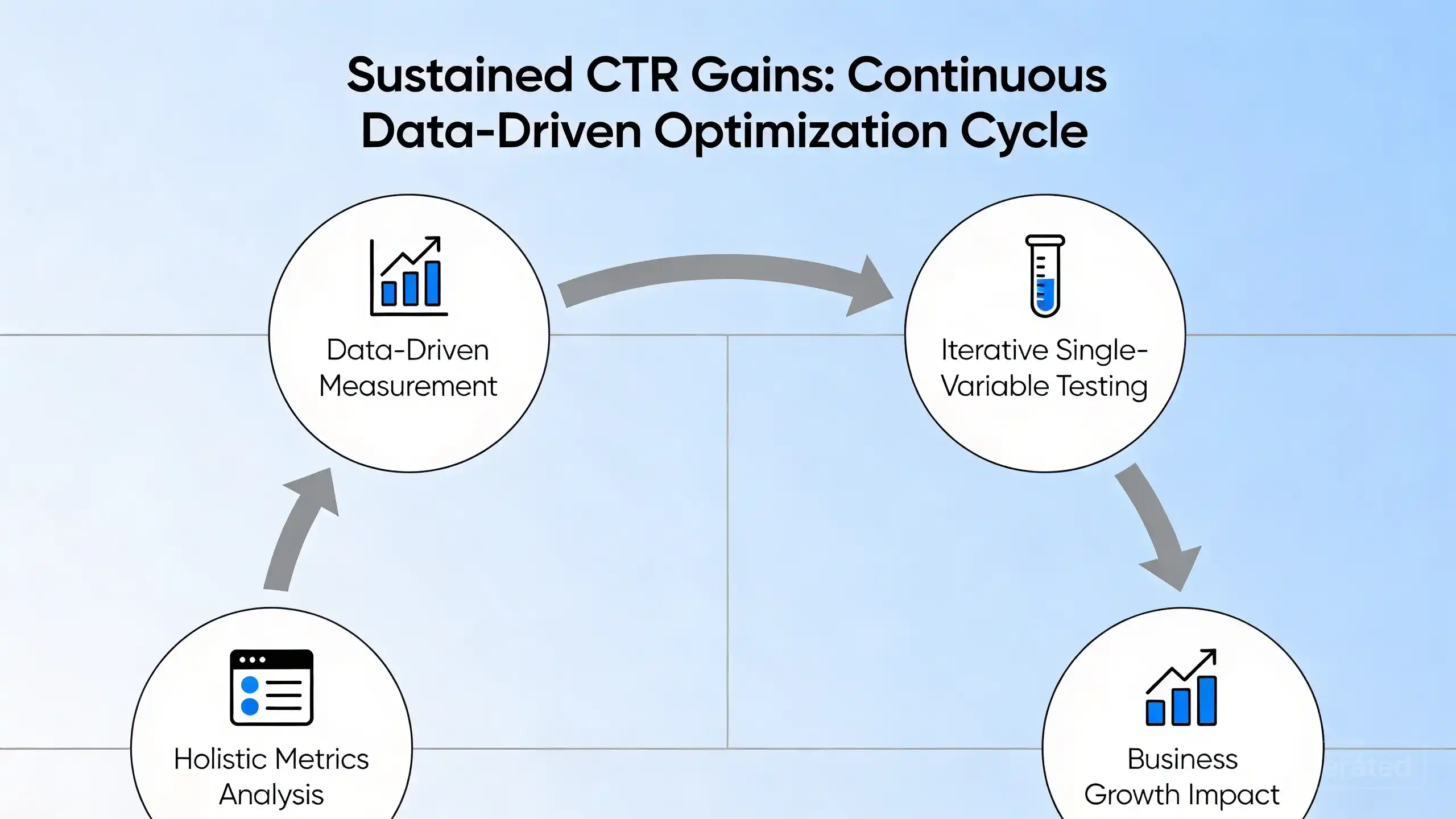
Achieving a high Click-Through Rate is not a one-time fix but a continuous cycle of measurement, iteration, and refinement. Sustaining CTR gains requires a disciplined, long-term strategy grounded in data. The first step is to move beyond tracking CTR in isolation. True optimization involves monitoring a balanced scorecard of metrics, including Conversion Rate (CVR), ACoS, and overall sales velocity. This holistic view ensures that your efforts to attract more clicks are also translating into profitable sales.
The core of this process is iterative testing. Instead of making drastic, multiple changes at once, focus on adjusting one variable at a time—such as updating your main product image—and then meticulously track the impact on CTR through your ad reports. This methodical approach allows you to attribute performance changes directly to specific actions.
The financial leverage of this process is significant. Consider a simple example:
- Scenario A: 100,000 impressions with a 0.4% CTR yields 400 clicks. With a 10% CVR, this results in 40 orders.
- Scenario B: After optimizing your main image, your CTR increases to just 0.5%. The same 100,000 impressions now generate 500 clicks. Assuming the CVR holds steady at 10%, you now have 50 orders.
This seemingly minor 0.1 percentage point lift in CTR has driven a 25% increase in orders. By consistently applying this measure-and-iterate loop, you can transform marginal gains into substantial, long-term business growth.
 Frequently Asked Questions About Amazon CTR
What is the difference between CTR and Conversion Rate (CVR)?
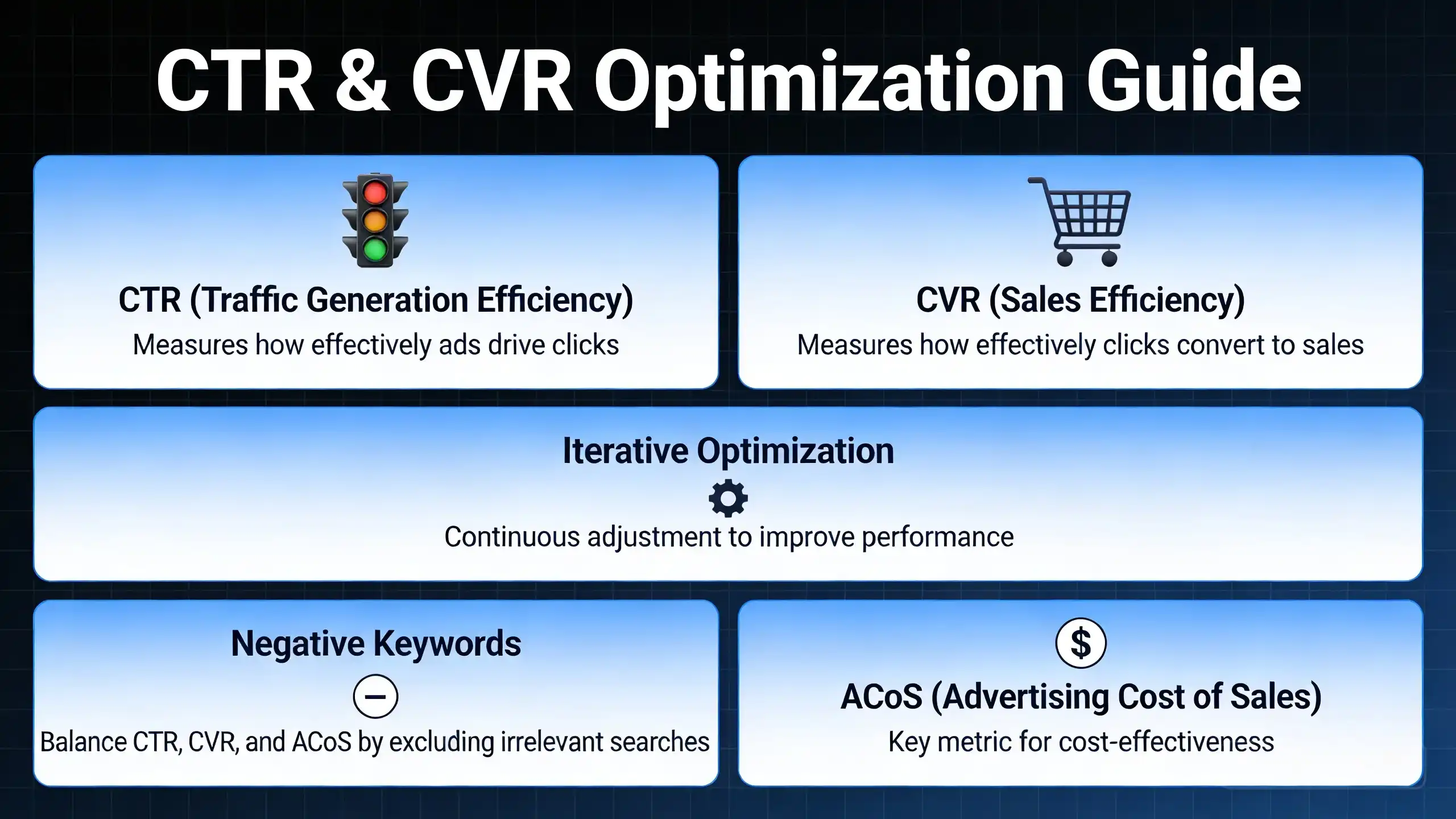
Click-Through Rate (CTR) and Conversion Rate (CVR) measure two distinct stages of the customer journey. CTR measures traffic generation efficiency—it's the percentage of shoppers who click your ad after seeing it (clicks ÷ impressions). A high CTR indicates your ad creative and targeting are effective at capturing attention. CVR, on the other hand, measures sales efficiency—it's the percentage of shoppers who purchase your product after clicking your ad (orders ÷ clicks). It reflects how well your product detail page persuades shoppers to buy.
How long does it take to see results from CTR optimization?
The time to see measurable results varies, but it's not instantaneous. After implementing changes like updating your main image or ad copy, you can typically start to see shifts in your CTR within a few days to a week by monitoring your advertising campaign reports. However, achieving significant, stable improvement is an iterative process. It requires continuous testing, analysis of performance data, and refinement of your strategy over several weeks.
Does a high CTR always mean good performance?
No, a high CTR alone does not guarantee good overall performance. While it shows you are successfully attracting clicks, those clicks must convert to sales to be valuable. A common pitfall is having a high CTR but a low CVR, which leads to wasted ad spend and a high Advertising Cost of Sale (ACoS). This can happen if your ad creative is misleading or attracts the wrong audience. True performance is found in the balance between a healthy CTR, a strong CVR, and a profitable ACoS.
How do negative keywords impact CTR?
Negative keywords are a powerful tool for improving CTR. By adding irrelevant search terms as negative keywords, you prevent your ads from showing to shoppers who are not looking for your product. This ensures your ad budget is spent only on a more qualified, relevant audience. Because these shoppers have a higher purchase intent matching your product, they are significantly more likely to click on your ad, thereby increasing your ad's relevance and boosting its CTR.
 Conclusion: Drive Amazon Sales with Optimized CTR
Mastering your Amazon ad Click-Through Rate is not a one-time project; it is a continuous cycle of strategic optimization. As we have explored, a high CTR is the first crucial signal that your products are resonating with your target audience. It directly lowers your ACoS, improves your ad rank, and fuels the Amazon flywheel for greater organic visibility and sales. The path to a higher CTR is paved with a relevance-first approach, ensuring your keywords, targeting, and creative assets are perfectly aligned. This requires a powerful presentation—from your main image to your title—that stops shoppers in their tracks.
Ultimately, sustainable growth hinges on a systematic, data-driven strategy. Guesswork and intuition are no match for a process of hypothesis, execution, and measurement. This is where a sophisticated tool becomes indispensable. By leveraging a platform like DeepBI, you can transform this complex process into a streamlined workflow. It empowers you to analyze performance, optimize your listings with precision, and rigorously track the impact of every change on your CTR. This disciplined approach moves you from simply participating in the marketplace to actively directing your growth trajectory.
Take the next step to transform your Amazon advertising from an expense into a high-return investment. Explore how DeepBI can equip you with the data-driven insights and optimization tools needed to elevate your CTR, boost conversions, and achieve new levels of profitability.