

In the hyper-competitive Amazon marketplace, turning a shopper's glance into a sale is the ultimate goal. Yet, many sellers find their listing optimization efforts are disconnected and based on subjective guesswork, leading to inconsistent results and wasted resources. While competitors rely on fleeting design trends, top sellers are adopting a more systematic, data-driven approach to gain a decisive edge. This is where a new paradigm of intelligent optimization becomes essential for survival and growth.
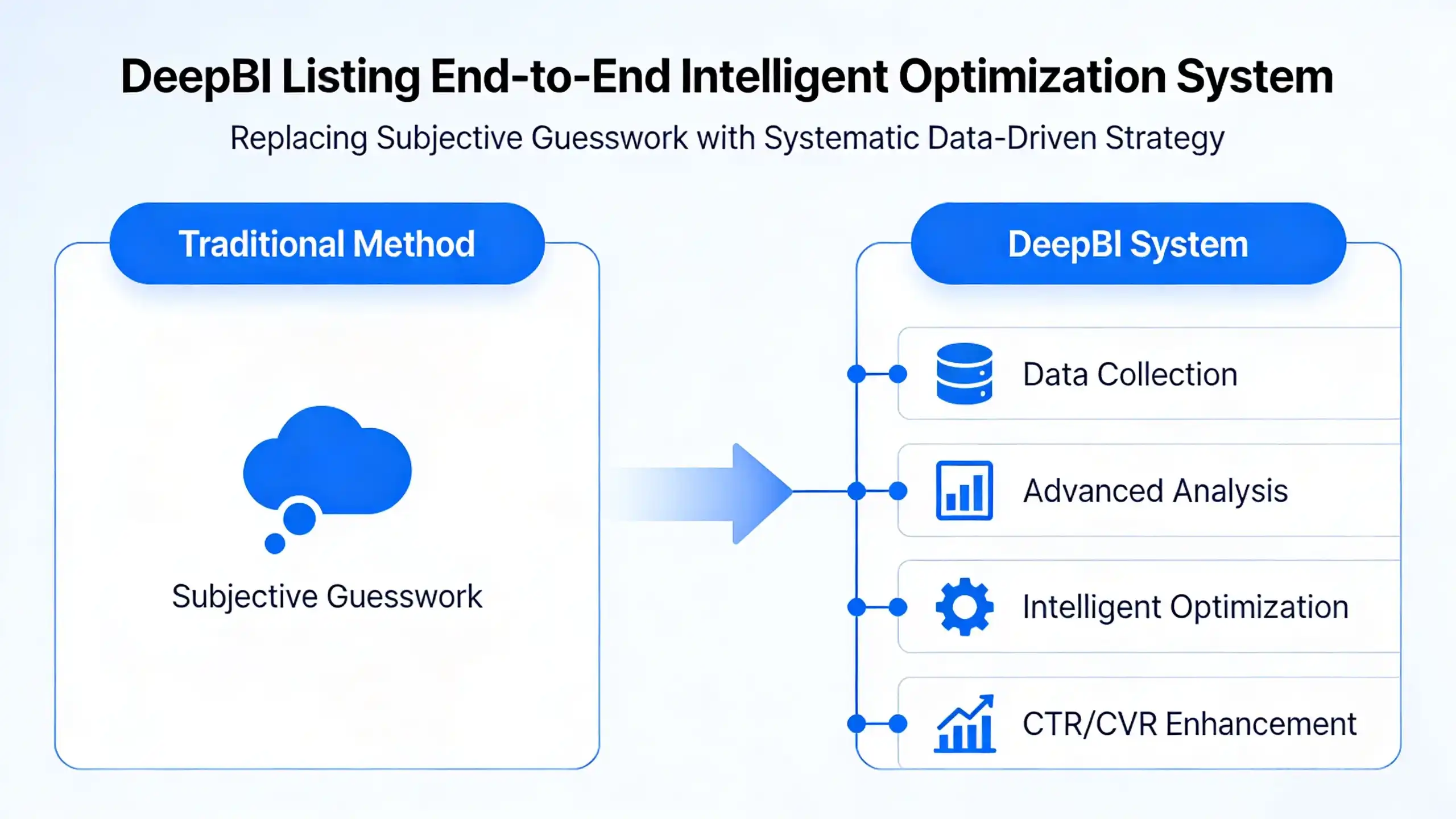
The key is to move beyond isolated adjustments and embrace a holistic strategy. The DeepBI Amazon Listing End-to-End Intelligent Optimization System is engineered to achieve this by connecting the traditionally siloed stages of operations: diagnosis, planning, production, and delivery. The process begins with quantitative diagnosis, benchmarking your listing's performance against the competition to identify precise weaknesses and opportunities. This data-driven foundation eliminates human uncertainty and translates business goals into clear, AI-executable instructions for optimization.
By integrating these stages, DeepBI elevates your listing's visual and textual assets from 'aesthetic displays' into a 'core commercial engine.' This system is designed to directly impact the metrics that matter most, driving measurable increases in your listing's Click-Through Rate (CTR) and Conversion Rate (CVR). The result is a continuous optimization cycle that systematically enhances the commercial performance of your Amazon presence.
 The Conversion Rate Challenge on Amazon: Why Every Percentage Point Matters
On Amazon, success isn't just about driving traffic to your listings; it's about turning that traffic into sales. This is where Conversion Rate (CVR) becomes the single most critical metric for profitability and growth.
Understanding Conversion Rate in the Amazon Ecosystem
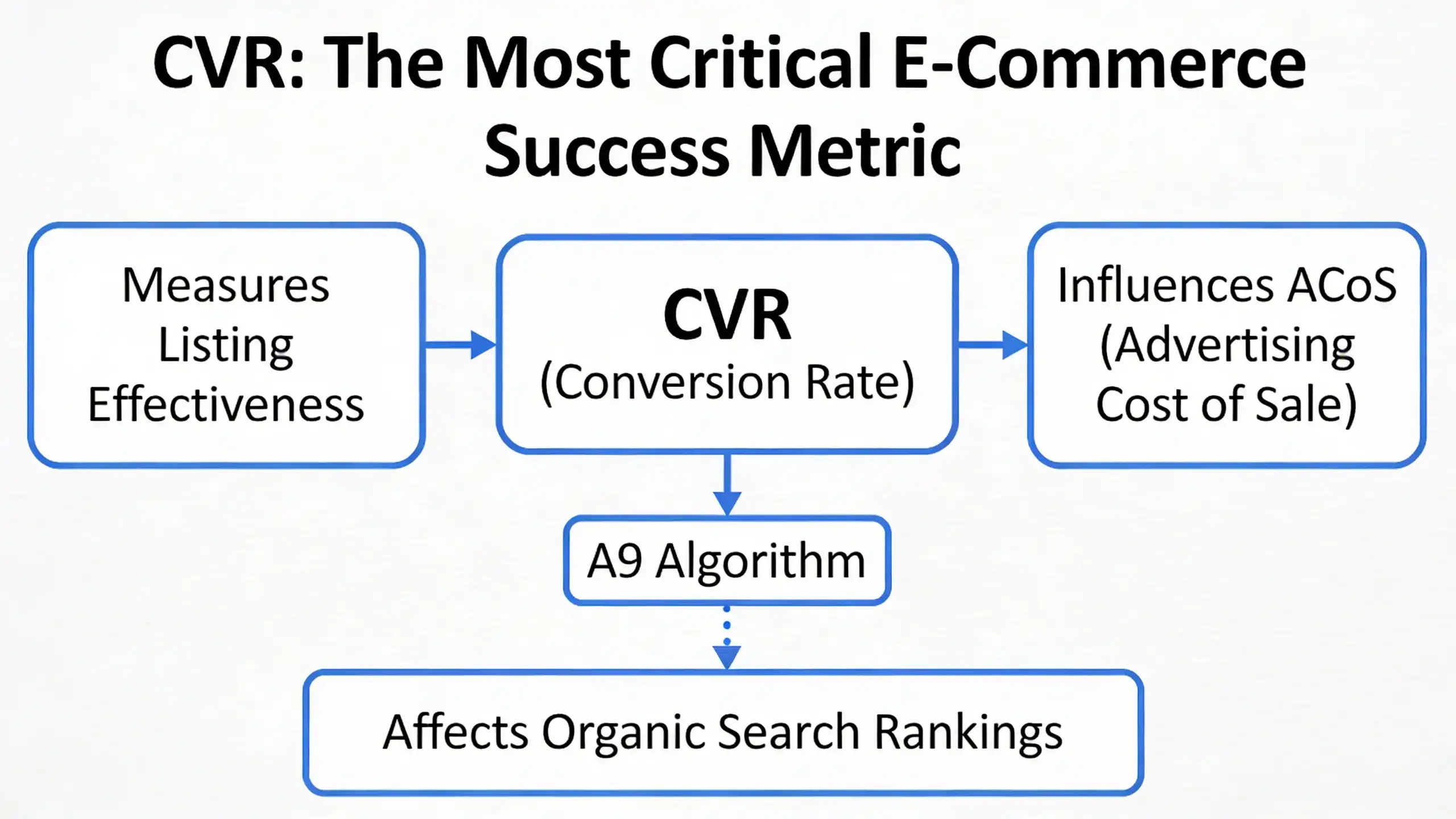
Conversion Rate is the percentage of visitors to your product page who complete a purchase within a specific timeframe. It’s a direct measure of your listing's effectiveness. This crucial KPI is influenced by a combination of factors, including your product's price, customer reviews, shipping speed, and, most importantly, the quality and persuasiveness of your listing content—from compelling images and video to informative copy. In the hyper-competitive Amazon marketplace, even a 0.5% improvement in CVR can translate into a significant increase in revenue and market share, making its optimization a top priority for serious sellers.
The Hidden Costs of Low Conversion Rates
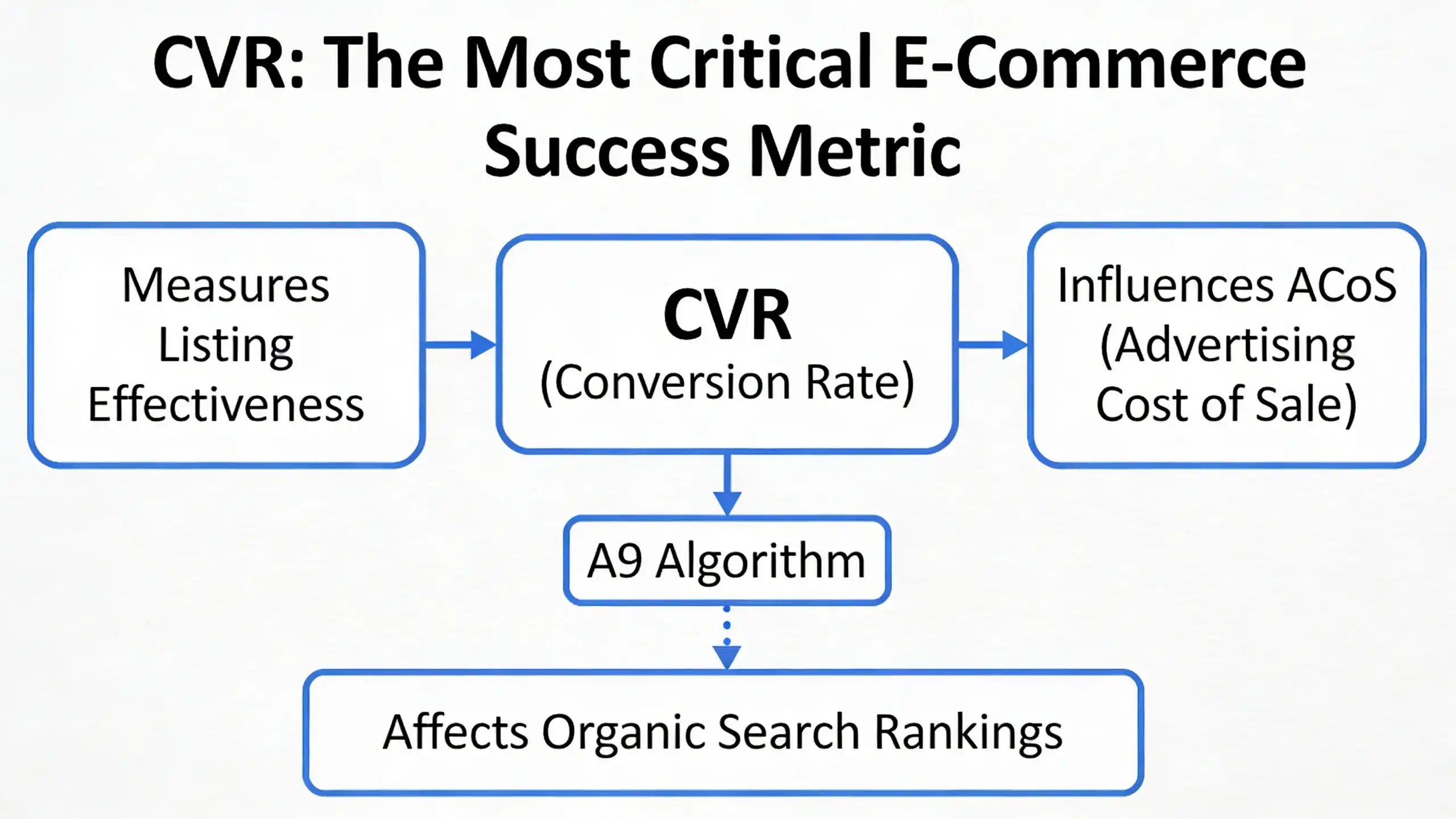
A low CVR is more than just a missed sale; it triggers a cascade of negative effects that can cripple your business. Every click you pay for that doesn't convert leads to wasted ad spend and a higher Advertising Cost of Sale (ACoS). Furthermore, Amazon's A9 algorithm heavily favors products that convert well. A poor CVR signals to the algorithm that your listing is less relevant to shoppers, resulting in lower organic search rankings and reduced visibility. This creates a vicious cycle: lower rank means less traffic, which means fewer sales, further damaging your product's momentum and allowing competitors with higher CVRs to dominate the market.
 The Strategic Imperative: Competitor Benchmarking for Conversion Growth
To increase your Amazon conversion rate (CVR), you must first understand what drives customers to click "Add to Cart" on a competitor's listing instead of yours. Simply guessing or imitating surface-level tactics is inefficient. The key is strategic competitor benchmarking—a systematic process of analyzing top-performing listings to decode the specific strategies that lead to their success. This approach provides a direct, data-driven path to improving your own performance.
What is Competitor Benchmarking and Why is it Crucial?
Competitor benchmarking is the quantitative audit of your rivals' product listings to establish a performance baseline. A thorough analysis goes beyond price, examining the core elements that influence customer decisions. This includes a diagnostic review across five key dimensions: the main image, title structure, persuasive bullet points, A+ page content, and the Voice of the Customer (VoC) found in reviews and questions.
This process is crucial because it reveals the proven tactics that resonate with your target audience. By understanding how leading sellers craft their messaging and visual presentation, you can identify specific, actionable gaps in your own listing. This insight transforms optimization from a guessing game into a targeted strategy, directly impacting your CVR.
Identifying Your True Competitors on Amazon
A common mistake is limiting your analysis to direct, one-to-one product equivalents. On Amazon, your true competitors are anyone vying for the same customer attention and keywords, even if their product is functionally different. These "search competitors" influence customer expectations for everything from image quality to shipping times within your shared search results page.
Therefore, a comprehensive benchmark must include not only direct rivals but also top-ranking sellers for your primary keywords. Analyzing this broader competitive set gives you a complete picture of the market landscape, revealing best practices you might otherwise miss and ensuring your optimization efforts are calibrated to what actually wins clicks and conversions in your niche.
DeepBI's Approach to Unlocking Competitor Insights
Effective competitor benchmarking goes far beyond manually tracking a few rival ASINs. It requires a systematic, data-driven process to identify the right competitors and deconstruct their strategies. DeepBI provides an end-to-end intelligent system designed to turn massive amounts of market data into a clear roadmap for improving your conversion rates.
Intelligent Competitor Identification and Data Aggregation
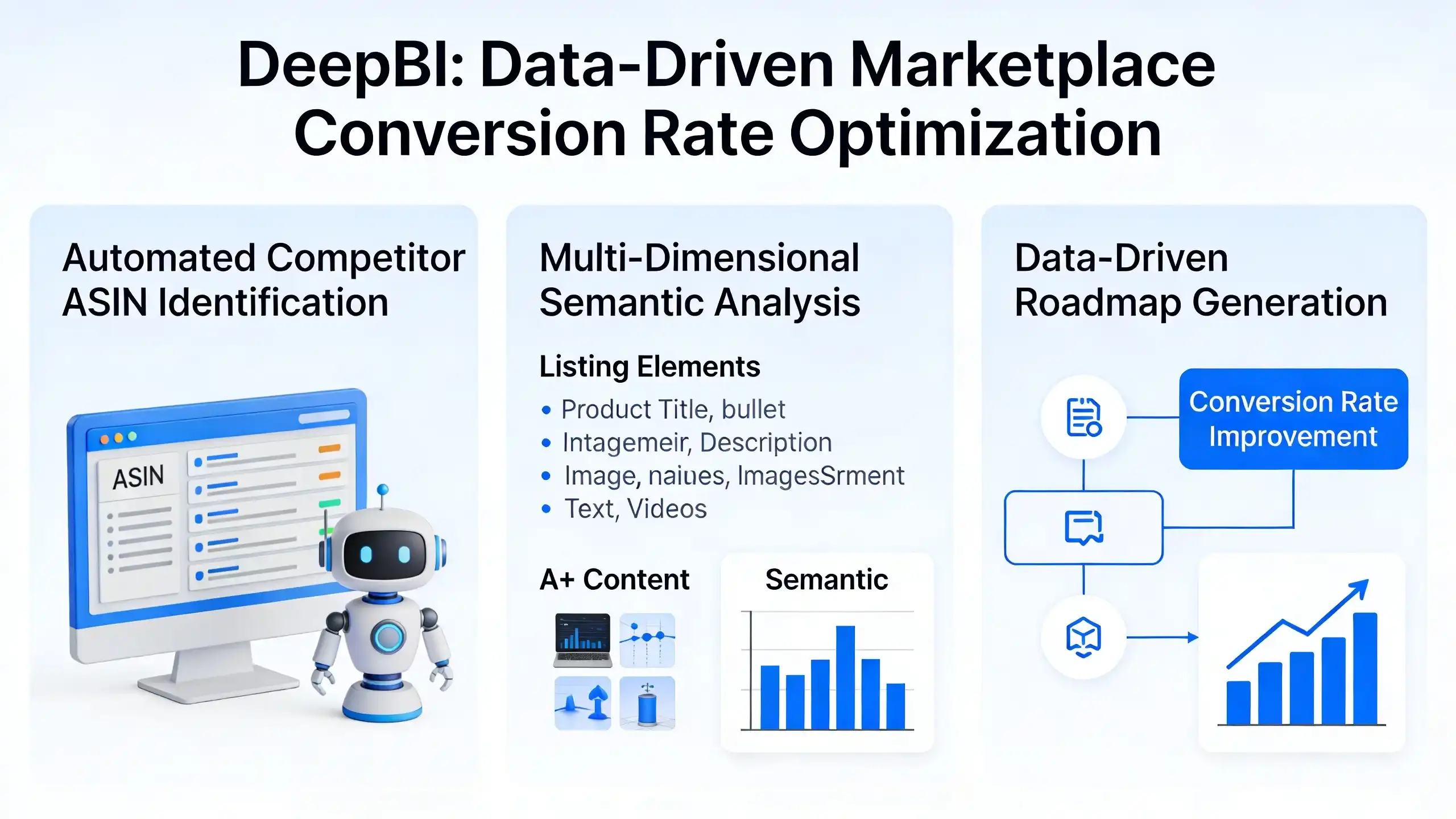
The first challenge in any analysis is identifying your true competitors. DeepBI automates this critical step by using advanced algorithms and distributed data crawling to scan the marketplace. Instead of leaving you to guess, the system automatically identifies and benchmarks the most relevant and highly competitive ASINs from a massive pool of candidates. This process builds a precise benchmarking framework from the outset, immediately clarifying the optimization direction needed to gain market share.
Multi-Dimensional Listing Analysis: Beyond Surface-Level Metrics
Once benchmarks are identified, DeepBI moves beyond surface-level metrics to perform a comprehensive diagnostic. The platform functions as an "automated market health check system," using multi-dimensional semantic analysis to deconstruct and score every critical element of a competitor's listing. This includes a granular assessment of main images, titles, bullet points, A+ content, and even the underlying structure of customer reviews. By systematically breaking down A+ pages into logical modules and analyzing bullet points for their problem-solution effectiveness, DeepBI provides a detailed, component-level scorecard that pinpoints exactly where your listing falls short and where the greatest opportunities for improvement lie.
 Translating Benchmarking Insights into Actionable Listing Optimizations
Effective benchmarking is not about data collection; it's about driving decisive action. DeepBI bridges the gap between analysis and execution by converting competitive insights into a clear, prioritized roadmap for listing optimization, ensuring every change is calculated to improve conversion rates (CVR).
Diagnosing Listing Weaknesses with DeepBI
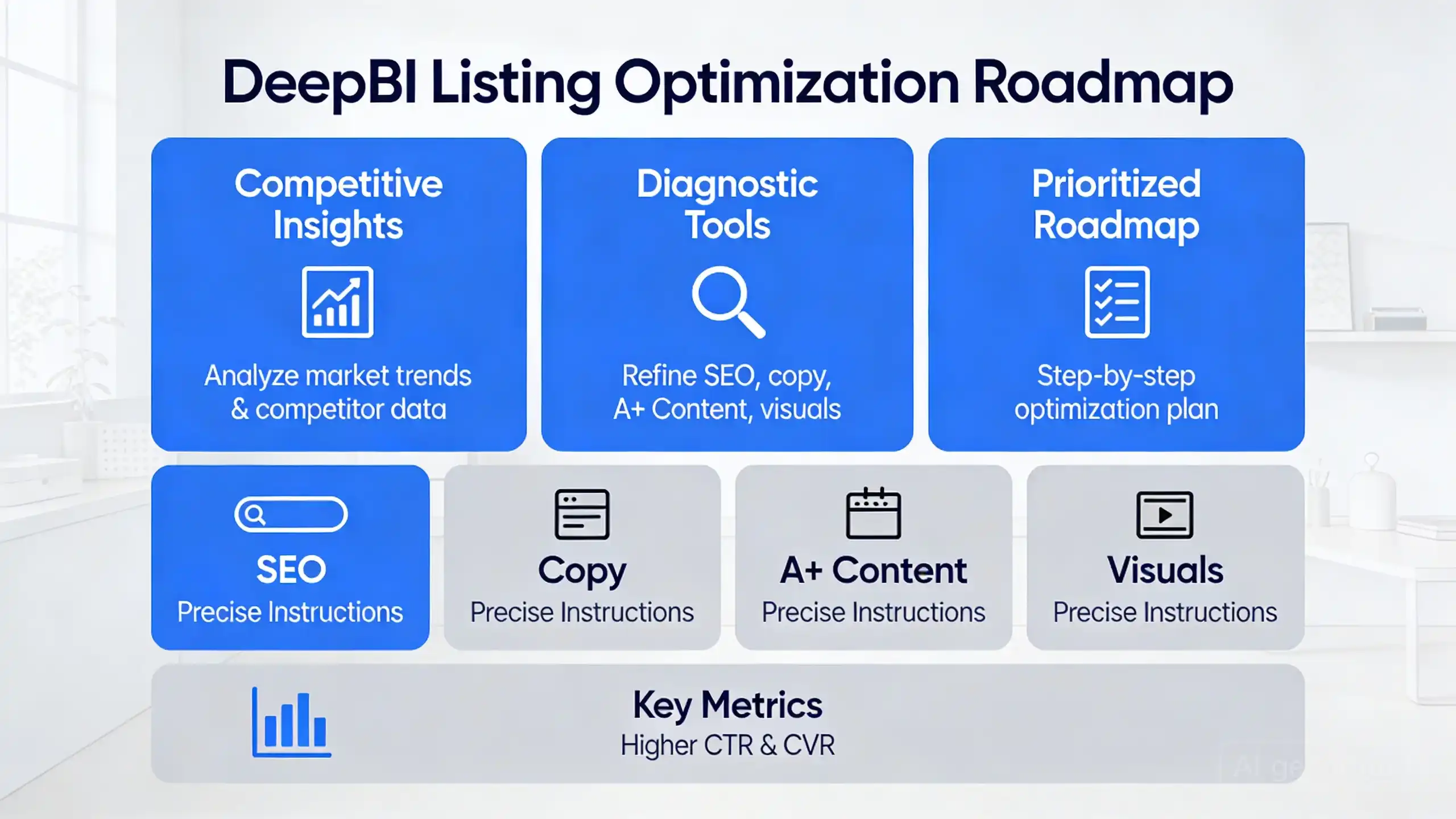
DeepBI's diagnostic tools move beyond surface-level metrics to pinpoint specific elements of your listing that underperform against top competitors. The system uses a Multi-Agent collaboration to analyze these gaps and generate structured, executable strategies. This process outputs an optimization plan covering every aspect of the listing—from SEO and conversion-oriented copy to visual expression, information hierarchy, and selling point presentation. These strategies are then ranked by their potential impact, forming a clear execution checklist for your team.
Crafting High-Converting Content: Titles, Bullet Points, and A+ Content
Armed with a data-driven diagnosis, you can refine your listing's text with precision. DeepBI's insights guide the optimization of titles for higher click-through rates (CTR), the restructuring of bullet points to emphasize benefits that resonate with customers, and the enhancement of A+ Content for more compelling brand storytelling. Instead of guessing which features to highlight, the system provides a clear path based on what is proven to work in your specific market, directly targeting an increase in CVR.
Optimizing Visuals: Main Images and Infographics
Visuals are a primary driver of conversion, and DeepBI transforms their optimization from a subjective art into an engineering discipline. Vague suggestions like "improve image quality" are replaced with precise, parameterized instructions for AI execution, detailing composition, camera angles, and lighting. For example, a strategy to "highlight battery life" becomes a specific directive: 'Generate a bottom-left infographic with a 4.5:1 text-to-detail ratio for '12-hour ultra-long journey'.' This ensures your main images and infographics are not only compelling but also strategically aligned with competitor best practices to capture attention and convey value instantly.
 The Direct Impact: How DeepBI-Driven Optimizations Boost Conversion Rate
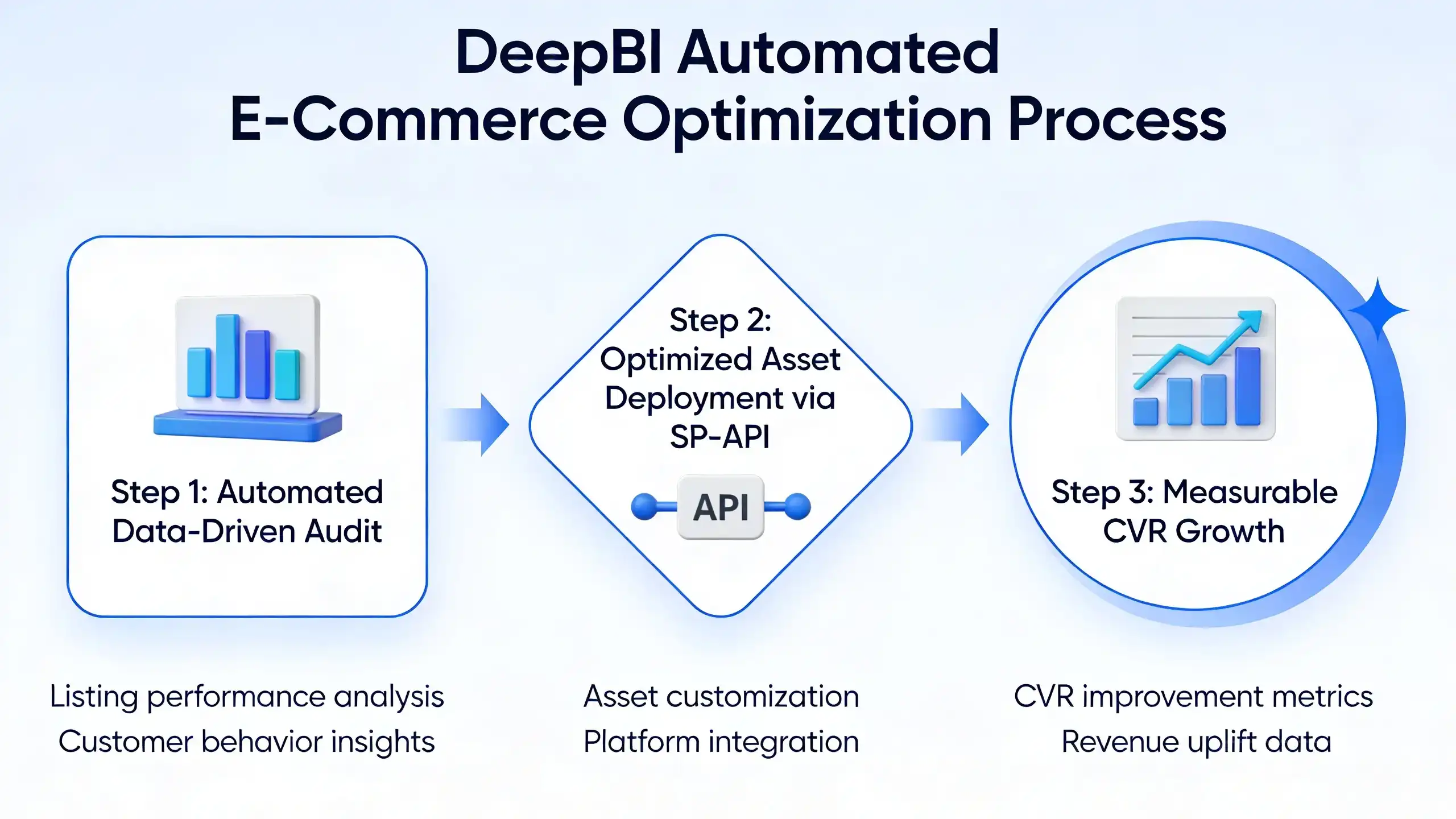
The ultimate goal of benchmarking is not just analysis but action that drives measurable growth. DeepBI creates a direct, quantifiable link between competitive insights and conversion rate (CVR) uplift. This isn't about creative guesswork; it's an automated visual production system driven by rigorous data. The platform enables a closed-loop process: it starts with a quantitative audit of your listing against top performers and ends with the automated deployment of optimized assets, allowing you to track the direct impact on your CVR.
Quantifying the Improvement: From Diagnosis to Higher CVR
DeepBI transforms abstract competitive gaps into an executable strategy. The system first generates a diagnostic report, scoring your visual assets against the market. It then merges this audit with your product's core attributes to produce a precise Optimization_Plan.json. These aren't vague suggestions but parameterized instructions for AI-driven production.
Once you approve the changes, DeepBI uses the official Amazon SP-API for secure, one-click publishing of the new assets. This "diagnosis to delivery" cycle ensures that every optimization is based on data. By monitoring your CVR before and after these targeted updates, you can directly attribute performance gains to specific, data-validated improvements.
Real-World Scenarios: DeepBI in Action
Consider a seller in the competitive home goods category. Their CVR is stagnating despite high traffic. Using DeepBI, they discover that the top three competitors consistently use a main image that visually demonstrates the product's dimensions. Their own listing lacks this crucial detail.
DeepBI flags this as a high-priority gap and generates an optimized main image that incorporates a clear size reference. The seller applies the update with a single click. Within two weeks, they observe their CVR climb from 12% to 14.5%, leading to a significant increase in daily sales and an improved Best Seller Rank (BSR). For large sellers managing hundreds of ASINs, this process allows for rapid, batch visual iterations, scaling CVR optimization across their entire catalog.
 Beyond Conversion: The Ripple Effect on Organic Rank and Ad Efficiency
A higher conversion rate (CVR) does more than just increase immediate sales; it creates a powerful ripple effect that enhances your brand's entire Amazon presence. By optimizing for CVR based on competitor benchmarks, you unlock significant advantages in organic visibility and advertising efficiency, turning a single metric improvement into a holistic growth engine.
Fueling Organic Growth Through Enhanced Conversion
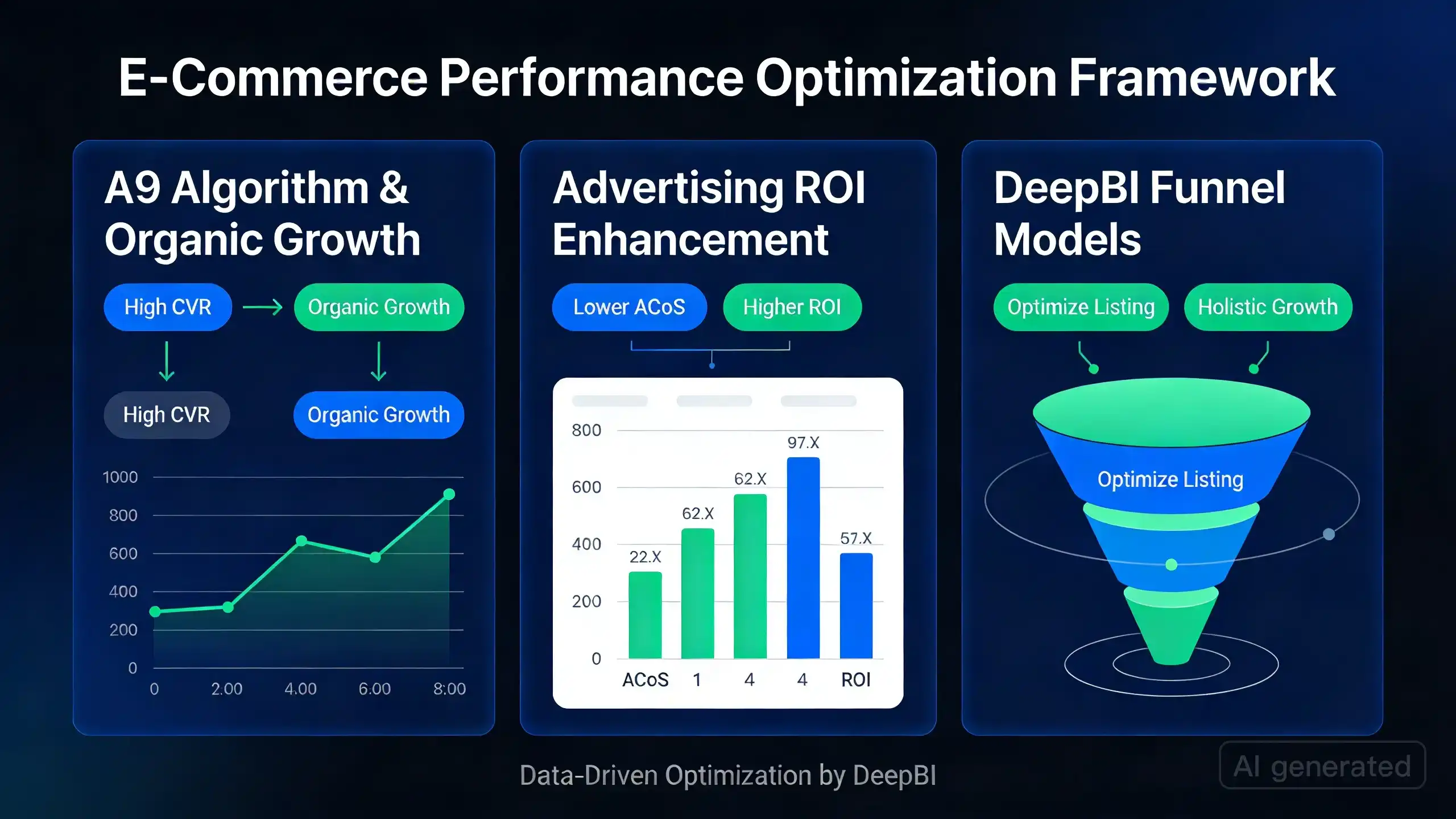
Amazon's A9 algorithm heavily favors listings that convert well. A high CVR signals to Amazon that your product satisfies customer intent, making it a preferred choice to show in search results. This creates a positive feedback loop: a better CVR leads to a higher organic rank, which drives more qualified traffic to your listing, resulting in even more sales.
This is where insights from advertising directly fuel organic strategy. DeepBI’s "Fifth-layer funnel" for organic growth is built on this principle. By analyzing ad data to filter for keywords with high click-through rates (CTR) and high CVR, you can strategically embed these proven terms into your listing’s title, bullets, and backend search terms to systematically improve your organic visibility.
Maximizing Ad Spend ROI with a High-Converting Listing
Driving paid traffic to a low-converting page is like pouring water into a leaky bucket. Many sellers face this issue, seeing high ad spend generate clicks but few sales, leading to a poor return. A listing optimized for conversion fundamentally changes this equation.
With a higher CVR, every ad click is more likely to result in a purchase, which directly lowers your Advertising Cost of Sale (ACoS) and increases profitability. This makes your entire advertising budget more effective. DeepBI’s "Four-layer traffic funnel model" amplifies this effect by enabling you to focus campaigns on the "Precise layer"—high-conversion keywords and competitor ASINs that have already been validated. By directing your most efficient ad spend to your most efficient listing, you maximize your return on every dollar invested.
 Future-Proofing Your Amazon Strategy with DeepBI
Continuous Optimization in a Dynamic Marketplace
The Amazon marketplace is not a static environment; it's a highly competitive landscape where consumer behavior, competitor tactics, and platform algorithms are in constant flux. A "set it and forget it" approach to your product listings is a recipe for declining sales and visibility. Thriving on Amazon requires a commitment to continuous, data-driven optimization.
DeepBI is engineered for this reality. It transforms optimization from a sporadic, manual task into a systematic, ongoing process. For instance, after you deploy a new main image, DeepBI can automatically tag the event within your advertising reports. This direct attribution allows you to precisely measure the impact of your visual merchandising on key metrics like Click-Through Rate (CTR) and conversion, creating a powerful feedback loop for sustained performance improvement.
Partnering with DeepBI for Sustainable Amazon Success
Choosing the right tools is fundamental to building a resilient and profitable Amazon business. Partnering with DeepBI provides a strategic advantage that goes beyond short-term gains, fostering sustainable growth in conversion rates, organic search ranking, and advertising efficiency.
We build trust through technical integrity. DeepBI operates exclusively through the official Amazon Selling Partner API (SP-API), which ensures secure, compliant operations and helps mitigate the account risks associated with manual backend access. Our system is built with strict guardrails that prohibit AI-generated inaccuracies or modifications that would misrepresent your product, guaranteeing that all optimizations are both effective and fully compliant with Amazon's policies. By integrating DeepBI into your workflow, you are not just optimizing listings—you are future-proofing your brand's success on Amazon.