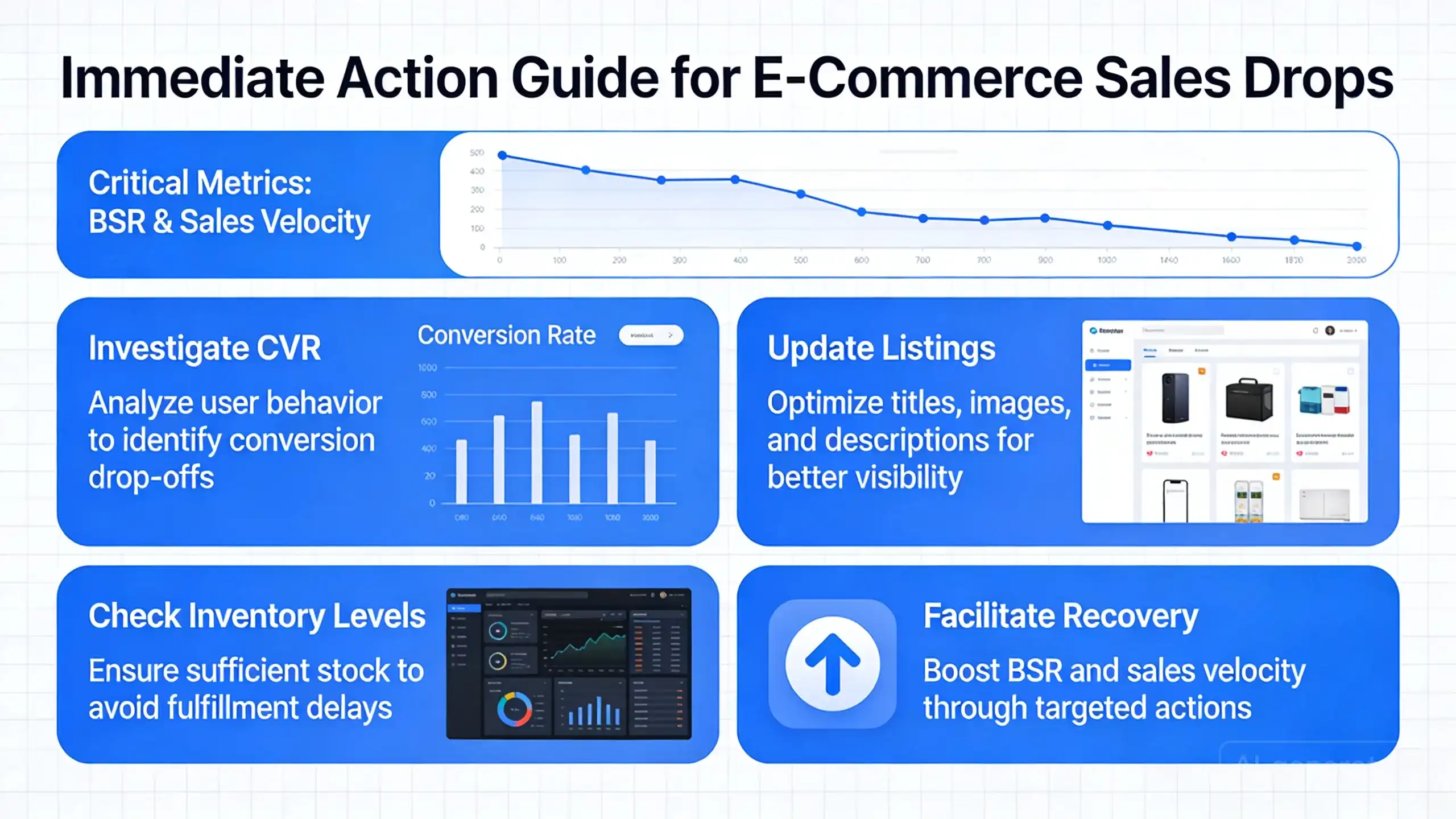
A sudden, sharp drop in your Amazon sales and ranking is one of the most stressful events a seller can face. It can shake your confidence and make you doubt the viability of your business, especially given the high attrition rates reported for new e-commerce ventures. When faced with plummeting metrics, the natural reaction is to panic and start making random changes. However, guesswork is the enemy of recovery. The most effective response is a structured, data-driven methodology we call "seller triage."
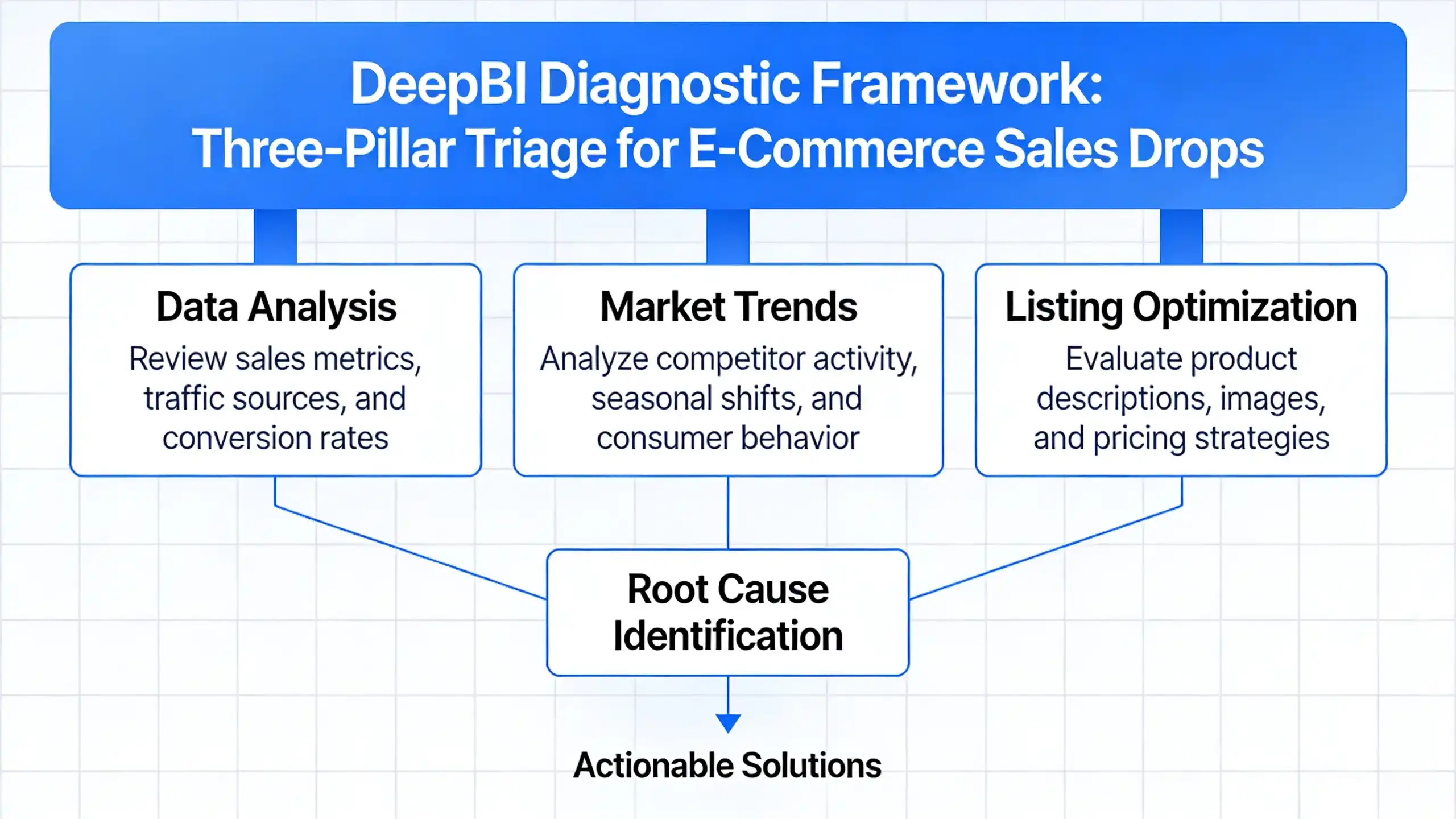
This approach moves beyond intuition and implements an automated market health check. Instead of reacting emotionally, you conduct a systematic audit to pinpoint the exact failure point in your sales funnel. A comprehensive triage system, like the one powered by DeepBI, breaks down the silos between diagnosis and execution. It provides a closed-loop process that starts with a quantitative audit and ends with targeted, actionable solutions. To effectively diagnose the root cause, we will examine your performance through three core pillars:
- Visibility: Are customers seeing your products? This involves analyzing traffic, impressions, and keyword rankings.
- Conversion: Are shoppers who find your listing actually buying? This focuses on Click-Through Rate (CTR), Conversion Rate (CVR), and listing content effectiveness.
- Operational Health: Are backend issues sabotaging your success? This covers inventory levels, account health, and fulfillment performance.
 The Alarming Reality of Amazon Sales Drops and Their Impact
A sudden drop in sales is more than a temporary dip in revenue; it's a critical alert for your business's health. The longer it goes unaddressed, the more severe the cascading damage becomes.
Why a Sudden Drop Demands Immediate Action
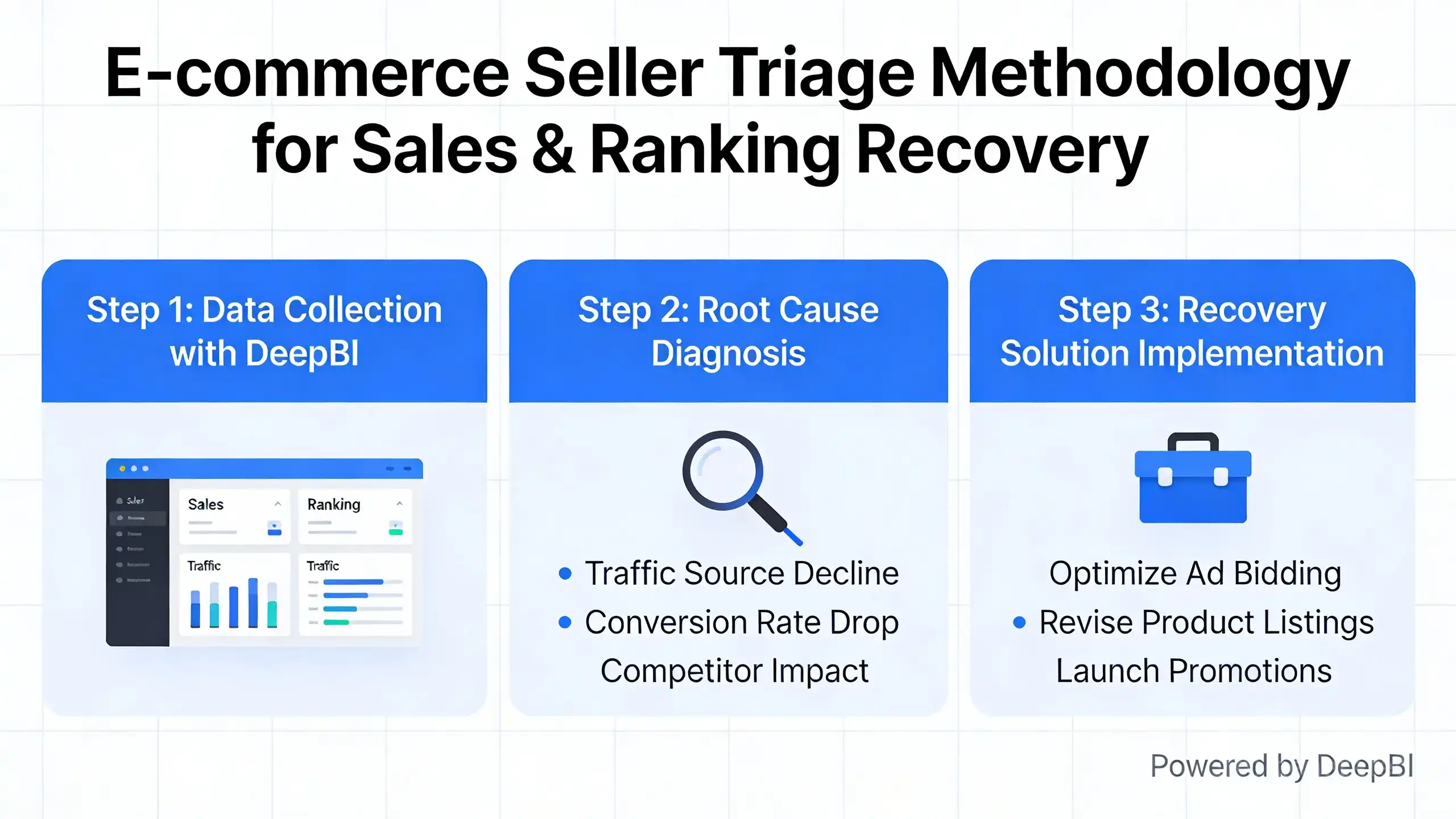
An unexpected sales decline demands an immediate response because its effects compound quickly. The most obvious impact is on your immediate cash flow and profitability. However, the long-term consequences are far more dangerous. A sustained drop in sales velocity causes your Best Seller Rank (BSR) to decay, which in turn reduces your product's organic visibility. Amazon's algorithm interprets this slowdown as a signal of decreasing customer interest, pushing your listing further down in search results. This creates a negative feedback loop that becomes progressively harder and more expensive to reverse. Every day of inaction makes recovery a steeper climb.
The Interconnectedness of Sales, Ranking, and Business Health
A sales drop is almost always a symptom, not the disease itself. It signals a breakdown in one or more areas of your Amazon flywheel, where sales, ranking, and overall business health are deeply linked. A decline in sales directly lowers your organic rank, which reduces traffic and leads to even fewer sales.
Often, the root cause is a hidden issue that erodes customer trust. For instance, a sudden spike in negative reviews can decimate your conversion rate (CVR) and send sales into a nosedive. The trigger might be a seemingly harmless update, like changing a main image. If that new image even slightly misrepresents the product's color or material, it can lead to a wave of "product-image mismatch" complaints. This single issue damages brand perception, increases returns, and tells the algorithm your listing is untrustworthy, creating a multifaceted crisis from a single oversight.
 The DeepBI Seller Triage: A Systematic Approach to Diagnosis
When sales suddenly plummet, the natural reaction is to panic and start changing everything at once—prices, keywords, images. This chaotic approach often makes things worse. Instead, what's needed is a calm, systematic triage to accurately diagnose the root cause before taking action. This is the principle behind the DeepBI diagnostic framework, which functions as an automated market health check for your listings.
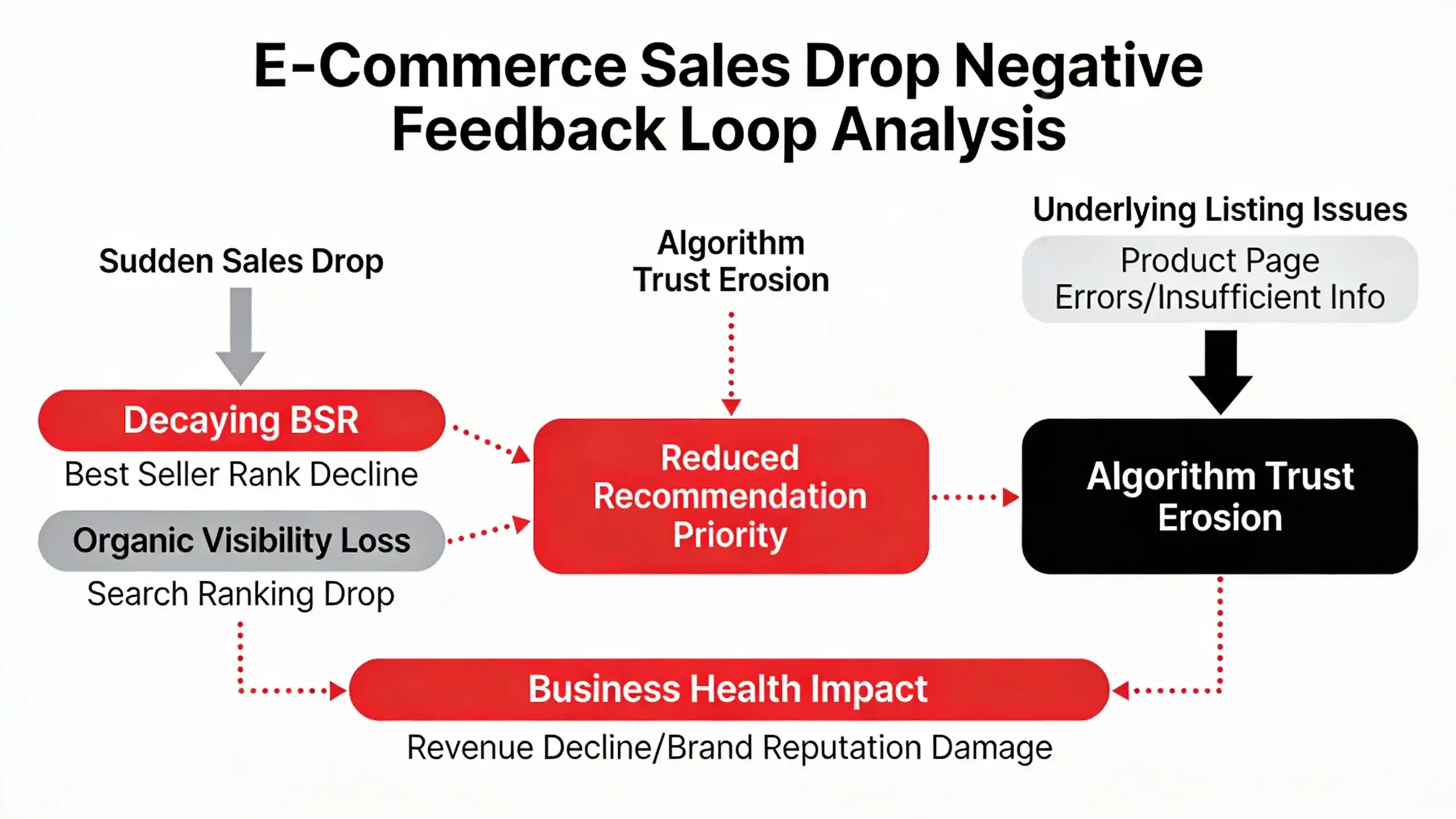
We break down the complex ecosystem of your Amazon business into three core pillars. By investigating each one in a specific order, you can quickly isolate the problem area without wasting time on irrelevant optimizations. This structured diagnosis breaks down the silos that traditionally separate analysis from execution, ensuring your response is both swift and precise.
The three pillars of our seller triage are:
- Visibility: Are potential customers finding your product? This pillar investigates everything that affects traffic and click-through rate (CTR), including keyword rank, ad performance, and the effectiveness of your main image in capturing attention.
- Conversion: Are shoppers who visit your listing actually buying? Here, we analyze the factors driving your conversion rate (CVR), such as price competitiveness, review quality, A+ Content effectiveness, and overall listing persuasiveness.
- Operational Health: Are backend issues sabotaging your performance? This final check looks for critical but often overlooked problems like inventory stockouts, suppressed listings, account health warnings, or lost Buy Box eligibility.
By methodically working through these areas, you can pinpoint the true source of the sales drop and focus your efforts where they will have the greatest impact.
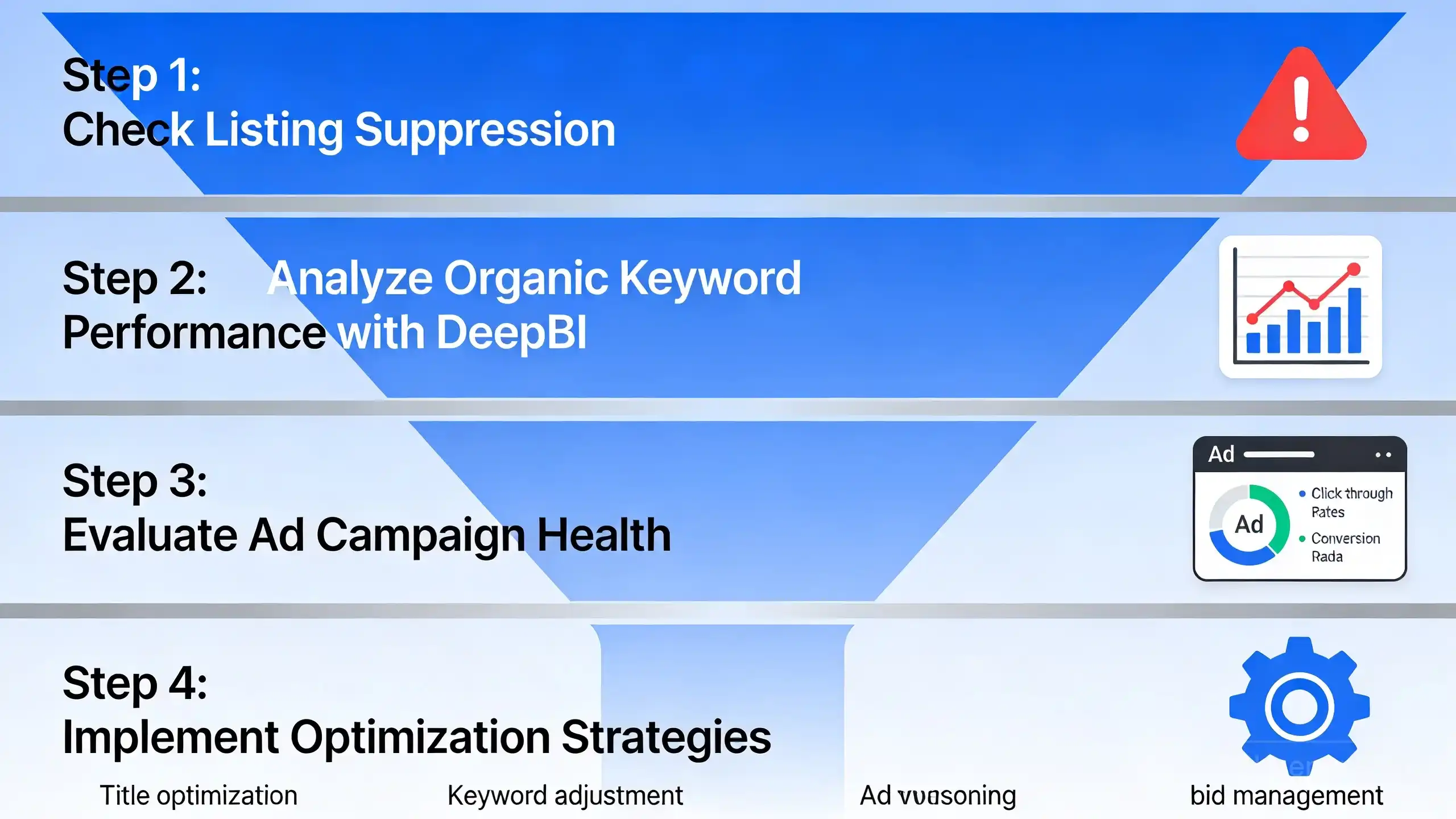
 Step 1: Is Your Product Visible? (Focus on Organic and Paid Traffic)
When sales suddenly decline, the first question to ask is: "Can shoppers still find my product?" A drop in visibility is the most common and immediate cause of a sales slump. Before you can fix the problem, you must diagnose where you are losing traffic—whether from organic search or paid advertising.
Checking for Listing Suppression and Searchability
The most severe visibility issue is a suppressed or de-indexed listing. A suppressed listing is active in Seller Central but hidden from search results and browsing, making it invisible to customers. To check this, perform a simple search on Amazon using your product's ASIN. If your product page does not appear, it's a red flag. This can happen due to compliance flags, main image violations, or incomplete product data. Resolving suppression is the highest priority, as no amount of optimization can fix a listing that shoppers cannot see.
Analyzing Keyword Performance and Organic Rank
If your listing is searchable, the next step is to analyze its organic ranking for critical keywords. A significant drop in your position for high-volume search terms directly reduces the organic traffic flowing to your page. To counteract this, you must identify which keywords drive real business results. DeepBI's organic traffic analysis helps you leverage your advertising data to find keywords with a proven high Click-Through Rate (CTR) and Conversion Rate (CVR). By focusing your SEO efforts on boosting the organic rank for these specific, high-performing terms, you can strategically reclaim valuable traffic.
Evaluating Ad Campaign Health and Reach
Paid traffic is a controllable lever for visibility, but only if your campaigns are healthy. A faltering ad campaign can silently drain your budget while failing to deliver qualified traffic. To diagnose this, DeepBI employs a four-layer advertising funnel model (Impressions, Clicks, Conversions, Profit) to pinpoint the exact source of underperformance. This structured analysis reveals whether the issue is low reach (impressions), poor ad creative (low CTR), or targeting irrelevant audiences (low CVR). By identifying and pausing underperforming keywords or ASIN targets, you can optimize ad spend, improve traffic quality, and restore your product's paid visibility.
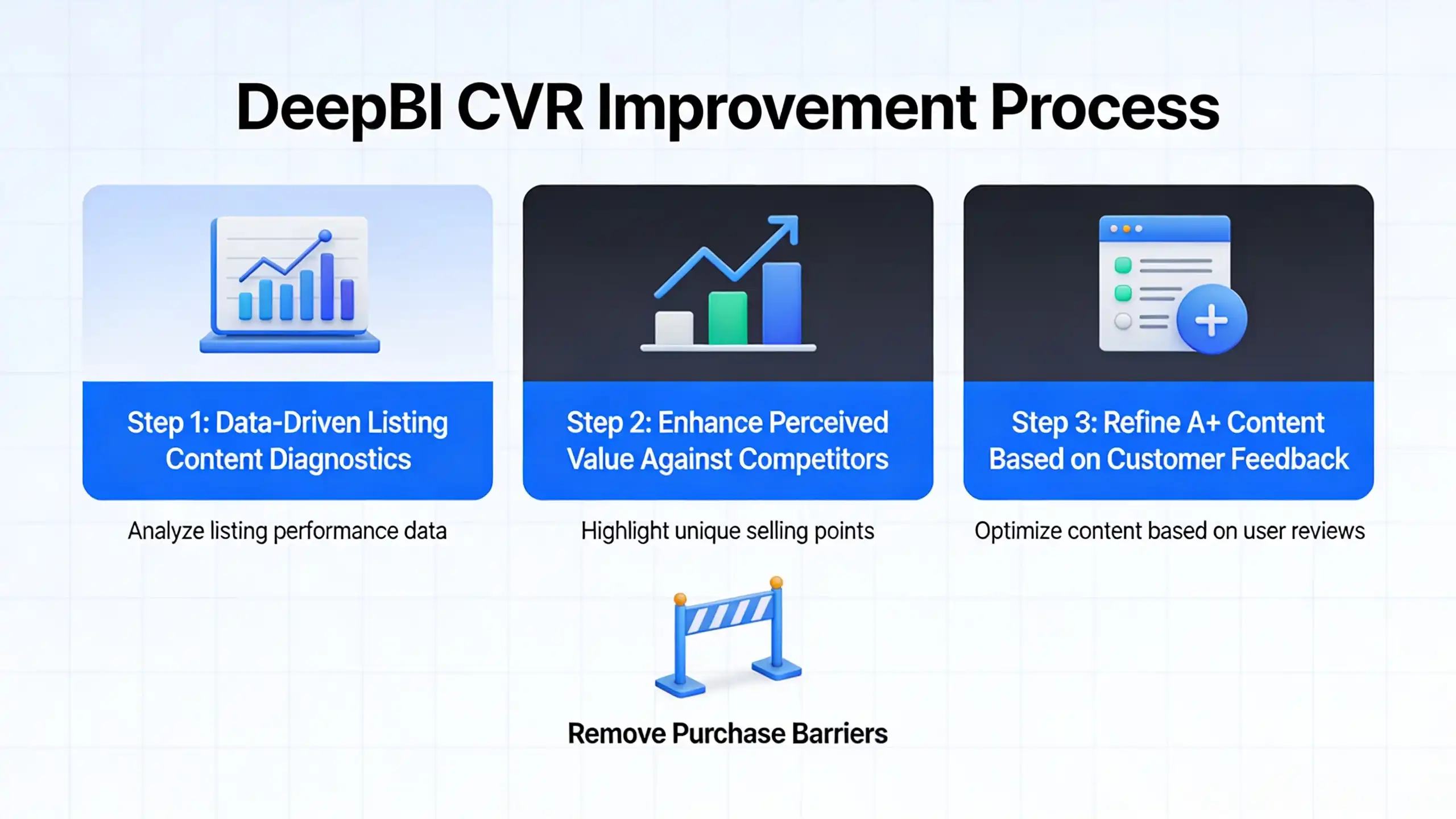
 Step 2: Is Your Product Converting? (Focus on Listing Quality and Buyer Interest)
Even with high traffic, a sudden sales drop often signals a conversion problem—shoppers are finding your product but not buying it. A low Conversion Rate (CVR) not only hurts immediate revenue but also negatively impacts your Best Sellers Rank (BSR) over time. This step focuses on diagnosing and fixing the issues on your product detail page that deter customers at the final hurdle.
Assessing Listing Content for Conversion Rate Optimization
Your listing is your 24/7 digital salesperson. If its main images, title, bullet points, and A+ Content fail to communicate value and build trust, your CVR will suffer. Subjective guesses about what to improve are inefficient and unreliable.
DeepBI’s ModuleListing replaces guesswork with data-driven diagnostics. It intelligently scores your listing elements by benchmarking them against high-performing competitors, pinpointing specific weaknesses. The system then transforms abstract goals into concrete, AI-executable instructions. For example, instead of a vague note to "highlight battery life," DeepBI generates a precise brief for a new main image, such as creating a "bottom-left high-visual-impact infographic" that clearly communicates a "12-hour ultra-long journey."
Furthermore, DeepBI functions as an automated visual production system, not a generic AI drawing board. It establishes a "Product DNA" map to constrain the AI, ensuring all generated visuals are authentic to the physical product and mitigating the risk of negative reviews from "AI hallucinations." Once content is generated, it can be applied to your listing in seconds via API, a process that manually takes over 30 minutes.
Monitoring Pricing and Competitiveness
Your price must align with the perceived value you offer. If competitors have stronger listings at a similar or lower price, shoppers will naturally gravitate toward them. A sudden price increase without a corresponding improvement in your listing's perceived value can cripple your CVR.
While DeepBI is not a repricing tool, its competitive analysis provides the essential context for your pricing strategy. By using DeepBI to elevate your listing quality—through better images, more persuasive copy, and professional A+ Content—you increase your product's perceived value. This allows you to better justify your current price point or even compete more effectively, directly strengthening your CVR against key rivals.
Understanding Customer Feedback and Reviews
Customer reviews and Q&A are a direct reflection of your post-click customer experience. A pattern of negative feedback or a series of unanswered questions can create significant doubt, stopping potential buyers in their tracks. This feedback is a goldmine for diagnosing conversion issues.
Analyzing this qualitative data reveals common customer pain points, feature misconceptions, or unmet expectations. These insights should become the direct input for your content optimization strategy. If reviews repeatedly mention confusion about a specific feature, use DeepBI to generate a new, clarifying bullet point or A+ Content module. By systematically addressing the concerns raised in customer feedback, you build trust and remove critical barriers to purchase.
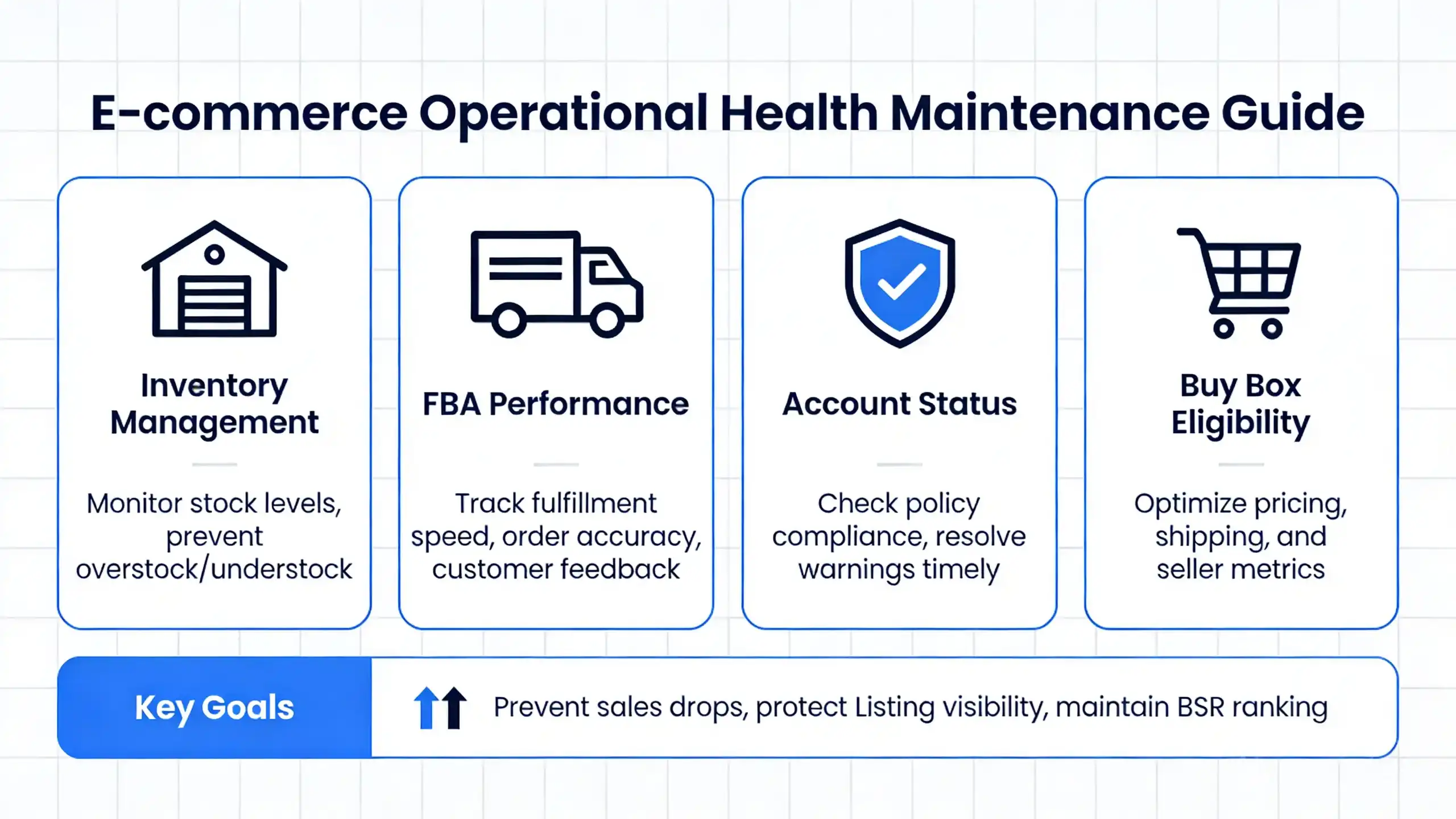
 Step 3: Is Your Operation Healthy? (Focus on Fulfillment and Account Health)
Even with perfect traffic and conversion rates, underlying operational failures can abruptly halt your sales and damage your rankings. A healthy operational backbone is non-negotiable for sustained success. Before you assume the problem is with your marketing or the market, conduct a thorough internal audit of your fulfillment and account status.
Reviewing Inventory Levels and FBA Performance
A stockout is the most direct cause of a sales drop. When your inventory hits zero, your listing is effectively deactivated, sales stop, and your Best Sellers Rank (BSR) will plummet.
- Check for Stockouts: Immediately verify inventory levels for your top-selling ASINs. A sudden sales dip on a specific product often points directly to an unexpected stockout.
- Analyze FBA Performance: Investigate your Inventory Performance Index (IPI) in Seller Central. Low scores can lead to storage limits, while FBA shipping delays or lost inventory can frustrate customers and lead to canceled orders, directly impacting sales volume.
Checking for Account Health Issues and Policy Violations
Amazon holds sellers to strict performance standards, and violations can trigger immediate penalties that suppress visibility and sales.
- Visit the Account Health Dashboard: This should be a daily habit. Look for any warnings related to Order Defect Rate (ODR), Late Shipment Rate (LSR), or policy violations.
- Review Performance Notifications: A single notification about a suppressed listing, intellectual property complaint, or other policy violation can be the root cause of your sales drop. Addressing these issues promptly is critical to restoring your listing and sales velocity.
Ensuring Buy Box Eligibility
Losing the Buy Box is like having your storefront boarded up; customers can still find you, but the path to purchase is significantly harder.
- Verify Buy Box Percentage: Check your Buy Box percentage for key products. A sudden drop indicates you are losing out to competitors, other sellers on your listing, or even Amazon itself.
- Assess Eligibility Factors: Buy Box ownership depends on competitive pricing, fulfillment method (FBA is heavily favored), shipping speed, and strong seller metrics. A recent dip in your seller feedback or an increase in your ODR can cause you to lose Buy Box eligibility, leading to a severe and immediate sales decline.
 Implementing Solutions and Recovering Momentum with DeepBI
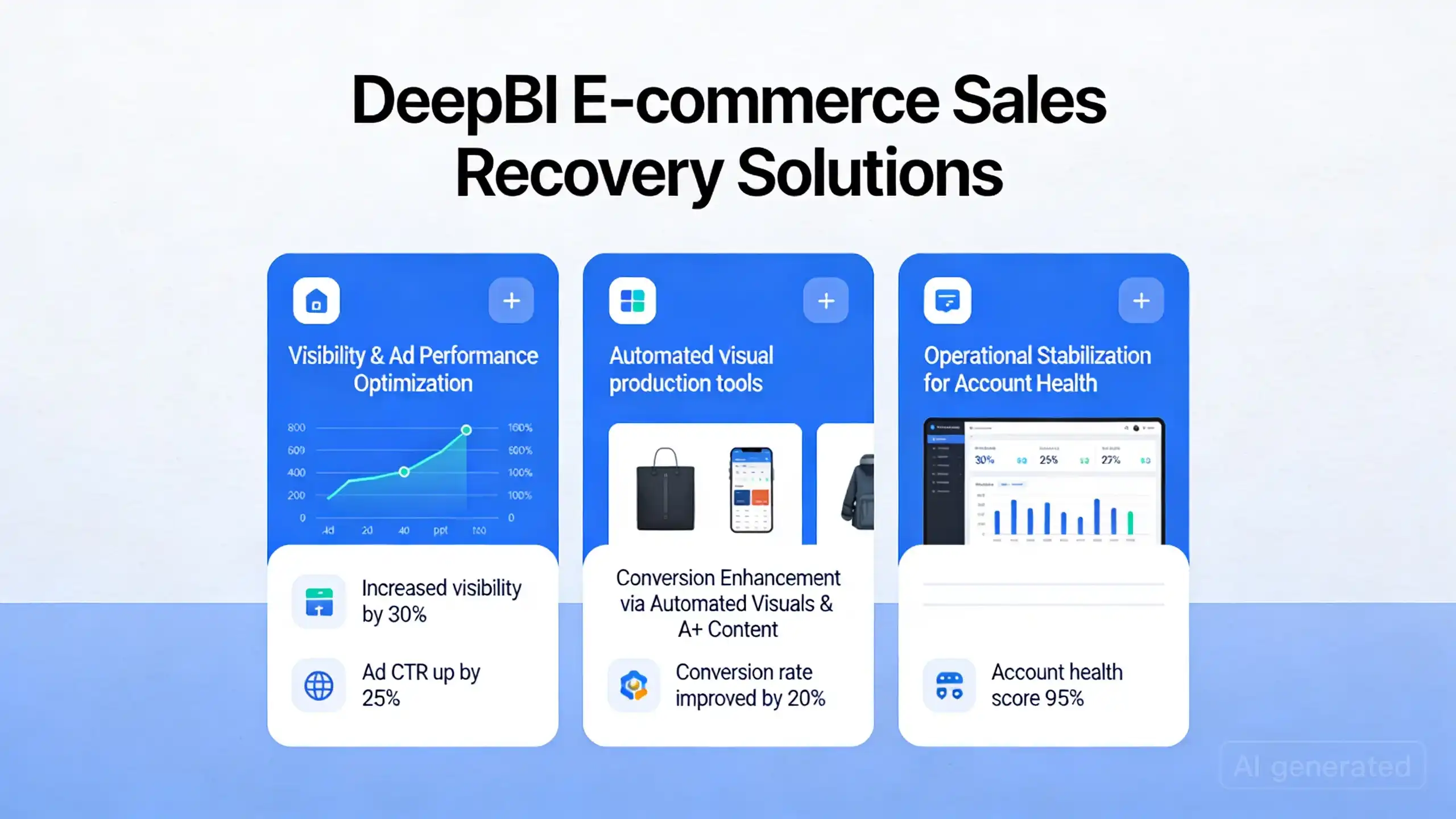
After diagnosing the root causes of a sales decline, the next critical phase is implementing targeted solutions to reverse the trend and rebuild momentum. A comprehensive recovery plan addresses visibility, conversion, and operational stability. DeepBI provides a powerful, integrated toolkit to execute and measure these optimizations, creating a closed-loop system for continuous improvement.
Optimizing Visibility: Driving Traffic Back to Your Listings
If your triage pointed to a traffic problem, the immediate goal is to improve both organic rank and paid advertising performance. This involves strategic keyword re-optimization, aggressive bid adjustments for high-potential targets, and potentially restructuring ad campaigns that are underperforming. While these are classic levers, DeepBI enhances their impact by directly linking listing quality to ad efficiency. For example, by optimizing your main image, you can significantly improve your ad's Click-Through Rate (CTR). DeepBI facilitates this by not only generating better visuals but also tracking their performance, allowing you to see the direct impact of an image update on your ad campaign's CTR and ACoS.
Enhancing Conversion: Turning Browsers into Buyers
Driving traffic is futile if your product detail page fails to convert. This is where DeepBI's automated visual production system provides a distinct advantage. Traditional optimization is often slow and relies on subjective feedback. In contrast, DeepBI translates vague goals like "improve texture" into precise, engineered instructions for AI, detailing parameters like composition, camera angle, and lighting.
Crucially, it mitigates the risk of "AI hallucinations" that can lead to product-image mismatches and negative reviews. By first building a "Product DNA" map, DeepBI ensures all generated visuals remain authentic to the physical product. Once an optimized image or A+ Content is ready, you can bypass the cumbersome manual upload process; DeepBI's API integration allows you to apply changes with a single click, reducing a 30-minute task to seconds and accelerating your listing optimization cycle.
Stabilizing Operations: Maintaining Seller Health
Front-end optimizations cannot succeed on a shaky operational foundation. Any recovery strategy must include a thorough review of your backend processes. Address any lingering inventory issues to prevent stockouts that kill sales velocity and ranking. Scrutinize your fulfillment methods (FBA or FBM) for delays or errors that impact customer experience. Finally, diligently monitor your Account Health dashboard in Seller Central for policy warnings or performance notifications that could throttle your visibility or even risk suspension. While DeepBI streamlines your listing and advertising efforts, maintaining pristine operational health is the bedrock that ensures your recovery is both rapid and sustainable.
 Proactive Strategies to Prevent Future Drops
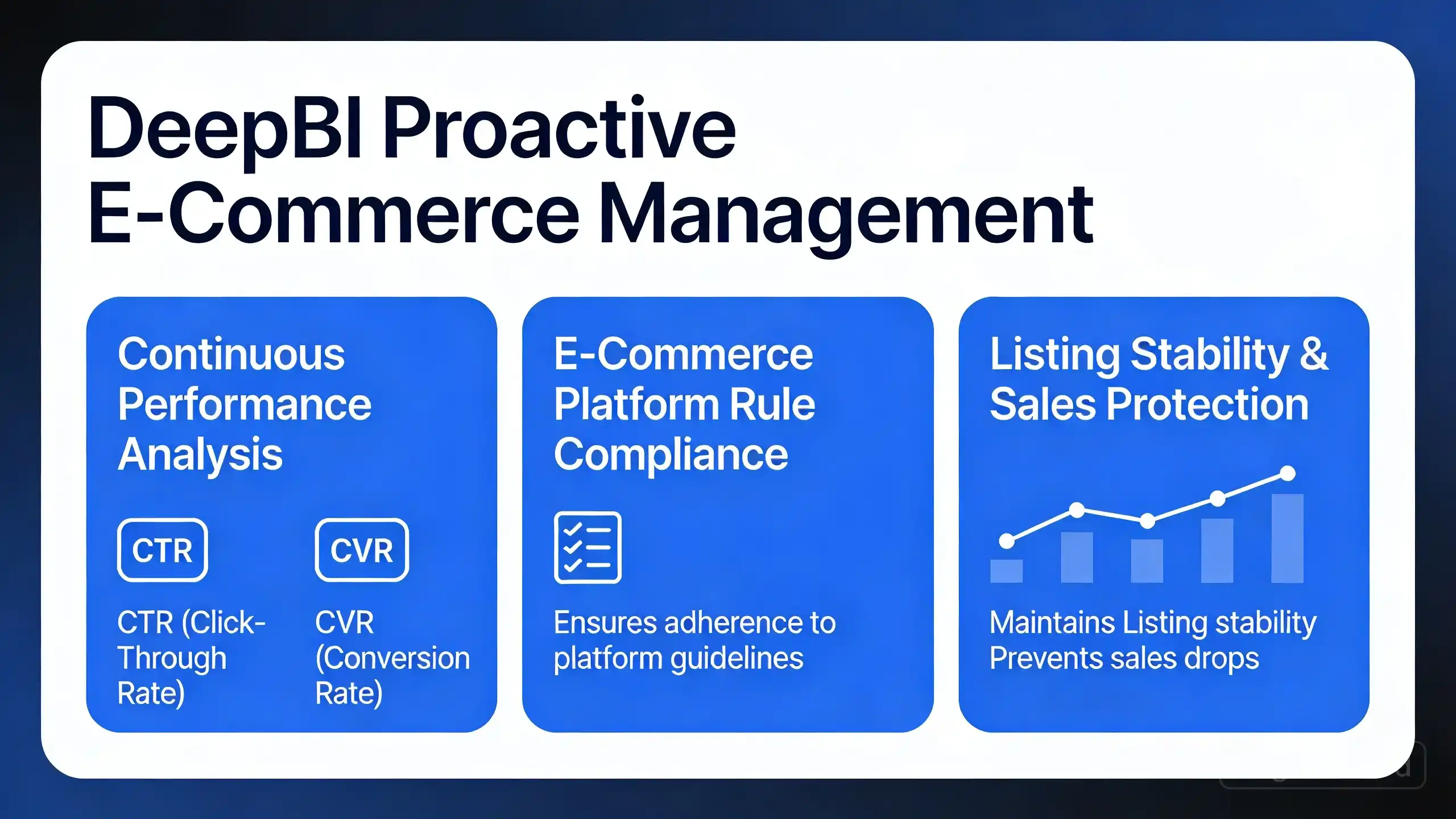
Fixing a sales drop is critical, but preventing the next one is what builds a resilient business. This requires shifting from reactive problem-solving to proactive, data-driven management. Instead of waiting for a crisis, you can use continuous analysis to identify and address risks before they impact your revenue.
Continuous Monitoring and Performance Analysis with DeepBI
The foundation of a proactive strategy is moving from "groping in the dark" to "precision targeting." This means abandoning gut-feel decisions in favor of continuous performance analysis. Without ongoing diagnosis, true optimization is impossible.
DeepBI enables this by creating a direct feedback loop between your actions and their results. For example, after a new product image is published, the system automatically tags the event within your advertising reports. This helps you precisely quantify the impact of that visual optimization on key business metrics like Click-Through Rate (CTR) and Conversion Rate (CVR). By understanding what truly drives performance, you can spot negative trends early and build a data-backed playbook for sustained growth, minimizing the risk of future shocks.
Adapting to Amazon's Evolving Landscape
The Amazon marketplace is not static; its policies and algorithms are constantly evolving. A common cause of sudden performance drops is falling out of compliance with new or existing platform guidelines.
A key function of an intelligent optimization system is to serve as a strategic guardrail. DeepBI is designed with Amazon's rules as core constraints. The system automatically blocks content that violates mandatory standards, such as main image white background ratios, pixel dimensions, or title character limits. It enforces product consistency and data authenticity, ensuring your optimizations enhance your listing without creating compliance risks. This allows you to innovate confidently, knowing your operations are aligned with the requirements for long-term stability and profitability on the platform.
 Frequently Asked Questions About Amazon Sales and Ranking Recovery
How quickly should I act when I see a sales drop?
Immediately. On Amazon, sales velocity is a critical component of your Best Sellers Rank (BSR). A delay of even a day or two can cause your BSR to fall, reducing organic visibility and making recovery progressively harder. The negative feedback loop is fast: lower sales lead to a worse rank, which leads to even lower sales. Treat any unexplained drop as an urgent issue requiring immediate diagnosis.
My traffic is stable, but sales are down. What's the first thing to check?
If your session count is steady but your order volume has fallen, the primary suspect is your conversion rate (CVR). A sudden CVR drop indicates that shoppers are visiting your page but are no longer convinced to buy. Investigate recent changes: have you lost the Buy Box? Has a new, prominent negative review appeared? Did a competitor drastically lower their price? Or has a recent listing update, like a new main image, inadvertently reduced your product's appeal?
Could my inventory levels be the problem, even if I'm not stocked out?
Absolutely. Even if you have units in stock, low inventory levels can trigger Amazon's algorithm to suppress your listing. Amazon prioritizes a consistent customer experience and may reduce your visibility or remove your Buy Box eligibility to prevent a potential stockout. If your inventory is projected to last for only a few weeks, the algorithm may already be throttling your sales velocity to spread out the remaining demand.
How long does it typically take to recover from a sales drop?
Recovery time depends entirely on the root cause. A simple fix, like repricing to win back the Buy Box, can show results within hours. However, recovering from a more severe issue like a full stockout or a significant BSR plunge can take weeks or even months of sustained effort, including aggressive ad campaigns and promotions, to rebuild sales velocity and regain your previous ranking.