


Introduction: Unlocking Potential in the Home & Garden Category
The Amazon Home & Garden category is one of the most dynamic and competitive marketplaces online. With countless sellers offering similar products, from patio furniture to kitchen gadgets, achieving visibility is a significant challenge. In this contest for customer attention, your product listing is your most critical asset. It serves as more than just digital shelf space; it is your virtual salesperson, tasked with capturing clicks, communicating value, and ultimately, driving sales. A well-optimized listing can dramatically improve your Best Seller Rank (BSR), whereas a poorly executed one can inflate your advertising costs with a high ACoS while delivering minimal returns.
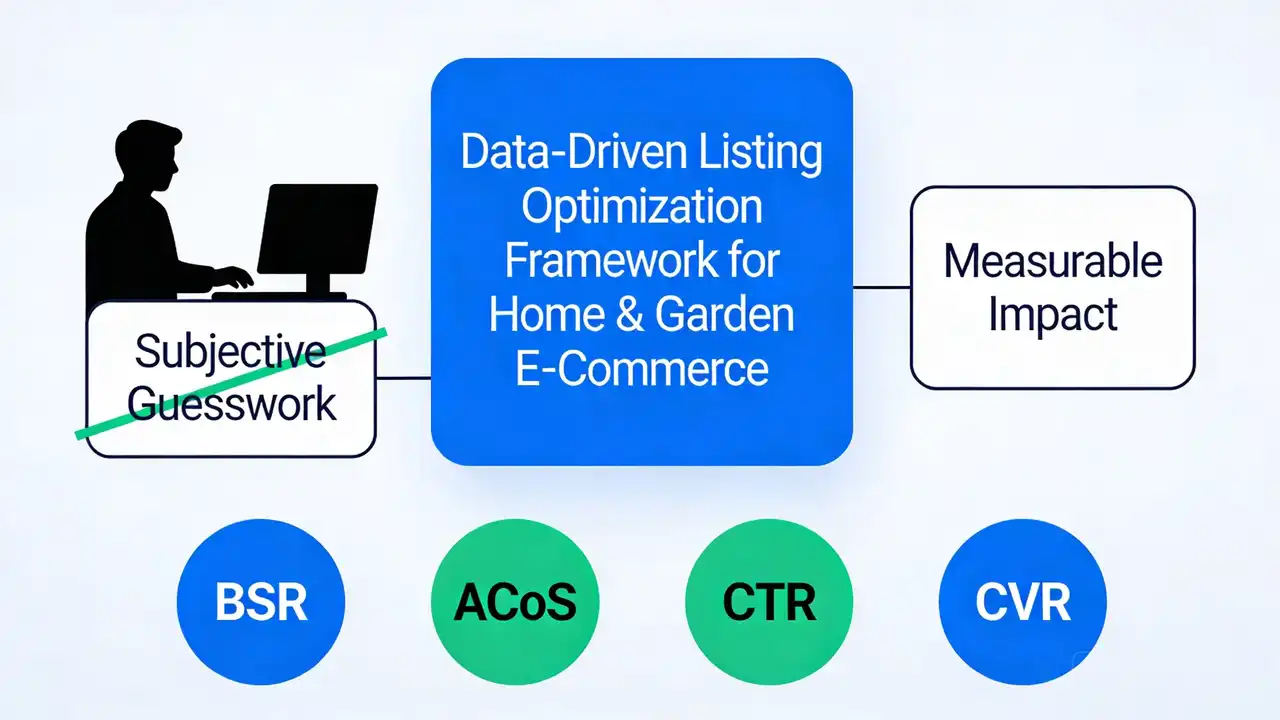
For many sellers, the optimization process becomes a frustrating cycle of guesswork. Traditional workflows are often fragmented, creating a disconnect between performance analysis and creative production. This separation leads to decisions based on subjective aesthetics rather than objective data, prioritizing a designer's intuition over measurable impact on key performance indicators like Click-Through Rate (CTR) and Conversion Rate (CVR). This disjointed approach makes it nearly impossible to determine whether a new main image or a revised bullet point caused a shift in sales, leaving teams unable to replicate successes or learn from failures.
To break this cycle and gain a decisive advantage, a strategic shift from subjective art to data-driven science is required. This guide introduces an end-to-end, data-powered framework for listing optimization. We will explore how to connect every stage of the process, from initial diagnosis and strategic planning to AI-assisted content creation and deployment. By establishing a direct feedback loop between your optimization efforts and their real-world impact on performance metrics, you can move beyond speculation and begin making decisions that consistently enhance the commercial power of your listings.
Understanding Amazon SEO: Beyond Traditional Search
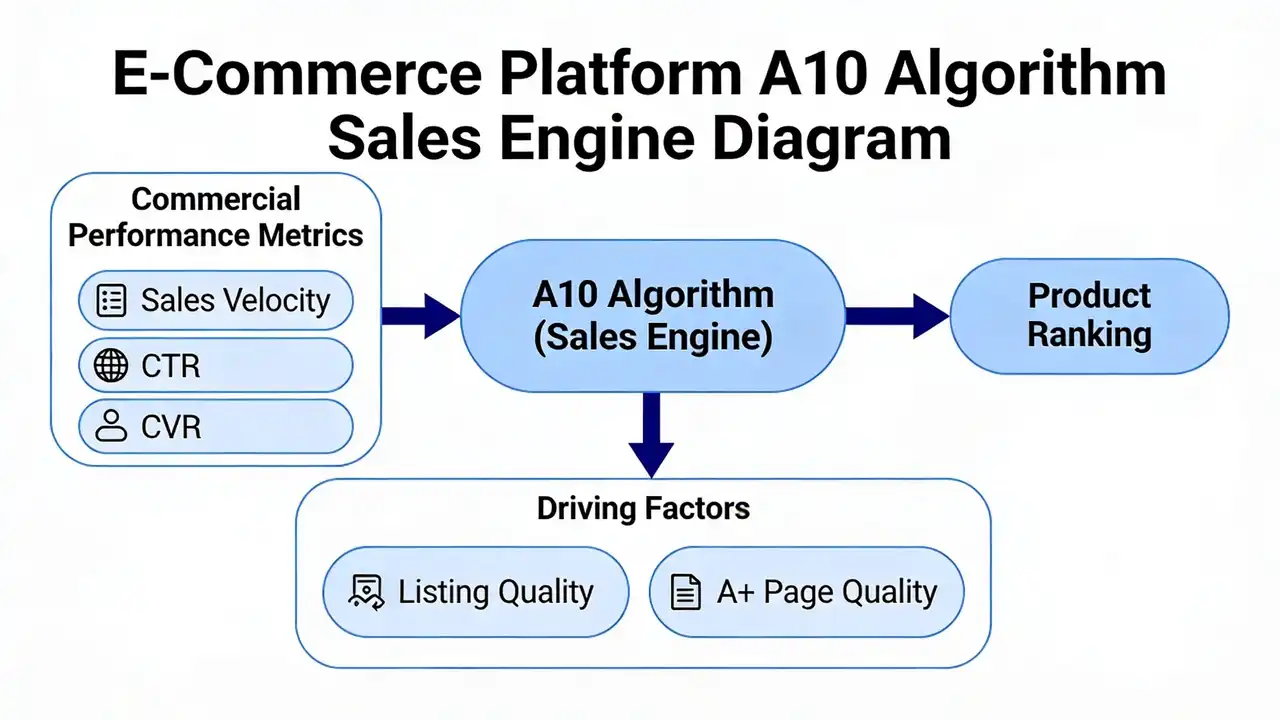
Unlike traditional search engines like Google, which aim to provide the best answer to a query, Amazon's A10 algorithm functions as a sophisticated sales engine. Its primary objective is to identify and rank products that are most likely to result in a purchase. This fundamental difference in purpose means that optimizing for Amazon requires a focus on commercial performance, not just informational relevance.
Your product's ranking on Amazon is determined by a combination of relevance and performance factors. While strategic keyword placement in your title, bullet points, and backend search terms establishes initial relevance, it is your sales metrics that ultimately drive visibility. The A10 algorithm heavily weighs performance indicators such as:
- Sales Velocity: The rate and volume of your sales over time.
- Click-Through Rate (CTR): The percentage of shoppers who click your product in search results.
- Conversion Rate (CVR): The percentage of listing visitors who complete a purchase.
- Customer Reviews: The quantity and quality of reviews provide social proof and impact CVR.
- Competitive Pricing: How your price compares to similar items in the marketplace.
For Home & Garden products, where visual appeal and detailed specifications are crucial, these metrics are directly influenced by the quality of your listing. The role of visual assets, particularly main images and A+ pages, has evolved from mere aesthetic display to a core commercial engine. These elements are now instrumental in driving both clicks and conversions, which in turn directly fuels your SEO performance.
Pillars of Listing Optimization for Home & Garden
A high-converting Amazon listing is not a single entity but a system of interconnected components, each playing a vital role in attracting, engaging, and converting shoppers. Within the Home & Garden category, where customers prioritize durability, aesthetics, and practical application, mastering these pillars is essential for success. Every element, from the initial keyword that draws a customer to your page to the final review that secures the purchase for the next buyer, must be strategically optimized.
 Strategic Keyword Research & Integration
An effective keyword strategy is the foundation of discoverability. The primary goal is to align your product with the exact terms customers use when searching for solutions. This process involves identifying high-volume, relevant keywords like "raised garden bed" or "solar pathway lights," as well as targeting niche, long-tail keywords such as "self-watering vertical herb planter for small balcony." Once identified with specialized tools, these keywords must be integrated naturally and logically across your title, bullet points, and product description to maximize both algorithmic ranking and human readability.
Crafting Compelling Titles
Your title is often the first point of contact with a potential buyer and a major factor in their click-through rate (CTR). A successful Home & Garden title balances keyword density for search algorithms with clear, persuasive language for shoppers. The structure should be logical, typically including the Brand, Product Type, Key Features (e.g., Material, Weather-Resistance), and essential specifics like Dimensions or Color. Avoid keyword stuffing; a title such as "GreenThumb Co. 4-Tier Raised Garden Bed | Cedar Wood Planter Box for Vegetables & Flowers | 48x24x30 Inches" is far more effective than an unreadable string of terms.
Engaging Bullet Points
Bullet points are your opportunity to sell the benefits behind the features. Instead of merely stating "powder-coated steel frame," explain the value: "Durable powder-coated steel frame resists rust and corrosion, ensuring your patio set withstands the elements for years of enjoyment." Use this space to highlight key use cases, proactively answer common questions (e.g., assembly time, weight capacity), and address customer pain points directly. Clear, concise, and benefit-driven language helps shoppers quickly understand why your product is the ideal choice for their home or garden.
High-Quality Main Images & Gallery
In the Home & Garden category, visuals are paramount. Customers need to see a product's quality, scale, and application to make an informed decision. Your image gallery should include professional, high-resolution photos on a pure white background, lifestyle shots showing the item in a realistic setting (e.g., a garden hose in use, a decorative pot on a patio), and infographics that highlight key dimensions and unique selling propositions. It is critical to maintain "product entity consistency" across all visuals. Any AI-generated image must be constrained to prevent alterations to the product's actual material, color, or design, as a mismatch between the image and the physical item can lead to damaging negative reviews and returns.
Detailed Product Descriptions & A+ Content
The product description and A+ Content sections provide space for deeper brand storytelling and detailed technical specifications. Structure your description with clear headings and paragraphs to improve readability and SEO. For brands enrolled in the Brand Registry, A+ Content is a powerful tool for elevating your listing. Use it to showcase your brand's story, provide detailed visual explanations of features, and create comparison charts that help customers choose the right product from your line. This rich media enhances the user experience and can significantly improve conversion rates (CVR).
Harnessing Customer Reviews & Ratings
Customer reviews serve as the ultimate form of social proof on Amazon. Positive ratings and detailed feedback build trust and directly influence purchase decisions, especially for items where long-term performance and durability are key concerns. Actively encourage legitimate feedback through follow-up campaigns or product inserts. More importantly, analyze the content of these reviews—both positive and negative—to gain invaluable insights into customer satisfaction, common issues, and unexpected use cases. This data can then be used to refine your listing copy, improve your product, and inform future development.
Leveraging DeepBI for Home & Garden Listing Success
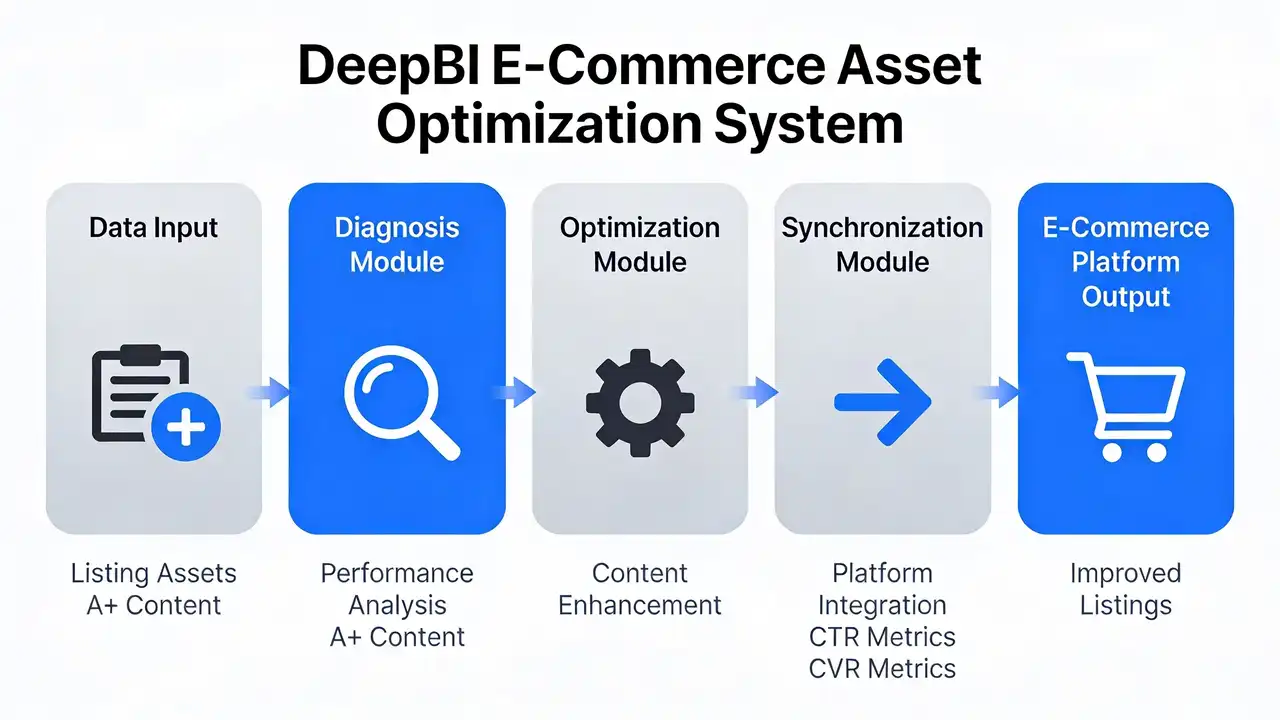
Transitioning from subjective guesswork to a data-driven strategy is essential for scaling in the competitive Home & Garden category. DeepBI acts as an automated market health check system, designed to systematically diagnose, optimize, and deploy high-performance listings. The process starts with a multi-dimensional diagnosis that quantifies key conversion factors to pinpoint specific weaknesses impacting your Click-Through Rate (CTR) and Conversion Rate (CVR). Using distributed data crawling and semantic alignment, the platform benchmarks your listing against top competitors, generating a comprehensive score across your main image, title, bullet points, and A+ content.
Once weaknesses are identified, DeepBI’s AI-powered generation engine creates optimized assets. To avoid the "product-image mismatch" common with general-purpose AI tools, the platform first constructs a detailed "Product DNA" map. This map functions as a hard constraint, ensuring all AI-generated images and copy remain authentic to your physical product. This approach transforms AI from a purely creative tool into a reliable, automated visual production system.
Finally, DeepBI streamlines execution with its One-Click Application feature. Instead of a tedious manual upload process that can take over 30 minutes, this module uses the official SP-API to synchronize all optimized content—images, titles, and A+ layouts—directly to your Amazon listing in seconds. This automated "analysis → generation → launch" cycle closes the loop by tracking the impact of visual updates on your advertising CTR, providing clear data on the effectiveness of your optimization efforts.
Measuring & Iterating on Your Optimization Efforts
Optimizing your Amazon listings is not a one-time task but a continuous cycle of improvement. To achieve sustained growth in the competitive Home & Garden category, you must adopt a data-driven, iterative approach. This begins with closely monitoring your Key Performance Indicators (KPIs). Track changes in sales velocity, conversion rates (CVR), click-through rates (CTR), organic keyword rankings, and customer feedback to gain a holistic view of your listing's performance.
When you implement changes, the objective is to create a closed-loop feedback system. For instance, after publishing a new main image, you can monitor the direct impact on your advertising CTR. This allows you to quantify the effectiveness of your visual optimization, connecting content updates directly to business metrics and helping to lower your ACoS over time.
This data-first mindset is crucial for informing your A/B testing strategy. Analytics tools can provide the diagnostic data to guide your hypotheses—for example, which image concept is likely to perform better—and you can then manually test these variations to validate the results. By consistently analyzing performance data and staying attuned to market trends, you can adapt your strategy proactively, ensuring your products remain visible, compelling, and profitable.
Conclusion: The Path to Sustained Growth
Thriving in Amazon's Home & Garden category requires more than just high-quality products; it demands a listing strategy that is both visually compelling and analytically sound. The era of relying on subjective feedback like "improve the texture" is giving way to a new standard. This data-driven approach involves engineering optimization rather than guessing, translating performance data into precise instructions for everything from image composition to lighting.
In this environment, an end-to-end intelligent optimization system becomes indispensable. Tools like DeepBI break down the traditional silos between diagnosing issues, planning improvements, producing content, and deploying changes. By automating and refining this cycle, processes that once took half an hour can be completed in seconds, dramatically accelerating your ability to adapt to market feedback. This data-first methodology transforms your creative process from a cost center into a powerful driver of sales, directly improving your Conversion Rate (CVR) while mitigating risks like negative reviews from mismatched images. Embracing this integrated, data-powered approach is the definitive path to building a resilient and profitable brand in the competitive Home & Garden marketplace.