

The Pivotal Role of Main Images in Amazon Success
In the crowded Amazon marketplace, your main image is the single most critical asset for capturing customer attention. It functions not merely as a product showcase but as a commercial engine designed to drive clicks and initiate the sales process. By moving beyond subjective aesthetics, a data-driven approach transforms this visual asset into a strategic tool for outperforming competitors.
Why the Main Image is Your Listing's First Impression
On a search results page filled with dozens of similar products, your main image is the primary factor that determines whether a shopper considers your offer or scrolls past it. This is your one chance to make a compelling first impression, communicating value, quality, and relevance in a single glance. A weak main image leads to low engagement, rendering your product invisible regardless of its price or quality. Conversely, a strategically optimized image acts as a powerful magnet, drawing qualified traffic to your listing.
Understanding Click-Through Rate (CTR) and Its Impact
Click-Through Rate (CTR) is a core metric that measures the effectiveness of your main image and title. It is calculated by dividing the total number of clicks your listing receives by the total number of times it was shown, or its impressions.
CTR = (Total Clicks / Total Impressions) x 100%
A higher CTR signals to Amazon's algorithm that your product is highly relevant and appealing to customers. This can positively influence your advertising efficiency, often contributing to a lower Advertising Cost of Sales (ACoS) and a higher Return on Ad Spend (RoAS) because your ads are deemed more effective.
The Direct Link Between Main Image Optimization, Sales, and Ranking
Optimizing your main image can fuel a powerful growth cycle on Amazon. A compelling image boosts your CTR, driving more traffic to your product detail page. With more visitors, and assuming a consistent conversion rate (CVR), your sales volume increases. This rise in sales velocity is a critical signal to Amazon's A9 algorithm, which often rewards high-performing listings with better organic search placement and an improved Best Sellers Rank (BSR). This enhanced visibility, in turn, generates more impressions, creating a self-reinforcing loop of traffic, sales, and improved ranking.
Amazon's Main Image Guidelines: Compliance and Best Practices
Your main image is the most important visual asset for driving clicks. Adhering to Amazon's strict guidelines is not just about avoiding penalties; it is the foundation of a high-performing listing. Mastering these rules ensures your product appears professional, clickable, and visible to shoppers.
Essential Technical and Content Requirements
Amazon requires your main image to have a pure white background (RGB 255, 255, 255) to create a clean, consistent shopping experience. The product must occupy at least 85% of the frame, be professionally photographed, and show only the item for sale. Any props or accessories not included with the purchase are strictly forbidden. Furthermore, the image must be free of all text, logos, watermarks, or inset graphics. On a technical level, images should be at least 1000 pixels on the longest side to enable the zoom feature, which is crucial for customer evaluation and can improve conversion rates (CVR).
Common Pitfalls to Avoid in Main Image Design
Many sellers inadvertently sabotage their listings by violating these core principles. Common mistakes include using off-white or lifestyle backgrounds, adding promotional text like "Sale" or "New," or showing accessories that are sold separately. These violations can lead to immediate listing suppression, making your product invisible to shoppers. Even if a listing is not suppressed, a non-compliant image appears unprofessional, which can erode customer trust and significantly lower your click-through rate (CTR) compared to compliant competitors.
Leveraging DeepBI for Compliance and Competitive Analysis
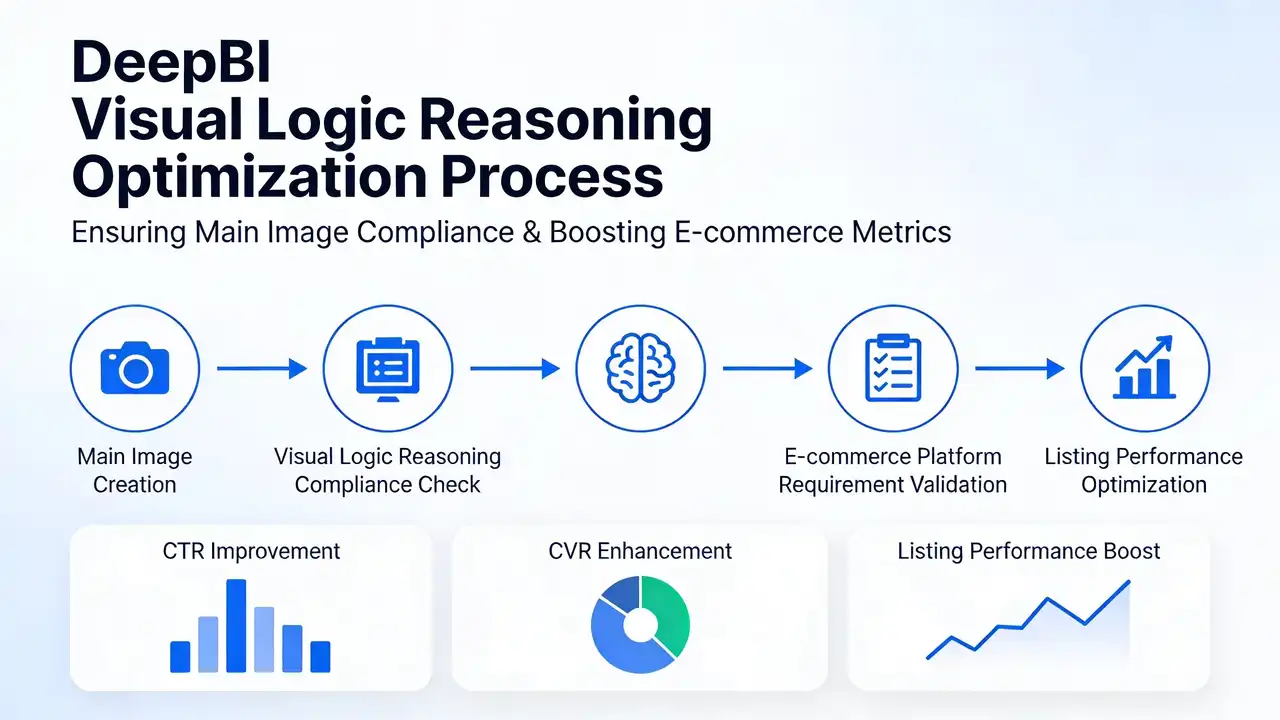
Winning on Amazon requires moving beyond manual checks and subjective aesthetic judgments. Instead of relying on a designer's intuition, DeepBI establishes "Visual Logic Reasoning" to analyze and score your main image against both Amazon's guidelines and the top-performing competitors in your category. The platform provides intelligent, data-backed diagnostics to identify compliance risks and competitive gaps. It replaces vague feedback with precise, actionable directives on composition, lighting, and angle, ensuring your main image is not only compliant but also engineered to maximize CTR and drive sales.
Data-Driven Strategies for Main Image Optimization
Abandoning subjective aesthetic preferences is critical for improving click-through rates (CTR) in a competitive marketplace. An analytical approach systematically deconstructs visual assets to find and exploit opportunities that directly impact performance metrics.
Identifying High-Impact Optimization Opportunities
Traditional image feedback often consists of vague, unhelpful critiques that are impossible to execute consistently. To effectively boost CTR, sellers must replace subjective opinions with a quantitative diagnostic process. This involves analyzing main images not as works of art, but as commercial assets that can be measured and improved.
A systematic approach pinpoints specific weaknesses by evaluating key conversion factors. Instead of ambiguous advice, a data-informed diagnosis provides precise, engineering-like instructions covering elements such as composition, camera perspective, lighting distribution, and color palette. By correlating these visual attributes with performance data, including high-converting search terms, you can identify the exact elements that are suppressing clicks and prioritize changes with the highest potential impact on your CTR.
Crafting Compelling Visuals: Beyond the Product Shot
A successful main image does more than just display the product; it communicates value and solves a customer's problem at a glance. The objective is to transform your visual assets into a core engine for driving both clicks and conversions (CVR). This requires showcasing product benefits, demonstrating scale, and highlighting unique selling propositions within a single, compelling frame.
Leveraging AI for this task demands strict commercial constraints. Unlike general-purpose AI art tools that can "hallucinate" and misrepresent product features, a business-focused system operates under the non-negotiable rule of product accuracy. By first defining a product’s core "DNA," AI can generate high-conversion visuals that are both compelling and truthful. This process translates dry specifications into tangible benefits, turning a feature like "10000mAh" into a visual promise to end battery anxiety on the go.
Advanced Listing Optimization Techniques Beyond the Main Image
While the main image grabs initial attention, the textual elements of your listing are what drive search visibility and persuade customers to purchase. In today's competitive marketplace, optimizing these components is no longer a matter of simple wordsmithing; it is a data-driven exercise in precise coordination to maximize performance.
Optimizing Titles for Search and Conversion
Your product title is the most critical piece of copy for both Amazon's A9 algorithm and potential buyers. An effective title strategically balances high-volume keywords for discoverability with clear, benefit-oriented language that boosts click-through rates (CTR). It must include your brand name, core product identifiers, and key features while adhering to category-specific character limits. Moving beyond simple keyword stuffing to a title that communicates value at a glance is the first step in converting impressions into page views.
Enhancing Bullet Points and Product Descriptions
Once a shopper clicks through to your listing, the bullet points are your opportunity to sell. Avoid listing dry, technical specifications. Instead, translate features into tangible benefits using a structured approach. For example, rather than merely stating "10000mAh," reframe it as: "Ultra-High Capacity (Selling Point) + 10000mAh Power Core (Data) + Eliminates Low-Battery Anxiety on the Go (Pain Point Solved)." This three-part structure transforms a simple parameter into a compelling value proposition, directly addressing customer needs and significantly improving your conversion rate (CVR).
The Power of A+ Content and Brand Storytelling
A+ Content is your canvas for brand storytelling and overcoming final purchase hesitations. The most effective A+ layouts are not treated as one long, scrolling image but are strategically broken down into distinct logical modules. Structure your content to guide the customer through a narrative that includes an introduction, a showcase of core selling points, a demonstration of how the product solves specific problems, and brand-building elements. This modular approach creates a more engaging and persuasive experience, building the trust and confidence needed to finalize the sale.
Implementing and Measuring Optimization Impact with DeepBI
Translating data-driven insights into live, performance-enhancing listings requires a seamless and measurable execution process. DeepBI bridges the gap between strategy and results, enabling sellers not only to deploy optimizations efficiently but also to quantify their impact on core business metrics.
From Strategy to Execution: DeepBI's Automated Workflow
A common bottleneck in listing optimization is the friction between generating assets and deploying them on Amazon. Manual uploads are slow, prone to error, and create delays that undermine strategic agility. To solve this, DeepBI integrates a "One-Click Application" feature. This automated delivery engine uses the official Amazon Selling Partner API (SP-API) to create a secure and direct channel to your Seller Central account.
With this system, the entire "analyze → generate → launch" workflow is streamlined. AI-generated main images, conversion-focused bullet points, and complete A+ content modules can be synchronized to your listings in seconds. This process eliminates manual transfer errors, drastically reduces the time to go live, and ensures that your carefully crafted optimizations are implemented precisely as intended.
Monitoring Key Performance Indicators (KPIs) Post-Optimization
Once your changes are live, the focus shifts to measurement. The effectiveness of any optimization must be validated with data. Within the DeepBI platform, you can closely monitor the key performance indicators that define listing success:
- Click-Through Rate (CTR): Directly measures the impact of your new main image and title on attracting shopper attention in search results.
- Conversion Rate (CVR): Reflects how effectively your updated bullet points, A+ content, and secondary images persuade visitors to purchase.
- Sales and BSR: The ultimate indicators of commercial success, showing the combined effect of improved traffic and conversion.
By tracking these KPIs before and after implementation, you can build a clear business case for each optimization and understand its direct contribution to revenue growth.
Continuous Improvement: Iterative Optimization Cycles
Amazon is a dynamic marketplace; what works today may be less effective tomorrow. True mastery comes from establishing a cycle of continuous improvement. The data you gather post-optimization becomes the input for your next strategic iteration. By analyzing performance trends, you can identify new opportunities, form new hypotheses, and use DeepBI to generate and deploy the next version of your listing content. This iterative loop of deploying, measuring, learning, and refining transforms listing management from a static task into a dynamic growth engine, ensuring your products remain competitive and profitable over the long term.
Conclusion: Sustained Growth Through Strategic Listing Optimization
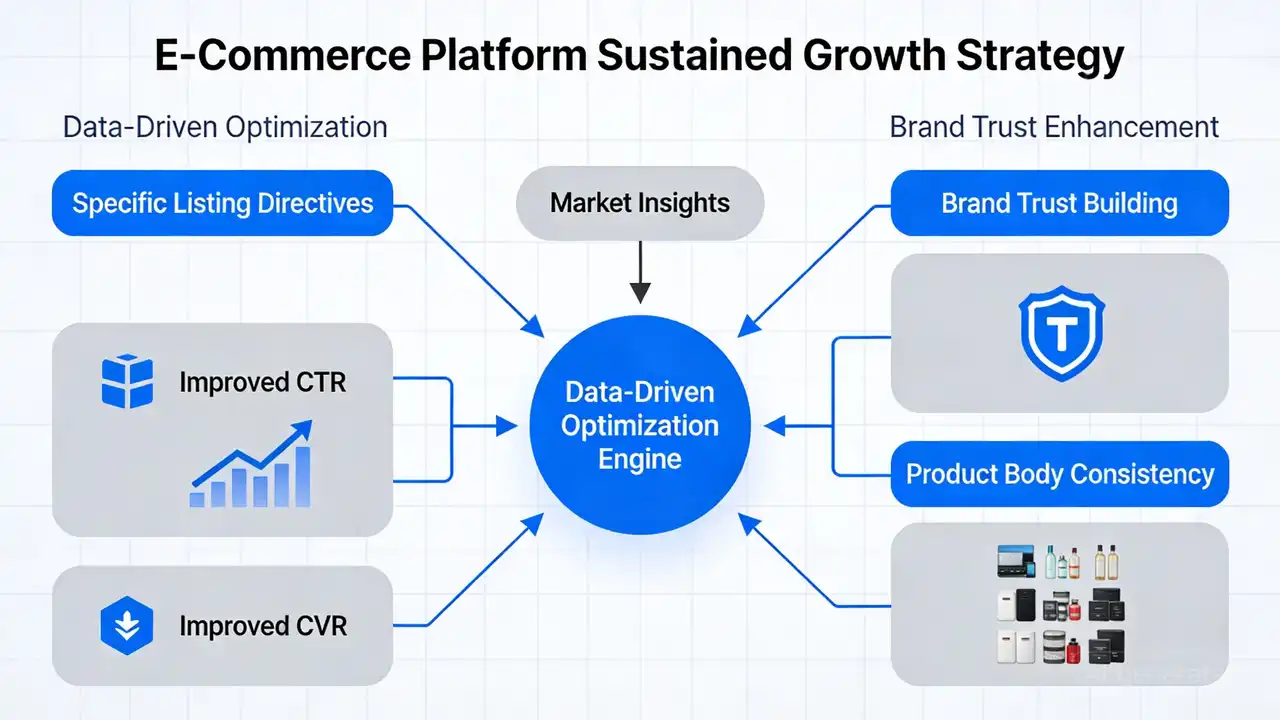
Achieving sustained growth on Amazon requires a fundamental shift from manual guesswork to a holistic, data-driven optimization engine. The era of blind trial-and-error is over; today's top sellers operate on a foundation of evidence-backed chains of logic, transforming abstract business goals into precise, executable actions that directly impact key performance indicators. This evolution is more than a simple productivity boost, like reducing listing upload times from minutes to seconds; it represents a strategic leap in how you manage your digital shelf.
By systematically translating market insights into specific visual and textual directives, you ensure every element of your listing—from the main image to the bullet points—is engineered to improve CTR and CVR. This disciplined approach, governed by principles like "product body consistency" to prevent misleading visuals, not only drives sales but also builds long-term brand trust by mitigating the risk of negative reviews. Ultimately, mastering this strategic optimization cycle is the key to unlocking consistent, defensible growth in the competitive Amazon marketplace.