The Critical Role of Conversion Rate Optimization (CRO) on Amazon
On Amazon, driving traffic to your listings is only the first step; converting that traffic into sales is essential for profitability. Conversion Rate Optimization (CRO) is the systematic process of refining a product detail page to maximize the percentage of visitors who make a purchase. This foundational discipline directly impacts sales volume, advertising efficiency, and organic visibility.
Why Every Click Must Count: The Impact of High Conversion
Every visitor to your product page represents a sales opportunity. A higher Conversion Rate (CVR) means you generate more revenue from the same amount of traffic, which directly improves your return on investment. For sponsored ads, this translates into a lower Advertising Cost of Sale (ACoS), making your campaigns more effective and profitable. By focusing on CRO, you ensure that every click you pay for has the highest possible chance of resulting in a sale, transforming your listing from a simple product display into a powerful sales tool.
Understanding Amazon's Ecosystem: How Conversion Fuels Visibility
Amazon's A10 algorithm is designed to prioritize products that customers are most likely to buy. A high CVR sends a strong signal that your product is relevant and desirable, effectively meeting customer needs. In response, Amazon rewards your listing with an improved organic search ranking and a greater chance of winning the Buy Box.
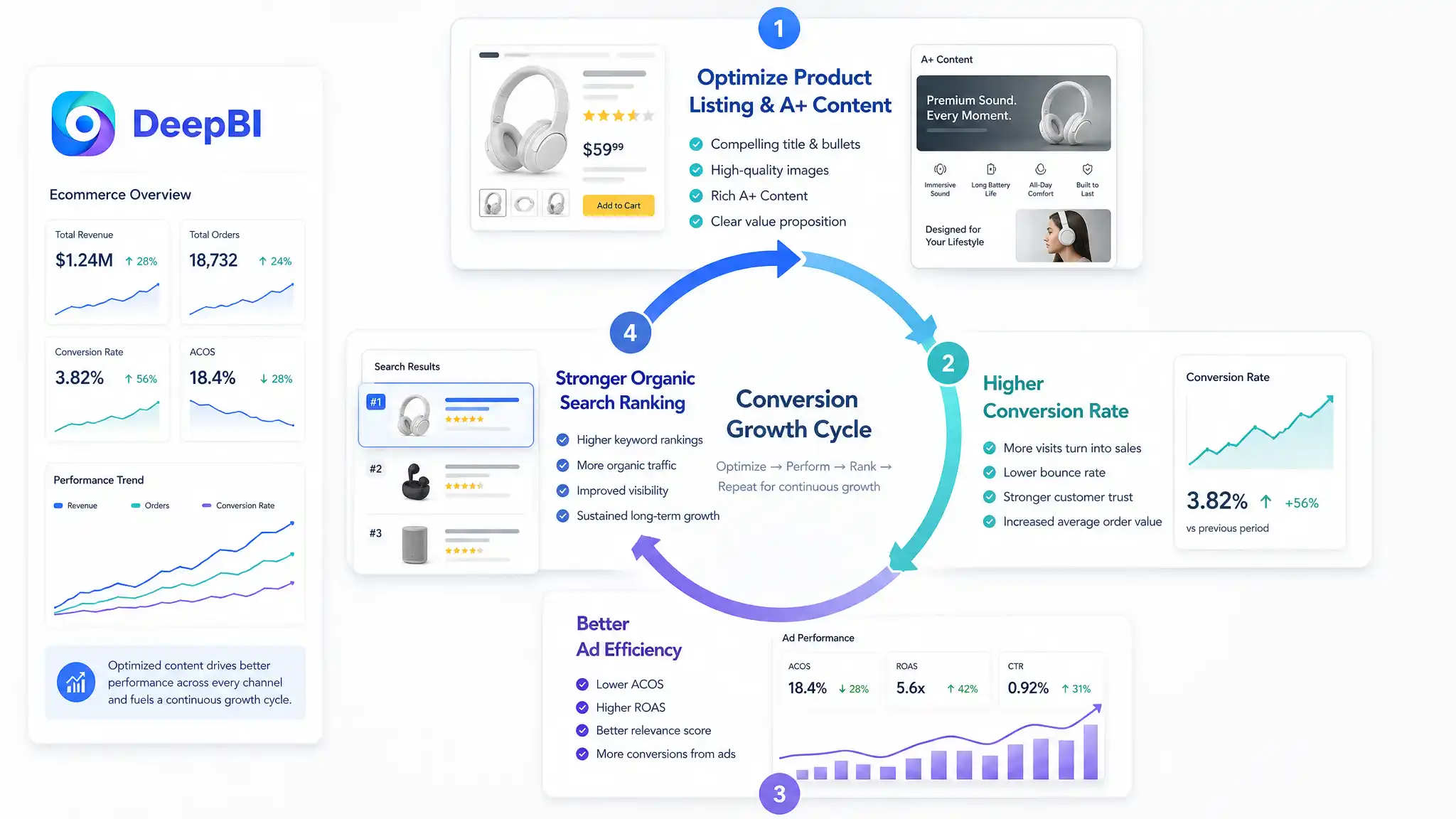
This dynamic creates a virtuous cycle: better conversion leads to higher visibility, which drives more traffic, resulting in more sales and further cementing your rank. However, this is not a one-time fix. Effective CRO is a continuous process of testing, learning, and refinement. It requires moving beyond subjective judgments to establish a data-driven feedback loop where changes to listing elements, such as images, are tracked against performance metrics like Click-Through Rate (CTR) to measure their real-world impact.
 Deep Dive into Listing Elements: Optimizing for Buyer Intent
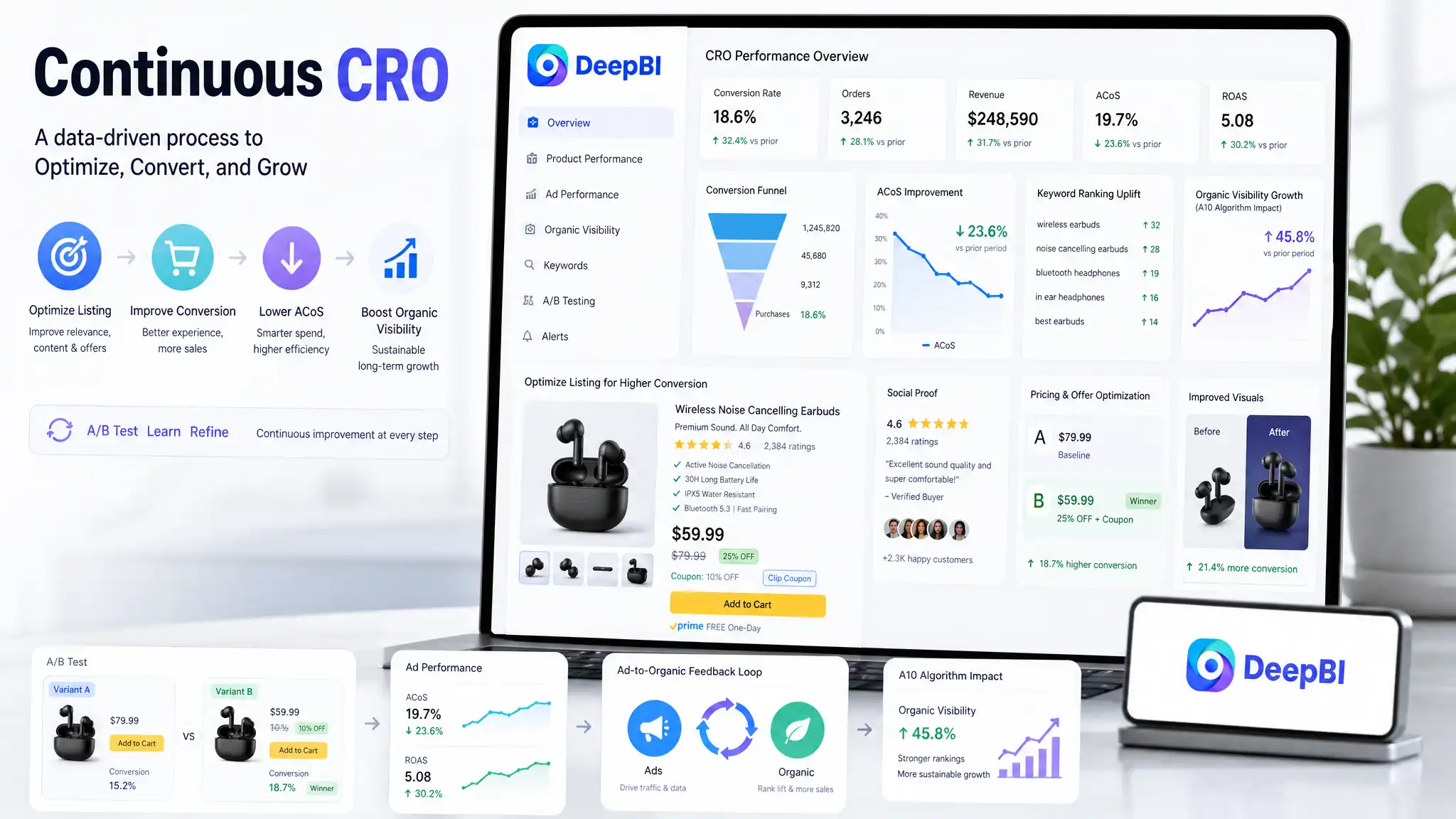
A high-converting Amazon listing is a carefully engineered system where every element works in concert to attract, persuade, and convert shoppers. Optimizing each component individually while ensuring they align with a unified strategy is the key to unlocking higher sales velocity and superior advertising performance.
Strategic Keyword Research: Matching Search with Purchase Intent
Keyword research is the bedrock of your entire listing strategy. While broad keywords attract traffic, long-tail keywords (phrases of three or more words) often signal higher purchase readiness. A customer searching for a "lightweight 15-inch laptop backpack for air travel" is much closer to buying than someone searching for "bag." This research informs your title, bullets, and backend search terms. To gain a competitive edge, leverage multi-dimensional semantic analysis to benchmark against top-performing ASINs, deconstructing their keyword strategy to identify high-value opportunities they are winning.
Crafting Irresistible Product Titles
Your title is the first, and sometimes only, text a customer reads. It must be optimized for both Amazon's search algorithm and human psychology. A strong title balances primary keywords with compelling benefits to maximize visibility and click-through rate (CTR). A proven formula is: [Brand Name] + [Main Keyword Phrase] + [Top 2-3 Benefits/Features] + [Size/Color/Quantity]. AI-powered content generation can accelerate this process, creating multiple title variations that are optimized for both search relevance and conversion.
Visual Excellence: High-Quality Images and Videos
Visuals are your most powerful conversion tool. The main image, which must have a pure white background and feature only the product, is the single biggest driver of CTR from search results. Your secondary images and videos are what drive conversion rate (CVR) on the page. They must tell a story, showcase benefits, and handle customer objections.
Using general-purpose AI for image creation carries the significant risk of a "product-image mismatch," where the generated visual fails to represent the physical item accurately, leading to damaging negative reviews. To solve this, an advanced visual production system operates on the principle of "product entity consistency." It first builds a "Product DNA" map of your item, which acts as a hard constraint for the AI. This process ensures all generated lifestyle images and infographics are authentic to the product's material, color, and design, mitigating post-sale risks. The system transforms abstract goals like "show long battery life" into precise, AI-executable design blueprints, such as an infographic with specific visual parameters, ensuring strategic alignment and brand consistency.
Persuasive Bullet Points: Highlighting Key Benefits
Shoppers scan bullet points to quickly determine if a product meets their needs. Lead with benefits, not just features. Instead of saying "5000mAh battery," say "All-Day Power: Work and stream for up to 12 hours on a single charge." Each bullet should address a potential customer question or pain point, turning a feature into a solution. AI-driven copy generation can analyze competitor listings and customer reviews to identify key pain points and craft benefit-oriented bullets that resonate with your target audience.
Engaging Product Descriptions and A+ Content: Telling Your Brand Story
A+ Content offers a crucial opportunity to deepen engagement and drive conversions, with sellers often seeing a CVR lift of 3-10% (and up to 20% with Premium A+). Use this space to tell your brand story, use comparison charts to upsell, and visually demonstrate complex features. It’s your chance to build an emotional connection that goes beyond a simple transaction. AI tools can help structure this narrative, generating compelling copy and suggesting visual layouts that align with your brand identity and highlight key purchase drivers.
Competitive Pricing and Promotions: Influencing Purchase Decisions
Price is a primary factor in the purchase decision. Employ psychological pricing strategies, such as pricing at $29.99 instead of $30.00, which can have a measurable impact on CVR. Additionally, Amazon Promotions and Coupons create a sense of urgency and can significantly improve conversion rates, especially for new product launches or during key sales periods. Consistently monitoring competitor pricing is essential for maintaining Buy Box eligibility and market relevance.
Harnessing Social Proof: The Power of Customer Reviews
Customer reviews are the ultimate form of social proof and a massive driver of trust. A high review count and average star rating directly correlate with a higher CVR. Furthermore, Prime eligibility is a powerful trust signal in itself. The promise of fast, free shipping through Amazon's trusted fulfillment network consistently leads to higher conversion rates. A well-optimized listing with accurate visuals and clear benefit communication is the foundation for earning the positive reviews that fuel this virtuous cycle of growth.
 The Synergy: Listing Quality, Advertising Performance, and Organic Rank
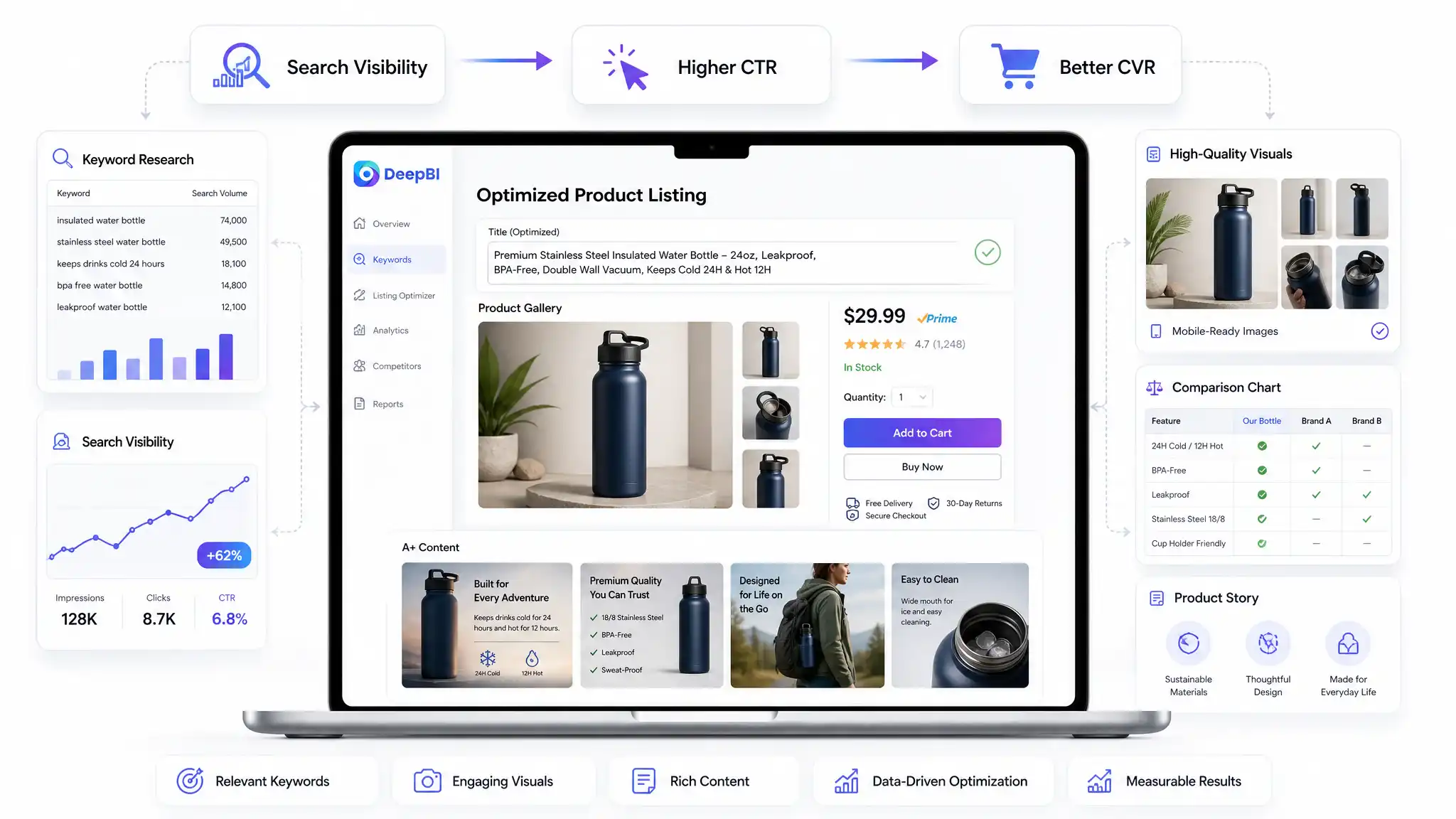
On Amazon, your product listing, advertising campaigns, and organic search ranking are not isolated pillars but deeply interconnected components of a single growth engine. Neglecting your listing quality is like pouring an advertising budget into a leaky bucket—it undermines every other effort. A truly optimized strategy recognizes that a high-converting listing is the foundation for both efficient advertising and dominant organic visibility.
How Listing Optimization Boosts Ad Effectiveness
Your product listing is the final destination for every dollar spent on advertising. A poorly optimized page wastes ad spend, while a high-performing one multiplies its effectiveness. The core principle is that a well-crafted listing—with compelling images, persuasive copy, and informative A+ Content—directly increases your Conversion Rate (CVR). When paid traffic lands on a page that converts efficiently, you generate more sales from the same number of clicks. This immediately improves key advertising metrics, lowering your Advertising Cost of Sale (ACoS) and boosting your campaign's return on investment. Visual assets are particularly critical, as their function has evolved from mere aesthetic display to being a primary driver of both clicks and conversions.
Driving Organic Growth Through Enhanced Conversion
Strong ad performance does more than generate immediate sales; it also fuels your organic growth. Amazon's algorithm heavily weighs sales velocity and conversion rates when determining search rankings. When your ads successfully convert shoppers for specific keywords, you send a powerful signal to Amazon that your product is a relevant solution for those queries. In response, the algorithm is more likely to reward your listing with a higher organic rank. This creates a self-reinforcing growth cycle: better listings lead to a higher ad CVR, which drives sales velocity and, in turn, improves organic placement. This increased organic visibility brings in more high-intent, "free" traffic, further solidifying your market position and creating a sustainable growth model.
 DeepBI: Your AI-Powered Partner for Amazon Listing Optimization
Transitioning from experience-based guesswork to a data-driven strategy is the key to scaling on Amazon. DeepBI is an AI-core, full-funnel operational optimization system designed for this purpose. It provides a systematic approach to enhancing your listings, ads, and traffic, moving beyond isolated tactics to build a foundation for long-term, stable profitability.
Intelligent Diagnostics and Competitive Benchmarking
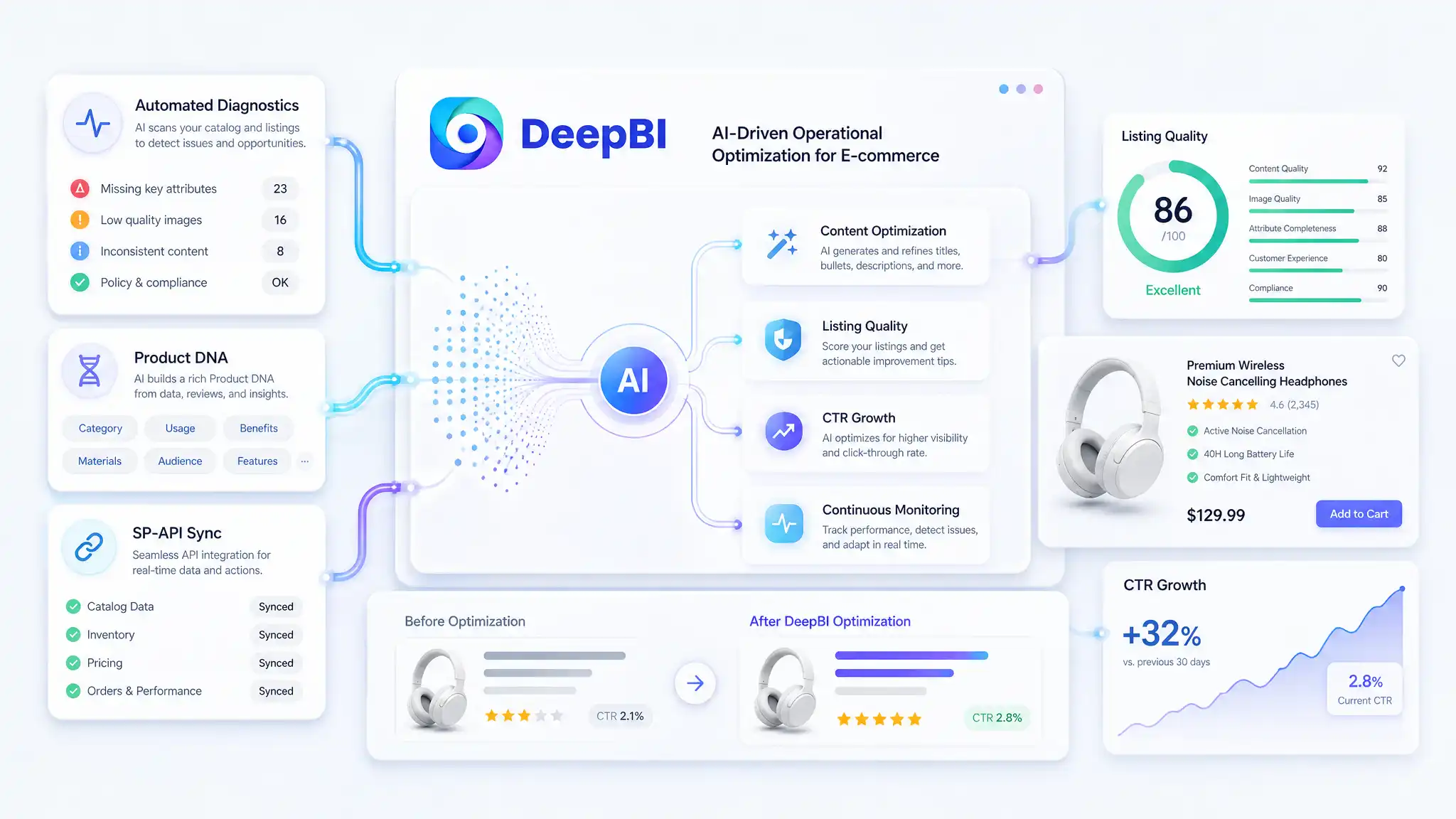
Before you can optimize, you must accurately diagnose performance. DeepBI functions as an automated market health check system, not just a simple scoring tool. It automatically identifies your true competitors and benchmarks your ASIN against top-performing listings. The system then generates a multi-dimensional diagnostic score that precisely pinpoints weaknesses across your title, images, bullet points, and A+ Content, providing a clear, data-backed starting point for improvement.
AI-Driven Content Generation and Seamless Application
Once weaknesses are identified, DeepBI generates structured, actionable optimization strategies ranked by potential impact. Its AI is not a general-purpose creative tool but an automated visual production system constrained by your product's unique "Product DNA." This ensures all generated content—from main images to A+ layouts—is authentic to your product, mitigating the risk of "AI hallucinations" that can lead to negative reviews.
After you approve the optimized assets, the manual process of downloading, renaming, and uploading is eliminated. DeepBI's one-click application uses the official Amazon SP-API to sync content seamlessly, reducing an operation that once took over 30 minutes to mere seconds.
A Holistic Approach to Continuous Optimization
Effective optimization requires a closed feedback loop. DeepBI connects your listing changes directly to performance metrics. When a new image is published through the system, it automatically creates a "visual iteration event point" in your ad reports. This allows you to clearly track the impact of your optimization on key KPIs like Click-Through Rate (CTR) over the following weeks, turning subjective changes into quantifiable business results and enabling a cycle of continuous, data-driven improvement.
 Sustaining Success: The Continuous CRO Cycle
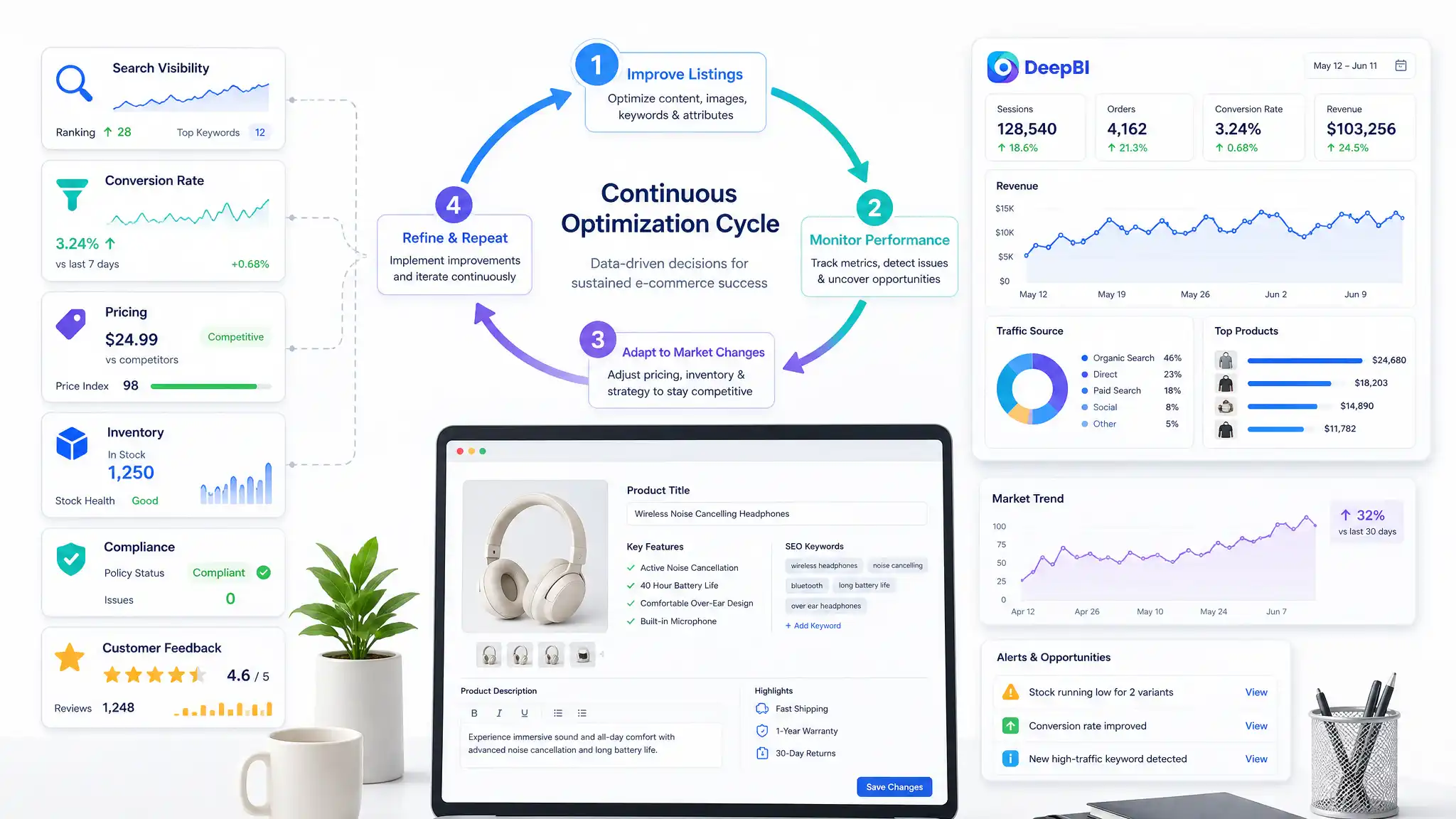
Achieving a high conversion rate is not a one-time project but a continuous cycle of improvement. While initial optimization provides a baseline, long-term success on Amazon requires a commitment to ongoing analysis and adaptation. Market dynamics, competitor strategies, and customer preferences are in constant flux, rendering a "set it and forget it" approach obsolete. Top-performing sellers treat conversion rate optimization as an integral, iterative part of their operations to consistently refine their listings, maintain a competitive edge, and maximize profitability.
Data-Driven Iteration and Performance Monitoring
Effective CRO is rooted in a disciplined, data-driven feedback loop. The traditional approach to listing updates often suffers from disconnected stages and subjective decision-making, which leads to inefficient and risky changes. A modern, sustainable strategy replaces guesswork with quantitative analysis. This involves regularly auditing key listing components—such as the main image, title, bullet points, and A+ content—against performance data and customer feedback.
By establishing a system for continuous performance monitoring, you can identify underperforming elements and iterate methodically. This repetitive process of diagnosis, planning, and execution creates a powerful engine for incremental gains in Click-Through Rate (CTR) and Conversion Rate (CVR), ensuring your listing's performance does not degrade over time.
Adapting to Amazon's Evolving Landscape
The Amazon marketplace is not a static environment. The platform's search algorithm, merchandising policies, and available marketing tools are constantly evolving. A listing that is perfectly optimized today may become non-compliant or less visible tomorrow as a result of these changes. Sustaining success therefore requires agility and the ability to adapt quickly.
Staying informed about Amazon's updates is critical. When a policy change occurs or a new feature is introduced, you must be prepared to adjust your listings promptly. Leveraging tools that connect directly to your seller account via the official SP-API enables the rapid deployment of updated content. This capability significantly reduces the listing update cycle time, ensuring your products remain compliant, competitive, and aligned with Amazon's latest best practices.