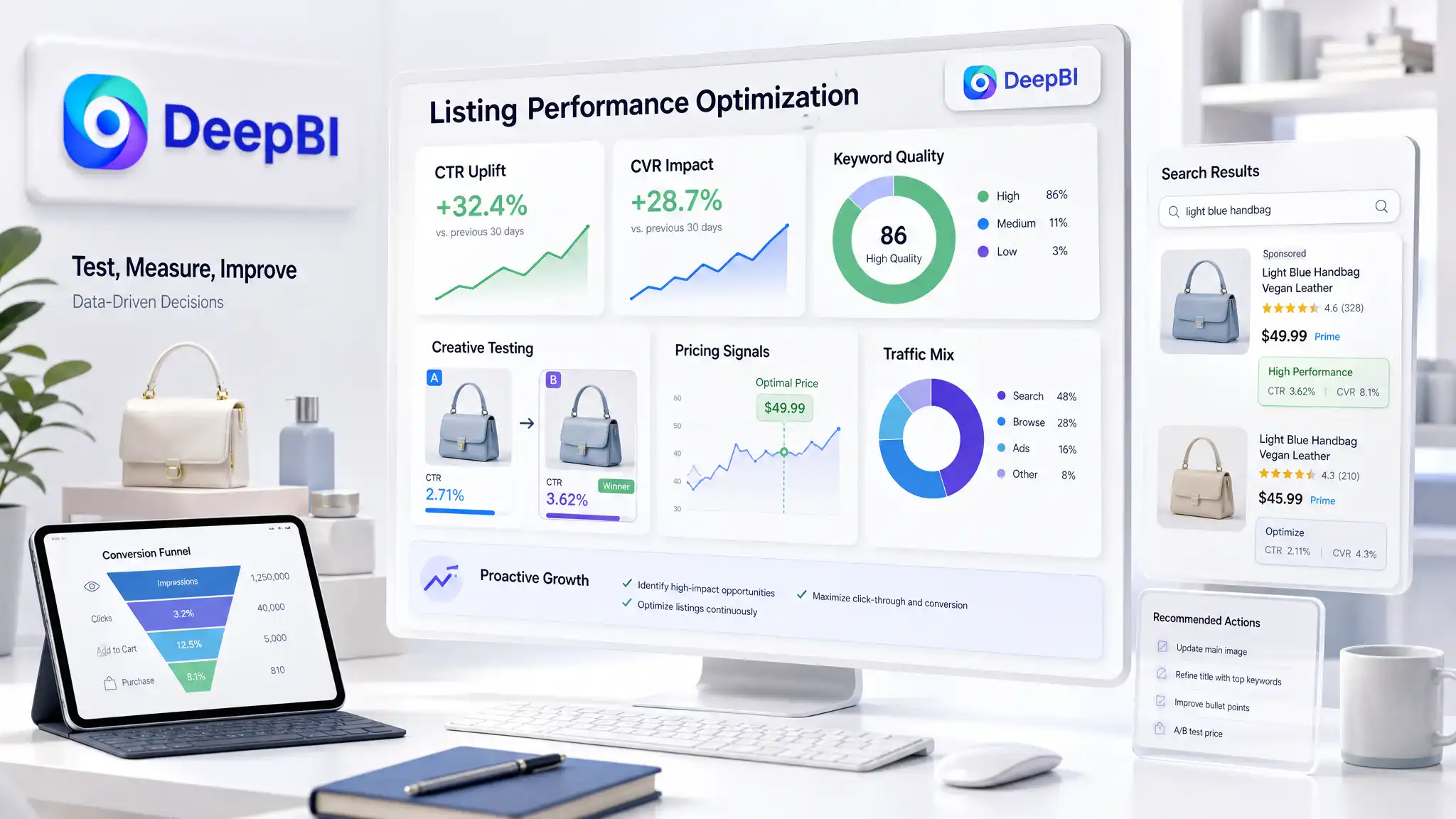
Introduction
On Amazon's crowded digital shelf, where millions of products compete for attention, visibility is paramount. Your product may have superior features and a competitive price, but if shoppers scroll past it on the search results page, it effectively does not exist. This is where the battle for the first click is won or lost, and the primary metric defining success is your organic Click-Through Rate (CTR). Simply put, organic CTR is the percentage of customers who see your product in their search results and are sufficiently compelled to click on it for more information.
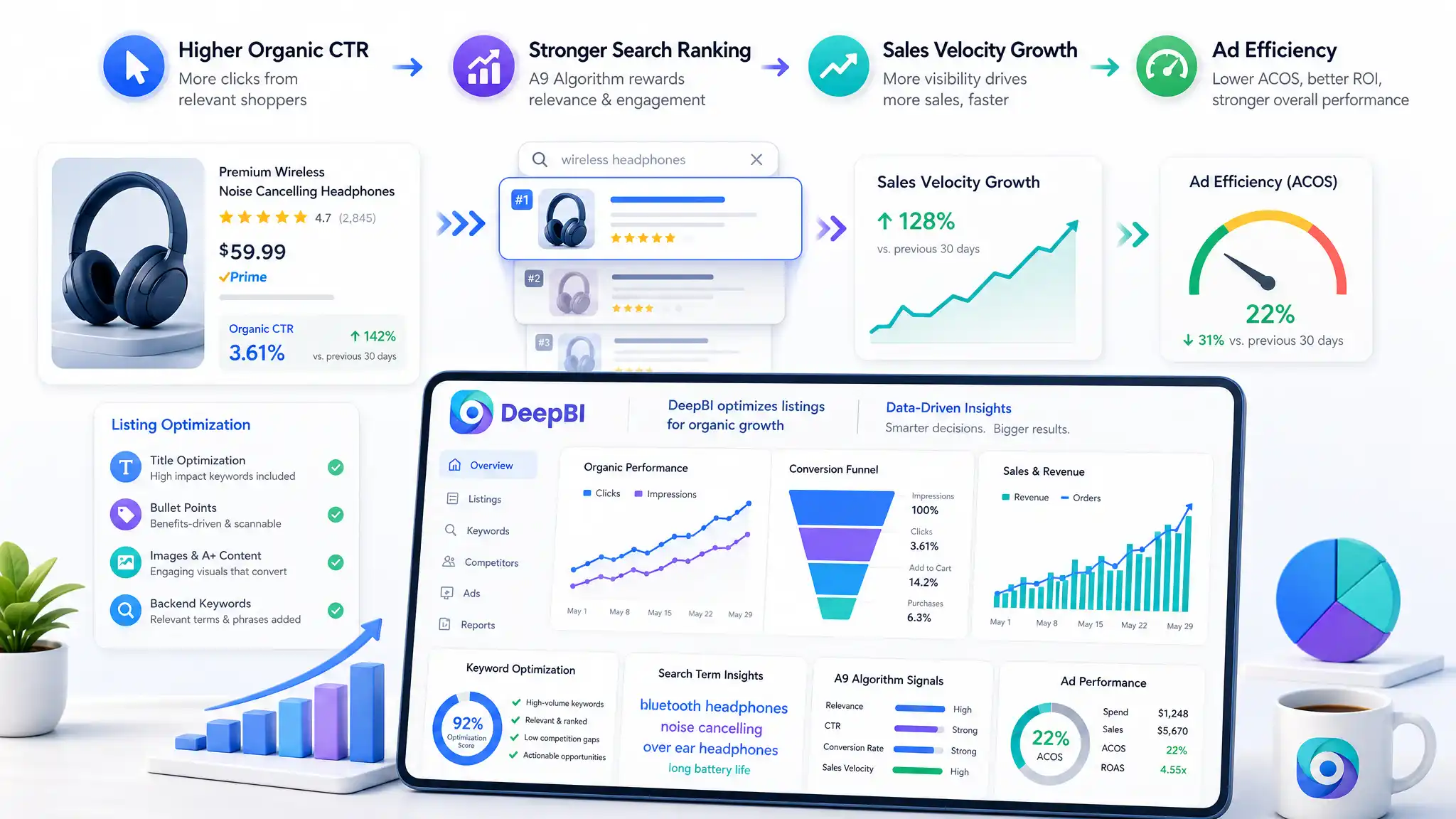
This metric is far more than a simple measure of engagement; it is a direct and powerful signal to Amazon's A9 algorithm. A high CTR indicates to Amazon that your listing—specifically its main image, title, price, and review rating—is highly relevant and appealing to customers for a given search term. In response, the algorithm rewards your product with a higher search ranking, creating a self-reinforcing cycle of increased visibility, more traffic, and ultimately, greater sales velocity. Conversely, a low CTR signals a mismatch, causing your product to sink in the rankings and starving it of the organic traffic needed to thrive.
While many sellers rely on intuition or aesthetic preference to optimize their listings, this approach leaves performance to chance. The most successful brands understand that winning the click requires a data-informed strategy. They leverage performance analytics to systematically refine the elements that drive customer engagement. This guide will demonstrate how to move beyond subjective assessments and transform your visual assets from simple product showcases into a core commercial engine designed to maximize your organic CTR, boost your Best Sellers Rank (BSR), and fuel sustainable growth.
 Understanding Amazon Organic Click-Through Rate (CTR)
What is Organic CTR and Why Does It Matter?
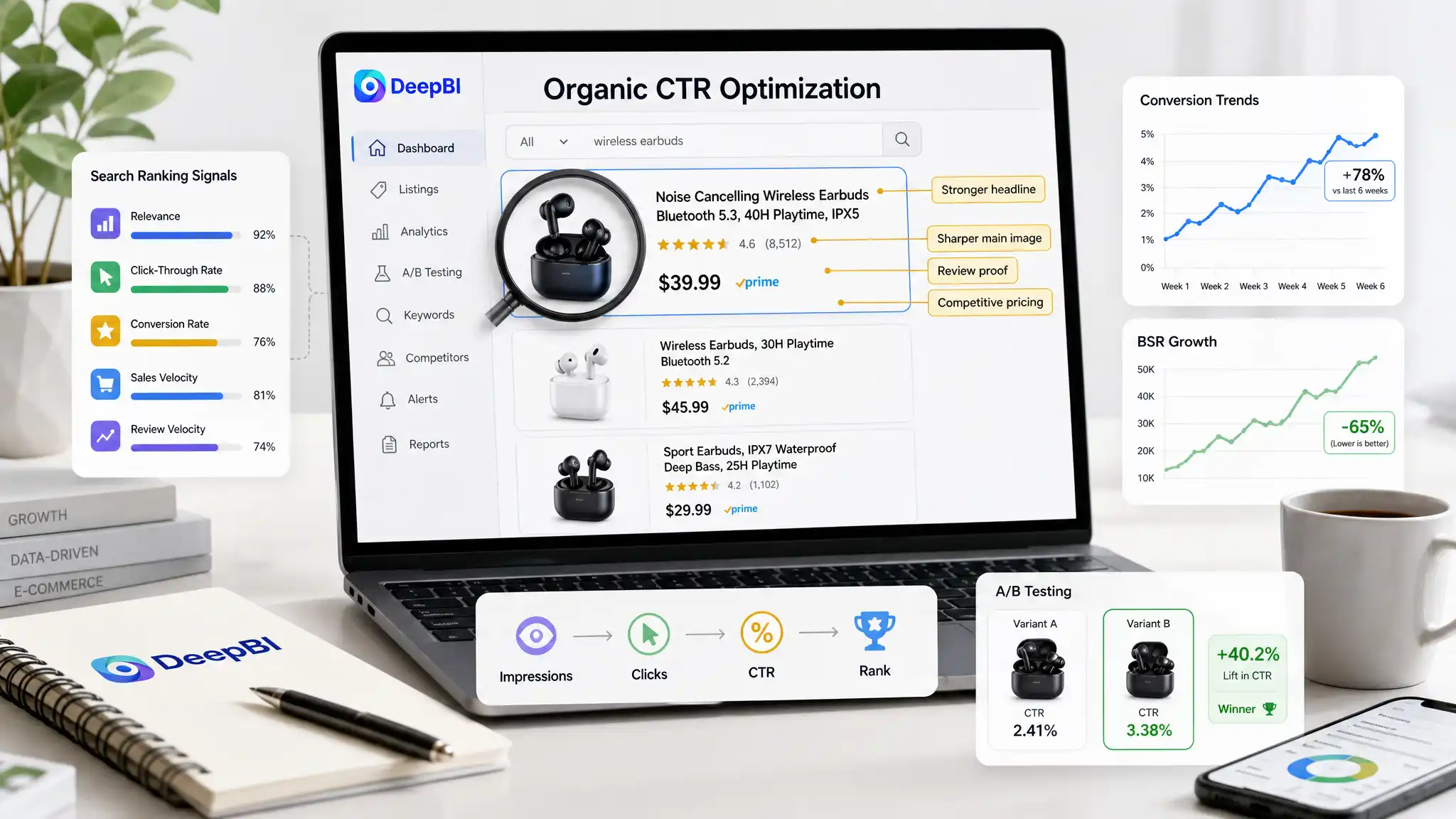
Organic Click-Through Rate (CTR) is the percentage of shoppers who click on your product listing after it appears in Amazon's non-sponsored, organic search results. This metric is a direct measure of your listing's "curb appeal"—how effectively your main image, title, price, and review rating capture a buyer's attention. A higher CTR signals to Amazon's A9 algorithm that your product is highly relevant and appealing for specific search queries, which can boost your organic search ranking, leading to greater visibility and more traffic without increased ad spend.
How to Calculate Your Amazon Organic CTR
Calculating your CTR is straightforward. You can find the necessary data within your Amazon Seller Central reports, specifically under "Business Reports." The formula is:
CTR = (Total Clicks / Total Impressions) x 100%
For example, if your product listing appeared in search results 1,000 times (impressions) and was clicked on 10 times, your organic CTR would be 1%.
What's a Good Amazon Organic CTR?
There is no single "good" CTR that applies to all products. A healthy benchmark varies significantly by product category, competition level, and price point. While some competitive categories might see a healthy CTR between 0.5% and 2%, this is not a universal standard. The key is to focus on continuous improvement relative to your specific market.
When a seller finds their core product's CTR is consistently below the category average, it serves as a clear signal for optimization. Instead of relying on guesswork, a data-driven diagnosis is essential. DeepBI's intelligent scoring capabilities provide this clarity by conducting a quantitative audit of your listing's core components, including the main image, title, and bullet points. By benchmarking your assets against high-performing competitors, DeepBI helps you pinpoint exactly why shoppers are not clicking and what needs to be fixed.
 The Impact of Organic CTR on Amazon Success
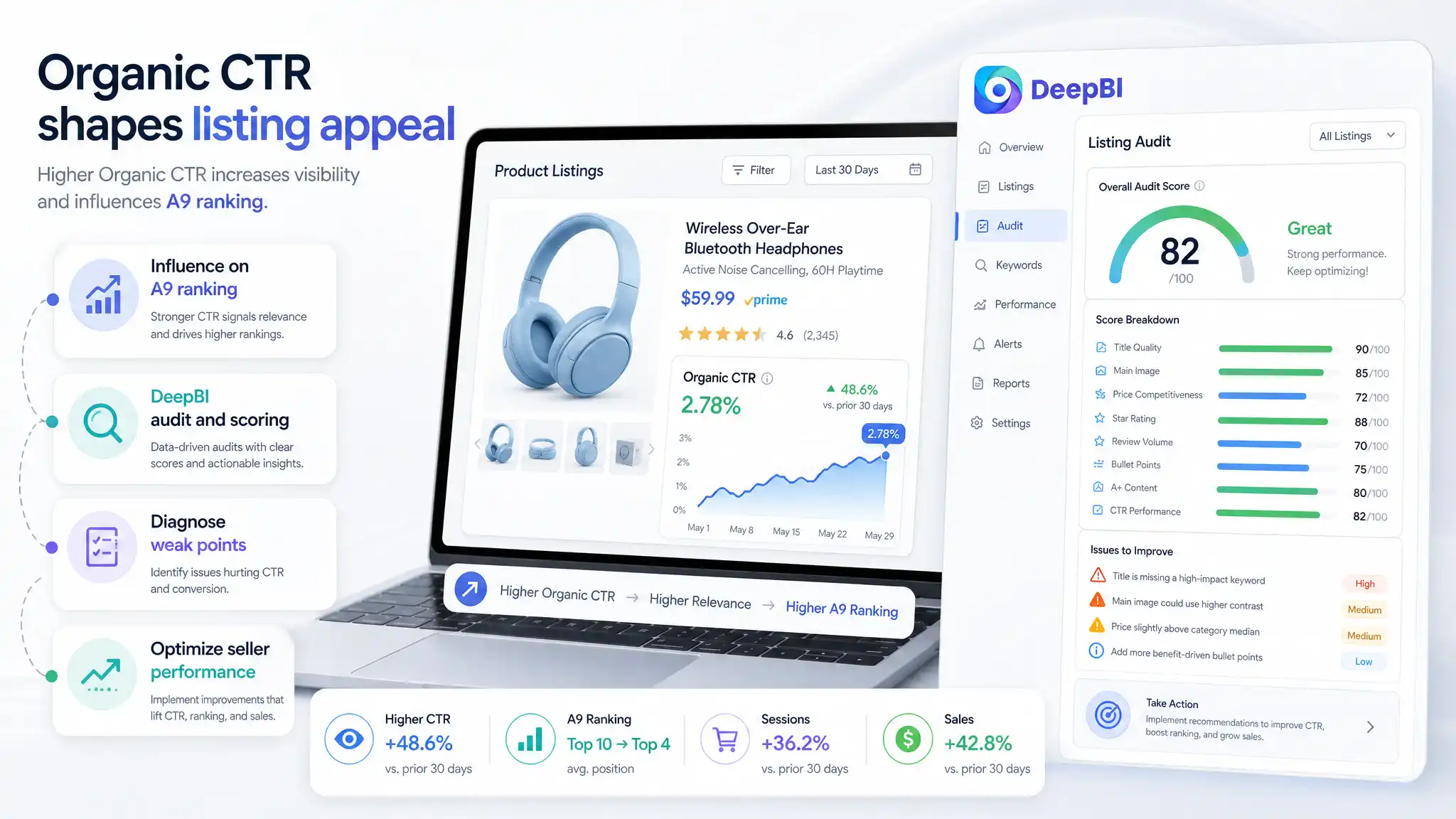
A high organic Click-Through Rate (CTR) is more than just a vanity metric; it is a primary driver of the Amazon flywheel. It signals to the platform that your product is highly relevant to customer searches, which directly influences your visibility, sales velocity, and overall profitability.
Organic CTR and Amazon's A9 Algorithm
Amazon's A9 algorithm interprets a high CTR as a strong vote of confidence from shoppers. When customers consistently choose your product over competitors' in search results, it indicates that your listing is a compelling match for their query. The algorithm rewards this relevance by boosting your product's organic ranking.
This creates a powerful positive feedback loop:
- An optimized listing achieves a higher CTR.
- Amazon's algorithm detects this and improves your search ranking.
- The higher ranking leads to more impressions.
- Increased visibility provides more opportunities for clicks, further solidifying your position.
The Synergy Between Organic CTR and Sales Velocity
An improved organic CTR directly fuels sales velocity, another critical factor in Amazon's ranking system. More clicks translate into more traffic on your product detail page, increasing the potential for conversions. This rise in sales volume signals to Amazon that your product is in demand, further reinforcing its organic rank.
This is where a data-centric strategy creates a dual-growth engine. By analyzing both organic and advertising data, you can identify keywords with high CTR and Conversion Rates (CVR). DeepBI leverages these insights to guide listing optimizations, such as generating new main images informed by ad performance. This approach not only boosts your organic CTR but also improves the efficiency of your ad spend. The result is an upward spiral where paid advertising insights accelerate organic growth, and a strong organic presence provides a more profitable foundation for ad campaigns.
 Key Factors Influencing Your Amazon Organic CTR
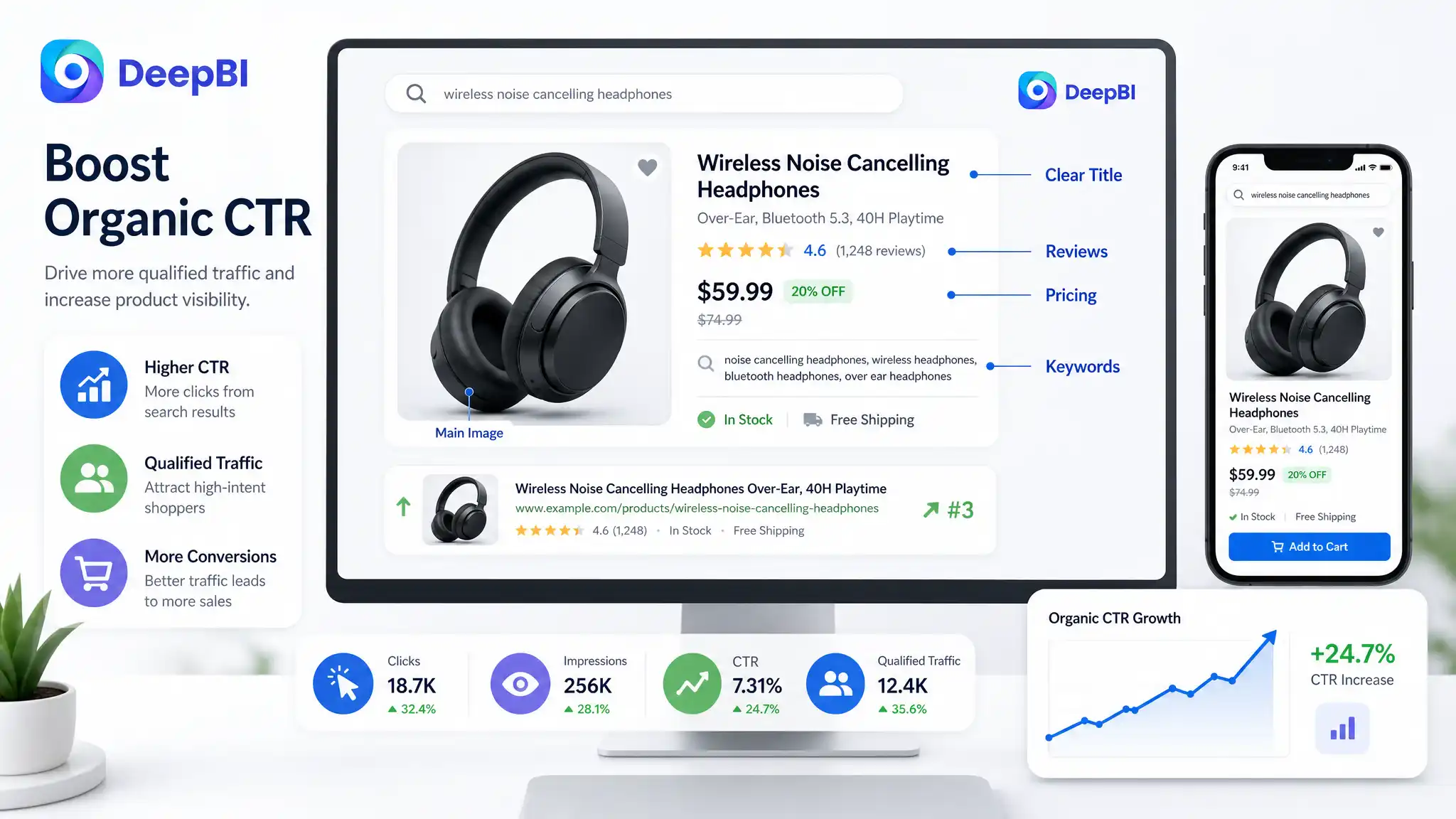
On a crowded Amazon search results page, your product has only a split second to capture a shopper's attention. Several key elements work in concert to either earn that click or lose it to a competitor. Mastering these factors is the first step toward improving your organic click-through rate (CTR) and driving qualified traffic to your listing.
Product Main Image: The First Impression
Your main image is your single most powerful tool for earning a click. It has evolved from a simple product photograph into a critical commercial asset that directly drives engagement. This first visual impression must not only comply with Amazon's technical standards, such as a pure white background, but also be compelling enough to stop a scrolling customer. A high-quality, professional image that clearly showcases the product and its key benefit can dramatically increase the likelihood of a click.
Compelling Product Title: Clarity and Keywords
The product title serves two audiences: the customer and the Amazon algorithm. It must be instantly understandable to a human shopper, clearly communicating what the product is and its primary value. Simultaneously, it needs to be optimized with relevant, high-volume keywords to ensure it appears in the right searches. A well-structured title that balances descriptive clarity with strategic keywords within Amazon's character limits is essential for attracting qualified clicks.
Customer Reviews and Ratings: Building Trust
Social proof is a powerful motivator. The star rating and review count displayed on the search page are immediate indicators of product quality and customer satisfaction. A high average rating and a substantial number of reviews build instant trust, reducing a shopper's perceived risk and encouraging them to click for more details. Conversely, a low rating or a lack of reviews can be a significant deterrent, pushing customers toward more established competitors.
Competitive Pricing: Value Perception
Price is a critical filter for most Amazon shoppers. Customers scan prices on the search results page to quickly assess value and determine if a product fits their budget. Your pricing strategy directly influences this perception. If your price is significantly higher than that of similar items without a clear justification, such as premium branding or features visible in the image, you risk losing the click. The goal is to be priced competitively to signal strong value relative to other options.
 Strategies to Optimize Your Amazon Organic CTR
Optimizing Product Images for Maximum Clicks
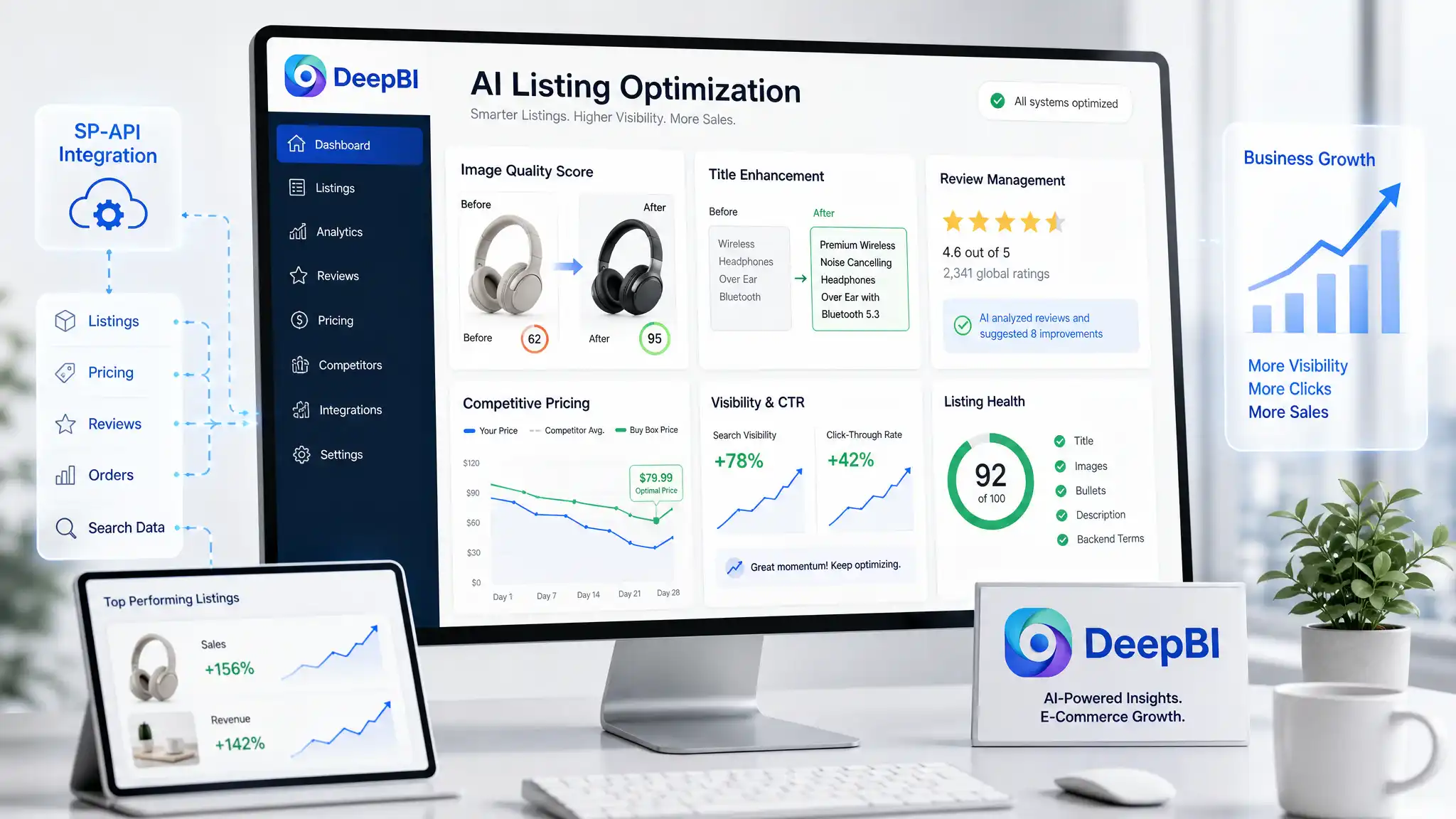
DeepBI’s AI generates multiple image options for your listing using a "Product DNA" map to ensure authenticity and prevent "AI hallucinations" that cause negative reviews. After selecting an image, DeepBI's one-click SP-API integration updates your listing in seconds, replacing a 30-minute manual process.
Adhering to Amazon's Main Image Guidelines
Your main image must show only the product on a pure white background. DeepBI’s system enforces these compliance rules, helping you create compelling hero images that avoid listing suppression.
Leveraging Lifestyle and Infographic Images
For secondary images, DeepBI translates abstract goals like "show durability" into specific, AI-executable instructions for creating high-impact infographics and lifestyle shots that clearly communicate value.
Crafting High-Converting Product Titles
DeepBI's AI generates multiple title variations optimized for Amazon's algorithm and human shoppers, allowing you to deploy the most effective version for maximizing clicks.
Incorporating Primary Keywords Naturally
Using search term report data, DeepBI seamlessly integrates high-traffic keywords into your titles, boosting visibility without the keyword-stuffing that deters buyers.
Highlighting Key Benefits and Unique Selling Propositions
AI-generated titles lead with your product's key benefits and unique selling propositions (USPs), capturing shopper interest directly on the search results page.
Enhancing Your Product's Review Profile
A high star rating and review count build immediate trust. This social proof is a primary factor influencing a shopper's decision to click on your listing over a competitor's.
Encouraging Legitimate Customer Reviews
Consistently use Amazon's ToS-compliant tools, like the "Request a Review" button, to build your review count and maintain positive engagement.
Addressing Negative Feedback Strategically
Treat negative reviews as actionable data. Use the insights to improve your product and listing, which builds brand trust and prevents future issues.
Strategic Pricing for Improved Clickability
Price is a critical filter. Your product must be priced competitively within its category to attract clicks from shoppers comparing options.
Competitive Analysis and Dynamic Pricing
Regularly analyze competitor pricing to ensure your offer remains attractive. A well-positioned price is foundational to achieving a high CTR.
Psychological Pricing Tactics
Subtle price adjustments can influence clicks. For instance, changing a price from $20.99 to $20.95 can sometimes influence buyer perception and click-through rates, though the effect varies.
 Leveraging DeepBI for Organic CTR Enhancement
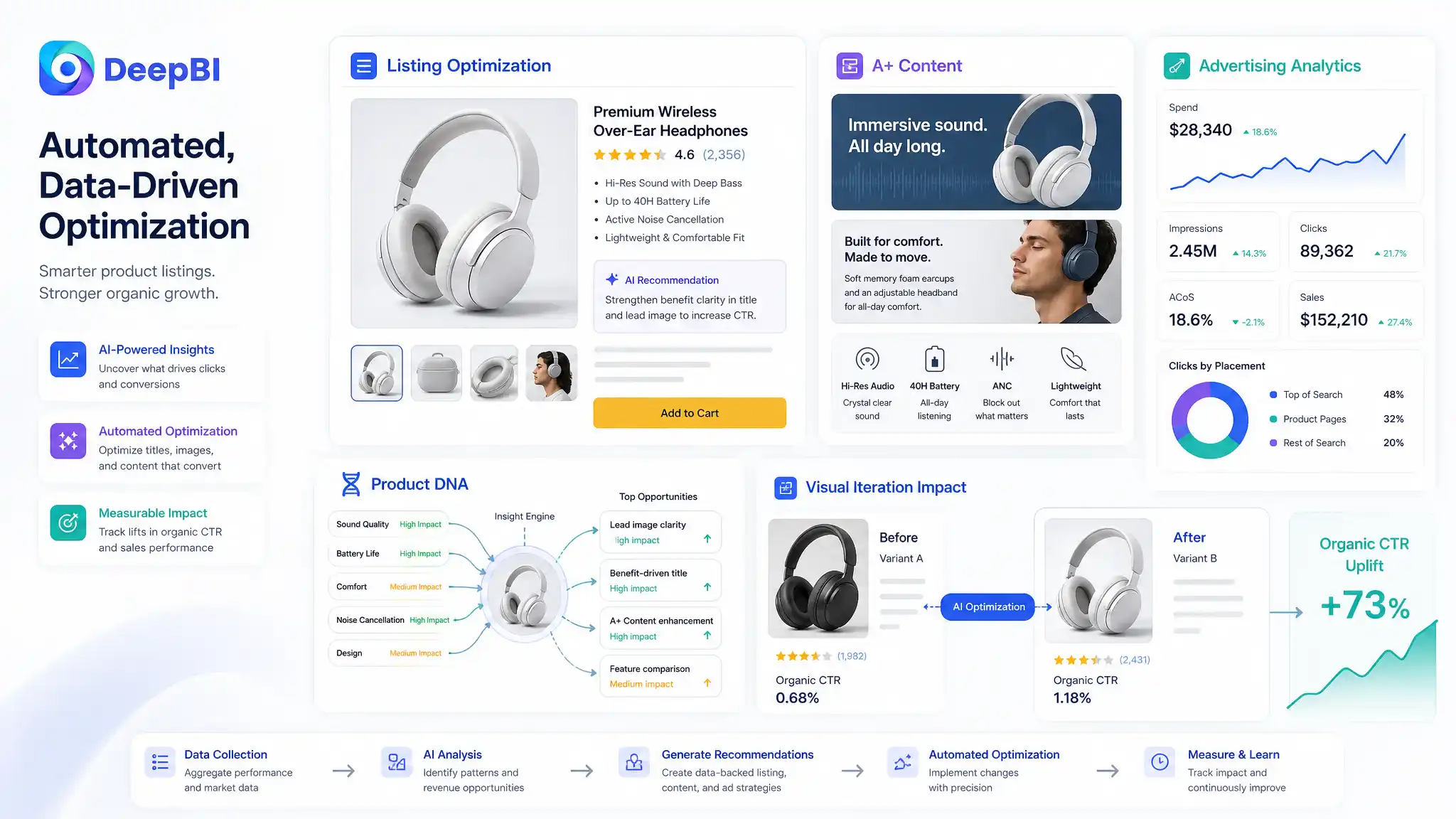
Implementing strategies to boost organic CTR manually can be time-consuming and reliant on subjective judgment. DeepBI transforms this process by providing an end-to-end intelligent optimization system that replaces subjective assessments with data-driven precision and automation.
DeepBI's Holistic Approach to Listing Optimization
DeepBI functions as an automated market health check system that moves far beyond simple scoring. It conducts a comprehensive diagnosis of your entire listing—including the main image, title, bullet points, and A+ Content—and benchmarks each element against top competitors to pinpoint specific weaknesses.
Instead of offering vague advice like "improve image quality," DeepBI provides engineered, actionable instructions with precise parameters for aspects such as composition, camera angle, and lighting. For image generation, it constructs a "Product DNA" map, a critical constraint that ensures all AI-generated visuals remain true to the physical product. This process prevents the "AI hallucinations" common with general-purpose tools, which can lead to product-image mismatches, negative reviews, and returns.
Data-Driven Insights for Organic Traffic Growth
A key advantage of DeepBI is its ability to create a powerful synergy between your paid and organic traffic strategies. Using its advanced advertising analytics, the platform identifies high-performing keywords from your ad campaigns—those with a proven high CTR and Conversion Rate (CVR). These keywords are prime candidates for integration into your product title and bullet points, directly fueling your organic ranking efforts.
Furthermore, DeepBI closes the feedback loop on your optimization efforts. When you apply a new main image, the system automatically creates a "visual iteration event point" in your ad reports. This feature allows you to clearly track the direct impact of the change on your ASIN's CTR over the following 7-14 days, turning optimization from an art into a measurable science.
 Conclusion: Sustained Organic Growth on Amazon
Mastering your organic Click-Through Rate is not a one-time task but a continuous discipline essential for long-term success on Amazon. A high CTR is the engine of visibility, driving the traffic that fuels sales velocity and improves your Best Sellers Rank (BSR). However, achieving and maintaining it requires a multifaceted strategy that harmonizes every element of your listing, from the main image and title to pricing and review velocity.
This is where a systematic, data-driven approach becomes a critical competitive advantage. Tools like DeepBI are designed to break down the operational silos between diagnosis, content creation, and performance analysis. By providing an end-to-end intelligent optimization system, they empower sellers to move beyond subjective decision-making. Instead of manually correlating changes, you can directly quantify the impact of visual and text optimizations on core metrics like CTR and Conversion Rate (CVR).
By embedding this data-centric workflow into your operations, you transform listing optimization from a reactive chore into a proactive growth strategy. This sustained effort builds a powerful moat around your business, ensuring you not only attract but consistently convert high-intent shoppers, paving the way for durable market share and increased profitability.