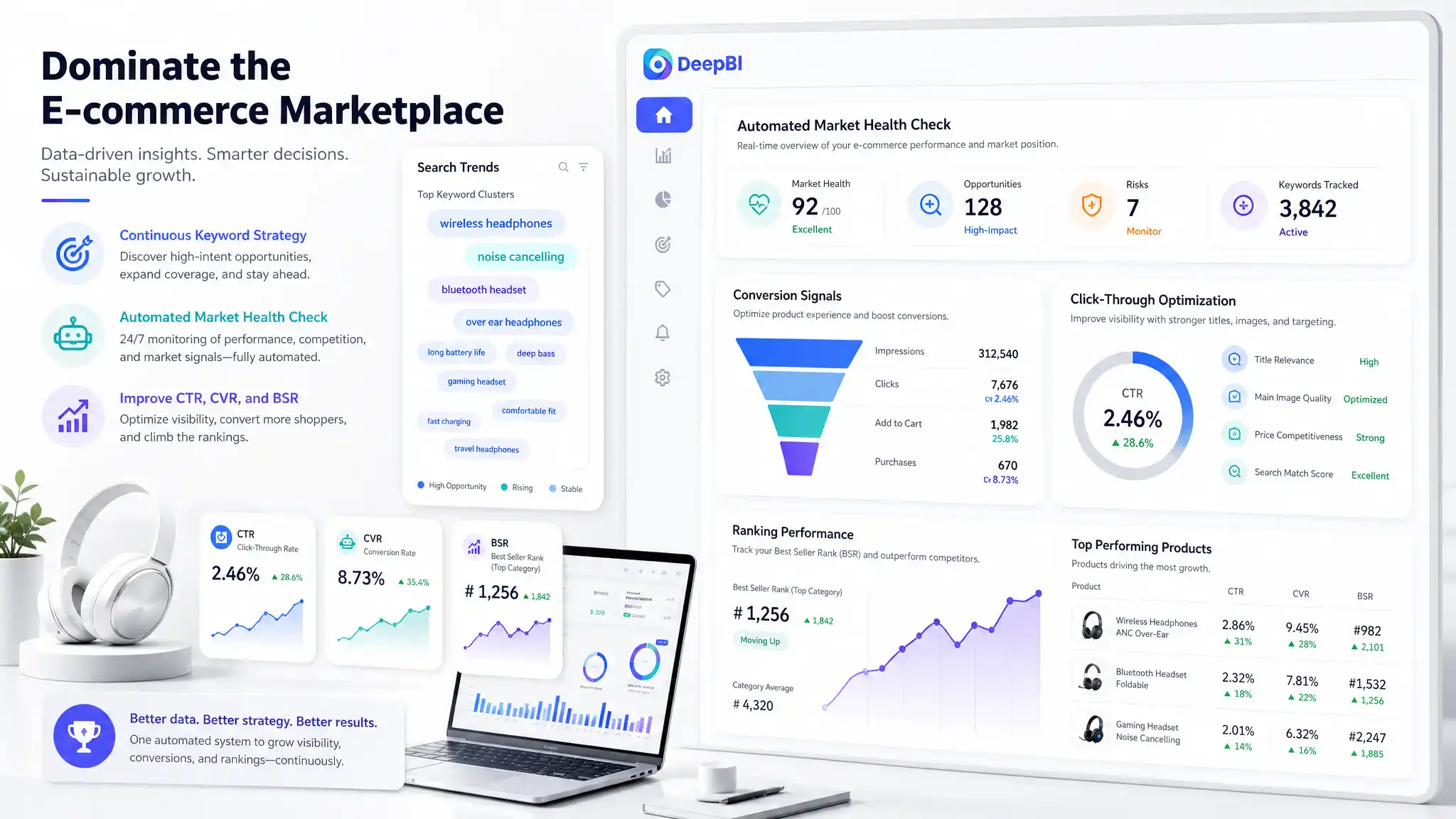
Introduction
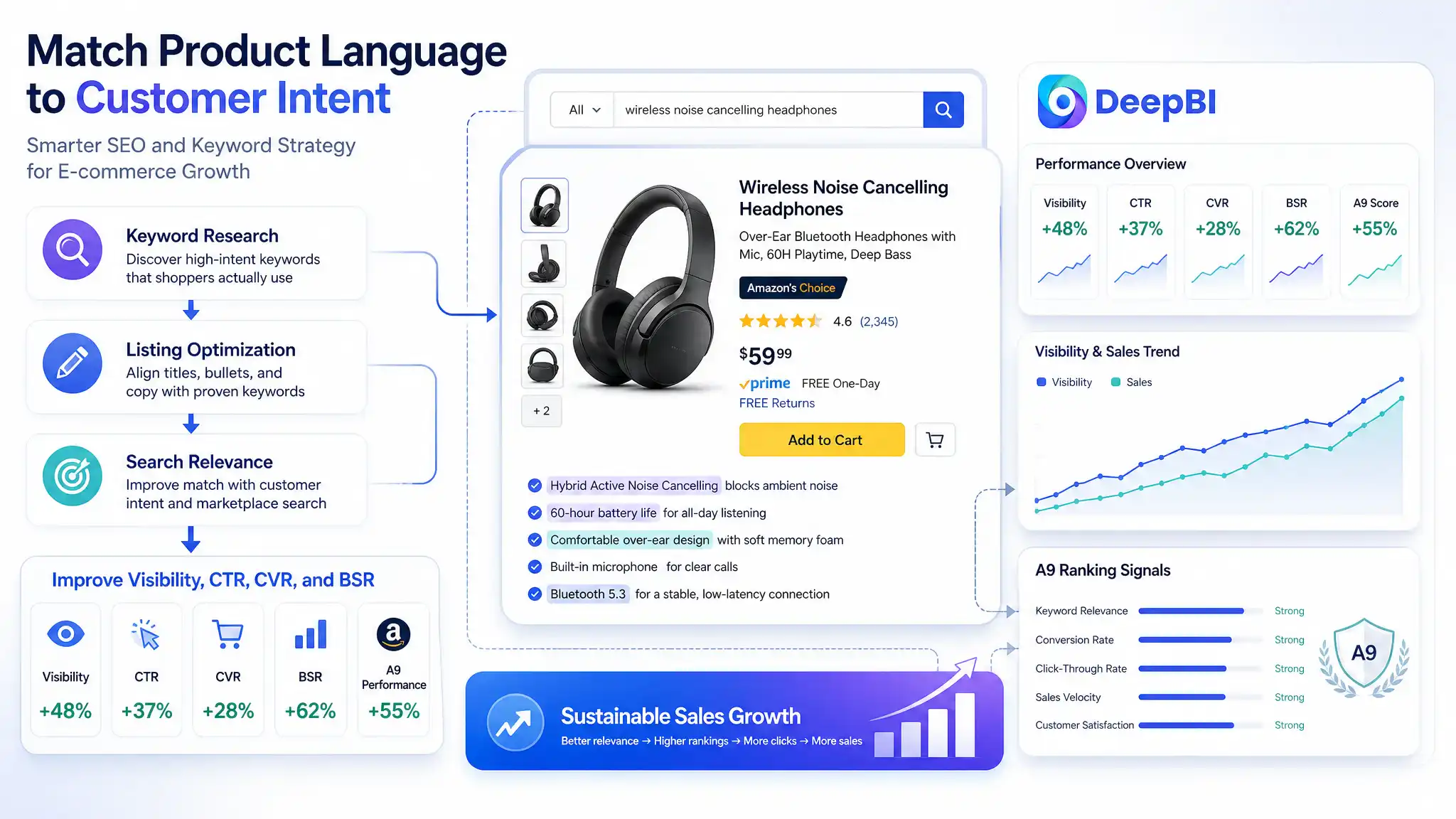
In the hyper-competitive Amazon marketplace, keywords are the essential link between customer intent and product discovery. They form the bridge connecting a shopper's search query to your product listing. Mastering Amazon Search Engine Optimization (SEO) is not about exploiting technical loopholes; it is the strategic science of aligning your product's language with the precise terms your target audience uses. A successful strategy ensures that when a customer searches, Amazon's A9 algorithm recognizes your product as a highly relevant solution, placing it prominently in the search results.
The connection between a sophisticated keyword strategy and business growth is both direct and measurable. Ranking for high-intent keywords drives visibility, which in turn boosts your Click-Through Rate (CTR). This influx of qualified traffic—shoppers actively seeking what you sell—naturally leads to a higher Conversion Rate (CVR). This virtuous cycle fuels sales velocity, improves your Best Sellers Rank (BSR), and builds a foundation for sustainable organic growth.
Industry studies suggest that improving Amazon search ranking can significantly increase sales. For instance, moving from the top of page two to the bottom of page one might yield an 84% sales increase, while securing the top spot could boost sales by over 150%. However, actual results vary greatly depending on the product, category, and competitive landscape. This guide provides a systematic framework for discovering, prioritizing, and implementing the keywords that matter most. We will explore how to leverage advanced analytics tools like DeepBI to transform complex data into an actionable optimization strategy, ensuring your products capture the visibility they deserve.
 The Foundational Role of Keywords in Amazon's Algorithm
To effectively optimize your listings, it is crucial to understand how Amazon's A9/A10 algorithm interprets and prioritizes keywords. This algorithm does not simply match words; it analyzes customer behavior to determine which products are most likely to result in a purchase. Mastering this system begins with grasping two core concepts: the difference between being indexed and being ranked, and the powerful role of sales performance.
Understanding Indexing vs. Ranking
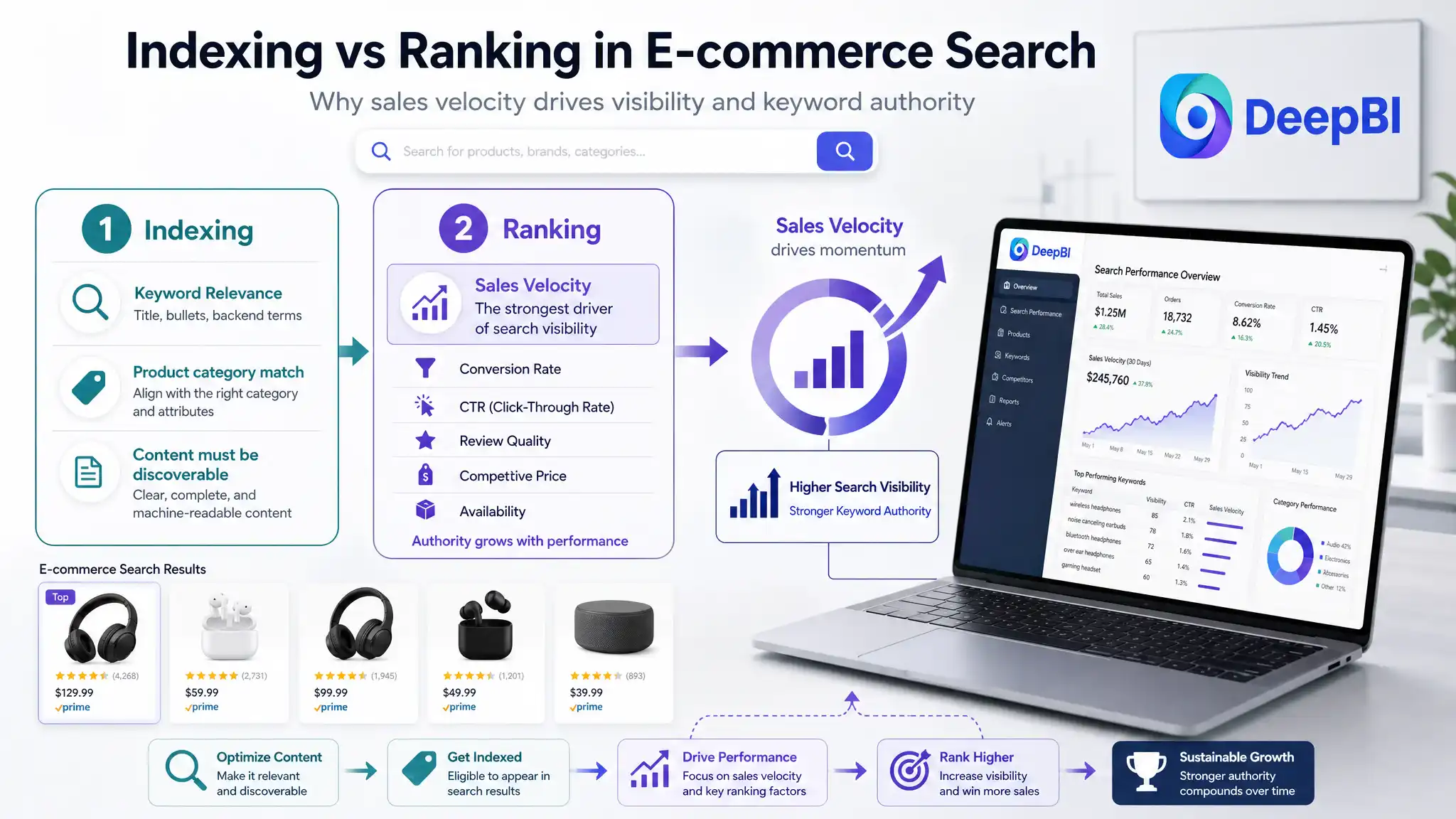
First, it is essential to distinguish between indexing and ranking. Indexing is the process where Amazon's algorithm scans your product listing—including the title, bullet points, backend search terms, and description—and associates it with specific keywords. If your product is indexed for a term like "ergonomic office chair," it becomes eligible to appear in the search results for that query.
Ranking, however, is the competitive dimension that determines your product's position on the search results page. While indexing allows you to enter the race, ranking decides your starting position. A product can be indexed for hundreds of keywords but will only rank highly for the select few that demonstrate strong performance metrics.
Sales Velocity: The Ultimate Keyword Amplifier
The single most influential factor in Amazon's ranking algorithm is sales velocity. As a conversion-driven marketplace, Amazon's algorithm is designed to reward products that sell effectively. When a customer searches for a keyword, clicks on your product, and completes a purchase, it sends a powerful signal to Amazon that your listing is a relevant and compelling match for that query.
The more sales you generate through a specific keyword, the more authority your product gains for that term. This creates a powerful feedback loop: higher sales lead to a better organic rank, which increases visibility, driving even more traffic and potential sales. This is why a targeted keyword strategy is not just about discoverability; it is about proving your product's conversion power to Amazon's algorithm.
 Strategic Keyword Research: Uncovering High-Impact Terms
Effective keyword research is the foundation of organic ranking success on Amazon. This process involves more than just finding high-volume terms; it requires a deep understanding of the customer journey to align your listing with specific search behaviors.
Identifying Buyer Intent and Search Volume
The core of a successful keyword strategy is decoding buyer intent. A customer searching for "bottle" has broad, undefined needs. In contrast, a search for "kids water bottle with straw" signals a specific, high-intent user who is much closer to making a purchase. Your goal is to capture this qualified traffic. While high search volume indicates market demand, it is the combination of volume and specific intent that drives conversions. Prioritizing keywords that reflect a clear need ensures your product appears before shoppers who are ready to buy.
Leveraging Competitor Insights
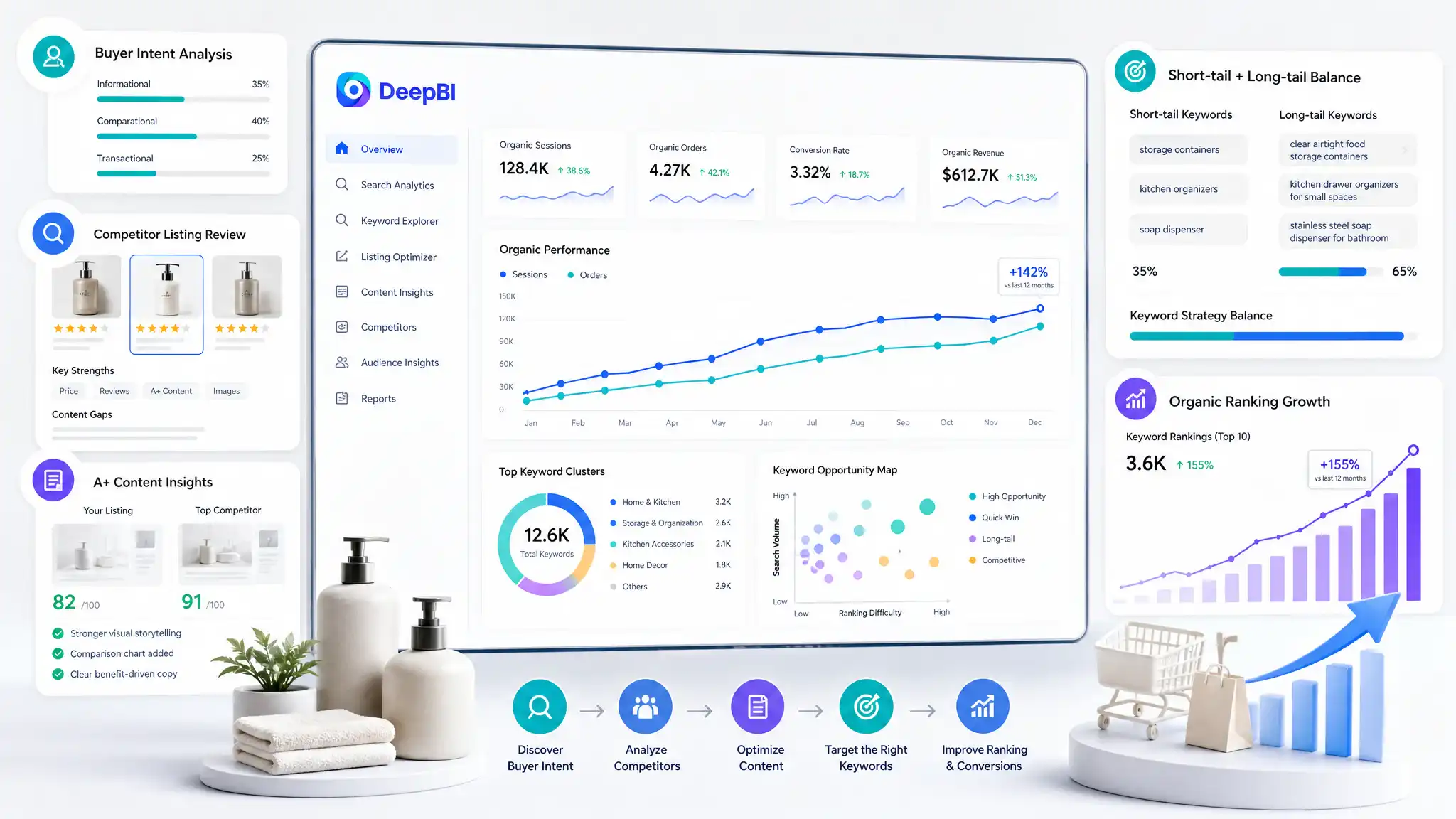
Your top competitors are a valuable source of keyword intelligence. Manually analyze their product titles, bullet points, and A+ Content to identify the core terms they are targeting. For a more advanced analysis, observe their sponsored ad placements to reverse-engineer which keywords they are willing to invest in, as this often indicates high-performing terms. DeepBI enhances this process through multi-dimensional semantic analysis, allowing you to systematically benchmark your keyword set against top-ranking competitors and uncover strategic gaps you can exploit.
Long-Tail vs. Short-Tail Keywords
A successful keyword strategy balances broad (short-tail) and specific (long-tail) terms.
- Short-tail keywords (e.g., "water bottle") have massive search volume but are highly competitive and often have lower conversion rates (CVR).
- Long-tail keywords (e.g., "insulated stainless steel water bottle 32 oz") have lower search volume but capture highly specific user intent, resulting in significantly better CVR.
DeepBI helps you master this balance by analyzing your advertising data. The platform can filter and identify keywords that already demonstrate high CTR, CVR, and order values, providing a data-driven roadmap for which long-tail terms to prioritize in your organic optimization efforts.
 Optimizing Your Amazon Listing with Keywords
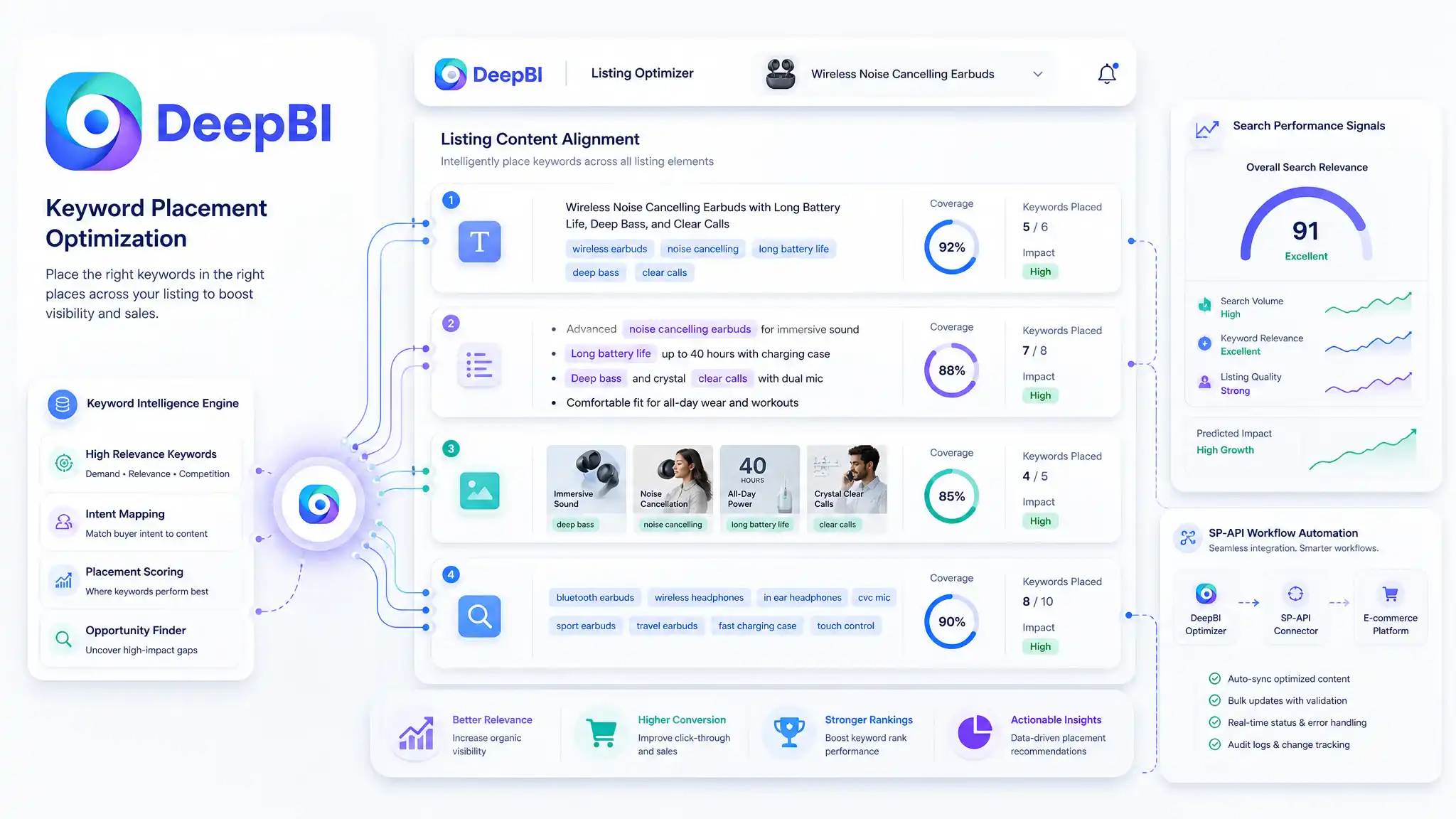
Once you have compiled a robust keyword list, the next critical step is strategic placement within your product listing. Each section of the listing serves a different purpose for both Amazon's A9 algorithm and your potential customers. Misplacing keywords can dilute their impact, hurting both your search visibility and conversion rate.
Keyword Placement in Titles and Bullet Points
The product title is the most heavily weighted field for keyword relevance. You should prioritize your most important, high-volume keywords at the beginning of the title to maximize their SEO impact and improve click-through rates (CTR) from the search results page.
The bullet points are your next most important asset for keyword integration. They should be crafted to sell the product's key features and benefits while naturally incorporating secondary and long-tail keywords. This dual approach satisfies the algorithm's need for relevant terms and the customer's need for compelling information, directly influencing CVR.
Maximizing Backend Search Terms
The backend search term fields are a powerful tool for keywords that do not fit aesthetically or logically into your visible listing content. This is the ideal place for synonyms, common misspellings, and other relevant search queries you want to be indexed for. Utilize all available space in these fields to cast the widest possible net without cluttering your customer-facing copy.
Enhancing Product Descriptions and A+ Content
While the title and backend terms carry significant SEO weight, the product description and A+ Content are crucial for conversion. For Brand Registered sellers, A+ Content offers a rich canvas to tell your brand story and detail product benefits, incorporating keywords in a narrative context. Higher customer engagement and an improved CVR send strong positive signals to Amazon's algorithm, indirectly boosting your organic rank over time.
Traditional listing optimization often involves a disconnected and inefficient workflow. DeepBI streamlines this entire process into a closed-loop system. The platform’s AI systematically generates optimized titles, bullet points, and A+ Content, ensuring ideal keyword integration. This system connects diagnosis to delivery, culminating in a one-click application via the official Amazon SP-API that reduces content update times from minutes to seconds.
 The Synergy: Keywords, Sales Velocity, and DeepBI's Ad Strategies
Understanding the relationship between paid advertising, sales, and organic ranking is fundamental to success on Amazon. These elements work together in a powerful cycle, where strategic investment in one area directly accelerates growth in another. By managing this synergy, sellers can create a sustainable growth engine for their products.
How PPC Campaigns Influence Organic Keyword Ranking
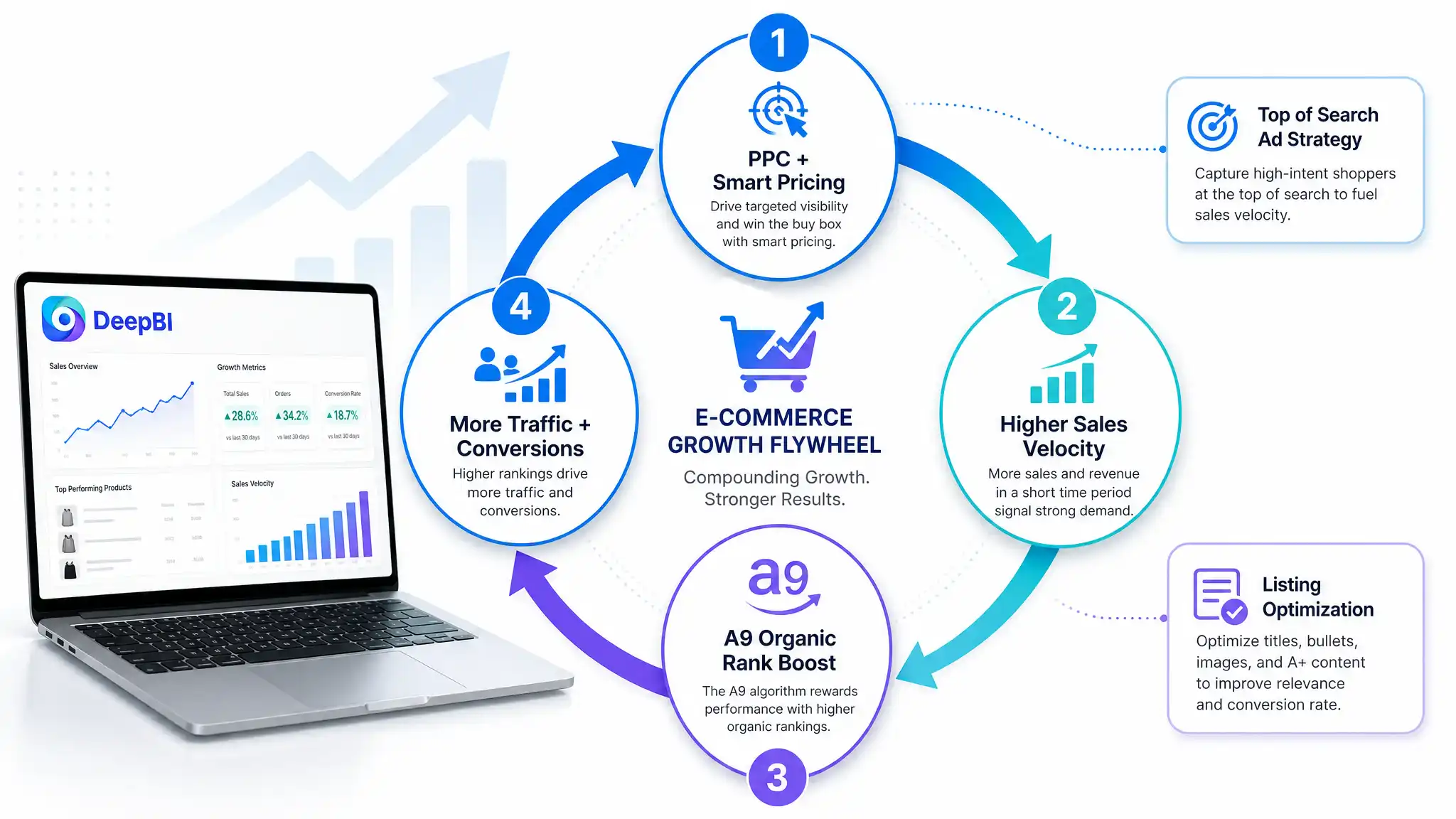
A common misconception is that Pay-Per-Click (PPC) advertising directly improves organic rank. The actual mechanism is more nuanced. PPC campaigns drive targeted traffic to your listing. When this traffic converts into sales for specific keywords, it signals to Amazon's A9 algorithm that your product is highly relevant for those search terms. This demonstrated relevance, proven through sales velocity, is what ultimately improves your organic ranking. This process, however, only works if your listing is already optimized for conversion; PPC can deliver traffic, but a weak listing will not secure the sales needed to influence rank.
The Sales Velocity Loop: A Continuous Growth Cycle
The interplay between paid traffic and organic visibility creates a self-reinforcing cycle. It begins with PPC campaigns driving initial sales, which boosts your organic ranking for targeted keywords. As your organic rank improves, you gain more visibility, leading to more organic clicks and sales. This increase in organic sales further enhances your overall sales velocity, reinforcing your product's relevance and pushing its rank even higher. This self-sustaining momentum, often called the "flywheel effect," is the key to long-term, profitable growth.
Strategic Pricing and Promotions for Keyword Impact
To initiate the sales velocity loop, especially for a new product, a strategic approach to pricing is essential. During the initial launch phase, consider adopting a competitive low-price strategy, such as offering significant discounts, to quickly accumulate sales. The specific discount should be set flexibly based on your product costs, target profit, market competition, and brand positioning. This initial surge in sales, amplified by targeted ad campaigns, provides the critical data Amazon's algorithm needs to begin ranking your product. DeepBI's ad strategies, which leverage a "Top of Search" focus for high-value keywords, are designed to maximize the impact of this initial velocity and build sustainable ranking momentum.
 Monitoring, Adapting, and Sustaining Keyword Performance
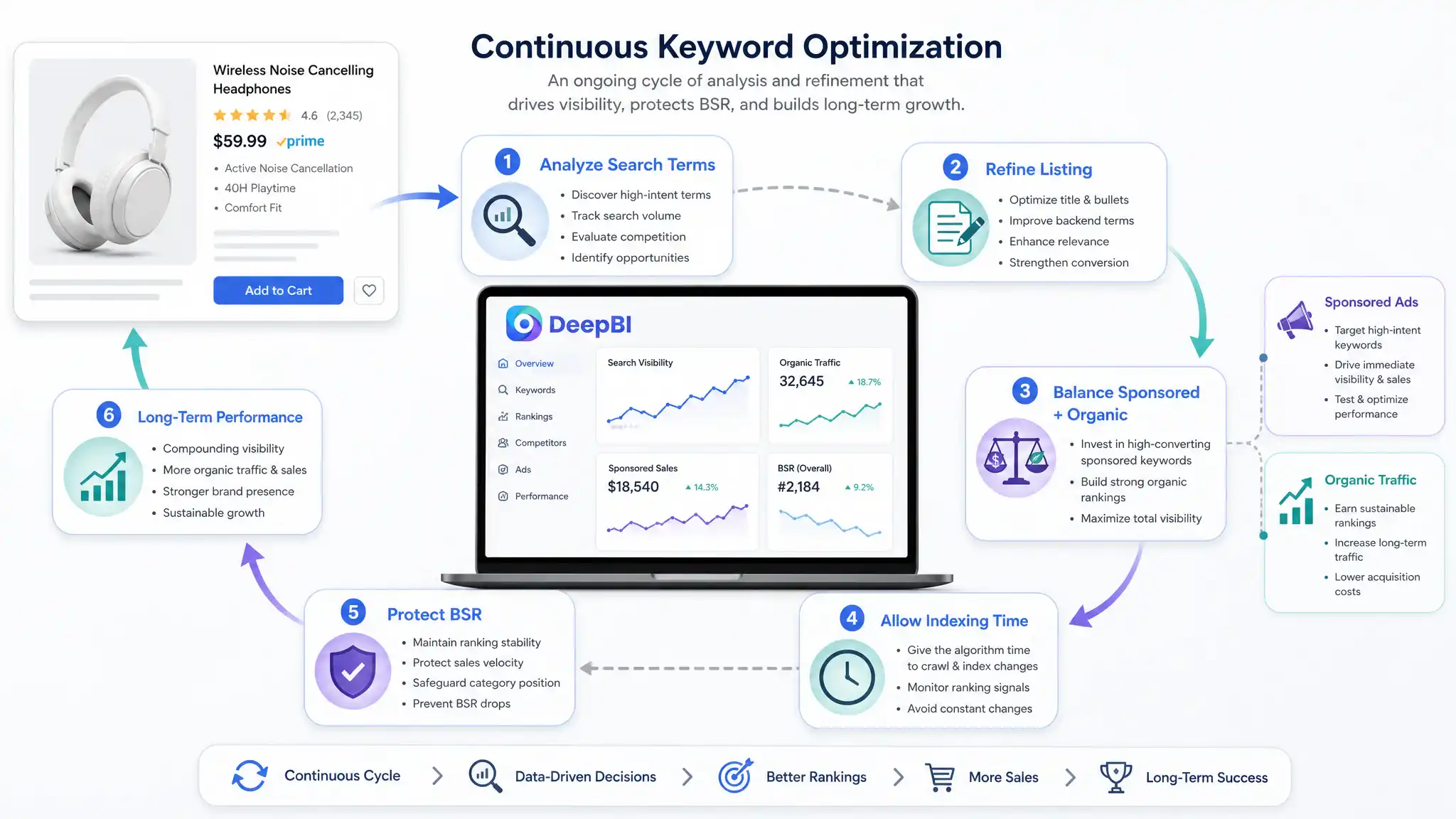
Keyword optimization is not a one-time task but a continuous cycle of analysis and refinement. Sustaining high organic rankings requires a long-term perspective, patience, and a commitment to data-driven adjustments.
The Timeline of Keyword Changes: What to Expect
After updating your listing's keywords, results are not instantaneous. It is crucial to understand the typical timeline to avoid making premature adjustments. Amazon's algorithm generally takes between 7 to 21 days to fully index new keywords and re-evaluate your product's relevance. During this initial period, you can expect ranking fluctuations as the system processes the changes.
Think of keyword optimization as a snowball, not a light switch. The effects are gradual and cumulative, building momentum over time as sales velocity and conversion rates on those keywords continuously signal relevance to Amazon.
Continuous Analysis and Iteration
The Amazon marketplace is dynamic, with customer search behavior, competitor strategies, and the algorithm itself constantly evolving. To maintain and improve your keyword performance, you must regularly review performance data. This involves tracking your rank for target keywords, analyzing sales reports to identify which terms are driving conversions, and monitoring competitor activity. This iterative process of monitoring, analyzing, and refining your strategy is essential for long-term success and protecting your Best Seller Rank (BSR).
Balancing Sponsored and Organic Keywords
Achieving a balance between sponsored and organic keywords is crucial for listing health. While some sellers find a ratio of one sponsored keyword to two organic keywords effective, the optimal mix varies by product, market, and competition. Sellers should continuously analyze data to find the best strategy for their listings. Paid campaigns provide valuable data on keyword conversion rates and drive initial sales velocity, which in turn can boost organic ranking for those same terms. This synergistic relationship allows you to use paid advertising to accelerate and inform your organic growth strategy.
 DeepBI: Your AI Partner for Amazon Keyword Mastery
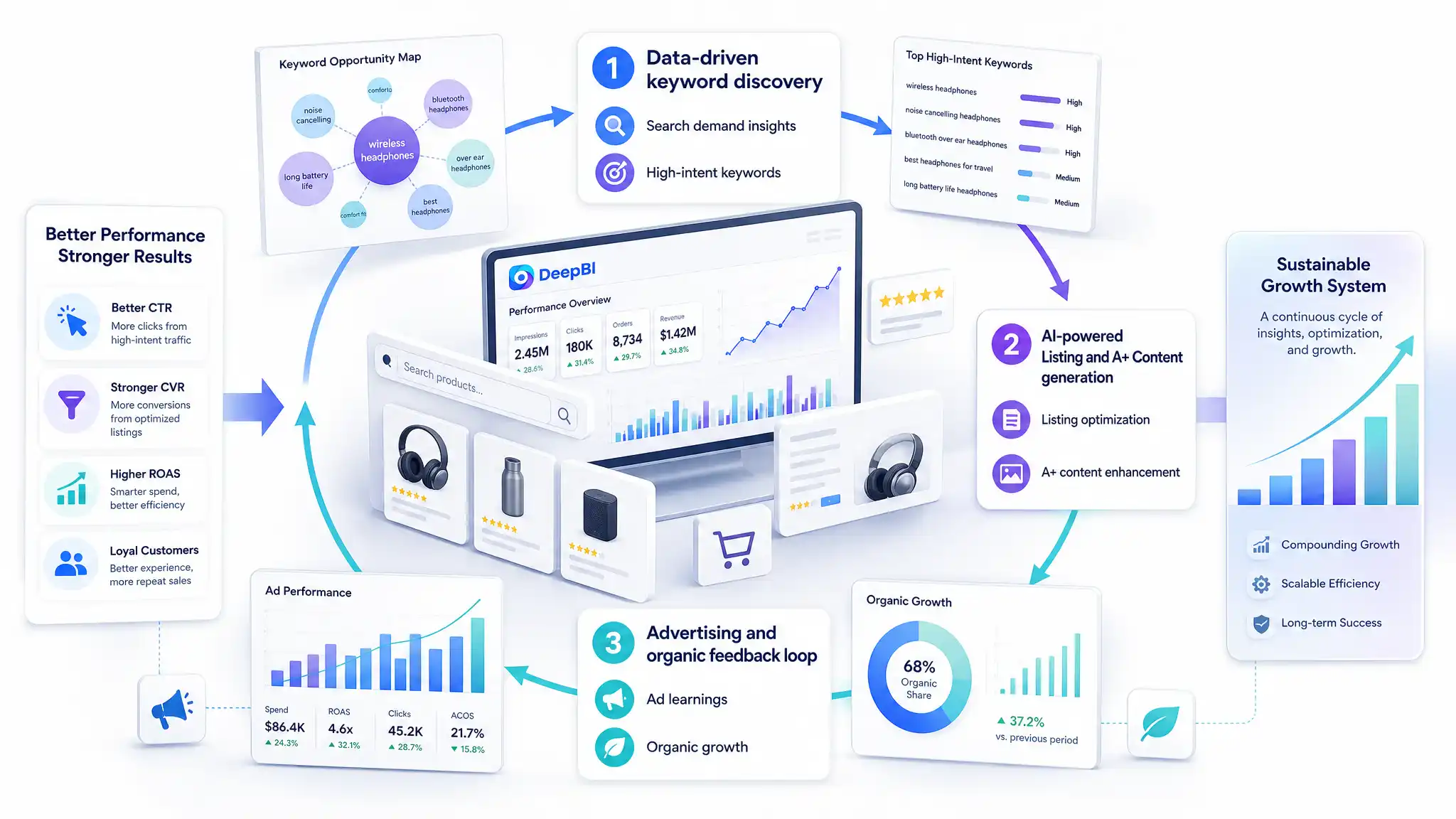
Mastering keywords requires an integrated system that connects data, content, and advertising. DeepBI provides this advantage by converting abstract strategies into precise, AI-executable instructions. It moves beyond simple tools to offer a comprehensive solution for achieving sustainable growth on Amazon.
Data-Driven Keyword Discovery and Optimization
An effective keyword strategy must be grounded in market reality, as any optimization detached from real benchmarks is a waste of resources. DeepBI functions as an "automated market health check system," not just a scoring tool. It uses rigorous data collection and a multimodal AI to identify high-value keywords based on actual market performance. This process moves beyond basic search volume to uncover terms with the highest potential to drive traffic and sales, providing a solid foundation for both your listing and advertising efforts.
AI-Powered Listing Content Generation
DeepBI translates data-driven keyword insights directly into high-converting listing content. The platform systematically generates optimized titles, bullet points, and descriptions designed to improve both Click-Through Rate (CTR) and Conversion Rate (CVR). For A+ Content, it deconstructs pages into six logical modules for targeted optimization, ensuring every element serves a strategic purpose. This AI-powered process eliminates the guesswork and subjective errors common in manual copywriting, ensuring your strategy is executed with precision.
Integrated Ad and Organic Strategy
DeepBI creates a powerful feedback loop between your paid advertising and organic ranking. It enables sellers to leverage ad campaign data to continuously refine listing content, including visual elements, for better CVR. By analyzing which keywords and creative approaches perform best in PPC, you can make informed adjustments to your organic strategy. This integrated approach builds a healthy growth model where advertising spend directly fuels organic visibility, creating a virtuous cycle of increasing traffic and sales.
 Conclusion
Dominating the Amazon marketplace begins and ends with a masterful keyword strategy. As we have explored, achieving high organic ranking is not a one-time setup but a continuous cycle of research, implementation, and refinement. In this competitive landscape, any optimization detached from real market benchmarks is ineffective. A scattershot approach to keywords will inevitably fall short, negatively impacting your Click-Through Rate (CTR), Conversion Rate (CVR), and ultimately, your Best Sellers Rank (BSR).
The path to success lies in a holistic strategy that integrates every facet of keyword management. This is where advanced platforms like DeepBI can transform your approach. It functions not as a simple scoring tool but as an automated market health check system. By leveraging AI-driven analysis and rigorous data collection, you can move beyond guesswork and implement a keyword strategy that is truly aligned with market dynamics. Embracing this data-centric methodology is the key to unlocking consistent visibility, improving conversion rates, and securing a sustainable competitive edge on Amazon.