The Foundation of Amazon Success: Why Listing Structure Matters
On Amazon, your product listing is far more than a digital product description; it is the central pillar of your entire sales funnel. Every dollar spent on advertising, every promotional campaign, and every external traffic source ultimately directs customers to this single page. Without a strong, conversion-focused listing structure, even the most effective marketing efforts will fail to deliver their full potential, leading to wasted ad spend and lost sales opportunities.
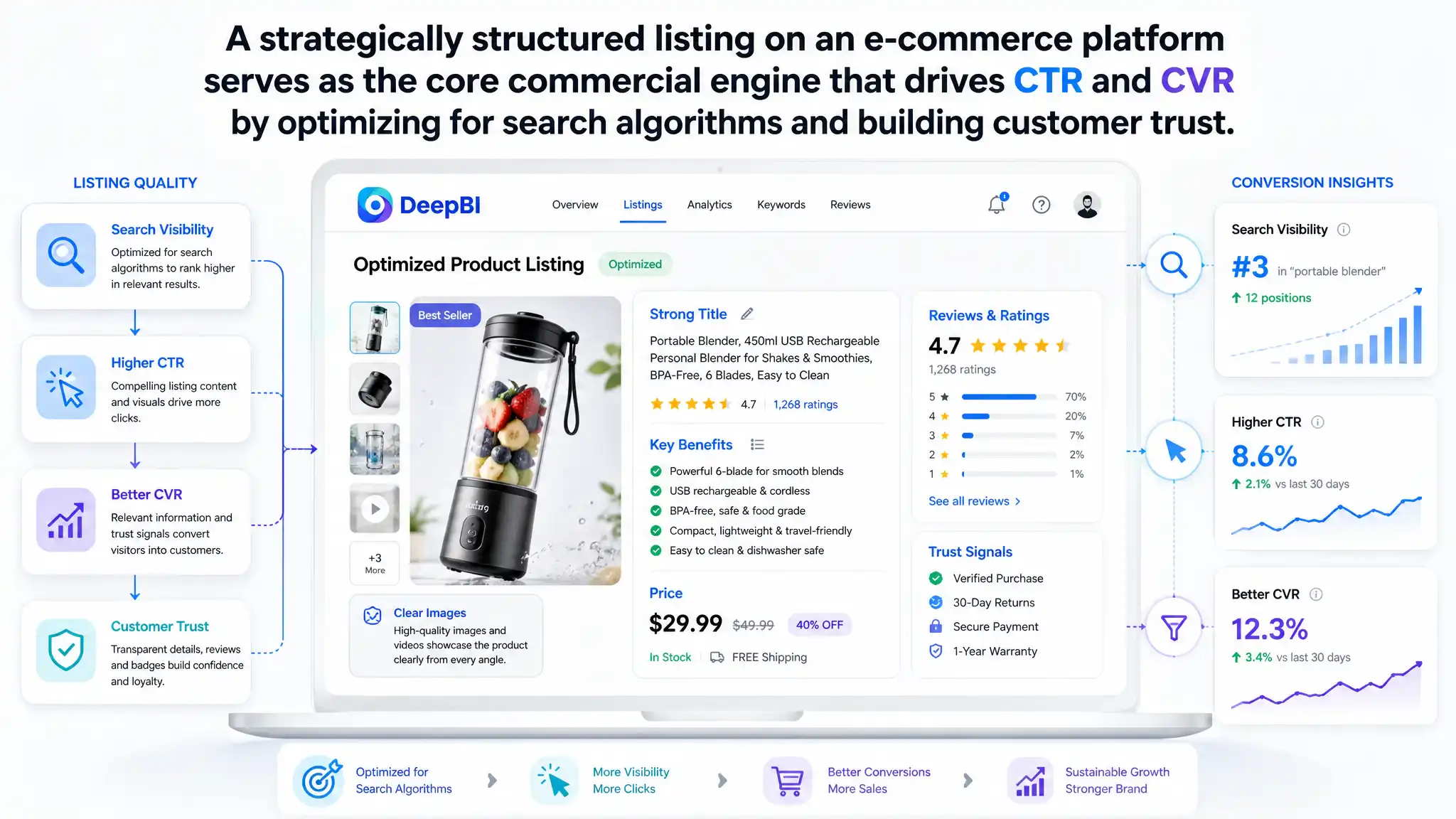
A well-structured listing serves two critical audiences simultaneously: Amazon's search algorithm and your potential customers. For the algorithm, a complete and compliant listing with relevant keywords is essential for discoverability and ranking. For customers, the quality of your listing directly shapes their perception of your product and brand. High-quality images, clear benefit-driven copy, and accurate product details build trust and confidence. Conversely, inconsistencies, such as a mismatch between images and the actual product, can quickly destroy that trust, leading to negative reviews and increased return rates.
Ultimately, the primary function of a listing is to convert browsers into buyers. Every element—from the title to the bullet points and visual assets—is a commercial tool designed to drive clicks (CTR) and conversions (CVR). A strategically optimized structure transforms your listing from a simple information display into a core commercial engine, ensuring that the traffic you work so hard to acquire has the highest possible chance of turning into revenue.
 Key Components of an Optimized Amazon Listing Structure
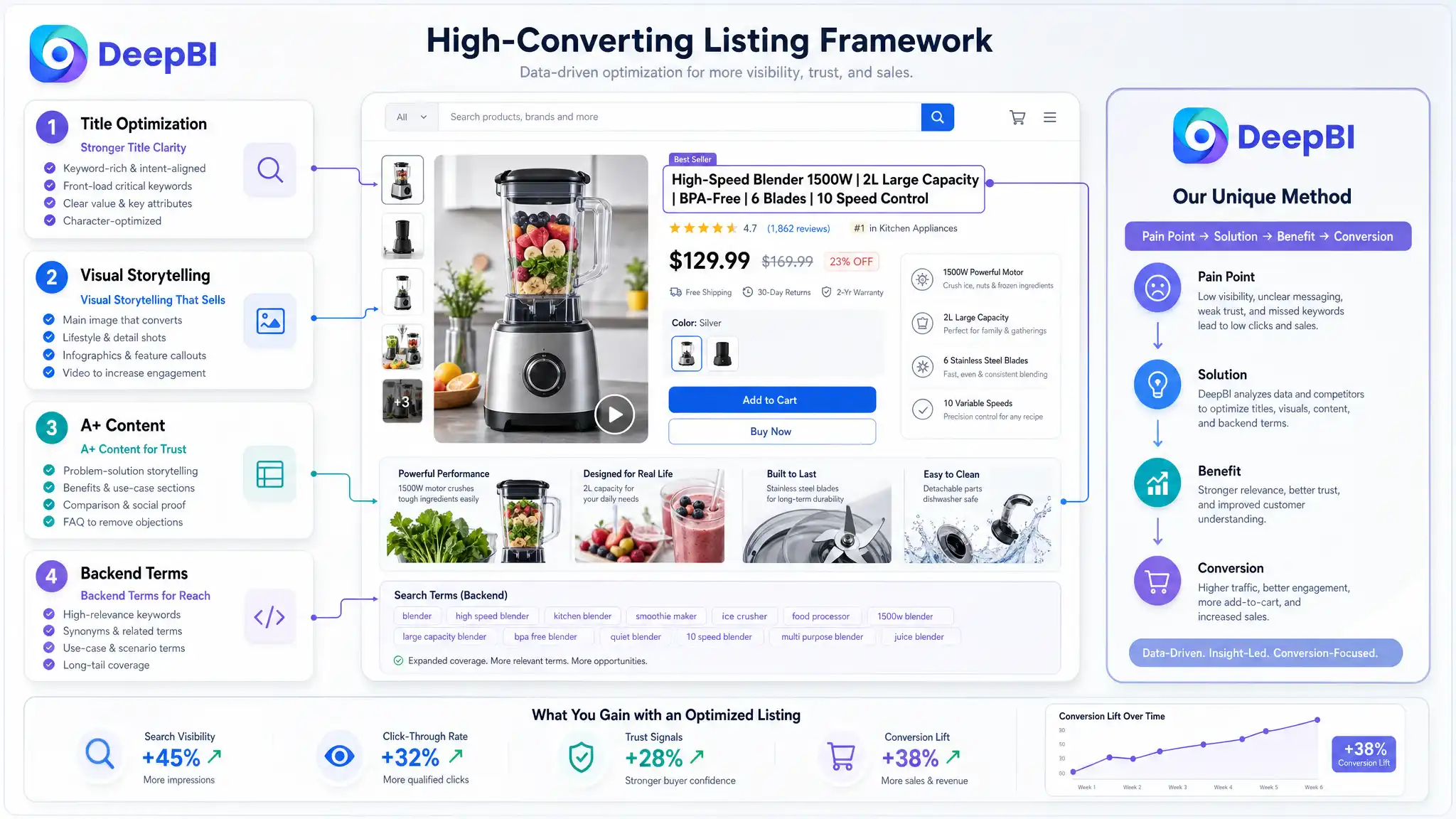
A high-converting Amazon listing is not a single block of text but a structured ecosystem of components, each playing a distinct role in attracting, engaging, and converting customers. Optimizing this structure requires a systematic approach that addresses every customer touchpoint, from initial discovery to the final purchase decision.
Compelling Product Title: Your First Impression
The product title is the single most important element for click-through rate (CTR). It must seamlessly integrate high-volume keywords for discoverability while clearly communicating the product's core function, key features, and brand. An effective title balances SEO requirements with human readability, making an instant, compelling case for why a shopper should click.
Engaging Bullet Points: Highlighting Core Benefits
Once a shopper clicks, the bullet points are their next stop. These must be scannable, impactful, and benefit-driven. Instead of just listing features, they should be structured to address customer pain points directly and present the product as the ideal solution. DeepBI helps restructure these points into a "pain point-solution" closed-loop, transforming a simple feature list into a persuasive sales argument that drives conversion.
High-Quality Product Images and Videos: Visual Storytelling
Visuals are paramount on Amazon. A mix of high-resolution primary images, lifestyle shots, and infographics tells a story that text alone cannot. However, using general-purpose AI for image creation introduces the risk of "hallucinations"—generating visuals that don't match the physical product, leading to negative reviews and returns. A professional system mitigates this by establishing a "Product DNA" as a hard constraint, ensuring all generated visuals are authentic and commercially safe.
Detailed Product Description and A+ Content: Deep Dive into Value
The product description and A+ Content modules are where you build brand trust and provide in-depth information. This space allows for rich storytelling, detailed feature breakdowns, and brand comparisons. AI-driven optimization deconstructs A+ pages into logical modules, ensuring a clear narrative flow that guides the customer through the product's value proposition, ultimately boosting confidence and conversion rates.
Backend Search Terms: Invisible but Powerful
While invisible to the customer, backend search terms are a critical driver of traffic. These keywords allow your product to be discovered for a wide range of relevant search queries that may not fit naturally into the title or bullet points. Leveraging AI for keyword research ensures you maximize discoverability by identifying and including relevant long-tail keywords and synonyms, capturing valuable traffic without compromising the readability of your visible listing content.
 Leveraging DeepBI for Listing Structure Optimization
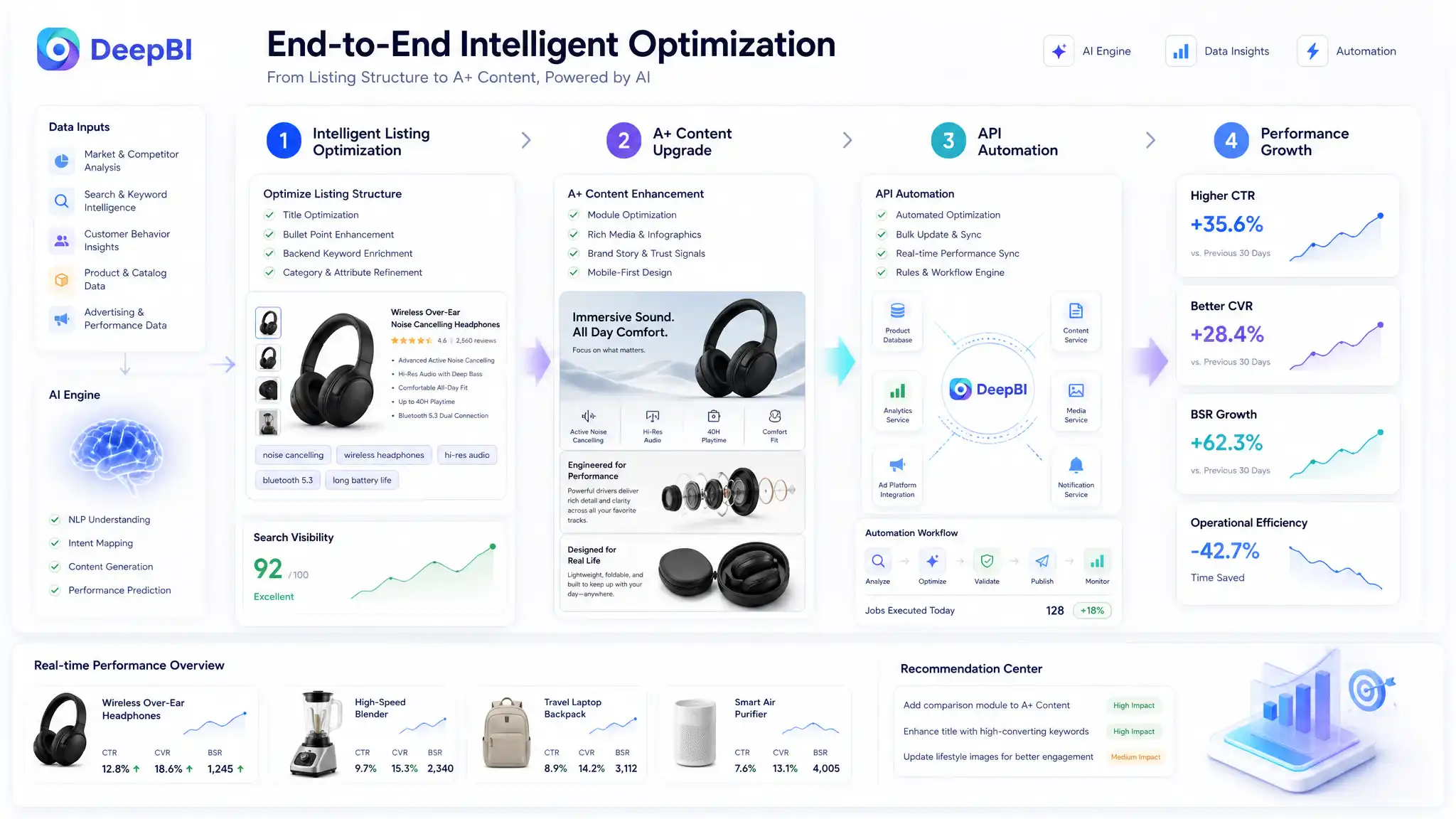
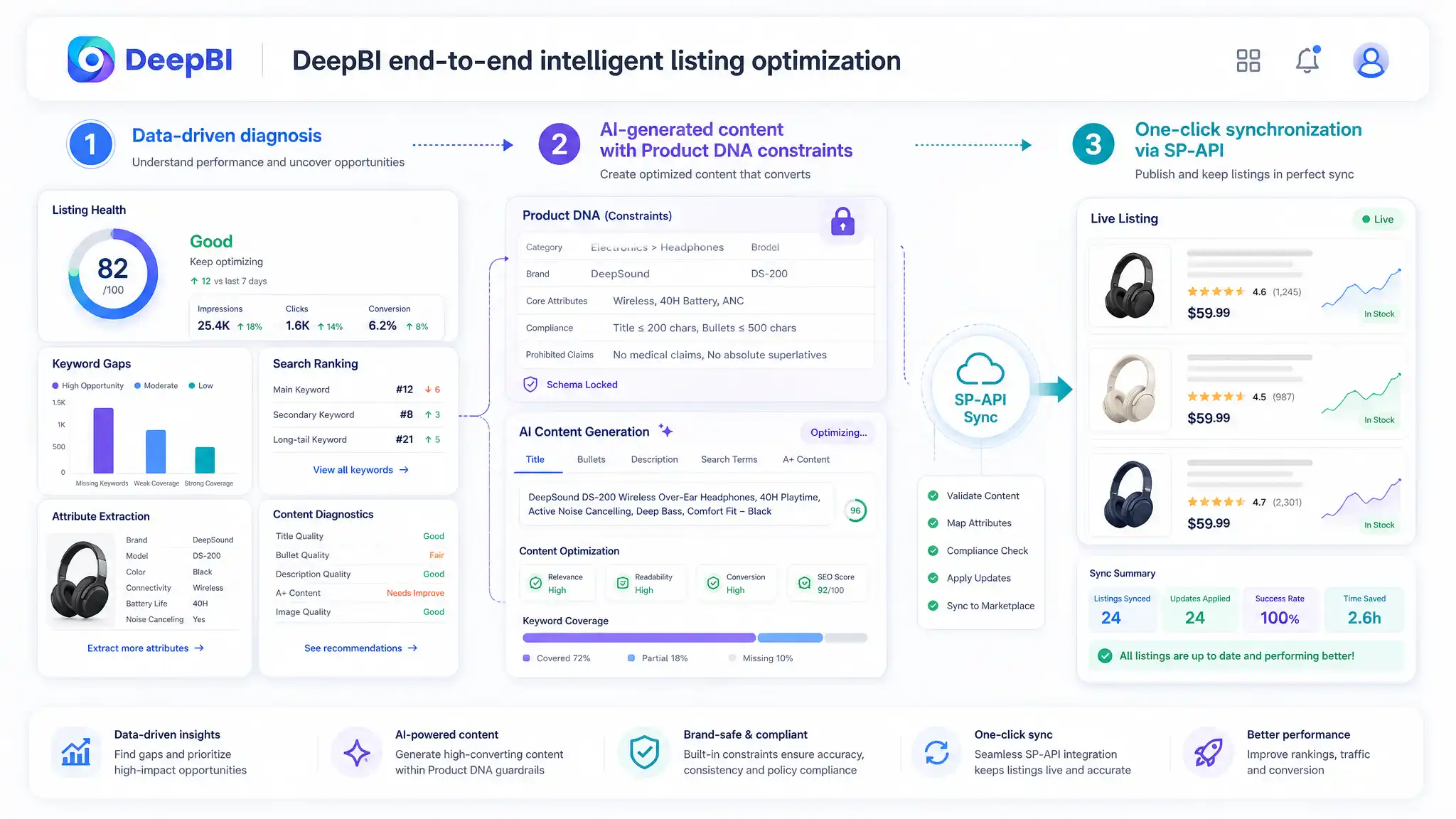
DeepBI provides an end-to-end intelligent system that transforms how sellers approach listing optimization, moving from guesswork to a data-driven production workflow. The process begins with an automated market health check, where the platform’s intelligent scoring and diagnosis engine uses distributed data capture and multi-dimensional semantic analysis. It screens massive numbers of ASINs to identify top-performing competitors, establishing a clear benchmark and outputting precise scores for each listing component to pinpoint specific weaknesses.
Once optimization targets are clear, DeepBI’s multi-agent system translates the diagnostic data into a structured, executable strategy. This strategy acts as a blueprint for the AI generation engine, which creates all necessary content, including main images, A+ content, titles, and bullet points. To prevent the "product-image mismatch" common with general-purpose AI, DeepBI establishes a "Product DNA" map for each item. This serves as a hard constraint, ensuring all generated visuals are authentic to the physical product and mitigating post-sale risks like negative reviews and returns.
Finally, DeepBI closes the loop by eliminating deployment friction. Instead of a manual upload process that can take over 30 minutes, the platform uses the official Amazon SP-API for one-click synchronization. This allows all optimized content to be applied to your listing in seconds, dramatically shortening the listing cycle time and ensuring a seamless transition from analysis to launch.
 Measuring and Iterating: The Continuous Optimization Loop
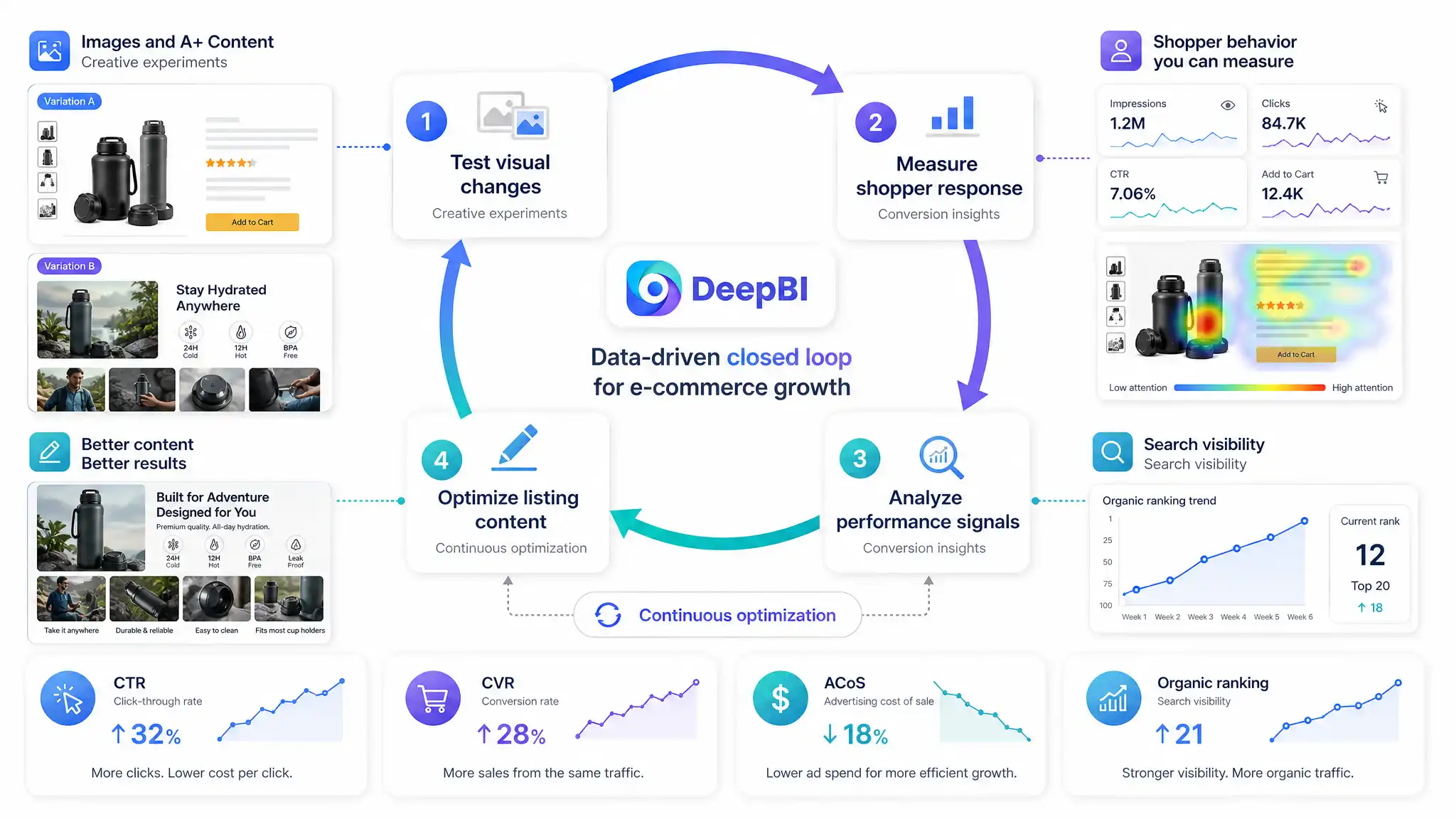
Optimizing your Amazon listing is not a one-time fix but a continuous cycle of refinement. The greatest challenge has always been moving beyond subjective judgment to quantify the real-world impact of visual changes. Without a clear feedback mechanism, it's difficult to know if a new main image or A+ Content module is actually improving performance.
DeepBI solves this by creating a data-driven closed loop. When you publish a new visual asset through the platform, the system automatically tags a "visual iteration event point" in your advertising reports. This allows you to directly observe the impact on your Click-Through Rate (CTR) in the days and weeks following the update, transforming a guess into a measurable outcome.
This data has a powerful cascading effect on your business. A higher CTR directly improves the efficiency of your ad campaigns, leading to a lower Advertising Cost of Sale (ACoS) and better returns. As more relevant traffic visits your page and converts—improving your Conversion Rate (CVR)—Amazon’s algorithm recognizes your product’s increased popularity. This can lead to a higher organic search ranking, driving more natural orders and improving your total profitability. This iterative process of analysis, optimization, and re-evaluation ensures your listing is always evolving toward peak performance.
 Conclusion: Drive Higher Conversions with a Strategic Listing Structure
In today's competitive Amazon marketplace, a meticulously optimized listing structure is not merely an advantage—it is the engine of conversion. The strategic arrangement of titles, bullets, images, and A+ Content directly impacts critical performance indicators, from Click-Through Rate (CTR) to Conversion Rate (CVR) and ultimately, your Best Seller Rank (BSR). Moving beyond guesswork and manual adjustments is essential for sustainable growth.
Tools like DeepBI are redefining this process by creating an end-to-end intelligent optimization system. This approach breaks down the traditional silos between diagnosing issues, planning improvements, producing content, and deploying updates. Instead of vague suggestions, the system provides precise, AI-executable instructions that ensure every change is purposeful and data-driven.
The operational impact is transformative. By leveraging direct API integration, processes that once took over 30 minutes of manual effort, such as uploading and arranging images, can be completed in seconds. This radical reduction in listing cycle time not only boosts team efficiency but also enables sellers to react faster to market trends and competitor movements. By embracing a strategic, instruction-based approach to listing optimization, you can unlock your product's full potential and build a durable competitive edge.