Introduction: Why A+ Content is Your Amazon Growth Engine
In the hyper-competitive Amazon marketplace, simply having a product listed is no longer enough. A+ Content has evolved from a premium feature to a baseline requirement for any brand serious about growth. It serves as your digital storefront, offering a critical opportunity to tell your brand story, showcase product value, and build a direct connection with potential buyers. For sellers aiming to stand out, A+ Content is not an option—it's the foundation of a competitive product detail page.
In practice, many brands still underestimate this. A personal care brand we worked with had a promising sulfate-free body wash in a high-potential “clean beauty” niche. Internally, they kept repeating, “We just need more reviews and a higher rating.” But when we benchmarked their listing against a household-name competitor, the real issue was blunt: the competitor had a fully built A+ story; they had almost nothing beneath the bullets. Shoppers weren’t just comparing star ratings—they were comparing how complete and convincing each product page felt.
The strategic value of well-executed A+ Content translates directly into measurable business outcomes. By combining high-resolution imagery, detailed product comparisons, and compelling brand narratives, it addresses customer questions and overcomes purchase hesitation, leading to a significant lift in Conversion Rate (CVR). This enhanced experience builds customer trust and reinforces brand identity, turning one-time buyers into loyal advocates and improving overall brand visibility on the platform.
This shift requires a new perspective: visual assets, especially A+ pages, are no longer just for “aesthetic display.” They are a “core commercial engine” designed to drive conversions and fuel sales growth. The challenge, however, lies in consistently creating and optimizing content that performs. Guesswork and intuition are unreliable when millions in revenue are at stake. In the body wash case, the team had been trying to “fix” reviews and run more promos, essentially paying to send more traffic into an underbuilt page—before the data forced them to confront that structural weakness.
This guide provides a comprehensive, data-driven framework for mastering A+ Content. We will walk you through an end-to-end process—from initial diagnosis and strategic planning to content production and deployment—powered by the intelligent optimization capabilities of DeepBI. By the end, you will have an actionable blueprint to transform your A+ Content from a static page into a dynamic, high-performing growth engine for your Amazon business.
 Understanding Amazon A+ Content: Basics and Beyond
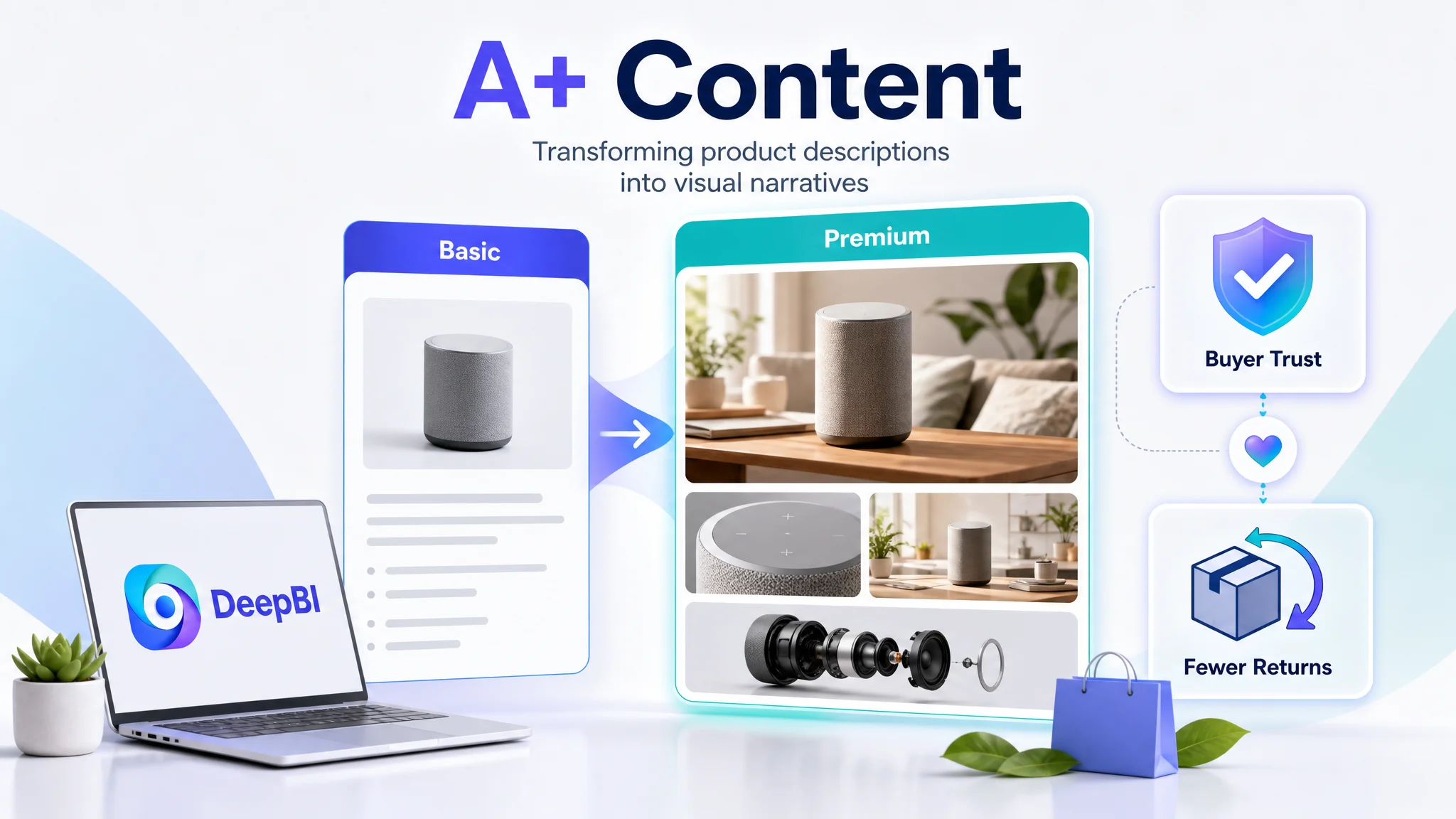
Amazon A+ Content is a powerful feature available to brand-registered sellers, allowing them to transform standard text-based product descriptions into visually rich, compelling narratives. Instead of a simple block of text, A+ Content uses high-quality images, comparison charts, and structured layouts to tell a brand's story, highlight unique value propositions, and showcase products in detail. This enhanced content lives on the product detail page, helping to capture customer attention and drive engagement.
In categories with strong incumbents, the difference between “with A+” and “without A+” is especially visible. In the body wash example, the category leader used its detail page to walk shoppers through benefits, technology, safety, and values in a clear sequence. The challenger’s page ended after bullets and reviews. Functionally, they were competing with half a page against a full decision journey—and losing.
Sellers can leverage two distinct tiers: Basic and Premium A+ Content.
- Basic A+ Content is the standard offering for all Brand Registry members. It allows for up to five modules, combining images and text to provide more detail than a standard description. According to Amazon, implementing Basic A+ Content can increase sales by an average of up to 8%.
- Premium A+ Content is an advanced, invitation-only tier for sellers who meet specific eligibility criteria. It unlocks more powerful features, including full-width imagery, video modules, interactive hotspots, and enhanced comparison charts. The impact is also greater, with Amazon data showing it can boost conversion rates by up to 20%.
Beyond direct sales lifts, well-executed A+ Content builds buyer confidence by answering questions visually and preemptively, which can significantly reduce product return rates. In the personal care case, the benchmark competitor used A+ modules to address sensitive-skin concerns, “free-from” claims, and ethical positioning in a way that reduced the need for shoppers to dig through reviews. Understanding the capabilities and performance potential of each tier is crucial for making informed decisions about your brand's content strategy and investment on the platform.
 Strategic Pillars of A+ Content Optimization
Effective A+ Content is built on four key pillars that work together to inform, persuade, and convert shoppers. Mastering these elements transforms your product detail page from a simple listing into a powerful sales tool that enhances brand equity and drives measurable growth in conversion rates (CVR).
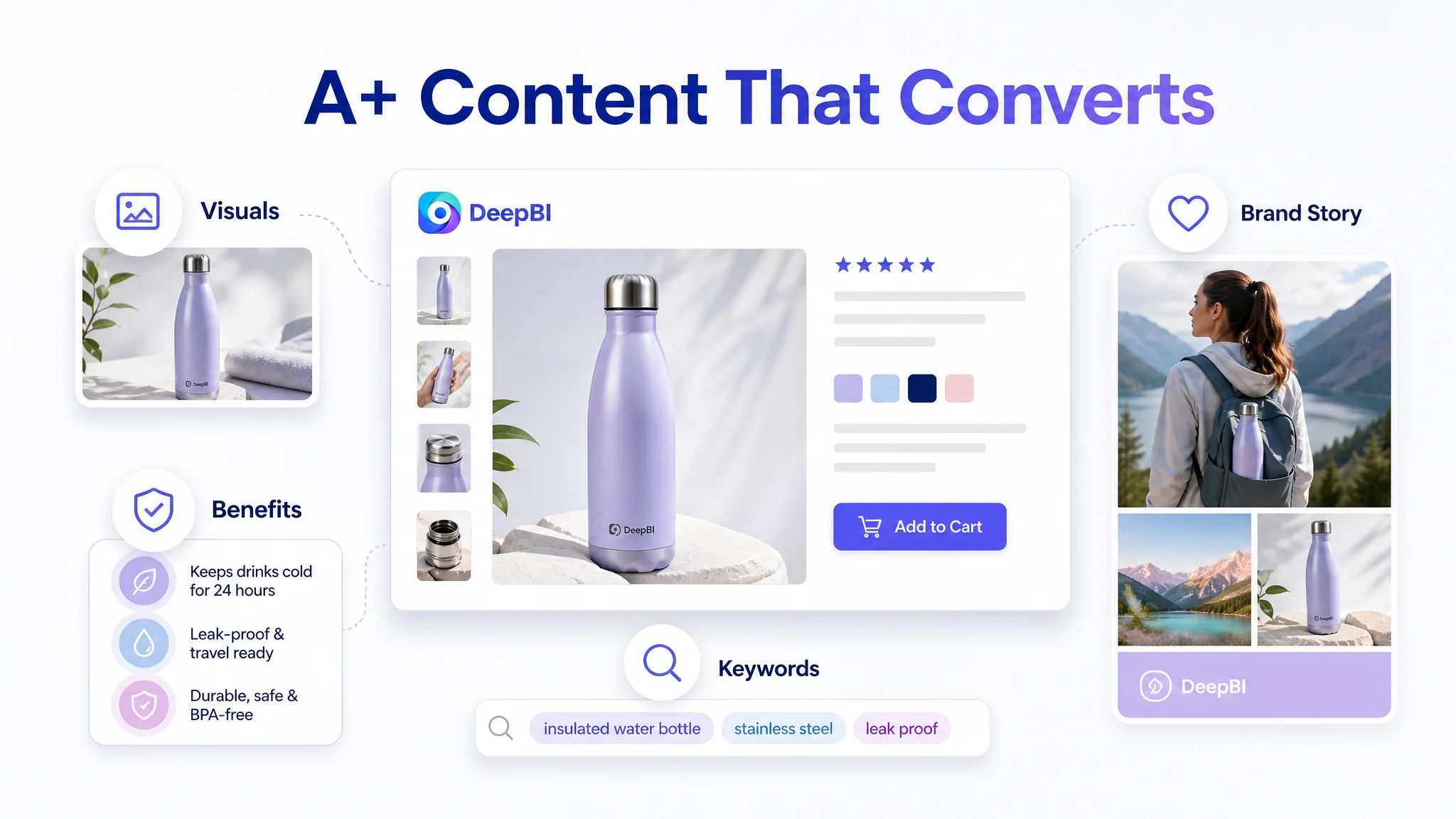
High-Quality Visuals
High-resolution images and videos are directly correlated with higher sales lift. Go beyond standard product shots by using lifestyle images to show your product in real-world scenarios and infographics to break down complex features into easily digestible benefits. Visuals must be authentic to the product; any discrepancy between the image and the actual item can lead to negative reviews and returns. This is why ensuring product authenticity, or “Product DNA,” is the ultimate constraint for any visual content, guaranteeing that what the customer sees is what they get.
When we audited the body wash listing, the main images weren’t “bad”—they just underperformed the benchmark on information density and trust signals. The competitor’s gallery integrated foam texture, award badges, and ingredient storytelling into its visuals. The challenger mostly “showed the bottle.” On paper, the image score gap looked small. In reality, the richer gallery made the benchmark feel more complete and professional, and the missing texture/benefit visuals on the challenger’s side forced buyers to work harder to imagine how the product actually felt and performed.
Compelling Copywriting
Your A+ Content copy should focus on translating features into tangible customer benefits. Use specific, data-driven language and quantifiable details to build credibility and help shoppers visualize the value they will receive. Structure your text for maximum readability with short paragraphs, clear headings, and bullet points. Detailed, benefit-rich explanations not only educate the consumer but also build the confidence needed to click “Add to Cart.”
Many teams fall into the trap of listing ingredients and certifications without connecting them to outcomes. In the body wash case, the original title and bullets emphasized “sulfate-free” and “naturally derived” but didn’t clearly answer, “So what does this do for my skin?” When the copy was reorganized into a persuasion ladder—authority and awards, sensory experience, expert endorsement, specific skin feel, then clean-beauty ethics—the same raw facts started working much harder to move shoppers toward a decision.
Strategic Keyword Integration
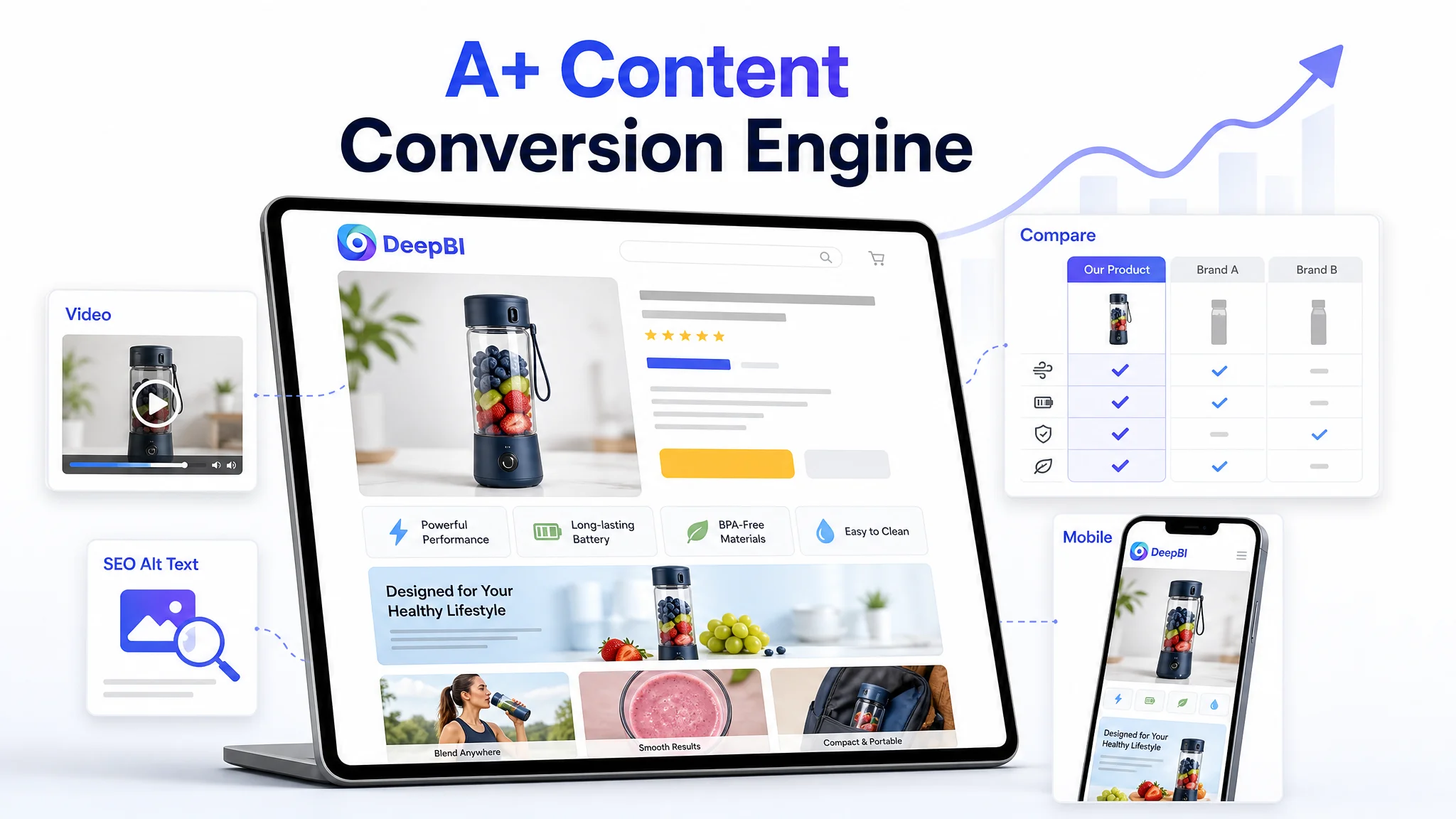
While not weighted as heavily as titles or bullet points, key elements within A+ Content are indexed by Amazon and contribute to product discoverability. According to Amazon's own guidelines, the alt text for your images is a critical field that helps your product appear in relevant search results. Furthermore, the visible, crawlable text within your A+ modules helps Amazon’s algorithm better understand your product’s context, features, and use cases, potentially improving its ranking for a wider range of long-tail keywords.
In practice, many brands leave image alt-text blank or fill it with generic labels like “image1” or “product photo.” In the body wash benchmark, the competitor consistently wove in phrases around moisturizing, gentle cleansing, and specific skin concerns, while the underperforming listing hadn’t taken advantage of this field at all. Once surfaced, this kind of gap is usually easy to fix—but only if you’re looking at A+ Content as both a conversion asset and a supporting SEO signal.
Brand Storytelling
A+ Content offers a unique space to tell your brand’s story. Use this section to communicate your company’s mission, values, and unique selling propositions. A compelling brand narrative helps differentiate you from competitors, builds an emotional connection with customers, and fosters the trust that leads to brand loyalty and repeat purchases. This is your opportunity to turn a one-time buyer into a long-term advocate.
Where the category leader in our body wash example built a cohesive brand world—clean formulas, ethical choices, skin science, lifestyle imagery—the challenger left that space empty. Shoppers who already believed in clean beauty and ethical sourcing had no story to connect with beyond a few lines in bullets and reviews. The absence of a brand narrative didn’t just “look incomplete”; it quietly pushed value-aligned buyers back toward the competitor who did the work of telling a full story.
 Advanced A+ Content Techniques for Maximum Impact
Beyond the basics, several advanced strategies can transform your A+ Content from a simple product description into a powerful conversion engine. Implementing these techniques requires a deeper understanding of customer behavior and Amazon's platform capabilities, but the return on investment is substantial. Distinguishing between Basic, Brand Story, and Premium A+ Content allows you to tailor your investment to the strategic value of each ASIN.
Leveraging Video Modules
Video is one of the most effective tools for boosting engagement and conversion rates. Industry data consistently shows that shoppers who watch a product video are significantly more likely to make a purchase. Effective videos go beyond simple product shots; use them for dynamic product demonstrations, lifestyle showcases that place the item in a real-world context, or compelling customer testimonials. A well-produced video can answer questions, build trust, and dramatically increase your listing's CVR.
In categories like personal care, a short video showing texture, lather, rinsability, and real-skin results can often do the work of multiple static images and paragraphs of copy. In the body wash case, the benchmark didn’t rely on video alone but used it to reinforce the same story the A+ modules told: what this product feels like, why it works, and who it’s for.
Utilizing Comparison Charts
Comparison charts are invaluable for helping customers make confident purchasing decisions. Use these modules to clearly differentiate your product from competitors or to highlight the unique features across your own product line. An effective chart uses clean design, concise text, and clear icons to compare key attributes like features, dimensions, or materials. This simplifies the research process for the buyer, reduces decision fatigue, and steers them toward the best option for their needs, directly impacting conversion.
We often see comparison charts used to map out variants (scent, size, skin type) in a way that mirrors how shoppers are already thinking about trade-offs. In the body wash benchmark, the leader didn’t just say “for all skin types”; it used structured content to show which formulas best fit dry, normal, or sensitive skin. The lack of any such structure on the challenger’s page forced shoppers to infer use cases from generic claims and reviews, lengthening the decision path.
Mobile Optimization
A significant portion of Amazon traffic comes from mobile devices, making mobile-first design non-negotiable. A+ Content that looks great on a desktop can appear cluttered and unreadable on a smaller screen. Prioritize mobile optimization by using large, legible fonts, high-contrast images, and a logical module order that flows vertically. Test your layout on multiple devices to ensure a seamless experience that prevents shoppers from bouncing off your page due to poor usability.
In real audits, it’s common to see brands design their A+ modules on large monitors, then discover on mobile that text overlays become illegible and key claims shrink into tiny badges. In the personal care case, part of the benchmark’s advantage was simply that its A+ modules were visually simple and vertically stacked—easy to scan on a phone—while the challenger hadn’t built any mobile-first decision path at all.
A+ Content and SEO: A Deeper Dive
While A+ Content text is not directly indexed in the same way as titles or bullet points, it still plays a crucial role in Amazon SEO. The text and, importantly, the alt-text for your images provide Amazon's algorithm with additional data about your product's features and use cases. This helps reinforce keyword relevance for your listing. Neglecting to populate image alt-text with relevant keywords is a missed opportunity to strengthen your organic ranking and drive more qualified traffic to your page.
The body wash diagnostics illustrated this clearly: the competitor’s robust A+ text, Q&A, and alt-text helped Amazon “understand” a broader range of moisturizing, cleansing, and skin-type queries. The challenger, by leaving these fields empty or underused, made it harder for the algorithm to associate the product with those long-tail needs—even though the formula itself was a fit.
 Measuring and Iterating A+ Content Performance with DeepBI
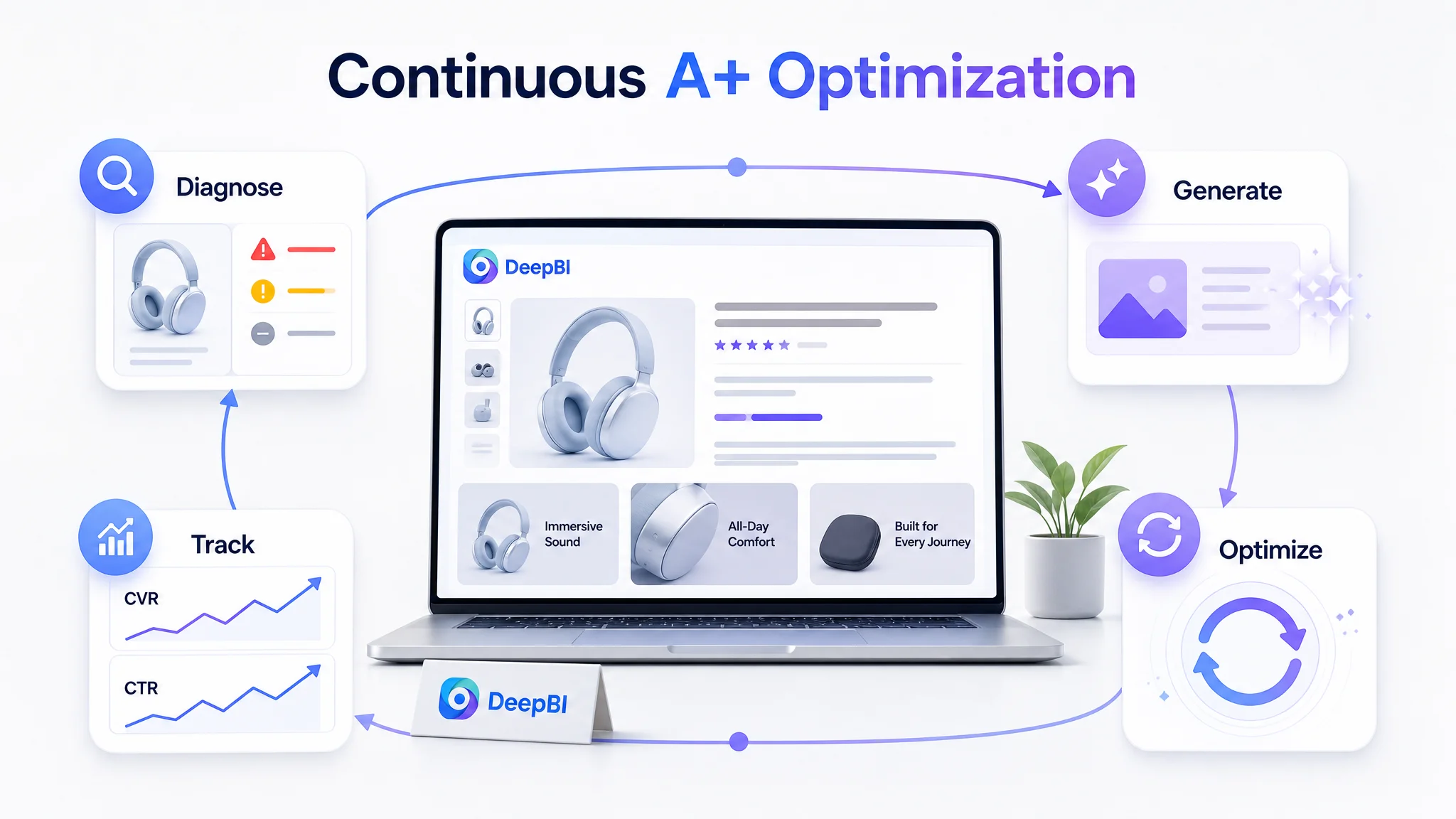
Effective A+ Content is not a “set it and forget it” asset. To maximize its impact, you must continuously measure performance and iterate based on data. This process transforms your listing from a static page into a dynamic sales tool that adapts to customer behavior and market trends.
Key Metrics to Track
To evaluate your A+ Content's effectiveness, focus on metrics that directly reflect customer engagement and purchase intent. Key performance indicators (KPIs) include Conversion Rate (CVR), which shows if your content is persuasive enough to drive sales, and session time, which indicates how long shoppers engage with your story. Tools like Amazon Brand Analytics and the “Manage Your Experiments” feature are invaluable for establishing baseline performance and measuring the lift from your optimization efforts.
When the body wash team first looked at their numbers, their instinct was to attribute weaker CVR to “brand power” and “review count.” Only after listing scoring decomposed where they were behind—especially on the detail page dimension—did they see that CVR wasn’t just a vague trust issue; it was linked to a very specific content gap.
The Role of Continuous Optimization
Optimization is an ongoing cycle, not a one-time task. The Amazon marketplace is constantly evolving, with new A+ Content layouts, changing ranking factors, and shifting consumer preferences. Regularly refreshing your visuals and messaging—whether for seasonal campaigns or to realign with new market data—is crucial for maintaining a competitive edge. A proactive approach ensures your brand story remains relevant and compelling, preventing performance decay over time.
In practical terms, this often means iterating in waves. For the personal care brand, the priority sequence shifted from “get more reviews” to: build a functioning A+ decision path, realign title and bullets with proven category structures, then improve main images, letting reviews compound over a stronger foundation. That order followed the funnel—fix conversion architecture first, then scale traffic—rather than chasing whichever idea felt most urgent internally.
DeepBI's Approach to A+ Content Optimization
DeepBI replaces guesswork with a data-driven, closed-loop system, moving your strategy from “groping in the dark” to precision targeting. The process begins with diagnosis, where DeepBI's Listing module provides intelligent scoring and benchmarks your ASIN against top competitors to pinpoint specific weaknesses in your A+ Content.
In the body wash case, this benchmarking exposed a stark 24-point gap on the detail page dimension alone. The brand’s title, bullets, images, and reviews were somewhat behind but not catastrophic; the A+ dimension was essentially zero compared to a fully built competitor. That clarity reframed internal debates from “we feel like our page is okay” to “we are structurally underbuilt where it matters most for conversion.”
Based on this analysis, the AI-powered generation engine creates fully optimized content packages, including images, text, and layouts tailored to your product's DNA. Finally, the one-click application feature uses the Amazon SP-API to seamlessly sync your new A+ Content, completing the cycle from diagnosis to live deployment. The system can then track post-update changes in KPIs like CTR, providing clear data on the impact of each iteration.
 Integrating A+ Content with Your Overall Amazon Strategy
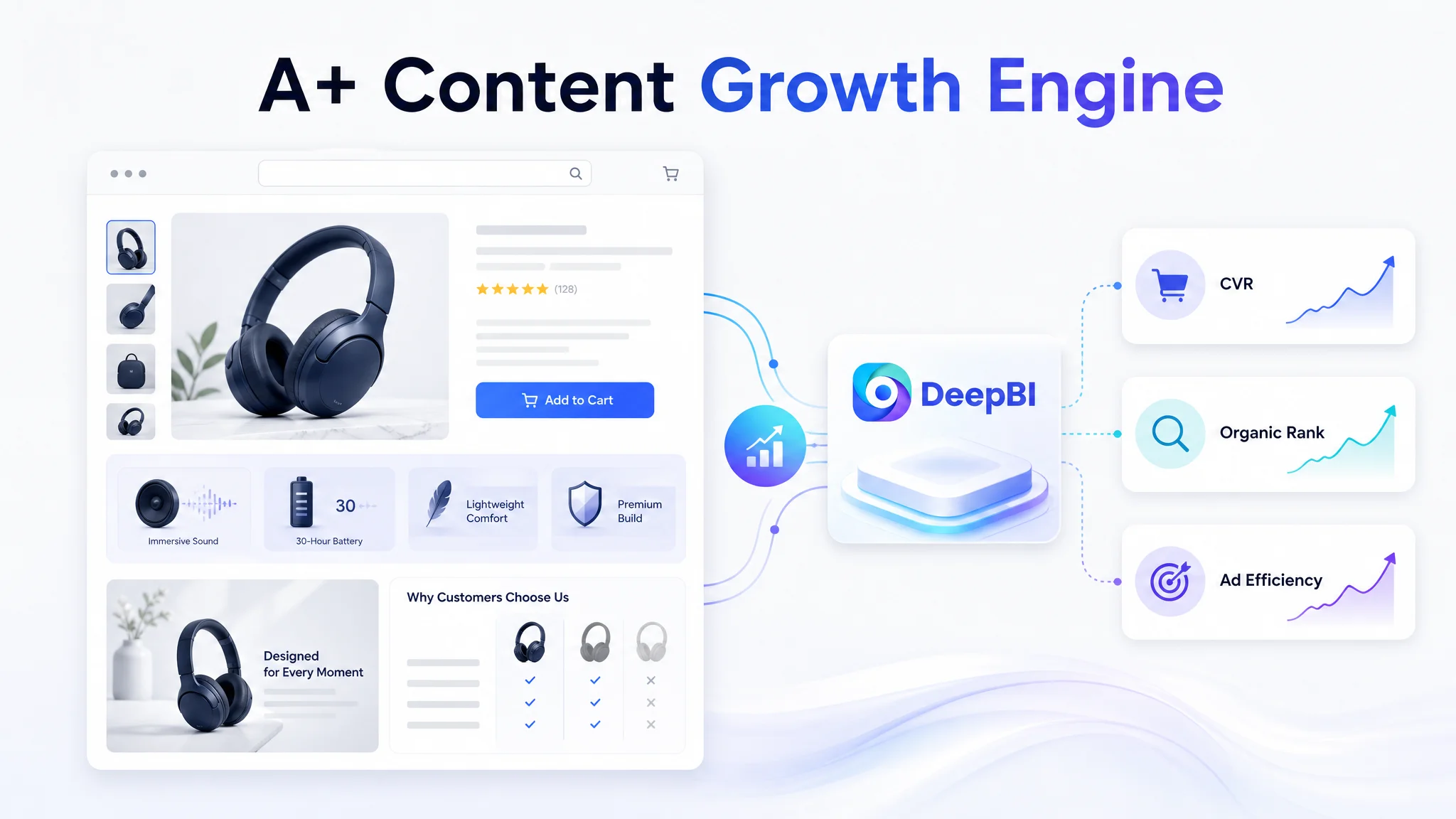
Optimized A+ Content is not an isolated asset; it's a critical engine within a holistic Amazon growth strategy. Its impact extends far beyond the product detail page, creating a powerful flywheel effect that enhances advertising efficiency, boosts organic visibility, and solidifies your brand's long-term value.
Synergy with Amazon Ads
Driving paid traffic to a poorly converting listing is a direct path to inefficient ad spend. High-quality A+ Content significantly improves the conversion rate (CVR) of traffic generated by your Amazon Ads campaigns. This synergy is where DeepBI's cross-module capabilities shine: the Ads Quant module drives highly targeted traffic, while the Listing module ensures the destination page is optimized to convert that traffic at the highest possible rate. The direct result is a more effective advertising budget and a lower, more profitable Advertising Cost of Sale (ACoS).
In the personal care scenario, the initial plan was to push more ads and promotions to “catch up on reviews.” Without realizing it, they were preparing to pour more budget into a funnel that lost shoppers on the page itself. Once the missing A+ structure became clear, the team reprioritized: build the conversion engine first, then scale ad traffic into a page that can monetize those clicks.
Boosting Organic Rankings
A+ Content indirectly but powerfully influences your product's organic search ranking. By improving CVR and reducing bounce rates, it sends strong positive signals to Amazon's algorithm about your product's relevance and quality. A higher CVR contributes to greater sales velocity, a key factor that Amazon rewards with better organic placement. DeepBI's Organic Traffic module capitalizes on this by analyzing ad data to identify high-converting keywords, allowing you to build targeted campaigns that leverage your listing's proven performance to climb the organic ranks.
For the body wash brand, the competitor’s stronger A+ and decision flow meant higher CVR, which compounded into better organic positioning on the same core keywords. Once diagnostics reframed A+ as part of the ranking equation—not just a cosmetic enhancement—it became clear that leaving the detail page underbuilt also meant leaving organic opportunity on the table.
Long-Term Brand Building
Beyond immediate performance metrics, consistent and compelling A+ Content is fundamental to building a durable brand on Amazon. It provides a dedicated space to tell your brand story, showcase your values, and differentiate your products from the competition. Over time, this consistency builds customer trust, fosters brand recognition, and encourages repeat purchases. A+ Content transforms a simple transaction into a brand experience, establishing the customer loyalty that is essential for sustainable growth.
In categories like beauty and personal care, where values, ingredients, and ethics matter, brands that repeatedly show up with rich, coherent A+ narratives become the “default choice” for shoppers over time. In the body wash example, the turning point was realizing that reviews and price could not substitute for that structural story—and that their competitor’s perceived “brand power” was heavily reinforced by the way its listing actually talked to customers.
 Conclusion: Unlock Your Full Amazon Potential with Optimized A+ Content
Mastering Amazon A+ Content is no longer a cosmetic touch-up; it is a fundamental driver of e-commerce success. A strategic, data-informed approach to your product listings directly translates into tangible business growth, boosting conversion rates, strengthening brand loyalty, and improving organic discoverability. By moving beyond static visuals and embracing dynamic, customer-centric content, you create a powerful competitive advantage.
The traditional optimization process, often fragmented by disconnected workflows and subjective guesswork, is no longer sufficient. Tools like DeepBI are engineered to overcome these challenges, providing an integrated, end-to-end solution that connects market diagnosis with content creation and performance analysis. This empowers sellers to replace inefficient cycles with a streamlined, intelligent system. In the body wash case, the biggest shift wasn’t a single image or line of copy, but the team’s operating logic: from blaming reviews and “brand power” to recognizing a missing decision architecture on the detail page.
To truly thrive on Amazon, adopt a mindset of continuous, data-driven improvement. Stop guessing what works and start knowing. By leveraging a unified platform to analyze, create, and refine your A+ Content, you can turn your product pages into consistent, high-performing conversion engines and unlock your brand's full potential on the world's largest marketplace.
Continuous optimization remains essential because Amazon rankings, shopper expectations, and competitive pressure keep changing. The brands that win are not just the ones with the best products—they are the ones that tell the most complete, convincing story at every step of the buyer’s journey, and keep refining that story as the market evolves.