Introduction: The Foundation of Amazon Advertising Success
In the hyper-competitive Amazon marketplace, visibility is paramount. With rising traffic costs and intense pressure on key metrics like Click-Through Rate (CTR) and Conversion Rate (CVR), a passive approach to advertising is no longer viable. Simply launching campaigns and hoping for the best often leads to wasted ad spend and stagnant growth. Success in Amazon PPC is not just about having a budget; it's about deploying that budget with precision, and that precision begins with a strategic campaign structure.
A well-architected campaign is the blueprint for scalable and profitable advertising. It provides the control needed to manage bids effectively, harvest valuable keyword data, and allocate budget toward top-performing segments. However, the complexity of Amazon's advertising platform, with its multiple ad types and targeting options, demands a systematic approach that goes beyond the campaign manager dashboard. True optimization requires a full-funnel perspective, recognizing that ad performance is fundamentally tied to the commercial power of the product listing itself.
In practice, many sellers only realize this connection when PPC symptoms don’t respond to “PPC fixes.” For example, a workwear seller in the U.S. once came to DeepBI convinced they had an “ads problem” with a heavyweight men’s work T‑shirt: ACOS was creeping up, traffic was decent, but conversions lagged. They kept tweaking bids, shifting budgets, and “buying more data,” yet nothing meaningfully changed. Once their listing was benchmarked against a direct competitor, it became clear that the real leak wasn’t in campaign structure, but in how the main images and A+ content answered basic buyer questions about fit, comfort, and fabric feel. The ads were doing their job—bringing traffic—but the product page wasn’t converting that traffic.
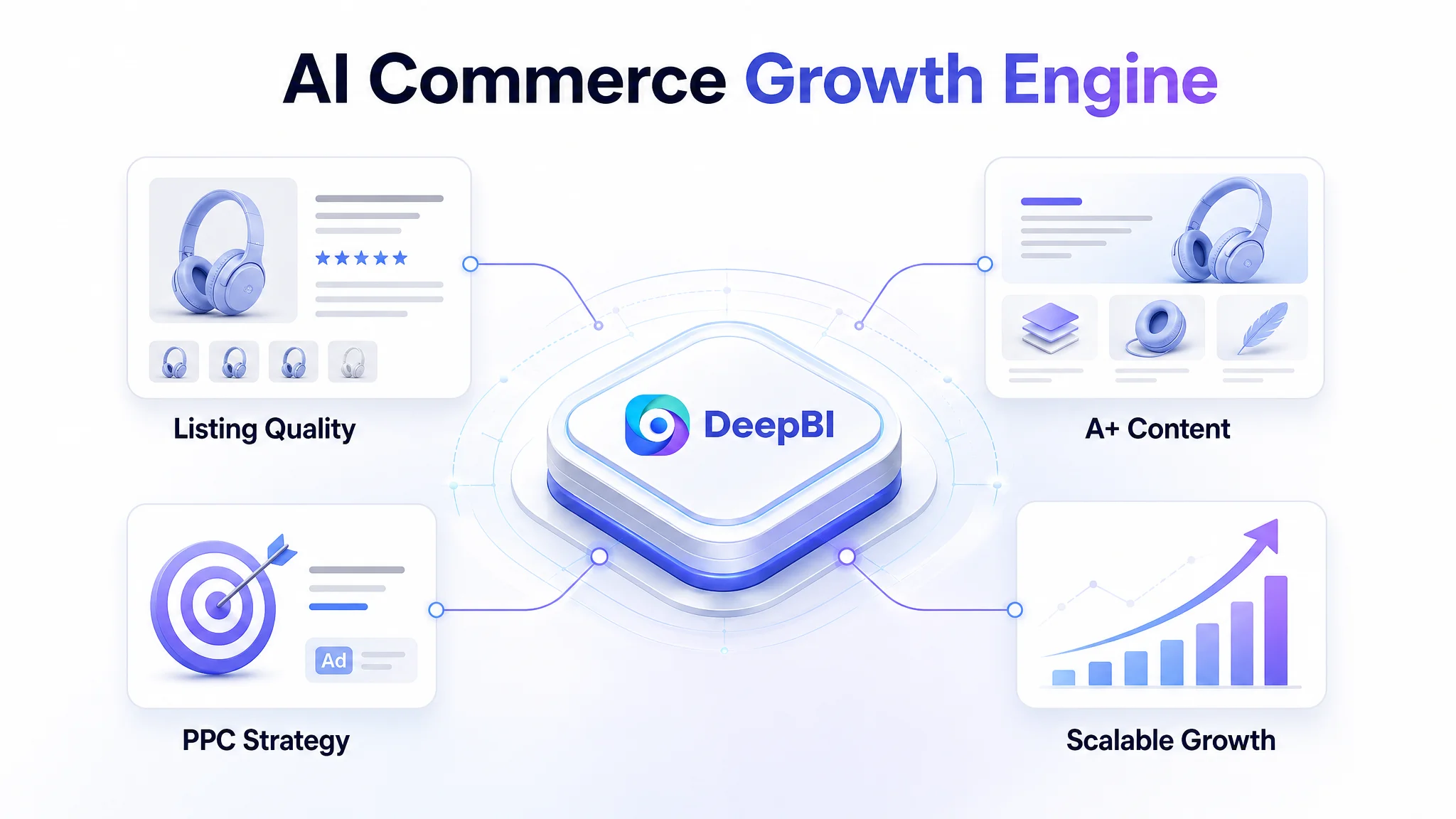
This is where an integrated operational system becomes a critical advantage. Tools like DeepBI provide an AI-powered framework for end-to-end Amazon operations, breaking down the traditional silos between product analysis, content creation, and advertising management. By optimizing the entire commercial engine—from product competitiveness and listing quality to ad placement and organic traffic—sellers can build a virtuous cycle of growth. A superior listing drives higher CTR and CVR for ads, which in turn boosts sales velocity and improves organic rank, creating a more resilient and profitable business.
Why a Strategic Campaign Structure Matters
Many Amazon sellers hit a frustrating plateau where increased ad spend doesn't translate into proportional growth. Performance becomes inconsistent, ACoS rises, and it's difficult to diagnose the root cause. This chaos is often a direct result of a disorganized campaign structure, which leads to wasted budget, unclear performance data, and internal competition where your own ad groups bid against each other, artificially inflating costs.
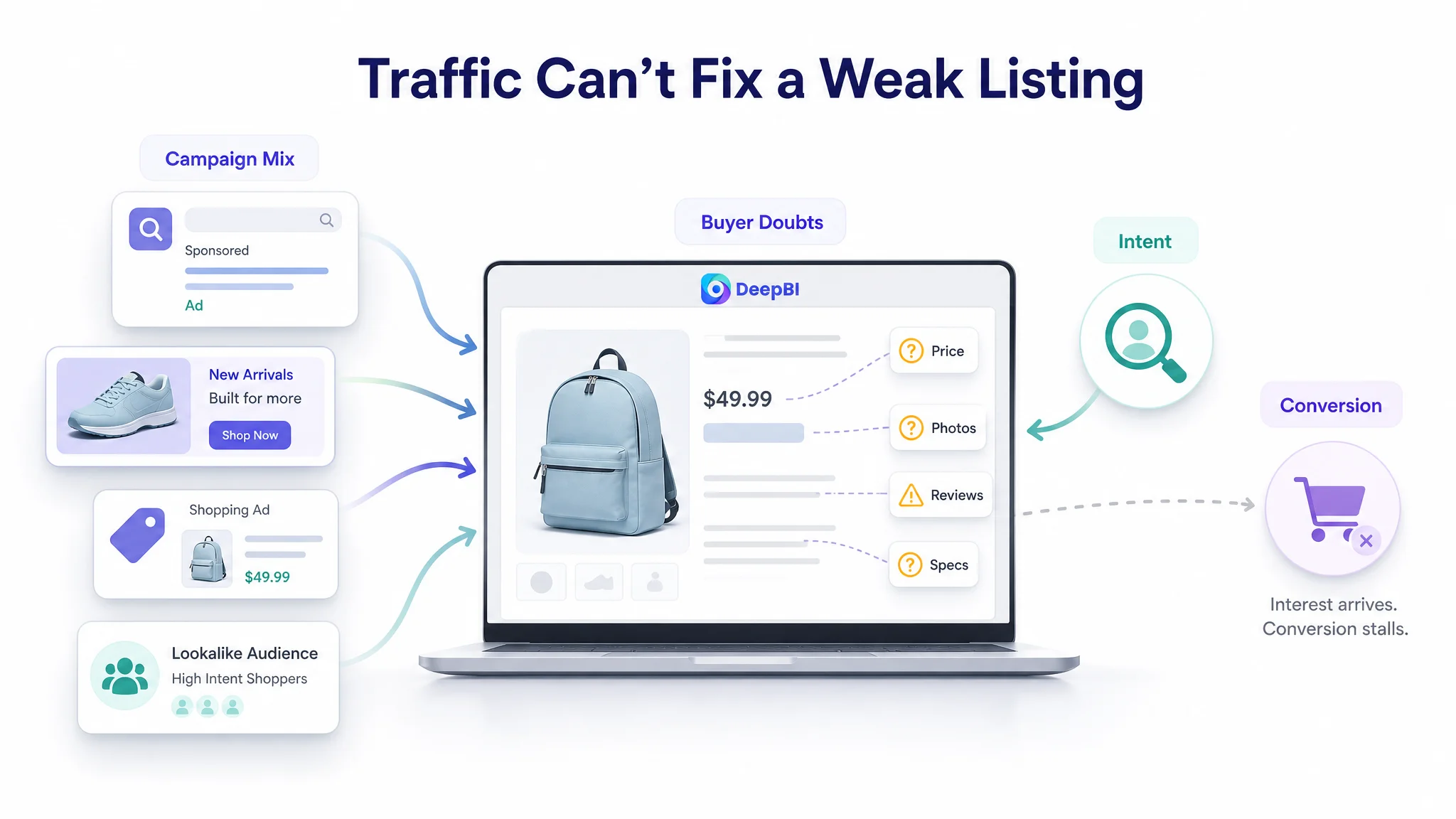
A strategic campaign structure is the foundation for scalable success. It simplifies management, ensures efficient budget allocation, and prevents keyword cannibalization, allowing you to clearly identify what’s working and what isn’t. However, even the most perfectly structured campaign will fail if it directs traffic to a product listing that doesn't convert. Your ads are responsible for generating clicks, but your listing is responsible for securing the sale.
This disconnect frequently shows up when sellers assume “ad quality” is the only lever they need. In the work T‑shirt case mentioned above, the team’s first instinct was to restructure campaigns, refine keywords, and rebalance budgets. On the surface, their listing even “scored” slightly higher than a key competitor in terms of detail and industrial positioning. Yet a deeper analysis showed that the main image sequence and A+ modules were over‑indexed on toughness and industrial mood, while under‑serving the buyer’s earliest questions: “How does this actually fit on me?” and “Can I trust the fabric feel and comfort?” As long as those concerns remained unresolved, every incremental ad dollar simply fed a page that wasn’t ready to convert.
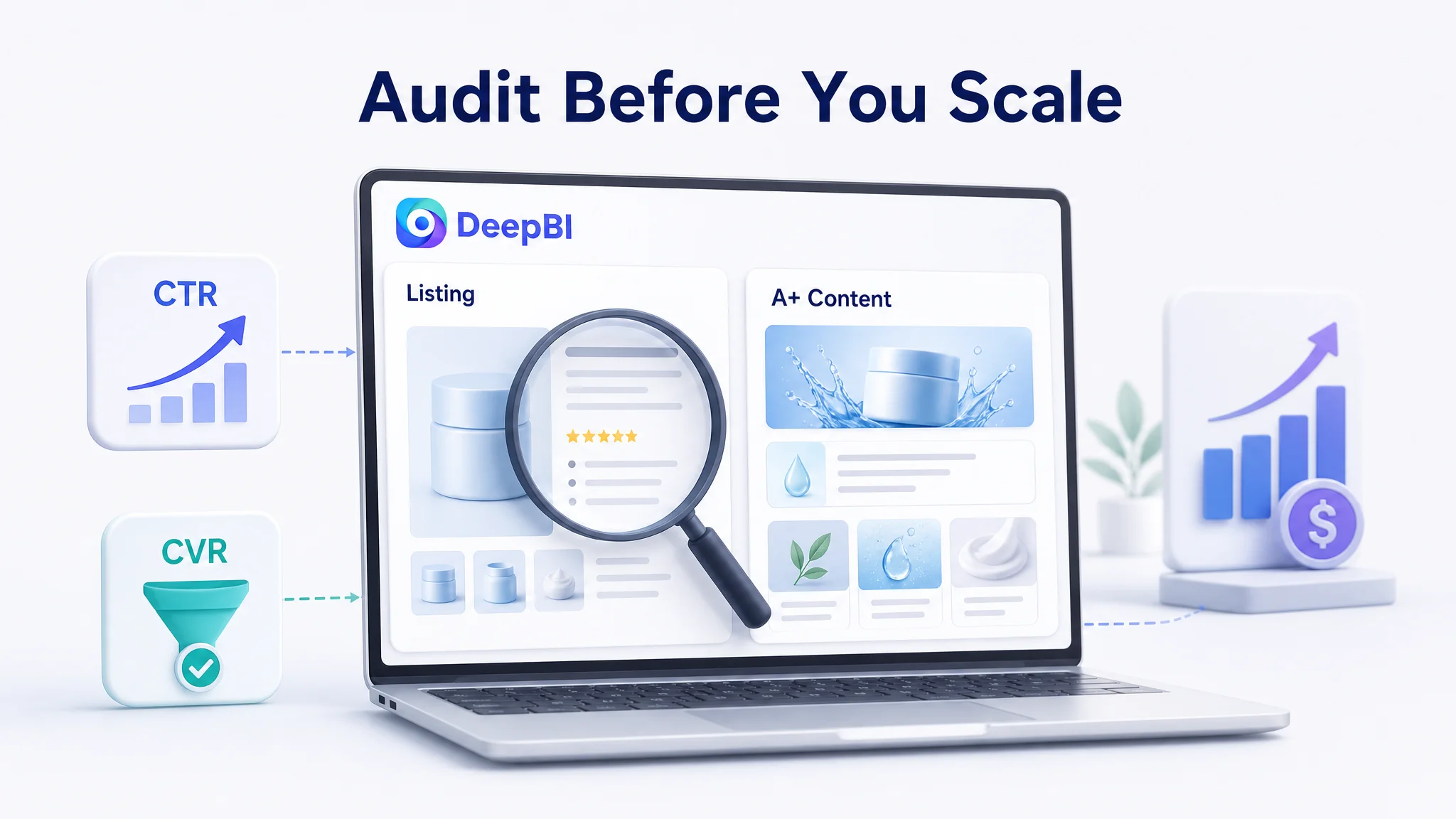
This is why a pre-flight check on your listing's health is critical. Before investing heavily in traffic, you must ensure the destination is optimized for conversion. DeepBI's Listing module acts as a diagnostic engine, auditing your product page across key dimensions like the main image, title, bullet points, and A+ content. It scores your listing's competitiveness against top market performers, identifying "core lesions" that suppress your Click-Through Rate (CTR) and Conversion Rate (CVR). By fixing these weaknesses first, you ensure your ad spend is directed to a high-performance asset, maximizing return and preventing wasted investment.
Core Principles of Effective Amazon PPC Campaign Structure
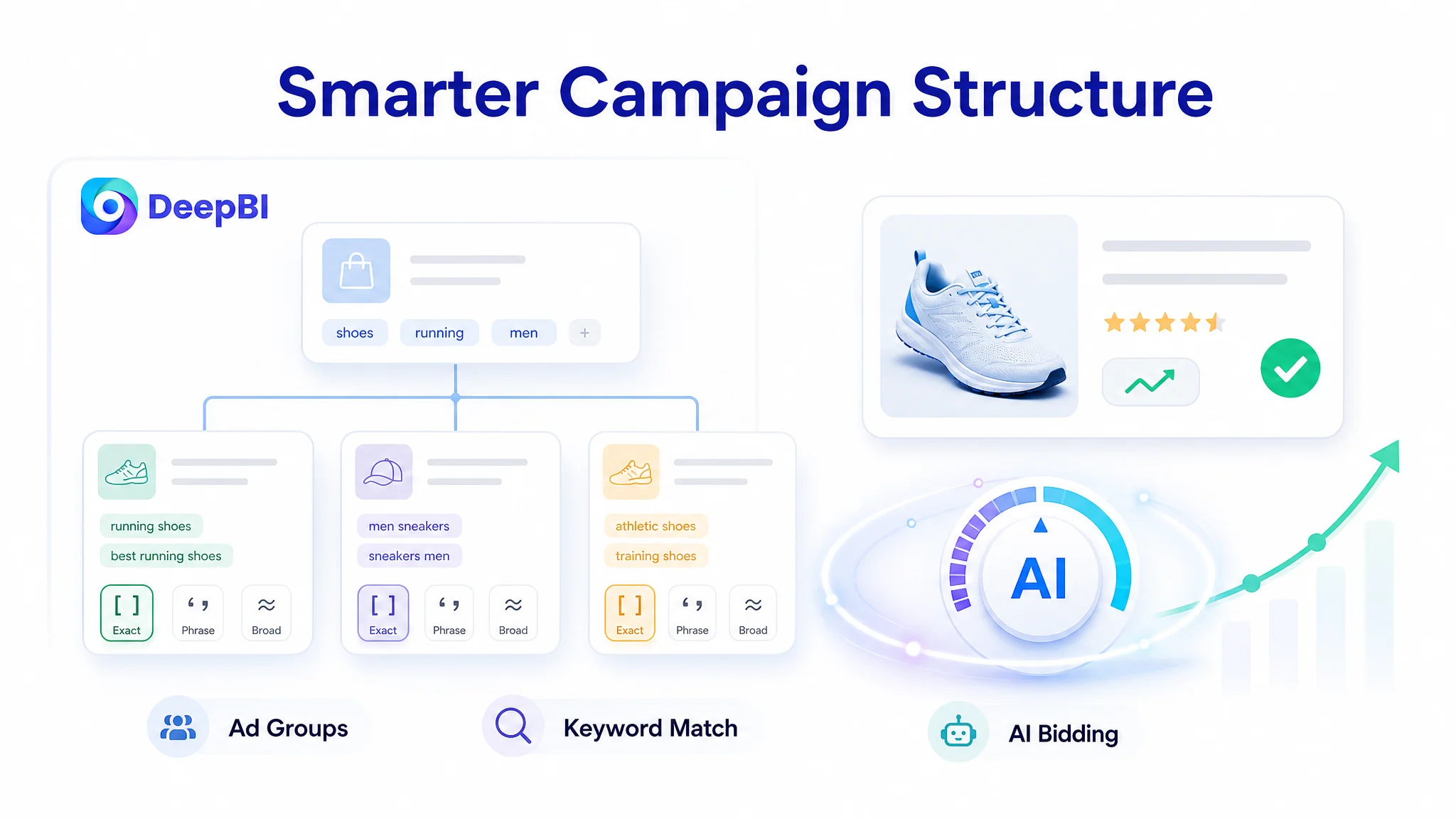
A well-structured campaign begins with granularity. This means grouping highly similar products and keywords into tight, thematic ad groups to ensure your ads are hyper-relevant to shopper searches. For instance, while an "avocado-shaped pool float" and a "donut-shaped pool float" are both pool toys, they appeal to different search queries. Placing them in separate ad groups allows you to tailor ad copy and bids specifically for each, improving Click-Through Rate (CTR) and Conversion Rate (CVR).
Within these groups, strategically layer keyword match types: use Broad match for discovery, Phrase for controlled targeting, and Exact for capturing high-intent buyers. Simultaneously, aggressively apply negative keywords to block irrelevant traffic and protect your budget, which directly lowers your Advertising Cost of Sale (ACoS). However, managing budget allocation presents a common challenge. Amazon's algorithm doesn't distribute a campaign budget evenly; a $100 budget across two ad groups might result in one receiving $80 and the other only $20 based on early performance signals, potentially starving a promising ad group.
This kind of structural thinking must be paired with an honest view of listing conversion capacity. In the workwear example, the seller’s campaigns were not fundamentally misaligned—they were already driving relevant traffic around “heavyweight work T‑shirt,” “loose fit,” and industrial usage. Yet, as DeepBI’s listing breakdown showed, the hierarchy of information on the page was out of sync with how shoppers decide: technical details and industrial scenes were richly presented, but the earliest visual confirmation of fit, comfort, and Tall sizes came too late. In practical terms, the campaign structure was sending the right people to the wrong story sequence, which kept both CTR and CVR below potential, despite “technically correct” targeting.
To counteract this, modern tools use automated intelligence. DeepBI’s system implements dynamic parameter adjustments, analyzing daily performance metrics—clicks, conversions, spend, and ACoS—to automatically fine-tune bids and reallocate budgets. This data-driven approach avoids overreactions to short-term fluctuations and ensures your ad spend is consistently directed toward the highest-performing targets for sustained growth.
Campaign Types and Their Strategic Roles
A robust Amazon advertising strategy relies on a structured portfolio of campaigns, not a single, all-purpose one. Separating campaigns by type provides clarity, prevents budget cannibalization, and simplifies performance diagnosis. Each campaign type serves a distinct strategic purpose, working together to create a cycle of discovery, targeting, and scaling.
- Automatic Campaigns: These are your primary research tools. By allowing Amazon's algorithm to match your product to a wide range of customer search terms and competitor ASINs, you can uncover high-performing keywords and product targets you might have missed. Their main role is data collection; analyzing the Search Term Report from these campaigns is essential for harvesting proven terms to move into manual campaigns. Use them for initial product launches and ongoing market exploration to keep your targeting fresh.
- Manual Campaigns (Keyword Targeting): This is where you exert precise control. After identifying profitable keywords from your automatic campaigns, you move them here to manage bids and budgets with greater accuracy. Best practices involve creating highly segmented campaigns—for example, separating branded keywords from non-branded ones or creating distinct campaigns for discovery versus scaling proven winners. Using tightly themed ad groups ensures your ad copy is highly relevant to the search query, improving Click-Through Rate (CTR) and Conversion Rate (CVR).
- Product Targeting Campaigns (PAT): These campaigns allow you to target specific ASINs or product categories directly. This enables both offensive and defensive strategies. Offensively, you can target competitor ASINs to capture their market share. Defensively, you can target your own complementary products to encourage cross-selling and protect your brand space from rivals.
When these campaign types are working well, they surface clear patterns in search behavior and placement performance. Problems often arise when sellers try to “force” better performance solely through moving keywords between campaigns or changing bids, while ignoring the signals about the product page itself. In the T‑shirt case, search term reports and placement data showed that shoppers were clicking from relevant queries, but drop‑off on the listing remained high. Automatic campaigns were doing their job discovering intent, manual campaigns were concentrating spend on promising terms, yet without adjustments to the title structure and early images, the funnel kept leaking at the same point. This highlights a crucial mindset: campaign types are instruments for directing traffic; they cannot compensate indefinitely for a listing that doesn’t resolve core buying doubts.
Advanced Strategies for Optimization and Scalability
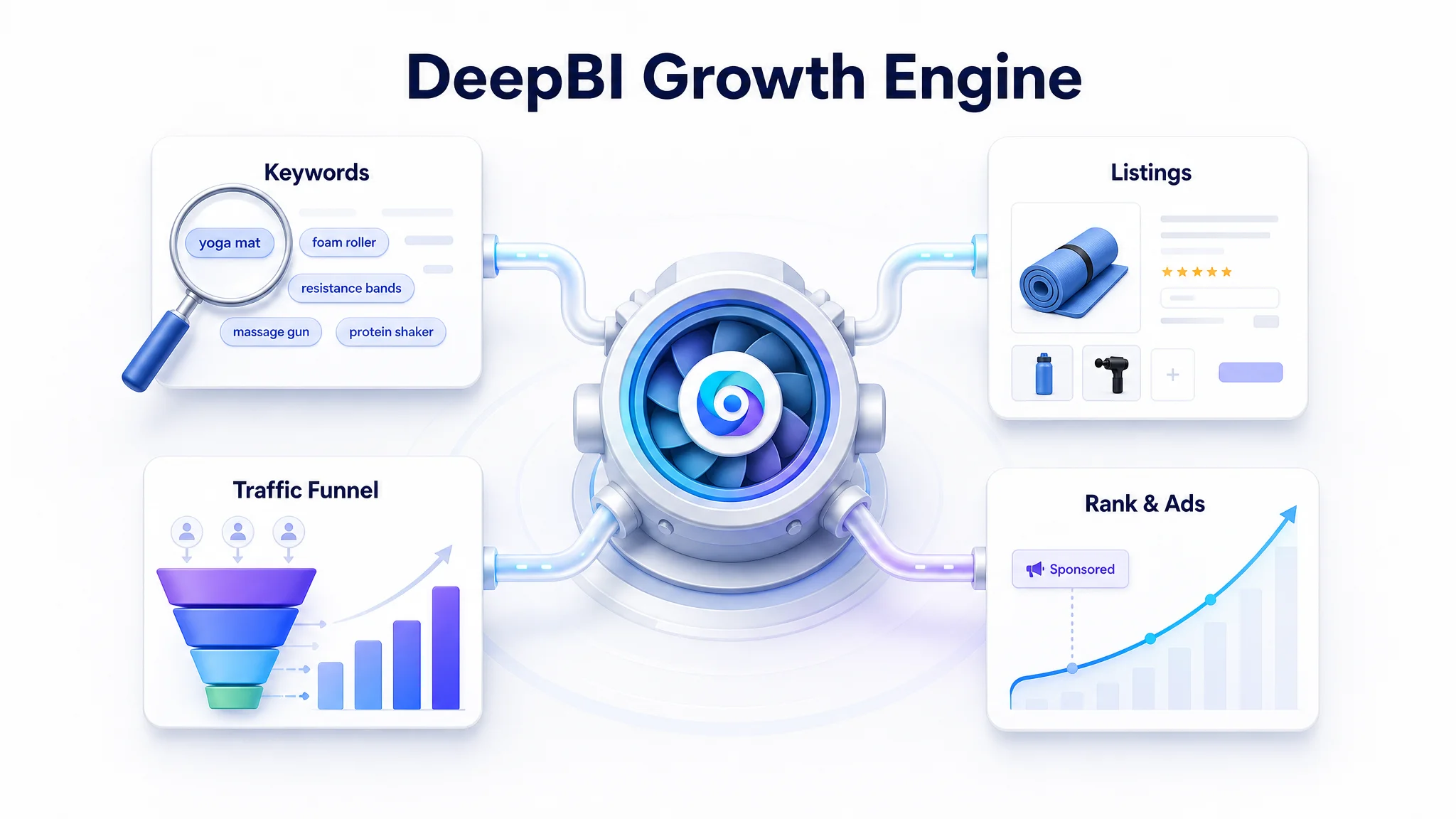
Effective campaign management evolves from isolated adjustments to a systematic engine for growth. Advanced optimization hinges on creating a structured feedback loop where data from broad discovery campaigns directly fuels high-precision targeting. This begins with keyword harvesting: identifying high-performing customer search terms from automatic or broad match campaigns and graduating them to dedicated exact match campaigns. This tactic isolates top converters, allowing for more aggressive and efficient bid optimization based on placement and strategic goals, while preventing keyword cannibalization. Similarly, using negative ASIN targeting in product targeting campaigns is crucial for pruning wasted ad spend on irrelevant or low-performing competitor pages.
To truly measure success and guide scalability, you must look beyond ACoS. Metrics like Total ACoS (TACoS) provide a more holistic view, revealing how your advertising investment impacts overall revenue, including organic sales. The goal is to build a system that compounds visibility and profitability over time.
In real operations, this often means interpreting ad metrics as feedback on both campaigns and listings. In the workwear scenario, rising ACOS and flat conversions under stable, relevant traffic were early indicators that simply harvesting more keywords wouldn’t change the outcome. DeepBI’s listing analysis made the pattern explicit: while the seller’s page outperformed a competitor on some technical dimensions (bullets, A+ depth), it underperformed on the sequence of decision-making. Without first restructuring the title, refreshing the main image to show real loose fit on a model, and rebalancing A+ modules toward comfort and sizing clarity, any attempt to “scale” exact‑match winners would have simply accelerated budget burn. Advanced optimization, therefore, became a two-part process: refine which queries and ASINs to buy, and, in parallel, upgrade the listing’s capacity to convert those very queries.
This is where a structured funnel approach becomes invaluable. DeepBI operationalizes this with a four-layer traffic funnel: Exploration, Initial Screening, Precision, and Scaling. This model automates the discovery, filtering, and scaling of high-value keywords and ASINs. Furthermore, a fifth layer focuses on natural traffic growth by identifying high-CTR and high-CVR keywords from ad data. It then creates targeted campaigns to boost "Top of Search" visibility, creating a powerful flywheel that drives growth in both ad volume and organic ranking simultaneously.
DeepBI's Role in Streamlining Amazon PPC Optimization
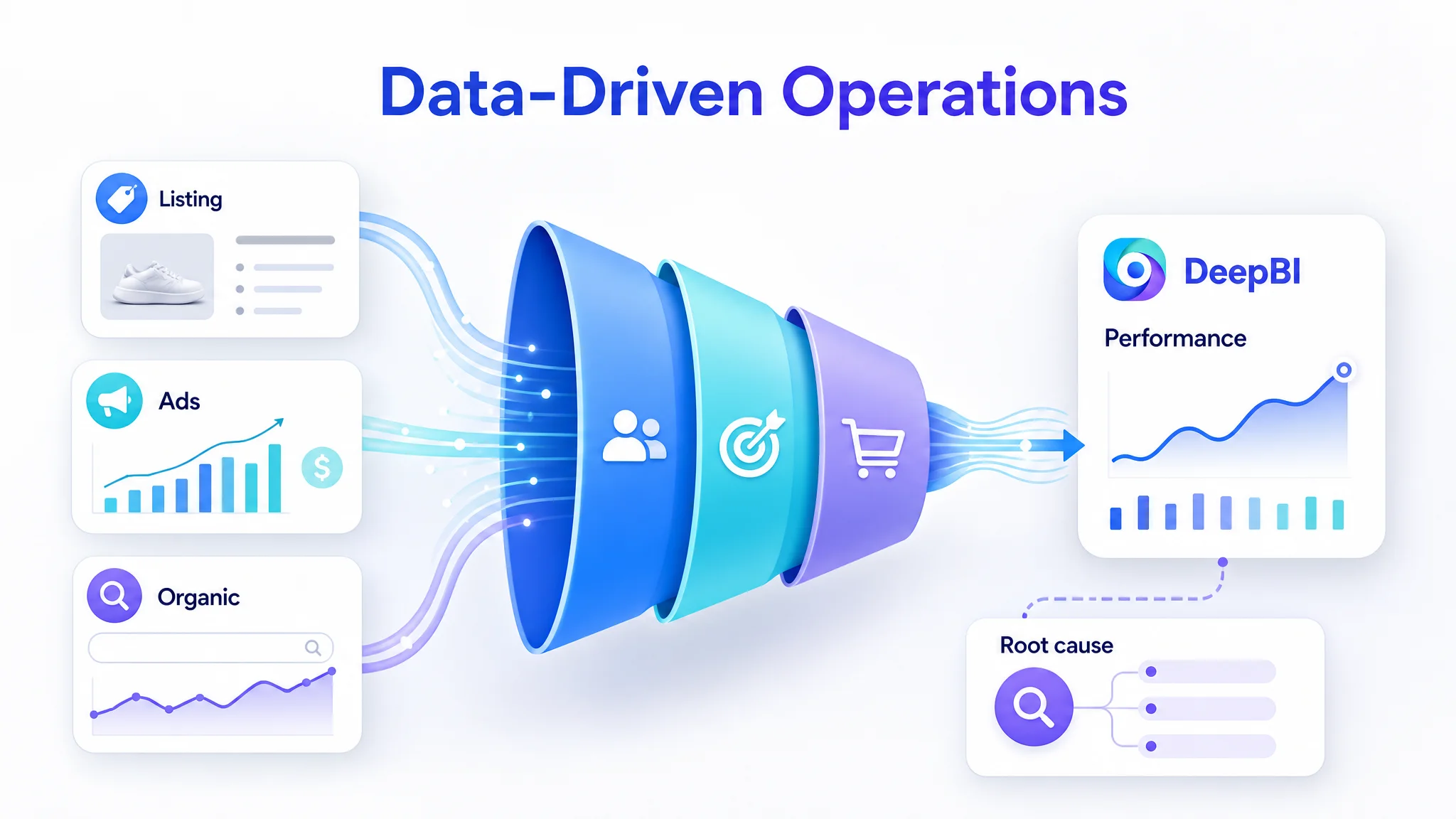
Executing a sophisticated, multi-layered PPC strategy requires moving beyond manual adjustments and subjective experience. This is where AI-driven platforms like DeepBI provide a decisive advantage, transitioning sellers from intuition-based tactics to a fully data-driven operational model. By integrating Listing optimization, advertising data, and organic traffic analysis into a single system, DeepBI ensures that every part of your sales funnel is aligned for maximum performance.
The platform's power lies in its ability to connect ad performance directly to its root causes. Key capabilities include:
- Intelligent Diagnosis: Before you can optimize, you must diagnose. DeepBI uses a multi-dimensional semantic algorithm to identify your true market competitors and performs a quantified audit of your listing against theirs. This process pinpoints specific weaknesses in your main images, titles, or descriptions that are suppressing Click-Through Rate (CTR) and Conversion Rate (CVR), providing a clear roadmap for improvement. In the work T‑shirt example, this meant discovering that, although the listing’s overall score slightly exceeded a benchmark competitor, its strengths were “in the wrong places” for first impressions: industrial toughness was over‑emphasized, while visual proof of fit, fabric feel, and Tall sizes appeared too late. That diagnostic shift reframed the internal narrative from “our ads are weak” to “our page is mis-sequenced for how shoppers actually decide.”
- Automated Optimization: Armed with this diagnosis, DeepBI facilitates dynamic bid and budget adjustments to ensure your ad spend remains efficient. It translates diagnostic insights into an actionable optimization plan, ensuring that every change is engineered to improve key performance indicators. For the workwear seller, this meant pausing aggressive scaling, rebuilding the title and image sequence around how real buyers search and scan, and only then letting automated bidding logic ramp up traffic to a now more trustworthy page.
- Strategic Campaign Management: DeepBI supports a comprehensive strategy that aligns with a four-layer ad traffic funnel to capture demand and a fifth layer focused on converting that paid momentum into sustainable organic growth. This systematic approach ensures that your advertising efforts not only drive immediate sales but also build long-term profitability by lowering your Total Advertising Cost of Sales (TACoS).
Conclusion: Building a Sustainable Amazon Advertising Ecosystem
Mastering Amazon PPC is not about finding a single winning keyword or a temporary bidding trick. It's about architecting a durable, scalable campaign structure that serves as the foundation for long-term growth. A logical, segmented structure transforms your advertising from a reactive expense into a predictable system for driving qualified traffic and gathering crucial market intelligence. This strategic framework is the essential first step toward sustainable profitability on the platform.
However, the structure itself is not a static endpoint. The Amazon marketplace is a dynamic environment, and success demands continuous adaptation. Optimization must evolve from an occasional project into a core business process—a dynamic logic that iterates in real-time based on performance data and market feedback. This ongoing refinement ensures your campaigns remain aligned with your business goals, maximizing return on ad spend.
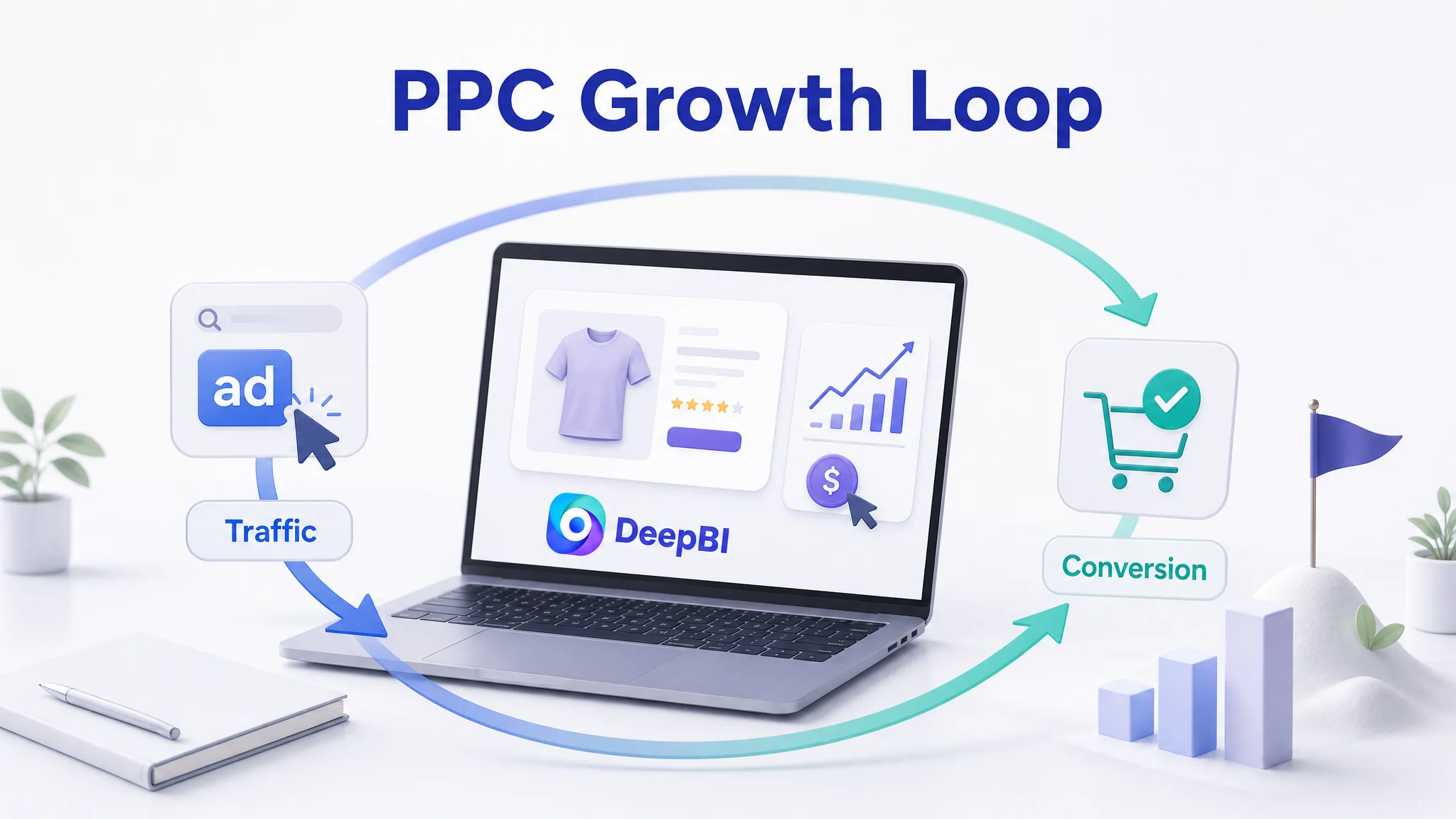
Crucially, that refinement must encompass both sides of the equation: how you buy traffic and how your listing converts it. The work T‑shirt case is a reminder that a “technically strong” page can still leak conversions if it tells the right story in the wrong order, and that ad metrics often surface listing problems before they reveal campaign flaws. By integrating a sophisticated campaign architecture with advanced analytical tools like DeepBI, sellers can create a powerful growth loop. The structure delivers precise traffic, while intelligent systems analyze the resulting data to optimize listings for higher Click-Through and Conversion Rates. This synergy turns advertising into a quantifiable, scientific process, ensuring every modification translates into tangible improvements in sales velocity, Best Seller Rank, and lasting brand dominance.