
Introduction
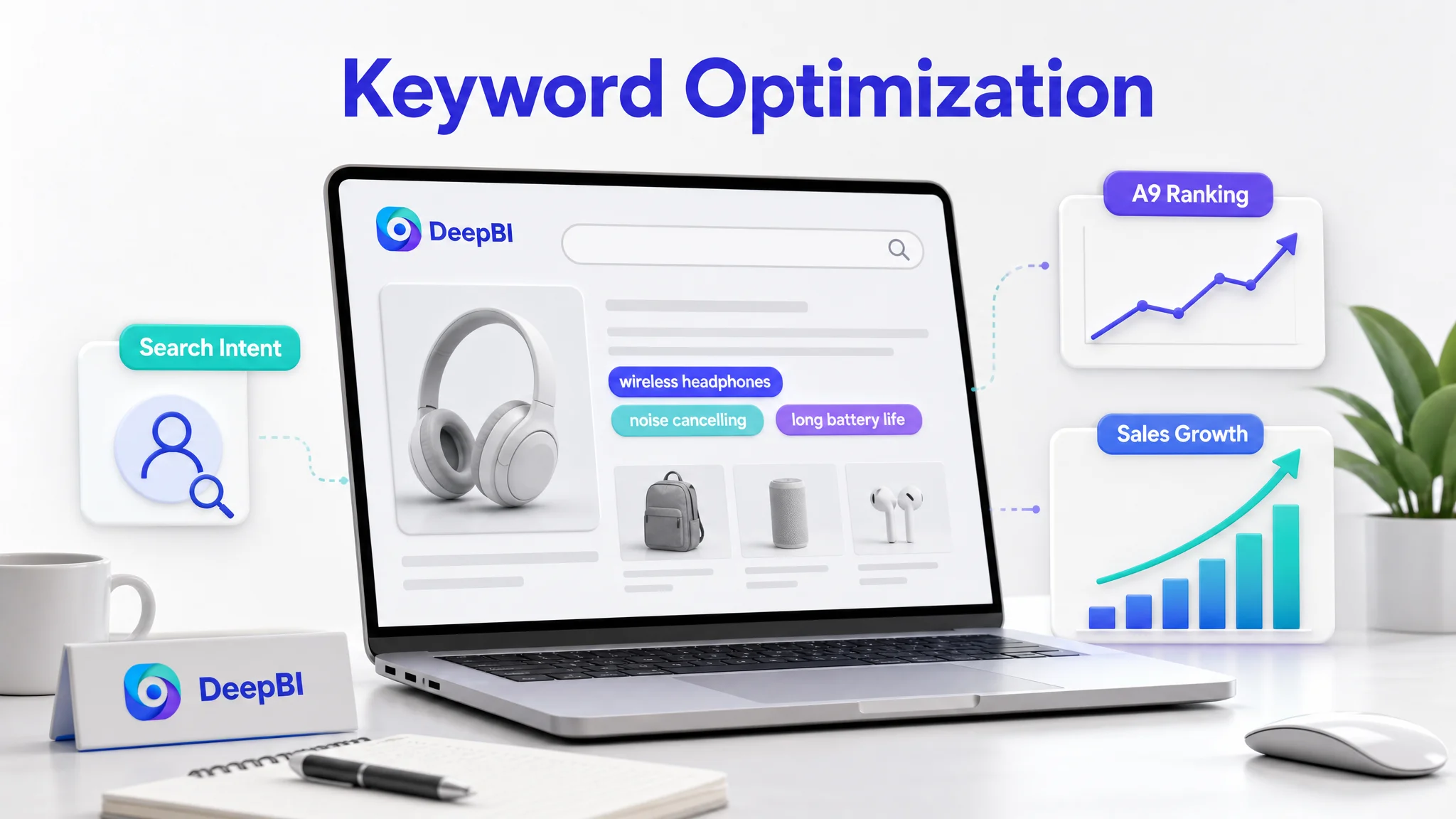
In the hyper-competitive Amazon marketplace, keywords are the essential link between customer intent and product discovery. They form the bridge connecting a shopper's search query to your product listing. Mastering Amazon Search Engine Optimization (SEO) is not about exploiting technical loopholes; it is the strategic science of aligning your product's language with the precise terms your target audience uses. A successful strategy ensures that when a customer searches, Amazon's A9 algorithm recognizes your product as a highly relevant solution, placing it prominently in the search results.
The connection between a sophisticated keyword strategy and business growth is both direct and measurable. Ranking for high-intent keywords drives visibility, which in turn boosts your Click-Through Rate (CTR). This influx of qualified traffic—shoppers actively seeking what you sell—naturally leads to a higher Conversion Rate (CVR). This virtuous cycle fuels sales velocity, improves your Best Sellers Rank (BSR), and builds a foundation for sustainable organic growth.
Industry studies suggest that improving Amazon search ranking can significantly increase sales. For instance, moving from the top of page two to the bottom of page one might yield an 84% sales increase, while securing the top spot could boost sales by over 150%. However, actual results vary greatly depending on the product, category, and competitive landscape. In practice, many brands discover that underperformance isn’t caused by some vague “branding issue”, but by very specific keyword and funnel weaknesses near the top of the page—title, main image, bullets—that quietly limit qualified traffic before their strong branding work ever gets a chance to convert. This guide provides a systematic framework for discovering, prioritizing, and implementing the keywords that matter most. We will explore how to leverage advanced analytics tools like DeepBI to transform complex data into an actionable optimization strategy, ensuring your products capture the visibility they deserve.
The Foundational Role of Keywords in Amazon's Algorithm
To effectively optimize your listings, it is crucial to understand how Amazon's A9/A10 algorithm interprets and prioritizes keywords. This algorithm does not simply match words; it analyzes customer behavior to determine which products are most likely to result in a purchase. Mastering this system begins with grasping two core concepts: the difference between being indexed and being ranked, and the powerful role of sales performance.
Understanding Indexing vs. Ranking
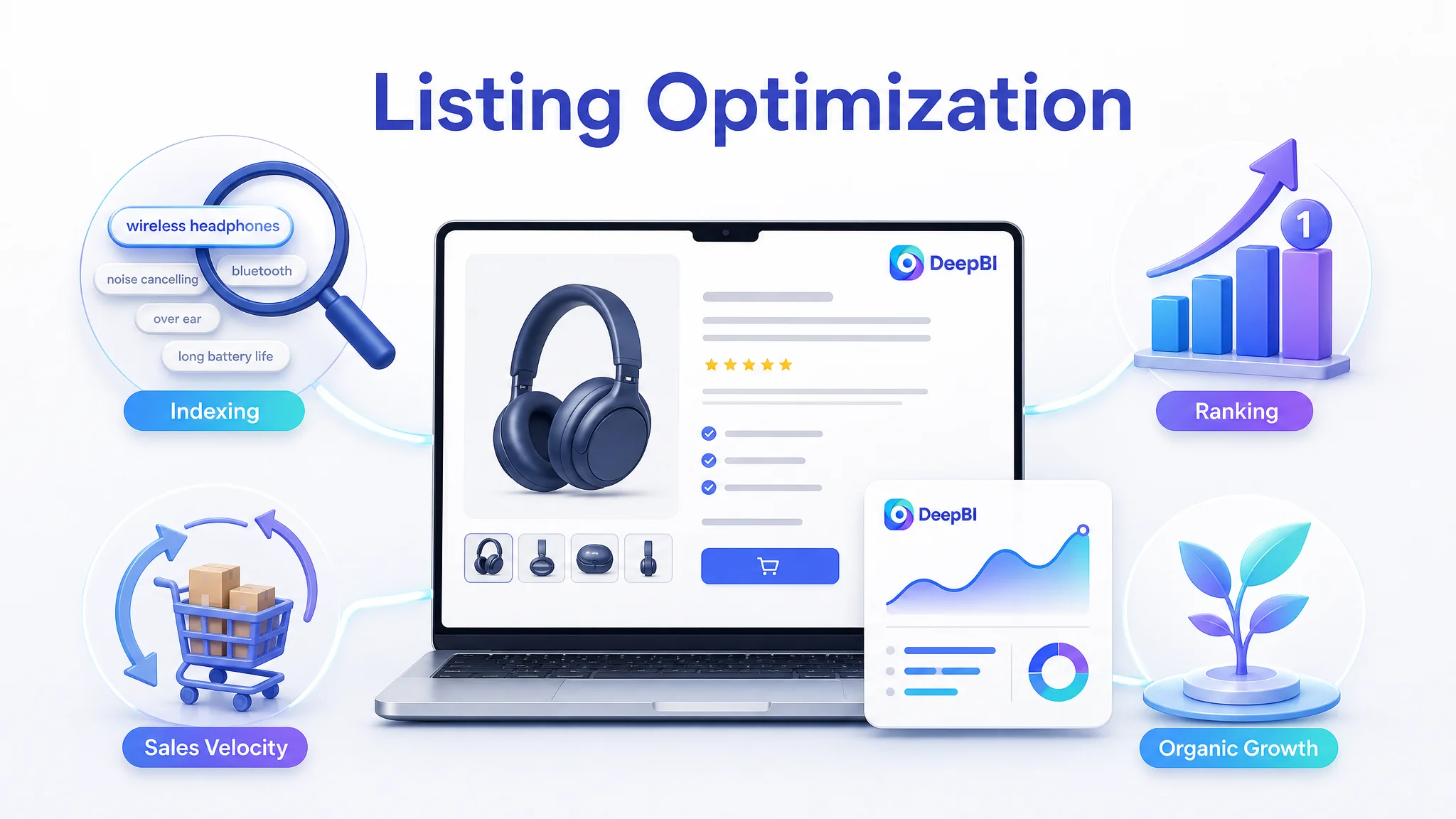
First, it is essential to distinguish between indexing and ranking. Indexing is the process where Amazon's algorithm scans your product listing—including the title, bullet points, backend search terms, and description—and associates it with specific keywords. If your product is indexed for a term like "ergonomic office chair," it becomes eligible to appear in the search results for that query.
Ranking, however, is the competitive dimension that determines your product's position on the search results page. While indexing allows you to enter the race, ranking decides your starting position. A product can be indexed for hundreds of keywords but will only rank highly for the select few that demonstrate strong performance metrics.
In real operations, this distinction is often blurred. For example, we’ve seen brands assume they have a “visibility problem” because a product doesn’t appear high enough for a broad category term. A closer look showed they were fully indexed for that term—but sat deep in results because there was no meaningful sales history or click behavior to justify a higher rank. In other words, they were technically in the race, but starting so far back that virtually no shoppers ever reached them.
Sales Velocity: The Ultimate Keyword Amplifier
The single most influential factor in Amazon's ranking algorithm is sales velocity. As a conversion-driven marketplace, Amazon's algorithm is designed to reward products that sell effectively. When a customer searches for a keyword, clicks on your product, and completes a purchase, it sends a powerful signal to Amazon that your listing is a relevant and compelling match for that query.
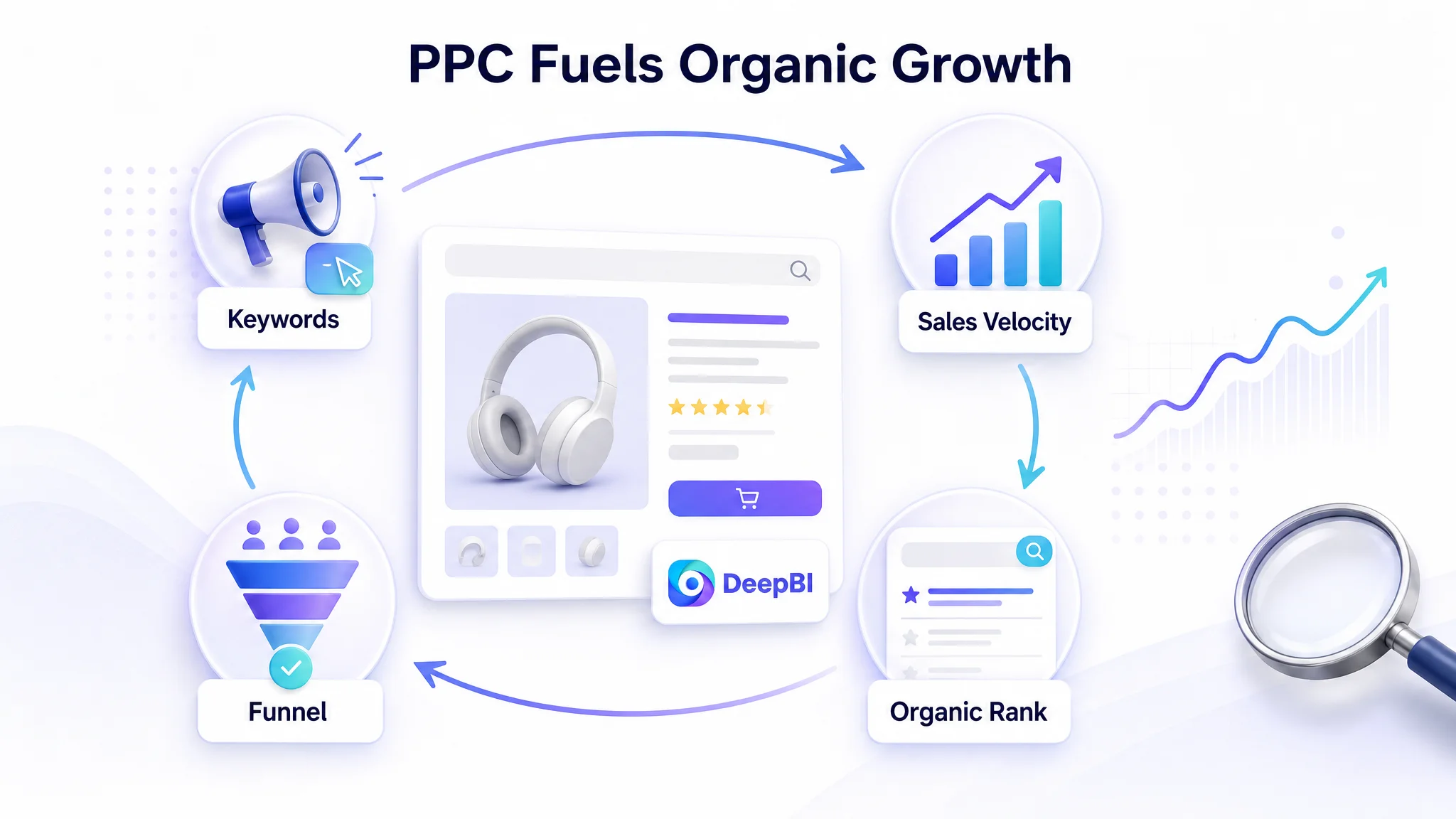
The more sales you generate through a specific keyword, the more authority your product gains for that term. This creates a powerful feedback loop: higher sales lead to a better organic rank, which increases visibility, driving even more traffic and potential sales. This is why a targeted keyword strategy is not just about discoverability; it is about proving your product's conversion power to Amazon's algorithm.
A typical pattern is what happened to a UK haircare brand in a crowded fine-hair segment. Their impressions were decent and a dominant competitor clearly led the category, but CTR and conversion lagged. Internally, the team blamed “branding” and wanted to overhaul their A+ Content. DeepBI’s diagnostics told a different story: the A+ section actually scored higher than the competitor—where they were losing was at the top of the funnel and in social proof (title and reviews). Without enough clicks from relevant searches and without sufficient review volume, they simply couldn’t generate the keyword-specific sales velocity needed for organic rank to move, regardless of how polished the lower part of the page looked.
Strategic Keyword Research: Uncovering High-Impact Terms
Effective keyword research is the foundation of organic ranking success on Amazon. This process involves more than just finding high-volume terms; it requires a deep understanding of the customer journey to align your listing with specific search behaviors.
Identifying Buyer Intent and Search Volume
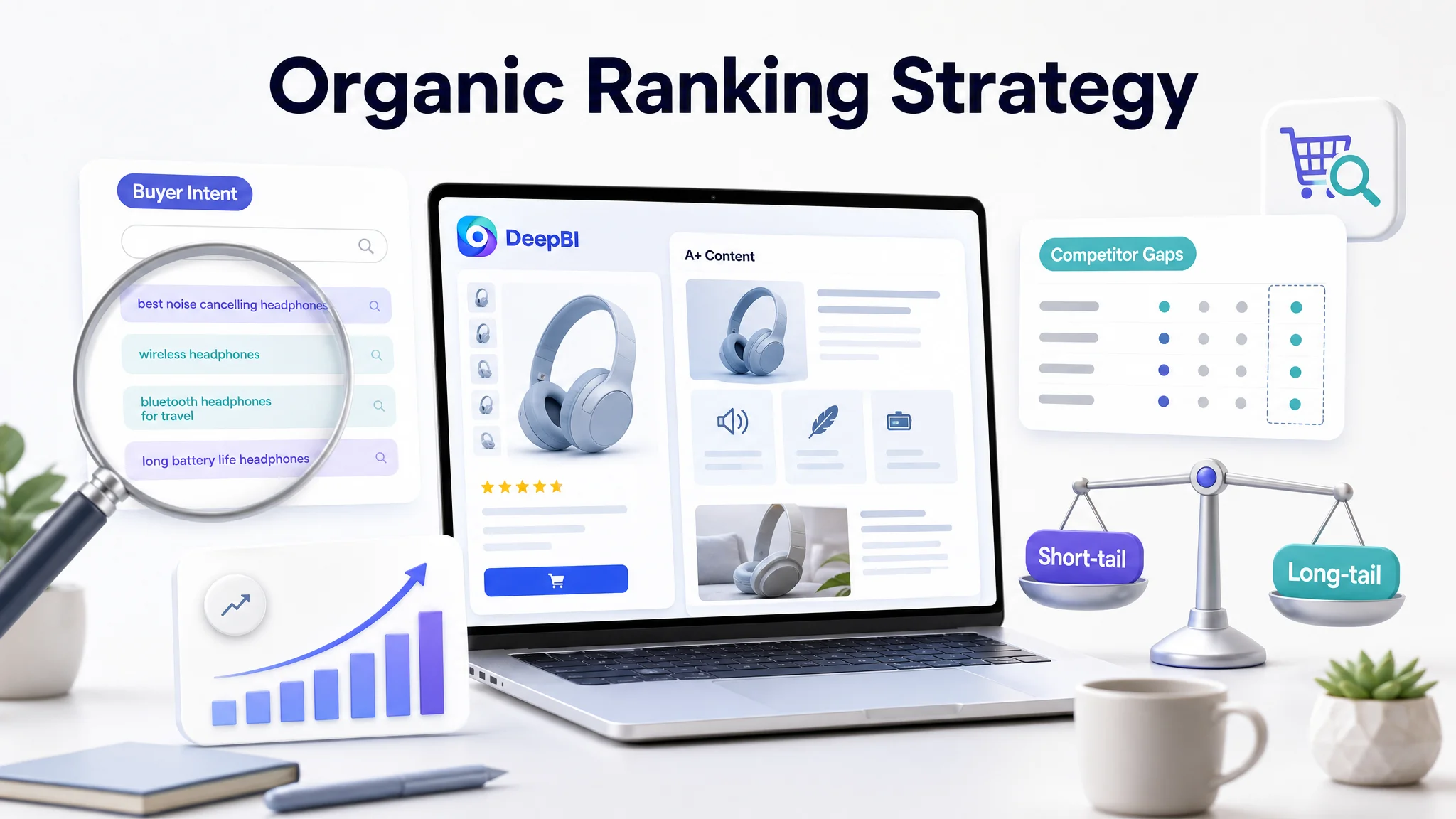
The core of a successful keyword strategy is decoding buyer intent. A customer searching for "bottle" has broad, undefined needs. In contrast, a search for "kids water bottle with straw" signals a specific, high-intent user who is much closer to making a purchase. Your goal is to capture this qualified traffic. While high search volume indicates market demand, it is the combination of volume and specific intent that drives conversions. Prioritizing keywords that reflect a clear need ensures your product appears before shoppers who are ready to buy.
In practice, misreading intent is common. In the haircare example, the brand’s original titling approach was essentially a shelf label—brand + product name + capacity—rather than a search-driven promise. Core intent phrases like “thickening shampoo”, “volumising” and “for fine hair” were underutilized or pushed to the back. The result: plenty of generic impressions, but weaker relevance for the specific, high-intent searches that actually convert—like shoppers explicitly looking for fine-hair volumising solutions.
Leveraging Competitor Insights
Your top competitors are a valuable source of keyword intelligence. Manually analyze their product titles, bullet points, and A+ Content to identify the core terms they are targeting. For a more advanced analysis, observe their sponsored ad placements to reverse-engineer which keywords they are willing to invest in, as this often indicates high-performing terms. DeepBI enhances this process through multi-dimensional semantic analysis, allowing you to systematically benchmark your keyword set against top-ranking competitors and uncover strategic gaps you can exploit.
In the UK haircare case, benchmarking against the category leader revealed exactly this kind of gap. The competitor’s title was fully loaded with ingredients, benefits, hair type, and key features, while the salon brand leaned heavily on its name and product line. Once DeepBI quantified a large title score gap and mapped the competitor’s language (“thickening”, “volumising”, “for fine hair”) against search behavior, it became obvious that the brand hadn’t lost on “creativity”—it had simply not encoded buyer-intent keywords into its most visible fields.
Long-Tail vs. Short-Tail Keywords
A successful keyword strategy balances broad (short-tail) and specific (long-tail) terms.
- Short-tail keywords (e.g., "water bottle") have massive search volume but are highly competitive and often have lower conversion rates (CVR).
- Long-tail keywords (e.g., "insulated stainless steel water bottle 32 oz") have lower search volume but capture highly specific user intent, resulting in significantly better CVR.
DeepBI helps you master this balance by analyzing your advertising data. The platform can filter and identify keywords that already demonstrate high CTR, CVR, and order values, providing a data-driven roadmap for which long-tail terms to prioritize in your organic optimization efforts.
We often see that when brands finally pivot their titles and bullets toward clearer long-tail expressions of their real use case—“for fine hair”, “volumising shampoo”, “thick and full results” in the haircare scenario—PPC data begins to show cleaner, more profitable keyword clusters. Those clusters then become the backbone of organic keyword placement, closing the loop between research and implementation.
Optimizing Your Amazon Listing with Keywords
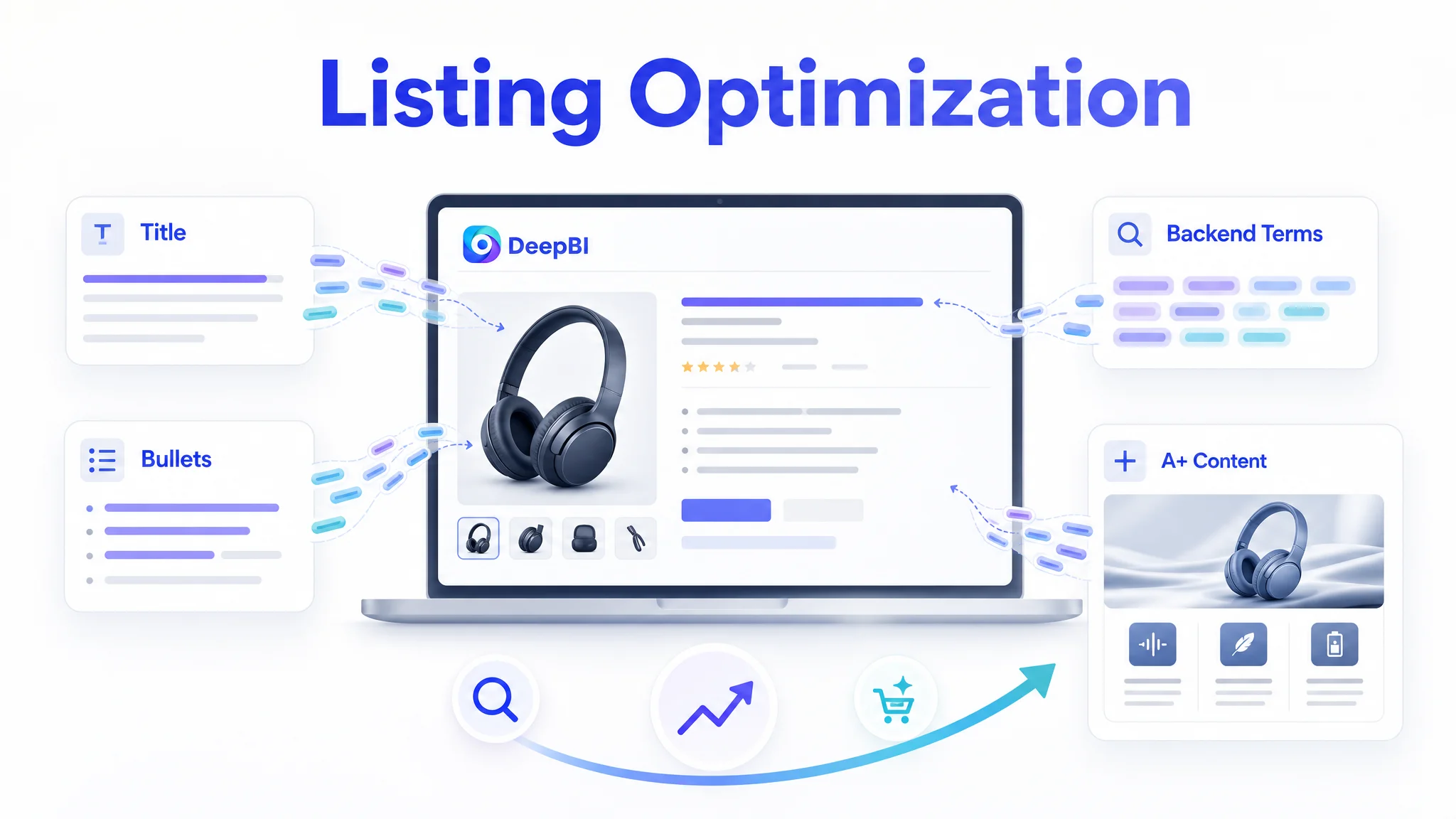
Once you have compiled a robust keyword list, the next critical step is strategic placement within your product listing. Each section of the listing serves a different purpose for both Amazon's A9 algorithm and your potential customers. Misplacing keywords can dilute their impact, hurting both your search visibility and conversion rate.
Keyword Placement in Titles and Bullet Points
The product title is the most heavily weighted field for keyword relevance. You should prioritize your most important, high-volume keywords at the beginning of the title to maximize their SEO impact and improve click-through rates (CTR) from the search results page.
The bullet points are your next most important asset for keyword integration. They should be crafted to sell the product's key features and benefits while naturally incorporating secondary and long-tail keywords. This dual approach satisfies the algorithm's need for relevant terms and the customer's need for compelling information, directly influencing CVR.
In the haircare example, DeepBI recommended reframing the title from a brand-first label to a search-first promise: leading with “thickening shampoo”, “for fine hair”, and “volumising treatment” before capacity. Bullet points were also reorganized around a “pain → promise → proof” pattern—explicitly linking fine-hair problems to volumising outcomes and then to specific technologies and ingredients. The keywords themselves didn’t change dramatically; what changed was where and how they appeared, turning static terms into a structured argument that both Amazon and shoppers could process quickly.
Maximizing Backend Search Terms
The backend search term fields are a powerful tool for keywords that do not fit aesthetically or logically into your visible listing content. This is the ideal place for synonyms, common misspellings, and other relevant search queries you want to be indexed for. Utilize all available space in these fields to cast the widest possible net without cluttering your customer-facing copy.
For instance, if your visible content targets “volumising shampoo for fine hair”, backend terms can quietly cover adjacent phrasing patterns like “volume shampoo fine hair”, “shampoo for thin hair”, or common spelling variations. In the UK haircare case, this allowed the brand to maintain a clean, premium front-end tone while still being indexed for the more functional, less polished queries buyers actually type.
Enhancing Product Descriptions and A+ Content
While the title and backend terms carry significant SEO weight, the product description and A+ Content are crucial for conversion. For Brand Registered sellers, A+ Content offers a rich canvas to tell your brand story and detail product benefits, incorporating keywords in a narrative context. Higher customer engagement and an improved CVR send strong positive signals to Amazon's algorithm, indirectly boosting your organic rank over time.
Traditional listing optimization often involves a disconnected and inefficient workflow. DeepBI streamlines this entire process into a closed-loop system. The platform’s AI systematically generates optimized titles, bullet points, and A+ Content, ensuring ideal keyword integration. This system connects diagnosis to delivery, culminating in a one-click application via the official Amazon SP-API that reduces content update times from minutes to seconds.
Crucially, the haircare brand’s experience shows that “optimizing A+” is not always the top priority. Their A+ already outperformed a key competitor, with strong before/after imagery and lifestyle storytelling. DeepBI’s role there was to layer in mechanism-level clarity (how the formula affects the hair structure, how the system should be used) using the same core keywords, rather than rewriting everything. The bigger lift came from aligning top-of-page text with search language, so more qualified shoppers actually reached that strong A+ in the first place.
The Synergy: Keywords, Sales Velocity, and DeepBI's Ad Strategies
Understanding the relationship between paid advertising, sales, and organic ranking is fundamental to success on Amazon. These elements work together in a powerful cycle, where strategic investment in one area directly accelerates growth in another. By managing this synergy, sellers can create a sustainable growth engine for their products.
How PPC Campaigns Influence Organic Keyword Ranking
A common misconception is that Pay-Per-Click (PPC) advertising directly improves organic rank. The actual mechanism is more nuanced. PPC campaigns drive targeted traffic to your listing. When this traffic converts into sales for specific keywords, it signals to Amazon's A9 algorithm that your product is highly relevant for those search terms. This demonstrated relevance, proven through sales velocity, is what ultimately improves your organic ranking. This process, however, only works if your listing is already optimized for conversion; PPC can deliver traffic, but a weak listing will not secure the sales needed to influence rank.
This is exactly where brands often misdiagnose the problem. In the UK haircare case, the team initially wanted to pour more effort into making their A+ “more salesy” while continuing to drive ads. DeepBI’s funnel analysis showed that clicks were being lost at the title and main-image stage, and trust was weakened by a tiny review base compared with a rival that had tens of thousands of reviews. Without fixing those entry and proof elements, additional PPC spend would simply buy more non-converting traffic, not the keyword-linked sales needed to nudge organic rankings.
The Sales Velocity Loop: A Continuous Growth Cycle
The interplay between paid traffic and organic visibility creates a self-reinforcing cycle. It begins with PPC campaigns driving initial sales, which boosts your organic ranking for targeted keywords. As your organic rank improves, you gain more visibility, leading to more organic clicks and sales. This increase in organic sales further enhances your overall sales velocity, reinforcing your product's relevance and pushing its rank even higher. This self-sustaining momentum, often called the "flywheel effect," is the key to long-term, profitable growth.
For that flywheel to work, every element has to be aligned: keywords must reflect buyer intent, creative must demonstrate outcomes, and reviews must provide credible social proof. In the haircare example, DeepBI’s step-by-step recommendations—reframing the title, restructuring bullets, clarifying visual proof in the image set, and then growing review volume—were specifically designed to make each PPC-driven visit more likely to convert on the core fine-hair and volumising keywords. Only then does ad spend start feeding a healthy velocity loop instead of just inflating cost.
Strategic Pricing and Promotions for Keyword Impact
To initiate the sales velocity loop, especially for a new product, a strategic approach to pricing is essential. During the initial launch phase, consider adopting a competitive low-price strategy, such as offering significant discounts, to quickly accumulate sales. The specific discount should be set flexibly based on your product costs, target profit, market competition, and brand positioning. This initial surge in sales, amplified by targeted ad campaigns, provides the critical data Amazon's algorithm needs to begin ranking your product. DeepBI's ad strategies, which leverage a "Top of Search" focus for high-value keywords, are designed to maximize the impact of this initial velocity and build sustainable ranking momentum.
In premium categories, where pack size and price can appear unfavorable next to larger, mass-market competitors, this becomes even more sensitive. The UK haircare brand, for example, was selling a smaller volume at a higher price point. Without crystal-clear messaging around “who it’s for” and “what results it delivers”, and without early review volume to back that up, promotional tactics alone could not reliably generate the right kind of sales. DeepBI’s analysis reframed pricing and deals as part of a broader keyword and positioning strategy, not a standalone lever.
Monitoring, Adapting, and Sustaining Keyword Performance
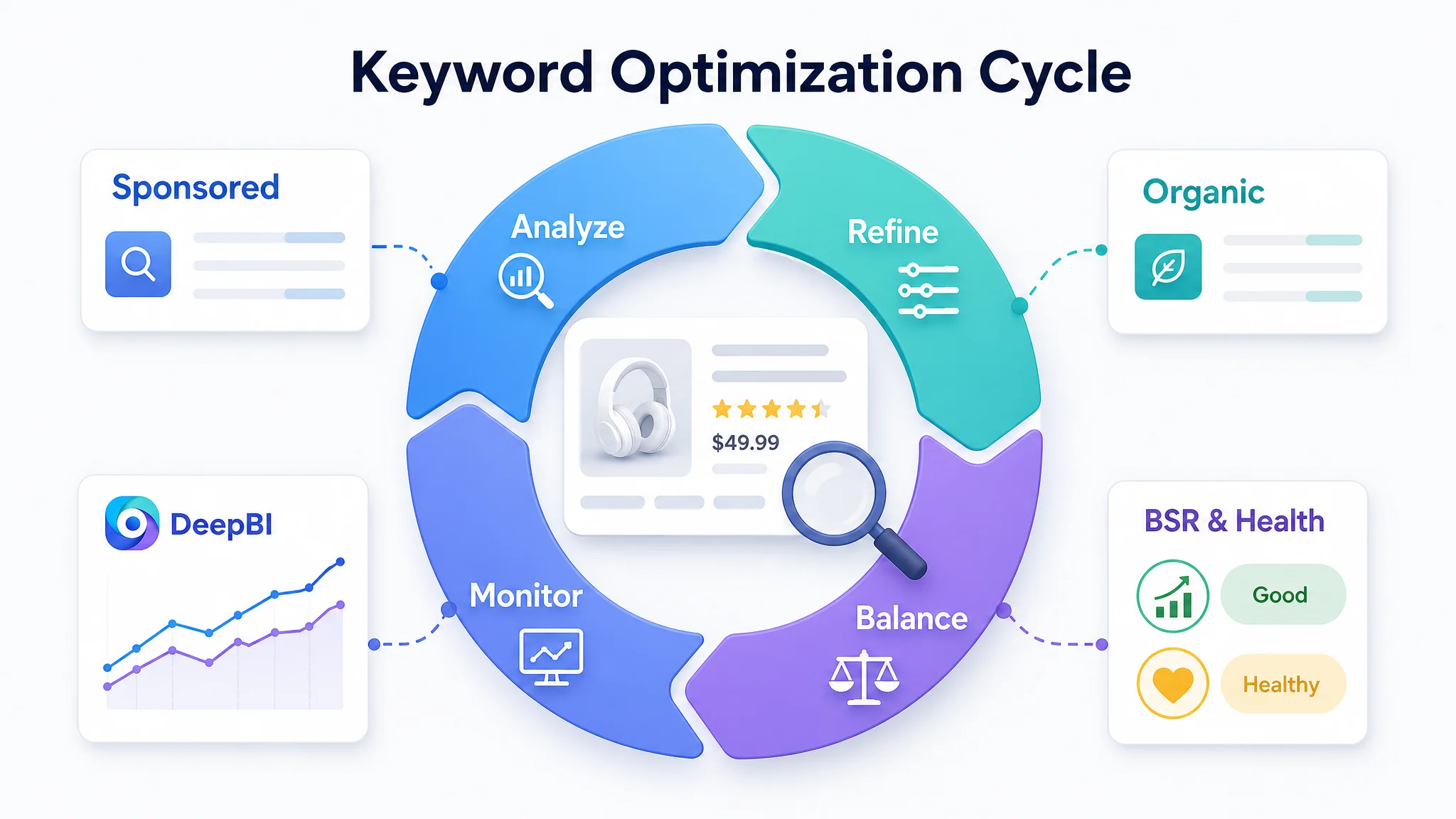
Keyword optimization is not a one-time task but a continuous cycle of analysis and refinement. Sustaining high organic rankings requires a long-term perspective, patience, and a commitment to data-driven adjustments.
The Timeline of Keyword Changes: What to Expect
After updating your listing's keywords, results are not instantaneous. It is crucial to understand the typical timeline to avoid making premature adjustments. Amazon's algorithm generally takes between 7 to 21 days to fully index new keywords and re-evaluate your product's relevance. During this initial period, you can expect ranking fluctuations as the system processes the changes.
Think of keyword optimization as a snowball, not a light switch. The effects are gradual and cumulative, building momentum over time as sales velocity and conversion rates on those keywords continuously signal relevance to Amazon.
This lag is one reason premature “creative overhauls” can be so damaging. In the haircare case, without the diagnostic clarity from DeepBI, the team was ready to rebuild their A+—the one area that was actually outperforming the benchmark—because they were impatient with early results. By understanding where the real keyword and funnel constraints were, and how long changes typically take to be reflected in ranking, they could resist constant reactive edits and instead give a well-structured plan time to compound.
Continuous Analysis and Iteration
The Amazon marketplace is dynamic, with customer search behavior, competitor strategies, and the algorithm itself constantly evolving. To maintain and improve your keyword performance, you must regularly review performance data. This involves tracking your rank for target keywords, analyzing sales reports to identify which terms are driving conversions, and monitoring competitor activity. This iterative process of monitoring, analyzing, and refining your strategy is essential for long-term success and protecting your Best Seller Rank (BSR).
Tools like DeepBI can surface patterns that are easy to miss manually. For example, analysis might show that certain volumising-related keywords in the haircare listing deliver high CTR but modest CVR, suggesting a mismatch between the promise in the search result and the proof on the page. That insight would trigger targeted adjustments to imagery or bullets around those terms, rather than a broad, unfocused rewrite.
Balancing Sponsored and Organic Keywords
Achieving a balance between sponsored and organic keywords is crucial for listing health. While some sellers find a ratio of one sponsored keyword to two organic keywords effective, the optimal mix varies by product, market, and competition. Sellers should continuously analyze data to find the best strategy for their listings. Paid campaigns provide valuable data on keyword conversion rates and drive initial sales velocity, which in turn can boost organic ranking for those same terms. This synergistic relationship allows you to use paid advertising to accelerate and inform your organic growth strategy.
In categories with entrenched leaders and huge review counts, like the haircare example, this balance becomes even more strategic. You may initially lean more heavily on sponsored placements for long-tail, high-intent terms (e.g., “volumising shampoo for fine hair”) where you can compete on clarity and outcome, using the resulting performance data to refine your organic keyword set. Over time, as reviews accumulate and the listing becomes more trusted, reliance on paid coverage for those terms can be gradually reduced.
DeepBI: Your AI Partner for Amazon Keyword Mastery
Mastering keywords requires an integrated system that connects data, content, and advertising. DeepBI provides this advantage by converting abstract strategies into precise, AI-executable instructions. It moves beyond simple tools to offer a comprehensive solution for achieving sustainable growth on Amazon.
Data-Driven Keyword Discovery and Optimization
An effective keyword strategy must be grounded in market reality, as any optimization detached from real benchmarks is a waste of resources. DeepBI functions as an "automated market health check system," not just a scoring tool. It uses rigorous data collection and a multimodal AI to identify high-value keywords based on actual market performance. This process moves beyond basic search volume to uncover terms with the highest potential to drive traffic and sales, providing a solid foundation for both your listing and advertising efforts.
In the UK haircare case, this “health check” showed something counterintuitive: the perceived problem area (A+ Content) wasn’t the bottleneck. DeepBI’s dimension-by-dimension scoring revealed that title and review volume were the real constraints, while the detail page actually outperformed the main competitor. That kind of quantified comparison prevents teams from pouring effort into the wrong part of the funnel and forces a sharper focus on where keywords and messaging are truly misaligned with market behavior.
AI-Powered Listing Content Generation
DeepBI translates data-driven keyword insights directly into high-converting listing content. The platform systematically generates optimized titles, bullet points, and descriptions designed to improve both Click-Through Rate (CTR) and Conversion Rate (CVR). For A+ Content, it deconstructs pages into six logical modules for targeted optimization, ensuring every element serves a strategic purpose. This AI-powered process eliminates the guesswork and subjective errors common in manual copywriting, ensuring your strategy is executed with precision.
For the salon brand, this meant more than just inserting extra keywords. DeepBI helped reorganize bullets around specific buyer pains (flat, fine hair), promised outcomes (visible thickness, volume), and concrete proof (technology, ingredients, usage system). It also suggested a clearer job for each main image—hero, benefit call-out, before/after, authority—so that keywords and visuals worked together to answer the exact questions raised by fine-hair shoppers.
Integrated Ad and Organic Strategy
DeepBI creates a powerful feedback loop between your paid advertising and organic ranking. It enables sellers to leverage ad campaign data to continuously refine listing content, including visual elements, for better CVR. By analyzing which keywords and creative approaches perform best in PPC, you can make informed adjustments to your organic strategy. This integrated approach builds a healthy growth model where advertising spend directly fuels organic visibility, creating a virtuous cycle of increasing traffic and sales.
In the haircare scenario, that meant using advertising performance on specific volumising and fine-hair terms to refine organic keyword prioritization and content emphasis. Instead of guessing which claims or visuals would resonate, the team could watch real search and conversion behavior, then let those patterns drive ongoing micro-optimizations—ensuring every incremental ad dollar improved both short-term sales and long-term organic positioning.

Conclusion
Dominating the Amazon marketplace begins and ends with a masterful keyword strategy. As we have explored, achieving high organic ranking is not a one-time setup but a continuous cycle of research, implementation, and refinement. In this competitive landscape, any optimization detached from real market benchmarks is ineffective. A scattershot approach to keywords will inevitably fall short, negatively impacting your Click-Through Rate (CTR), Conversion Rate (CVR), and ultimately, your Best Sellers Rank (BSR).
The real-world experiences of brands like the UK haircare seller show how easy it is to misdiagnose listing problems—focusing on “branding” or A+ content when the true constraint lies in keyword framing, title clarity, or review structure. The path to success lies in a holistic strategy that integrates every facet of keyword management, from discovery and placement to funnel design and ad alignment.
This is where advanced platforms like DeepBI can transform your approach. It functions not as a simple scoring tool but as an automated market health check system. By leveraging AI-driven analysis and rigorous data collection, you can move beyond guesswork and implement a keyword strategy that is truly aligned with market dynamics. Embracing this data-centric methodology is the key to unlocking consistent visibility, improving conversion rates, and securing a sustainable competitive edge on Amazon.