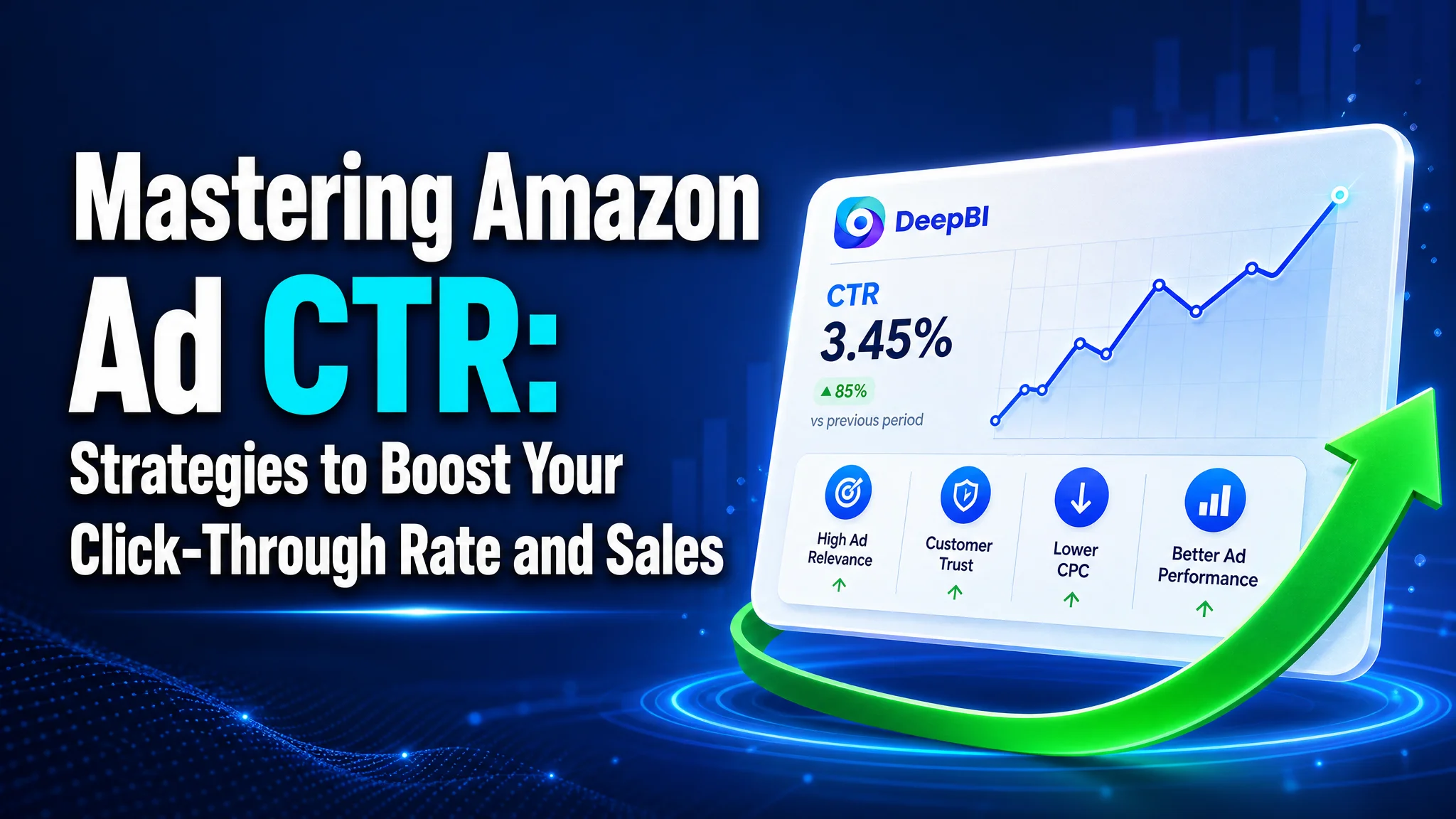
Understanding Amazon Ad CTR: Definition and Importance
Click-Through Rate (CTR) is a core metric in Amazon advertising that measures the percentage of shoppers who click an ad after viewing it. The formula is simple: (Total Clicks ÷ Total Impressions) × 100%. For instance, if an ad is displayed 10,000 times and receives 40 clicks, its CTR is 0.4%. Despite its simplicity, CTR is a powerful indicator of an ad's relevance and overall performance.
A high CTR signals to Amazon's algorithm that your ad creative and targeting are highly relevant to customer searches. This relevance directly improves your ad rank, which increases visibility and often lowers your Cost-Per-Click (CPC)—the actual price you pay for each click. It is important to distinguish CPC from the Pay-Per-Click (PPC) advertising model itself; PPC is the system, while CPC is a cost metric within it. By improving your CTR, you can drive more qualified traffic to your listings for the same ad spend, a critical step toward reducing your total Advertising Cost of Sale (ACoS).
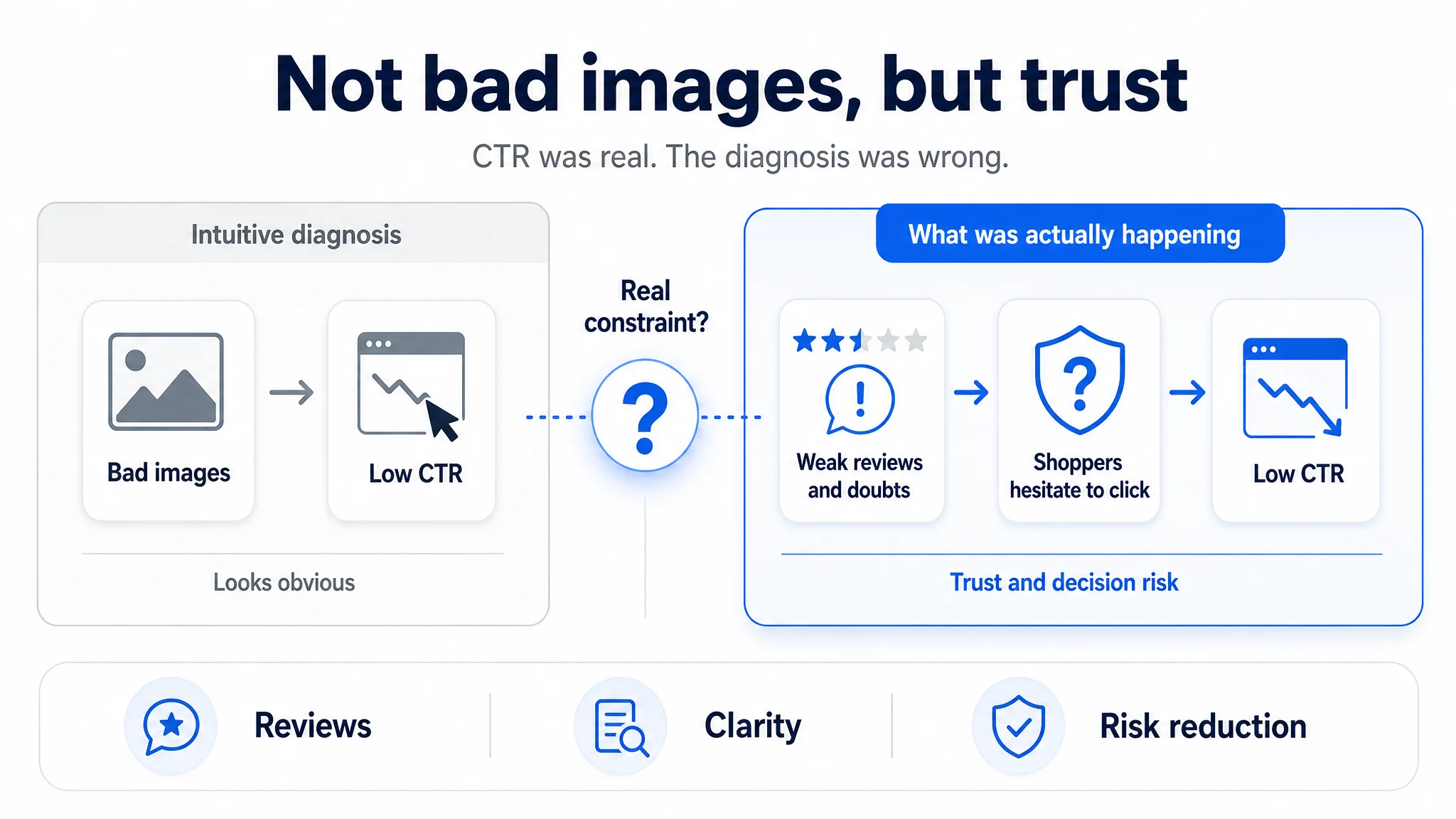
On Amazon, average CTRs typically range from 0.3% to 0.9%, though this can vary significantly by product category, competitive landscape, and ad quality. A consistently low CTR is often the first sign of a problem, frequently pointing to an unappealing main image that fails to capture shopper attention. In practice, many teams stop here and assume “our images are bad, let’s just redesign,” without verifying if the image is truly the main constraint. In one sports audio account selling swimming headphones, internal discussions revolved around “our visuals aren’t premium enough,” yet a structured diagnosis later showed the main image was only marginally weaker than the category leader—most of the performance gap actually came from low ratings and unclear usage expectations. The CTR issues were real, but the root cause was more about trust and decision risk than pure aesthetics.
 To effectively diagnose and optimize performance, you need a clear view of your metrics. Data analytics platforms like DeepBI consolidate campaign data, providing a precise overview of your current CTR and establishing the factual baseline required for strategic improvements. This kind of quantified view helps you distinguish between situations where CTR is truly capped by weak creatives and cases where CTR is being dragged down by deeper confidence issues that first show up in your click behavior.
Key Factors Influencing Your Amazon Ad CTR
A high Click-Through Rate (CTR) is not accidental; it is the result of a strategically optimized ad presentation that aligns with customer psychology and search behavior. Several distinct factors work in concert to persuade a shopper to click your ad instead of a competitor's. Understanding and mastering these elements is fundamental to enhancing your advertising performance and driving sales.
The most critical factors include:
- Ad Creative: Your main image is the single most important element for capturing attention on a crowded search results page. It must create a "visual hook" that stops the scroll. This, combined with a clear, benefit-driven title and competitive pricing, forms the core trio of click appeal. An ad for a blender showing a vibrant, perfectly smooth smoothie is far more compelling than one showing the blender in its box. In the swimming headphone example, the brand’s main image already checked the basic boxes—underwater scene, product clearly visible—but the sequence of follow-up images delayed the strongest reassurance (real underwater usage) and spent a prime slot on technical diagrams. The result was a weaker first impression in search, even though the raw image quality wasn’t far off from the benchmark.
- Keyword Relevancy: Precision in targeting is paramount. An ad targeting the long-tail keyword "quiet lightweight hair dryer for travel" will almost always have a higher CTR than one targeting the broad term "hair dryer" because it perfectly matches a specific user's search intent.
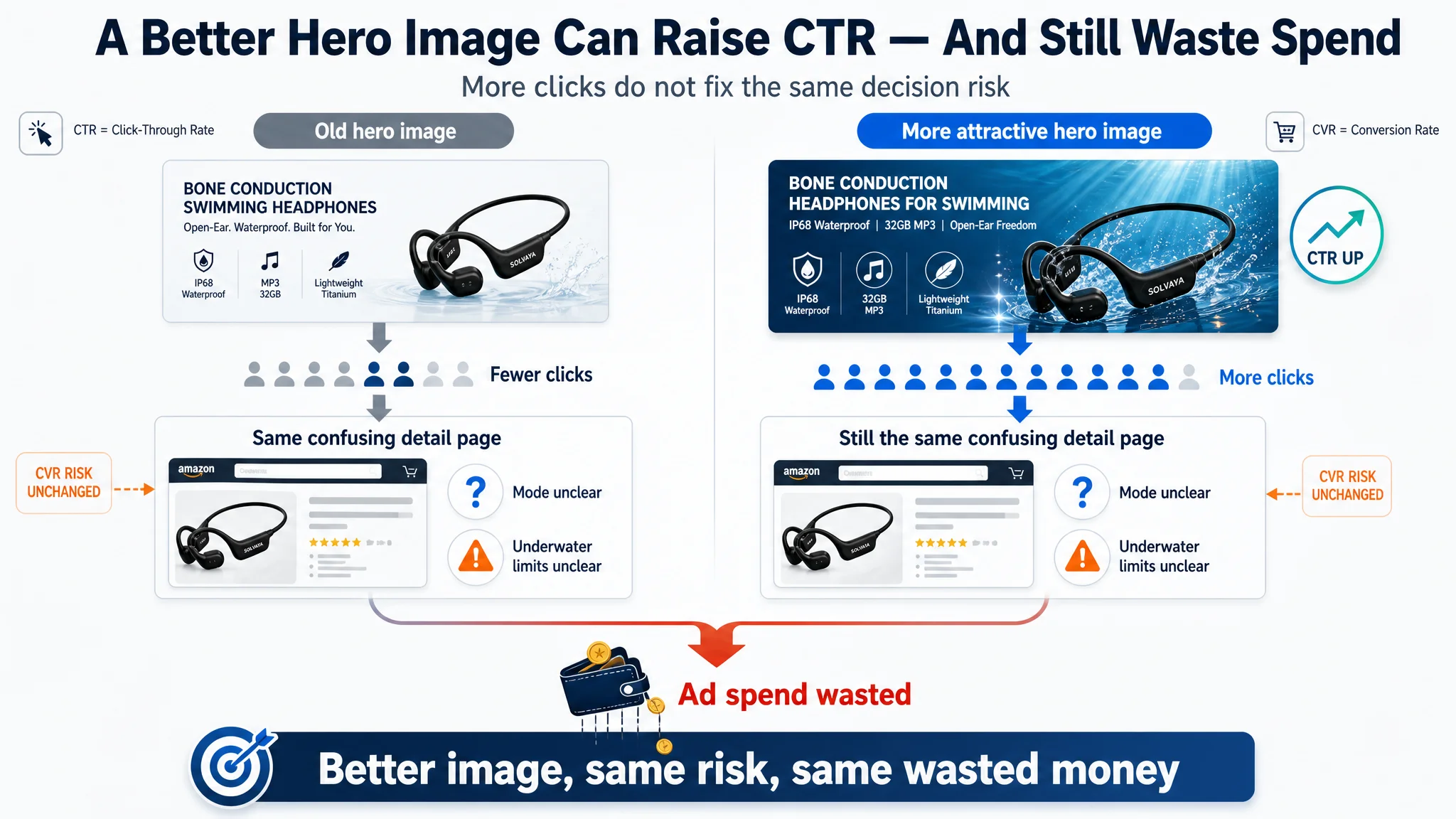
- Social Proof: High ratings and a substantial number of reviews act as powerful trust signals. Shoppers are psychologically wired to favor products endorsed by others. An ad displaying a 4.5-star rating with over 1,000 reviews is inherently more clickable than one with a 5-star rating from only three reviews. In the headphone case, the product’s 3.1-star average and a large share of low-star reviews meant that even a decent main image and technically rich copy could not fully compensate—shoppers saw the star rating in the ad unit and hesitated, suppressing CTR before they ever reached the detail page.
- Badges and Promotions: Official Amazon badges like "Best Seller" or "Amazon's Choice" serve as strong, third-party endorsements. These visual cues reduce perceived risk for the buyer and significantly increase an ad's authority and appeal.
- Prime Eligibility: For millions of Amazon Prime members, the Prime badge is a non-negotiable filter. Ads for products fulfilled by Amazon (FBA) are immediately more attractive to this massive, high-value customer segment that prioritizes fast, free shipping.
- Ad Placement: Visibility directly impacts clicks. Ads placed at the top of search results typically command a higher CTR than those appearing on product detail pages or further down the page, simply due to their prominent positioning.
Actionable Strategies to Boost Your Amazon Ad CTR
Improving your Click-Through Rate requires a dual-pronged approach: refining the ad campaigns that generate traffic and optimizing the product listings that secure the click. A strong CTR indicates to Amazon that your ads and products are highly relevant to customer searches, which can lead to better ad placements and a lower cost-per-click (CPC).
Optimizing Your Amazon Ad Campaigns (AdsQuant Module Focus)
Effective ad management is the first step toward a better CTR. This involves a disciplined approach to keyword strategy, bidding, and campaign structure. Begin by conducting thorough keyword research to target high-intent search terms, and use negative keywords to filter out irrelevant traffic that consumes your budget. Organize your campaigns into tightly themed ad groups to ensure your ad copy and landing page align perfectly with the search query.
Many sellers, under pressure from low CTR and rising ACoS, instinctively push for broader keywords or higher bids, assuming they just “don’t have enough traffic.” In reality, traffic is often not the primary constraint. In the swimming headphone account, for example, the brand was already bidding on highly relevant terms around “swimming headphones,” “IPX8 waterproof,” and “bone conduction,” and impression volume was healthy. The issue was that shoppers who saw the ad did not feel confident enough to click—largely because the visible review score and rating volume undercut the promise made by the visuals. Without recognizing this, the team risked overspending on bids in a funnel where the real bottleneck was trust, not reach.
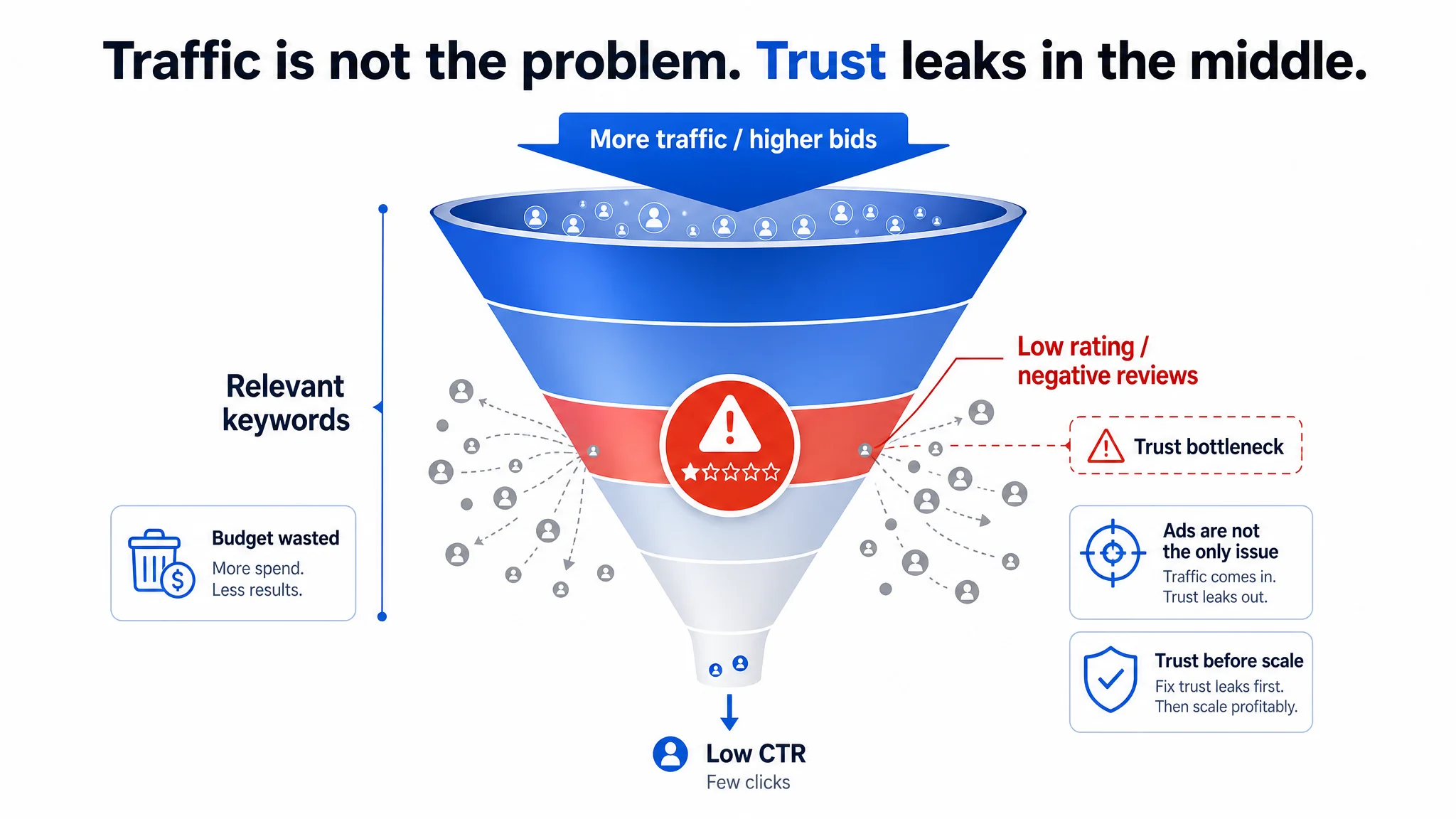 To automate and scale this process, DeepBI's AdsQuant module employs a four-layer traffic funnel model—exploration, initial screening, precision, and scaling—to systematically identify and optimize high-potential keywords and ASINs. It performs dynamic, daily adjustments to bids and budgets based on a rolling seven-day analysis of key metrics like clicks, conversions, and spend. This process ensures your budget is continuously allocated to the highest-performing targets. The system also helps you manage Advertising Cost of Sales (ACoS) effectively; while a low ACoS is generally desirable, an excessively low figure may indicate that you are under-spending and missing valuable growth opportunities.
Because AdsQuant cross-references traffic quality with listing health, it can also prevent the kind of misdiagnosis seen in the headphone case: instead of pushing more budget into keywords that are already relevant but underperforming due to low ratings and unclear expectations, it highlights that “creative and listing trust” must be addressed before scaling spend further.
Enhancing Your Product Listing and Ad Creatives (Listing Module Focus)
Your product listing is what ultimately converts an impression into a click. It must be compelling, informative, and visually appealing. Key areas for optimization include the main image, title, bullet points, and A+ Content. Strong social proof, reflected in the quantity and quality of product reviews, is also a critical factor that influences a shopper's decision to click.
DeepBI's Listing module elevates this optimization from subjective guesswork to a data-driven science. It starts by diagnosing listing weaknesses through quantitative benchmarking against top competitors. Instead of offering vague advice like "improve the image," the platform generates precise, actionable instructions for AI-powered content creation, specifying parameters such as composition, lighting, and camera angles. It can produce multiple schemes for main images, titles, and bullet points for comparison and preview before applying them with a single click via the Amazon SP-API. When a new image is published, DeepBI automatically tags a "visual iteration event" in your ad reports, creating a closed data loop that allows you to directly measure the impact of visual optimizations on your CTR over the following 7-14 days.
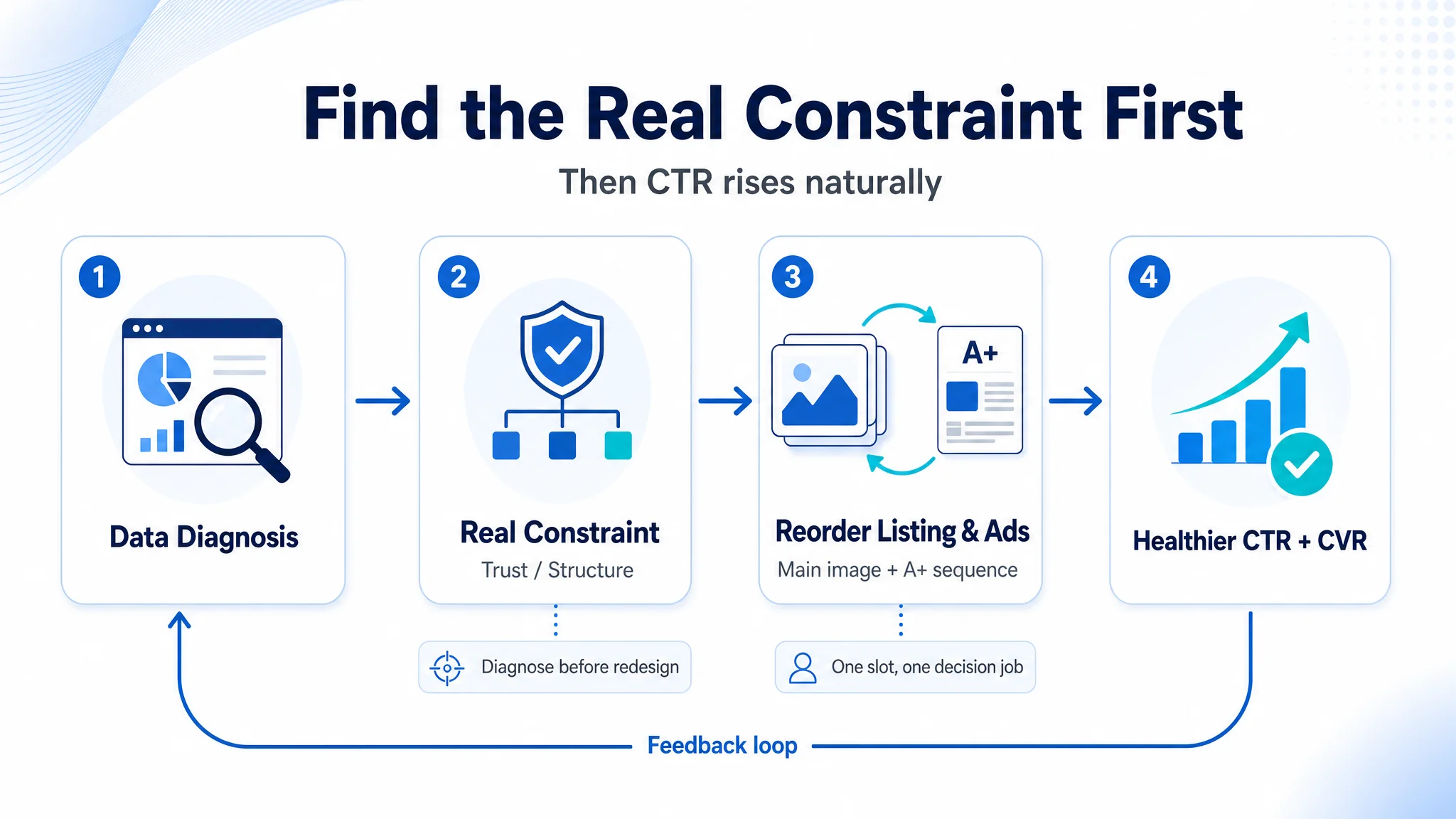
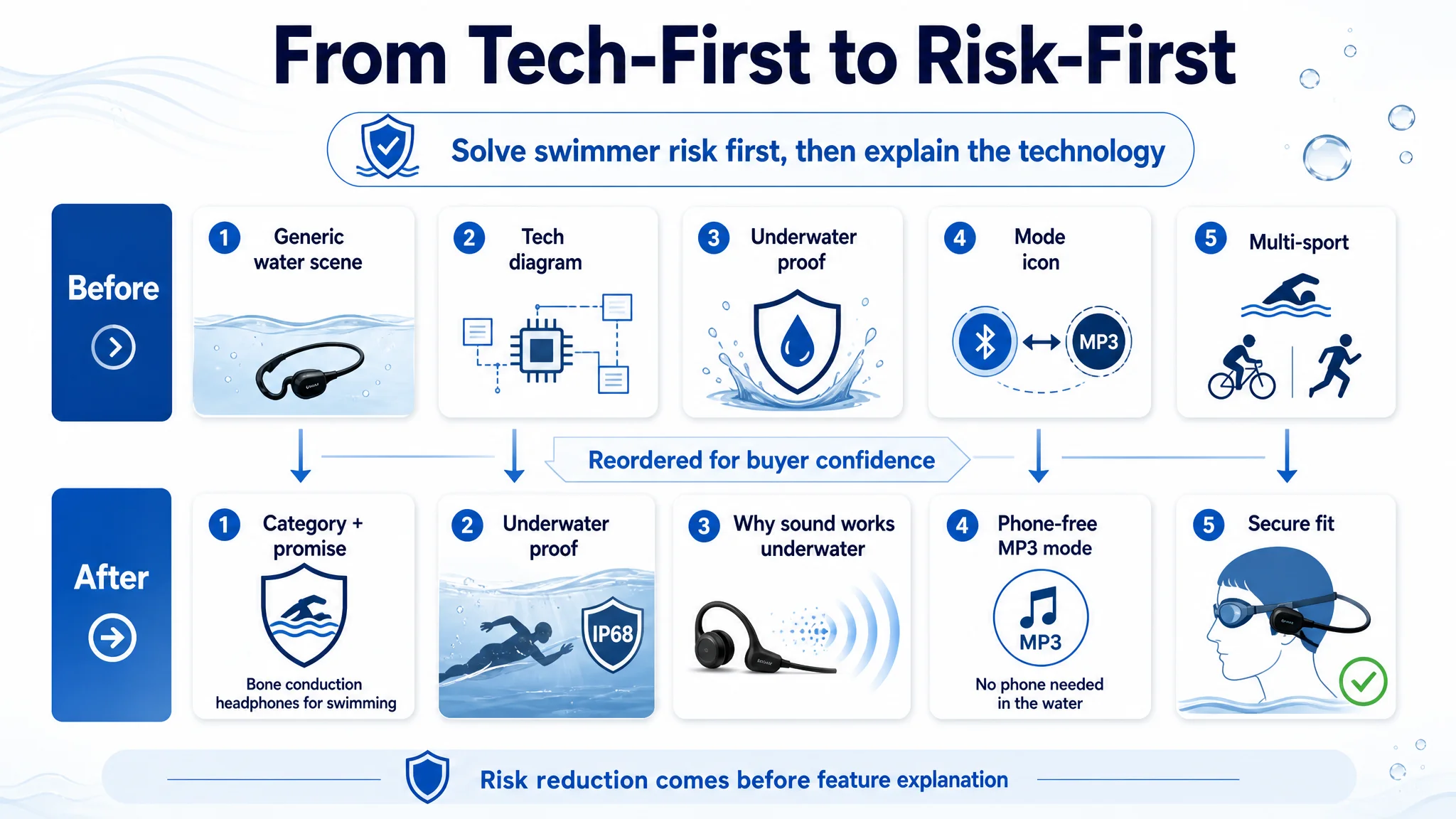
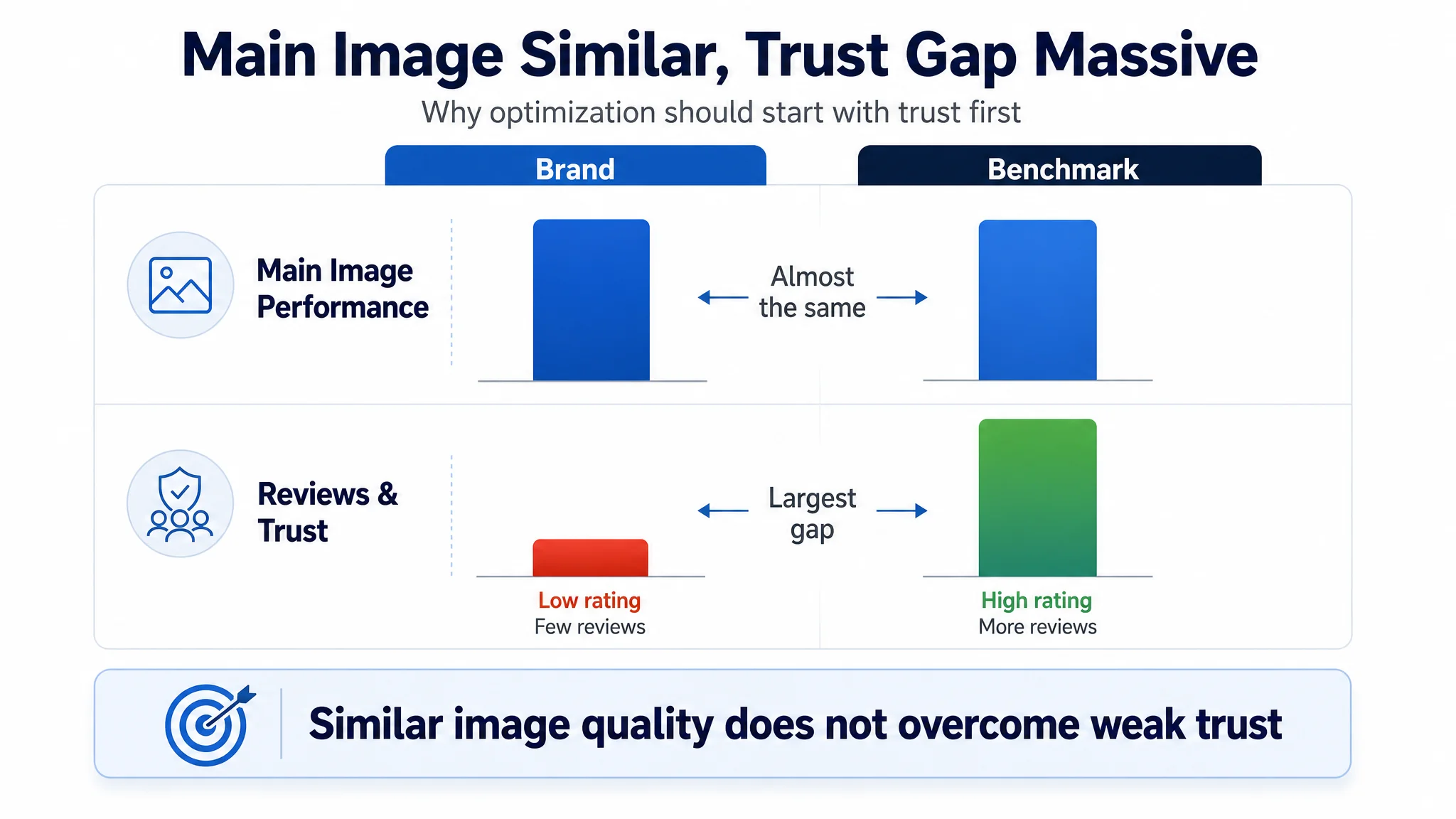 In the swimming headphone scenario, this type of listing diagnosis changed the team’s priorities. A benchmark comparison showed that the main image score was close to the category leader, while the largest quantified gap sat in reviews and in how the listing answered basic buyer questions: Can I truly swim with this? How do Bluetooth and MP3 modes work in and out of water? Will the headset stay on under a cap? Instead of commissioning an expensive full redesign aimed purely at “looking more premium,” the team re-sequenced main images to address underwater reliability earlier, rewrote bullets around usage flows and limitations, and restructured A+ modules so that risk reduction and clarity came before advanced technical claims. The goal was not just to look better in the ad slot, but to align the entire click decision with a clearer, lower-risk promise—something shoppers can sense even before they land on the detail page.
Measuring and Analyzing CTR Performance
To effectively improve your Click-Through Rate, you must move beyond surface-level observations and adopt a systematic approach to data analysis. Begin by monitoring a core set of interconnected metrics within your advertising reports: Impressions, Clicks, CTR, Conversion Rate (CVR), and Advertising Cost of Sales (ACoS). These KPIs provide a comprehensive view of your sales funnel, from initial visibility to the final purchase.
While Amazon Seller Central provides basic reporting, gaining a competitive edge requires deeper analysis. Benchmark your CTR against category averages, which typically fall between 0.3% and 0.9%. However, a "good" CTR is highly dependent on your specific niche; a rate that is excellent in one category may be underperforming in another. Interpreting trends is therefore critical. For example, a consistently low CTR (e.g., below 0.35%) often indicates that your main image lacks a strong visual hook and is failing to capture shopper attention.
At the same time, you need to be careful not to reduce every CTR problem to “image quality.” In the headphone case, a combined view of CTR, CVR, and review metrics told a more nuanced story: the ad attracted some clicks, but both CTR and CVR lagged behind the benchmark, and review content repeatedly surfaced issues around mode switching and underwater expectations. This pattern suggested that shoppers were sensing risk early—through the star rating and review count on the ad unit—and that those who did click often confirmed their doubts on the detail page. Simply swapping the main image without addressing these underlying concerns would have made it harder to interpret CTR changes: was an improvement due to better visuals, or just random fluctuation over a listing that still confused buyers?
 Advanced analytics platforms like DeepBI transform this data into actionable intelligence. Its comprehensive dashboard delivers real-time insights, functioning as an automated market health check system. The platform cross-validates ad performance data against listing quality scores to pinpoint specific weaknesses. When you implement a change, such as uploading a new main image, the system automatically marks an event in your reports. This feature allows you to precisely track the impact of your optimization on CTR over the subsequent 7-14 days, closing the loop between action and measurable results. In practice, this kind of event tagging was what allowed the headphone brand to separate the effect of re-ordered images and clarified copy from other variables like bid changes or seasonal demand, and to see whether shoppers were actually responding with more clicks and fewer drop-offs.
Continuous Optimization and Long-Term Growth
Achieving a high CTR is not a one-time fix but the start of a continuous optimization cycle essential for long-term growth. To maintain a competitive edge, sellers must iteratively test variables like ad creatives, product titles, and bidding strategies to discover what resonates most with shoppers. The Amazon marketplace is dynamic; competitor tactics evolve and the ranking algorithm is constantly updated, requiring vigilant monitoring and swift adaptation to stay ahead.
This process has a powerful holistic impact. A consistently high ad CTR sends strong positive signals to Amazon's algorithm, which can significantly boost your product's organic ranking and overall brand visibility. This synergy creates a growth flywheel where paid advertising success directly fuels organic performance. By analyzing ad data, you can identify proven high-CTR and high-CVR keywords and then strategically target them to improve your natural search placement.
In real operations, this also means rethinking what “optimization” actually is. The swimming headphone brand initially framed listing work as a dispute between design and copy—should they invest more in prettier visuals or in punchier language? After a structured diagnosis, the conversation shifted to decision sequence and risk management: which question does the first image answer, which doubts do the bullets clear, and how quickly does the A+ content neutralize predictable complaints? Once this mindset changed, their ongoing tests became more targeted: one iteration focused on surfacing underwater proof earlier in the image set; another clarified when Bluetooth does and doesn’t work; a third made mode switching visually explicit rather than burying it in text. Each test was then read through CTR and CVR changes, rather than judged by internal taste.
 DeepBI is designed to automate this entire feedback cycle. The system converts listing optimization from a reactive, manual task into a proactive, scientific process. It continuously analyzes ad performance data, generates data-backed optimization strategies, and executes adjustments in a closed-loop fashion. This ensures your listings are always evolving based on real market feedback, which helps convert stable ad signals into stronger organic rankings and drives healthier, sustainable growth without constant manual oversight.
Conclusion
Mastering your Amazon Ad Click-Through Rate is fundamental to achieving sustainable growth. A high CTR is more than just a performance metric; it is a direct signal from the market that your ads are relevant and your product visuals are compelling. This relevance translates into a more efficient advertising budget, driving down your ACoS and maximizing sales velocity. Reaching this level of performance requires moving beyond guesswork and adopting a systematic, data-driven approach to optimization.
This is where integrated platforms become indispensable. Tools like DeepBI offer an end-to-end solution that breaks down the traditional silos between performance diagnosis, content production, and delivery. By connecting advertising data directly to the listing optimization workflow, the system ensures that every change—from a main image tweak to a title revision—is a calculated move designed to improve CTR and CVR. In situations like the swimming headphone brand, this means challenging the first, intuitive diagnosis (“our images are bad”) and replacing it with a quantified, ordered roadmap that starts with the true constraint—trust and clarity—and then moves into creative refinement. This approach transforms listing management from a reactive, time-consuming task into a predictable, scientific process. By leveraging such intelligent systems, sellers can build a powerful competitive advantage, ensuring every ad dollar works harder to capture customer attention and drive long-term success.