


Understanding Amazon A+ Content: The Foundation of Enhanced Listings
A+ Content is a feature that allows brand owners to transform a standard product description into a visually rich and informative brand story. By leveraging high-quality images, comparison charts, and compelling copy, you can guide customers through your product’s features and benefits more effectively than with plain text alone.
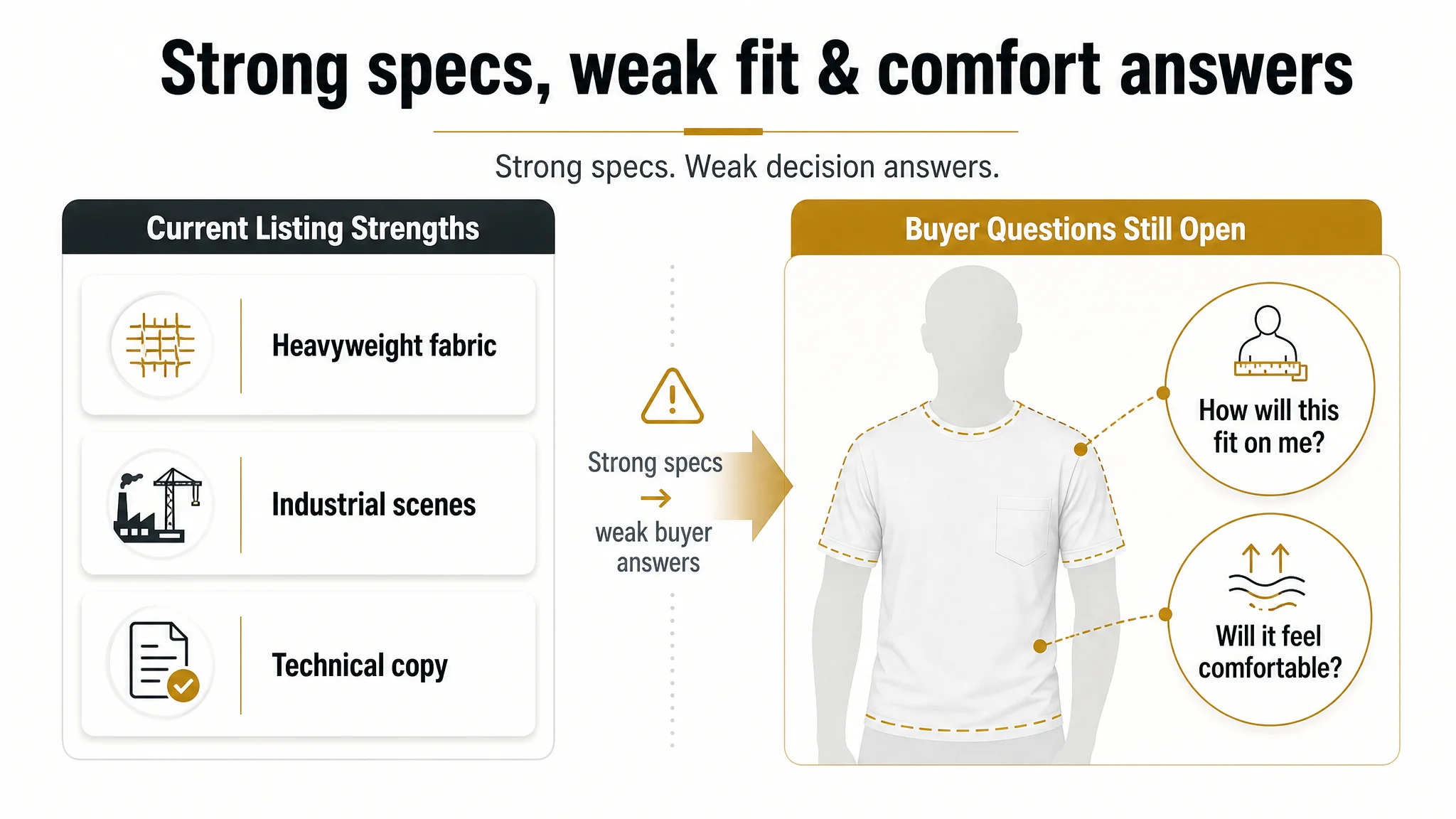
In practice, many sellers believe they are already “doing this well” because their listings are packed with specs and modules. Yet we often see the opposite: technically detailed pages that still leak conversion because the content is not telling the right story in the right order. In one workwear listing we reviewed, the seller had extensive copy about fabric weight and durability, but early images and A+ modules barely addressed basic buyer questions like “How does this fit on me?” and “Will this feel comfortable for a 10‑hour shift?” The content was rich, but it wasn’t structured around how shoppers actually decide.
 What is Amazon A+ Content?
Amazon A+ Content, formerly known as Enhanced Brand Content (EBC), is available to sellers enrolled in the Amazon Brand Registry program. It enables you to enhance product detail pages by replacing the standard text description with a modular layout of rich media. This layout can include custom-formatted text, high-resolution images, and detailed comparison charts, creating an engaging shopping experience that effectively communicates your brand's value proposition.
These modules are not just decorative; they define the sequence in which a shopper consumes information. When that sequence is misaligned with buyer priorities, even high-quality assets underperform. The workwear seller mentioned earlier had strong industrial photography and technical diagrams, but because comfort, fit, and sizing clarity were buried deeper in the A+ instead of being surfaced early, many new visitors bounced before those strengths were ever seen.
Why A+ Content is Crucial for Amazon Sellers
Strategically implemented A+ Content directly impacts key performance indicators. According to Amazon, well-crafted A+ pages can increase conversion rates by up to 10%. This lift in CVR not only boosts sales but also improves the efficiency of advertising spend, leading to a lower ACoS. Furthermore, by providing comprehensive product information and addressing potential customer questions upfront, A+ Content helps reduce return rates and build stronger brand trust, which encourages repeat purchases.
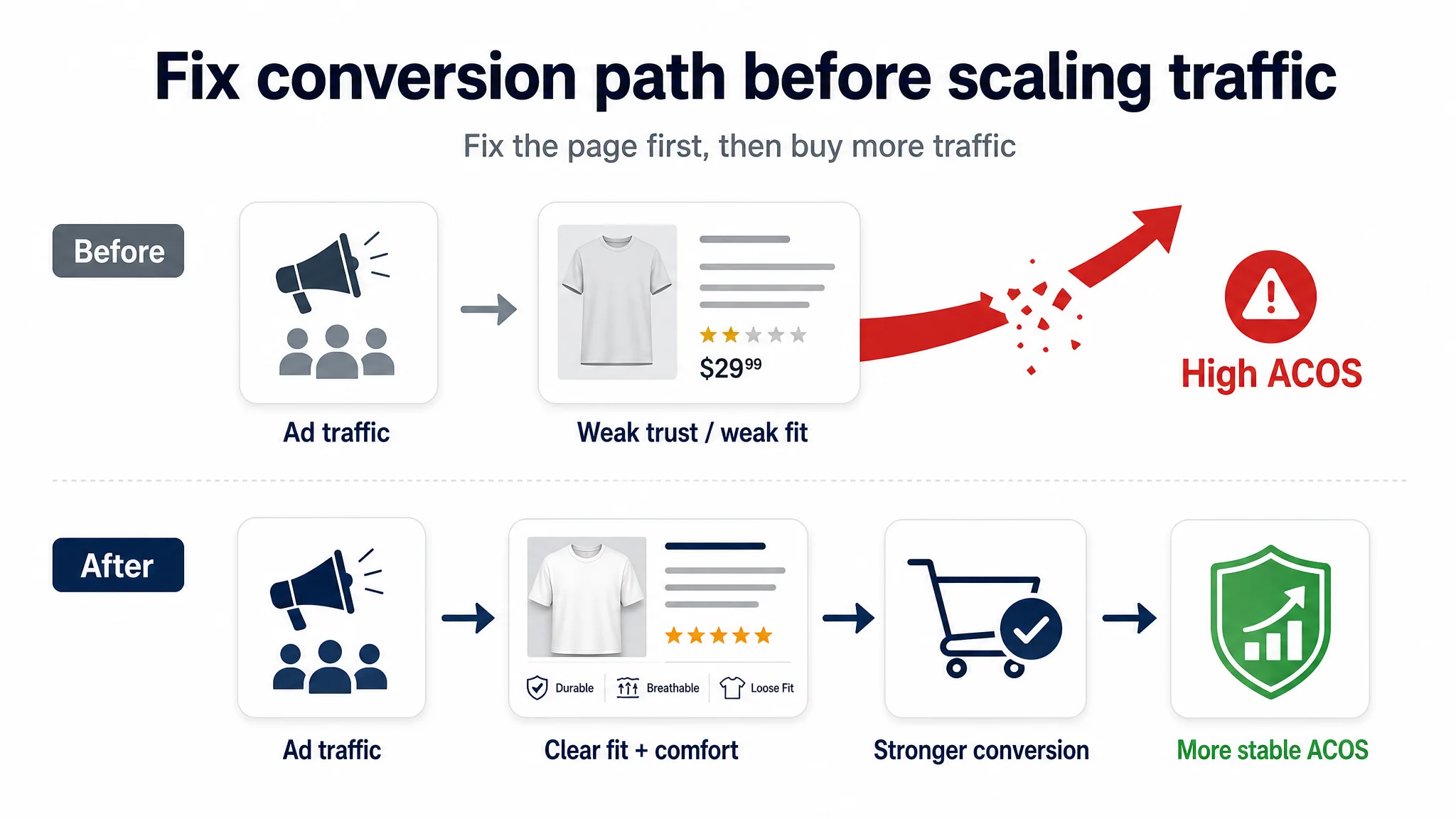
This relationship between A+ and ad efficiency becomes very visible in real operations. The work T‑shirt seller initially treated rising ACOS as a pure “ads problem” and kept tweaking bids and keywords. Only after diagnosing the listing did it become clear that the page itself wasn’t resolving shoppers’ trust and fit concerns. Once the main-image sequence and A+ modules were restructured to balance toughness with comfort and sizing clarity, the same ad traffic started converting more predictably—demonstrating that A+ content quality can be a bigger lever than further ad optimization.
 Eligibility for Basic and Premium A+ Content
There are two tiers of A+ Content, each with its own eligibility requirements:
- Basic A+ Content: This is available to all professional sellers who are approved as brand owners through the Amazon Brand Registry program. It provides access to a solid range of modules to build out your product story.
- Premium A+ Content (A++): This advanced tier offers more sophisticated features, such as video modules, interactive hotspots, and wider image layouts. Historically an expensive, invitation-only feature, Premium A+ is now available at no cost to brands that meet specific criteria, which typically involve having an active brand story published and A+ content approved on a significant number of ASINs within their catalog.
Access to Premium A+ only unlocks potential. Whether that potential turns into real performance depends on whether you use modules to answer the first, simplest questions in a buyer’s mind. In categories like apparel, we repeatedly see sellers invest in rich Premium features while still neglecting fundamentals like showing a clear on-body fit early in the content.
Strategic Pillars of High-Converting A+ Content
Effective A+ content moves beyond simple product descriptions to become a powerful conversion tool. Building it requires a strategic approach grounded in four key pillars, which can transform your page from a static brochure into a compelling sales narrative.
Know Your Audience and Product Story
The most successful A+ content begins with a deep understanding of your customer's pain points. Instead of merely listing features, craft a cohesive brand narrative that presents your product as the definitive solution. Structure your page logically to guide the shopper's journey, moving from an introduction and core selling points to pain point resolution and trust-building endorsements, creating a seamless path to purchase.
When this narrative is off, conversion suffers even if individual modules look “good.” In the workwear example, the narrative heavily emphasized “industrial toughness” from the first screen, which resonated with existing heavy users but didn’t immediately reassure new buyers about everyday comfort and fit. Once the seller reframed the story to “rugged yet comfortable for long shifts,” and brought fit and comfort visuals forward, the same facts became more persuasive because they now matched the buyer’s mental sequence.
Compelling Visuals: Beyond Basic Product Shots
With 76% of Amazon shoppers making purchasing decisions based on product images alone, your visuals are a core commercial engine driving both Click-Through Rate (CTR) and Conversion Rate (CVR). Go beyond basic white-background shots by incorporating high-quality lifestyle images, informative infographics, and clear comparison charts. These assets must not only look professional but also maintain absolute product authenticity to build trust and prevent post-purchase issues.
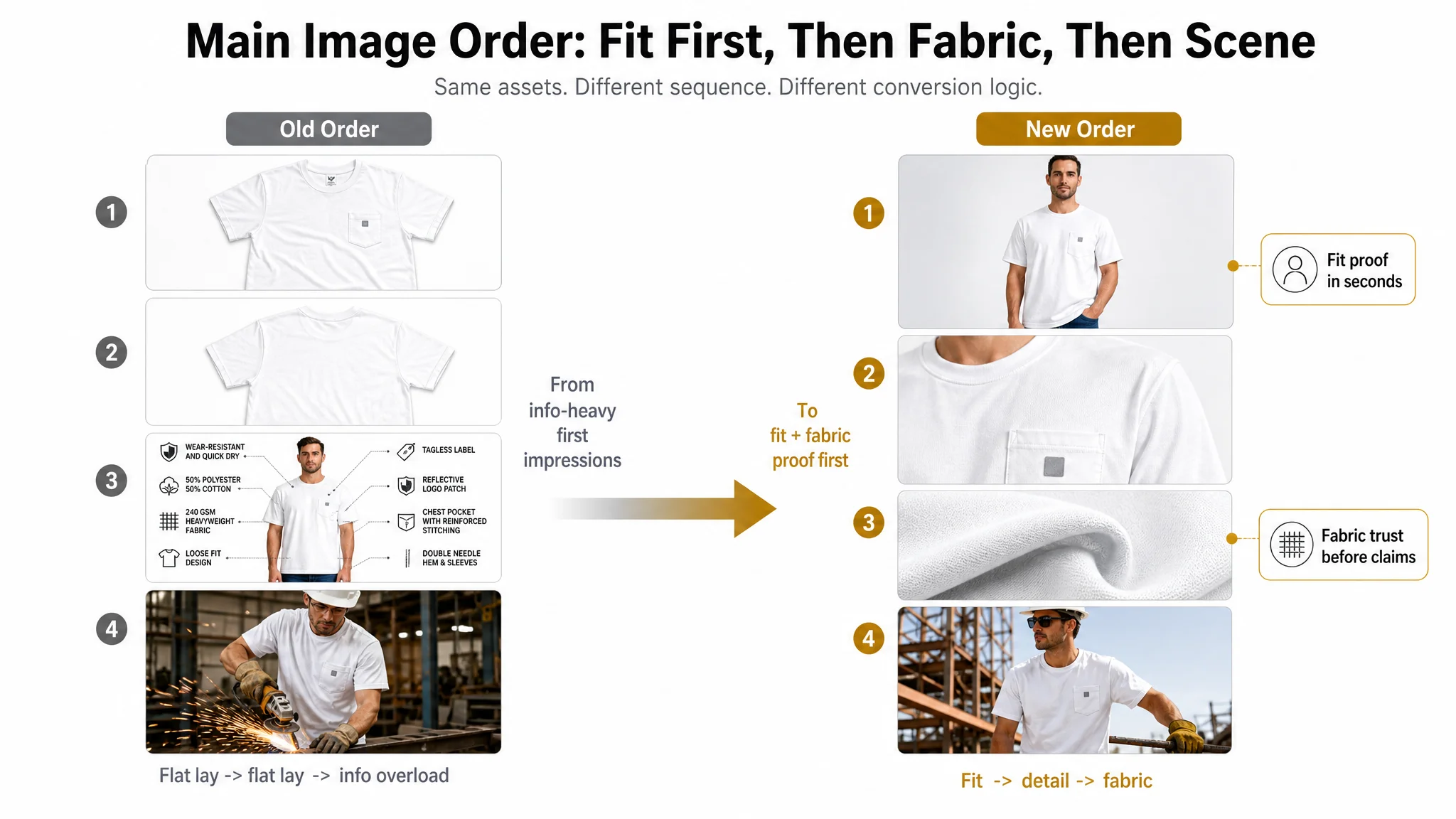
What often breaks performance is not the lack of visuals, but the wrong visual order. The T‑shirt seller had multiple angles, industrial scenes, and text overlays detailing “240 GSM heavyweight fabric,” yet early images were mostly flat lays and dense infographics. Buyers could not quickly see how the shirt fit on a real person or what the fabric felt like beyond a claim. After switching to a model hero image, a close-up fit/detail shot, and a clear fabric texture image before reintroducing industrial scenes, the visuals began to answer core questions in the first few seconds—exactly where most shoppers decide whether to keep scrolling.
 Engaging Copywriting: Features, Benefits, and Solutions
Modern shoppers do not read; they skim. Avoid long, dense paragraphs that are likely to be ignored. Instead, use bold headings, short sentences, and bullet points to create scannable, benefit-driven copy. Frame your text around a "pain point-solution" model. A highly effective formula is: [Selling Point Name] + [Data or Proof] to [Resolve Specific Customer Need]. This structure directly connects a feature to a tangible benefit, making the value proposition instantly clear.
In real listings, we see a common mistake: bullets and A+ text are stacked with specs but lack a buying logic. In the workwear case, the seller initially listed fabric composition, weight, and stitching details as separate, somewhat repetitive claims. When those same elements were restructured into a sequence—first bullet proving toughness with 240 GSM, second bullet translating the fabric blend into “all-day comfort in long shifts,” third bullet focusing on functional details that matter on the job—each line started to remove a specific customer doubt instead of adding noise.
Mobile Optimization: Designing for the On-the-Go Shopper
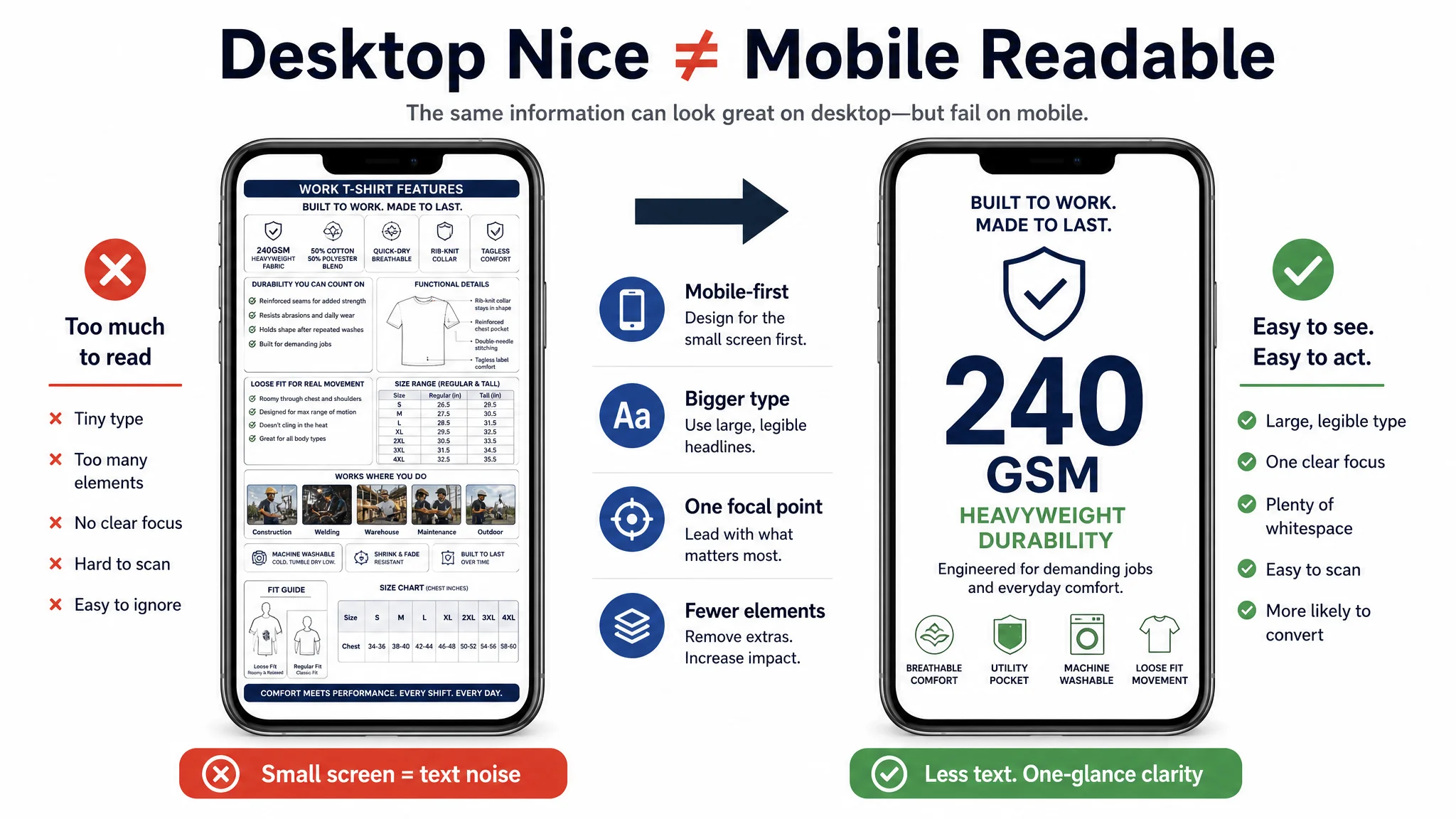
Over 60% of Amazon's traffic comes from mobile devices, where A+ modules stack vertically. A desktop-centric design will inevitably fail on the platform where most of your customers shop. Adopt a mobile-first approach by ensuring images are clear and impactful on small screens, text is large and legible, and copy within each module is concise. This focus on mobile readability reduces friction and keeps shoppers engaged as they scroll.
In practice, listings that were designed on large monitors often break down on phones: text overlays become unreadable, complex infographics turn into clutter, and key visuals shrink to the point of losing impact. In the T‑shirt listing, several early images included dense technical text and multiple small icons, which looked acceptable on desktop but became illegible on mobile. Simplifying those graphics and prioritizing clean, single-focus visuals made the mobile A+ flow much easier to scan, which is where most of the traffic actually was.
 Advanced A+ Content Optimization Techniques
Beyond the fundamentals, advanced A+ content involves a strategic blend of high-impact modules, data-driven iteration, and integration with your broader growth strategy. This requires a shift from subjective design choices to a systematic, performance-focused approach.
Leveraging DeepBI for A+ Content Excellence
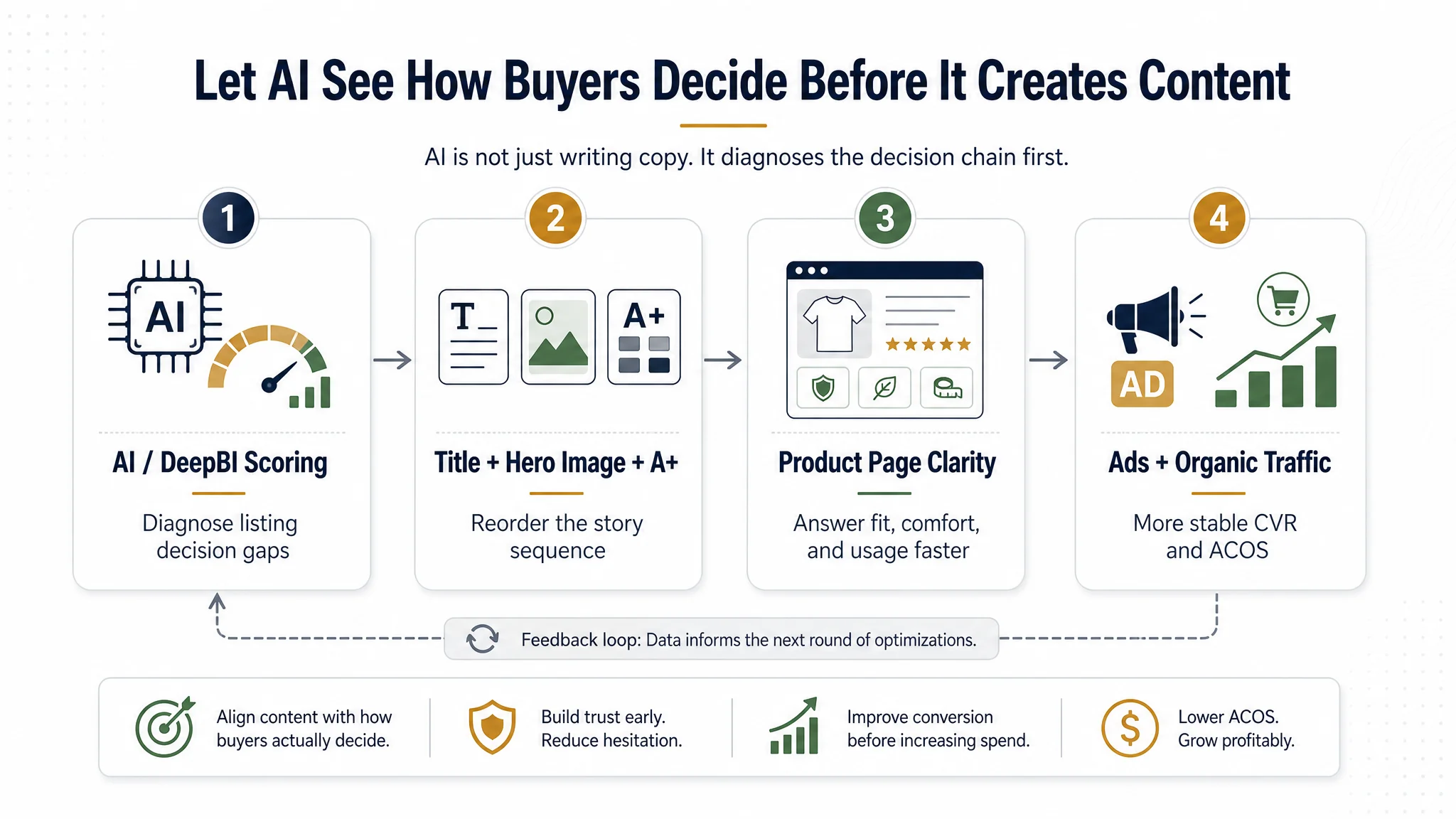
To execute advanced strategies at scale, sellers can leverage specialized AI platforms like DeepBI. This Amazon-only system creates a closed loop covering diagnosis, strategy, generation, and delivery. It begins by automatically benchmarking your listings against top-performing competitors, providing multi-dimensional scores for your images, title, bullet points, and A+ content to pinpoint specific weaknesses.
Based on this diagnosis, DeepBI generates structured optimization strategies and uses AI to produce conversion-focused copy and visuals. Instead of a tedious manual upload process, the platform uses the Amazon SP-API for one-click application, syncing new content directly to your listing in seconds and closing the loop from analysis to launch.
This kind of diagnosis often challenges initial assumptions. In the workwear case, the seller’s listing actually scored slightly higher than a key competitor overall, especially on depth of technical information. However, DeepBI’s breakdown showed that the “extra strength” was concentrated in later-stage industrial detail, while weaker elements like title structure and early visuals were hurting first impressions. That gap between “total score” and “decision-stage score” was exactly where conversion was leaking.
Top-Performing A+ Content Modules and Their Impact
Choosing the right modules is critical for maximizing engagement and conversion. While standard modules like comparison charts are effective for cross-selling, Premium A+ content offers even more powerful tools. For eligible sellers, incorporating modules with rich media can yield significant returns:
- Auto-play Video: Can increase Conversion Rate (CVR) by an estimated 12-18% by demonstrating product use and value dynamically.
- Interactive Hotspots: Can boost customer engagement by 10-15% by allowing shoppers to explore key features interactively.
These modules help answer customer questions proactively, reduce friction in the purchasing process, and create a more compelling brand experience.
However, these advanced modules work best when they are aligned with the buyer’s real questions. In the T‑shirt example, the priority was not adding more module types, but reassigning roles: using the opening A+ banner to balance rugged work identity with visible comfort, bringing fit imagery and Tall-size clarity into earlier modules, and leaving technical diagrams and size charts to the end where buyers are ready to make a final decision. The module choice mattered less than the function each module served in the decision path.
Continuous Testing and Iteration for Performance Gains
A+ content optimization is not a one-time task but an ongoing process of refinement. The goal is to continuously improve performance based on data. While general testing principles are valuable, it is important to note that DeepBI does not support A/B testing for listings. Instead, it enables data-driven iteration by connecting content changes to performance metrics. For example, after a new A+ version is published, you can monitor its impact on KPIs like unit session percentage and CVR to validate whether the changes are driving positive results.
In practice, this mindset shift is crucial. The workwear seller initially kept iterating ad structures while leaving the page largely unchanged. Once they treated listing changes as experiments—rebuilding the hero image, simplifying early A+ modules, and then watching how unit session percentage moved over the following weeks—they could see which specific content changes actually improved conversion, rather than attributing everything to “market conditions” or “traffic quality.”
Integrating A+ Content with Your Overall Amazon Strategy
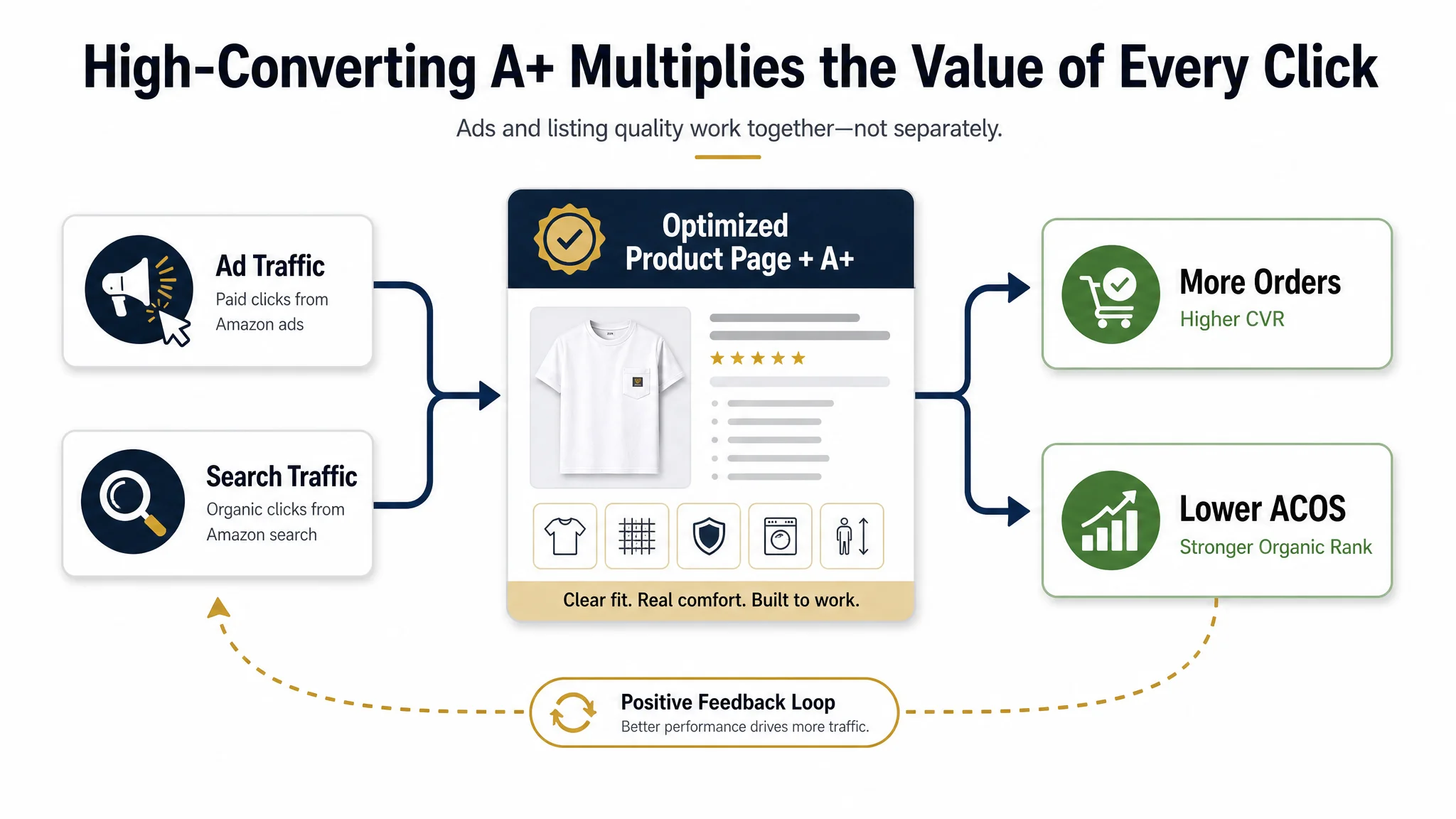
Effective A+ content creates a powerful synergy with your other marketing efforts. A high-converting product detail page directly enhances your advertising campaigns. By increasing your CVR, strong A+ content makes every ad click more profitable, leading to a lower Advertising Cost of Sale (ACoS) and improved ad ROI. Furthermore, the increased engagement and higher conversion rates send positive signals to Amazon's algorithm, which can contribute to a better organic search ranking over time.
This synergy is easy to overlook when teams are siloed. In the T‑shirt case, the ads team kept “fixing” campaigns that were, in reality, feeding into a page that over-indexed on industrial mood while under-serving basic trust needs. Once the listing was reframed around fit, comfort, and tall sizing—and only then did the seller step back into serious ad scaling—the same or even lower budgets began to produce more controllable results, because the landing page was finally aligned with the promise made in the ads.
 Common Pitfalls to Avoid in A+ Content Creation
Creating effective A+ Content involves more than just beautiful design. Many sellers invest heavily in visuals only to see conversion rates stagnate or even fall. Avoiding common mistakes is crucial for turning your A+ modules into a powerful sales tool.
Over-Designing and Information Overload
A frequent mistake is prioritizing subjective aesthetics over clarity. While visually appealing, overly complex layouts and dense blocks of text can overwhelm shoppers, causing them to abandon the page. Remember that "good-looking" is not always "good-selling." Instead of cramming every feature into one module, structure your content logically to guide the customer. Focus on scannable text and clean visuals that highlight core selling points and solve customer pain points, which will directly improve your Conversion Rate (CVR).
We see this very clearly in technically oriented categories. The workwear seller’s original main-image sequence used several rich compositions with multiple overlays, icons, and repeated industrial scenes. On desktop, the visuals looked “impressive,” but for a new buyer on mobile, they were cognitively heavy and repetitive. After simplifying each image to serve a single purpose—fit, fabric, scenario—customers could absorb the same information much faster, and the page stopped consuming traffic with unnecessary complexity.
Neglecting Mobile Responsiveness
With a majority of shoppers browsing on their phones, a desktop-centric design is a critical oversight. A+ Content modules that look perfect on a large screen can become jumbled, unreadable, or visually broken on a mobile device. This poor user experience immediately undermines trust and can lead to lost sales. Always design with a mobile-first mindset by ensuring images are clear, text is legible, and modules stack logically on smaller screens. Preview your content on a mobile device before publishing.
In the T‑shirt listing, some early A+ modules combined multiple small callouts and dense technical text. These looked fine during desktop previews but collapsed into clutter on mobile, with key claims reduced to tiny, unreadable fonts. Only after prioritizing larger typography, fewer on-image words, and simpler layouts did the mobile experience match the seller’s original intention.
Inconsistent Branding and Messaging
Your A+ Content is a direct extension of your brand identity. Using inconsistent logos, color schemes, fonts, or tone of voice across your modules and the rest of your listing confuses customers and weakens brand credibility. A cohesive brand presentation builds trust and reinforces your identity, encouraging customer loyalty. Ensure your A+ Content strictly adheres to your established brand guidelines, treating them as immutable constraints for a professional and trustworthy appearance.
Inconsistency also shows up at the messaging level. The workwear listing originally projected a very intense “dangerous jobs only” tone in early modules, whereas the title and bullets also appealed to more general work and casual scenarios. By softening the visuals to “rugged yet comfortable” and aligning copy across title, bullets, and A+ modules, the seller reduced that internal conflict and made the page feel like one coherent brand voice instead of mixed signals.
Ignoring Amazon's Guidelines and Policies
Failing to comply with Amazon's rules can lead to content rejection, listing suppression, or negative customer experiences. This includes both technical specifications and content policies. Authenticity is a red line; never fabricate product parameters, exaggerate features, or show accessories that are not included. All visuals must be consistent with the physical product to avoid misleading customers, which can result in damaging reviews and increased return rates. Also, be aware that for any given ASIN, A+ Content provided by a vendor through Vendor Central will take precedence over content submitted by a seller.
In categories like apparel, there is an added temptation to visually enhance fit or fabric beyond reality. In the T‑shirt case, the seller had correctly represented the heavyweight fabric and construction, but initially relied too heavily on text claims without clear visual proof. The optimization work focused on making the real qualities more obvious—like showing genuine fabric texture and on-body drape—rather than inventing new promises. That alignment between visual and physical reality is what protects both conversion and long-term review health.
Future-Proofing Your Amazon A+ Content Strategy
To maintain a competitive edge, sellers must move beyond a static, "set it and forget it" mindset. The Amazon ecosystem is constantly evolving, with frequent updates to policies, A+ Content modules, and consumer behavior. Future-proofing your strategy requires a commitment to continuous monitoring and adaptation, treating listing optimization as a dynamic, ongoing process rather than a one-time project.
Adapting to Amazon's Evolving Landscape
Staying competitive on Amazon requires constant vigilance. Sellers must actively monitor changes to Amazon's A+ Content policies, the introduction of new creative modules, and shifts in customer search and purchasing behavior. A content strategy that was effective last quarter may be obsolete today. Success hinges on adopting an agile and iterative approach, continuously refining your listings to align with the platform's current best practices and market demands. This proactive stance ensures your content remains relevant, compliant, and optimized for maximum impact.
In real operations, this often means revisiting listings that seem “good enough” whenever performance drifts. The workwear seller’s page did not suddenly become bad; rather, buyer expectations and competitive standards moved, while their listing stayed locked in an older narrative. It was only when traffic and ACOS trends forced a re-evaluation that they discovered how much the content sequence needed to be updated to match current shopper behavior.
The Role of AI in Content Creation and Optimization
Artificial intelligence is transforming listing management from an art based on experience into a science driven by data. AI-powered tools are now indispensable for analyzing performance, identifying trends, and executing optimizations at scale. These systems create a powerful feedback loop between your advertising and your organic presence.
By analyzing advertising data, AI can identify keywords with high Click-Through Rates (CTR) and Conversion Rates (CVR). This intelligence informs a dual strategy: targeted ad campaigns are established to boost "Top of Search" visibility for these terms, while the A+ Content is simultaneously optimized to visually reinforce the features that drive those conversions. This synergy between paid traffic and a high-converting detail page accelerates sales velocity, improving both short-term ad performance and long-term organic rankings.
In the workwear case, AI-based listing scoring exposed a critical insight: the seller’s strengths were concentrated in later-stage technical reassurance, while early-stage content lagged. By using that data to redesign the title, main images, and front sections of A+, the seller effectively rebalanced the listing around the queries and concerns that were already producing strong CTR in their ads—but weren’t yet being answered clearly on the page.
 Conclusion: Elevate Your Brand with Optimized A+ Content
Mastering Amazon A+ Content is no longer about simple copywriting or subjective aesthetics; it has evolved into a data-driven science. In today's competitive marketplace, your visual assets must function as a core commercial engine, engineered to drive clicks and conversions. Moving away from guesswork and "gut-feeling" optimizations is essential for survival and growth. Every change to your listing, from a single image to a module layout, must be a calculated decision designed to produce a measurable improvement in your key performance indicators.
The workwear example illustrates a pattern many sellers face: a listing that seems technically strong, ads that are “doing their job” bringing traffic, and yet conversion and ACOS remain stuck. The turning point was not a new campaign structure, but a reframed A+ story and main-image sequence that finally answered how the product fits, feels, and performs in the way buyers actually decide.
Adopting a full-funnel, data-centric approach transforms listing optimization from a high-risk project into a predictable, scientific process. By leveraging advanced analytics and tools like DeepBI, you can ensure that every pixel change is directly tied to visible gains in Click-Through Rate (CTR) and Conversion Rate (CVR). This methodology converts operational experience into a concrete data evidence chain, allowing you to build a more profitable listing based on market reality. By embracing this continuous optimization cycle, you can lock in a decisive winning advantage and build a resilient brand that thrives on Amazon.