Introduction: The Data Imperative for Amazon Sellers
In the hyper-competitive arena of Amazon, sellers face constant anxiety over two key metrics: Click-Through Rate (CTR) and Conversion Rate (CVR). The era of simple listing updates is over, as today's marketplace demands a level of precision that intuition alone cannot provide. Many sellers still fall into the trap of making modifications based on subjective aesthetics, pouring resources into design changes only to see their core metrics stagnate or decline. This traditional approach, heavily reliant on a designer's personal experience, makes it impossible to quantify the business impact of an optimization effort. While a competitor's listing may perform better, without data, it is impossible to diagnose why—is it their scene composition, information density, or a more compelling trust signal?
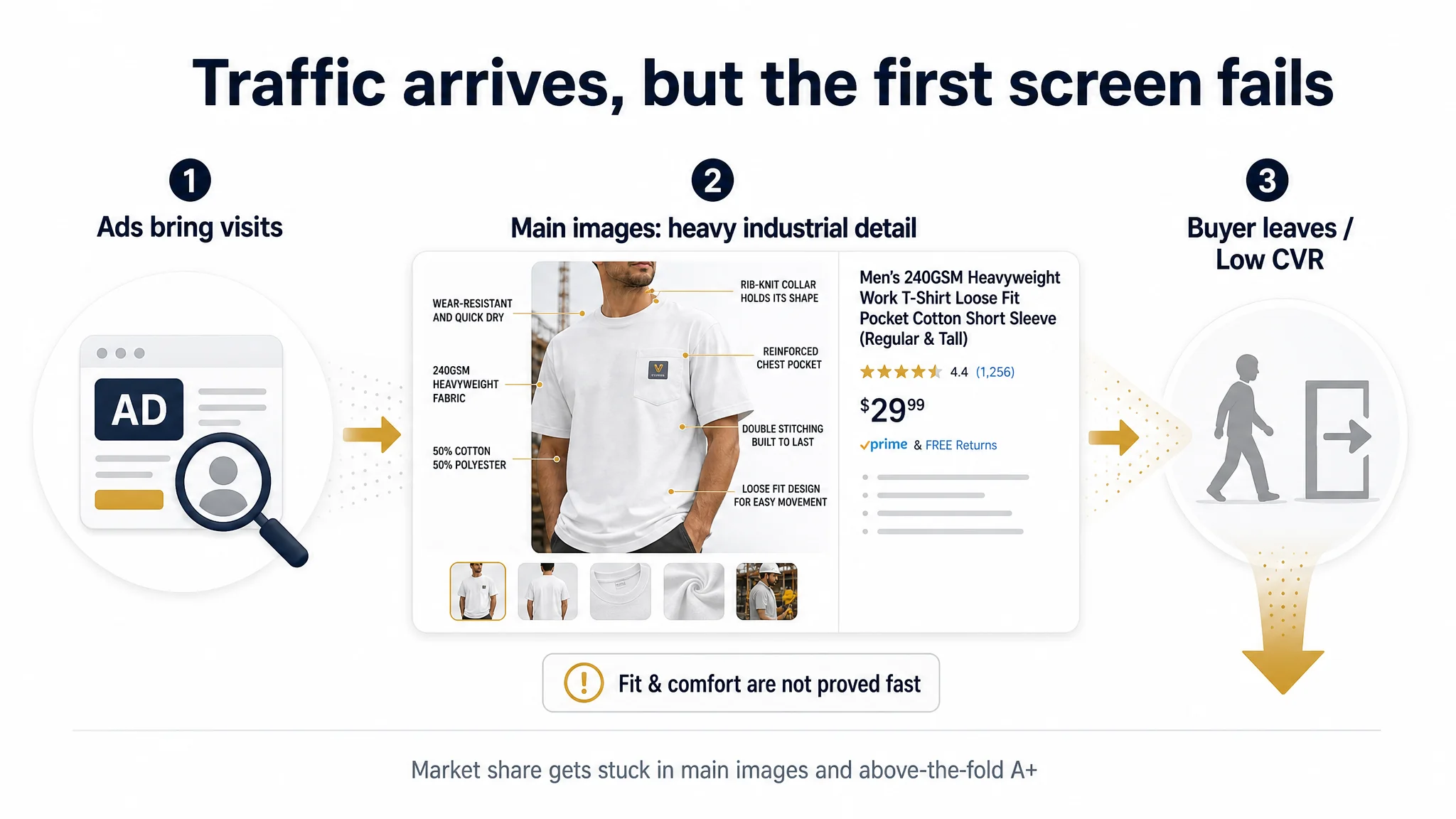
This disconnect between “nice design” and “actual effect” is not theoretical. A workwear seller in the US, for example, had already invested heavily in detailing durability, fabric specs, and industrial scenarios for a heavyweight men’s pocket T‑shirt. On paper, their listing looked technically robust and even scored slightly higher than a key competitor in a DeepBI benchmark. Yet, ad traffic was not converting as expected. Internally, the team assumed the problem must lie in Amazon ads—bids, keywords, and campaign structure—and started endlessly tweaking campaigns. Only when the listing was scored dimension‑by‑dimension did it become clear that the leak was not in the ad console at all. The core issue was that the main images and A+ content were not answering basic buyer questions early enough: “How does it actually fit on me?” and “Can I trust the fabric feel and comfort?” As long as those concerns remained unresolved on the page, no amount of ad optimization could sustainably fix ACOS or TACOS.

Success on Amazon has evolved from an art into a science, requiring a fundamental shift from speculative trial and error to establishing a clear data-backed rationale for every decision. The goal is to eliminate the subjective errors of human judgment and convert complex operational choices into a standardized, repeatable process. This transforms your product visuals and copy from a mere aesthetic display into a core commercial engine engineered to drive clicks and sales. By leveraging data, you ensure that every modification is a calculated move designed to produce a measurable improvement in your most critical KPIs. This guide provides the essential statistics and frameworks to help you transition from creating listings that are simply good-looking to those that are demonstrably effective at selling.
Understanding Amazon's Marketplace Dynamics
To succeed on Amazon, sellers must first grasp the fundamental structure of the marketplace. The platform operates on a dual model that creates distinct competitive environments and data landscapes, directly impacting strategy and growth potential.
The Dual Nature: 1P vs. 3P Sales
Amazon's ecosystem is divided into two primary seller relationships. First-party (1P) sales involve manufacturers selling their products wholesale to Amazon, which then retails them under the "Ships from and sold by Amazon.com" label. This relationship provides brands with access to certain types of aggregate sales data directly from Amazon.
In contrast, third-party (3P) sales involve independent businesses or individuals selling directly to consumers through the Amazon marketplace. These sellers retain control over their inventory, pricing, and fulfillment strategies, whether using Fulfillment by Amazon (FBA) or Fulfillment by Merchant (FBM). While this model offers greater flexibility, it presents a significant data challenge in understanding the broader competitive context.
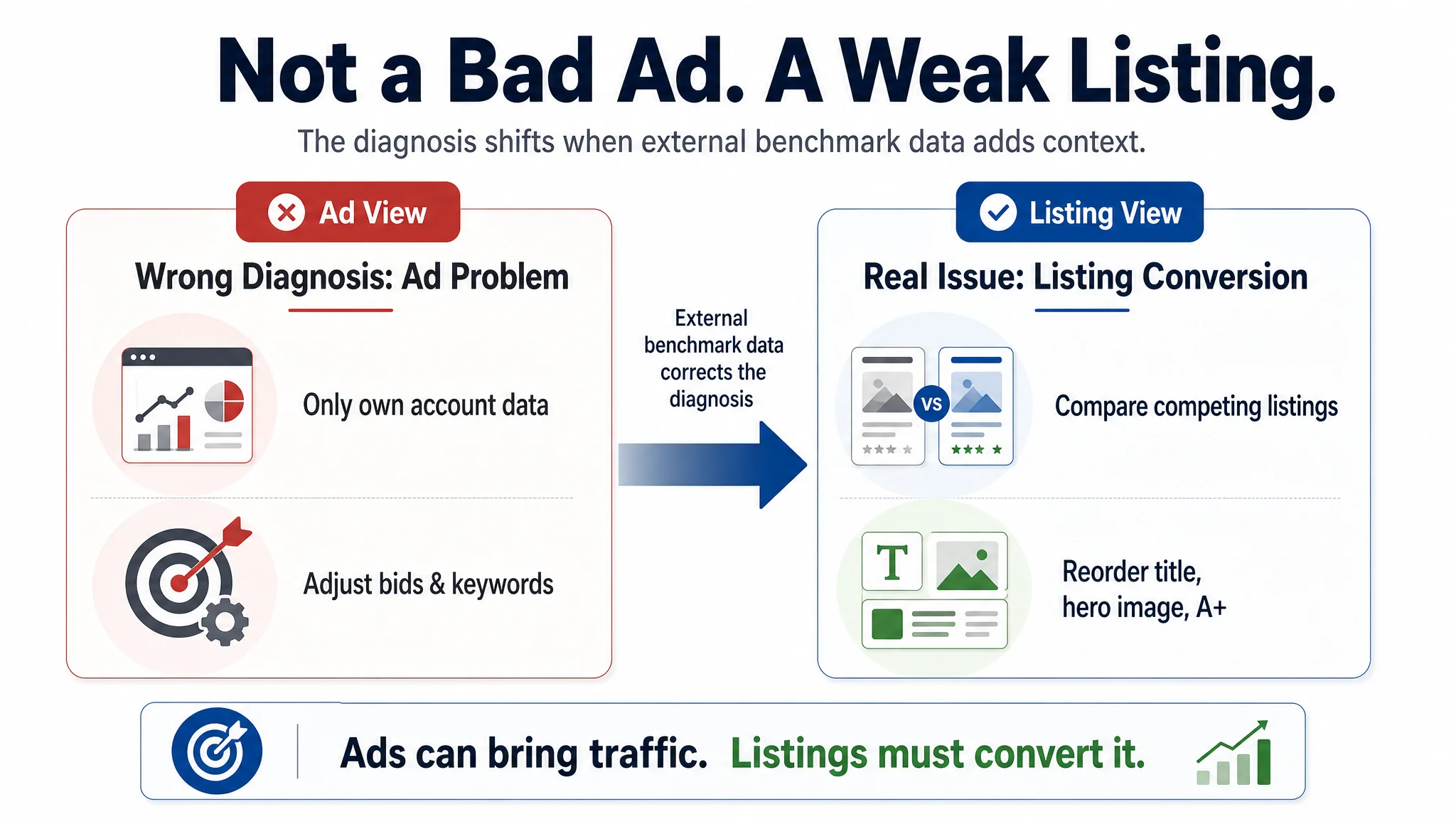
This tension between control and visibility often shows up in how teams interpret their own performance. For the workwear seller mentioned earlier, the internal dashboards painted a partial picture: ads were bringing in traffic, CTR was acceptable, but CVR lagged. Because they only saw their own 3P account data, the instinct was to diagnose “ad problems” in isolation. It wasn’t until their ASIN was benchmarked against a competitor with different title structure, image sequence, and A+ narrative that they understood the real issue: in the same 3P environment, a rival listing was simply answering buyer questions in a more logical order. Without that external lens, they were trying to solve a listing problem with an advertising tool.
The Scale of Third-Party Sellers
Third-party sellers are not a niche segment; they are the dominant force on the platform, accounting for the vast majority of all physical units sold. This immense scale creates a highly competitive environment where understanding market share and competitor performance is critical for survival and growth.
However, gaining this understanding is a significant hurdle. While Amazon's native seller analytics tools offer performance data for an individual account, they provide no direct, category-wide data on 3P activity for competitive benchmarking. To accurately assess market positioning and identify opportunities, sellers must turn to specialized analytics platforms capable of providing these crucial insights.
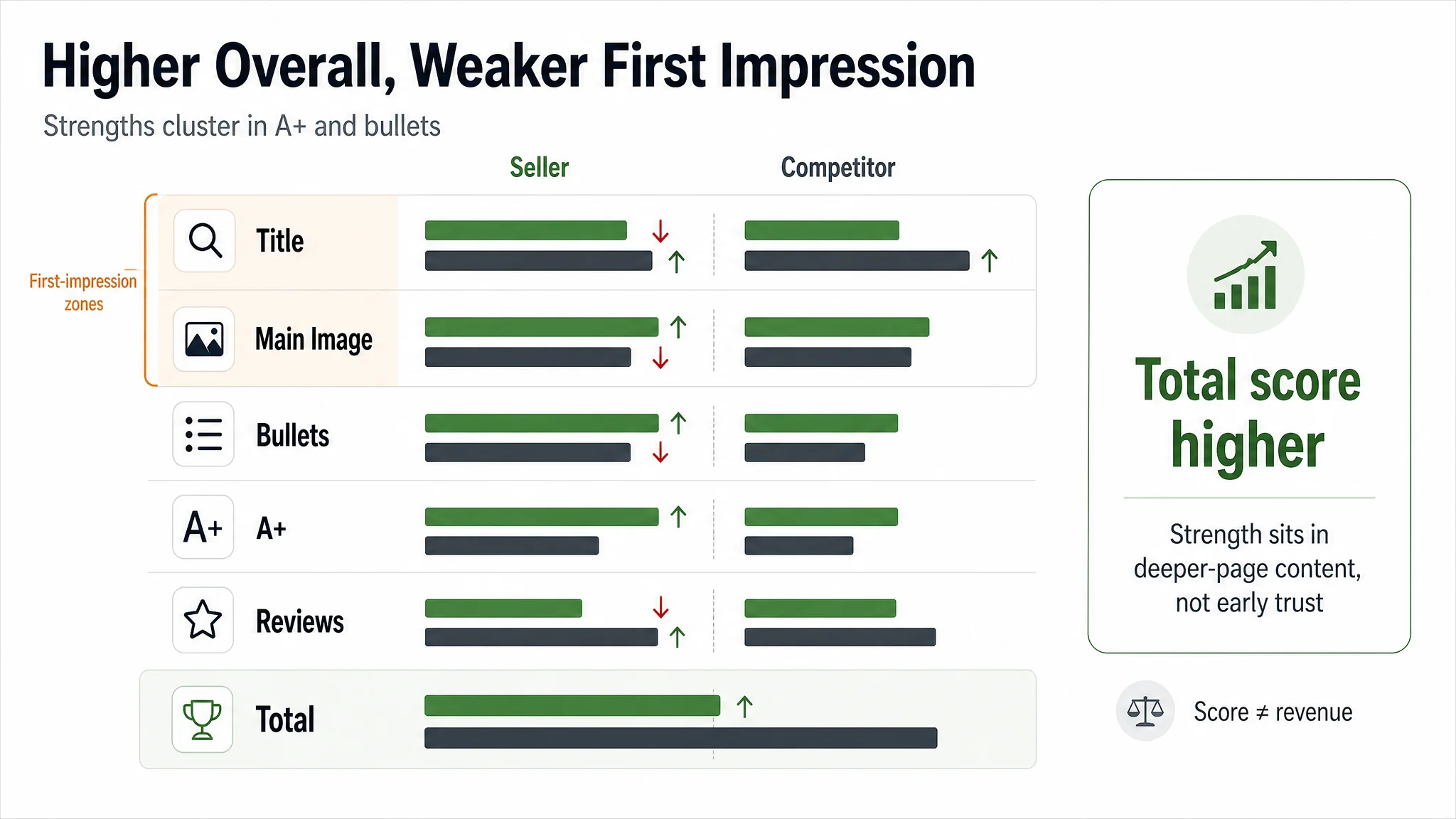
In the work T‑shirt case, this broader perspective was exactly what reframed the team’s thinking. DeepBI’s listing scoring compared their ASIN to a benchmark competitor and broke performance down into title, main image, bullet points, A+ detail, and reviews. Even though the seller’s total score was slightly higher, the diagnostic showed that their strengths were concentrated in deeper industrial storytelling and technical details—great for experienced users, but misaligned with early-stage buyer concerns. Without a tool that connected their micro listing decisions to category norms and competitive patterns, the team would have continued treating a conversion-capacity problem as a pure traffic issue.
Key Data Points for Strategic Decision-Making
To move from reactive sales management to proactive market leadership, sellers must leverage a specific set of data points. Simply tracking internal sales figures is insufficient; true strategic insight comes from understanding performance in the context of the broader market, including share of sales, growth trends, and the competitive landscape. This data-driven approach informs everything from pricing and marketing to brand protection and product development.
Monitoring Sales and Market Share
Knowing your daily sales is operational; knowing your market share is strategic. Without understanding your portion of the market, you cannot accurately gauge growth potential or identify competitive threats. Effective monitoring requires benchmarking your performance against the category's top players to establish a clear ceiling for success.
Advanced analytics platforms provide the necessary context. For example, DeepBI's Listing module delivers an intelligent score and diagnosis by benchmarking an ASIN against high-performing competitors. It generates a competitiveness radar chart across key dimensions like main image visuals, title structure, and A+ page content. This analysis reveals specific weaknesses that are costing market share and provides a clear roadmap for optimization.
In practice, these weaknesses are often counterintuitive. The workwear seller’s radar chart, for instance, showed them ahead of a key competitor in areas they felt proud of—detailed bullet points and rich industrial A+ content—while lagging where it mattered most for first impressions. Their title underperformed on search structure and seasonal coverage, and their main-image sequence looked rich but failed to quickly reassure shoppers about fit and comfort. From a revenue perspective, this meant they were “overbuilt” for convincing hardened industrial users but underbuilt for converting new shoppers entering via ads. By quantifying these gaps against a known competitor, DeepBI turned vague dissatisfaction (“why is our ACOS creeping up?”) into a concrete, prioritized action list tied directly to potential market share.
Competitive Analysis and Brand Protection
Comprehensive competitive data is the foundation of an effective Amazon strategy. Analyzing a competitor's keyword layout in their title or the "pain point-solution" flow in their bullet points provides direct intelligence for refining your own marketing and improving conversion rates (CVR). This analysis informs not only pricing and advertising campaigns but also the long-term product development roadmap.
In the work T‑shirt case, a title-level comparison revealed that the competitor front‑loaded “Oversized” alongside “T‑Shirt,” added a seasonal keyword like “Summer,” and closed with a clear size span that general shoppers instantly recognized. The seller, by contrast, separated “Loose Fit” from the category term, omitted an obvious season word, and buried their true edge—Regular & Tall sizes—in a way that neither algorithms nor humans could fully exploit. As long as this structure remained, they were losing the search battle before the page even loaded, forcing ads to work harder to deliver the same volume of qualified traffic.
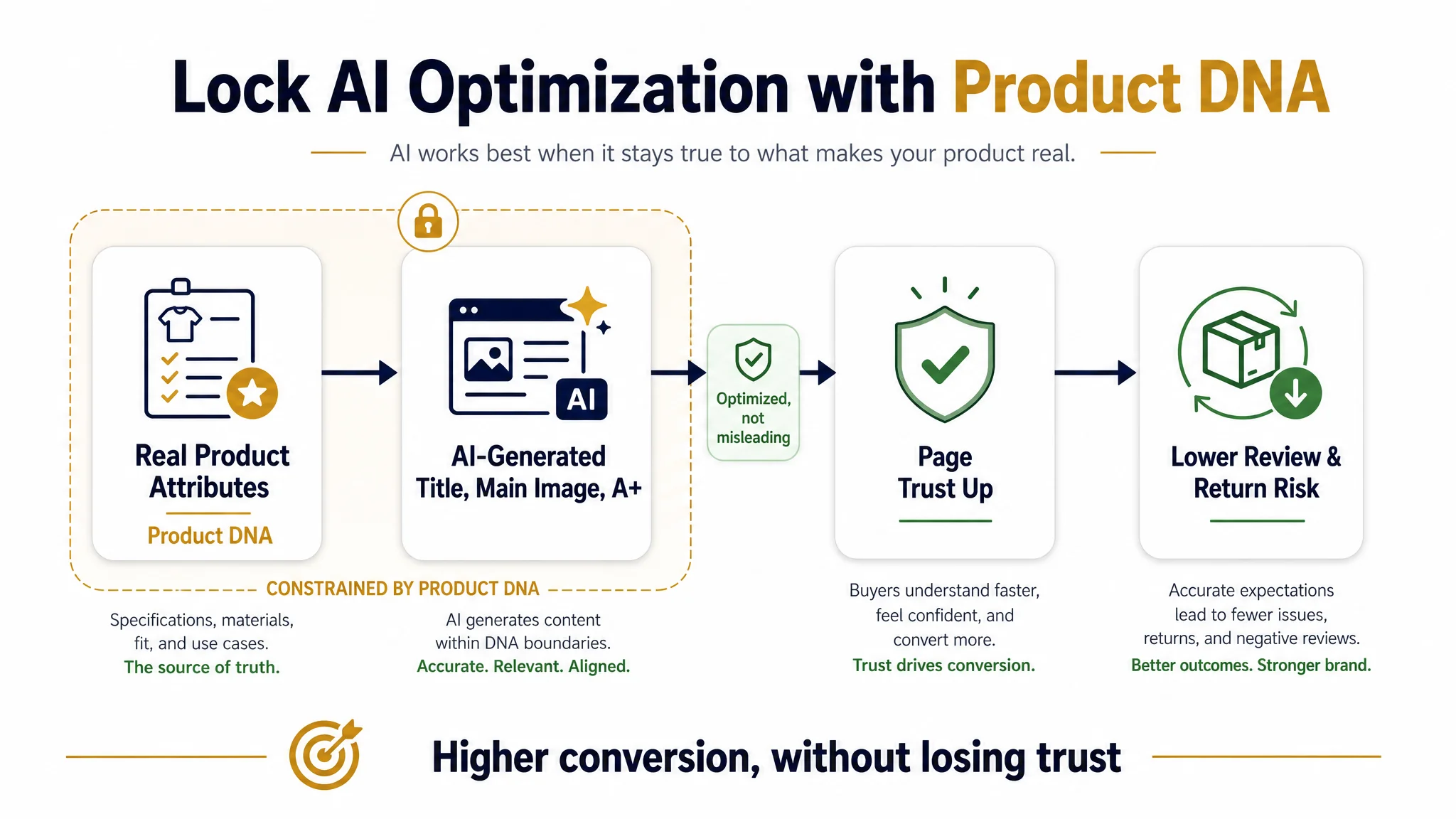
Simultaneously, data plays a critical defensive role in protecting a brand's image. While learning from competitors is valuable, ensuring the listing's authenticity is paramount. A common risk, especially with AI-generated visuals, is a product-image mismatch that leads to negative reviews and returns. To prevent this, sophisticated systems establish a "Product DNA" map—a set of hard constraints based on the product's true physical attributes—to ensure all optimizations maintain brand integrity and customer trust.
For the workwear seller, that meant any generated hero shots, fabric close‑ups, or Tall-size visuals had to faithfully reflect the actual 240GSM fabric, cut, and length. The point was not just to create more attractive imagery, but to tell a more conversion‑aligned story without drifting into misrepresentation. Anchoring changes in “Product DNA” allowed them to strengthen trust around fit and comfort while avoiding the long‑term damage that misleading visuals can cause.
Leveraging Data for Growth: DeepBI's Role
Transitioning from experience-driven guesswork to a data-driven strategy is the key to unlocking sustainable growth on Amazon. Although raw data is abundant, the primary challenge lies in converting it into actionable insights for listings, advertising, and organic rank. DeepBI provides a suite of intelligent tools designed to bridge this gap, automating analysis and optimization across the core pillars of an Amazon business.
Optimizing Product Listings for Conversion
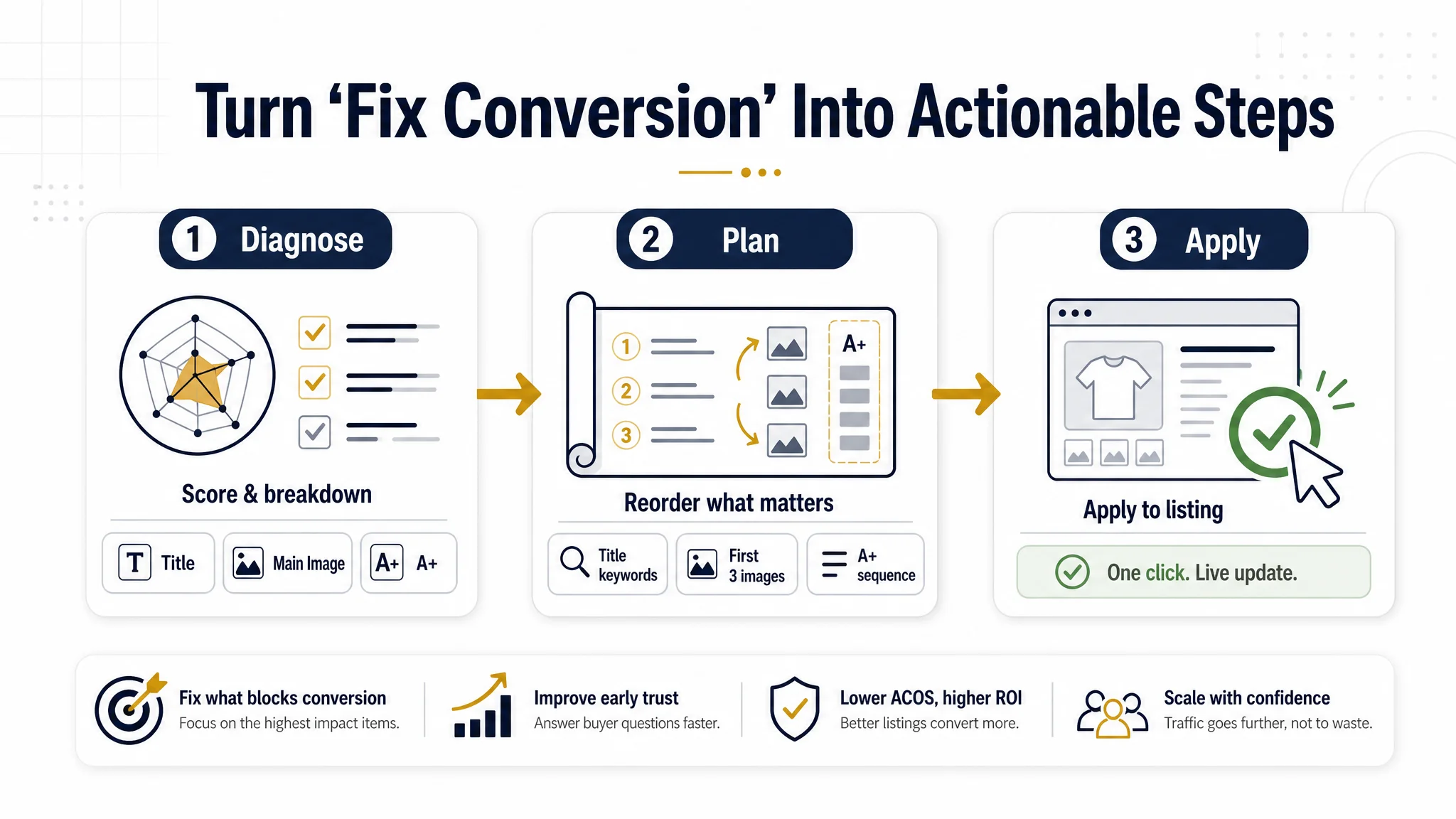
A high-converting listing is a precisely engineered asset. Every element—from the main image and title to bullet points and A+ content—must be optimized based on market data, not intuition. DeepBI's Listing module automates this process by first scoring a listing against top competitors to diagnose specific weaknesses. It then generates structured optimization strategies for both text and visuals. Its AI generation is constrained by a "Product DNA" map to ensure all created assets are authentic to the product, mitigating the risk of customer complaints. Finally, approved changes can be applied with a single click via the Amazon SP-API, reducing a 30-minute manual task to seconds.
In the work T‑shirt scenario, this process went beyond generic recommendations like “improve images” or “add more detail.” DeepBI’s scoring broke the listing into concrete dimensions: title, main image, bullets, detail/A+, and reviews. The total score was actually slightly higher than a benchmark competitor, which initially confused the seller. On paper, they were ahead in main images, bullet points, and A+ modules. However, the diagnostic highlighted that those “higher” scores reflected depth of industrial storytelling and technical detail, not alignment with early buyer decision logic.
The system flagged the title as underperforming in keyword structure and seasonal coverage, and the main-image sequence as information‑rich but cognitively heavy. Instead of leading with a clear, on‑body confirmation of loose fit and fabric feel, they opened with flat lays, dense info graphics, and repeated industrial scenes. A+ content over‑indexed on toughness imagery while pushing comfort, movement, and Tall-size clarity too far down the page. By mapping these issues against competitors’ proven layouts, DeepBI turned the abstract goal of “fix conversion” into a step‑by‑step optimization plan: reframe the title around core search terms and seasonality, restructure the first three images to answer fit and comfort, and reorder A+ modules to bring real-world wearability forward.
Quantifying Advertising Performance
Effective advertising should be a growth engine, not a cost center. Success depends on continuously optimizing bids, budgets, and targeting based on real-time performance metrics like ACoS and ROI. DeepBI's Ads Quant module transforms ad management by employing a four-layer traffic funnel model to guide spending. Its system uses dynamic parameter adjustments to automatically fine-tune bids and budgets daily based on the latest performance data. This proactive approach ensures stable scaling and systematically improves ACoS and ROI, eliminating the need for manual, reactive adjustments.
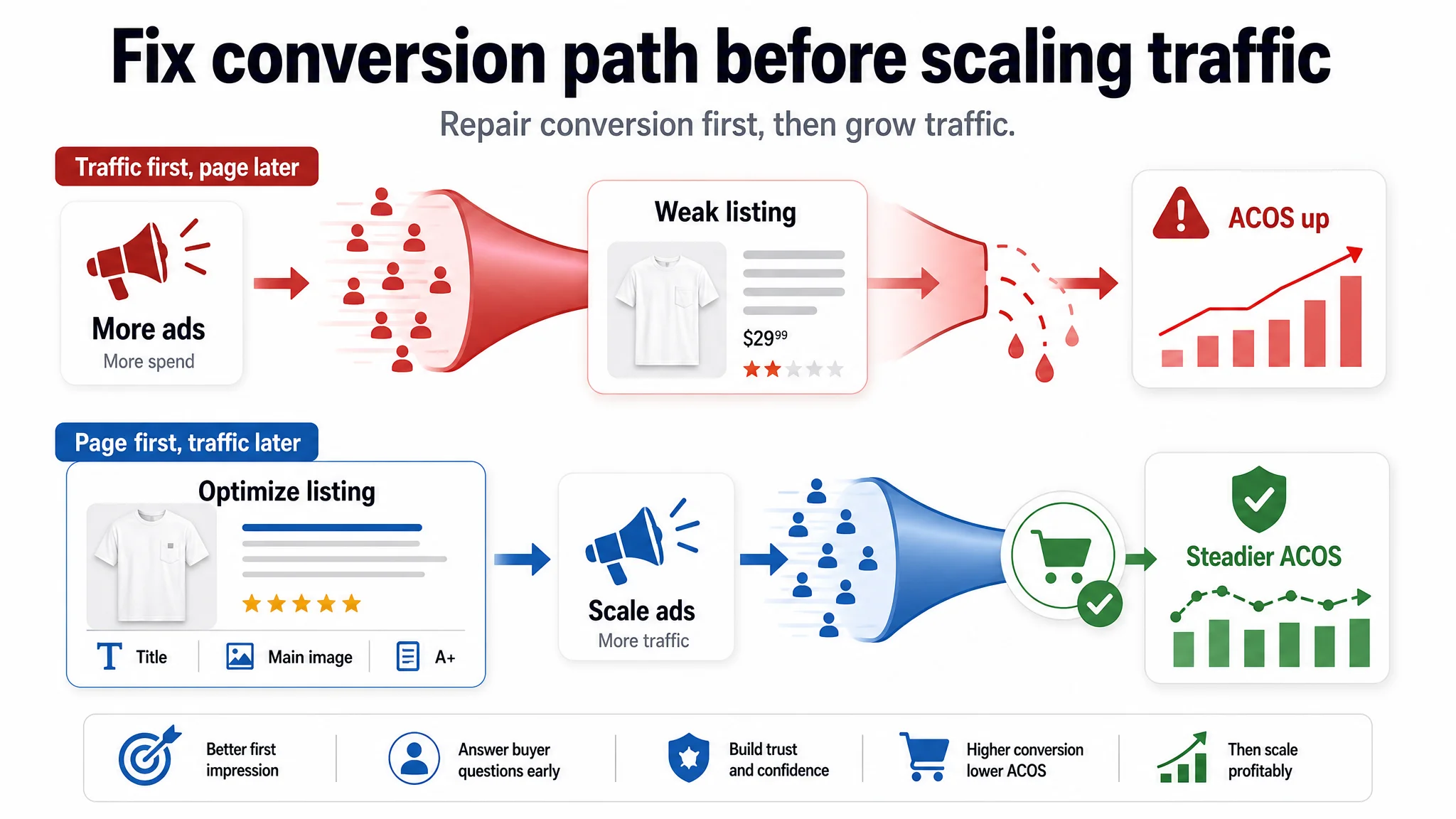
Yet even the most sophisticated ad optimization cannot compensate for a listing that consumes traffic instead of converting it. The workwear seller’s initial reaction to rising ACOS was to double down on typical ad actions: adjust bids, reshuffle budgets, and “buy more data.” CTR wasn’t catastrophic, so the conclusion was that campaign structure needed more refinement. DeepBI’s analysis contradicted that narrative. It showed that ads were already delivering meaningful visits; the bottleneck sat inside the first few seconds on the product page. Put differently, the Ads Quant module could have continued optimizing around the edges, but every extra click would still collide with unresolved doubts about fit and fabric feel.
By aligning ad data with listing diagnostics, the seller reframed their understanding of advertising metrics. ACOS stopped being a standalone media indicator and instead became a real-time signal of the listing’s conversion capacity. Only after the title, images, and A+ were restructured to better match buyer decision flow did it make sense to lean back into more aggressive ad scaling. Without this sequencing, “better” ads would simply have accelerated budget burn.
Driving Organic Traffic and Profitability
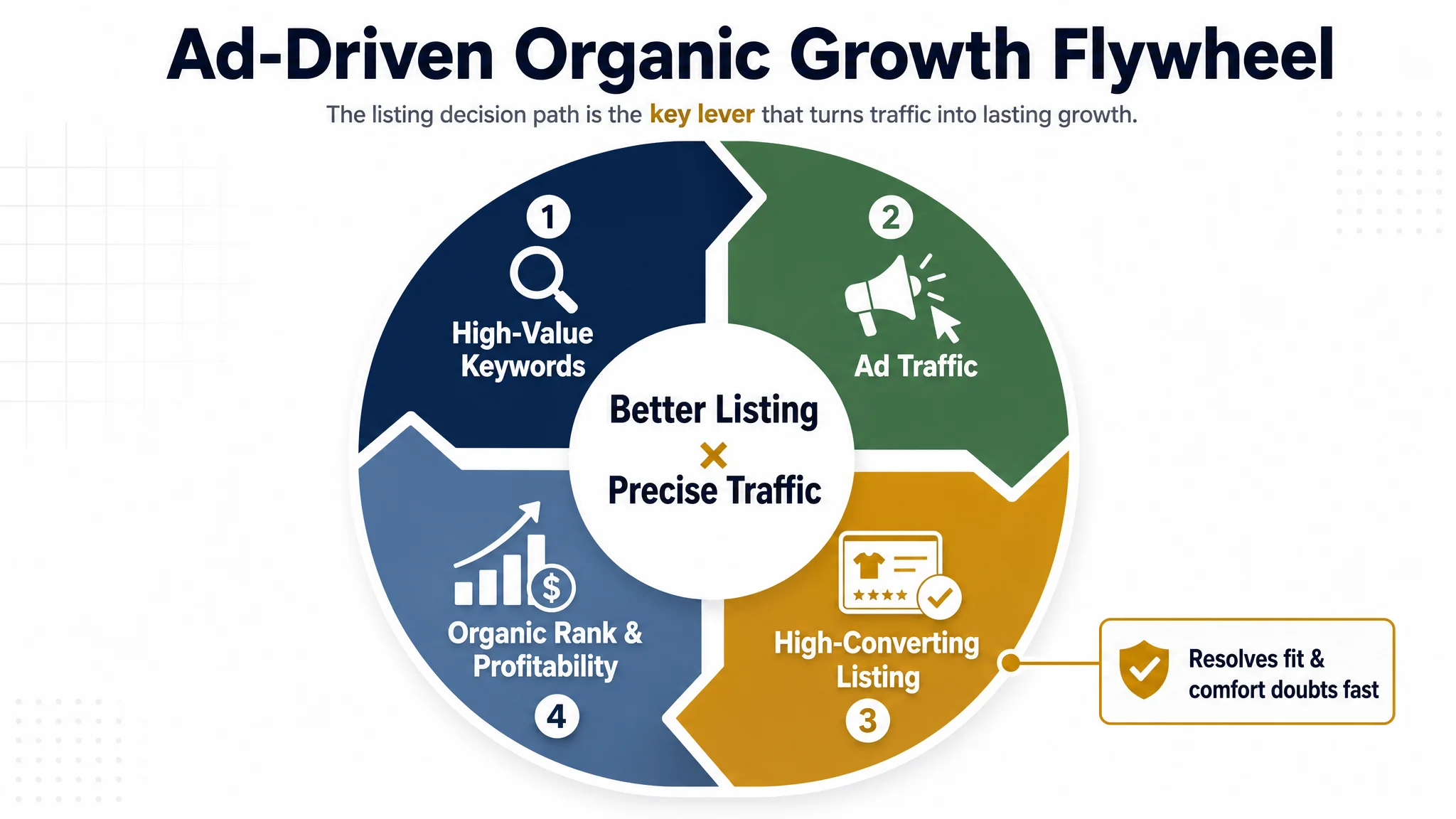
The ultimate goal is to build a profitable business where advertising directly fuels organic growth. Effective ad campaigns boost sales velocity, which in turn improves organic rankings. DeepBI's Organic Traffic module operationalizes this synergy with a fifth-layer funnel strategy. The system automatically screens ad data to identify keywords with the highest CTR, CVR, and order value. It then creates dedicated campaigns to push these proven keywords to the "Top of Search," creating a powerful flywheel that scales short-term ad performance while building long-term, profitable organic visibility.
This only works if the underlying listing can reliably convert the traffic those high-value keywords bring. In the T‑shirt case, valuable queries around “heavyweight work t shirt,” “loose fit pocket tee,” and size‑related phrases were already in play, but the page was disproportionately persuasive for existing industrial users rather than new buyers. Industrial mood, toughness claims, and fabric weight were over‑communicated, while the everyday concerns of “Will this actually look loose on me?” and “Is it comfortable in summer?” were under‑served.
Once DeepBI helped reframe the listing—title aligned with search patterns, hero image switched to an on‑body shot, early A+ modules visually combining ruggedness with comfort—the same high-intent keywords started feeding a more balanced conversion machine. This is the core logic behind a healthy organic flywheel: traffic from proven terms lands on a page that resolves primary doubts quickly, turning ad‑driven clicks into sales velocity and, ultimately, stronger organic rank and profitability.
Addressing Data Challenges and Strategic Considerations
The Importance of Comprehensive Analytics
Success on Amazon requires moving beyond the platform's native reporting tools. While Seller Central provides essential data, relying on it exclusively offers a fragmented view of the market and your performance funnel. This often leads to "blind modifications," where sellers make changes based on subjective aesthetics or flawed comparisons to top sellers, a classic case of survivor bias. Such actions frequently waste resources without improving core metrics like Click-Through Rate (CTR) or Conversion Rate (CVR).
The workwear seller’s early response to underwhelming performance illustrates this pattern. They were convinced their listing was “technically solid,” citing durable fabric specs, multiple industrial scenes, and detailed bullets as proof. When results failed to match expectations, the default move was to tweak visuals based on internal taste and to fine‑tune ads, without a systematic way to test whether these changes actually addressed buyer friction. From the inside, the listing looked superior to many competitors; from the buyer’s perspective, it left key questions hanging at the wrong moments.
To gain a true competitive edge, a more integrated approach is necessary. This is where comprehensive systems like DeepBI provide critical value. DeepBI is an AI-powered, full-funnel operational optimization system for Amazon that integrates diagnosis, strategy, execution, and launch. It covers product competitiveness, ad placement, and organic traffic to create a data-driven, automated operational loop. By establishing a clear, evidence-based framework, it helps sellers transition from experience-based decisions to data-backed, long-term profitable operations, ensuring every change is a calculated move to improve performance.
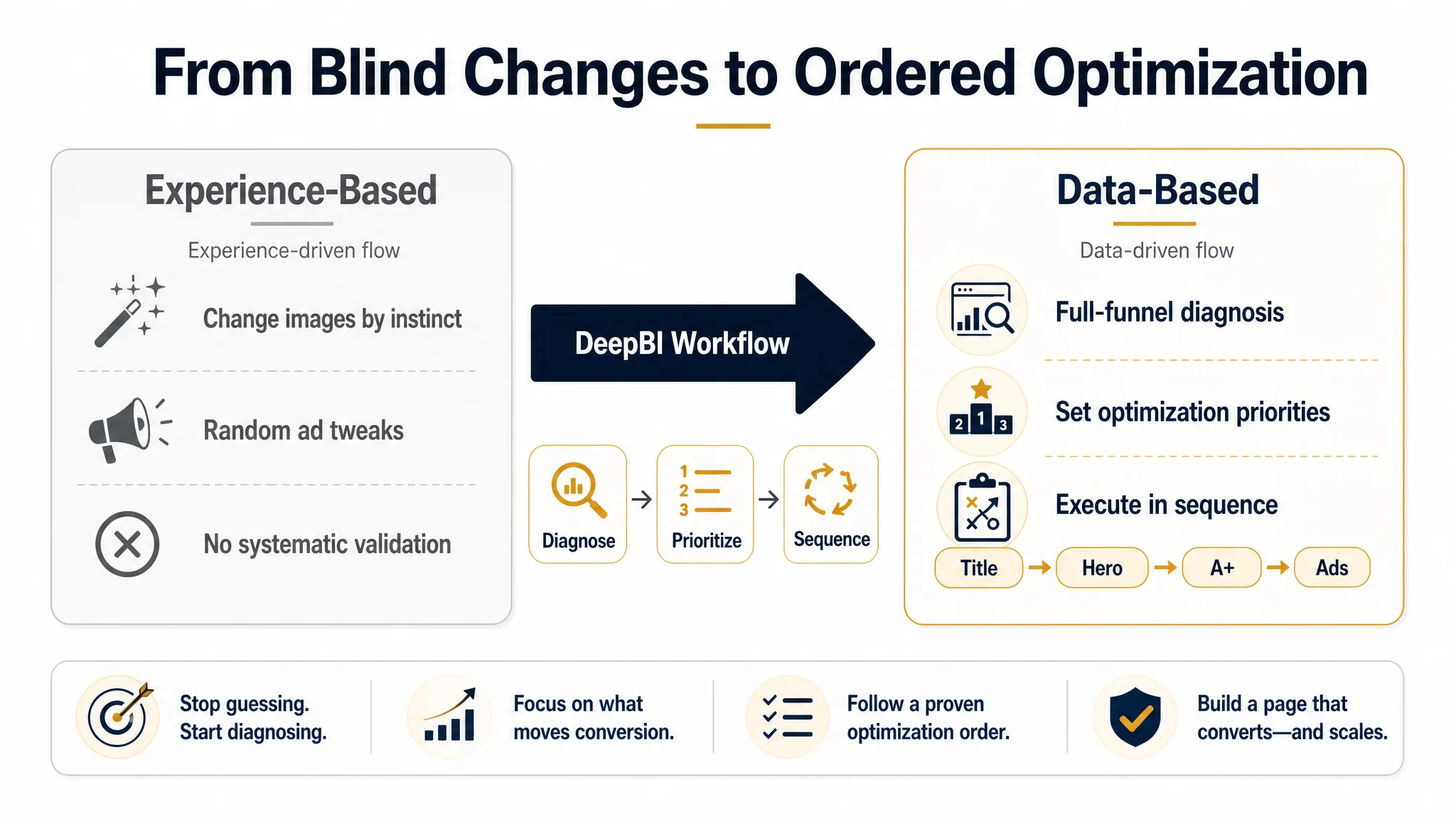
In the T‑shirt case, that meant using diagnostics not just to generate ideas, but to sequence decisions: first fix the title and hero images to align with search and first‑impression logic, then restructure A+ to balance toughness with comfort and fit, and only after that revisit ad budgets and keyword expansion. This kind of ordered, data‑driven workflow is what separates corrective listing work from random experimentation.
Navigating Platform Relationships and Data Privacy
Operating within the Amazon ecosystem presents a fundamental strategic challenge: the platform is simultaneously your sales channel and your competitor. This dual role necessitates a clear-eyed approach to data privacy and competitive strategy. While creating an independent retail experience offers maximum control, it's often not a feasible or scalable option for most sellers. This issue highlights the need for platforms like Amazon to ensure fair data practices and for regulators to address potential anti-competitive behaviors.
These concerns extend to the infrastructure that powers modern e-commerce. While specific data misuse reports often focus on Amazon Retail, the broader discussion correctly notes that AWS is part of the same corporate entity, shares leadership, and its profits can indirectly support Amazon's retail business. This poses significant competitive concerns for businesses that use AWS while also competing with Amazon. Consequently, for retailers in direct competition with Amazon, migrating from AWS to other cloud providers like Azure or GCP is a strategic business decision aimed at avoiding funding a competitor and mitigating potential risks, rather than an overreaction.
For operational teams on the ground, these high-level strategic choices intersect with day‑to‑day reality in a simple way: if you’re going to compete inside Amazon’s ecosystem, you need tooling that works with, but does not depend solely on, Amazon’s own reporting logic. In the workwear example, Seller Central alone could not explain why ad spend was becoming harder to justify. It took an external, data‑rich view of competitor titles, image sequences, and A+ storylines to expose the listing’s misalignment. Balancing platform dependence with independent analytics is thus not just a governance conversation; it is a practical requirement for making better listing and advertising decisions.
Conclusion: Data-Driven Selling on Amazon
The Amazon landscape is no longer a marketplace of intuition but an arena of data. Lasting success is now defined by the ability to move beyond subjective adjustments and embrace a systematic, data-driven strategy for growth. This evolution transforms listing optimization from a cycle of speculative trial and error into a predictable, scientific process where every decision is backed by clear evidence. The primary goal is to eliminate human guesswork and ensure every modification is directly tied to measurable improvements in key performance indicators like Click-Through Rate (CTR) and Conversion Rate (CVR).
The work T‑shirt seller’s experience shows what happens when these principles are not followed—and what becomes possible when they are. For a long time, the team treated rising ACOS as an ad console problem, while their listing quietly failed to answer basic questions about fit, comfort, and Tall sizing in the right order. Only after their ASIN was benchmarked and broken down into title, main image, bullets, and A+ modules did they recognize that advertising was amplifying the page’s weaknesses as much as its strengths. By restructuring the title around search intent, rebuilding the first images into a progressive trust path, and reframing A+ content to balance toughness with comfort and sizing clarity, they turned a “technically perfect” page into one that aligned with how Amazon shoppers actually decide.
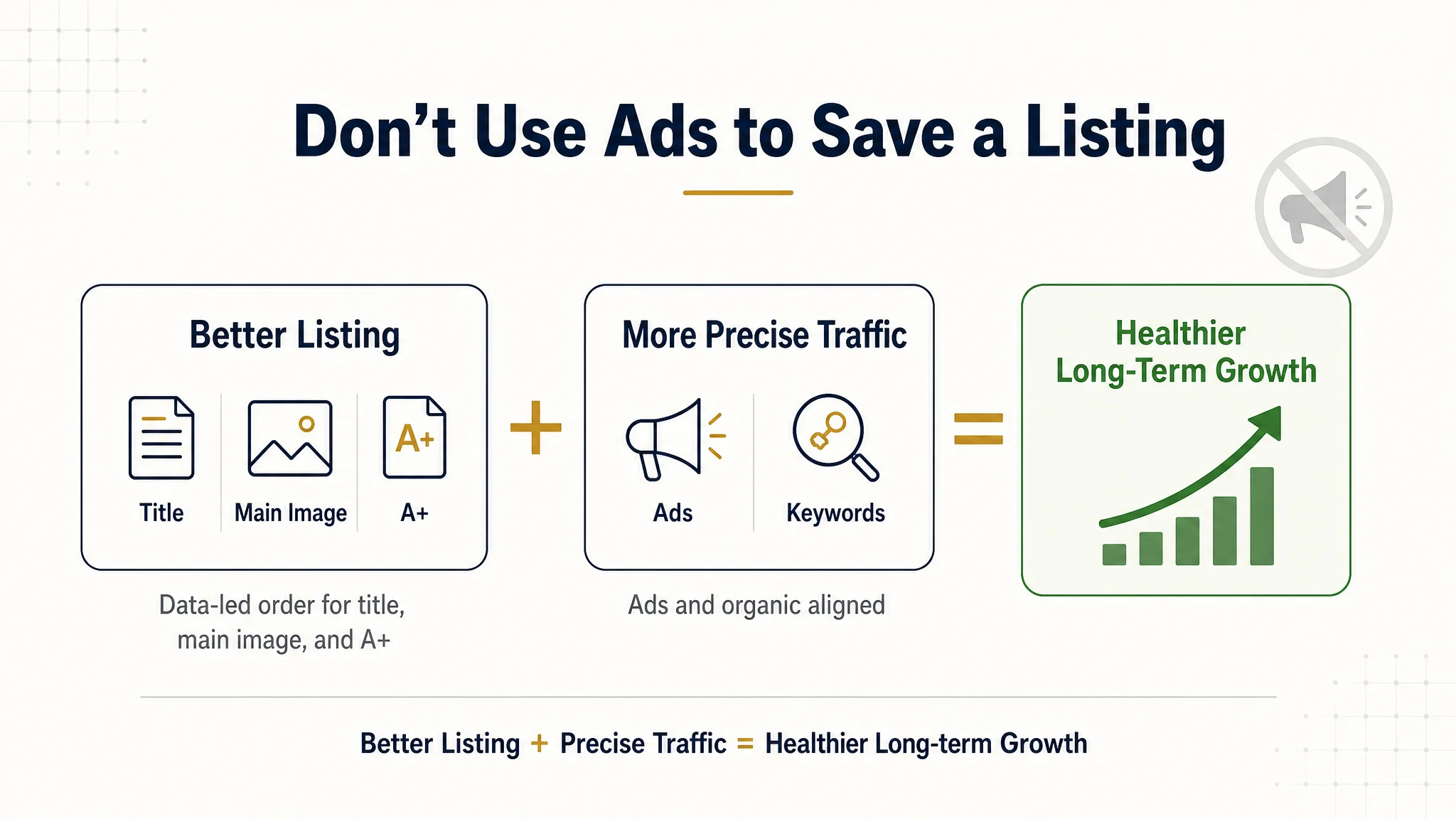
Tools like DeepBI are at the forefront of this shift, integrating diagnosis, strategy, and AI-powered production into a single, cohesive workflow. They replace vague suggestions with precise, machine-executable instructions, turning creative assets into engineered drivers of performance while strictly adhering to product consistency to mitigate business risks. Ultimately, this approach redefines listing management from an occasional project into a dynamic, real-time process. By creating a virtuous cycle of 'Better Listing + More Precise Traffic = Healthier Long-term Growth', sellers can secure a decisive, data-backed advantage in a competitive global market—and avoid the costly trap of trying to fix conversion problems with ad spend alone.