

Introduction: Unlocking Organic Growth on Amazon
In today's fiercely competitive Amazon marketplace, where rising advertising costs are squeezing profit margins, sellers aiming for long-term success must master organic search traffic. This is no longer an optional strategy but the primary engine for profitability. Organic traffic consists of customers who find and purchase products through unpaid search results, driven by a listing's relevance and performance. A high organic ranking reduces reliance on expensive ad campaigns, creating a more resilient and scalable business model.
However, achieving this goal requires a deep understanding of Amazon's unique SEO landscape. Unlike traditional web SEO, which often centers on informational content and backlinks, Amazon SEO is a purely commercial discipline. The A9 algorithm is engineered for a single purpose: converting searches into sales. This means that while keywords are foundational, the platform gives significant weight to performance metrics like Click-Through Rate (CTR) and Conversion Rate (CVR). Your product's visual assets, from the main image to A+ Content, are not merely decorative; they are the core commercial engine driving these critical KPIs.
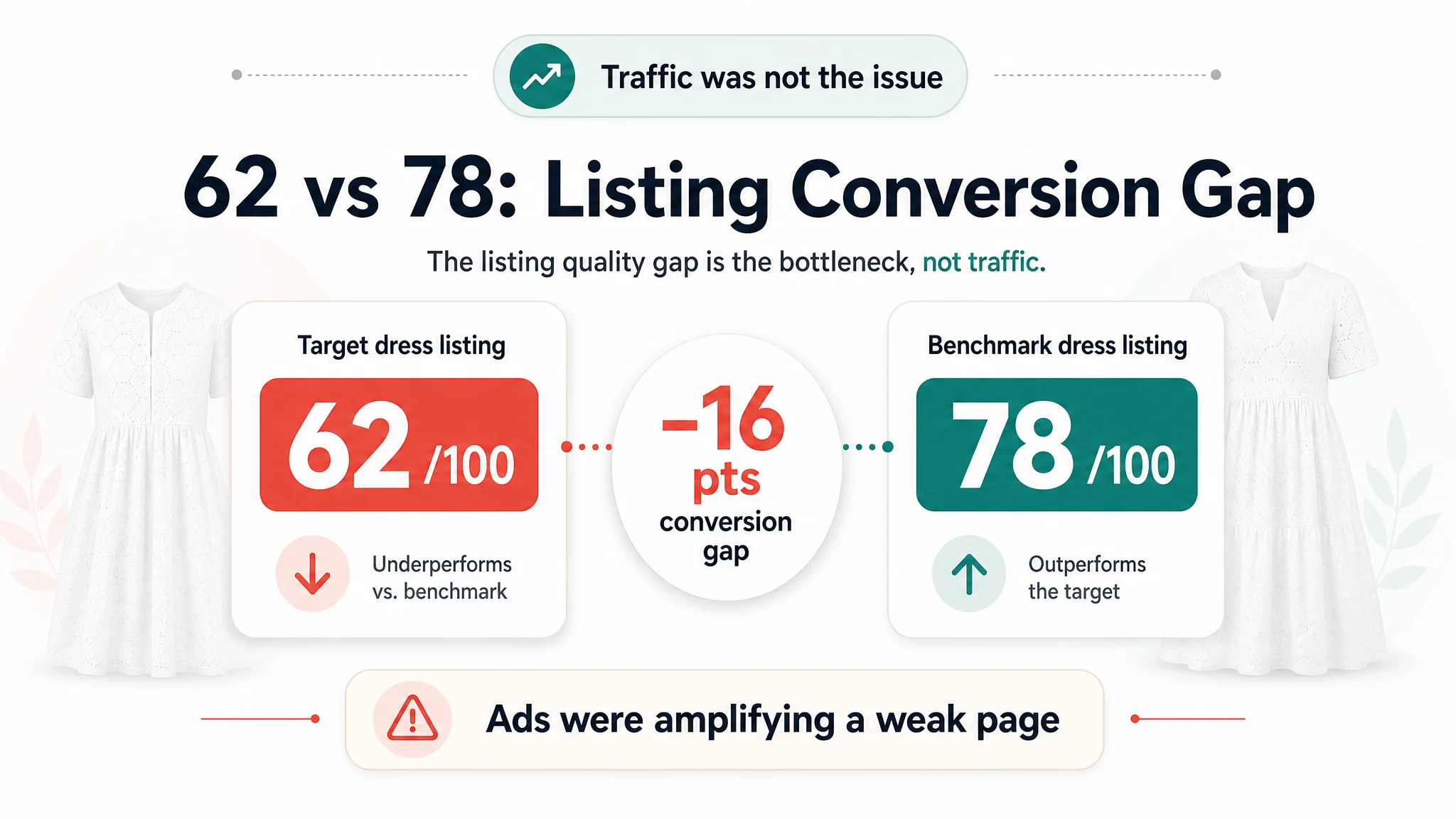
This becomes painfully obvious when ads are already delivering traffic, but orders refuse to follow. A fashion seller on Amazon US recently learned this the hard way with a summer eyelet dress. The team kept increasing bids, expanding keywords, and testing budgets, convinced that high ACOS and unstable orders were “an ads problem.” DeepBI’s listing analysis showed something very different: compared against a directly comparable competitor dress, the page scored 62/100 vs. 78/100. Traffic was coming in; the listing simply wasn’t built to convert it. Title logic, main-image path, bullet-point persuasion, and A+ detail structure were all systematically weaker. Ads were amplifying a page that had not yet earned the right to receive that traffic.
This guide moves beyond simple keyword tactics to present a comprehensive, multi-faceted system for organic growth. We will deconstruct the entire optimization lifecycle, from the data-driven diagnosis of a listing's weaknesses to strategic planning, AI-assisted content production, and seamless implementation. By treating listing optimization as a precise, data-backed engineering process, you can ensure every change is a calculated step toward improved visibility, higher conversion, and sustainable long-term growth.
Understanding Amazon's Search Algorithm (A10)
Amazon's search algorithm is fundamentally designed to maximize customer satisfaction and revenue. While the company does not officially name its algorithm updates, the seller community uses the term "A10" to describe the latest evolution, which builds upon the principles of its predecessor, A9. The system ranks products based on three core pillars: relevance, performance, and customer satisfaction. Relevance measures how well a listing matches a customer's search query, while performance is gauged by metrics like CTR and CVR, which directly influence sales velocity. Finally, customer satisfaction is reflected through signals such as reviews, ratings, and return rates.
The most significant shift in the A10 era is the increased emphasis on organic engagement and external traffic. Although sales driven by paid advertising remain a crucial factor, the algorithm now more heavily rewards listings that attract and convert traffic organically, as this signals genuine market demand. In practice, this means that when two products in the same niche have similar review profiles, the one that converts a higher share of its traffic will tend to win visibility over time.
That dynamic was clearly visible in the summer dress case mentioned earlier. The dress in question did not suffer from a catastrophic review problem: around 4.2 stars with roughly 30 reviews versus 4.4 stars and about 37 reviews for the benchmark competitor. From a pure VoC standpoint, both products were in the same ballpark. Yet DeepBI’s scoring still showed a 16-point gap in overall listing strength. The conclusion was straightforward: the algorithm wasn’t penalizing the dress because shoppers hated it; it was prioritizing a competitor that gave visitors a clearer, more convincing path to purchase.
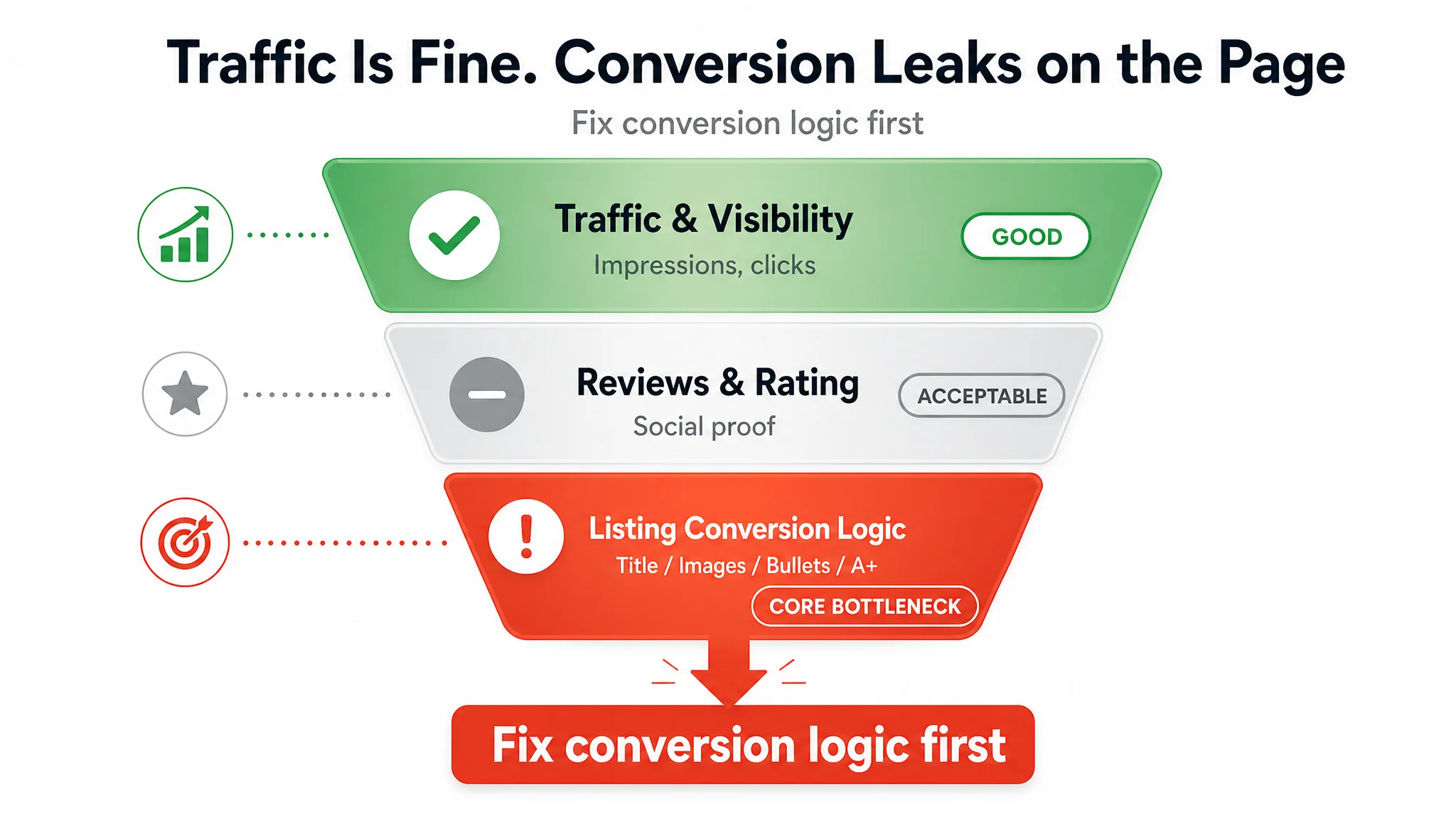
To master these complex signals, sellers need a systematic approach. An automated market health check is critical, utilizing tools with multi-dimensional semantic analysis to diagnose a listing's competitive strength across five core dimensions: main image, title, bullet points, A+ content, and Voice of the Customer (VoC). By benchmarking these elements against top competitors, you can pinpoint specific weaknesses impacting relevance and performance, enabling data-driven optimizations that align with the algorithm's priorities. In the fashion case, that diagnostic step is what broke the team out of the “it must be the ads” loop and redirected effort to the true constraint: conversion capacity.
Pillar 1: Foundational Listing Optimization for Organic Visibility
A listing that ranks well organically is one that effectively communicates its value to both Amazon's A9 algorithm and human shoppers. This foundation is built on three core components: strategic keyword integration, compelling copy, and high-impact visuals. Neglecting any of these areas will place a ceiling on your organic traffic potential.
Keyword Research and Strategic Integration
Effective organic visibility begins with Amazon-centric keyword research that captures high-transactional search intent. The objective is to identify and prioritize the high-volume, relevant search terms your target customers are actively using. These keywords must then be strategically integrated throughout your listing—primarily in the title, bullet points, and backend search fields—to signal relevance to the A9 algorithm and secure initial search placements.
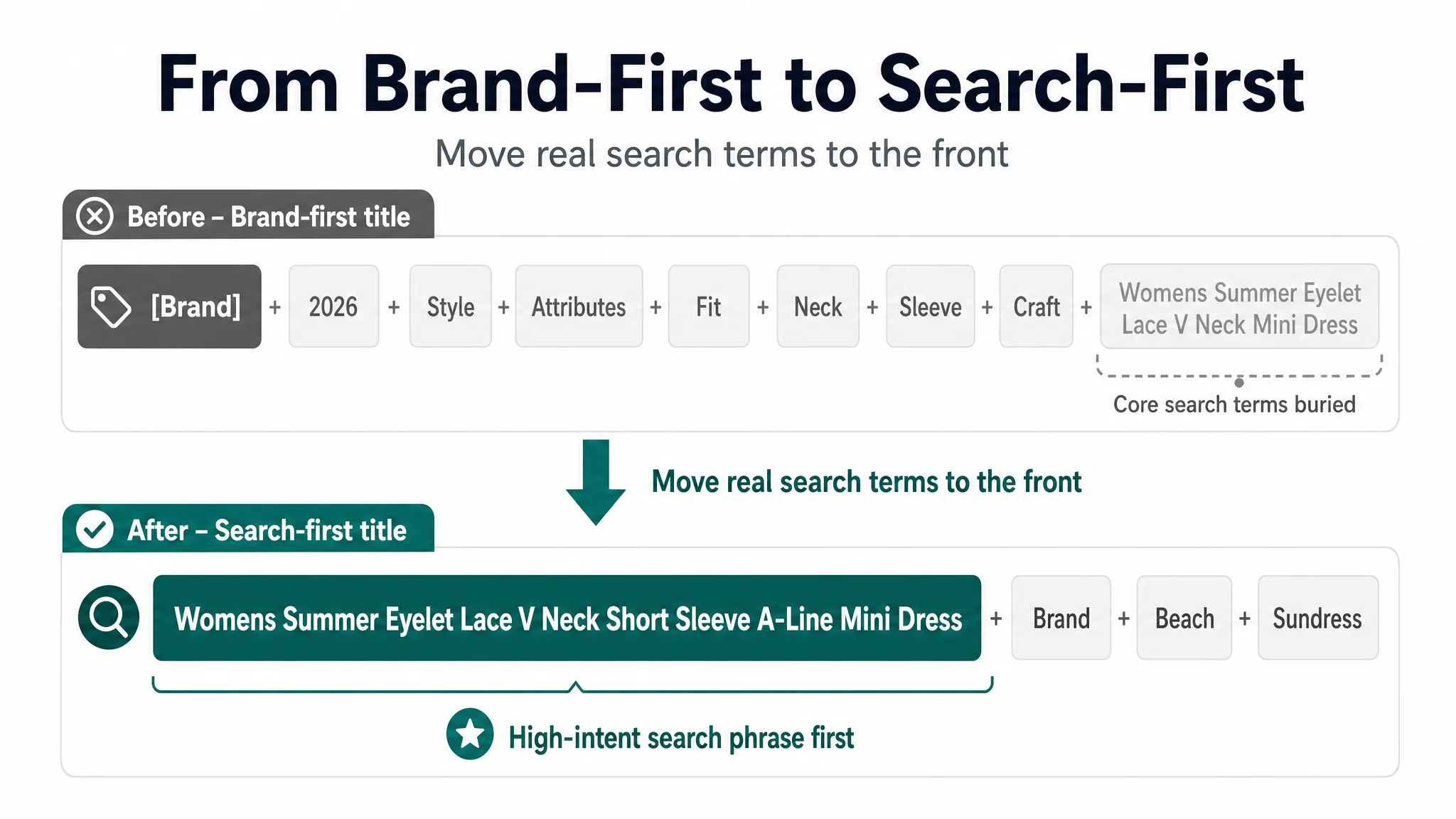
In the summer dress example, this distinction between “what we want to say” and “what customers actually type” became very concrete. The original title led with the brand name and a cluttered string of attributes, even squeezing “2026” into the text—something shoppers weren’t looking for and that added no real relevance. The primary type term favored internally was “Tunic Dress,” while competing listings that actually converted leaned on phrases like “Mini Sundress” and “Womens Summer Eyelet Dress,” which map more directly to real search behavior in the category.
DeepBI’s diagnosis reframed the title as a scarce resource that must reflect Amazon search reality, not internal naming habits. The adjusted direction moved brand to the back and pulled category and intent phrases forward: “Womens Summer Eyelet Lace V Neck Short Sleeve A-Line Mini Dress” plus scenario cues like “Beach” and “Sundress.” The product did not change, but the way it described itself to the algorithm and to shoppers did. That kind of alignment is exactly what keyword research should drive: every major term in the title and bullets should earn its place by tying back to real user queries, not just internal preference.
Crafting Compelling Product Titles, Bullet Points, and Descriptions
Your listing's text must simultaneously satisfy search algorithms and persuade customers. This requires a careful balance between keyword density for discoverability and compelling copy that boosts your Conversion Rate (CVR). High-performing listings often structure bullet points around a "Pain Point-Solution" framework, translating technical features into tangible benefits. Tools like DeepBI can accelerate this process by benchmarking your listing against top competitors to diagnose textual weaknesses. Its AI can then generate optimized titles, benefit-driven bullet points, and structured A+ Content designed to improve both relevance and conversion.
The summer dress listing illustrates how easy it is to stop one step too early. On the surface, the bullets looked “complete”: they mentioned style names, fabrics, and even washing instructions. But when compared against a better-converting competitor, several issues appeared:
- Bullets were fragmented around variant names instead of a coherent product story.
- Most lines listed neutral facts (material, neckline) without turning them into body-confidence or comfort benefits.
- Practical but low-intent information like wash care occupied an entire bullet, disrupting the buying logic.
DeepBI’s rework treated the bullets as a conversion sequence. The first bullet reframed cotton and eyelet as a solution to summer heat (“exceptionally breathable and skin-friendly”). The next focused on design as a way to flatter the body (“visually elongates the neckline,” “modifies the body shape, hiding imperfections”). Only after establishing comfort and confidence did the copy talk about versatile styling and scenarios (date nights, vacations, commuting), with care instructions integrated at the end rather than leading the story.
The underlying principle applies to any category: feature lists rarely persuade on their own. When your textual content is outperformed by a competitor that explicitly connects design choices to user outcomes, the algorithm sees the result in higher CVR—and rewards it accordingly.

Optimizing Visual Content: Images and Videos
Visuals are the primary driver of your Click-Through Rate (CTR) from search results and a critical factor in on-page conversion. A weak main image can suppress traffic before a customer even visits your product detail page. DeepBI’s diagnostic engine identifies these weaknesses by analyzing top-performing ASINs, transforming vague goals like "improve visual appeal" into concrete, AI-executable instructions for layout, lighting, and scene composition. Crucially, all AI generation adheres to a strict "product entity consistency" principle, which prohibits altering the product's physical design, thus mitigating the risk of negative reviews from product-image mismatches. Once optimized, these assets can be synced directly to your listing in seconds via SP-API, eliminating a manual upload process that can take over 30 minutes.
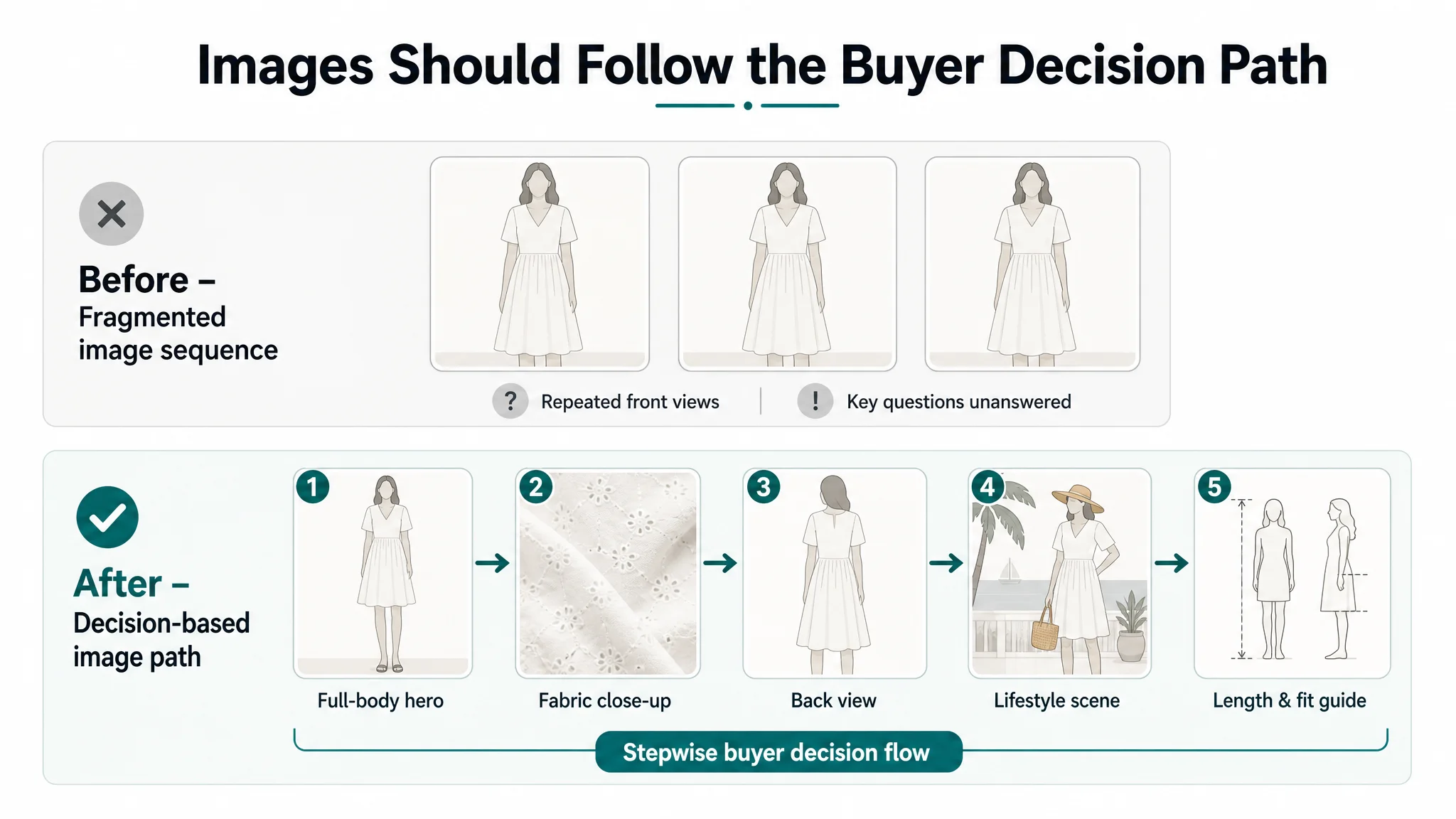
The fashion case makes the difference between “many images” and “the right image path” very tangible. Both the target dress and its benchmark competitor had enough photos. But the competitor’s sequence traced a deliberate decision journey:
1. A clear hero shot on a model that showed the full dress without obstruction.
2. Close-ups of fabric and eyelet details that answered “What does this actually look and feel like?”
3. Early back-view images that built trust in the cut and construction.
4. Scenario images (vacation, city walk) that helped shoppers imagine real use.
5. Proportion and length confirmations to reduce fit anxiety.
By contrast, the underperforming listing repeated similar front views. A prop bag partially blocked the hem and details, and key views like the back of the dress appeared too late in the sequence. The result was subtle but costly: shoppers’ real questions—“How does it hang? Is the fabric breathable? Is the back consistent with the front?”—were not answered in the order they emerged.
DeepBI’s recommendation was not “add more photos,” but reorder and refine them to match the shopper’s mental script: start with an unobstructed full-body view, then prove fabric and neckline up close, then show the back, then move into lifestyle and proportion. Once those changes were made, the same ad clicks led to a page that removed more doubt per scroll, which is exactly how better visuals turn into higher CTR and CVR.
Pillar 2: Leveraging Sales Performance and Customer Engagement
Amazon’s A9 algorithm is fundamentally a sales engine; it prioritizes products that sell well and satisfy customers. Your sales performance and customer engagement metrics are not just business outcomes—they are direct inputs that determine your organic ranking. Mastering these factors is essential for achieving sustainable visibility.
Driving Sales Velocity and Conversion Rate
Sales velocity—the rate and volume of your sales over time—is one of the most powerful ranking signals, proving to Amazon that your product is in demand. Equally critical is your Conversion Rate (CVR). A high CVR indicates to the algorithm that your listing is highly relevant and persuasive for the traffic it receives, making it a preferred result to show other shoppers.
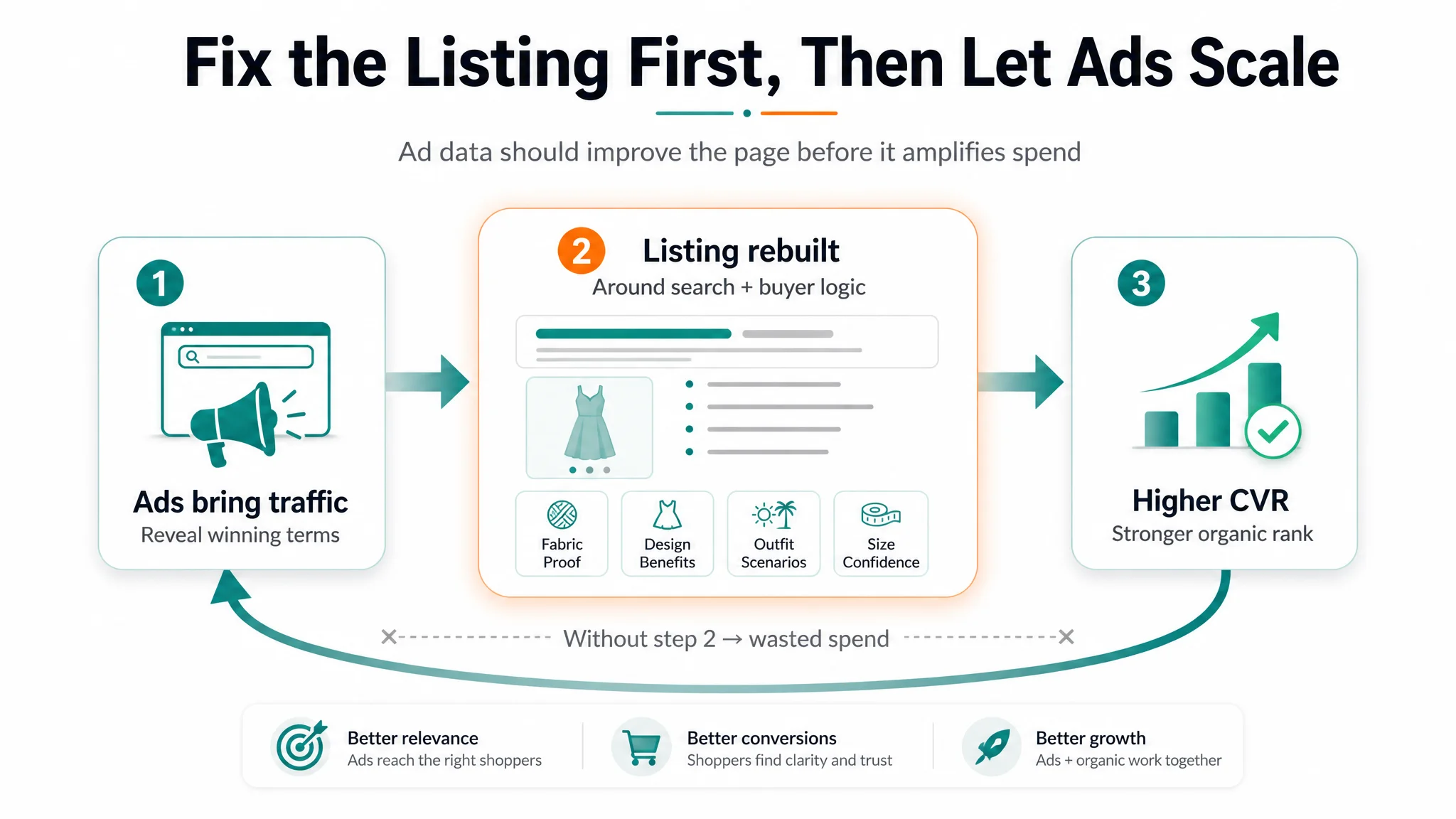
To improve these metrics, you can transform advertising data into organic strength. For example, DeepBI analyzes ad reports to identify high-conversion keywords, or "winning terms." By strategically embedding these proven terms into your listing's title and backend fields, you attract more qualified organic traffic, which directly improves your CVR and accelerates sales velocity.
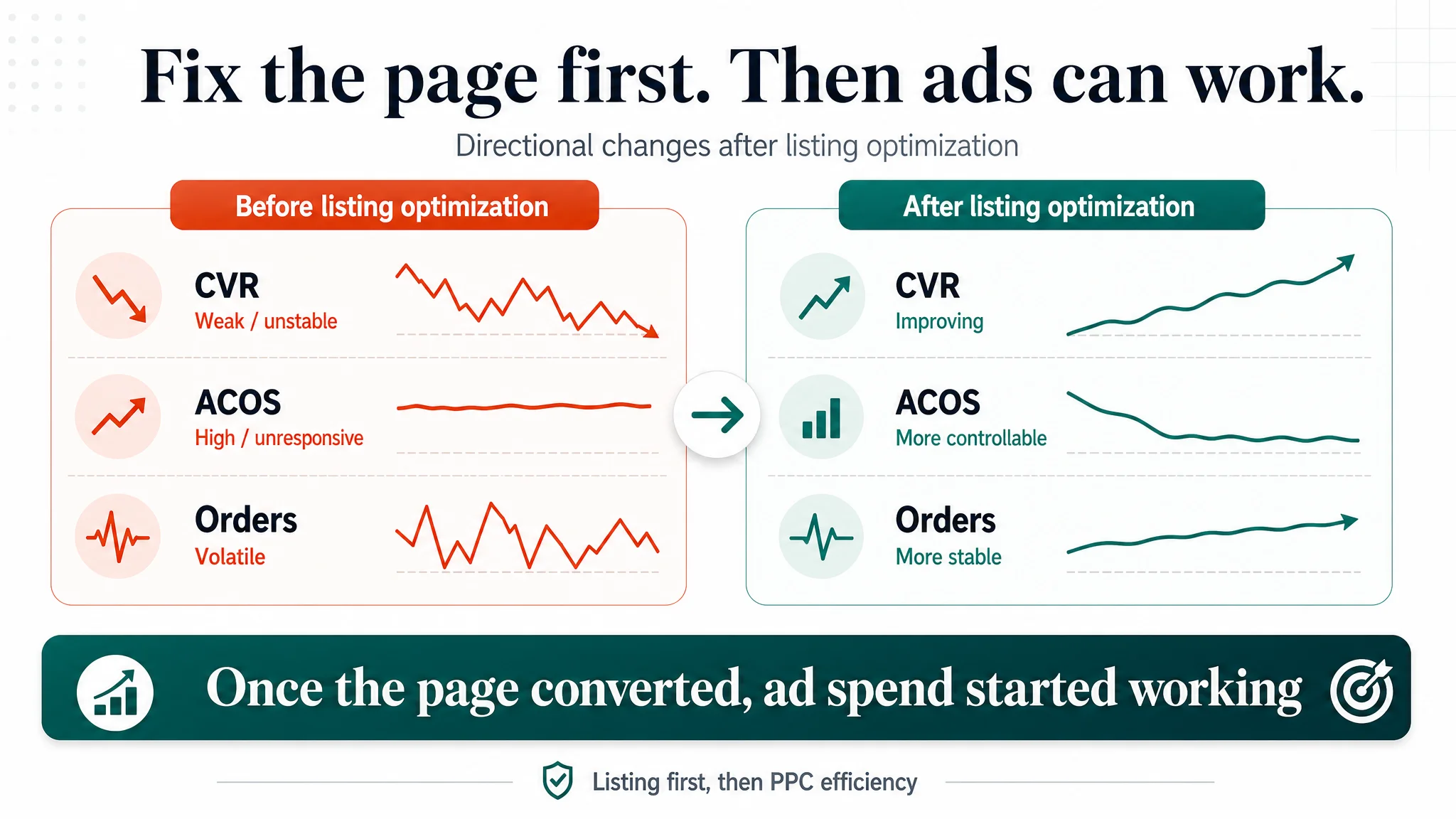
In the dress example, the seller initially treated ad data only as a lever for bid changes. They saw high ACOS and unstable daily orders and assumed “we need more relevant keywords” or “our match types aren’t right.” Several weeks of bid tweaks and keyword expansion didn’t meaningfully shift CVR. From DeepBI’s perspective, the pattern was different: ads were consistently bringing people in, but the listing—scoring 62/100 against a 78/100 competitor—could not convert them at a category-competitive rate.
Once that diagnosis was accepted, the same data set became a resource for structural improvements. Search terms that already drove conversions were elevated into the title and key bullets; weakly performing phrases were deprioritized. As the listing’s narrative and visuals started closing more of the traffic, sales velocity had a stronger foundation, and ad traffic began to contribute more effectively to long-term organic positioning instead of being consumed by a weak page.
Cultivating Positive Customer Reviews and Ratings
Customer reviews serve a dual purpose: they build social proof for shoppers and provide direct feedback to the A9 algorithm. A high volume of positive reviews and a strong overall star rating signal product quality and trustworthiness. This not only boosts your CVR but also contributes directly to a higher organic rank. Consistently monitoring and ethically encouraging customer feedback is a core activity for maintaining a healthy product lifecycle and strong search visibility.
The fashion seller’s experience also shows that reviews, while critical, are only part of the picture. Their rating and review count were not dramatically behind the competitor’s; there was no obvious “review disaster” to blame. Yet conversion still lagged. This scenario is common across categories: teams fixate on star ratings and forget that reviews interact with the rest of the page. If your A+ content does not visually confirm quality claims, or if your bullets never address fit and usage scenarios raised in reviews, you’re not fully leveraging that social proof. The algorithm only sees the end result: whether visitors arriving with reasonable expectations actually buy.
Competitive Pricing and Promotions
Your pricing strategy is inextricably linked to organic performance, primarily through its influence on winning the Buy Box. Since the majority of sales occur through the Buy Box, securing it is essential for maintaining sales velocity. Furthermore, strategic promotions like coupons and limited-time deals can create a significant, short-term surge in sales. This spike can provide a powerful boost to your organic ranking, creating a window of opportunity to capture more organic traffic and establish a new baseline of visibility.
However, the dress case illustrates a critical boundary: promotions can only amplify what your listing already is. In that instance, the seller could secure traffic and run deals, but because title, image sequencing, bullets, and A+ structure underperformed, the extra exposure didn’t translate into stable conversion. Before leaning heavily on coupons or aggressive price moves, it’s worth asking a blunt question: “If I double my sessions tomorrow at this price, does the page truly deserve those visits?” If the honest answer is no, work on conversion first, then use pricing and promos to accelerate momentum rather than trying to compensate for a structurally weak listing.
Pillar 3: Strategic Use of Advertising and External Traffic
While organic traffic is the ultimate goal, paid advertising and external traffic should be viewed as powerful accelerators, not separate channels. A sophisticated strategy integrates these elements to create a flywheel effect, where an initial paid investment amplifies long-term organic visibility and sales, ultimately lowering your Total Advertising Cost of Sales (TACoS).
PPC as an Organic Accelerator
Amazon PPC is more than a sales driver; it is a crucial data-gathering tool. Successful campaigns reveal the highest-converting search terms your customers use, providing a direct roadmap for organic optimization. By analyzing ad reports, you can identify these "winning terms" that generate not just clicks, but actual sales.
This is where intelligent automation provides a competitive edge. For instance, DeepBI's Ads Quant module can analyze advertising data to pinpoint high-value keywords. Based on these insights, you can establish specific, aggressive campaigns with concentrated budget allocation to push for homepage visibility on those exact terms. The sales velocity and conversion data from these targeted ads send strong positive signals to Amazon's A9 algorithm, directly boosting your organic ranking for your most profitable keywords. This creates a virtuous cycle: paid ads generate data and sales, which inform listing optimizations that improve CVR, leading to a higher organic rank and more efficient ad spend.
The challenge is that many teams never reach this virtuous cycle because they misdiagnose the bottleneck. The summer dress seller spent weeks “living” in the ad console—adjusting bids, playing with match types, adding negatives—while keeping the listing nearly static. When ACOS didn’t improve, the only conclusion they could draw was “ads are getting more expensive.” DeepBI’s listing score comparison against a directly competing dress reframed the situation: ads were doing their job; it was the product page consuming the traffic.
Only after the listing was systematically rebuilt—search-aligned title, non-redundant image path, benefit-driven bullets, and a more persuasive A+ layout—did PPC truly become an organic accelerator. With conversion capacity improved, bid changes finally translated into meaningful shifts in CVR and sales velocity. The lesson is simple but easy to ignore: PPC amplifies whatever page you have today. If that page is weak, more budget and finer controls just magnify inefficiencies.
Driving External Traffic to Amazon Listings
Directing traffic from off-Amazon sources like social media, blogs, or email newsletters is a key strategy for signaling relevance and authority to the platform. A customer who follows a link from an external site and makes a purchase is a high-quality signal of demand that can significantly impact your product's standing.
Amazon actively encourages this practice through its Brand Referral Bonus program. For registered brands, this program provides a bonus—typically a percentage of the product's sale price—on sales attributed to external traffic. This bonus effectively reduces your referral fees, making external marketing campaigns more cost-effective. By strategically driving qualified external traffic, you not only capture new sales but also strengthen your listing's organic ranking and Best Seller Rank (BSR), creating a durable competitive advantage.
But the same caution applies here: external traffic strategies are most effective when the listing is already capable of converting. The fashion seller’s experience shows the risk of reversing that order. Had they pushed influencer posts or email campaigns to the original, under-optimized dress page, they would have incurred external acquisition costs only to run into the same conversion bottlenecks—unclear fit, insufficient fabric proof, and scattered benefits. Before you pay to bring the world to your listing from outside Amazon, ensure that your title, imagery, bullets, and A+ content collectively answer the basic questions and objections that internal traffic is already revealing.
Monitoring and Iterating: The Continuous Optimization Cycle
Achieving top organic rankings on Amazon is not a one-time task but a continuous cycle of performance monitoring and data-driven iteration. To remain competitive, sellers must move beyond occasional, project-based updates and embrace a dynamic optimization strategy that responds to real-time market feedback.
The foundation of this cycle is tracking the right Key Performance Indicators (KPIs). Consistently analyze your organic impressions, clicks and Click-Through Rate (CTR), organic sales and Conversion Rate (CVR), and Best Seller Rank (BSR). These metrics are the vital signs of your listing's health. For instance, a persistently low CTR often indicates a problem with your main image's ability to capture attention, while a poor CVR may signal that your A+ content is not building sufficient trust or providing key information.
In the case of the summer dress, the team’s early iterations focused almost entirely on ad metrics—ACOS, CPC, and keyword-level performance. What shifted the trajectory was adding structured listing diagnostics into that monitoring rhythm. DeepBI’s 62/100 vs. 78/100 comparison made the gap visible; subsequent changes to title, images, bullets, and A+ content were treated as deliberate experiments rather than sporadic tweaks. As each batch of improvements went live, the team observed how CTR and CVR responded over the next 7–14 days, instead of expecting an immediate overnight jump.
Intelligent automation transforms this process. Instead of relying on slow manual analysis and subjective guesswork, systems like DeepBI create a closed-loop feedback system. When a new visual asset is deployed, the system can automatically tag this as an "iteration event" in your advertising reports. This allows you to precisely measure the subsequent impact on CTR and CVR over the next 7-14 days, turning optimization into a predictable, quantifiable scientific process. This continuous data feedback loop ensures your listings evolve based on what actually drives performance, not subjective opinion. In practical terms, it turns experiences like the dress listing—from a vague sense that “ads stopped working” into a clear sequence of hypotheses, changes, and measurable outcomes.
Conclusion: Sustaining Organic Success on Amazon
Achieving and maintaining top organic rankings on Amazon requires moving beyond isolated tactics to embrace a holistic, data-driven strategy. True long-term success is not built on one-off projects but on a continuous, iterative process that integrates every stage of the listing lifecycle—from diagnosis and planning to production and performance tracking. This approach systematically replaces subjective operational guesses with a clear evidence chain, ensuring every optimization is directly linked to measurable improvements in core metrics like CTR and CVR.
The summer dress seller’s journey—from assuming “the ads are broken” to recognizing a 16-point gap in listing quality—highlights why this mindset shift matters. Ads, pricing, and promotions are powerful levers, but they can only amplify what your product page already is. When the title reflects real search behavior, images follow a shopper’s decision flow, bullets turn features into body- or life-improving benefits, and A+ content methodically reduces risk around material, fit, and scenarios, every click—paid or organic—has a better chance of becoming a sale.
By treating listing management as a dynamic system that responds to market feedback, sellers can build a powerful and healthy revenue flywheel. The primary benefit is a reduced dependency on paid traffic, leading to a more profitable business model. Consistently converting visual and textual asset improvements into confirmed CVR increases directly fuels growth in organic ranking and Best Seller Rank (BSR). Ultimately, this transforms your Amazon presence from a constant struggle for visibility into a predictable engine for sustainable brand growth and a durable competitive advantage.