

Introduction: Navigating the Challenges of Organic Rank Decline on Amazon
For any Amazon seller, a sudden drop in organic search ranking is more than a metric—it is a direct threat to visibility, sales, and profitability. In an environment of rising traffic costs and constant pressure on click-through rates (CTR) and conversion rates (CVR), maintaining a high position in search results is essential for survival and growth. When a product starts sliding down the pages, it becomes invisible to potential customers, leading to an immediate and often steep decline in revenue.
While minor daily fluctuations are a normal part of the Amazon ecosystem, a sustained downward trend is a critical alarm that requires a methodical investigation. The most common and costly mistake is to react with panicked, subjective changes to listings—a form of blind trial and error that can worsen performance. The principle of "no diagnosis, no optimization" is paramount. Before an effective recovery plan can be devised, the root cause must be understood with certainty.
This is where a systematic, data-driven approach becomes essential. A platform like DeepBI functions as an automated market health check, providing the objective analysis needed to replace guesswork with a supported evidence chain. It empowers sellers to proactively monitor their listings, diagnose the fundamental issue behind a performance drop—whether it is a flawed main image hurting CTR or weak copy impacting CVR—and build a recovery strategy based on objective facts, not intuition.
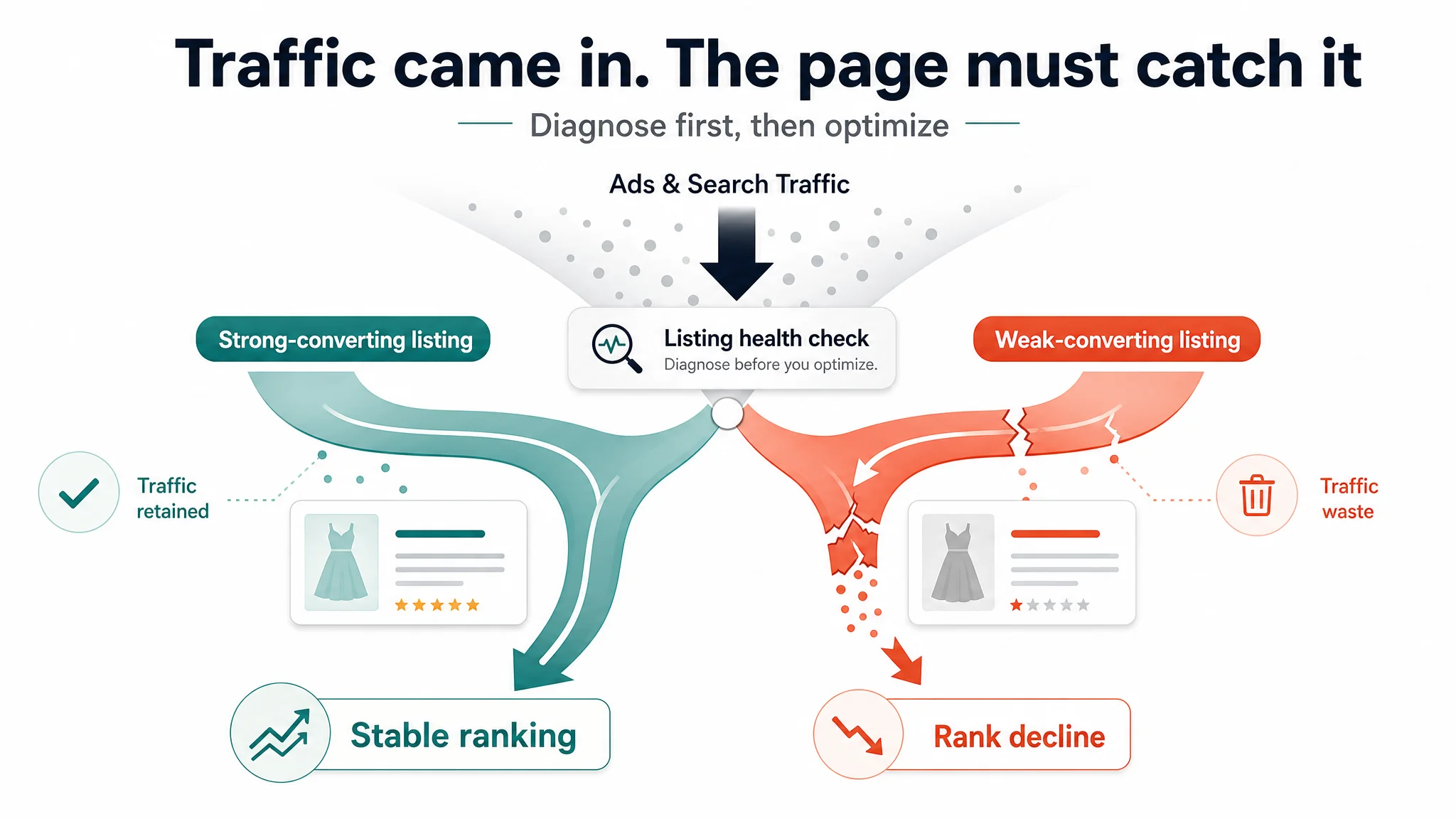
This shift from intuition to evidence becomes very tangible when you look at real listing behavior. In one women’s summer dress listing on Amazon US, the team responded to unstable sales and rising ACOS by “working harder on ads”—tuning bids, expanding keywords, and testing budgets—because they instinctively framed the issue as a traffic problem. DeepBI’s analysis later showed that ads were already doing their job: traffic was coming in, but the page itself was not converting. The organic rank decline they were experiencing was not primarily a visibility issue; it was the consequence of a listing that could not turn visits into orders. That is precisely the kind of misdiagnosis a structured, data-led approach is designed to prevent.
Understanding Organic Rank Decline: Why It Matters for Amazon Sellers
On Amazon, organic search ranking is the bedrock of sustainable profitability. A product's position in search results directly correlates with its visibility, traffic, and sales velocity. A higher rank means more potential customers see the listing without paid advertising for each click, creating a powerful engine for long-term growth. This is often described as the Amazon "flywheel effect": strong organic sales improve the Best Sellers Rank (BSR), which in turn boosts organic visibility and leads to even more sales. This positive feedback loop is essential for building a healthy business and reducing the Total Advertising Cost of Sales (TACoS).
However, not every dip in ranking is a cause for alarm. It is crucial to differentiate between minor, temporary fluctuations—which are normal in a competitive marketplace—and a significant, sustained decline that signals a deeper problem. A meaningful decline is one that persists over time and negatively impacts core business metrics. For instance, a persistent drop in Click-Through Rate (CTR) or Conversion Rate (CVR) alongside a falling rank indicates that a listing is failing to attract or convert shoppers effectively. Ignoring such a trend allows competitors to capture market share, disrupts sales momentum, and can quickly erode profitability, making a swift diagnosis and recovery plan essential.
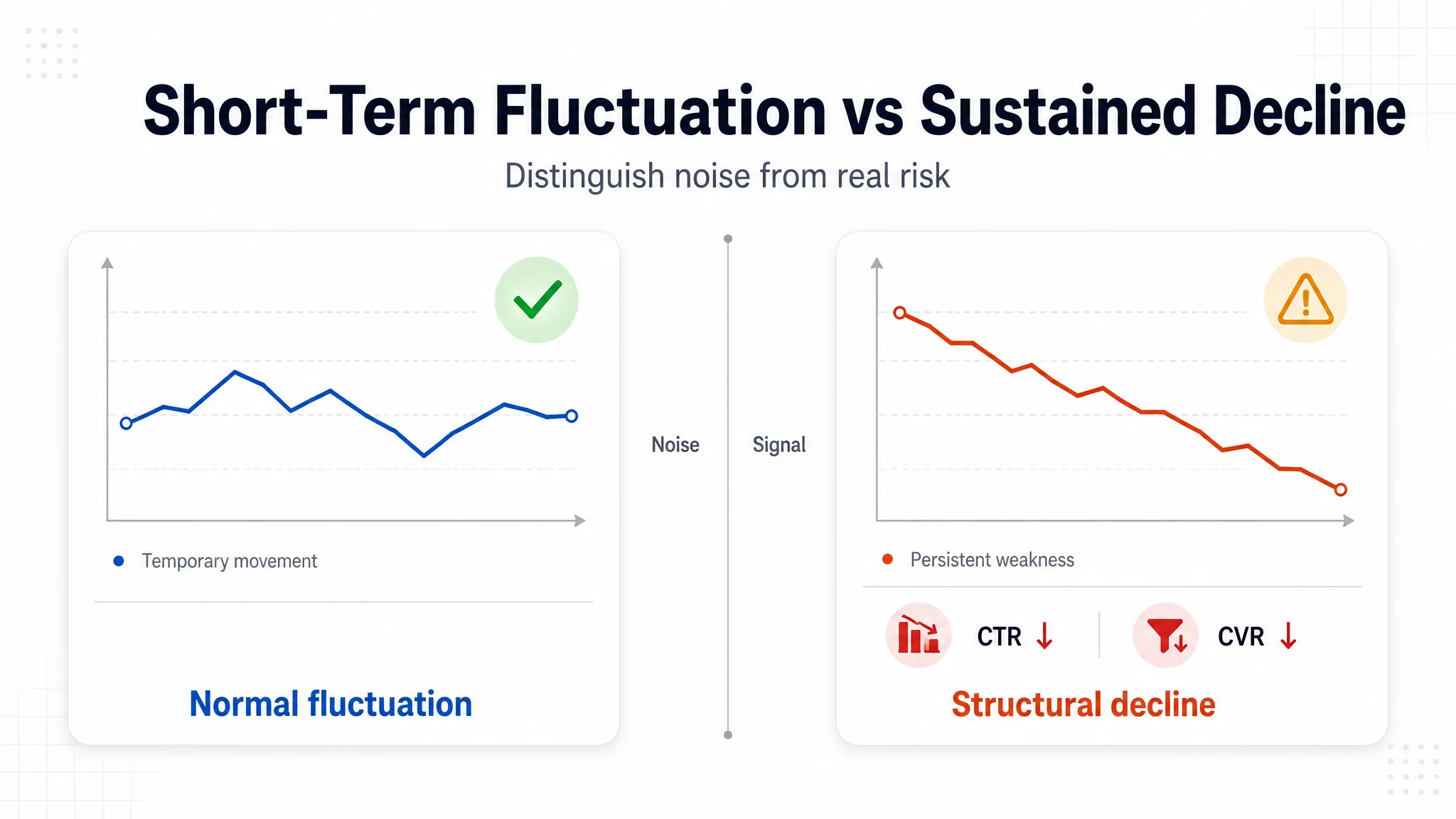
This distinction between “noise” and “signal” is often blurred in day-to-day operations. In the summer dress case mentioned earlier, there were regular ups and downs in orders that the team initially wrote off as normal volatility. Only when DeepBI overlaid rank trends with CTR and CVR did a clearer picture emerge: impressions were not collapsing, but both CTR and CVR were consistently underperforming compared to a directly comparable competitor dress. That pattern signaled a real structural issue in how the listing attracted and converted traffic, not just a random seasonal fluctuation. Once that became visible, it was much harder to explain away the rank decline as mere “market noise,” and far easier to justify a deeper diagnostic effort.
Initial Checks: Verifying the Decline with DeepBI
Before you can fix a drop in organic rank, you must first confirm it is a genuine, significant decline and not just a temporary market fluctuation. Suspicions and anecdotal evidence are insufficient; objective data is needed to guide your strategy. DeepBI serves as your primary diagnostic tool, transforming uncertainty into a clear, data-backed assessment of your listing's health.
The first step is to move beyond simple rank tracking to analyze the core performance indicators that a rank drop directly impacts: impressions, Click-Through Rate (CTR), and Conversion Rate (CVR). Within DeepBI, you can analyze these metrics to establish a clear line of causation. A sustained downturn in impressions and CTR, for example, is a strong signal that your product is losing visibility in search results.
DeepBI’s diagnostic capabilities allow you to pinpoint the scope of the problem. By analyzing your traffic and trust funnels, you can determine if the issue is at the top of the funnel (a low CTR suggesting a weak main image or title) or the bottom of the funnel (a low CVR pointing to issues with A+ content or negative reviews). This granular analysis helps you understand whether the decline affects an ASIN's ability to attract clicks or its power to convert shoppers, ensuring your recovery efforts are precisely targeted.
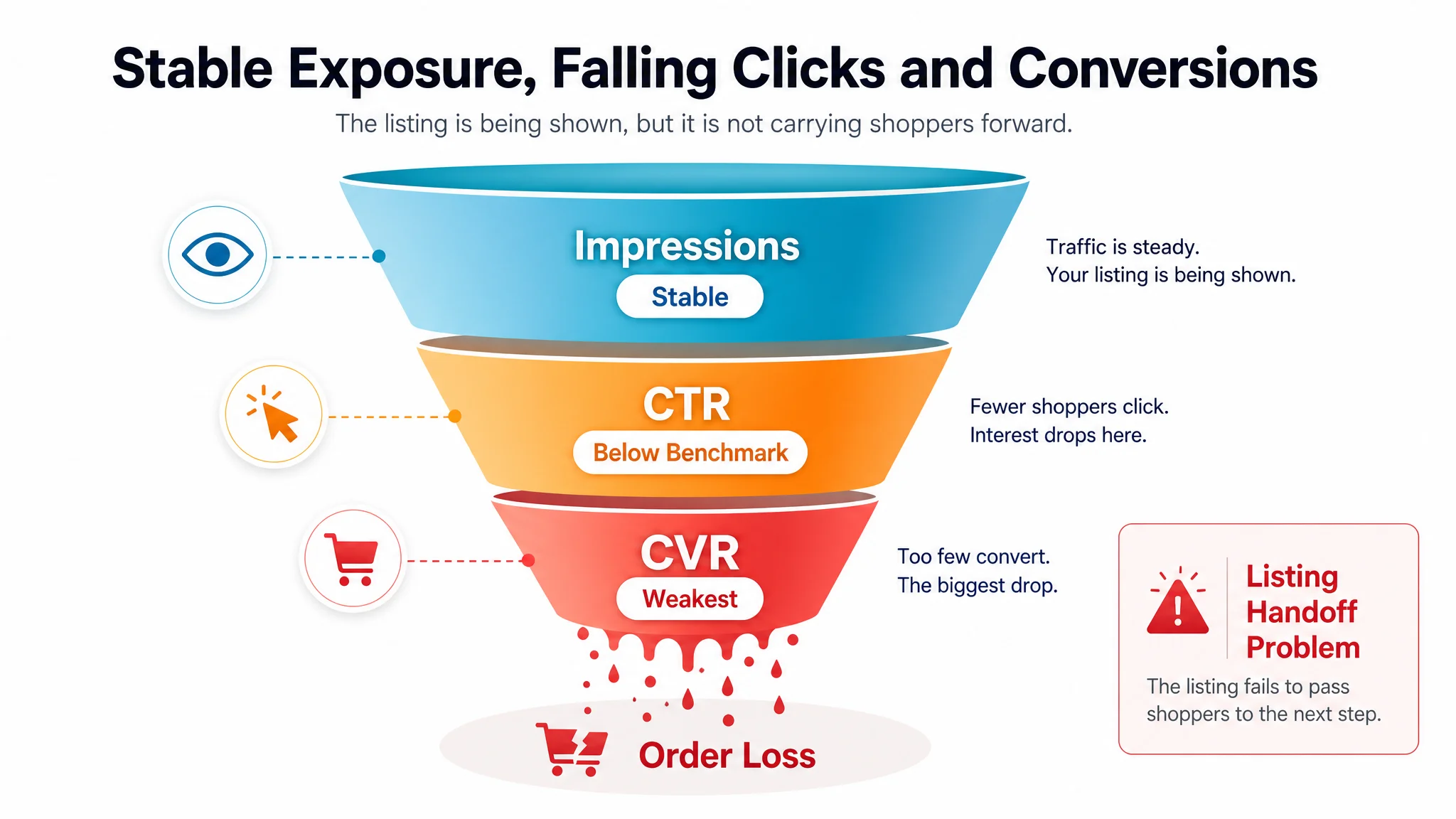
In the fashion seller’s case, these initial checks were what broke the “ad problem” narrative. DeepBI surfaced that:
- Impressions for the core summer dress keywords were relatively stable.
- CTR lagged behind a benchmark dress despite similar exposure.
- CVR was the clearest weakness, with many clicks failing to progress into orders.
From a rank perspective, this meant Amazon was still showing the product, but signals from shoppers (low click engagement and weak conversion) were undermining its relevance score. Instead of chasing more impressions through aggressive bidding, the seller was confronted with evidence that their listing was underperforming relative to the traffic it already had. That kind of initial verification is the difference between chasing symptoms and tackling the true source of organic decline.
Deep Dive Diagnosis: Identifying the Root Causes of Organic Rank Drops
To effectively reverse a decline in organic rank, you must first move from speculation to precision targeting. A systematic diagnosis is essential to uncover the core issues constraining performance, providing an objective data foundation for all subsequent optimization actions.
Amazon Algorithm Updates and Market Shifts
Amazon's ranking algorithm is constantly evolving to prioritize product relevance and customer experience. Unlike search engines such as Google, Amazon does not announce these updates. However, sudden market-wide volatility or shifts in competitor rankings can indicate an algorithmic change. It's also critical to consider external factors like new market trends, seasonality, and evolving customer search behavior, which can impact your product's visibility regardless of your own actions.
In practical terms, this means you must distinguish between a “you” problem and a “market” problem. When the summer eyelet dress seller examined their category through DeepBI, they could see that not all dresses were suffering similarly. The benchmark competitor maintained stronger rank positions on core summer dress keywords over the same period. That observation suggested there was no broad algorithmic penalty in the category; instead, competitor listings were simply sending better signals—higher CTRs, stronger CVRs, more coherent content—under the same algorithm. Recognizing that the environment had not collapsed uniformly was a key step in focusing efforts on their own page, rather than attributing the issue to a mysterious platform change.
Technical Issues Affecting Amazon Listing Visibility
Foundational technical problems can render your optimization efforts useless. The most common issue is improper indexing, where your ASINs are not correctly registered in Amazon's search system. Another critical factor is listing health; violations of Amazon's policies can lead to your listing being suppressed or de-indexed entirely. Ensuring all product variations are properly structured and discoverable within your brand's Amazon store is a prerequisite for any successful organic strategy.
Before launching into content changes, the dress seller used DeepBI to rule out these technical risks. The listing was indexed for key terms like “womens summer dress,” “eyelet dress,” and “mini sundress,” and there were no suppression flags or policy violations on record. Variation relationships across colors and sizes were intact. This eliminated the possibility that the rank decline stemmed from a hidden de-indexing or structural issue. It also underscored a broader diagnostic principle: when technical foundations are sound, yet rank and performance are deteriorating, the likely culprit shifts toward listing quality and competitive positioning rather than backend configuration.
Listing Quality and Competitiveness: The Core of Organic Performance
Your listing's quality is the primary lever for organic performance. A comprehensive audit should analyze content degradation in titles, bullet points, and A+ Content. DeepBI provides a quantitative audit across five key dimensions—main image, title, bullet points, A+ page, and Voice of the Customer (VoC)—benchmarking your listing against top competitors. This data-driven approach identifies specific weaknesses, such as a low Click-Through Rate (CTR) linked to a poor main image or a low Conversion Rate (CVR) tied to a trust deficit in reviews and A+ content.
In the eyelet dress example, DeepBI’s Listing scoring made the conversion problem visible in a single snapshot:
- Target listing: 62/100
- Benchmark competitor: 78/100
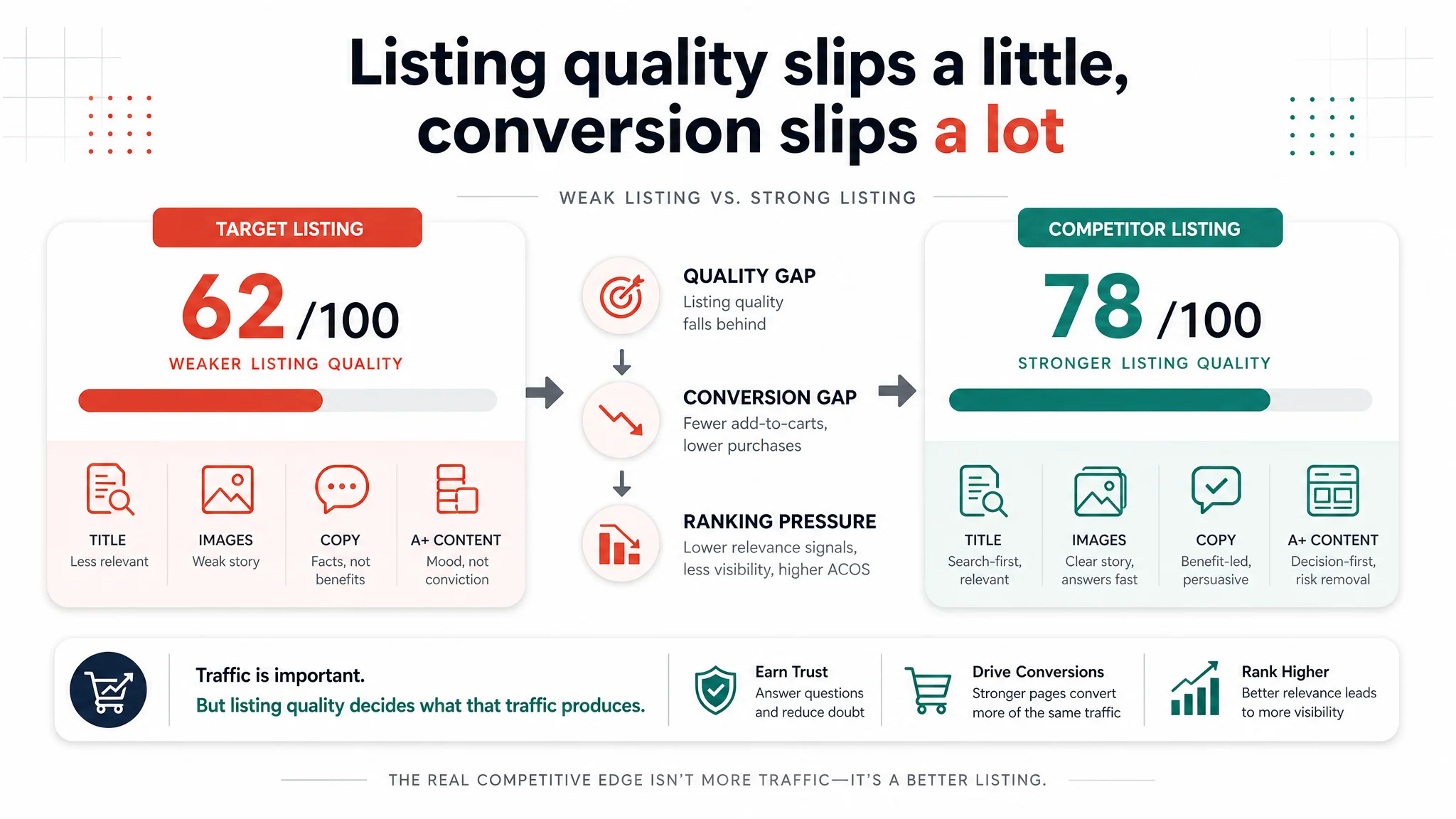
The gap was not limited to one area; it spanned multiple conversion levers:
- Title: weaker alignment with real Amazon search behavior
- Main images: no clear, progressive decision path
- Bullet points: factual but not persuasive
- A+ content: atmospheric but light on risk reduction
- Reviews: slightly behind, but not a catastrophic blocker
From an organic rank perspective, this matters because Amazon’s algorithm rewards listings that both attract and satisfy shoppers. When your title fails to highlight the terms customers actually search, your main image does not communicate value at a glance, and your detail content leaves questions about fabric, fit, and scenarios unresolved, shoppers hesitate or bounce. Over time, this behavior translates into weaker engagement and conversion signals, which the algorithm interprets as lower relevance. In other words, listing quality becomes the underlying cause of both conversion decline and the organic rank drop that follows.
Keyword Performance and Search Term Strategy
A sudden rank drop is often tied directly to keyword performance. The first step is to identify which specific, high-value keywords have lost ranking. This could be due to changes in search volume or a shift in user intent, making your existing terms less relevant. Furthermore, your advertising strategy has an indirect impact; underperforming ad campaigns can harm organic visibility by sending low-quality traffic that fails to convert, weakening the positive signals your listing sends to Amazon's algorithm.
In the dress case, DeepBI showed that the listing was technically indexed for relevant phrases, but the title structure buried those phrases behind low-value tokens. The seller had led with their brand and extraneous details, even including a future year, while the benchmark focused immediately on high-intent search phrases like “womens summer eyelet lace mini dress” and scenario words like “beach” and “sundress.” Ads were also heavily weighted toward generic, broad terms, which brought in traffic that was not always aligned with the specific style and use case of the dress. This combination—suboptimal keyword prominence in the title and loosely targeted ad traffic—meant that the listing was neither maximally discoverable for the right queries nor particularly convincing when those shoppers arrived. Over time, rank on the most important summer dress search terms eroded, not because the product disappeared from indexing, but because its keyword and content strategy failed to keep up with evolving search behavior and competitive benchmarks.
Strategic Recovery and Prevention: Leveraging DeepBI for Sustained Growth
Data-Driven Optimization with DeepBI
A successful recovery requires a coordinated, data-driven strategy. DeepBI centralizes this effort by integrating diagnostics with execution. Use the Organic Traffic module to screen advertising data for keywords with high CTR and CVR. The Listing module then benchmarks your content against competitors, identifies weaknesses, and uses AI to generate optimized titles and A+ content. Finally, deploy the Ads Quant module to create targeted "Top of Search" campaigns for these keywords, driving immediate traffic that reinforces positive signals to Amazon's ranking algorithm.
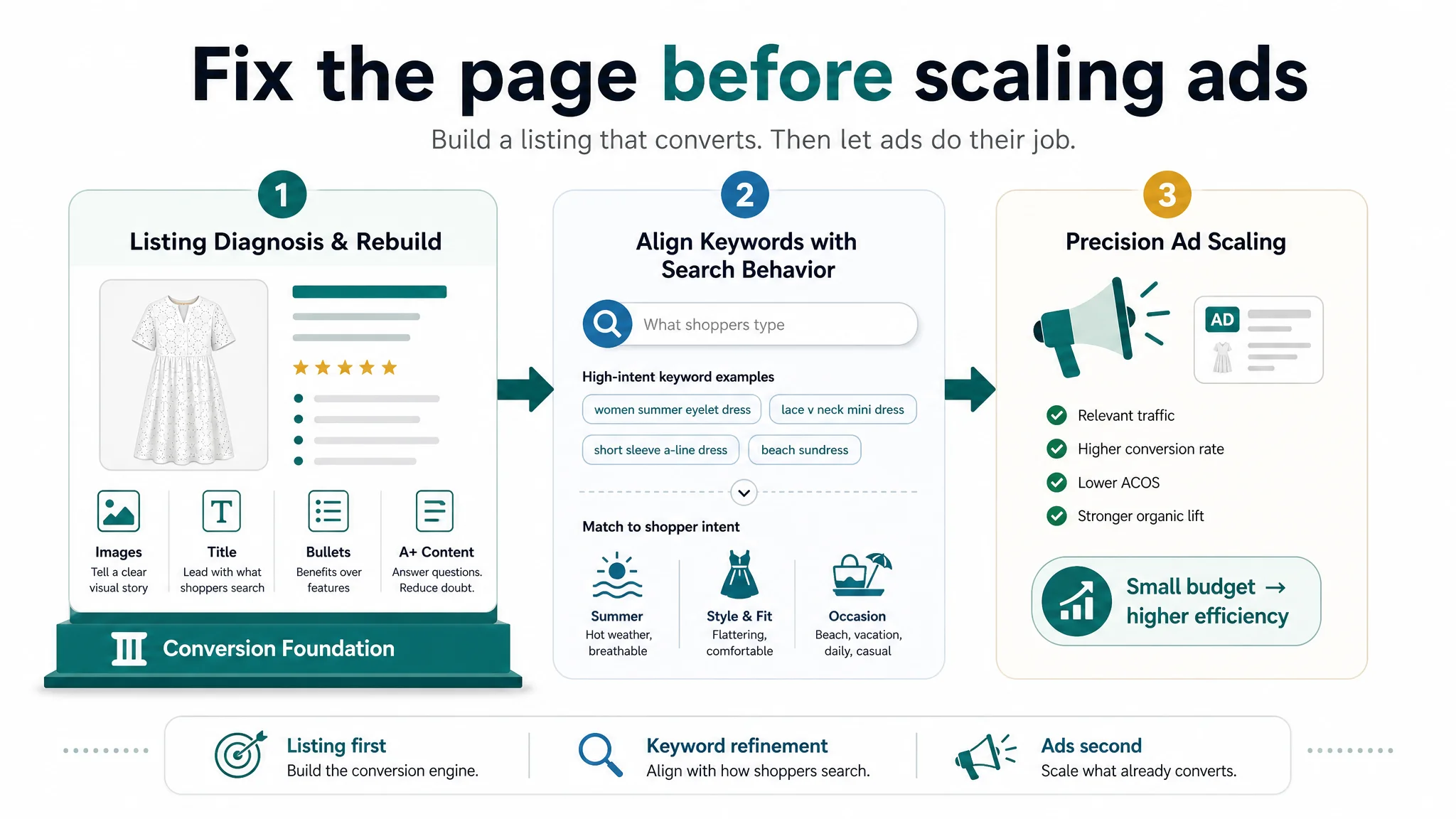
What distinguishes this approach in practice is the order of operations. In the summer dress scenario, the team had already spent weeks adjusting bids and broadening keyword coverage without seeing sustainable improvements in CVR or organic rank. DeepBI effectively reversed that sequence:
1. Listing first: Use Listing scoring and competitor benchmarks to identify structural weaknesses in title, images, bullets, and A+.
2. Keyword refinement: Align title and backend terms with real search behavior uncovered in traffic data.
3. Ads second: Once the page could plausibly convert, reintroduce and refine ads to reinforce positive engagement and conversion signals.
By following this sequence, the seller stopped using ads to compensate for a weak listing and started using them to amplify a stronger one. DeepBI’s modules provided the connective tissue between these steps, ensuring that each change—whether in content or advertising—was directly tied to measurable shifts in organic visibility and rank stability.
Content and Listing Enhancement
Translate diagnostic insights into tangible listing improvements. DeepBI's analysis fuels fresh keyword research to align with current search behavior. For visuals, the platform generates precise, AI-executable instructions for images and A+ content based on parameters like composition and lighting to boost CTR and CVR. This process is governed by a strict 'Product DNA' constraint, ensuring all AI-generated visuals remain true to the product. By analyzing review data, you can also address customer pain points, fostering positive feedback that indirectly supports rank recovery.
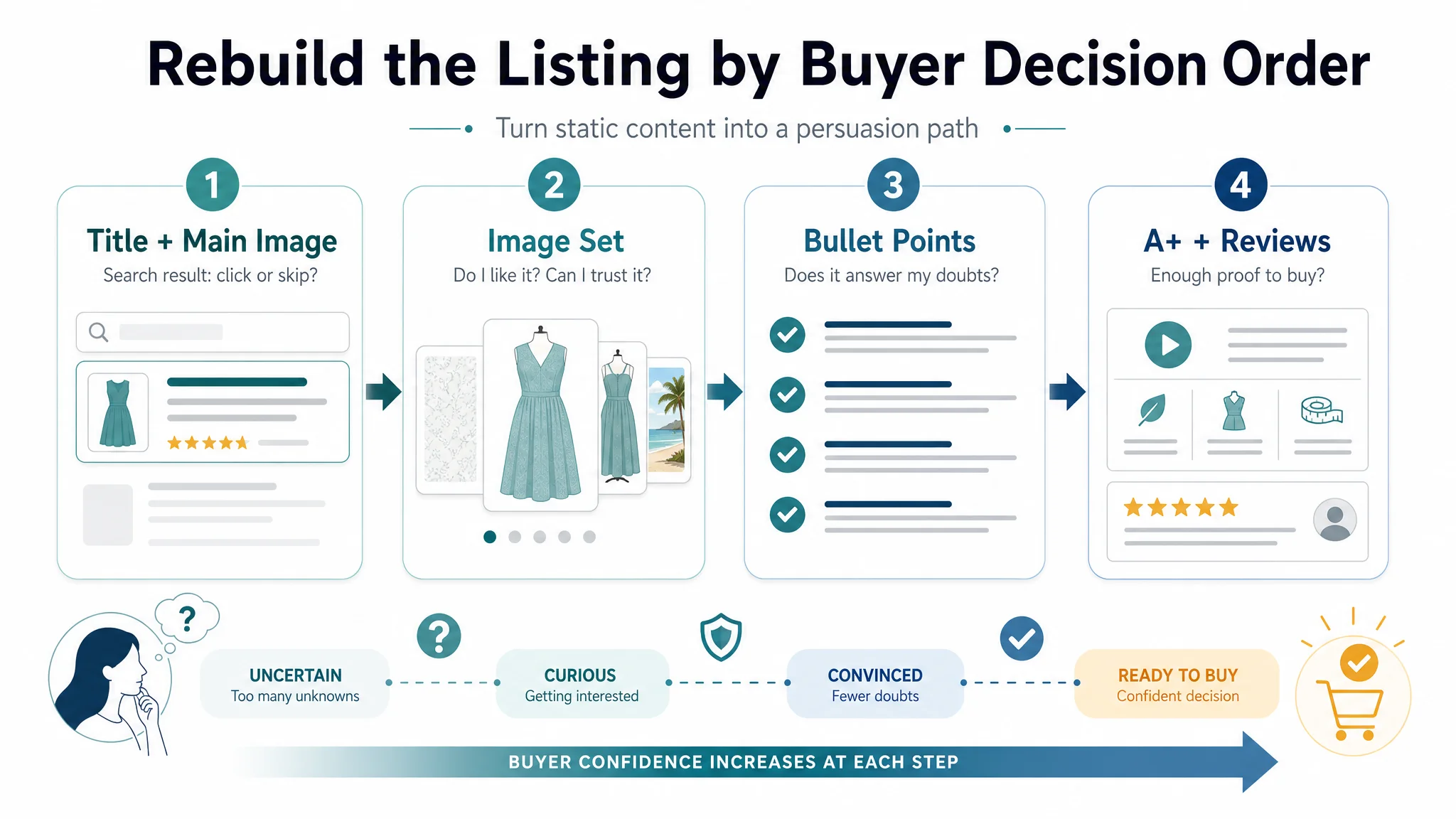
The summer dress optimization illustrates how granular this content work can become:
- Title: DeepBI recommended moving the brand name back and leading instead with “Womens Summer Eyelet Lace V Neck Short Sleeve A-Line Mini Dress,” explicitly integrating category and scenario terms like “Beach” and “Sundress.” This made the title more relevant to how shoppers actually search and more attractive in search results, supporting both CTR and keyword relevance.
- Main images: The previous image stack repeated similar views and even obscured parts of the dress with props. DeepBI’s guidance reorganized the sequence into a clear path:
1. A clean, unobstructed front view on a model.
2. Early close-ups of fabric and neckline to answer texture and comfort questions.
3. A back view brought forward to establish consistency.
4. A lifestyle image anchoring the dress in a real summer scenario.
5. A final image confirming length, drape, and overall proportion.
This addressed real user doubts revealed in behavior data: shoppers wanted to see how the dress moved, what the fabric looked like up close, and whether the back matched the front.
- Bullet points: Instead of listing variant names and basic attributes, bullets were rewritten as a logical persuasion sequence—highlighting breathable fabric for hot weather, a flattering A-line silhouette, inclusive fit, versatile styling options, and clear use-case scenarios such as dates, vacations, and daily commuting. This shift turned static information into a narrative that guided shoppers toward a purchase decision.
- A+ content: Existing modules leaned heavily into mood and brand story without sufficiently reducing buying risk. DeepBI recommended restructuring A+ around decision-making stages: showing multiple colors in real outdoor contexts, labeling design features with explicit benefits, providing macro shots of the eyelet fabric to prove comfort and quality, offering concrete outfit ideas for specific scenarios, and giving more actionable size guidance. As a result, shoppers scrolling through A+ encountered a structured argument for why this dress fit their needs, rather than a loose collection of images.
These changes were not cosmetic tweaks; they directly strengthened the listing’s ability to convert, which, in turn, improved the quality of engagement signals that influence organic rank. The key lesson is that content enhancement should be guided by data on where shoppers are hesitating or dropping off, not by general design preferences.
Proactive Monitoring and Adaptation
Sustaining organic rank requires continuous vigilance. Use DeepBI's dashboards to proactively monitor organic rankings, traffic, and sales. The platform's competitive benchmarking features help you adapt to market shifts. This creates a powerful feedback loop where market performance data refines future optimization models. This transforms listing management from a reactive task into a predictable, quantifiable process for long-term growth on Amazon.
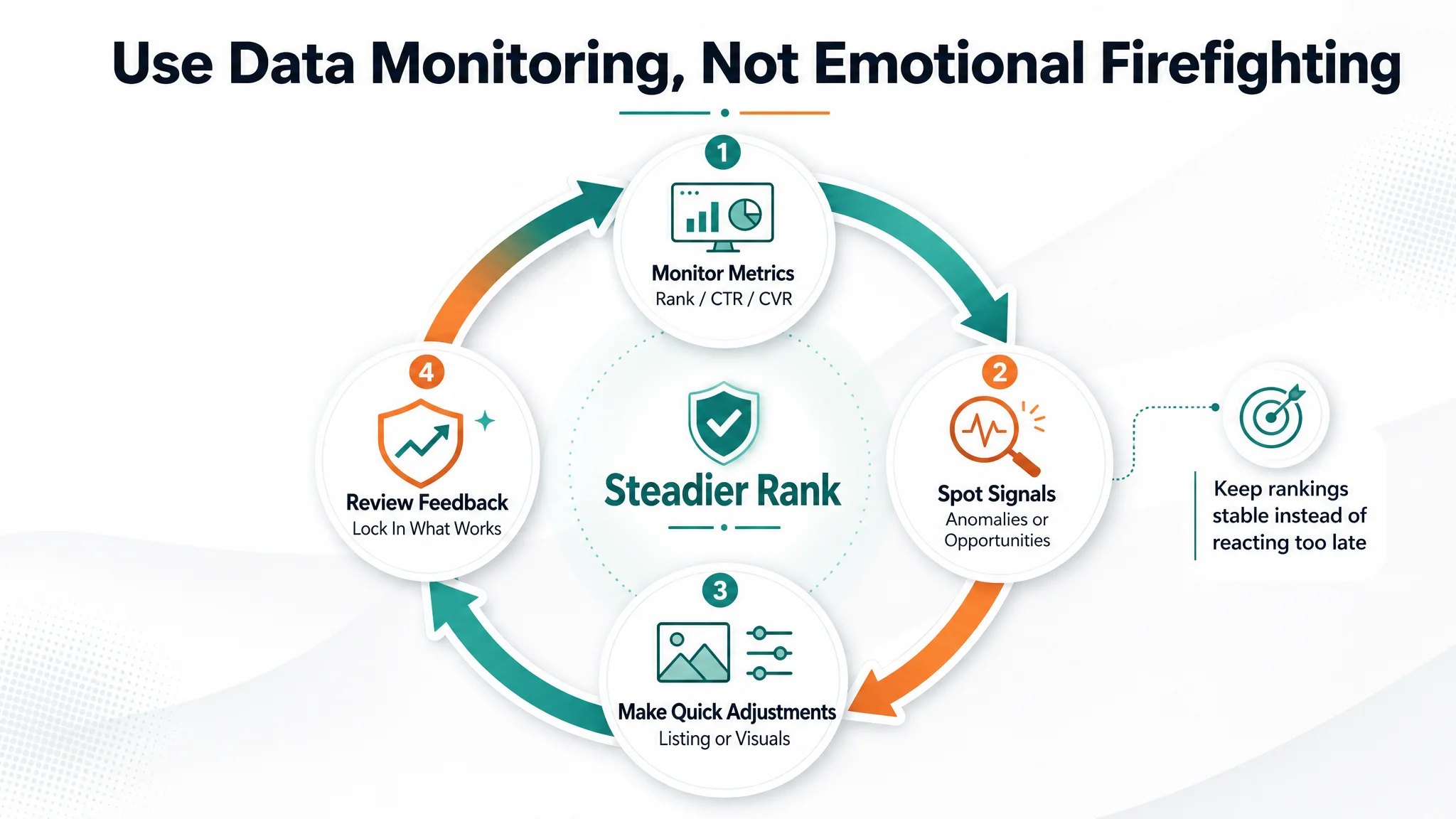
In the fashion seller’s experience, this ongoing monitoring changed how they interpreted future fluctuations. Instead of reacting immediately to every small rank change with ad adjustments, they used DeepBI to check:
- Are CTR and CVR moving in the same direction as rank?
- Is a competitor suddenly outperforming on a key dimension, such as main image or recent reviews?
- Are new search terms emerging in their category that their title and bullets do not yet reflect?
When one of the benchmark dresses updated its imagery and saw a CTR improvement, DeepBI’s competitive view highlighted the shift early. Rather than waiting for their own rank to erode again, the seller evaluated whether their own visual story still held up and adjusted accordingly. This kind of proactive adaptation—grounded in continuous data, not intuition—helped stabilize organic performance and prevented the return of the earlier pattern where ads were used as a blunt tool to chase away rank decline.
Conclusion: Sustaining Organic Growth on Amazon with DeepBI
A decline in organic rank is not a permanent setback but a critical data point demanding a strategic response. The era of relying on intuition and subjective listing changes is over. True recovery and long-term success on Amazon depend on shifting from reactive fixes to a proactive, data-informed methodology where every optimization is a calculated move to improve performance.
This is the operational standard that DeepBI enables. By integrating diagnosis, strategic planning, and AI-powered execution into a unified workflow, DeepBI transforms listing management into a predictable, scientific process. It creates a powerful feedback loop, using advertising data to guide visual and textual optimizations and then precisely measuring their impact on key metrics like Click-Through Rate (CTR) and Conversion Rate (CVR). This system converts stable advertising signals into stronger, more resilient organic rankings.
The summer dress listing illustrates what this looks like in real practice. The seller began with a familiar misdiagnosis—blaming ads for poor performance—only to discover through DeepBI that the true constraint lay in the listing’s conversion capacity. Once content, images, and A+ structure were rebuilt around real shopper behavior, ad traffic started to make economic sense again, and organic rank had a more solid foundation from which to recover.
Ultimately, embracing this approach allows you to move beyond simply reacting to problems. You can begin to engineer sustainable growth, turning every listing update into a precision strike that fortifies your market position. Adopting a data-first strategy is the definitive path to converting operational efficiency into lasting profitability on Amazon—and to ensuring that when organic rank comes under pressure, you have both the tools and the evidence to correct course with confidence.