


The Indispensable Role of Product Images on Amazon
On Amazon's crowded digital shelf, your main product image is the single most critical factor in capturing a shopper's attention. It serves as the visual hook that determines whether a potential customer clicks on your listing or scrolls past to a competitor. In a marketplace defined by intense competition and rising traffic costs, this initial engagement is paramount for survival and growth.
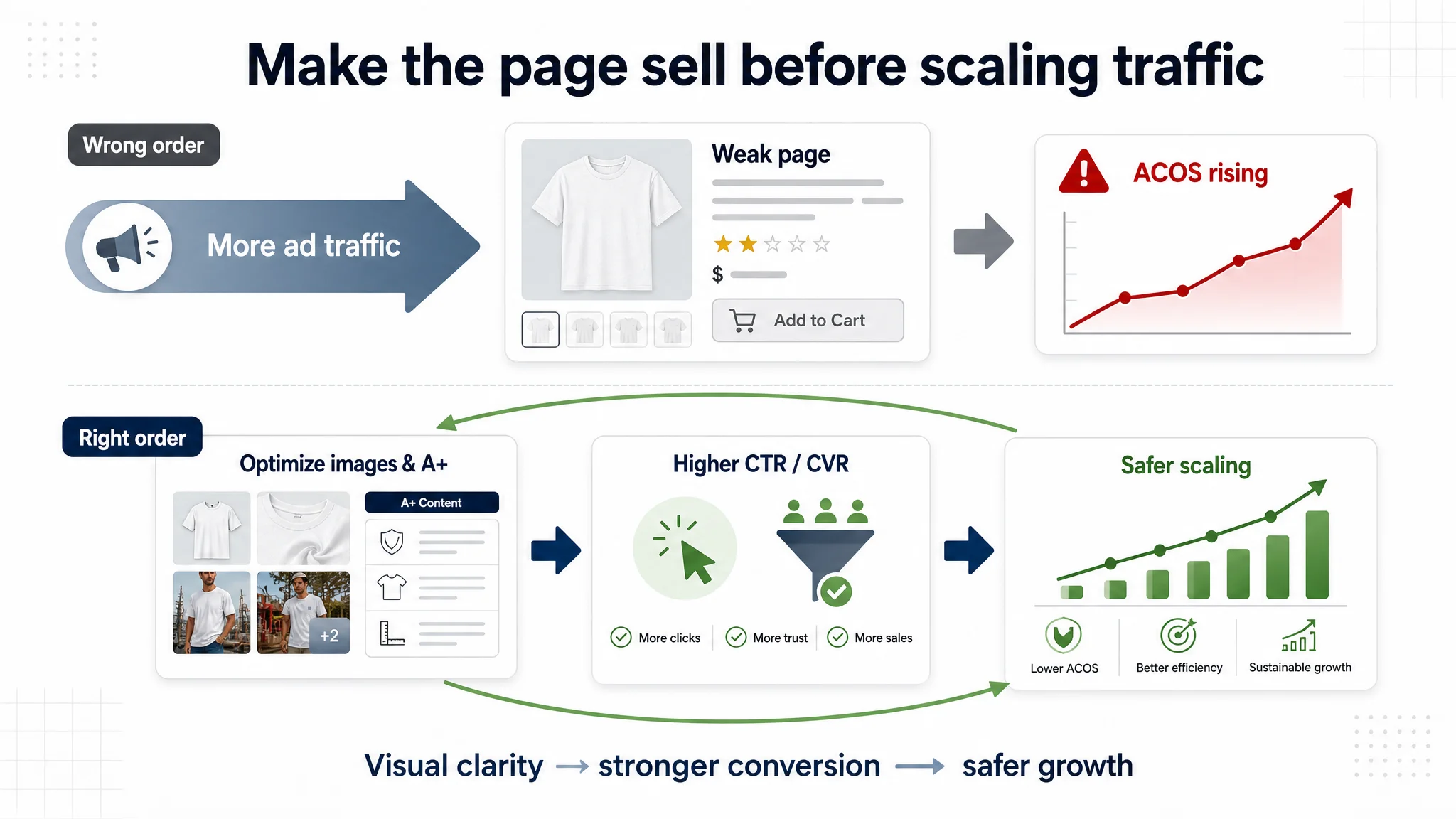
This isn’t just theory. In one workwear project DeepBI audited, the seller had what they believed was a “technically strong” heavyweight work T‑shirt listing: detailed fabric specs, industrial usage scenes, and extensive copy on durability. On paper, the listing even scored slightly higher than a key competitor in aggregate. Yet ad traffic was not converting as expected. The team kept blaming bids and keywords, but the real leak was simpler: shoppers could not quickly see how the shirt actually fit on a real body or trust how the fabric would feel on long shifts. The main images and A+ content were rich in industrial toughness, but thin on basic fit and comfort reassurance. As long as those visual basics were missing, no amount of ad adjustment could make the traffic convert.
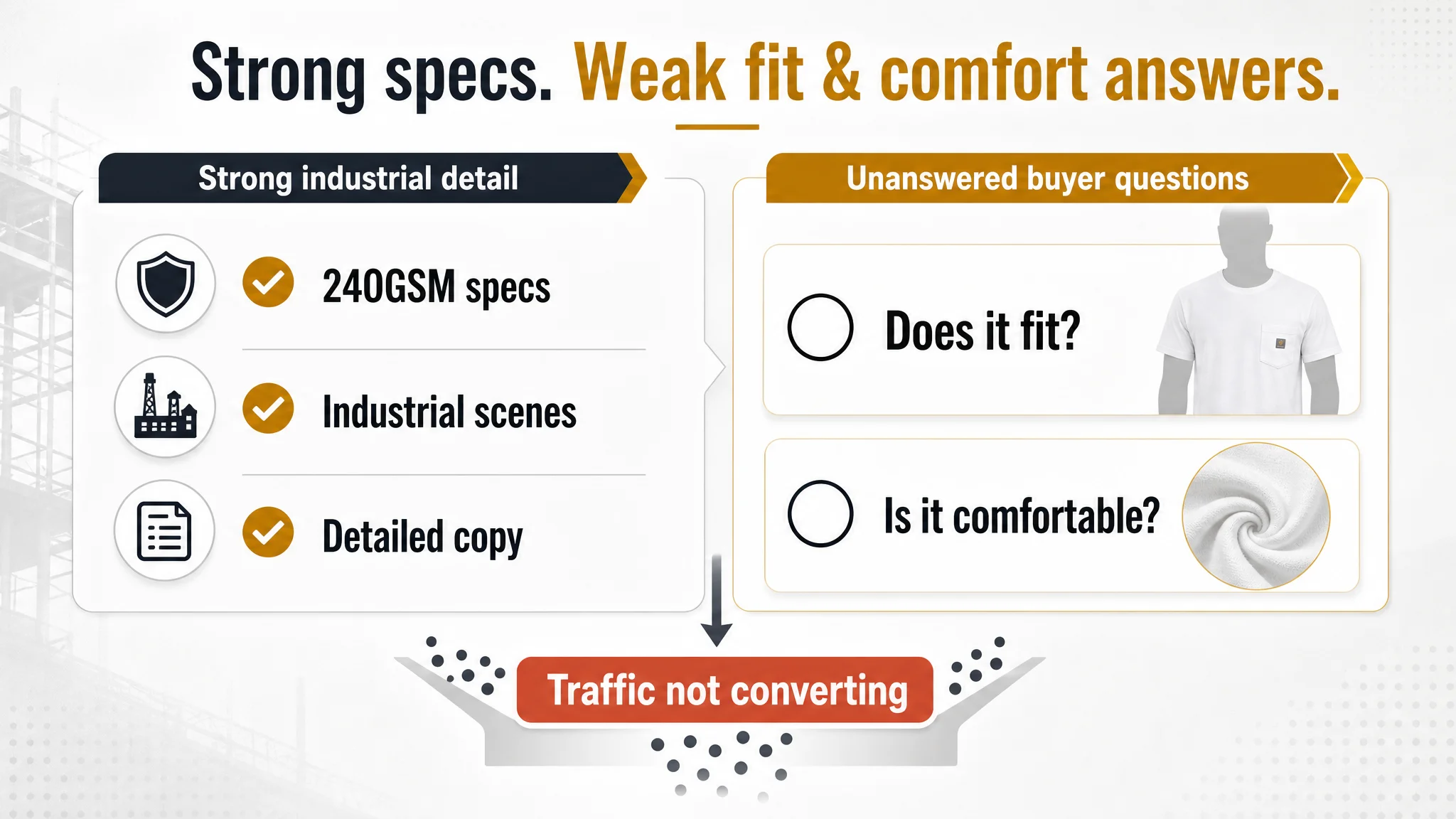
The function of visual assets has fundamentally evolved. They are no longer just for aesthetic display; they are a core commercial engine that directly drives clicks and conversions. A compelling main image is your primary tool for improving your Click-Through Rate (CTR) from search results. Subsequently, a full suite of high-quality secondary images and A+ content is essential for persuading shoppers on the detail page, directly boosting your Conversion Rate (CVR).
Sellers who treat their images as a strategic asset—meticulously optimized to stand out and communicate value—gain a decisive advantage. Neglecting visual performance means wasting ad spend on listings that don't convert and allowing competitors to seize market share. Ultimately, as the workwear seller discovered, investing in data-driven image optimization is not an expense but a direct investment in higher CTR, better CVR, and healthier long-term growth for your brand.
Amazon's Official Image Requirements: The Foundation
Before optimizing for conversion, you must first ensure your product listings are compliant and visible. Amazon enforces a strict set of image requirements to maintain a consistent and trustworthy shopping experience for its customers. Failure to meet these foundational standards isn't a minor oversight; it can lead to your listings being suppressed or removed entirely by Amazon's automated systems, effectively halting your sales before they can even begin.
In the workwear case, the seller had cleared this basic hurdle: white backgrounds, correct formats, and sufficient resolution. That initial compliance meant the listing could run and receive traffic. But as their experience showed, meeting the requirements only keeps the door open; it does not guarantee that the traffic you pay for will actually convert.
General Technical Specifications
Adhering to Amazon's technical framework is the first step. Your images must meet specific criteria to be accepted by the platform.
- File Formats: Use TIFF, JPEG, GIF, or PNG formats. JPEG is the most common and recommended for its balance of quality and file size.
- Image Size: Images should be at least 1000 pixels on the shortest side, with 1600 pixels or more recommended to enable the zoom feature, which is critical for customer evaluation.
- Color Mode: All images must be in the sRGB or CMYK color mode. RGB is the standard for web content and ensures color consistency across devices.
- File Naming: Files must be named with the product identifier (ASIN, UPC, EAN, etc.) followed by a period and the appropriate file extension (e.g., B000123456.jpg).
Main Image Specifics
The main image, or "hero image," is the most important visual asset and has the strictest rules. It's the first impression customers have of your product in search results.
- Background: The background must be pure white (RGB 255, 255, 255). Amazon's systems can detect and reject images that fail to meet this standard.
- Product Focus: The product itself must fill at least 85% of the image frame.
- Clean Presentation: The main image must show only the product for sale, outside of its packaging. No additional text, graphics, logos, watermarks, or inset images are permitted.
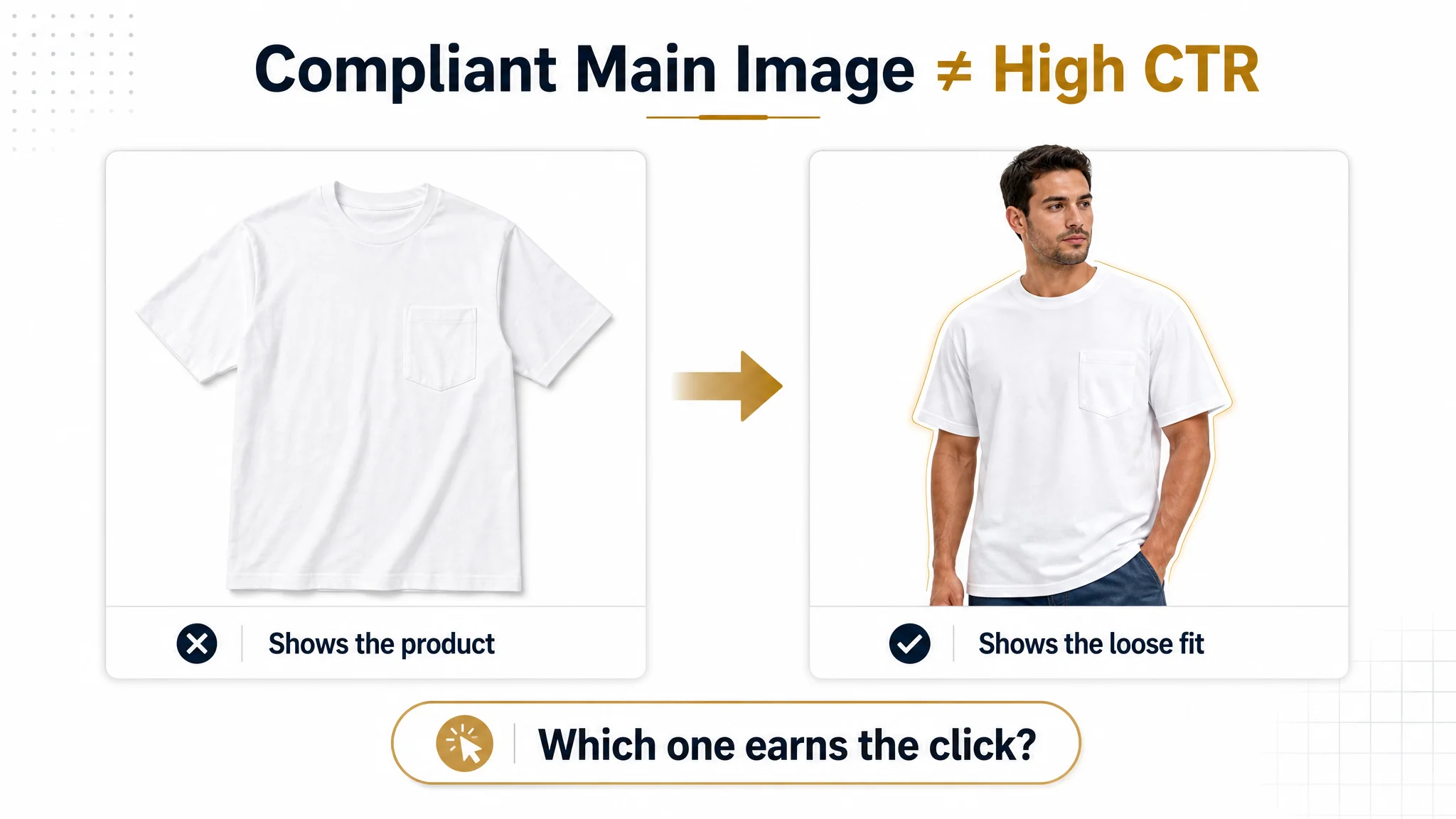
In the work T‑shirt example, the seller’s hero image complied with these rules: plain white background, product centered, no extraneous graphics. Yet in search results, it still underperformed a competitor that led with a clean front-view model shot clearly showing the oversized fit. Both listings were compliant, but the competitor’s main image answered a crucial buyer question (“Will this actually look loose on me?”) in a single glance, which is exactly what drives CTR in real search environments.
Prohibited Content
To protect the integrity of the marketplace, Amazon explicitly forbids certain types of content across all product images. Uploading any of the following will result in immediate rejection or listing suspension:
- Watermarks, logos, or text not intrinsic to the product.
- Placeholder images, such as "no image available" or drawings.
- Nudity or any sexually suggestive or offensive material.
- Images that are blurry, pixelated, or have jagged edges.
Compliance with these rules is non-negotiable. But as the workwear listing showed, “technically perfect” images that only focus on meeting the rules can still leak conversion if they don’t also align with how buyers actually make decisions.
Strategic Image Optimization for Enhanced Conversion
Meeting Amazon's technical image requirements—like pure white backgrounds and minimum pixel dimensions—is the absolute baseline. It keeps your listing active but does little to drive sales. True growth comes from transforming your product images from a simple aesthetic display into a core commercial engine designed to increase both Click-Through Rate (CTR) and Conversion Rate (CVR). This strategic approach prioritizes the customer experience, focusing on visual clarity and showcasing unique value to persuade shoppers to buy.
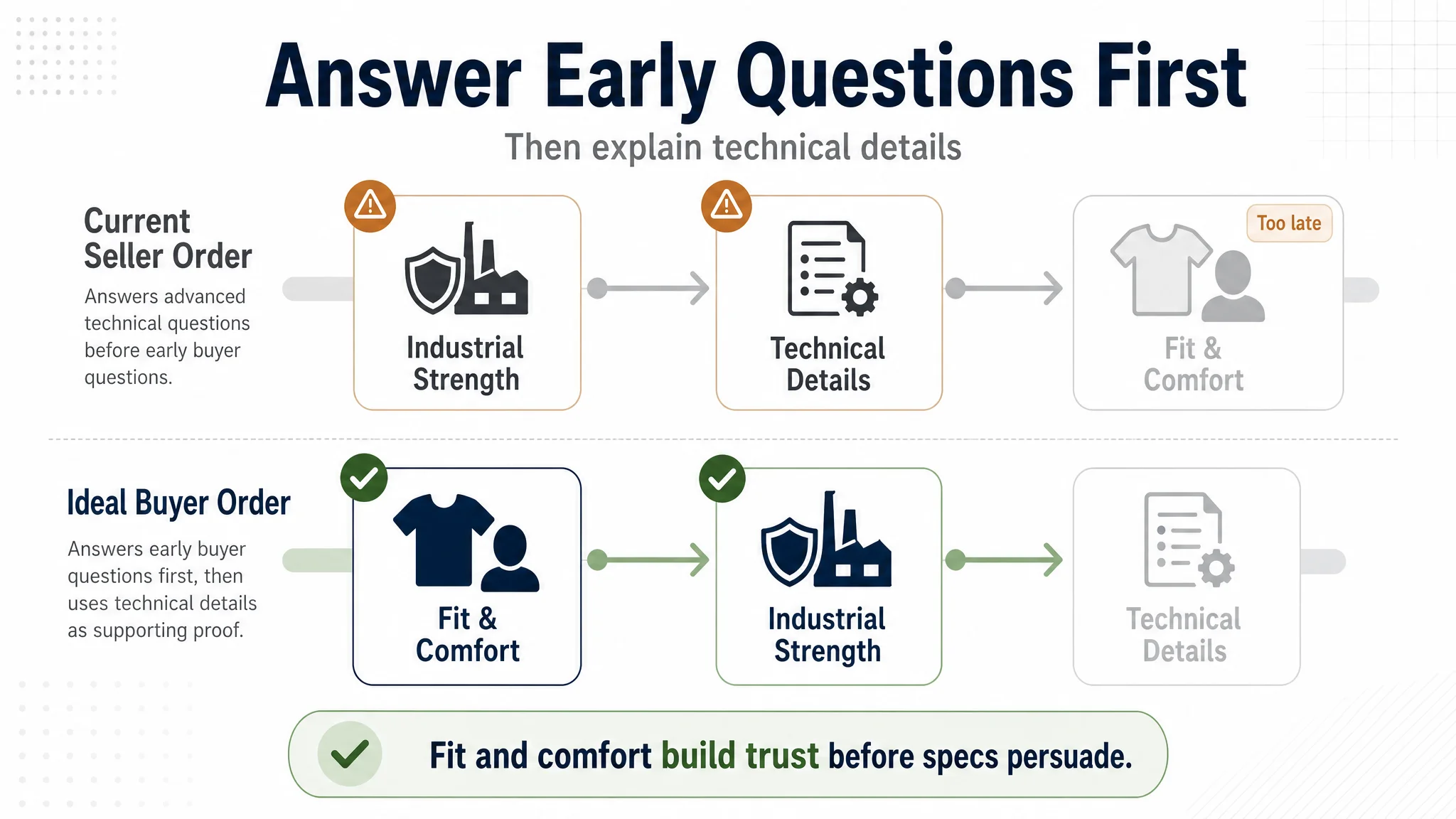
A pattern DeepBI sees repeatedly is that sellers assume “more detail” automatically means “more conversion.” The work T‑shirt seller exemplified this: they invested heavily in technical fabric callouts, industrial scenes, and detailed A+ modules about stitching and GSM. DeepBI’s scoring even showed them slightly ahead of a competitor in total listing score. But when performance lagged, the diagnosis was clear: the images were answering later-stage questions (industrial toughness) before addressing early-stage ones (fit, comfort, and sizing). Strategically, they had the right ingredients in the wrong order.
Optimizing Your Main Image for Click-Through
Your main image is your most important asset for winning the click in crowded search results. While it must adhere to Amazon's terms of service, its primary commercial goal is to maximize CTR. This means going beyond compliance to create a visually arresting image that stands out from competitors, clearly communicates the product, and entices the shopper to learn more.
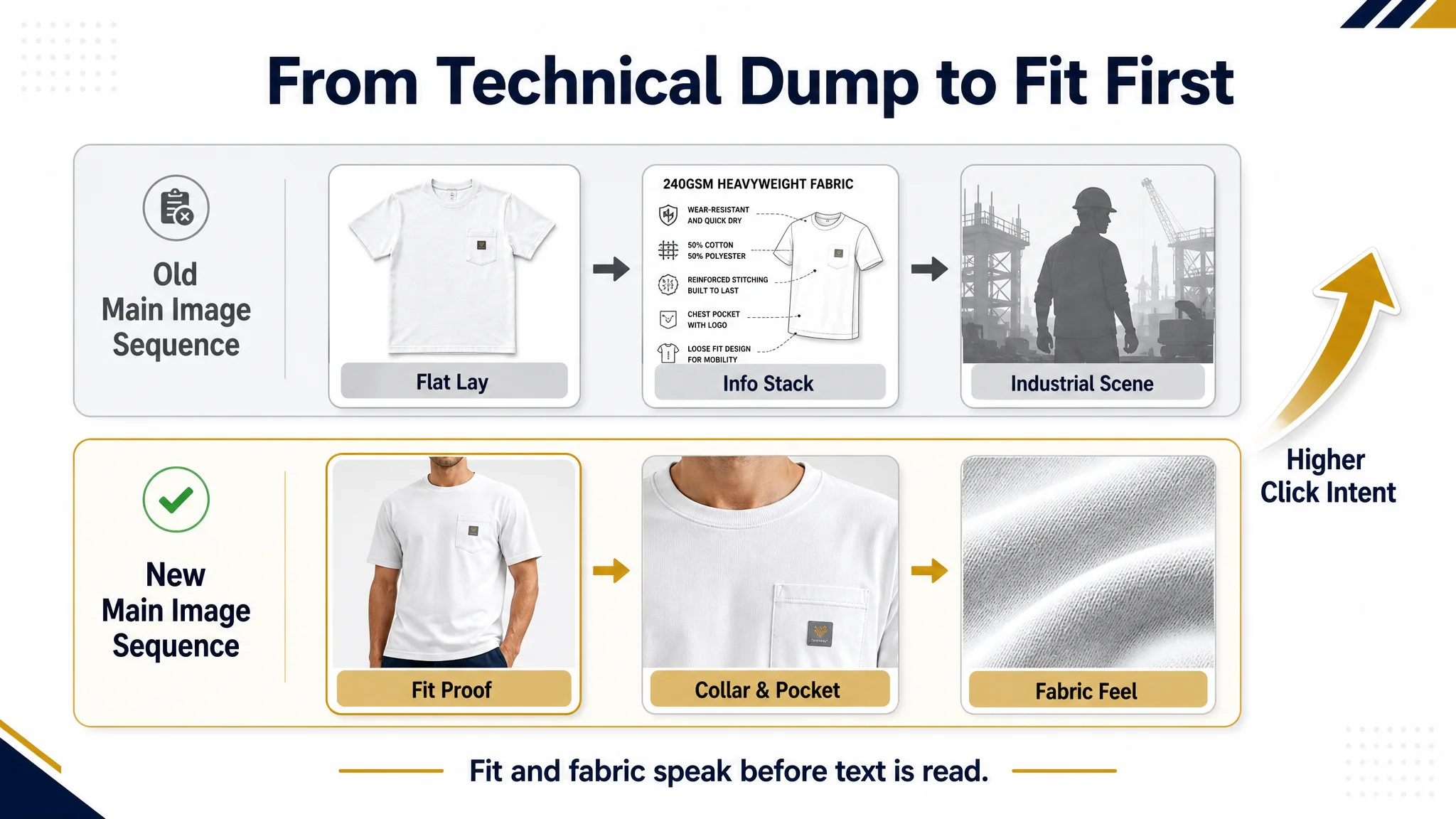
In the workwear case, DeepBI’s analysis highlighted that the seller’s main image sequence leaned heavily on flat lays and text overlays like “240GSM HEAVYWEIGHT,” but did not show a real person wearing the product until later images. The competitor, by contrast, opened with:
- A front-view model shot that instantly confirmed the oversized fit.
- A follow-up upper-torso close-up showing collar and pocket construction.
- A clear fabric texture shot to visually support the “heavyweight” claim.
This difference in early images directly translated to click behavior. Shoppers searching “work t-shirt” or “loose fit work tee” could see, right in search results, how the competitor’s shirt would sit on their body, while the seller’s image forced them to guess. DeepBI’s recommendation was to rebuild the seller’s hero image to feature a clean front-view model shot, in a lighter color that exposes fabric texture, so that fit and fabric speak visually before any text is read. The goal wasn’t to add “more” images, but to ensure the first image earns the click by answering the first questions in the buyer’s mind.
This illustrates a broader principle: main-image optimization is not just about highlighting features; it’s about sequencing visuals to match search intent. If buyers care first about silhouette, your hero must show silhouette. If they care first about color or pack size, that needs to be unmistakably visible at thumbnail size. Otherwise, even compliant, nicely lit images will underperform on CTR.
Crafting Compelling Secondary Images
Once a shopper clicks, your secondary images are responsible for conversion. This is where you build a powerful visual argument, using infographics to highlight features and lifestyle shots to show the product solving a problem. Instead of vague goals like "showcase battery life," a data-driven strategy provides precise instructions, such as creating a "high-visual-impact infographic for '12-hour ultra-long journey'," turning abstract concepts into concrete assets that address customer pain points.
In the T‑shirt project, the seller’s secondary images did contain many “correct” elements in isolation:
- White background angles from front, back, and side.
- Industrial scenarios (welders, mechanics, warehouse work).
- Overlays calling out fabric weight and durability.
However, viewed as a sequence, these images forced buyers to work too hard. Early slots were dominated by flat lays and information-heavy graphics, while crucial proof points—how the shirt moves, how the collar and pocket sit in real use, what the fabric looks like up close—were either delayed or only addressed via text.
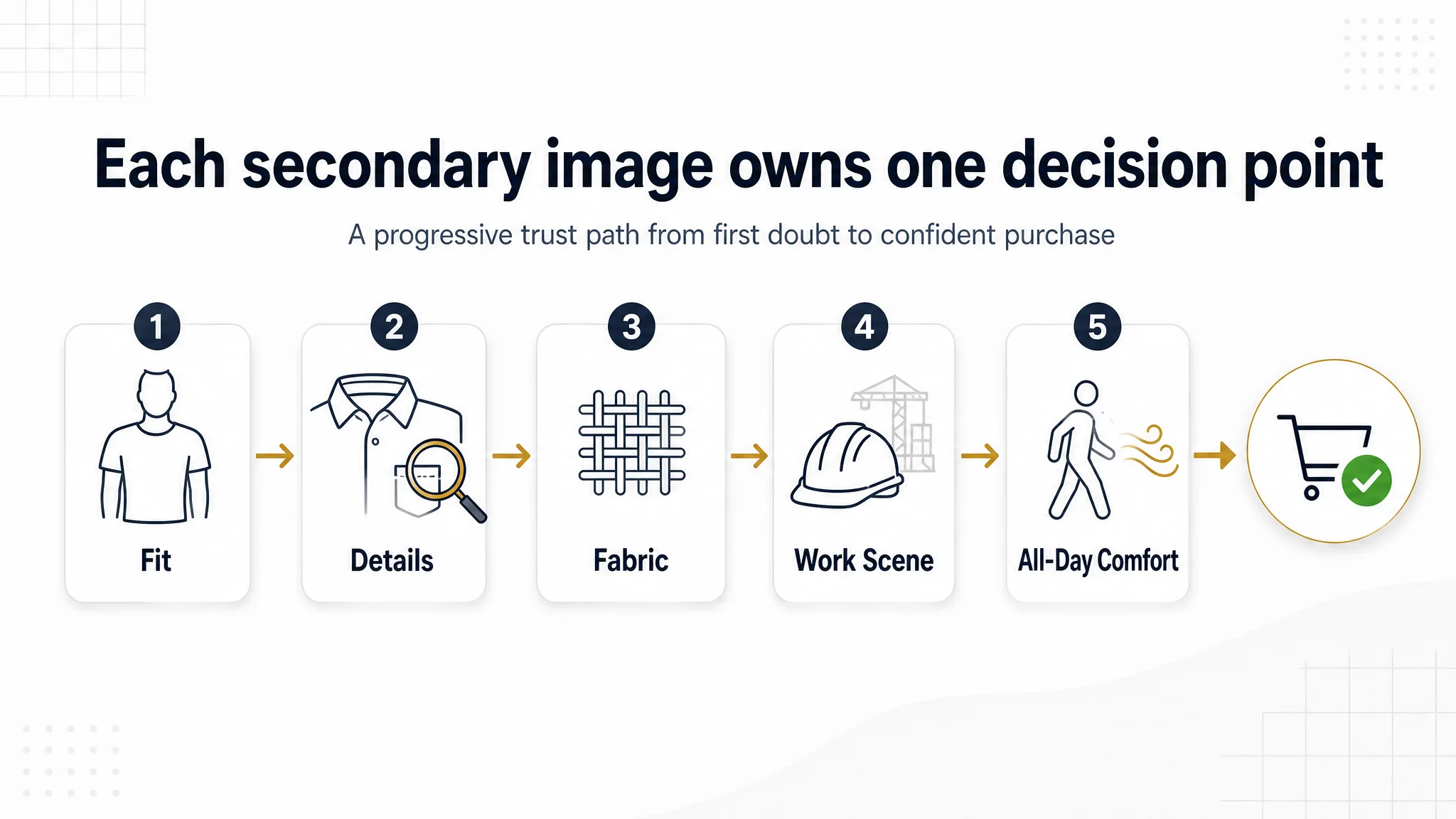
DeepBI reframed the secondary image plan into a progressive trust path:
1. Image 1 (Hero): Front-view model shot—fit clarity first.
2. Image 2: Upper torso detail—collar and pocket trust.
3. Image 3: Fabric texture close-up—visual proof of “heavyweight.”
4. Image 4: Industrial performance scene—real work context.
5. Image 5: Comfort and versatility scene—movement and all-day wear.
For other categories, the specifics change, but the logic holds: each secondary image should have a defined role in the decision chain instead of duplicating previous visuals or piling on text. When sellers simply stack “more angles” or “more icons” without a plan, they create the same problem this workwear listing had—information-rich galleries that still fail to resolve core doubts.
Elevating Brand Story with A+ Content
A+ Content allows you to move beyond product features and forge a deeper connection with customers. Use this space to tell your brand's story, provide detailed usage guides, and build trust with comparison charts and lifestyle modules. By creating a rich brand experience, A+ Content reinforces your value proposition, providing the final push needed to secure the purchase and maximize your listing's CVR.
The work T‑shirt seller initially used A+ to double down on industrial toughness: dramatic worksite imagery, repeated references to heavy fabric, stitching diagrams, and durability claims. On a feature-by-feature basis, their A+ looked “stronger” than a competitor’s simpler layout. But DeepBI’s breakdown revealed a mismatch: the opening modules drilled into industrial emotion and technical detail before giving buyers simple visual reassurance on comfort, fit, and Tall sizing.
After diagnosis, the A+ restructuring focused on:
- Putting a lifestyle-work hero module first that showed loose fit and ease of movement.
- Bringing comfort and “all-day wear” visuals higher in the A+ sequence.
- Making Tall-size advantages visually obvious with model comparisons, rather than burying them in charts.
- Shifting stitching and GSM diagrams later in the flow to support, rather than lead, the story.
Once the A+ content was reorganized around how shoppers actually think—“Will this feel good and fit me?” before “Will it survive industrial abuse?”—the page became much more capable of converting both cold and warm traffic. This is the essence of strategic A+ use: not adding more content, but assigning each module a clear role in guiding the buyer from initial interest to confident purchase.
Leveraging DeepBI for Data-Driven Image Strategy
Effective image optimization moves beyond subjective aesthetics and into the realm of data science. DeepBI replaces guesswork with a systematic, data-backed methodology, transforming your visual strategy from a creative exercise into a measurable driver of sales growth.
The workwear case is a clear example of why this matters. The seller’s internal narrative was simple: “ACOS is creeping up, so we must have an Amazon ads problem.” They responded with familiar tactics—tweaking bids, shifting budgets, and chasing “better” keyword structures—yet their core business symptoms remained: traffic entered the page, but too few visitors converted.
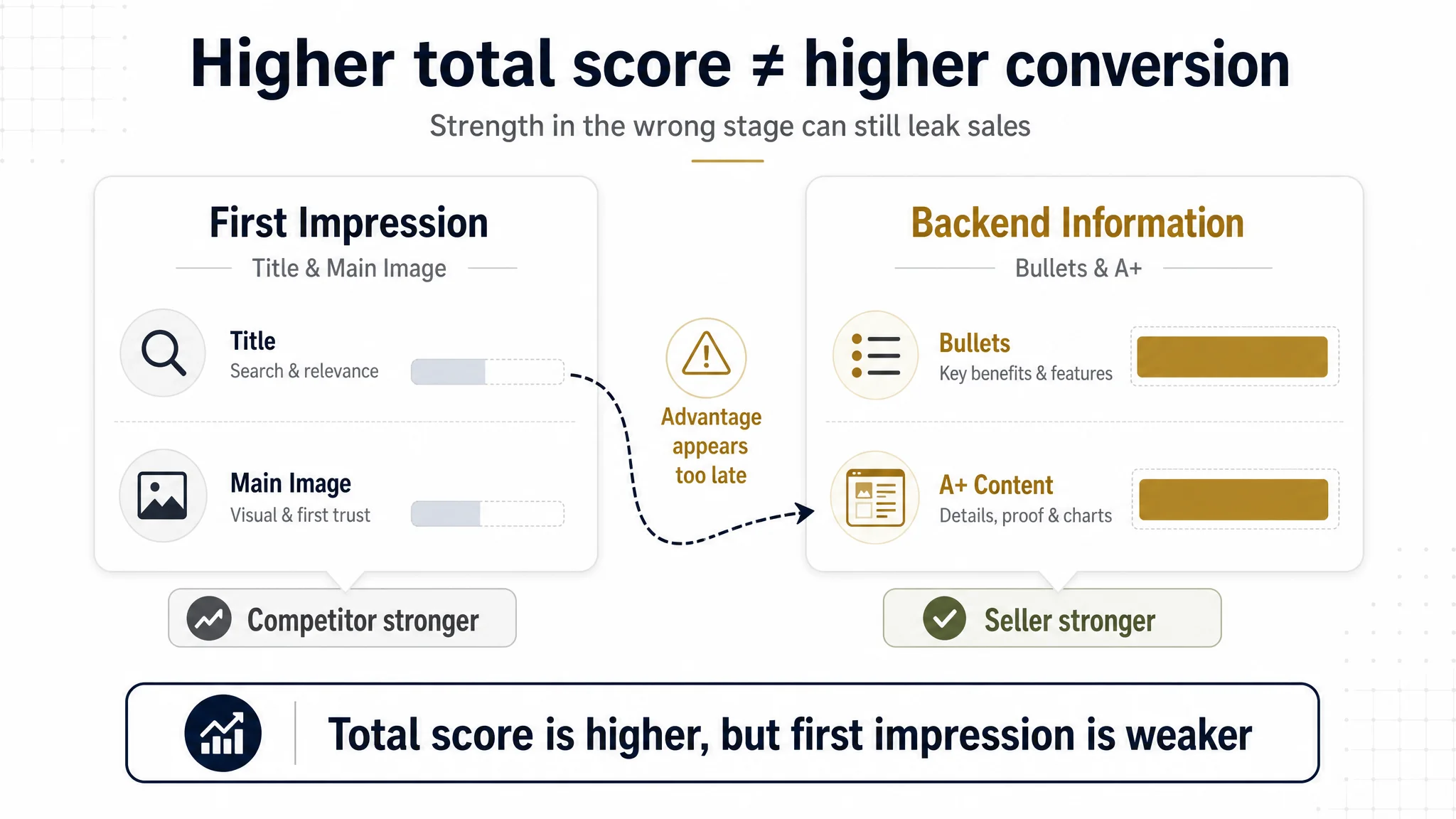
When DeepBI’s Smart Scoring and Diagnosis module audited the listing and benchmarked it against a key competitor, a different story emerged. Dimension-by-dimension scoring showed the seller actually ahead in main images, bullets, and A+ detail, with a slightly higher total score overall. But the system’s visual and semantic analysis exposed where their strengths were concentrated: deep industrial specifics and technical narrative, rather than the early-stage trust and fit clarity that drive first-time purchases.
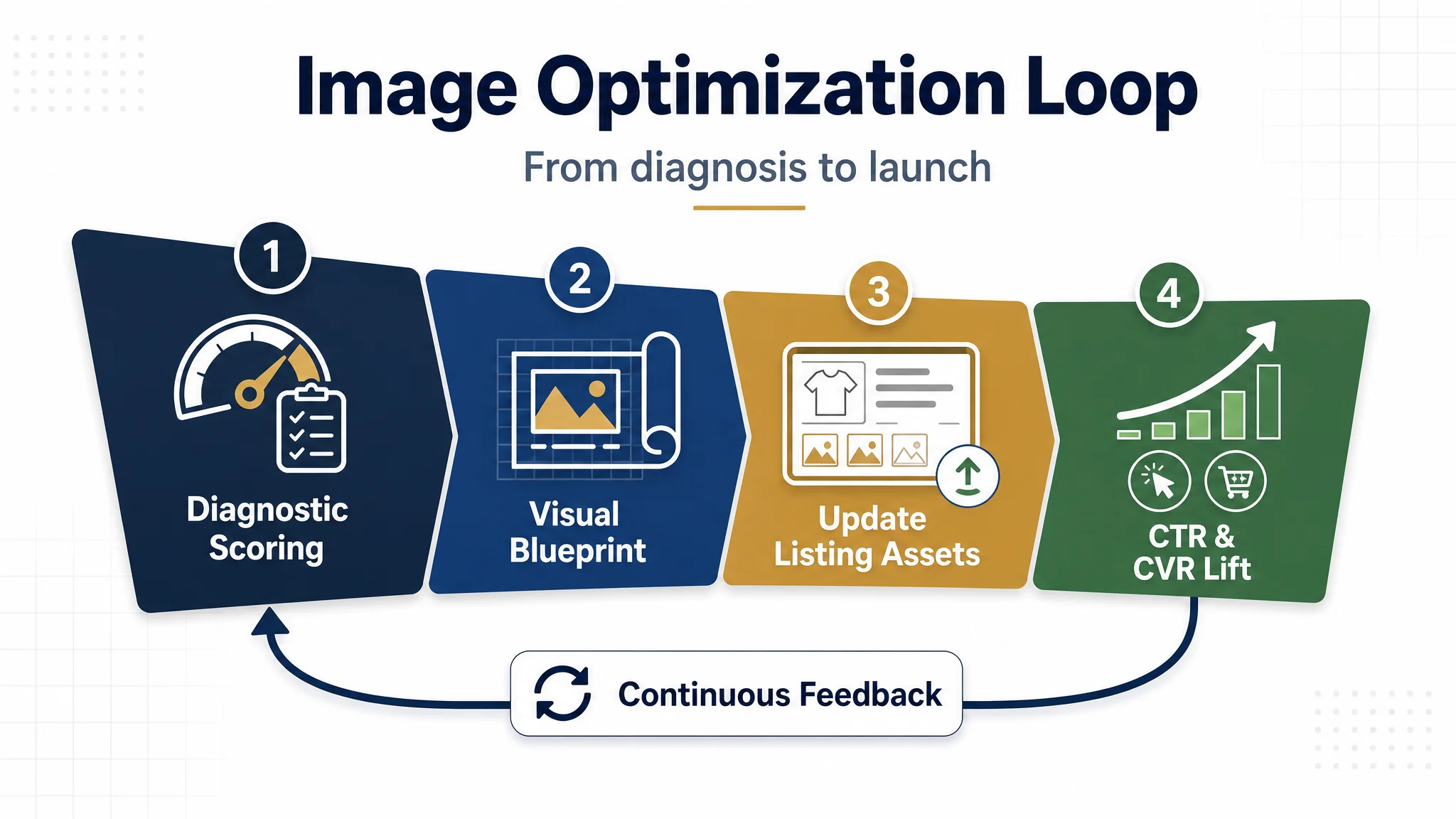
The process begins with DeepBI's Smart Scoring and Diagnosis module, which audits your existing listing—from the main image to A+ content—and benchmarks it against high-performing competitors. The system identifies specific weaknesses and translates these diagnostic findings into a structured, AI-executable strategy for visual expression and information hierarchy. This provides a clear blueprint for creating optimized main images, detailed secondary shots, and compelling A+ content visuals.
In the T‑shirt example, that blueprint translated into precise, practical directions such as:
- Reordering the title to front-load critical search terms like “Heavyweight Work T‑Shirt Loose Fit Pocket,” while still preserving the seller’s “Regular & Tall” differentiation.
- Rebuilding the main-image sequence around model fit, collar and pocket details, and fabric texture before repeating industrial scenes.
- Reframing A+ modules so that comfort, movement, and Tall-size visuals appeared early, with toughness repositioned as supporting proof rather than the only story.
Crucially, DeepBI's AI generation is constrained by a "Product DNA" map, ensuring all visual enhancements preserve the product's physical reality. This helps mitigate the significant risk of negative reviews caused by product-image mismatches. In the workwear project, for example, any generated or redesigned imagery still had to match the real fabric weight, pocket placement, and cut; DeepBI’s constraints helped keep the optimization aligned with the actual garment instead of drifting into unrealistic representations.
Once your new assets are ready, the One-Click Apply feature uses the official SP-API to sync them directly to your Amazon listing in seconds, eliminating a manual process that can take over 30 minutes. For the seller, this streamlined the shift from diagnosis to live test: revised title, new hero, re-ordered secondary images, and restructured A+ went from plan to production without weeks of back-and-forth uploads.
This creates a powerful performance loop. The improved images directly impact your Click-Through Rate (CTR) and Conversion Rate (CVR). These gains, which can be tracked within DeepBI, send strong positive signals to Amazon's algorithm, contributing to better organic rankings and fueling a virtuous cycle of long-term growth. Just as importantly, the seller’s mindset changed: instead of reading ad metrics purely as a media issue, they began to see CTR and CVR as feedback on listing conversion capacity—and treated visual optimization as a first-line lever, not an afterthought.
Common Image Optimization Pitfalls and Solutions
Many sellers fall into common traps with their product visuals, often making changes based on subjective aesthetics rather than data, which leads to wasted resources and stagnant performance. By understanding and correcting these frequent missteps, you can transform your images into powerful sales drivers.
The work T‑shirt case surfaced several of these pitfalls in a very concrete way. The team had:
- Compliant, high-resolution images that still underperformed.
- A gallery rich in industrial scenes but repetitive in decision value.
- A+ content that impressed existing industrial users but overwhelmed new buyers.
DeepBI’s diagnosis made one thing clear: the problem was not a lack of effort or content, but misalignment between how the listing was built and how Amazon shoppers actually decide. The same misalignments show up across categories and volumes of sellers.
Here are the most critical pitfalls and their solutions:
- Low-Resolution and Non-Compliant Images: Pixelated images prevent customers from zooming and signal low quality, while main images that violate Amazon's terms (e.g., non-white backgrounds, added text) risk suppression. The solution is strict compliance: always use high-resolution images (at least 1600 pixels on the longest side) and ensure your main image features only the product against a pure white background.
In the workwear example, this baseline was already met. But the case illustrates why treating compliance as a “finished” state is dangerous. Once the seller saw that a compliant yet generic flat-lay hero image was being outperformed by a compliant model shot, they understood that resolution and background are prerequisites, not performance levers.
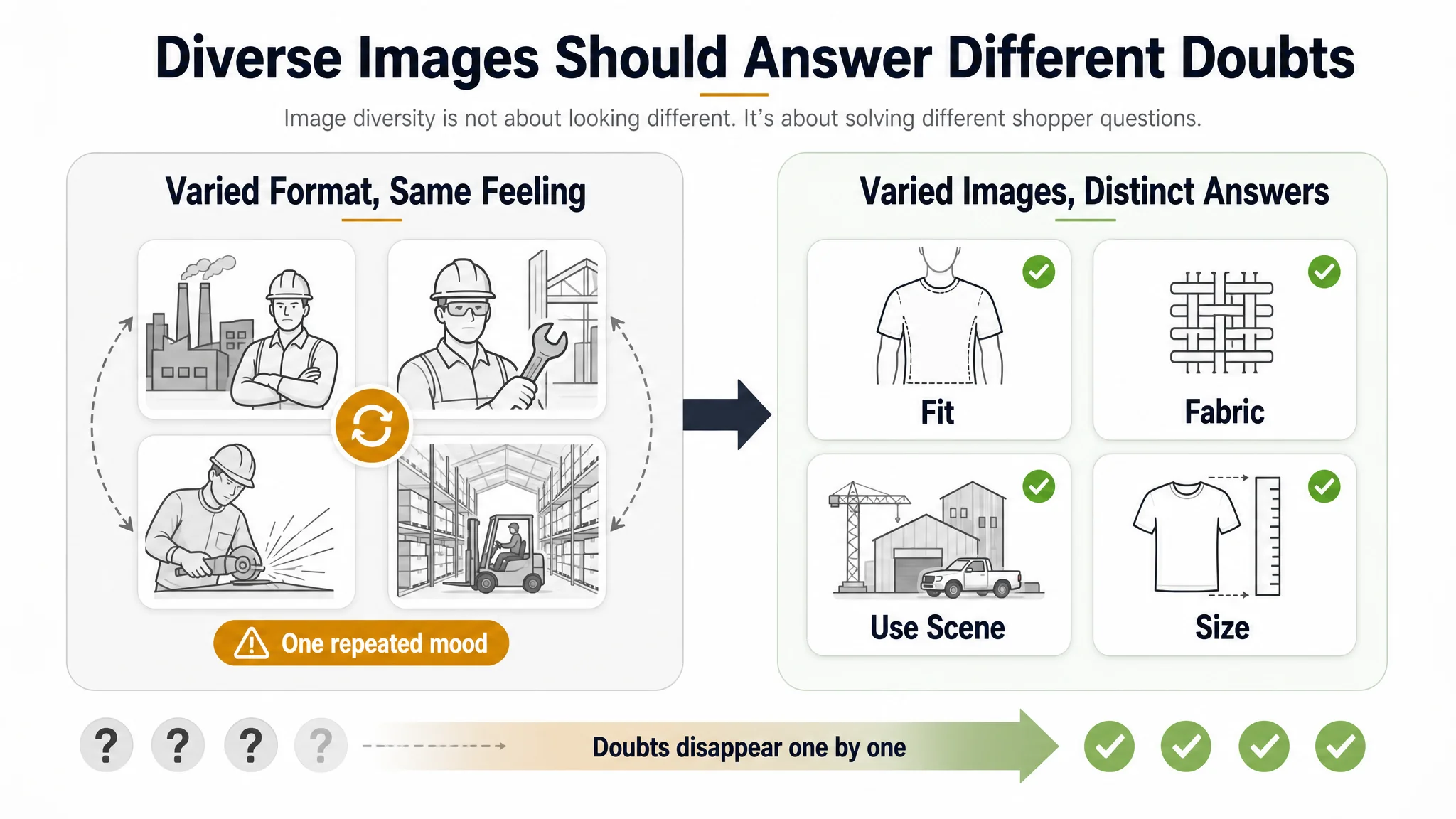
- Lack of Image Diversity: A gallery filled with only studio shots of the product fails to tell a complete story. To boost conversion rates (CVR), you must build trust and answer customer questions visually. Diversify your image set with lifestyle photos showing the product in use, infographics that highlight key benefits, and images that illustrate scale and dimensions.
The work T‑shirt gallery technically had diversity—flat lays, industrial scenes, text overlays—yet DeepBI’s review showed that diversity alone is not enough. Early images overloaded buyers with repeated industrial mood and fabric numbers but did not visually differentiate fit types or show Tall sizing clearly. After reworking the sequence to include human-body context, fabric close-ups, and explicit Tall-fit visuals, each image started shouldering a distinct part of the story instead of overlapping. The key isn’t just having different types of images; it’s ensuring each type resolves a different doubt.
- Ignoring the Mobile Experience: With over 60% of Amazon shoppers browsing on mobile devices, desktop-first design is a critical error. Text-heavy infographics become illegible and complex details are lost on small screens. Always review your images on a mobile device to ensure they are clear, compelling, and easy to understand at a glance.
In the apparel case, many of the seller’s early info-heavy images were technically informative but visually dense. On a desktop, a motivated buyer might zoom in to parse every bullet and icon. On mobile, those same overlays compressed into near-unreadable text blocks, meaning the images carried little persuasive weight for a majority of visitors. DeepBI’s revised guidance reduced text density and pushed key claims into bold, simple phrases paired with clear visuals, so the message survived the move to smaller screens.
- Stagnant, Untracked Visuals: Treating your images as a "set it and forget it" task is a missed opportunity. Your visuals should evolve with performance data. The most effective solution is to create a data-driven feedback loop. After updating an image, use a system that tags the change as an event in your advertising reports. This allows you to directly track the impact on Click-Through Rate (CTR), turning optimization from guesswork into a quantifiable strategy.
For the workwear seller, this meant stopping the pattern of endlessly tuning bids against a static, underperforming page. Once DeepBI helped restructure the title, main image, and A+ modules, those changes were treated as discrete events, and their impact on CTR and CVR monitored over time. The team’s operating question shifted from “Which bid level is right?” to “Did this new hero image and A+ sequence actually improve conversion enough to justify more traffic?” That mindset—linking each visual change to measurable outcomes—is what prevents image optimization from becoming a one-off project.
Conclusion: Visual Excellence Drives Amazon Success
The journey to mastering Amazon's digital shelf has evolved far beyond basic image compliance. It's a strategic discipline where visual content is one of the most powerful levers for driving sales. As we've explored, success is no longer left to subjective judgment or disconnected workflows. Instead, it requires a systematic approach that links every pixel to performance metrics like Click-Through Rate (CTR) and Conversion Rate (CVR). This transforms listing optimization from an occasional project into a dynamic, ongoing process of refinement based on real market feedback.
The work T‑shirt seller’s experience illustrates this shift. They started with a familiar misdiagnosis—blaming ads for poor results—only to discover that their real constraint was how their images and A+ content sequenced the buying story. Once fit, comfort, and Tall sizing were made visually obvious early in the journey, industrial toughness became a meaningful proof point instead of a distracting theme. Ad performance became more interpretable, and the listing itself regained the capacity to convert both organic and paid traffic.
Achieving this level of sophistication demands a new class of tools. DeepBI provides the end-to-end system necessary to win, breaking down the traditional silos between diagnosis, planning, production, and delivery. By converting vague artistic suggestions into precise, data-driven instructions, it ensures that your visual assets are not just beautiful, but are engineered to be more profitable. Most importantly, it helps you avoid the costly trap of pushing more traffic into a page that isn’t ready to convert.
Embracing this intelligent, closed-loop approach is the key to converting visual excellence into a sustainable competitive advantage and long-term growth on the Amazon marketplace.