Understanding Amazon ACoS: The Foundational Metric
For any Amazon seller running Pay-Per-Click (PPC) campaigns, Advertising Cost of Sale (ACoS) is the most immediate and widely used performance metric. It measures the direct relationship between advertising expenditure and the revenue generated from those ads, providing a clear snapshot of campaign efficiency. The calculation is straightforward:
ACoS = (Ad Spend / Ad Sales Revenue) x 100
In essence, ACoS tells you what percentage of your ad-driven sales is being spent on the advertising itself. A lower ACoS indicates higher efficiency, as you are spending less to achieve each sale. This makes it an indispensable tool for quick, at-a-glance assessments of campaign health and for making tactical adjustments.
However, relying solely on ACoS can be misleading. It is a measure of ad campaign efficiency, not overall business profitability. A "good" ACoS is not a universal benchmark; it is highly dependent on your product's profit margin, your strategic goals—such as launching a new product versus maximizing profit on an established one—and your broader marketing strategy. Therefore, while ACoS is a critical starting point for analysis, it represents just one piece of a much larger profitability puzzle.
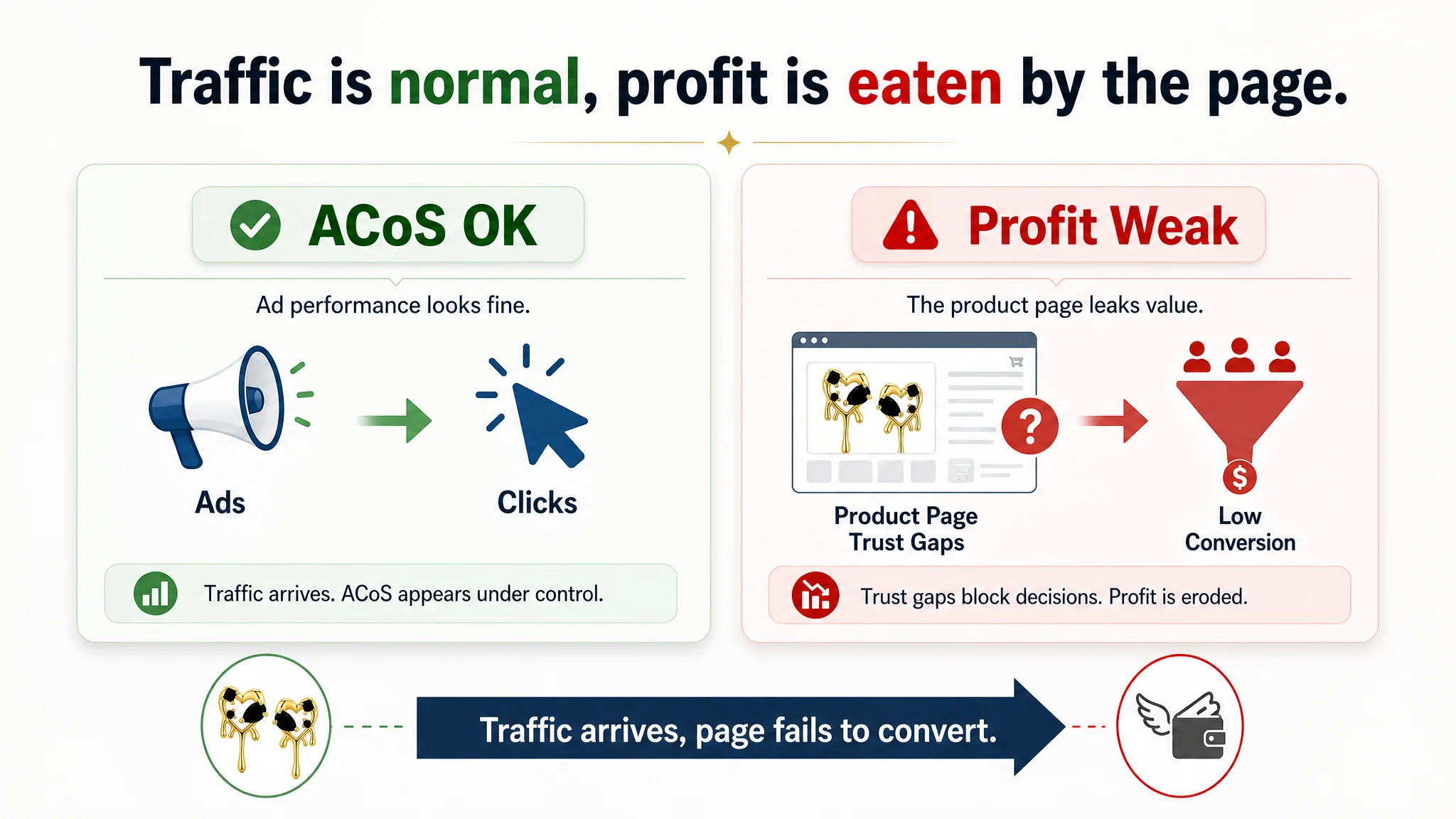
This gap between “efficiency on paper” and “profit in reality” also shows up when we look at how traffic is actually used. In one jewelry project DeepBI worked on, the seller’s ads were delivering consistent clicks at a seemingly acceptable ACoS. On the surface, ACoS told them the campaigns were “under control.” But the product page itself was quietly consuming those visits: the listing looked polished and even outscored a key competitor in many structural dimensions, yet conversion lagged and ad costs felt increasingly heavy. The data and on-page analysis later showed that the problem wasn’t bringing traffic in; it was what happened after the click, and how much margin was left once all costs were counted. That discrepancy is exactly why ACoS, while foundational, cannot be the only lens.

The Critical Flaw: Why ACoS Alone Doesn't Tell the Whole Profit Story
For many sellers, Advertising Cost of Sales (ACoS) is the primary gauge of campaign success. The Amazon Ads console places it front and center, creating the impression that a low ACoS directly equals high profit. This is a dangerous oversimplification. ACoS measures ad spend against the revenue generated by those ads, but it completely ignores the most critical factor: your actual profit margin.
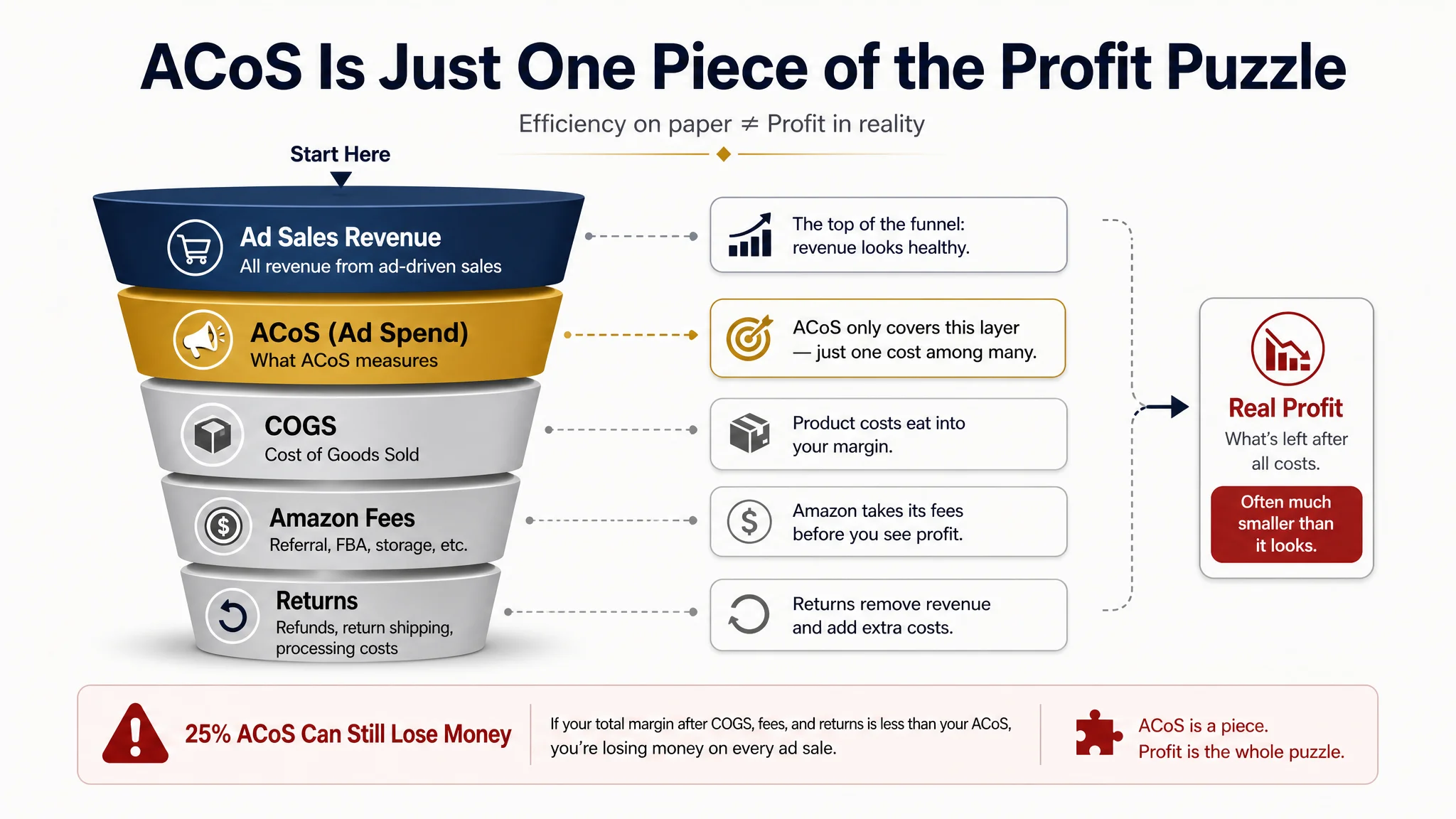
True profitability is eroded by numerous costs that ACoS doesn't account for. These include:
- Cost of Goods Sold (COGS): The direct cost of manufacturing or acquiring your product.
- Amazon Fees: A complex web of charges, including FBA fulfillment fees, referral fees on the sale price, and monthly or long-term storage fees.
- Product Returns: When a customer returns an item, you not only lose the sale revenue but also the ad spend that acquired that sale, and you may incur additional processing costs.
A campaign with a seemingly healthy 25% ACoS could easily be losing money. If your product’s total margin after COGS and all Amazon fees is only 20%, you are losing 5% on every single ad-driven sale. This is why a one-size-fits-all ACoS target is ineffective; the break-even ACoS is unique to each product, dictated by its specific cost structure. Relying on ACoS alone is like navigating with only one point on a map—you see direction, but you have no idea if you're heading toward a cliff.
This misalignment between ACoS and actual profit becomes very visible when campaigns scale. In the pearl earrings case mentioned earlier, the advertising team felt constant pressure on ACoS and TACOS as they increased traffic, even though the listing looked “better” than the benchmark competitor and reviews were stronger. Taken at face value, their ACoS numbers suggested that ad efficiency was within a reasonable band. But once DeepBI factored in jewelry-specific COGS, Amazon fees, and the effect of returns on high-ticket accessories, the picture changed: ad spend was running into a conversion bottleneck, and the remaining per-unit margin after all expenses was far thinner than the ACoS alone implied.
The seller’s initial assumption was that the answer lay entirely inside the ad console: optimize keywords again, tweak bids, polish creatives. In reality, every incremental click was pushing more cost into a page that wasn’t fully neutralizing buyers’ perceived risk around sizing, comfort, allergy safety, and after-sales protection. The result was a double squeeze: rising advertising costs and an incomplete trust story eroding margin in ways ACoS didn’t reveal. That’s the hidden risk of treating ACoS as a proxy for profit instead of a subset of it.
Calculating True Profitability: From ACoS to Break-Even and Target ACoS
To move beyond surface-level metrics, you must anchor your advertising strategy in true profitability. This starts with understanding your product's profit margin before any ad spend is factored in. This pre-advertising profit margin is the key to unlocking two critical metrics: Break-Even ACoS and Target ACoS.
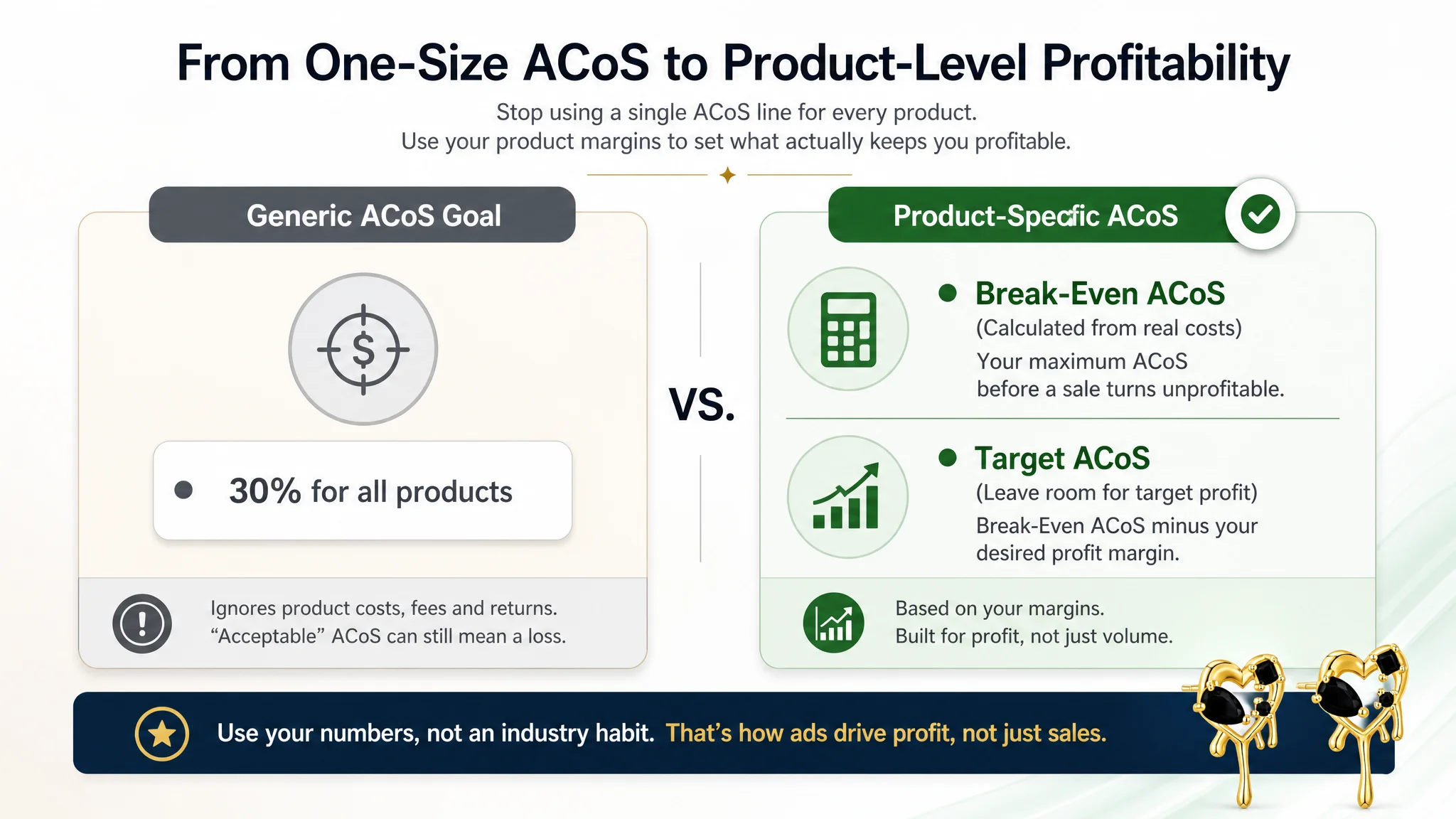
Your Break-Even ACoS is simply your profit margin on a product before advertising costs. It represents the maximum ACoS you can sustain before a sale becomes unprofitable. To calculate it, take your sale price and subtract the cost of goods sold (COGS) and all associated Amazon fees. The resulting number, divided by the sale price, is your pre-ad profit margin and your Break-Even ACoS. For example, if your margin is 35%, your Break-Even ACoS is 35%. Any ACoS above this level means you are losing money on that advertised sale.
With this baseline, you can set a strategic Target ACoS. This isn't an arbitrary number; it's your Break-Even ACoS minus your desired net profit margin. If your Break-Even ACoS is 35% and you aim for a 15% net profit on each sale, your Target ACoS is 20%. This calculation transforms ACoS from a reactive cost metric into a proactive lever for achieving specific profit goals, proving that a "good ACoS" is entirely dependent on your unique product economics and business objectives.
In practice, these calculations often expose why “reasonable” ACoS values may still be dangerous. In the jewelry listing project, the seller had never rigorously tied their ACoS thresholds back to item-level economics. They were content to beat an internal ACoS benchmark and assume profit followed. Once DeepBI reconstructed their per-unit profit structure—including jewelry-specific COGS, packaging, fulfillment, and expected return rates—it became clear that their actual break-even ACoS for that SKU sat lower than the band they were tolerating in campaigns. The listing’s imperfect conversion meant that even at that seemingly acceptable ACoS, there was not enough margin left to comfortably absorb returns and still hit the brand’s profit target.
Bringing those numbers into the open had two effects. First, it reset expectations: the team could no longer view any ACoS under a generic “30% threshold” as automatically healthy. Second, it reframed ad optimization work around a clear Target ACoS grounded in real margins, not just around “getting ACoS down a bit more.” This shift from generic cost control to product-specific profitability is essential if you want your campaigns to scale without silently draining your bottom line.
Strategic ACoS Management for Diverse Business Goals
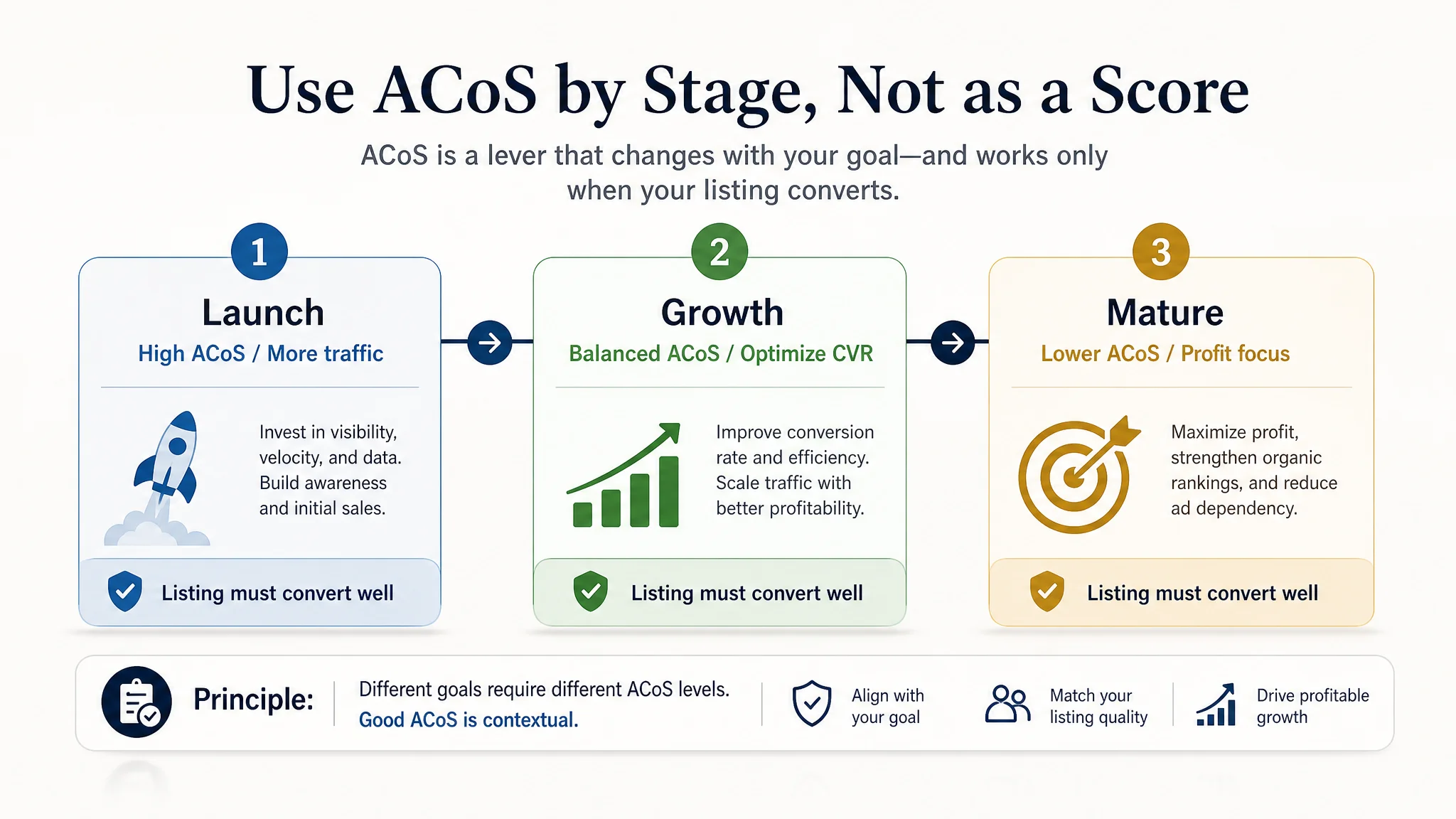
A common misconception among Amazon sellers is that a lower Advertising Cost of Sale (ACoS) is always the primary objective. In reality, ACoS is a strategic lever, not just a cost metric. The optimal ACoS target is entirely dependent on your specific business goal for a given product or campaign. Blindly chasing the lowest possible ACoS can severely limit your brand’s reach and stifle growth.
There are several strategic scenarios where a higher ACoS is not only acceptable but necessary. For new product launches, a high ACoS is an investment in visibility, initial sales velocity, and crucial performance data. When executing an aggressive competitive strategy to seize market share, you may need to temporarily accept a higher ACoS to outbid rivals for top placements. Similarly, during inventory liquidation, the goal is to move units quickly to avoid long-term storage fees, making a higher ACoS a calculated business expense.
Conversely, for mature, established products with strong organic ranking, the focus shifts to maximizing profitability. In this phase, the primary goal is to achieve a low ACoS, reducing reliance on paid traffic and improving your Total ACoS (TACoS). The key is understanding the trade-off: lowering ACoS by reducing bids will decrease impressions and potentially total sales. Finding the optimal balance requires continuous testing and iteration, allowing you to align your ad spend directly with your evolving business objectives.
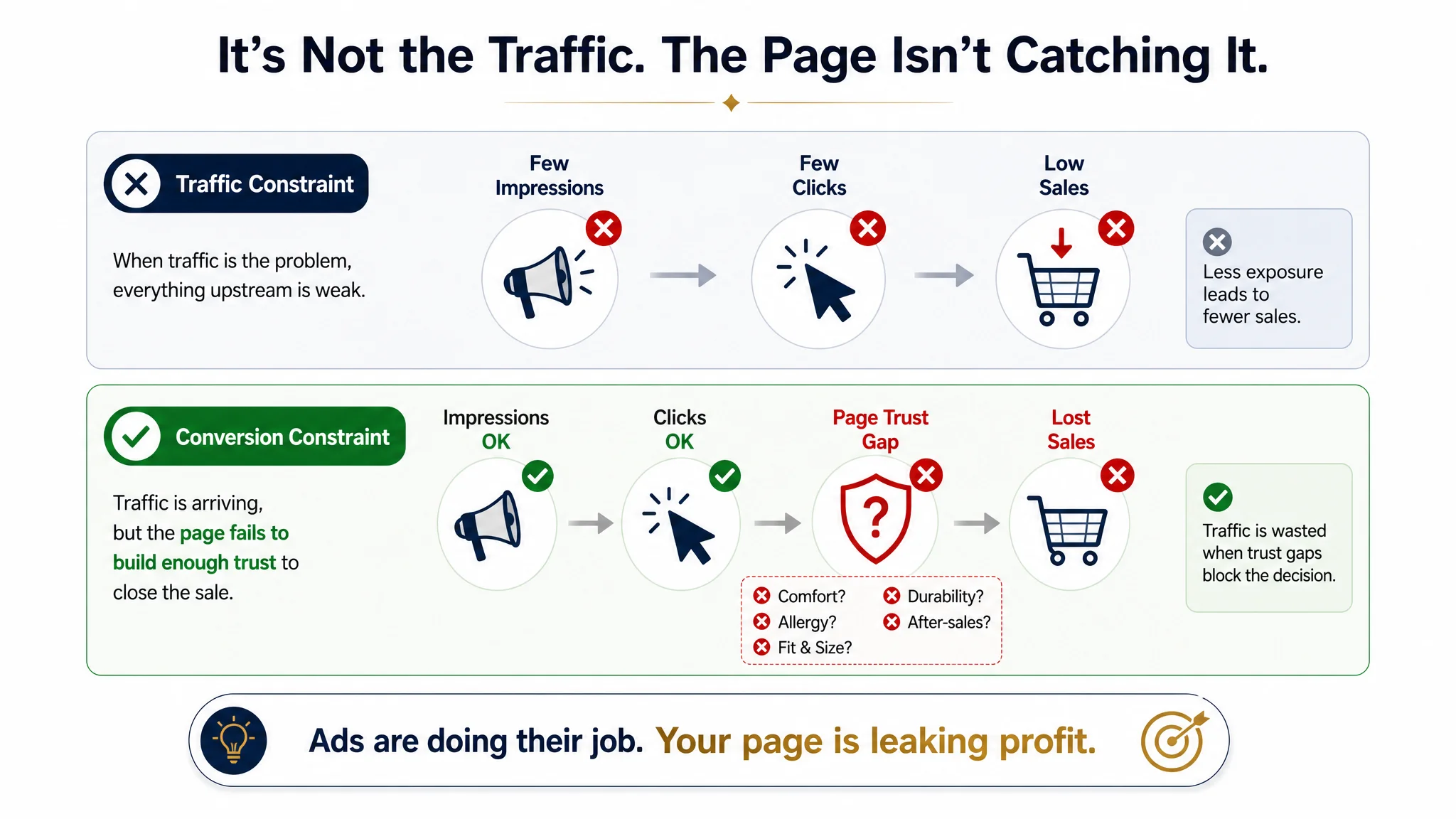
This distinction between “ACoS as lever” and “ACoS as scoreboard” played out clearly in the pearl earrings case. The seller assumed that because their listing “beat” the competitor in structural scores and reviews, the only way to restore profitability was to force ACoS lower—primarily by cutting bids and refining keywords. DeepBI’s diagnosis showed a different picture: the ad traffic itself was not fundamentally weak; click-through rates were normal and the listing attracted attention in search. The bottleneck was the listing’s decision logic: aesthetic and technical details were front-loaded, while material safety, comfort, sizing clarity, and after-sales reassurance appeared later or less prominently.
Under those conditions, relentlessly compressing ACoS by throttling bids would simply have reduced exposure without fixing the core issue. A more effective strategy was to temporarily accept a controlled ACoS level while rebuilding the listing’s trust path, so that each paid visit had a higher chance of converting and contributing to a profit-focused goal. Only after the page was aligned with how jewelry buyers actually decide—safety, fit, style, gifting, then protection—did it make sense to push ACoS down for long-term profit or back up for aggressive share capture. The scenario illustrates that strategic ACoS management is inseparable from how well your listing itself converts and supports your stated goal.
Optimizing Amazon Ads for Sustainable Profit with DeepBI
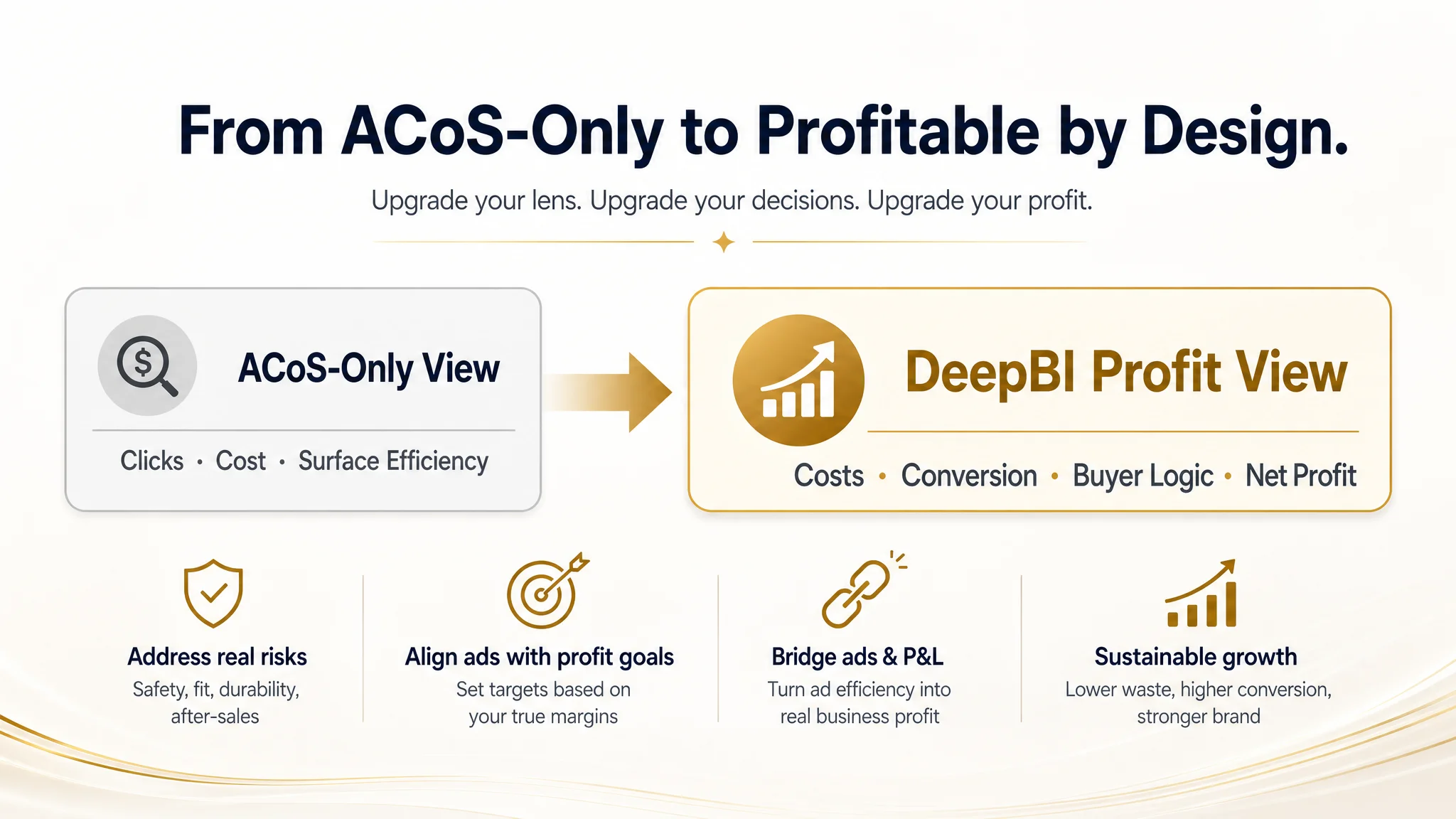
Relying solely on Advertising Cost of Sales (ACoS) to measure campaign success is a critical blind spot that can conceal underlying unprofitability. To achieve sustainable growth, sellers must move beyond this surface-level metric. DeepBI provides the necessary framework by shifting the focus from ad spend efficiency to true, net profitability. The platform achieves this by integrating a comprehensive set of cost factors—including Cost of Goods Sold (COGS), all relevant Amazon fees, and return rates—to calculate the actual profit generated by each product.
This profit-first approach directly powers DeepBI’s intelligent automation. Instead of optimizing for an arbitrarily low ACoS, the system enables you to set profit-driven goals and then uses dynamic bidding and budget adjustment mechanisms to hit those targets. This ensures that every dollar spent on advertising is strategically allocated to maximize net returns, facilitating stable and profitable scaling.
The gap between ad metrics and real profit becomes especially clear when diagnosing why “good” campaigns still feel expensive. In the jewelry seller’s situation, DeepBI’s scoring system showed that their listing actually outperformed a key competitor on many structural axes: title coverage, main images, A+ depth, and review volume and sentiment. On paper, that suggested the “listing problem” was already solved. Yet as they increased traffic, ACOS and TACOS remained stubborn, and orders did not scale in proportion to spend. DeepBI’s combined view of cost and conversion patterns flagged a conversion constraint, not a traffic constraint: ads were doing their job, but the page was not neutralizing the specific risks buyers cared about.
To systematically identify and expand these profitable traffic sources, DeepBI employs a four-layer traffic funnel model. This structure guides campaigns from broad keyword exploration and ASIN discovery to precise targeting and, ultimately, stable scaling of proven performers. In the jewelry case, that meant distinguishing between keywords that were feeding high-intent visitors and those simply adding cost, then watching how those segments behaved once they hit the rebuilt listing. As the trust-focused changes to titles, bullets, images, and A+ content went live, DeepBI’s funnel data could show not only which terms brought in traffic, but which combinations of traffic and page structure produced healthy, repeatable profit at the SKU level.
Furthermore, for global sellers, DeepBI consolidates ad efficiency tracking across multiple Amazon regions into a single, unified view, providing the multi-marketplace perspective needed to manage a worldwide advertising strategy effectively. That same unified lens is what allowed the jewelry seller to stop treating ads and listing content as separate initiatives and instead see them as one connected system: traffic sources feeding a conversion engine, all judged by their contribution to net profit rather than ACoS in isolation.
The Synergy of Ads and Organic Traffic for Overall Profitability
Focusing exclusively on Advertising Cost of Sales (ACoS) provides a narrow view of your business health. A more powerful metric is Total ACoS (TACOS), which measures your total ad spend against your total sales, including both ad-attributed and organic revenue. This KPI reveals the true leverage of your advertising budget on overall profitability, shifting the goal from simply efficient ads to sustainable business growth.
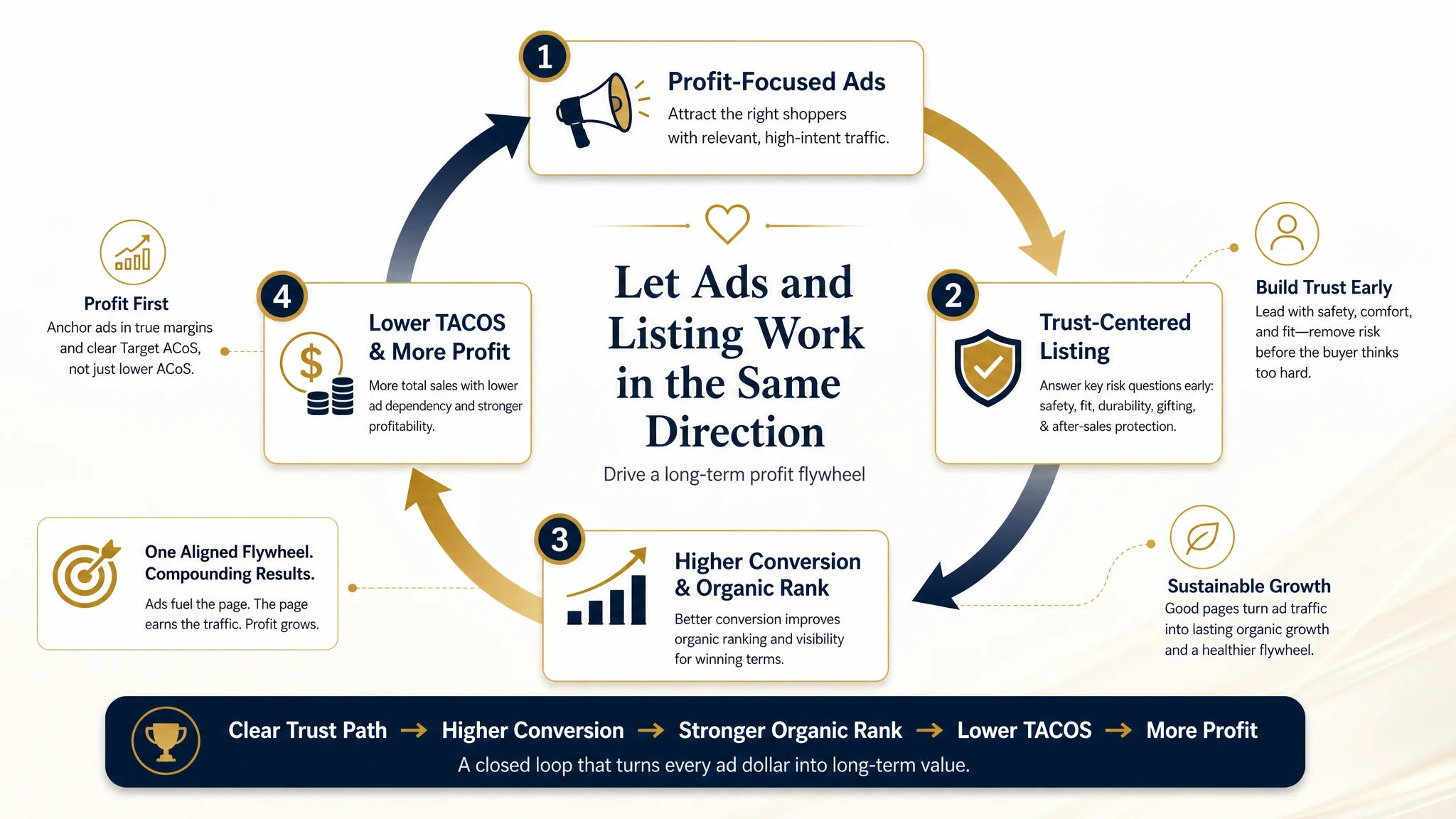
A well-executed, profit-focused ad strategy creates a powerful flywheel effect. Successful campaigns drive sales velocity, which is a critical signal for Amazon's search algorithm. As your product gains sales history for specific high-value keywords, its organic ranking for those terms improves. This increased organic visibility leads to more sales that don't require a direct ad click, systematically lowering your TACOS and creating a self-reinforcing cycle of growth.
The jewelry project offers a concrete illustration of how this synergy can be blocked—and then restored. Initially, ads were feeding a visually impressive listing that underplayed the very assurances that jewelry buyers look for first: “Is this safe for my skin?”, “Will it fit and look right?”, “Will it last?”, “What happens if I’m not satisfied?”. The competitor’s less polished listing addressed those questions early in bullets and imagery, while the higher-scoring listing treated them later, or implicitly. The result was that paid traffic generated clicks, but the conversion path was leaky; organic ranking stalled because the page never built a strong enough performance history for key terms, and TACOS stayed heavy.
This is where DeepBI introduces a "fifth funnel layer" strategy. The system mines high-conversion "Winning Terms" from your ad data and, instead of only using them for bidding, transforms these signals into optimization weights for your listing itself. By enhancing titles and images to align with proven search terms, DeepBI improves your product page's core conversion rate (CVR). In the jewelry case, that meant repositioning the title to lead with the primary product form and keyword cluster (“Pearl Stud Earrings”), weaving material and safety terms directly into early copy, and restructuring bullets and A+ modules to follow the actual buyer decision order: safety and fit, then style and scenes, then gifting and after-sales reassurance.
These changes turned temporary ad learnings—such as which queries signal high-intent shoppers—into permanent upgrades to the listing’s trust story. As the page began answering risk questions in the first few seconds, both ad-driven and organic visitors behaved differently: more sessions ended in orders instead of back-button exits. Over time, this improved CVR supported better organic ranking for those winning terms, making it easier to increase total sales while gradually easing ad dependency and lowering TACOS. Ultimately, a holistic approach that uses paid advertising to strategically fuel organic growth, and uses ad insights to rebuild listing logic, is the key to building a long-term, healthy profit engine on Amazon.
Conclusion: Mastering Amazon Profitability Beyond ACoS
Relying solely on Advertising Cost of Sales (ACoS) to measure success is a critical yet common oversight. While ACoS is an essential metric for campaign efficiency, it provides an incomplete picture of your financial health. True PPC profitability only becomes clear when you meticulously factor in all underlying costs—from COGS and Amazon seller fees to return rates—to understand your actual profit margins on every sale driven by ads. Strategic ACoS management means treating it not as a fixed target, but as a dynamic lever to achieve diverse business goals, whether launching a new product or maximizing profit on a mature one.
Real-world operating data reinforces this point. In the jewelry listing case, the team’s initial instinct was to “fix ads” because ACoS and TACOS felt high, while their page looked refined and scored well in audits. DeepBI’s diagnosis showed that ads were not failing to bring traffic; the listing was failing to close the exact risks buyers cared about. Once the title, bullets, images, and A+ modules were reordered around a clear trust path—safety, comfort, sizing, durability, gifting, and explicit post-purchase protection—the same ad traffic began to convert more efficiently, and the seller could finally align ACoS targets with a realistic break-even and profit structure. The lesson extends beyond jewelry: before you push more traffic, you need to ask whether your page deserves it and whether your ACoS goals reflect true margin realities.
This is where a platform like DeepBI becomes indispensable. It bridges the critical gap between ad performance and your overall business P&L. By creating a powerful commercial closed loop, DeepBI transforms stable advertising data into stronger organic rankings and a lower Total ACoS (TACoS). It makes the evolution of your listings a predictable, quantifiable scientific process, ensuring that every dollar spent on advertising is directly tied to sustainable growth. For sellers serious about building a resilient and profitable brand on Amazon, moving beyond ACoS with an integrated intelligence tool—and grounding both ads and listings in real buyer decision logic—is no longer an option; it is the foundation of long-term success.