

Introduction: The Dawn of AI in Amazon E-commerce
The Evolving Landscape of Online Retail
The Amazon marketplace has entered an era of intense inventory-led competition, where growth is no longer guaranteed by mere presence. Sellers now contend with escalating traffic costs, sophisticated platform algorithms, and aggressive competitor strategies, creating persistent pressure to maintain a healthy Click-Through Rate (CTR) while securing a high Conversion Rate (CVR). In this high-stakes environment, traditional optimization methods that rely on subjective aesthetics and manual trial and error are proving insufficient.
Making arbitrary changes based on intuition or incomplete competitor analysis leads to wasted resources and missed opportunities. As cross-border e-commerce has matured, listing optimization has evolved from simple copy polishing into a precise, data-driven science. To succeed, sellers must move beyond guesswork and adopt a systematic approach where every decision is validated by objective market benchmarks and a clear understanding of the entire traffic funnel.
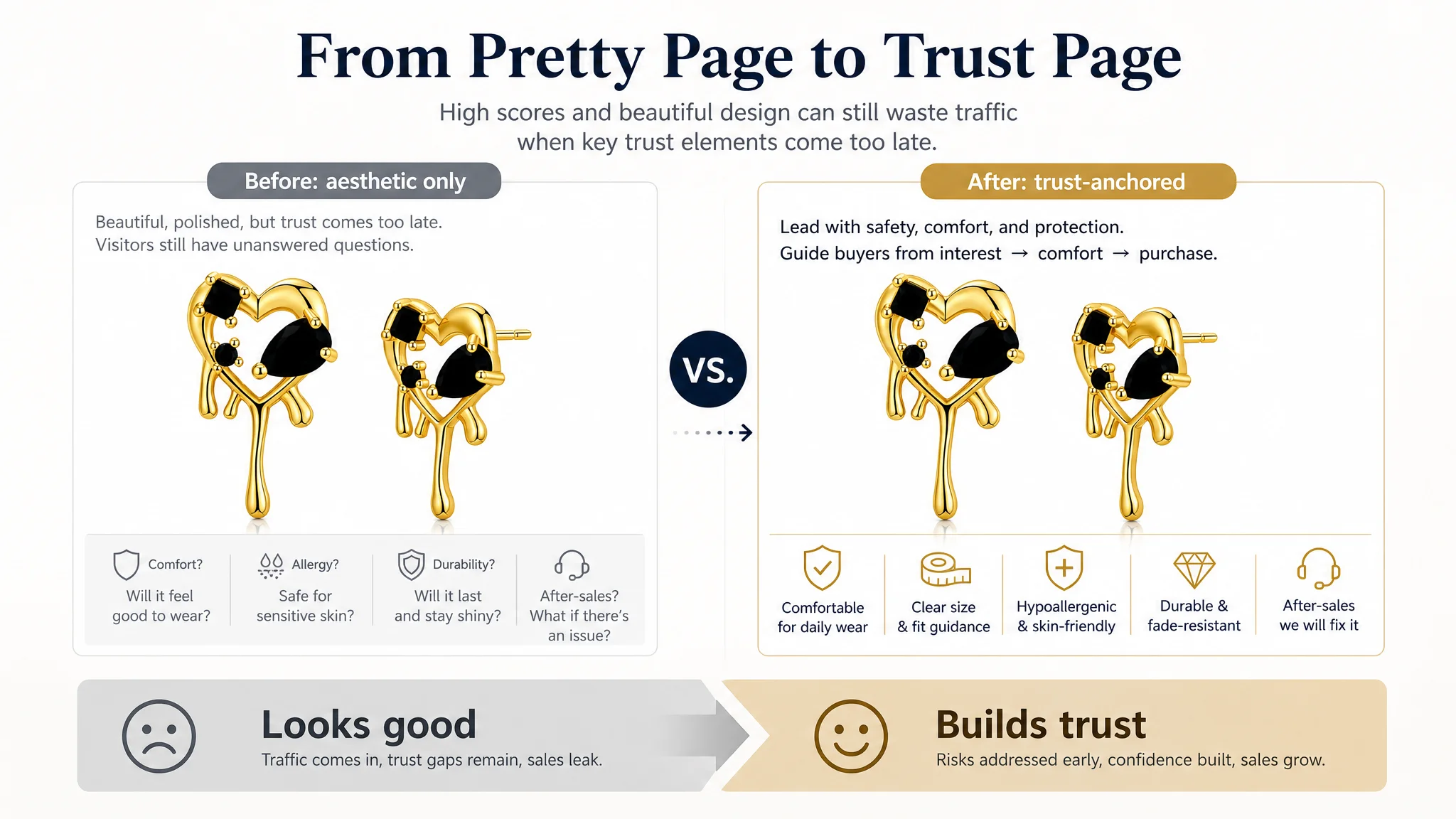
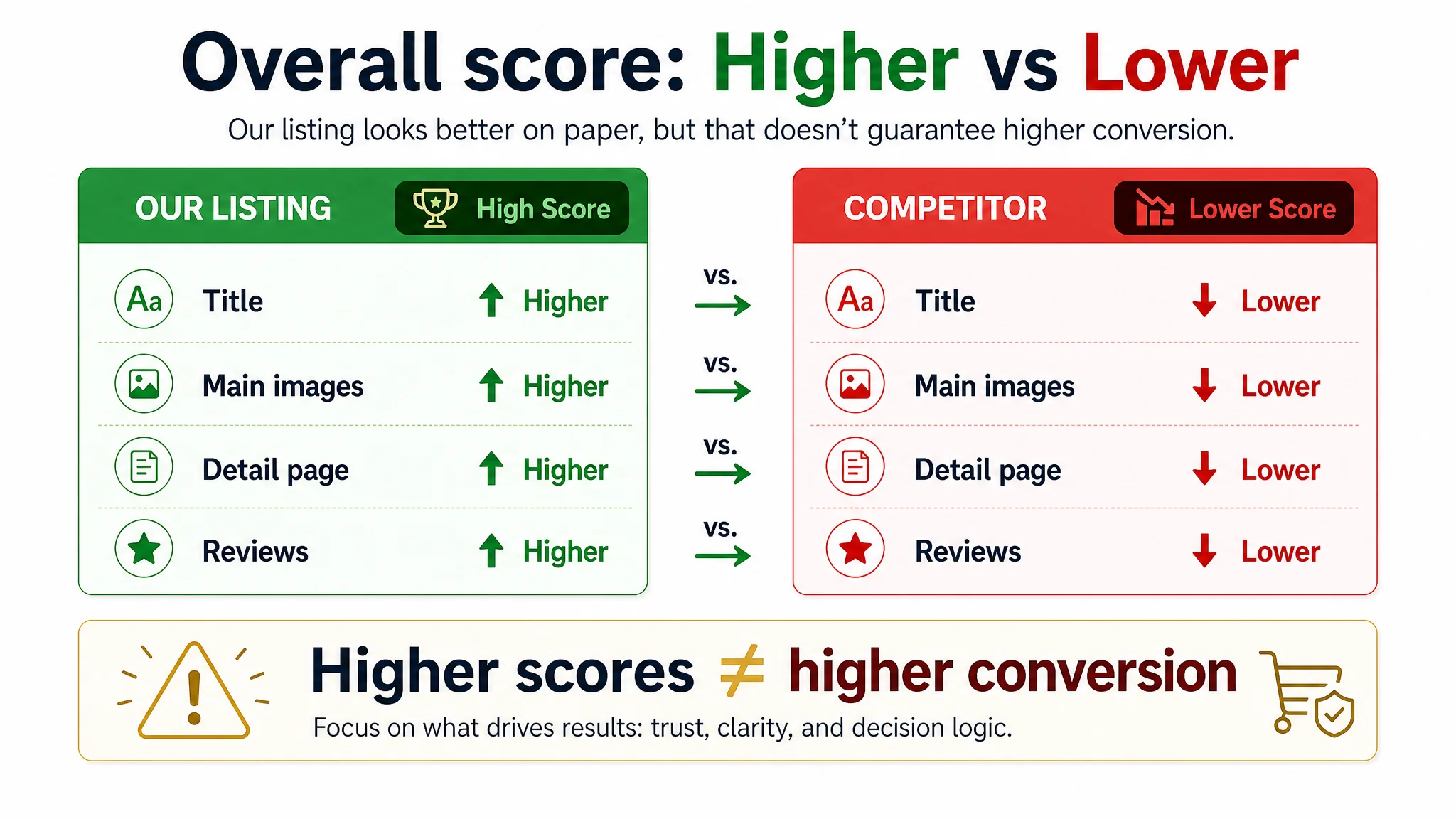
This tension between “the page looks good” and “the business still bleeds” is not theoretical. In one jewelry category project, a seller’s pearl earrings listing actually outscored a key competitor on most measurable dimensions: higher overall listing score, richer A+ content, more reviews with healthier sentiment, and fewer prominent negative reviews. On paper, the listing looked “done.” Yet ad costs were hard to control and traffic did not convert as efficiently as expected. The internal diagnosis defaulted to familiar explanations—“ads aren’t optimized enough,” “our creatives need more pop,” “we should tune keywords again”—and the team kept iterating campaigns and polishing visuals.

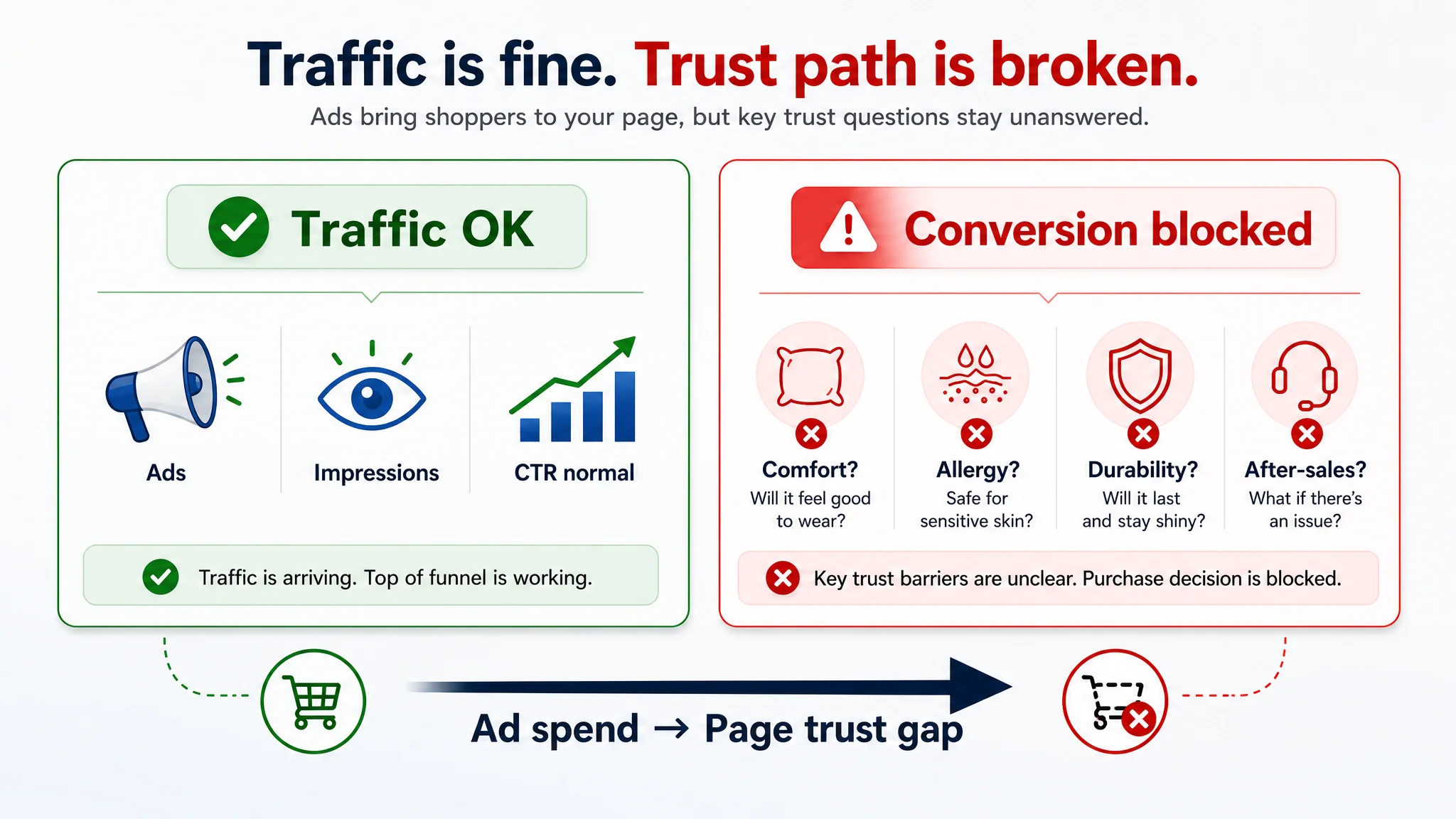
A deeper diagnostic showed that performance problems were not rooted in traffic quantity or superficial visual quality. The listing was telling the product story in the wrong order: over-investing in aesthetic and technical polish while delaying or underplaying the trust elements that actually reduce decision risk in jewelry—sizing clarity, everyday wear comfort, allergy safety, durability, and after‑sales reassurance. The result was a visually refined page that still consumed expensive clicks without closing the sale. This kind of misalignment is exactly what a modern, AI-driven model is designed to expose and correct: not just whether a listing looks better than a competitor’s, but whether its structure matches how buyers actually decide.
Why AI is the Game Changer for Amazon Sellers
This is where an AI-driven growth model becomes essential. This model represents a fundamental shift from reactive analysis to proactive, prescriptive action, establishing a clear “data evidence chain” for every optimization. Artificial intelligence tames market complexity by transforming multifaceted operational decisions into standardized, engineered processes that systematically eliminate subjective human error.
In the jewelry case above, the turning point was not another round of ad experiments; it was an AI-led listing audit that quantified where the page really stood versus a tightly matched competitor and highlighted structural trust gaps. The AI did not stop at “your main images score 24 vs. 23”; it decomposed titles, bullets, images, and A+ modules into specific buyer decision steps and flagged that risk-reducing information (hypoallergenic claims, after-sales support, practical sizing guidance) appeared too late in the journey. This diagnostic layer provided a concrete, machine-readable basis for rewriting bullets, reordering A+ modules, and reframing the image set around trust, not just aesthetics.
DeepBI embodies this new paradigm as an Amazon-focused, full-funnel intelligent optimization system with AI at its core. It is engineered to break down the silos between the traditional operational stages of diagnosis, planning, production, and delivery. By integrating these functions into a single, closed-loop system, DeepBI ensures that every modification is directly linked to improving commercial performance. It elevates visual assets from simple aesthetic displays into a core commercial engine designed to drive measurable gains in CTR and CVR, providing sellers with the intelligent tools needed to thrive in Amazon’s evolving ecosystem.
DeepBI's Holistic AI Growth Framework: A Three-Pillar Approach
DeepBI integrates the traditionally siloed stages of Amazon operations—diagnosis, strategy, production, and delivery—into a single, AI-driven growth engine. This full-link optimization system is built on three core pillars that work in concert to create a closed-loop cycle of continuous improvement, ensuring every action is data-backed and directly tied to performance metrics.
The jewelry listing example illustrates how this integration works in practice. The diagnosis pillar identified that ads were feeding a page with misordered trust signals. The strategy pillar redefined the optimization goal from “make the listing prettier” to “rebuild the trust and decision path.” The production and delivery pillars translated that strategy into concrete title revisions, bullet restructuring, image repurposing, and A+ re-sequencing—and deployed those changes efficiently. Instead of treating listing and ads as separate projects, the system aligned them around a shared conversion objective.
Pillar 1: Enhancing Product Competitiveness with AI-Powered Listing Optimization
This pillar transforms listing management from a subjective art into a data-driven science. DeepBI begins by conducting an intelligent diagnosis, using semantic analysis to score your listing's components against top-performing competitor ASINs. It then converts identified weaknesses into precise, AI-executable instructions. Instead of a vague suggestion like “improve the main image,” the AI generates specific visual compositions designed to boost CTR.
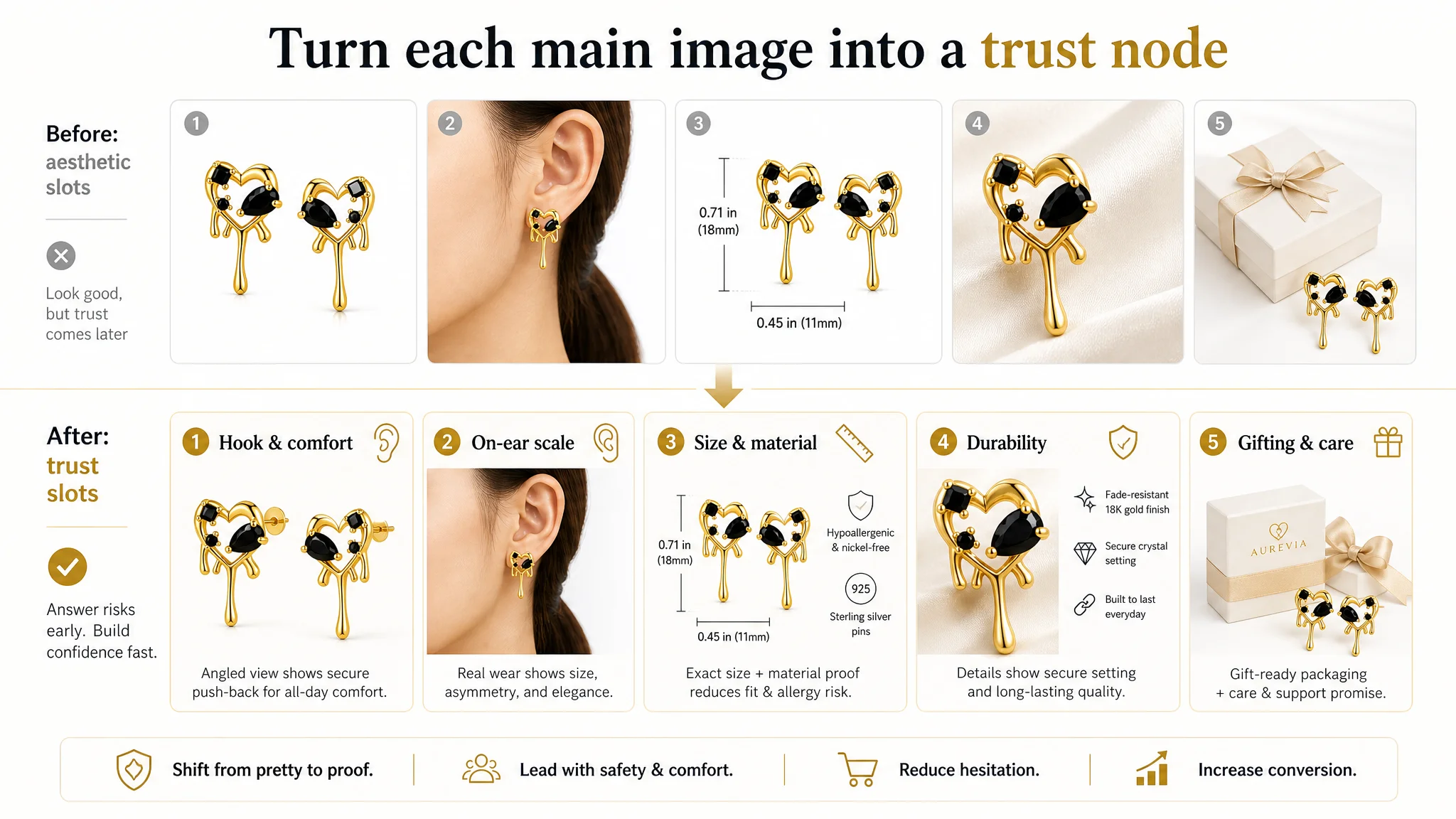
In the jewelry case, this meant going far beyond a generic “your images are fine” assessment. The system broke down the main image set and A+ detail page into functional roles: hook, scale demonstration, material reassurance, giftability, and durability proof. It flagged that while the seller’s visuals were more refined than the competitor’s, they were underutilized as trust assets. Key insights included:
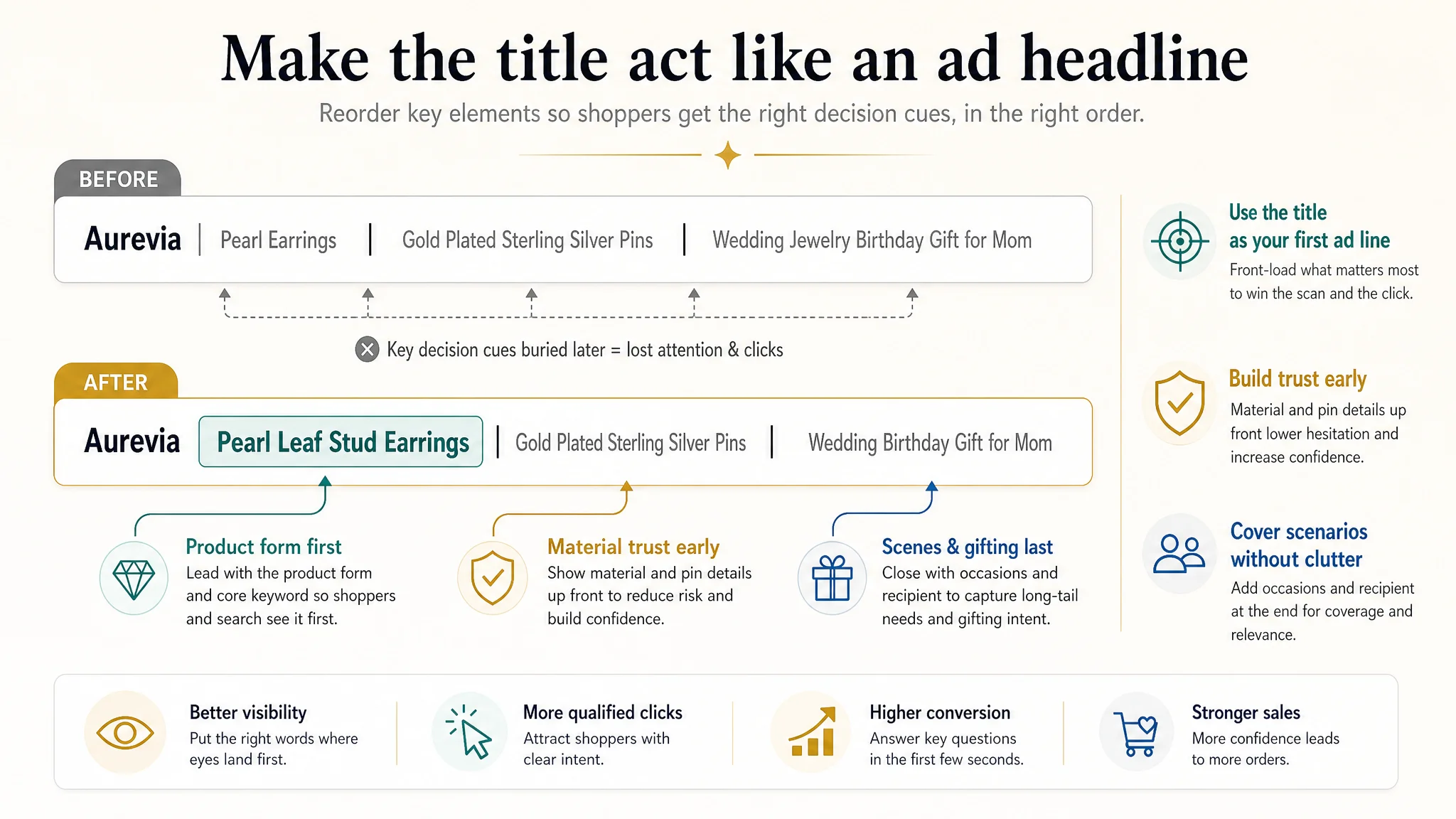
- The title led with brand and decorative language, while the competitor’s title front-loaded the core search term (“Pearl Stud Earrings”) and an emotional hook (“Elegant… for Mom”), making it stronger for scanability and click intent.
- Bullets opened with design and scenes, pushing material safety and after-sales protection further down, whereas the competitor attacked skin safety and returns assurance in the first bullets.
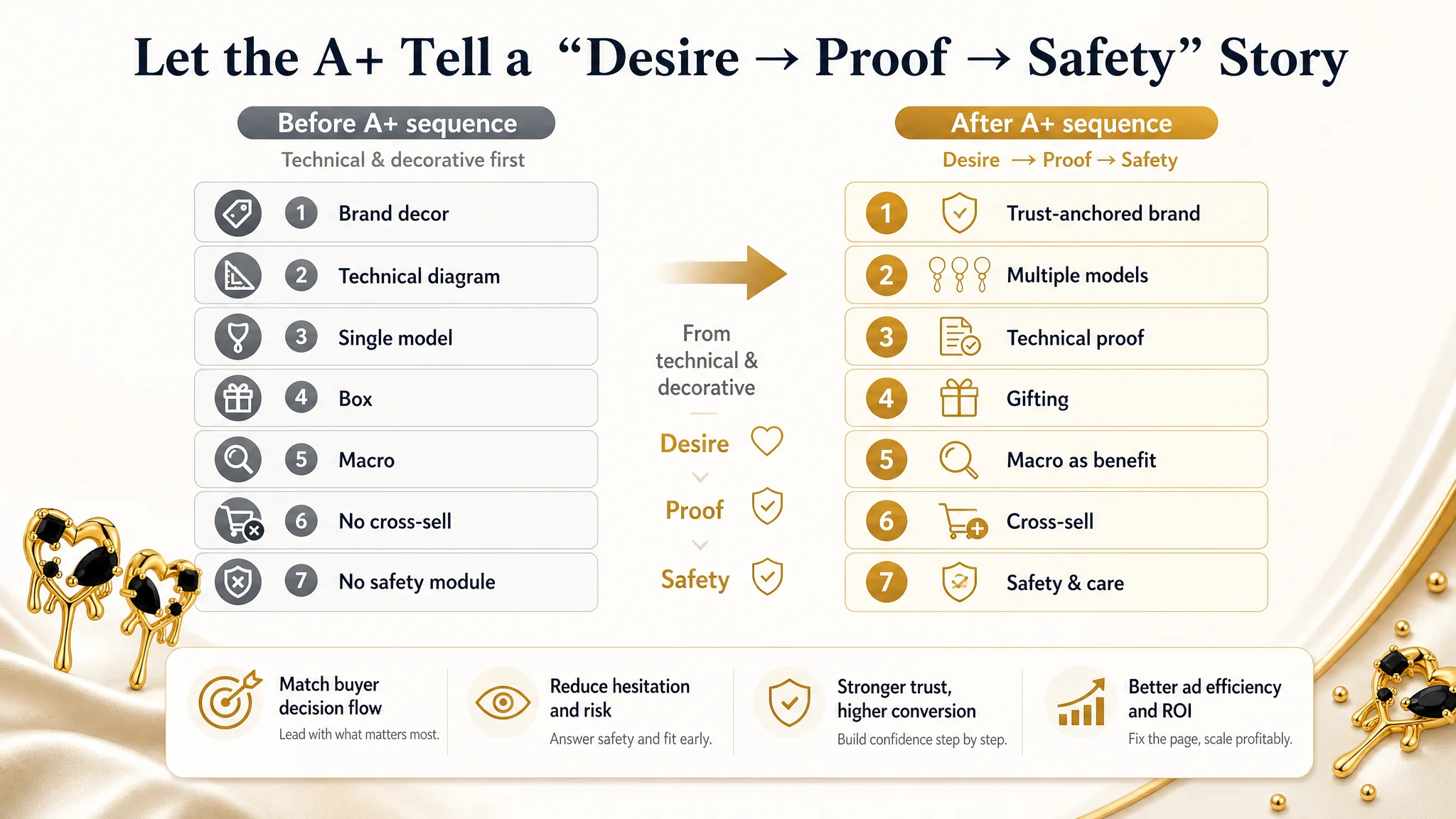
- A highly informative size diagram existed, but it appeared mid-flow and behaved like a rational afterthought rather than an early fit reassurance.
Crucially, the AI-powered image and text generation operates under a strict “product entity consistency” principle, which prevents alterations to the product’s core design that could lead to negative reviews. In the jewelry scenario, this translated into guidance such as: keep the real product form and materials intact, but recompose slots to highlight the push-back setting for comfort, show multiple on-ear angles for scale, couple size diagrams with material callouts, and dedicate a visual to gift readiness and hypoallergenic claims. The AI’s role was not to invent a different earring, but to expose and reorganize the proof the seller already had.
Finally, with one-click application via the SP-API, optimized content is deployed in seconds. This automates a process that once took many minutes and establishes a direct feedback loop to measure the impact on CVR and CTR. In practice, this meant that once the trust-first title, reordered bullets, and restructured A+ modules were generated, the seller could push them live quickly and observe whether ACOS stabilized and conversion became less sensitive to rising CPC. The listing moved from a static “nice page” to a continuously tested conversion asset.
Pillar 2: Maximizing Ad Performance Through AI-Quantified Advertising
DeepBI brings strategic structure and automation to your ad campaigns. It employs a four-layer traffic funnel model—Exploration, Initial Screening, Precision, and Scaling—to systematically manage ad spend and objectives. The system moves beyond manual guesswork by implementing dynamic parameter adjustments. Based on stable 7-day performance metrics like ACoS, clicks, and conversions, the AI automatically optimizes bids and budgets daily. This ensures your ad strategy remains agile, explainable, and relentlessly focused on maximizing return on investment.
The jewelry seller’s experience highlights why this pillar must be tightly coupled with listing diagnostics. Before the audit, rising competition on jewelry keywords and stubbornly high ACOS led the team to assume an “ad problem.” Normal CTRs but weak order growth pushed them to refresh creatives, test more ad types, and keep adjusting bids—all within the advertising layer. Yet, when DeepBI compared their listing structure and trust messaging with a direct competitor in the same subcategory, the data pattern pointed to a conversion constraint:
- The customer had richer A+ content, better review volume and sentiment, and stronger detail page scores.
- Despite this, the competitor’s bullets opened with allergy-free, nickel-free claims and an explicit after-sales safety net, while the customer’s page buried these reassurances.
From an ad manager’s view, continuing to tweak creatives and bids in isolation would have just pushed more impressions into the same leak. By quantifying that traffic quality was not the primary bottleneck, the AI recommended a different sequence: fix the listing’s trust logic first, then re-enter the four-layer funnel with a page that can actually convert the traffic being purchased.
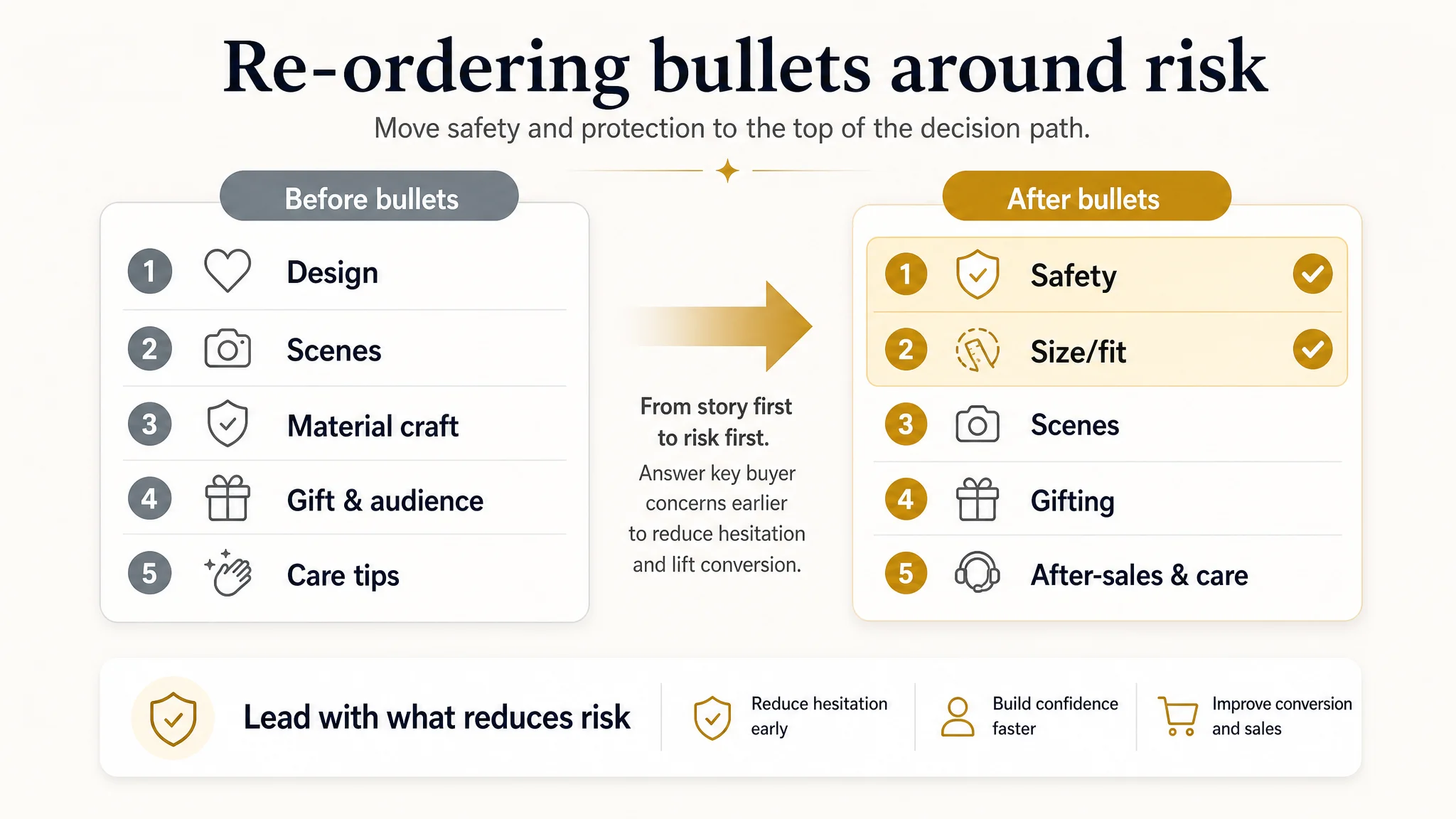
Within this framework, once the listing was realigned, the advertising module could treat ACOS anomalies more reliably. For example, if after reordering the bullets (safety → fit → scenes → gifting → after-sales) and reframing the main images around comfort and durability, ACOS still behaved erratically, the AI would have stronger grounds to attribute variance to competitive bidding intensity or keyword mix rather than latent listing flaws. The result is ad optimization that is not blind to page-level constraints.
Pillar 3: Boosting Organic Traffic and Long-Term Profitability
This pillar creates a powerful synergy between paid advertising and organic growth. DeepBI analyzes ad data to identify high-converting keywords that have proven their value. It then uses these insights to fuel targeted “Top of Search” reinforcement campaigns, strategically designed to improve homepage visibility and elevate organic rankings. This “dual growth” approach ensures that your ad spend is not just a short-term sales driver but a direct investment in building sustainable, long-term organic profitability and brand dominance.
In the jewelry example, once the listing regained conversion capacity—through a trust-first title, restructured bullets, repurposed main images, and desire-then-proof A+ modules—paid traffic became more productive. Each click had a clearer path from curiosity to comfort to purchase, which is a precondition for profitable keyword reinforcement. The AI could then identify which search terms (e.g., combinations of “pearl stud earrings,” “hypoallergenic,” “gift for mom”) were consistently converting under the improved page and prioritize them for Top of Search campaigns.
Because the listing itself now addressed risk questions early and consistently across text and visuals, organic visitors benefited as well. The page no longer relied entirely on aggressive ad spend to move units; instead, it offered a complete, low-friction decision path that supported both Sponsored and organic traffic. Over time, this alignment between ad-informed keyword strategy and trust-optimized listing content is what turns short-term performance wins into sustainable rank and profitability gains.
Implementing the AI Growth Model: A Step-by-Step Guide
Adopting an AI-driven approach transforms listing management from a series of manual tasks into a strategic, automated growth engine. The process is designed to align AI capabilities with your specific business goals, creating a continuous cycle of data-informed improvement.
The jewelry project shows how implementation unfolds when a seller initially believes “our listing is already better than the competitor’s,” yet performance says otherwise. Rather than immediately scaling ads or rebuilding creatives from scratch, the rollout began with a disciplined diagnostic and goal-setting phase that uncovered misaligned assumptions, then transitioned into automated strategy execution calibrated to those findings.
Data-Driven Diagnostics and Goal Setting
Implementation begins with you defining the strategic direction. You set primary business objectives, such as maximizing profit or accelerating market share growth, and establish key operational guardrails like a target ACoS. Once you authorize secure access via the SP-API, DeepBI initiates a comprehensive diagnostic phase. The system analyzes your listing's performance against key competitors and cross-references its findings with your historical advertising data, including CTR and CVR, to identify the most critical conversion bottlenecks. This process moves beyond vague suggestions like “improve image quality,” instead generating a precise, machine-readable optimization plan with parameterized instructions for composition, lighting, and scene elements to create an actionable blueprint for enhancement.
In the jewelry case, the seller’s initial goal was to bring ACOS under control while maintaining volume. Their internal narrative was that ad settings were the main constraint because “our listing has better scores, more reviews, and a deeper A+ page than the benchmark.” DeepBI’s diagnostic challenged that narrative by:
- Scoring titles, bullets, main images, detail page, and reviews side-by-side with a direct competitor.
- Highlighting that while the customer led in title coverage, A+ richness, and review volume, the competitor led in the logical ordering of material safety, fit guidance, and after-sales assurances.
- Mapping ad performance patterns—normal CTR but weaker order follow-through—as indicative of conversion friction rather than upper-funnel failure.
This is where data-driven diagnostics shifted the business question from “which ad types should we test next?” to “is our listing actually neutralizing the risks buyers care about, in the order they experience them?” The resulting optimization plan did not simply say “rewrite bullets”; it specified that bullets should be restructured so that hypoallergenic claims, durability, and explicit post-purchase protection moved into the leading positions, with design and scenes supporting rather than displacing trust.
Automated Strategy Execution and Continuous Optimization
With a clear plan in place, DeepBI’s AI engine executes the strategy by generating optimized visual and text assets. The system then streamlines deployment through a “One-Click Apply” function, which uses SP-API integration to update your Amazon listing directly. This automation reduces a manual upload process that could take over 30 minutes to mere seconds, significantly shortening the listing iteration cycle. While the process is automated, you retain final control, with the ability to review and approve all changes in a side-by-side comparison before they go live. After an update, the system automatically tracks the impact on advertising KPIs, feeding performance data back into the model. This creates a powerful, closed-loop system where your listing continuously evolves based on real market feedback to improve CTR and lower ACoS over time.
In practice, for the jewelry seller, automated execution meant:
- Generating a revised title that front-loaded the product form and primary keyword cluster (“Pearl Stud Earrings”) immediately after the brand, then followed with material trust cues (e.g., gold-plated sterling silver pins) and gifting and occasion signals.
- Rewriting bullet points to follow the buyer’s mental process—safety and material quality first, then fit and wear scenarios, then gifting logic, and finally an explicit satisfaction and care statement—rather than leading with abstract design language and burying protection.
- Reframing main images so each slot played a clear role: an initial hook that subtly shows secure, comfortable backs; an on-ear shot that normalizes the chunky design; a combined size and material diagram; a macro shot emphasizing integrity and durability; and a giftability or material-story visual that makes “safe, durable, gift-ready” obvious.
- Reordering A+ modules from a technical-first narrative to a desire → proof → safety sequence, ensuring that the first impression builds aspiration while quickly anchoring material safety, skin comfort, and gifting reassurance.

Because these assets were applied via SP-API with one-click publishing, the seller did not need to manually upload and arrange each module. More importantly, the AI could then observe how the new trust-first structure affected CVR and ACOS, and iteratively refine wording or image emphasis without rebuilding the page from scratch. The listing moved from a static, assumption-driven artifact to a living component in a continuous optimization loop.
The Future of Amazon Selling: Sustainable Growth with AI
The competitive landscape of Amazon demands more than just intuition and manual adjustments. Success is increasingly defined by the ability to systematically convert data into performance—a challenge that artificial intelligence is uniquely positioned to solve. AI-powered systems are moving e-commerce operations beyond subjective decision-making and fragmented workflows, establishing a new paradigm for growth.
The jewelry seller’s journey from “our listing scores higher than the competitor’s” to “our listing finally matches how buyers decide” underscores a broader shift. Many Amazon operators still treat listing quality as a binary checkbox—either the page is “fine” or “broken”—and focus optimization energy on ads whenever metrics disappoint. AI exposes a more nuanced reality: a listing can be visually refined yet structurally misaligned; scores can be high while the trust story is misordered. Without a system that quantifies these gaps and ties them to conversion outcomes, teams risk pouring budget into campaigns that only amplify latent defects.
Overcoming Challenges and Embracing Innovation
Traditional Amazon operations often suffer from a disconnect between analysis, creative production, and back-end execution. This leads to slow listing cycles and optimizations based on guesswork rather than a clear data evidence chain. AI transforms this process by integrating these functions into a single, logical flow. It enables sellers to move from speculative trial and error to a predictable, scientific method where every optimization is engineered to produce a measurable improvement in key metrics like Click-Through Rate (CTR) and Conversion Rate (CVR). This fosters a culture of continuous, data-backed innovation rather than one of sporadic, high-risk updates.
In the jewelry example, this shift was visible in three ways:
- Analysis stopped at neither “the ads are too expensive” nor “the listing looks polished.” Instead, it traced performance issues back to specific, testable hypotheses about trust sequencing—such as whether allergy safety should appear in the first bullet or be left implicit.
- Creative production was not driven by subjective aesthetic preferences, but by role-based assignments for each title segment, bullet, image, and A+ module in the buyer’s decision path.
- Execution no longer depended on manual uploads and scattered experiments; once the revised assets were approved, they were pushed live coherently, allowing the team to see the compounded effect on conversion instead of isolated tweaks.
By closing these gaps, AI helps sellers avoid a common trap: misdiagnosing conversion constraints as purely advertising issues. When the listing itself is structured to manage risk and clarify decisions early, ad optimization becomes a genuine lever for growth rather than a compensating mechanism for page-level weaknesses.
DeepBI: Your Partner in AI-Powered E-commerce Growth
DeepBI embodies this future as a comprehensive, AI-driven system built specifically for Amazon. It moves beyond simple content generation to provide a full-funnel solution that integrates diagnosis, planning, production, and delivery. The platform translates high-level business goals into precise, machine-executable instructions, ensuring that AI operates as a high-quality executor, not a blind creator.
In the jewelry project, this meant that the AI did not simply suggest “add more images” or “rewrite copy.” It specified how to reorder trust elements in bullets, which A+ modules should move from technical introductions to proof stages, and how to repurpose existing visuals to answer exactly the questions buyers bring—“Will this irritate my skin? Will it fit and look right? What happens if I’m not satisfied?” This level of prescriptive detail turned what had been a vague sense of “we need to improve” into a concrete, testable execution plan.
Crucially, DeepBI builds growth on a foundation of security and compliance. By enforcing strict constraints like “Product DNA” to prevent misrepresentation, adhering to brand identity, and complying with Amazon's technical guidelines, it mitigates the risks of AI hallucinations. With its secure, one-click publishing via the official SP-API, DeepBI transforms from an analysis center into an execution center, empowering sellers to achieve sustainable, long-term success.
Conclusion: Redefining Success in the Amazon Ecosystem
The era of relying on intuition and manual experimentation to succeed on Amazon is over. The future belongs to sellers who embrace a systematic, AI-driven growth model that transforms complex operational decisions into a predictable and quantifiable science. This approach moves beyond subjective adjustments, ensuring every optimization is engineered to produce measurable gains in key performance indicators.
The jewelry listing experience underscores a critical lesson: a higher listing score, stronger reviews, and more polished visuals do not automatically translate into higher conversion or lower ACOS. If the page underplays material safety, fit guidance, everyday comfort, durability, and after-sales reassurance—or surfaces them too late in the journey—ads will feel “expensive” no matter how often creatives and bids are tweaked. AI makes these invisible structural issues visible, and, more importantly, provides a repeatable way to correct them.
At the core of this transformation is the synergy between foundational listing quality and targeted traffic generation. DeepBI’s integrated modules exemplify this principle. The Listing module first establishes a high-conversion foundation by systematically optimizing every element from titles to A+ content, directly boosting CTR and CVR. In the jewelry case, this meant reframing the page around trust and decision clarity, so that each paid and organic visit encountered a coherent, risk-reducing story. This optimized asset then acts as a powerful amplifier for the Ads Quant and Organic Traffic modules, ensuring that every advertising dollar and every ranking effort yields a higher return. This creates a virtuous cycle where a better listing attracts more effective traffic, leading to healthier, long-term growth.
In the increasingly competitive e-commerce landscape, adopting AI is no longer a choice but a necessity for market leadership. Platforms like DeepBI serve as an intelligent decision-making core, empowering sellers to convert their visual and textual assets into a definitive competitive advantage and secure sustainable profitability. Before you push more traffic, the critical judgment is whether your page truly deserves it—and with an AI-driven growth model, that judgment is finally grounded in evidence rather than intuition.