Introduction
In the fiercely competitive Amazon marketplace, success is no longer achieved through simple adjustments to text and images. Winning now demands a precise collaboration of data, algorithms, and strategy, where every operational decision is optimized for maximum impact on performance. Consequently, listing optimization has evolved from a creative task into a rigorous, data-driven science.
Artificial Intelligence has emerged as the critical enabler of this shift, evolving from a buzzword into a core commercial engine for driving clicks and conversions. AI allows sellers to process vast amounts of market data, identify hidden opportunities, and execute complex strategies with a speed and accuracy that manual methods cannot replicate.
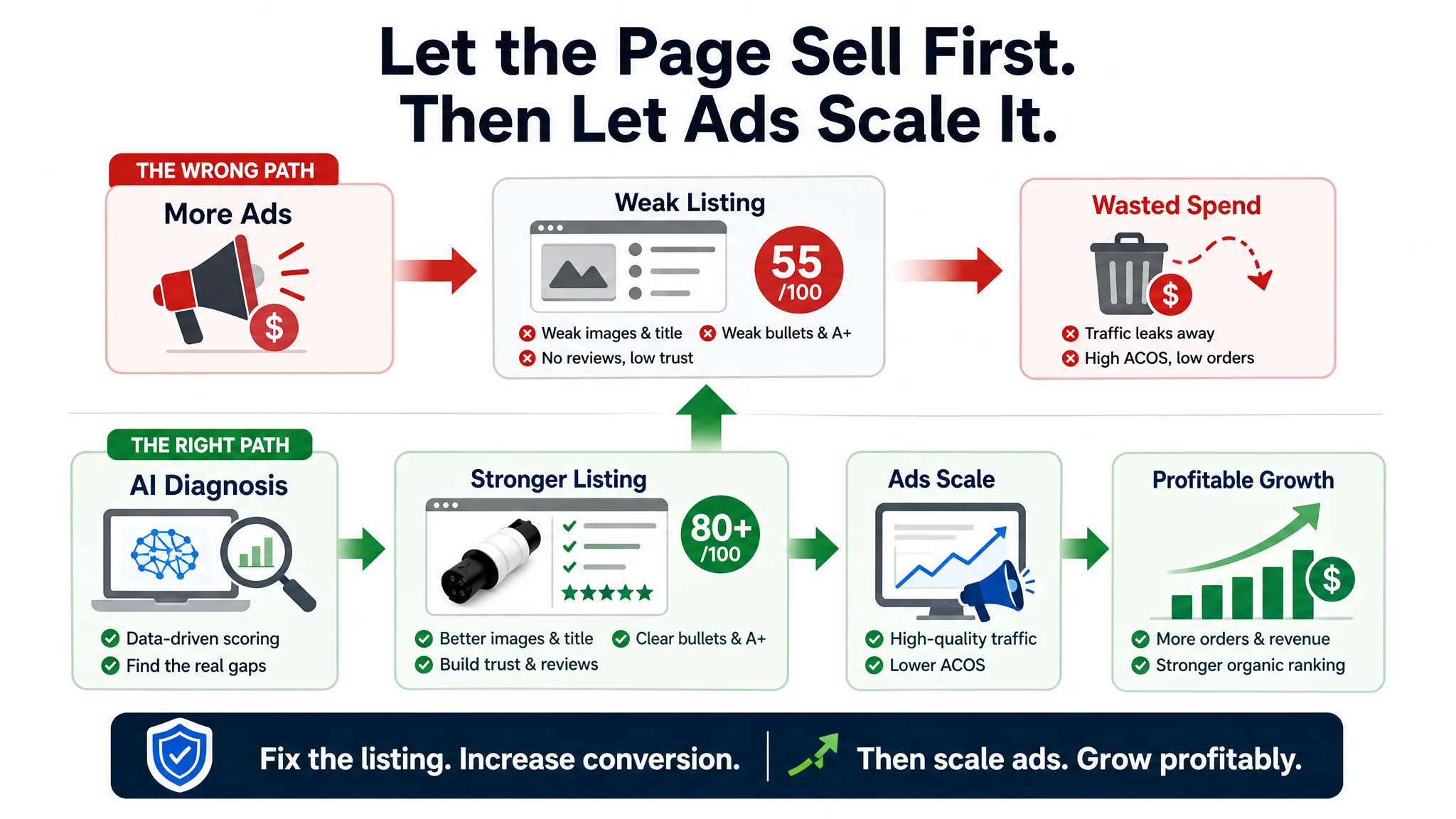
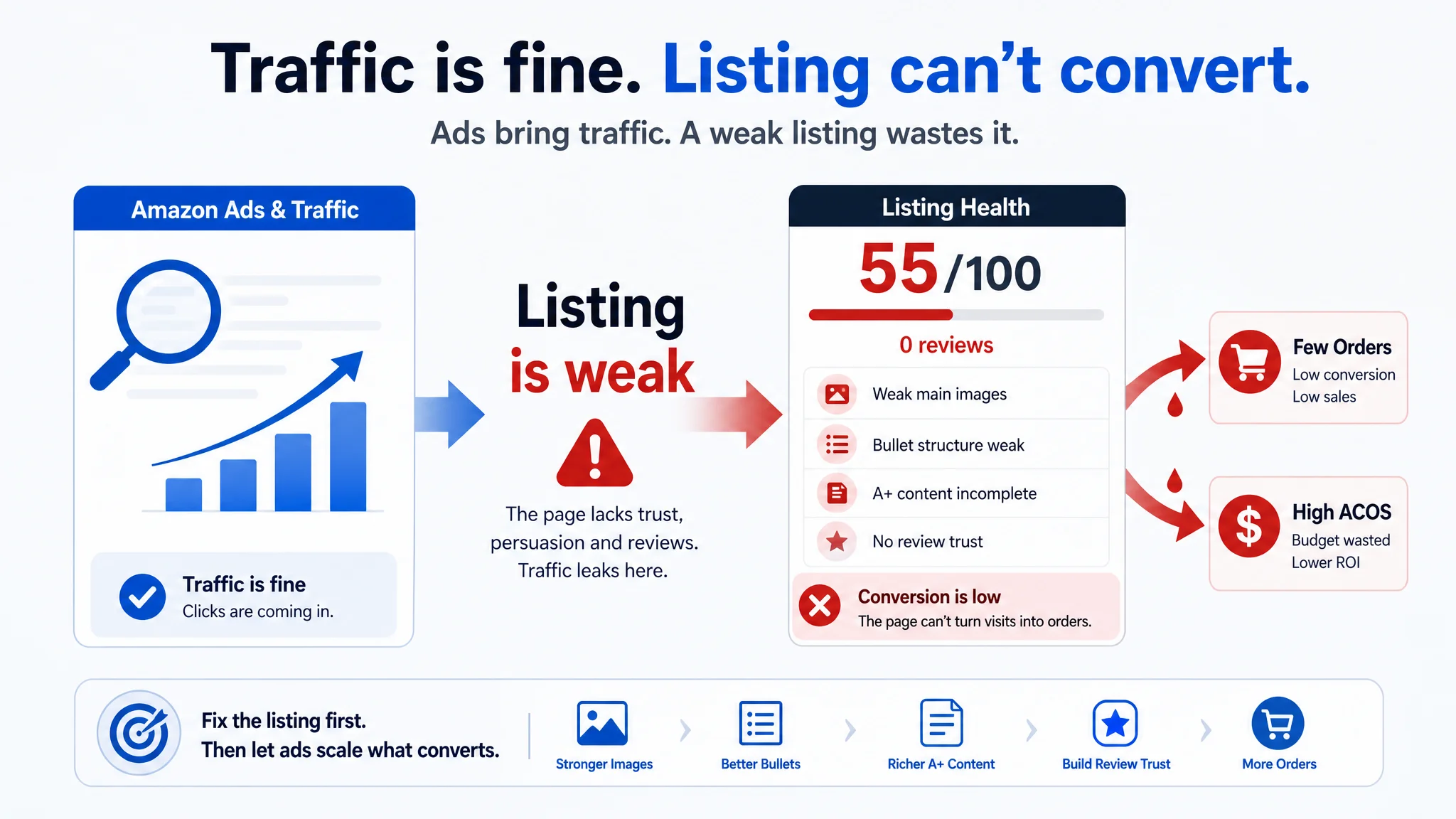
This is not just a theoretical shift. In real operations, teams still often default to “old” ways of thinking. A US seller in the EV accessories category illustrates this: as soon as their new Tesla/J1772 adapter kit showed weak order growth, the instinctive reaction was, “our campaigns and bids aren’t tuned enough; we need better ad optimization.” More budget was pushed into ads, dashboards were closely watched, and yet clicks and orders refused to grow in proportion. Only when an AI-driven diagnosis was run did a different picture emerge: ads were doing their job bringing traffic, but a 55/100 listing with zero reviews could not convert it. This kind of misalignment between modern tools (ads dashboards) and old habits (assume it’s an ads problem) is precisely what AI is meant to resolve.

This guide explores how to harness this power using DeepBI, an AI-driven SaaS platform designed exclusively for Amazon sellers. DeepBI is engineered to eliminate the fragmentation of traditional operations, which often separates performance diagnosis from creative production and ad management. It provides an end-to-end intelligent optimization system that unifies the entire lifecycle—from diagnosing listing weaknesses and planning data-backed improvements to producing AI-generated assets and delivering them directly to your listings. This integrated workflow ensures that every change is a strategic move designed to improve key performance indicators.
The primary objective is to create a powerful growth cycle where enhanced product competitiveness drives more precise ad placement, which in turn boosts organic traffic and lowers the Total Advertising Cost of Sale (TACoS). This establishes a virtuous sequence: Better Listings + More Precise Traffic = Healthier Long-term Growth. This guide will detail the strategies to achieve this outcome.
The AI Revolution in Amazon Selling: Why It's Indispensable for Amazon Sellers
The Evolving Amazon Landscape and the Need for AI
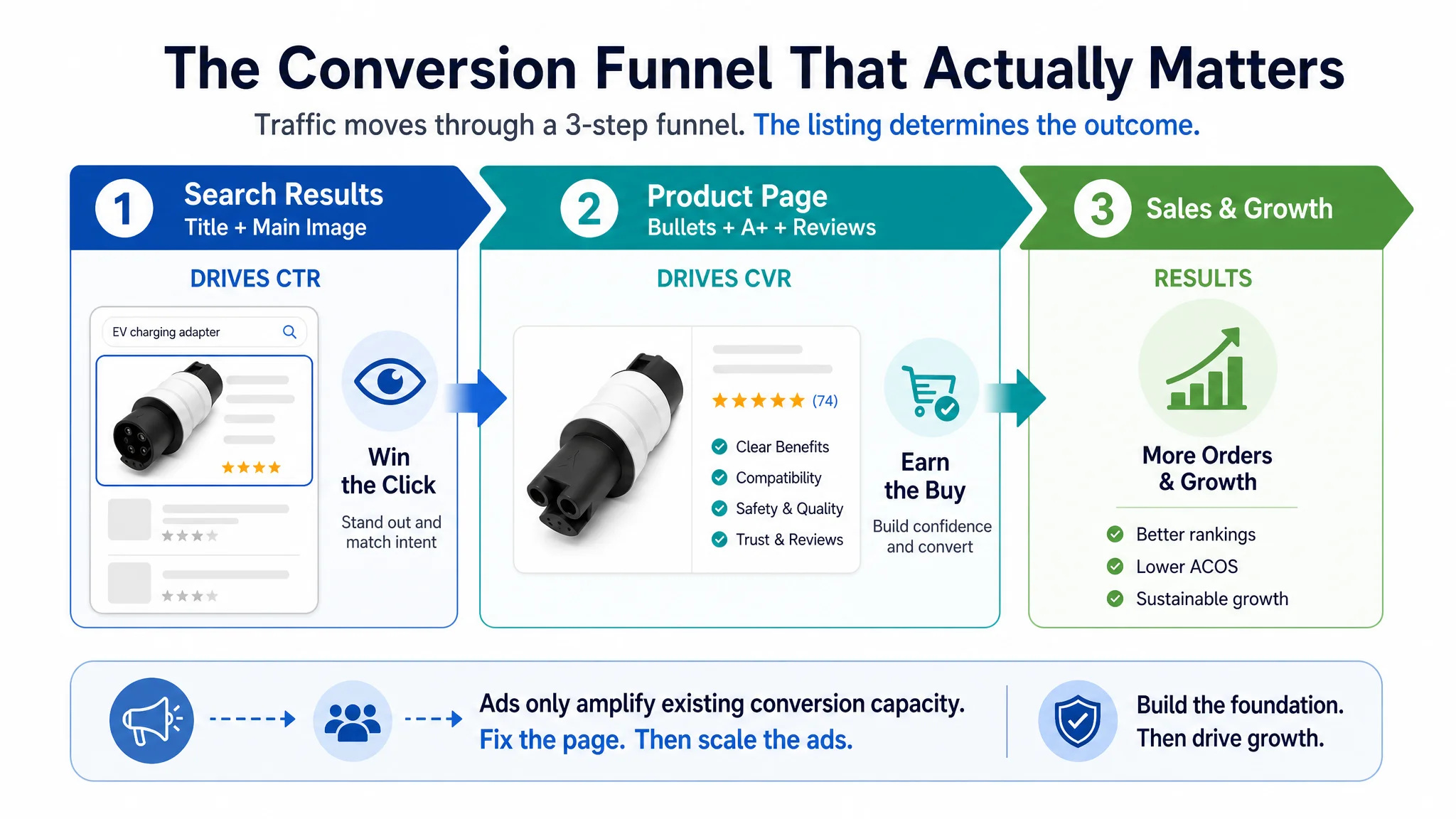
The Amazon marketplace has evolved into a hyper-competitive "stock competition" where rising traffic costs and saturated markets squeeze seller margins. In this environment, visual assets like main images and A+ Content are no longer just decorative; they are core commercial engines that directly drive click-through rates (CTR) and conversion rates (CVR).
However, traditional optimization methods are proving insufficient. Sellers are often trapped in a cycle of disconnected workflows for diagnosis, production, and delivery. Decisions are frequently based on subjective aesthetics or incomplete competitor analysis, leading to ineffective trial-and-error modifications. This manual approach is not only slow and inefficient but also risks damaging key performance metrics, as sellers struggle to process massive volumes of data and react to dynamic market shifts.
A common pattern in real accounts shows how fragile manual judgment can be. In the EV charging adapter case, the team was under pressure: a new product, no review base yet, and ads already running. Early signals showed that traffic existed but orders did not follow. Internally, every discussion circled around the ad console—keyword coverage, bids, match types, budgets. The underlying assumption was simple: “if we get more relevant impressions and clicks, orders must come.” What they did not have was a quantified view of the listing itself relative to the category’s best-performing page. Without AI, they lacked the ability to see whether the bottleneck was at the traffic layer or at the conversion layer.
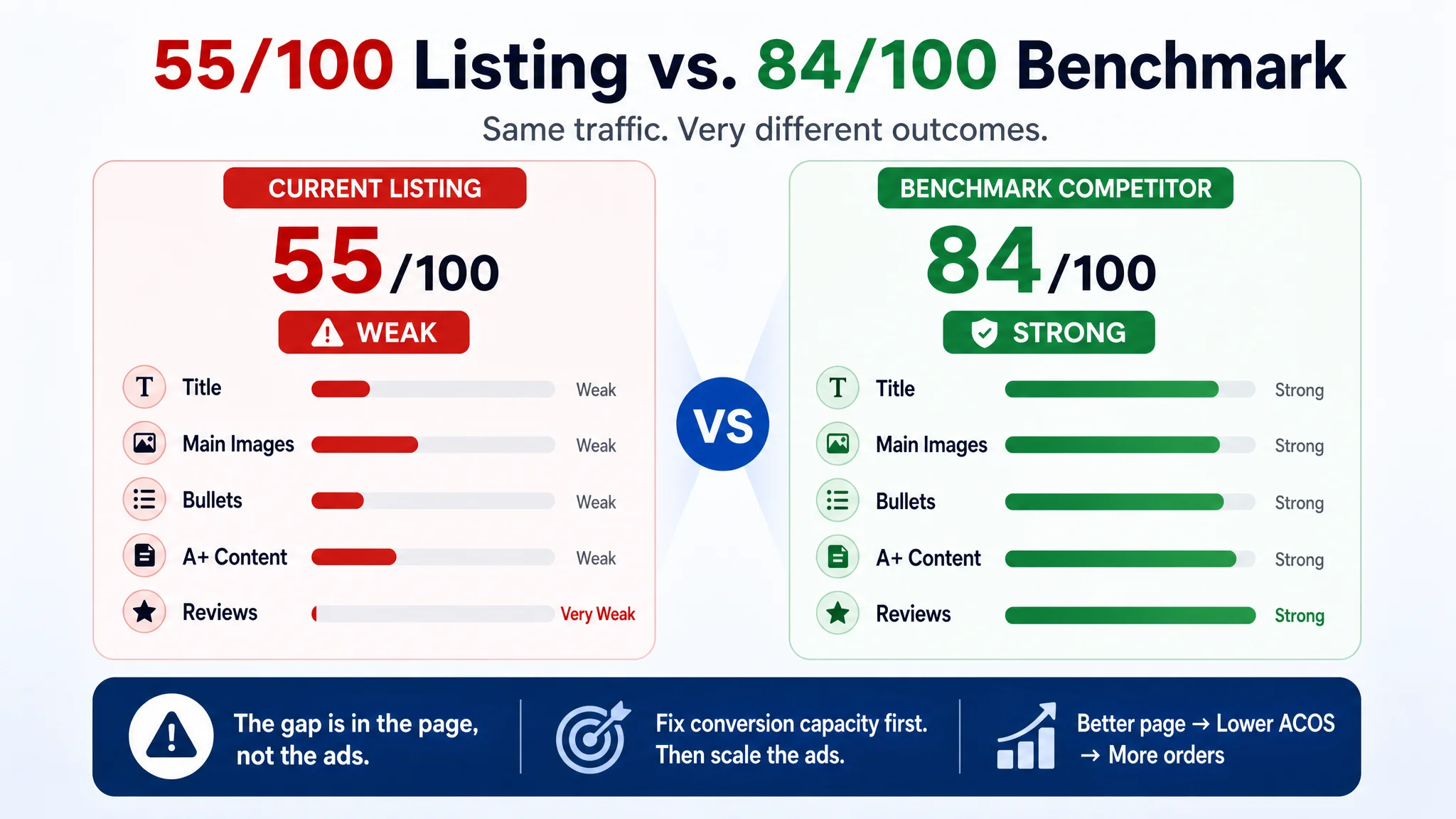
Once DeepBI applied an AI-based listing scoring model, the reality surfaced: the listing scored 55/100 against a benchmark competitor at 84/100, with the biggest gaps in main image strategy, A+ storytelling, and review trust—and literally zero reviews on the seller’s page. Ads, in other words, were amplifying a weak asset. This misdiagnosis—treating a page-level conversion problem as an ads problem—is the type of systemic error that becomes increasingly costly as traffic prices rise.
Core Benefits of AI in Amazon Operations
AI-driven platforms address these challenges by transforming listing optimization from an art into a science. Instead of relying on guesswork, AI provides a data-driven evidence chain that links business performance directly to specific listing elements. For example, it can diagnose a low CTR as a weakness in the main image or a poor CVR as a lack of trust-building content.
In the EV adapter example, this evidence chain made the trade-offs explicit:
- The AI scorecard showed a 29-point gap versus the benchmark: title, main images, bullets, A+ content, and reviews all underperformed.
- Visual analysis identified that the main images lacked real charging scenarios and clear compatibility signals, while the competitor used car-interaction shots and crisp performance callouts.
- A+ content was not only weaker in breadth and logic but also visually implied Tesla Supercharger usage, even though the text clearly said “not compatible with Superchargers”—a mismatch that invites returns and negative reviews.
Once these specifics were surfaced, the narrative “we just need better ads” was no longer tenable. The AI made it obvious that traffic was being lost at the listing layer, not at the auction layer.
The core benefits of AI are centered on efficiency and precision. Instead of vague feedback like "improve the texture," AI provides engineered, actionable instructions specifying parameters such as composition, camera angle, and lighting. This enhances both decision-making and operational speed. Furthermore, by integrating with Amazon's SP-API, the system automates tedious manual processes. Tasks like updating listing images, which could take over 30 minutes of downloading, renaming, and uploading, can be completed in seconds. This radical improvement in efficiency shortens the listing optimization cycle and empowers sellers to shift from speculative adjustments to targeted actions, ensuring every change is designed to grow profits.
AI-Powered Listing Optimization with DeepBI: Enhancing Product Competitiveness
Optimizing an Amazon listing is a continuous cycle of diagnosis, strategy, production, and delivery. DeepBI integrates these stages into a single, AI-driven workflow, transforming a complex manual process into a streamlined system for enhancing product visibility and conversion. By leveraging AI to analyze market dynamics and automate content creation, sellers can systematically improve their listings to outperform competitors.
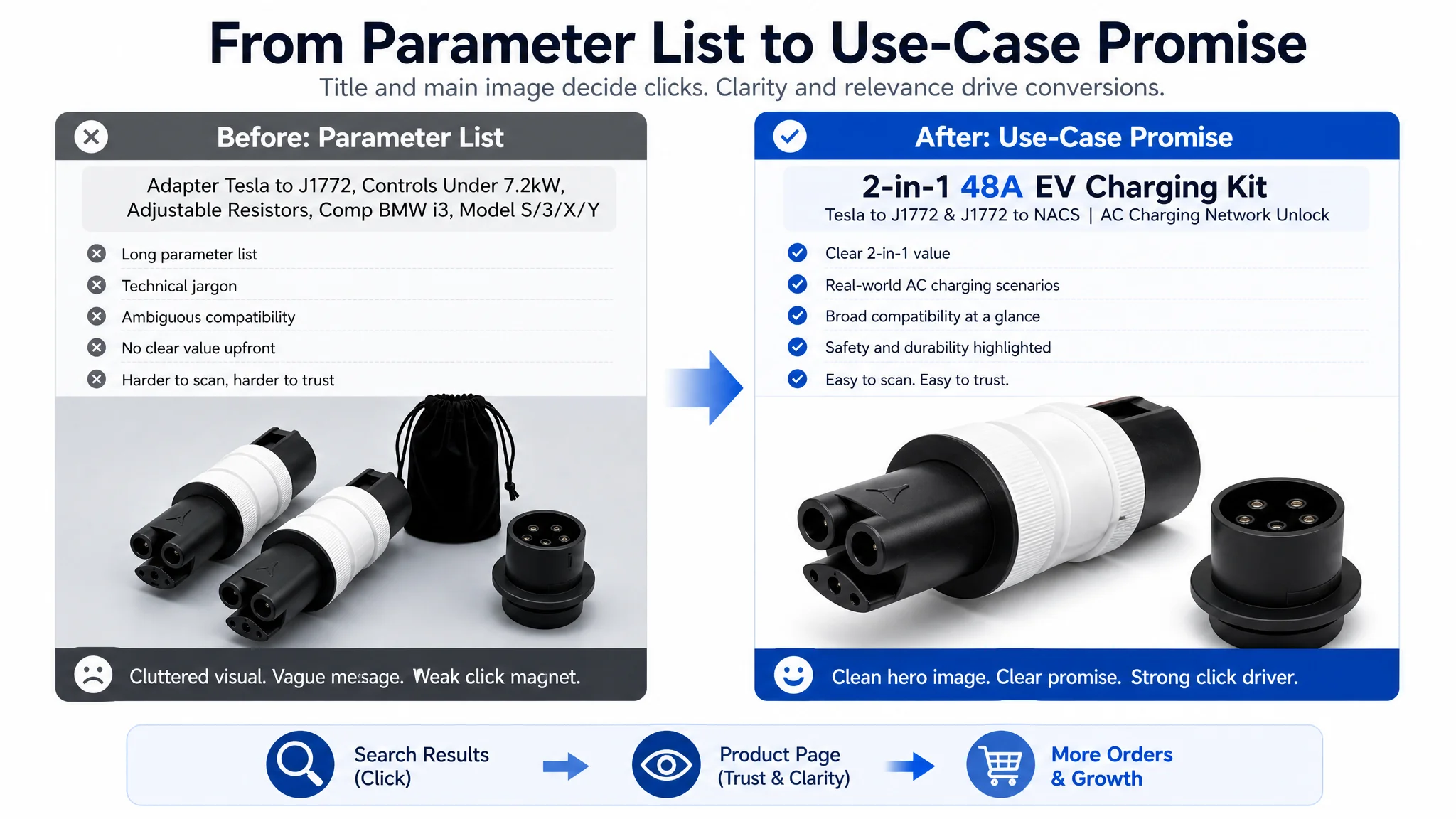
The EV adapter listing illustrates why this cycle matters. Before AI-led optimization, the page mixed vague titles, cluttered visuals, and technical warning-style bullets. The story the buyer saw was not “a clear 2-in-1 solution to unlock more AC charging options,” but a loosely organized set of technical points that required effort to decode. When the AI agents audited the listing and benchmarked it against the category leader, they were able to break down the gap dimension by dimension—title clarity, main image click appeal, bullet persuasion structure, A+ narrative coherence, and review trust. That diagnostic step became the foundation for a targeted, rather than generic, optimization plan.
Intelligent Diagnostics and Competitive Benchmarking
Effective optimization begins with an accurate diagnosis. DeepBI’s intelligent scoring module functions as an "automated market health check system," moving beyond simple checklists to provide a deep, data-driven analysis of your listing's health. Using a multi-dimensional semantic algorithm, the system identifies your true high-performing "benchmark competitors," providing a realistic standard for success. A multi-agent AI then audits your listing across five critical dimensions—main image visuals, title structure, bullet point logic, A+ content richness, and customer feedback—to pinpoint specific weaknesses and prioritize optimization efforts.
In the EV charging adapter case, this diagnostic step was pivotal. Rather than comparing the listing to a generic best practice list, DeepBI identified a specific benchmark page that already dominated the category. The AI then quantified the gap:
- Title: structured more like a parameter list than a clear buying logic, while the benchmark used a “benefit + keyword + conditions” pattern with powerful numbers and explicit fitment.
- Main images: the seller relied on a raw product shot and a storage pouch, whereas the benchmark used close-ups of real vehicles, dynamic compositions, and clear visualized benefits like power ratings and dual-mode functionality.
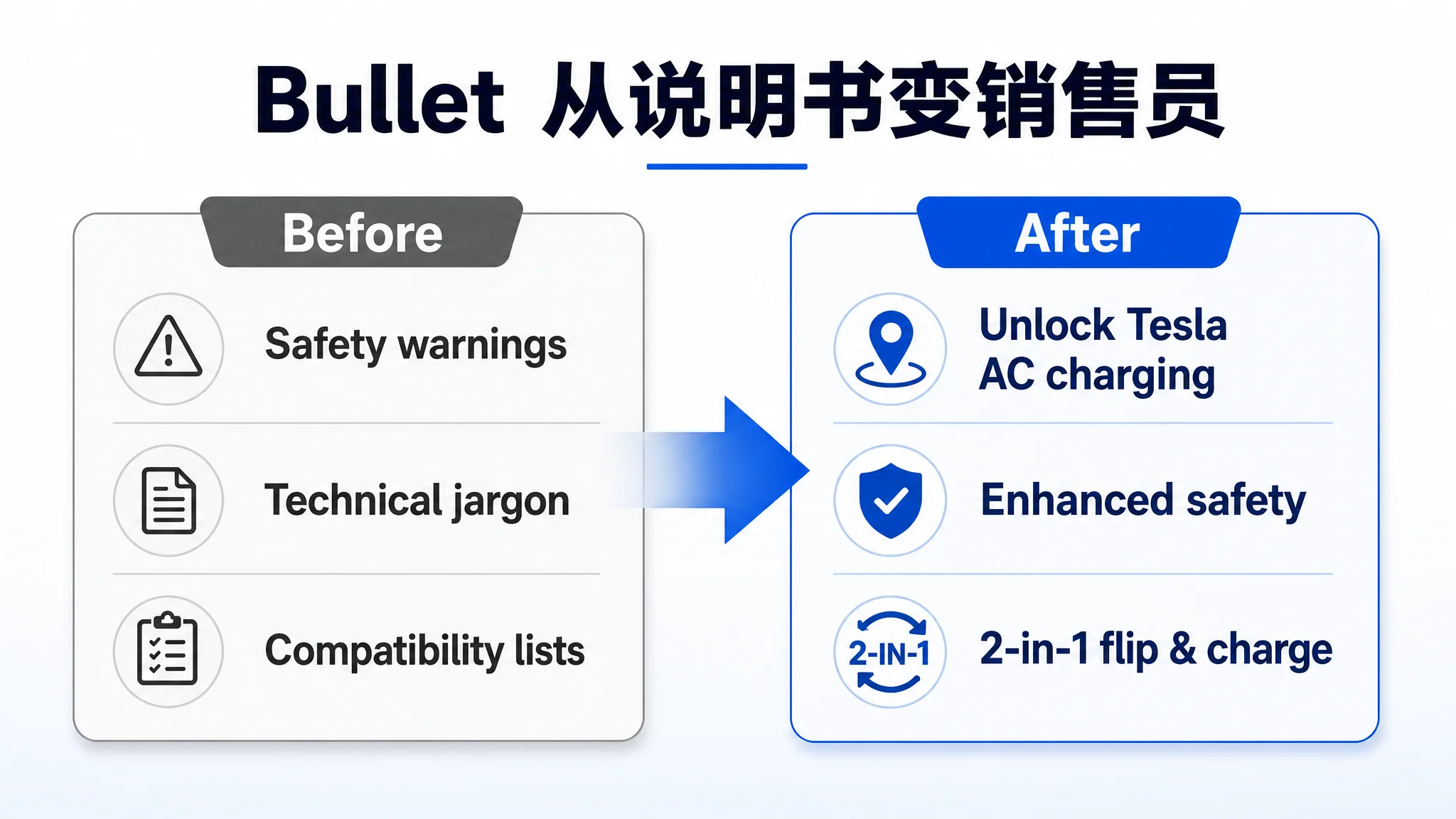
- Bullets: the seller’s bullets read like an instruction manual full of technical warnings, while the benchmark followed a “problem–benefit–assurance” flow that framed each feature as a solution to a real user pain.
- A+ content: the seller duplicated certain visuals and underplayed installation ease and durability, while the benchmark walked buyers through “why buy,” “how to use,” and “why trust,” with compatibility charts and durability tests.
- Reviews: the seller had none, the benchmark had dozens of reviews and a strong star rating.
The diagnosis made two strategic conclusions clear:
1. The listing did not lack traffic; it lacked conversion capacity.
2. Every additional ad dollar was being funneled into a page that structurally could not persuade or reassure buyers.
This kind of AI-driven benchmarking transforms a vague sense of “something is off” into a prioritized optimization roadmap.
AI-Driven Content Generation for High Conversion
Once diagnostic insights are gathered, DeepBI’s AI translates them into high-converting content. Trained on proven e-commerce frameworks, the AI generates compelling titles, bullet points, and A+ content by analyzing competitor strategies and customer reviews. For instance, it can restructure bullet points around a "Pain Point -> Solution -> Benefit" model to resonate more strongly with shoppers. This AI-generated content, which has helped users achieve outcomes like a 27% increase in conversion rate, can be synchronized directly to your Amazon listing. The one-click application feature uses API integration to reduce a manual update process that takes over 30 minutes down to mere seconds.
In the adapter case, this translation from diagnosis to content played out in concrete ways:
- The title was reframed to foreground the real use case—“Tesla to J1772 Adapter and J1772 to NACS Adapter Kit (2-Pack), 48A Max EV Charging Accessories”—highlighting the dual-direction value, the credible 48A parameter, and the AC charging scenarios that actually matter (wall connectors, destination chargers, Level 1/2 stations). Instead of scattershot keyword stuffing, the AI structured the title as a concise promise, aligned with search intent and purchase logic.
- Bullets were rebuilt from a scattered technical list into a benefit-driven narrative. Each bullet started with a bold, user-facing header (“Unlock Tesla AC Charging Network,” “Exclusive Adjustable Resistor for Enhanced Safety,” “Innovative 2-in-1 ‘Flip & Charge’ Design”), followed by practical scenarios and then the supporting technical explanation. The AI reused the seller’s real strengths—adjustable resistor design, 48A capability, 2-in-1 architecture—but reordered and expressed them in a way that matches how buyers actually think through risk, convenience, and value.
- A+ content was reorganized into a coherent story arc: dual-adapter solution, technical safety advantage, corrected real-world scenario (non-Tesla using Tesla AC chargers, not DC fast chargers), 2-in-1 usage logic, durability and portability, and compatibility plus support. The AI explicitly avoided visuals that could mislead buyers, such as Tesla Supercharger imagery for an AC-only product, and instead anchored every visual in what the product truly does.
Because DeepBI’s content engine is wired into Amazon’s SP-API, these changes did not remain as static recommendations. Once approved, the titles, bullets, and A+ modules could be pushed directly into the listing, turning insight into live listing assets without the friction of manual uploads. For the seller, this meant the listing’s sales logic could be rebuilt in days, not weeks.
Ensuring Amazon Compliance and Maximizing Visual Impact
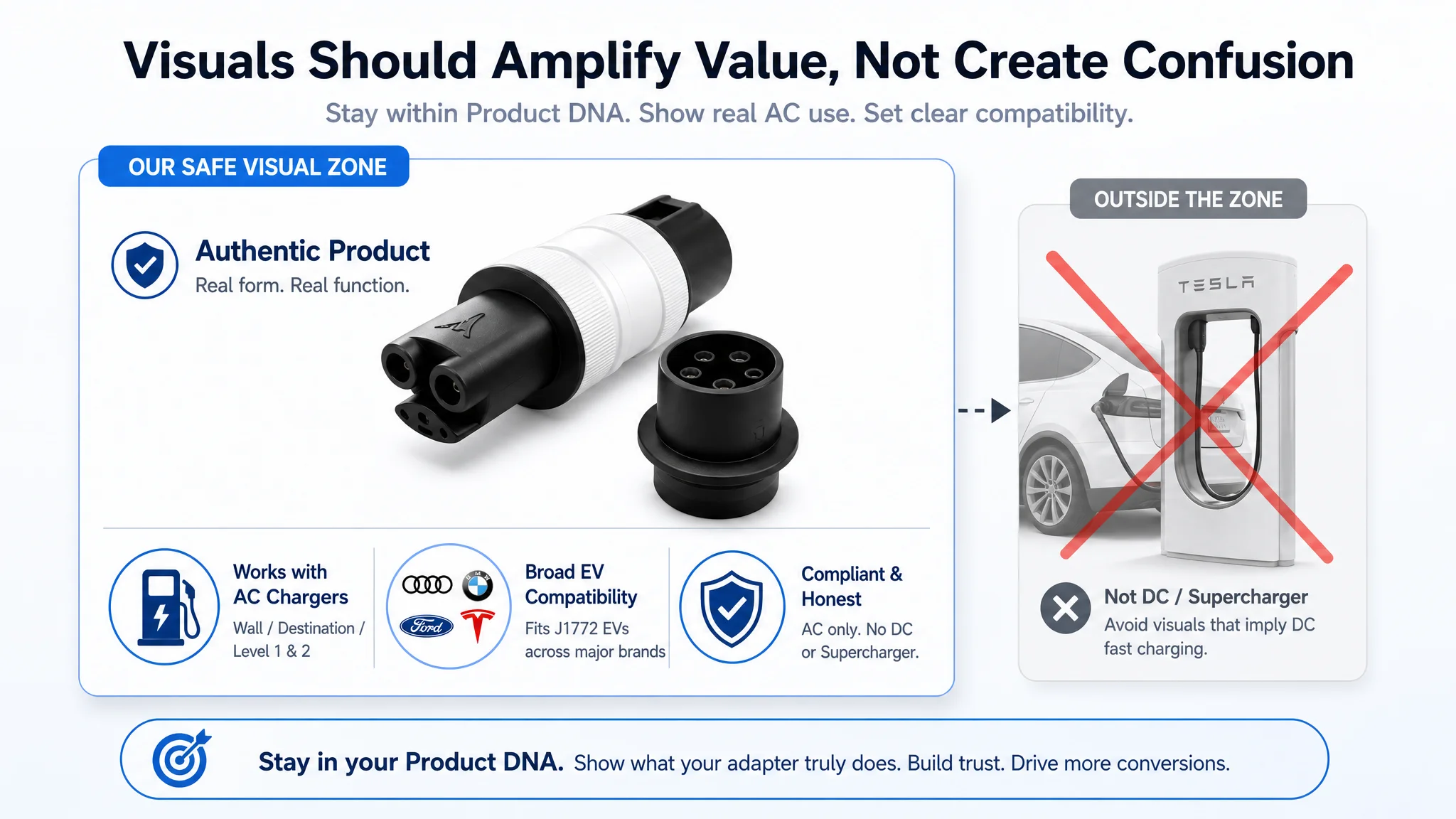
Visual content is critical for capturing shopper attention, but using general AI tools risks creating "product-image mismatch" that leads to negative reviews. DeepBI mitigates this risk with its "Product DNA" technology, which locks in your product's authentic physical attributes. This allows the AI to safely enhance visual elements like composition, lighting, and background to maximize click-through rate (CTR) without altering the product itself. The system also automates compliance, ensuring all generated images meet Amazon's technical requirements, such as white backgrounds for main images. Finally, it closes the feedback loop by tracking CTR changes after a new image is applied, connecting visual optimization directly to measurable performance.
The EV adapter diagnosis showed how easy it is to drift into risky territory without such constraints. The original A+ content had a Tesla Supercharger in the background while explicitly stating that the product does not support Level 3 DC charging. This kind of mismatch doesn’t just confuse buyers; it sets up future complaints, returns, and early negative reviews that can harm long-term ranking.
Under Product DNA constraints, DeepBI’s visual recommendations focused on:
- Hero images that emphasize the actual adapters in clean, white-background compositions with high material fidelity.
- Realistic charging scenes using AC destination chargers and wall connectors that match the product’s AC-only nature.
- Compatibility visuals that rely on brand logos and charger-type icons rather than implied DC fast-charging scenarios.
By anchoring all AI-generated visuals in the product’s authentic capabilities, DeepBI ensures that higher CTR does not come at the cost of misrepresentation. For the EV adapter seller, this meant that future clicks would be based on accurate expectations, sharply reducing the risk that paid traffic would convert into dissatisfied buyers.
Driving Traffic with AI-Enhanced Amazon Advertising: DeepBI AdsQuant in Action
Effective advertising is the engine of Amazon growth, but manual campaign management often fails to keep pace with market dynamics. DeepBI’s AdsQuant module leverages AI to transform advertising data into a strategic advantage, creating a powerful synergy between your campaigns and your product listings to maximize traffic quality and conversion.
In many real accounts, including the EV adapter scenario, the temptation is to blame ads when ACOS creeps up and orders lag. The seller’s internal narrative was familiar: “our keyword coverage might be too narrow,” “bids and budgets may not be aggressive enough,” “we should push more spend.” Without a structured link between ad metrics and listing health, all roads led back to the campaign console. DeepBI AdsQuant changes that by positioning ads as part of a fuller optimization loop, not an isolated lever.
Strategic Keyword and ASIN Targeting
Success in Amazon advertising begins with precision targeting. DeepBI’s AI automates the discovery of high-potential keywords and competitor ASINs by mining performance data from Sponsored Products campaigns. The system analyzes ad reports to identify high-converting "Winning terms" that signal strong customer intent. Simultaneously, it sifts through thousands of competitors to identify true "benchmark ASINs," providing a data-validated standard for campaign targeting and listing optimization. This ensures your ad spend is focused on the most profitable segments of the market.
For the EV adapter seller, this kind of keyword and ASIN intelligence is especially valuable. Buyers search with very specific phrases—“Tesla to J1772 adapter,” “J1772 to NACS,” “EV charging adapter 48A,” etc.—and the competition is dense. AdsQuant can highlight which queries not only generate clicks but also correlate with higher conversion on the benchmark products. When combined with listing scoring, the system can reveal patterns such as:
- Certain high-intent keywords consistently converting better on competitor pages due to stronger visuals or clearer titles.
- Search terms that drive clicks but underperform on the seller’s current listing because key questions (safety, compatibility, use cases) are not answered upfront.
Instead of simply increasing bids on every keyword, the seller can see which terms should be prioritized in both ads and on-page content, aligning ad acquisition with listing relevance.
Dynamic Bid and Budget Optimization for SP Campaigns
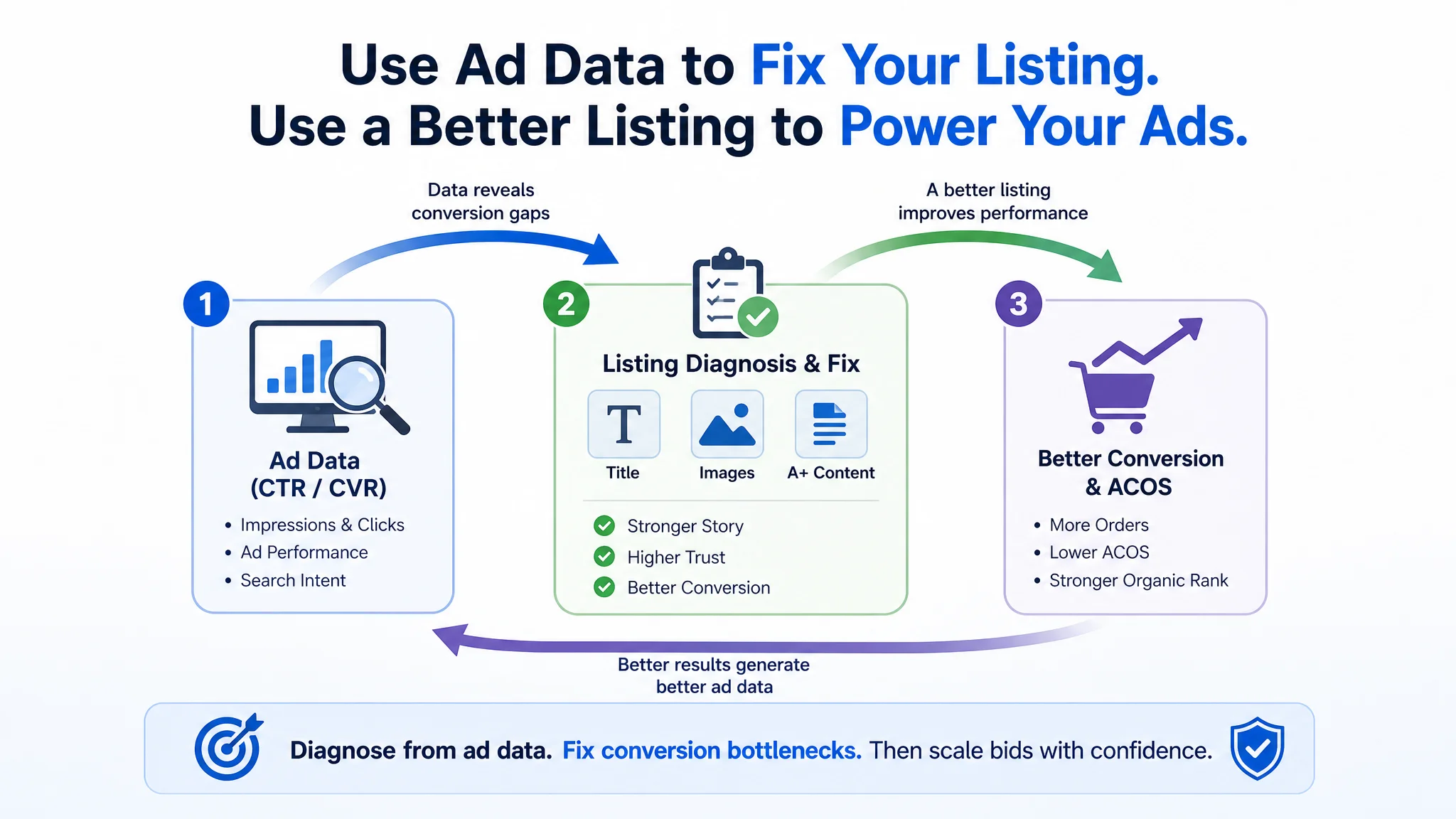
True advertising efficiency comes from continuous, data-driven adjustments. DeepBI establishes a direct link between your ad performance and your product detail page. The system uses campaign metrics like Click-Through Rate (CTR) and Conversion Rate (CVR) to diagnose underlying listing weaknesses. For instance, a low CTR points to an underperforming main image, while a low CVR may indicate issues with A+ content. By using ad data to drive listing improvements, the platform ensures your budget is spent driving traffic to a page that is continuously optimized for conversion, maximizing the return on every ad dollar.
In the EV adapter case, this linkage helps explain why pure bid optimization would have failed. The funnel looked like this:
1. Ads were already generating impressions and some clicks on core keywords—an indication that targeting and keyword choices were not fundamentally broken.
2. CTR was capped by a modest hero image and a parameter-heavy title, making it hard to stand out in search results.
3. CVR suffered because the landing page did not quickly answer “Is this safe? Does it fit my car? Does it really solve my charging problem?”, and there was no social proof layer.
AdsQuant, in such a scenario, would interpret sustained low CVR and weak listing scores as signs that the page, not just the campaigns, needed work. Rather than simply raising bids or expanding keyword lists, DeepBI’s logic is to first ensure the landing experience can convert incremental traffic. Once listing improvements (new images, revised title, restructured bullets, corrected A+) are deployed, the system can then iteratively adjust bids and budgets to test how the new assets perform across different queries.
This sequence—diagnose listing issues from ad data, repair conversion bottlenecks, then scale bids—is what keeps ad optimization from degenerating into expensive trial-and-error.
Achieving Scalable Growth and Improved ACOS
The overarching goal is to build a self-reinforcing growth cycle. By linking ad performance directly to listing optimization, DeepBI helps improve core advertising KPIs. A better, more relevant listing naturally leads to higher CTR and CVR, which in turn improves your campaign’s quality score. This process helps lower your Advertising Cost of Sales (ACoS) and, more importantly, your Total Advertising Cost of Sales (TACoS) by strengthening organic rank. This data-driven relationship between paid and organic performance creates a stable foundation for scalable growth and a consistently higher return on ad spend.
This principle came into sharp focus for the EV adapter seller. Before the DeepBI diagnosis, ACOS felt “stuck” because ads were amplifying a weak 55/100 listing; extra spend barely moved orders, and every adjustment in bids seemed to produce diminishing returns. After reframing the problem as one of conversion capacity, the logic changed:
- Priority shifted from squeezing more impressions out of existing ads to rebuilding the page so that each visit had a higher probability of converting.
- Once the listing could credibly convert (better visuals, clearer title, disciplined A+, honest scenario depiction), returning to ads made sense because every new click was less likely to be wasted.
- Over time, improved conversion behavior can support higher relevance signals to Amazon’s algorithm, easing ACOS pressure and contributing to organic lift.
In this way, AdsQuant does not treat ads as a standalone growth engine, but as a lever that must be synchronized with listing quality to achieve sustainable, scalable performance.
Boosting Organic Ranking and Profitability with DeepBI: The Natural Traffic Engine
Effective advertising is more than a sales channel; it is a data engine for organic growth. DeepBI creates a positive feedback loop where paid campaign insights directly fuel your natural traffic, building a sustainable and profitable business flywheel.
Bridging Ads Performance to Organic Growth
DeepBI transforms ad data from a simple performance metric into a strategic asset for listing optimization. The AI mines high-conversion "winning keywords" from your ad reports and systematically integrates them into your product titles and visuals to enhance relevance and conversion power. This creates a closed business loop: a superior listing informed by precise traffic data leads to healthier organic growth, elevating your strategy from guesswork to precision targeting.
In practice, this bridge is particularly important for new products with no review base, like the EV adapter. Early paid campaigns are often the only source of meaningful behavioral data—what queries bring the right visitors, where they drop off, which images get more clicks in search, which bullet wording correlates with better add-to-cart behavior. DeepBI taps into this data and feeds it back into the listing optimization engine. For the adapter seller, this meant that the content changes (new title structure, benefit-led bullets, corrected AC-only scenarios) were not generic; they were informed by how real users were already searching and behaving around the category and its benchmark listings.
Optimizing for Top of Search Placement
Achieving Top of Search placement requires superior relevance, not just aggressive bidding. By leveraging insights from successful ad campaigns, DeepBI helps optimize your listing for the keywords that matter most. When ads for these terms drive sales, the resulting velocity sends a strong positive signal to Amazon's algorithm. This demonstrates your product's relevance, boosting its organic ranking for those high-value queries and creating a powerful connection between paid and natural visibility.
For a technical category like EV charging accessories, where buyers often have clear intent and search with specific terms, this relevance loop is critical. Once the EV adapter listing was reworked to better answer “does it fit my situation?” and “is it safe?”, the product was in a position where successful ad-driven orders on precise queries could translate more efficiently into organic ranking improvements. Top-of-search visibility becomes more attainable when the page aligns tightly with what highly targeted traffic expects to see.
Sustaining Long-Term Natural Order Share
A key objective is to reduce reliance on paid traffic and improve profitability. As your organic ranking climbs for critical keywords, you capture a larger share of natural orders. This increased organic sales volume directly lowers your Total Advertising Cost of Sale (TACoS), as you spend less to acquire each customer. DeepBI's strategy enables a continuous cycle of optimization, transforming ad spend into a long-term asset that builds a dominant, cost-effective market presence.
The EV adapter case underscores the risk of neglecting this long-term view. Pushing more budget into a poorly converting listing not only inflates near-term ACOS but can also damage long-term organic prospects if early buyers feel misled and leave negative feedback. By intervening at the listing level—aligning claims with reality, strengthening trust elements, and structuring content around buyer logic—DeepBI helped the seller protect the foundation needed for future organic growth. Once that foundation is in place, it becomes realistic to gradually shift the mix from paid to organic orders without sacrificing volume.
The DeepBI Advantage: A Unified, Data-Driven Approach to Amazon Success
DeepBI provides a comprehensive, AI-powered solution designed exclusively for the Amazon marketplace. It moves beyond fragmented tools by integrating the entire optimization lifecycle into a single, data-driven workflow. This approach ensures that every decision is connected, measurable, and aligned with improving core business metrics.
DeepBI's Holistic Optimization Framework
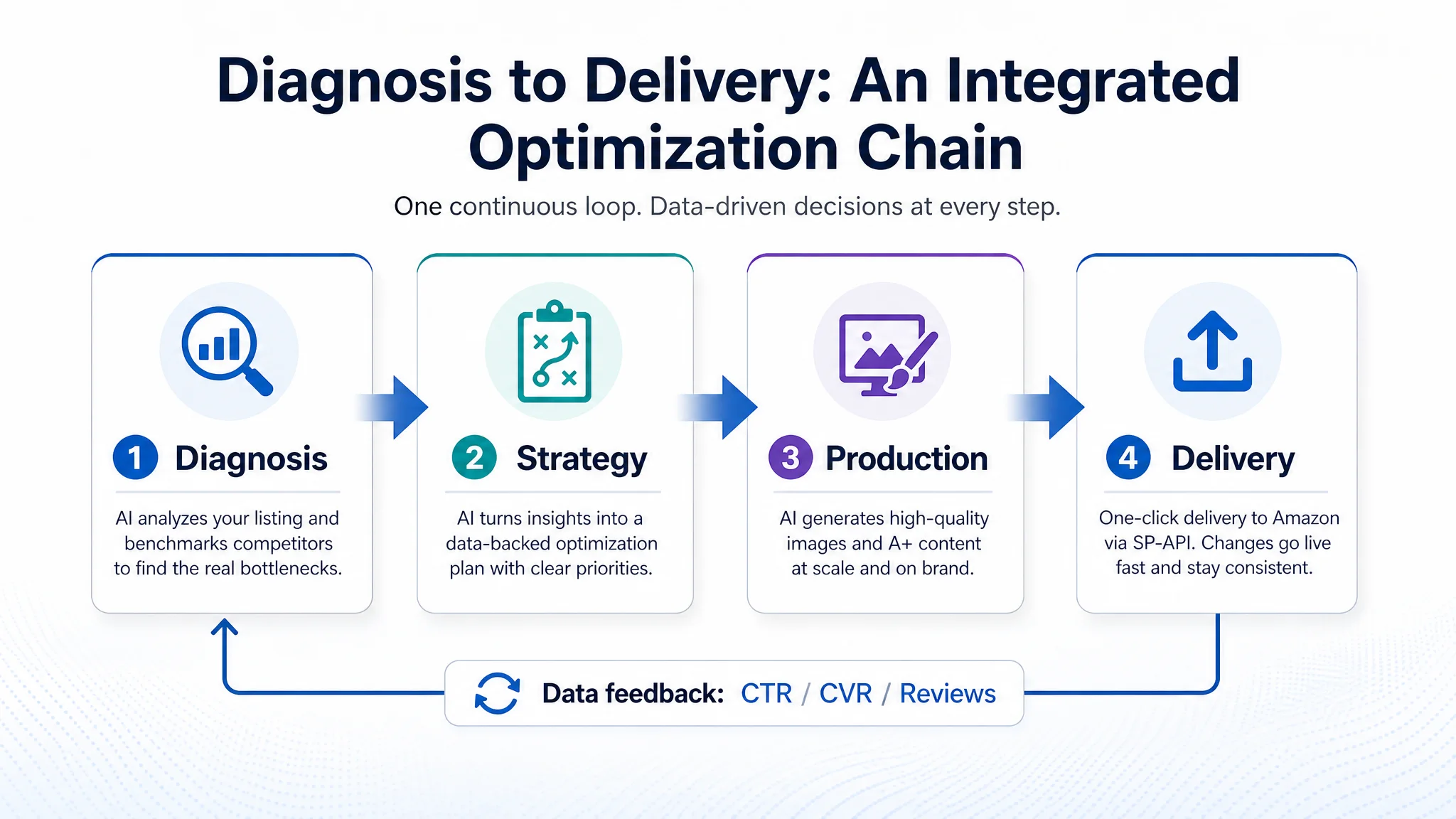
The platform breaks down traditional operational silos by unifying four critical stages: diagnosis, strategy, production, and delivery. It begins with an intelligent analysis of your listings and competitors to identify performance gaps. From this data, DeepBI generates precise optimization strategies. Its AI engine then produces high-quality creative assets and copy, which can be implemented directly into your Seller Central account via a secure, one-click SP-API connection.
In the EV adapter case, this holistic framework manifested as a step-by-step operational path rather than isolated fixes:
- Diagnosis: The AI scoring module established that the listing stood at 55/100 against an 84/100 benchmark, with detailed breakdowns highlighting weaknesses in title clarity, visual impact, A+ structure, and complete absence of reviews.
- Strategy: Instead of generalized advice (“improve images,” “strengthen bullets”), DeepBI proposed a structured sales narrative—hero title positioning the 2-in-1 value, benefit-led bullets aligned with safety and convenience, A+ modules that progressed from “why buy” to “why trust,” and visuals that accurately depicted AC-only usage.
- Production: AI-driven content and visual guidelines translated this strategy into specific assets: reworded titles and bullets, rearchitected A+ layouts, and detailed briefs for compliant, high-impact imagery.
- Delivery: Through SP-API integration, these assets could be pushed live in a coordinated way, minimizing the operational friction and errors often associated with manual uploads and version control.
This establishes an intelligent feedback system where performance data from advertising reports, such as Click-Through Rate (CTR) and Conversion Rate (CVR), continuously informs and refines future optimization cycles. The entire process is designed to make listing evolution a predictable, quantifiable, and scientific process, transforming complex operations into a standardized engineering path.
The Synergy of AI and Human Expertise
DeepBI is engineered to augment, not replace, human expertise. It acts as a powerful execution center, automating time-consuming tasks like data analysis, competitor research, and asset uploads. The AI excels at converting abstract business goals into precise, executable instructions, eliminating the inconsistencies and subjective errors common in manual processes.
In the EV adapter scenario, the team initially brought valuable domain knowledge—understanding AC vs. DC charging, adjustable resistor designs, and compatibility nuances. What they lacked was a structured way to translate that expertise into a listing that spoke clearly to buyers and aligned with category benchmarks. DeepBI provided the scaffolding: quantifying where they lagged, suggesting how to reframe strengths into buyer-facing benefits, and ensuring that new visuals stayed true to the product’s real capabilities.
This synergy frees you to focus on what matters most: high-level strategy and core business decisions. While the AI handles tactical execution, you retain full control, setting the objectives and providing final approval for all changes. DeepBI operates with strict guardrails, respecting your brand identity and product authenticity as non-negotiable constraints. The system is built on the principle that AI should empower human decision-making, not override it.
Conclusion: Future-Proofing Your Amazon Business with AI
In the demanding landscape of Amazon, leveraging AI is no longer a forward-thinking advantage but a competitive necessity. The era of fragmented tools and manual guesswork is giving way to integrated, data-driven operational excellence. Systems like DeepBI represent this shift by providing a full-funnel optimization engine that unifies diagnosis, strategy, production, and delivery into a single, intelligent workflow. This approach transforms listing management from a reactive task into a predictable and quantifiable process for growth.
The EV charging adapter case is a concrete reminder of what is at stake. The seller’s first instinct—that poor performance must be an “ads problem”—is a common and costly misjudgment. Only when AI-based diagnosis exposed a 55/100 listing with serious gaps in visuals, storytelling, and trust did the team see that ads were not failing; the page was consuming the traffic. By rebuilding the listing’s conversion capacity first and then letting ads scale a stronger asset, they shifted from chasing impressions to engineering outcomes.
By systematically connecting every optimization action to core business metrics, this technology ensures that every change is engineered for impact. The goal is to make certain that every pixel adjustment translates into measurable improvements in Click-Through Rate (CTR) and Conversion Rate (CVR). Adopting a comprehensive AI strategy empowers sellers not only to enhance operational efficiency but also to build a resilient and profitable business. Ultimately, integrating AI serves as an intelligent co-pilot, driving every asset back to its commercial purpose to secure a decisive, long-term winning edge in a dynamic marketplace.