


Why Amazon Product Images Are Non-Negotiable for Seller Success
On the crowded Amazon marketplace, product images are the most critical touchpoint for potential buyers. For the majority of online shoppers, visual information is the primary factor influencing their purchase decisions. These images are not merely decorative; they have evolved from simple aesthetic displays into a core commercial engine that directly drives business performance. The quality of your main image dictates your Click-Through Rate (CTR) from search results, while your complete image set builds the trust and conveys the value necessary to secure a high Conversion Rate (CVR).
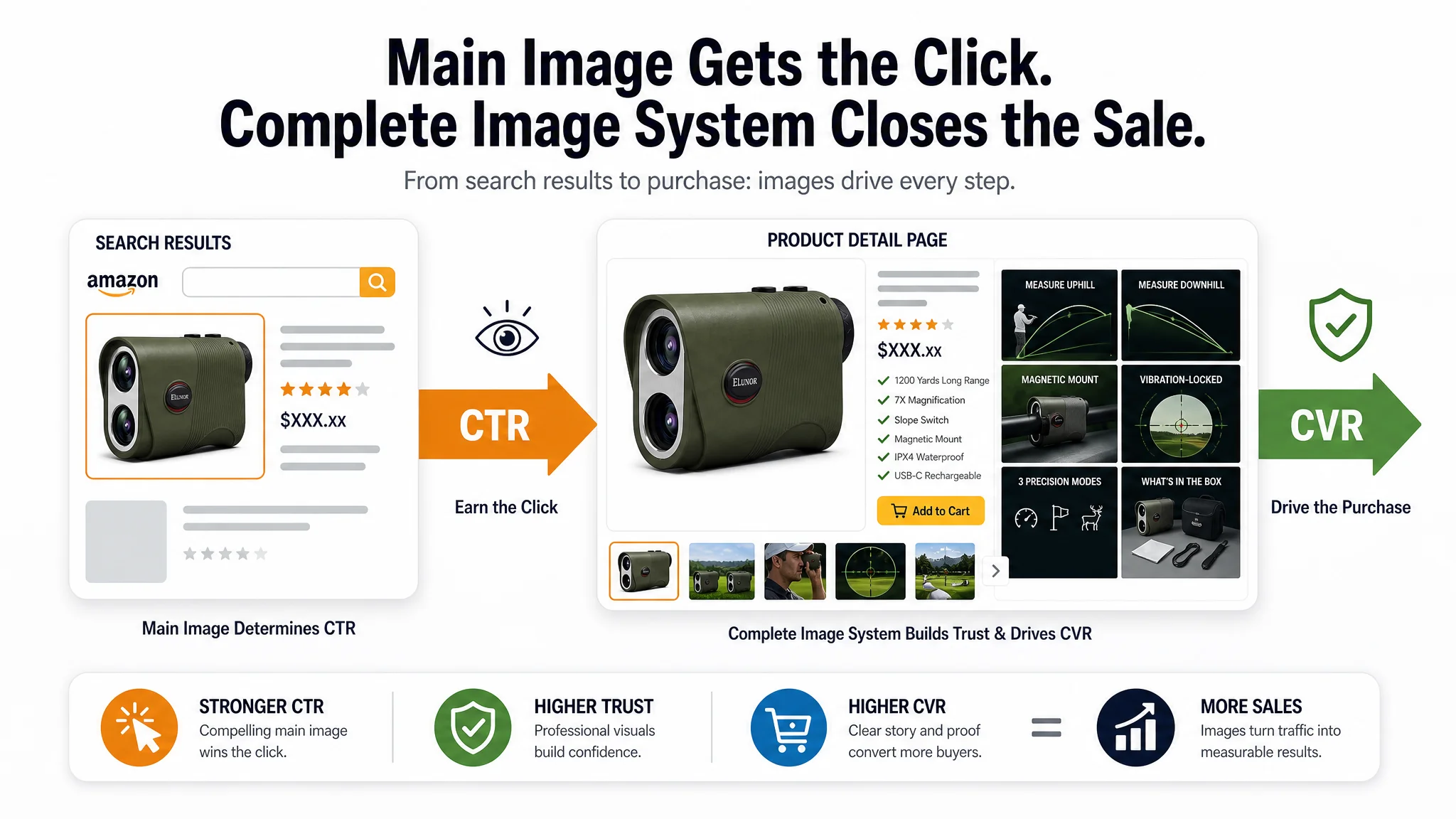
A common and costly mistake is to modify images based on subjective taste, as a designer's preference does not always translate to sales. This approach often leads to low CTR and CVR, wasting advertising spend and suppressing organic rank. Because Amazon's ranking algorithm heavily weighs sales velocity and conversion metrics, a data-informed visual strategy is essential for visibility and growth.
This misalignment between “what looks good internally” and “what performs in the marketplace” shows up frequently in real operations. One golf rangefinder seller on Amazon US, for instance, initially framed their problem purely as an advertising issue: ACOS was high, impressions were strong, and orders were not following. Their instinct was to keep tweaking bids and campaign structures. Yet, once their listing was evaluated against a category-leading competitor, it became clear the ads were doing their job—traffic was coming in—but the page itself visually resembled a low-end gadget rather than a professional instrument. The main image lacked precision feel, and secondary visuals did little to build trust. In other words, subjective creative choices and a lack of structured visual strategy were directly depressing CTR and CVR, making every click more expensive and less productive.
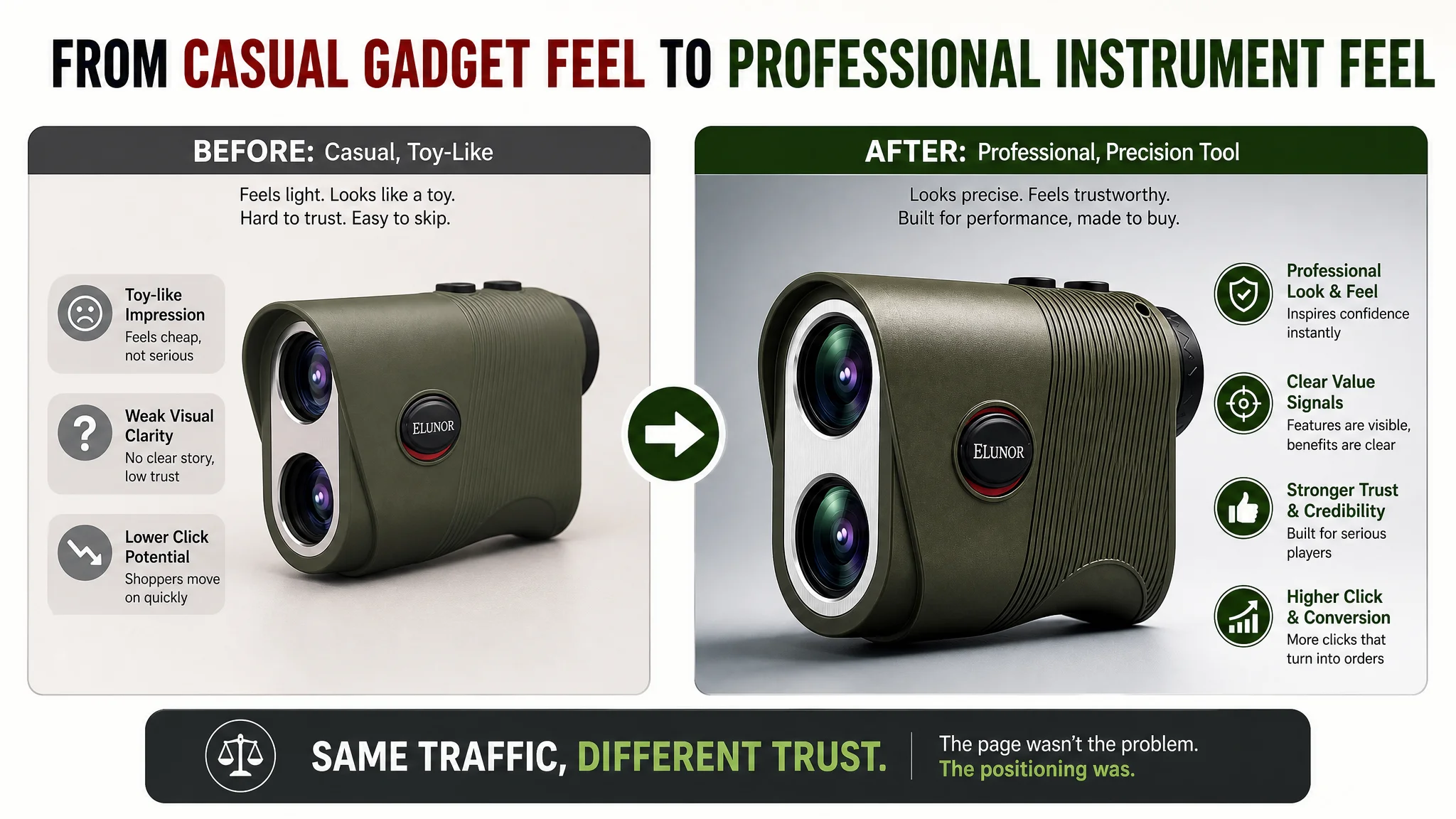
To connect creative assets with commercial results, sellers are increasingly turning to AI-powered systems. DeepBI provides a full-funnel optimization solution that offers data-driven insights into listing quality. By analyzing performance metrics, it helps sellers move beyond guesswork, ensuring every visual enhancement is calculated to improve product competitiveness and deliver measurable gains in key performance indicators. In the rangefinder example, this meant shifting the focus from “fixing ads” to rebuilding the visual and textual story of the listing so that it finally deserved the click and the price point. That diagnostic shift is precisely what a data-informed visual strategy is designed to achieve.
Amazon's Core Image Guidelines: Technical and Content Requirements
Adhering to Amazon's image guidelines is non-negotiable. Failure to comply can lead to listing suppression, making your product invisible to shoppers. Mastering these rules is the foundational step toward effective visual merchandising.
Technically, your images must be in TIFF, JPEG, PNG, or GIF file formats and use the sRGB color mode. To enable the crucial zoom feature, images must be at least 1000 pixels on their longest side, with 1600 pixels being the recommended size for an optimal customer experience.
The main image, which serves as your product's primary introduction, is subject to the strictest rules:
- Background: Must be pure white (RGB 255, 255, 255).
- Content: The product must fill at least 85% of the frame and be shown alone, without any additional text, logos, watermarks, or props.
- Accuracy: All images must be professional, high-quality, and accurately represent the product being sold.
Proper file naming is also essential for correct image placement. The standard convention uses the product's Amazon Standard Identification Number (ASIN), followed by a variant code, such as ASIN.MAIN.jpg for the main image or ASIN.PT01.jpg for a secondary image.
In practice, many teams underestimate how easy it is to drift away from these requirements as they chase “more descriptive” or “more eye-catching” images. In the golf rangefinder case, the seller’s visual choices were not overt policy violations, but they pushed the listing toward a “toy-like” perception: busy compositions, model choices that did not fit serious golf or hunting scenarios, and function diagrams that looked more like abstract posters than product proof. None of these individually triggered suppression, but together they undermined professionalism and trust—illustrating how operating within the letter of Amazon’s rules is only the starting point. The spirit of the guidelines is to ensure clarity, accuracy, and focus; when visuals introduce noise, even technically compliant images can degrade perceived quality.

Manually checking every image against this extensive list of technical and content rules is time-consuming and prone to error, making intelligent diagnostics critical. DeepBI’s scoring and diagnosis engine audits your images against Amazon's mandatory standards and benchmarks them against top competitor practices. Its Main Image Diagnosis Agent uses multimodal AI to evaluate compliance, visual quality, and asset diversity, automatically identifying issues like incorrect background ratios or insufficient pixel dimensions before you upload. In cases like the rangefinder listing, it also highlighted subtler issues such as an unstable visual center and a lack of clearly visualized key parameters (e.g., range and waterproof rating), showing exactly where the visuals fell short of category leaders. This ensures your listings are always compliant and competitive.
Strategic Optimization of Your Amazon Main Image
Your main image is not just a picture; it is a powerful business asset responsible for driving your Click-Through Rate (CTR). As the first visual element shoppers see on a crowded search results page, it must instantly capture attention and build trust. The fundamentals are essential: a high-resolution, professionally lit photograph of the product on a pure white background, shot from an angle that best showcases its key features and quality.
However, elevating a compliant image to a high-performing one requires a strategic approach. The key is to systematically test different visual hypotheses—such as variations in angle, lighting, and scale—to identify which version resonates most with shoppers and yields the highest CTR. This iterative process transforms optimization from subjective guesswork into a data-driven discipline.
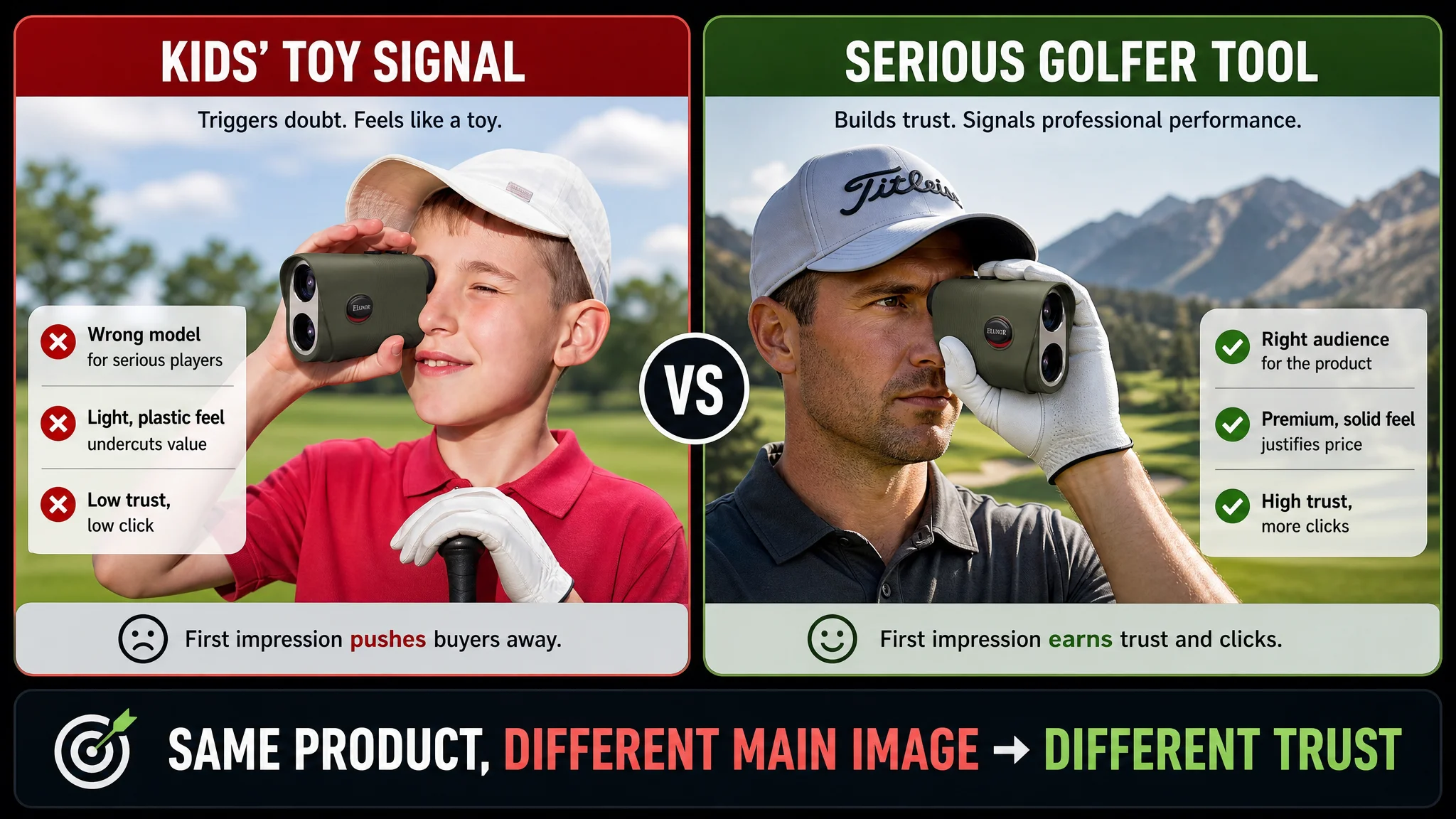
The rangefinder seller’s experience shows how easily main-image decisions can cap performance when they are not grounded in shopper expectations. When their listing was benchmarked, the primary hero shot looked light, slightly plastic, and lacked the industrial, precision feel buyers expect from a technical optical tool. One of the supporting main images even featured a child as the model—a visual that clashed with the product’s promise of long-range, slope-enabled accuracy. For serious golfers and hunters, this created an instant dissonance: the spec sheet read “high-precision instrument,” but the images read “entry-level gadget.” No amount of bid tuning could compensate for a first impression that undermined seriousness and price justification.
Here, AI-driven visual production provides a decisive advantage. Unlike general-purpose AI drawing tools that risk "hallucinations" and product mismatches, a specialized system like DeepBI functions as an automated visual production engine. It uses a "Product DNA" map to lock in your product's authentic physical attributes, ensuring any AI-generated enhancement never alters its material, color, or design. In the rangefinder case, this meant keeping the real geometry and finish of the device intact while re-engineering the hero image: shifting to a 45-degree angle, sharpening edges with controlled lighting, and cleaning the background to emphasize precision rather than playfulness. The AI then focuses exclusively on optimizing external elements—such as upgrading a flat photo to a high-impact 45-degree angle or reshaping light and shadow to enhance texture—to create a main image engineered for maximum click appeal while remaining 100% true to the product. This combination of authenticity and optimization is what turns the main image into a reliable lever on CTR instead of a bottleneck.
Leveraging Secondary Images and A+ Content for Conversion
While the main image earns the click, your secondary images and A+ Content are what close the sale. A comprehensive visual strategy that utilizes every available slot is essential for maximizing your Conversion Rate (CVR) and reducing returns. Go beyond the primary shot by incorporating a mix of asset types: lifestyle images show the product in a real-world context, infographics with text overlays highlight key features and dimensions, and close-up feature callouts showcase unique selling points. Including images of the packaging also helps manage customer expectations about what they will receive.

This is exactly where many listings underperform without realizing it. In the golf rangefinder example, the seller’s image gallery and A+ section were “full” on paper: multiple modules, feature diagrams, performance scenes, and an unboxing layout. Yet, when set against a leading competitor, several conversion-critical gaps emerged:
- The function visuals for slope compensation were noisy and theoretical, rather than clear, real-course examples. Shoppers saw arrows and lines but not a credible “before/after” scenario explaining how their shot would change.
- High-value features like vibration flag lock and a physical slope switch were barely visible, even though they were important differentiators in the copy. Competitive images, by contrast, zoomed in on these elements with clear reticles and vibration cues.
- One A+ module used dramatic lion imagery to suggest broader outdoor usage, but the scene did not resemble a realistic hunting scenario. Instead of expanding scenarios, it introduced confusion and a stock-photo feel that weakened trust.
This visual storytelling extends into A+ Content, where larger, richer modules can detail your brand story and provide in-depth product information. Crucially, all images within A+ Content and your Amazon Store should include descriptive alt text. This not only makes your listing accessible to shoppers using screen readers but also improves indexing on external search engines like Google, which can drive additional traffic.
Creating this diverse set of assets consistently can be a major operational bottleneck. AI-driven platforms like DeepBI address this challenge by automatically generating compelling lifestyle scenes, detailed infographics, and structured A+ page modules. In the rangefinder case, that meant re-architecting A+ modules into a coherent narrative: opening with a professional “next level” cover scene, visualizing slope compensation with specific numeric examples on real terrain, demonstrating the magnetic mount on an actual golf cart, and clearly separating golf and hunting use cases with believable environments. To prevent "product-image mismatch"—a major cause of negative reviews—DeepBI uses its "Product DNA" map as a hard constraint. This ensures the AI can creatively alter backgrounds and scenes but never modifies the product's core attributes, guaranteeing authenticity. The result is a cohesive, conversion-optimized visual narrative across your entire listing, built faster and with greater brand consistency, and with each image deliberately contributing to trust rather than just filling a slot.
Advanced Image Optimization Tactics
Beyond meeting Amazon's basic requirements, advanced visual strategies are essential for gaining a competitive edge. This begins with treating your image gallery as a narrative. Strategically sequence your images to tell a story: the main image attracts the click, while subsequent visuals work to progressively resolve customer doubts, showcase use cases, and build trust. Color psychology also plays a vital role; for instance, a product intended for home use often performs better with a warm, inviting background that evokes positive emotions, rather than a cold, sterile one.
However, an effective strategy relies on sharp competitive intelligence. Manually analyzing competitor listings can be subjective, making it difficult to pinpoint exactly why their images perform better. Is their success due to more immersive scenes, higher information density, or stronger authority endorsements like certification badges?
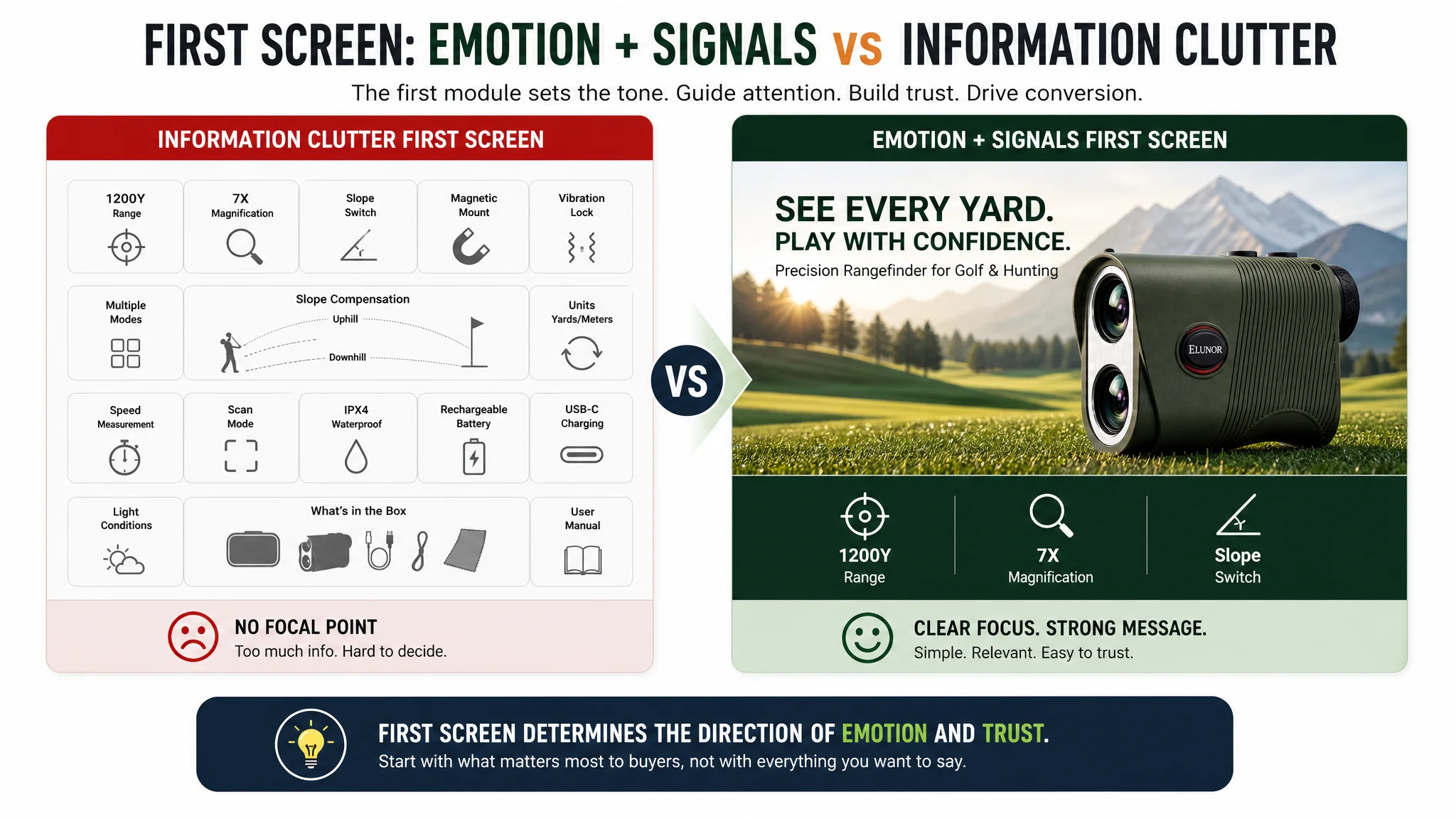
The rangefinder listing made this problem very concrete. On the surface, both it and the competitor had similar categories of assets: slope diagrams, multi-mode explanations, and environment scenes. But DeepBI’s benchmarking exposed specific, structural advantages on the competitor side:
- The competitor’s first A+ module opened with a clean, emotionally resonant “serious golfer” scene and a concise slogan, immediately positioning the product as a premium tool. The rangefinder listing led with a busy, information-heavy graphic that lacked a clear focal point, forcing shoppers to work to decode value.
- Technical features like smart slope compensation were visualized with real course terrain and clear numeric examples (such as actual vs. adjusted distance), whereas the rangefinder relied on abstraction. One glance at the competitor’s module answered “How does this help my shot?”; the other raised more questions than it resolved.
- Scenario expansion was handled differently: the competitor separated golf and hunting use logically, with realistic environments; the rangefinder’s attempt at a hunting mode used a dramatic lion image that felt disconnected from plausible use, subtly eroding credibility.
This is where data-driven analysis provides a clear path forward. DeepBI's competitor benchmarking feature allows sellers to quantitatively analyze the image strategies of top-performing ASINs. The system identifies specific weaknesses in your visual content—such as an unstable visual center or a lack of visualized key parameters—and provides actionable insights to close the gap. For the rangefinder, that meant not only identifying that the overall listing score lagged (e.g., lower scores in title, main images, A+ detail, and reviews) but also translating that gap into concrete visual tasks: reinforce 1200-yard capability in early visuals, make waterproof standards visible, and replace ambiguous scenes with grounded, category-native imagery. Finally, ensure all images are optimized for mobile, where clarity on small screens is paramount, and consider integrating a product video to offer a dynamic and compelling demonstration.
Measuring and Iterating on Image Performance
Effective image optimization is not a one-time task but a continuous cycle of analysis, adjustment, and re-evaluation. To drive sustainable growth, sellers must adopt a data-driven approach to measure the impact of their visual assets and iterate based on performance feedback.
Start by monitoring key performance indicators (KPIs) within your Amazon reports. A low Click-Through Rate (CTR), for example, often signals that your main image is not compelling enough to stand out among competitors. If your listing receives high impressions but has a CTR below 0.35%, it is a clear indicator that the main image needs a redesign. Similarly, a low Conversion Rate (CVR) can suggest that your secondary images and A+ content are failing to build trust or communicate value effectively. Beyond quantitative data, pay close attention to customer questions and reviews, as they often contain direct feedback on product appearance and features.
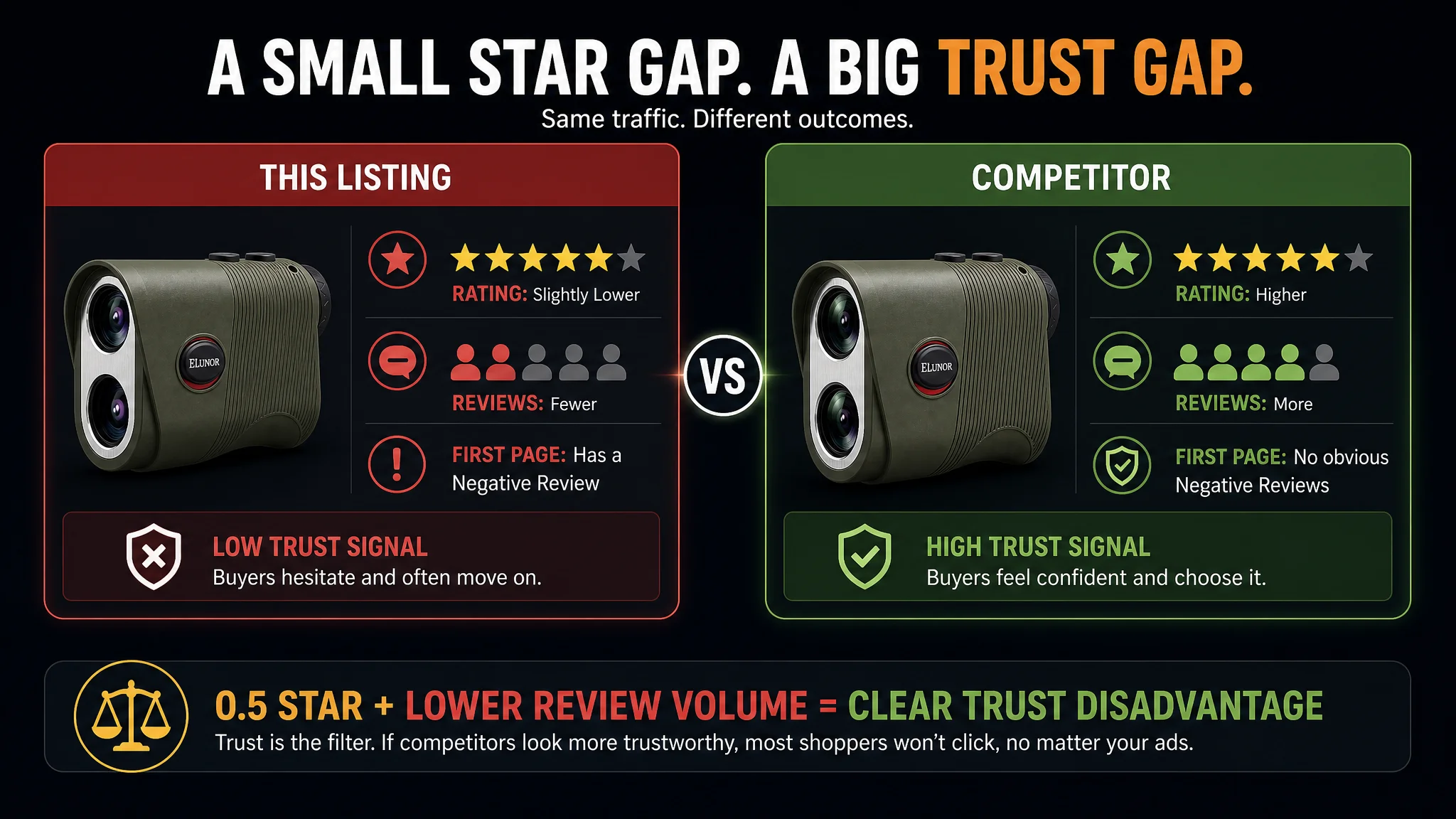
The rangefinder seller’s ad account signals illustrated how misreading these metrics can lead to the wrong optimization loop. Ads were bringing in traffic; impressions were not the issue. Yet ACOS remained hard to control, and pushing more spend did not yield proportional order growth. The internal conclusion was “our ads must be wrong,” when the data from DeepBI’s listing scoring and competitor comparison clearly pointed elsewhere: the page itself did not project professional, trustworthy value, and reviews were too few and too fragile to compensate. A 0.5-star gap, lower review volume, and a visible negative review on the first page combined with underpowered visuals to depress conversion. In such a scenario, measuring only ad-side KPIs without connecting them to listing quality can trap teams in endless bid testing while the real leak remains unaddressed.
This iterative loop of analysis and execution can be streamlined with the right tools. Traditionally, updating images is a tedious manual process of downloading, renaming, and uploading files, which can take up to 30 minutes per ASIN. DeepBI’s platform transforms this workflow with a one-click application feature that syncs optimized images directly to your listing via the Amazon SP-API in seconds.
More importantly, DeepBI closes the feedback loop from execution to measurement. When a new image is published, the system automatically marks a "visual iteration event point" in your advertising reports. This allows you to clearly track how your CTR and CVR change in the 7-14 days following the update, turning subjective assessments into quantifiable results. In a case like the rangefinder listing, that means being able to see, in data, whether a rebuilt main-image system and restructured A+ storytelling actually reduce wasted traffic by improving conversion, instead of guessing based on intuition. By continuously refining your images based on this data, you create a powerful flywheel effect: a higher CVR leads to more efficient ad spend and improved organic search ranking. Most importantly, you shift your mindset from “ads will fix a weak page” to “optimized images and content make every click more valuable,” which is the foundation of sustainable growth on Amazon.