

A Native-branded sulfate-free body wash on Amazon US was facing a paradox:
- Ratings were good (4.6 stars, zero visible bad reviews on page 1)
- The scent was loved
- The brand had media awards and “clean” ingredients
Yet in its core category, it was being crushed by a Dove benchmark Listing that converted better, ranked higher, and dominated the review landscape.
The team had been tweaking titles, talking up awards, and relying on the brand’s “clean beauty” halo.
DeepBI’s diagnosis showed something uncomfortable:
The real problem wasn’t the formula, the scent, or the brand.
It was that the Listing itself simply didn’t know how to build trust and close the sale—while the ads and traffic were quietly amplifying that weakness.
1. Where the Problem Started: “Our Listing Is Fine, We Just Need More Traffic”
From the seller’s perspective, the surface picture looked acceptable:
- 4.6-star rating
- Nearly 600 reviews
- No obvious complaints on the first review page
- A known DTC brand with offline awareness
So when growth stalled, the default internal explanation was simple:
- “We need more traffic.”
- “ACOS is high because bids are expensive in this category.”
- “Competitors like Dove are just spending more and have bigger brands.”
In other words, the team implicitly assumed:
“The product and Listing are not the issue; the problem is traffic and competition.”
This led to a familiar optimization path:
- Keep bidding on core body wash terms
- Slightly adjust titles for keywords
- Rely on the brand story and existing images
- Postpone A+ content because “we’re already converting ok”
But the numbers told a different story once DeepBI put this ASIN side‑by‑side with its true category benchmark.
2. The First Shock: A 37-Point Gap Against the Benchmark
When DeepBI locked in Dove’s top body wash Listing as the benchmark, the gap was not subtle:
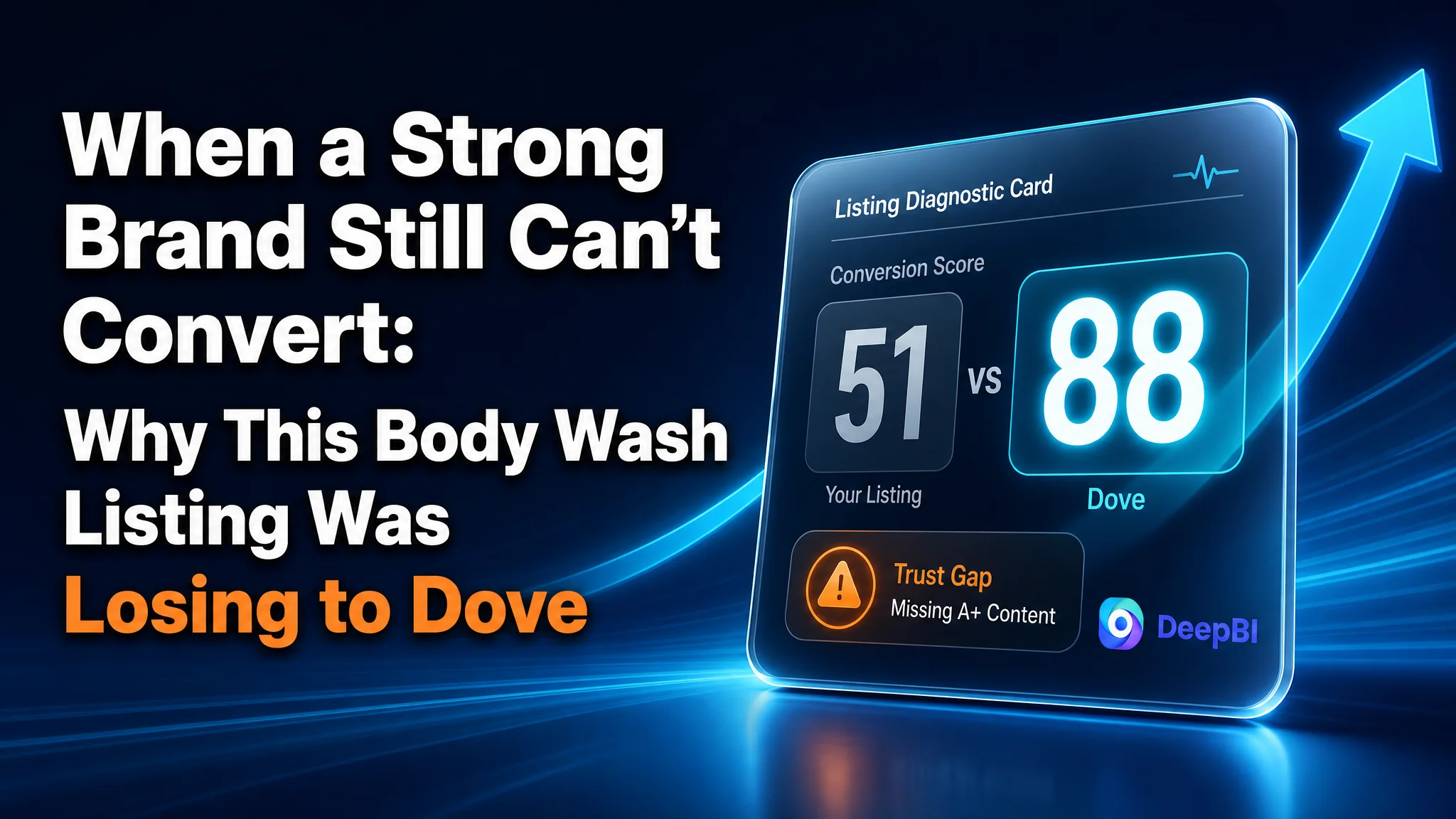
- Native Listing total score: 51/100
- Dove benchmark: 88/100
- Gap: -37 points
Broken down by dimension:
| Dimension | Native | Dove | Max | Gap |
| Title | 11 | 15 | 20 | -4 |
| Main Images | 23 | 26 | 30 | -3 |
| Bullet Points | 6 | 9 | 10 | -3 |
| Detail / A+ | 0 | 24 | 25 | -24 |
| Reviews | 11 | 14 | 15 | -3 |
One line stands out:
Details / A+ content: 0 vs 24 (out of 25).
This meant:
the product was essentially selling without a real detail page, competing in a category where Dove was using a full A+ stack to build trust, explain technology, and pre‑answer objections.
This immediately reframed the problem.
The issue was not “we need more traffic” but:
“We are pushing traffic into a page that barely does any trust-building beyond the default content.”
3. The Team’s Original Misjudgment: Confusing “Good Product” With “Good Listing”
Why did the seller not see this earlier?
Because every visible signal they trusted was telling them “things are fine”:
- Star rating: 4.6 is objectively good
- Page 1 reviews: all 4 stars and above
- Brand equity: Native is widely seen as a premium clean brand
- Product promise: sulfate-free, naturally derived, coconut & vanilla
With these indicators, the internal narrative drifted into:
- “We already look premium.”
- “Our reviews prove customers love it.”
- “Our competitors convert because they are bigger, not because their pages are better.”
That misjudgment had a subtle but dangerous consequence:
The team kept fine‑tuning traffic and bids, while leaving the trust and persuasion structure of the Listing almost untouched.
DeepBI’s scoring made it explicit:
against the true category benchmark, this Listing wasn’t “slightly weaker”. It was structurally incomplete.
4. Why Traditional Tweaks Kept Failing
Before DeepBI, most of the “optimizations” looked like this:
- Add or remove one or two keywords from the title
- Slightly adjust bullets to sound more “premium”
- Test different scent descriptions
- Rely on existing product images with minor retouching
None of those moves addressed the real deficits that showed up in the benchmark comparison:
4.1. Title: Too Descriptive, Not Outcome-Driven
Dove’s title structure:
Brand + Result/Outcome + Product Type + Safety Claims + Size
For example:
Dove Body Wash Deep Moisture for 24hr Lotion-Soft Skin Moisture Moisturizing Skin Cleanser with No Sulfates No Parabens 30.6 oz
It leads with:
- A known brand
- A time-bound result (“24hr Lotion-Soft Skin”)
- Clear use case (“Moisturizing Skin Cleanser”)
- Strong “no” claims (“No Sulfates No Parabens”)
Native’s original title was heavily “ingredient + target user” oriented, with weaker emphasis on:
- Outcome
- Cleanser function
- Specific, quantifiable benefits
Every small keyword tweak the team made stayed inside the same flawed structure.
4.2. Main Images: Visually Clean, but Trust-Light
Native’s images had:
- Basic white background pack shots
- Some lifestyle and texture images
- Scent storytelling through visual ingredients
But compared to Dove, they lacked:
- Authority symbols (awards, dermatologist recommendations, certifications)
- Clear visual representation of texture, foam, and “sulfate-free clarity”
- Strong, high-contrast hooks on search result thumbnails
So while the images were “on brand”, they didn’t perform the job that Dove’s did:
Make the product look clinically credible, safe for sensitive skin, and clearly effective in one glance.
Again, tweaks remained aesthetic rather than structural.
4.3. Bullet Points: Parallel Claims vs. a Persuasion Funnel
DeepBI’s bullet comparison uncovered a critical pattern:
- Dove uses a funnel:
- Technology / awards
- Immediate and long-term effect
- Scientific mechanism
- Extreme-condition use cases
- Ethics & sustainability
- Native used parallel claims:
- Core benefits
- Scent description
- Media awards
- Sub-category awards
- Ingredient safety
Nothing inherently wrong—but it didn’t guide the buyer from:
“Why should I trust you?” → “What will I feel?” → “How do you do it?” → “Is this safe?” → “Do I feel good choosing this?”
The seller’s previous iterations only polished these parallel claims, instead of rebuilding them into a true decision path.
4.4. Detail Page / A+: The Missing Trust Layer
This was the biggest structural hole:
- Native: no A+ modules
- Dove: full A+ stack including:
- Core benefit hero panel
- Award badges and “#1 dermatologist recommended” claims
- Technology explanation (“24h micro‑moisture”)
- Clean formulation proof (no sulfates/parabens, PETA)
- Sustainability highlights
- Q&A module addressing sensitive, face use, mildness concerns
In a high-consideration, skin-contact personal care category:
Not having A+ content is effectively choosing not to systematically answer buyer fears, questions, and objections.
No amount of minor title or bullet tweaks could compensate for that.
5. What DeepBI Saw in the Data: A Page That Couldn’t Carry the Traffic
DeepBI’s multi-dimensional scoring did more than say “your score is low.”
It made the structural risk visible:
- The Listing was underbuilding trust exactly where the benchmark overdelivered
- The stronger the traffic push, the more obvious those structural weaknesses would become
- Advertising was at risk of doing only one thing very efficiently:
sending more buyers into an incomplete persuasion experience
In other words:
The problem wasn’t that ads were bad.
Ads were doing their job: delivering traffic.
It was the Listing that couldn’t consistently turn that traffic into orders.
This is where the decision logic diverged from the seller’s original instinct.
6. Why DeepBI Did Not Start by “Fixing Ads” or “Pushing Harder”
Looking at the Listing vs. benchmark gap, DeepBI effectively answered three questions:
- Where is the biggest structural leak in the funnel?
- Detail / A+ score at 0 vs 24 signaled a massive trust gap.
- Is the issue primarily attracting clicks (CTR) or closing sales (CVR)?
- Main images: slight gap (-3) → CTR problem was moderate.
- Detail / A+: catastrophic gap (-24) → CVR problem was structural.
- If we push more traffic now, what happens?
- Increased ad spend would mostly amplify an underperforming detail experience.
- TACOS and ACOS risk going up without a proportional revenue lift.
From a risk standpoint:
The greatest danger was not “insufficient exposure”.
The greatest danger was scaling exposure on a page that didn’t fully earn trust.
So the optimization order had to flip:
- Not: “optimize bids, then maybe refine creatives later.”
- But: “stabilize the Listing’s trust and persuasion capacity first, then consider scaling.”
7. How DeepBI Reframed the Core Problem: From “Keywords” to “Persuasion Architecture”
Instead of chasing more traffic, DeepBI treated this as a persuasion architecture problem.
There was one central bottleneck:
The detail and narrative layer was missing or underpowered.
Ads and search exposure were feeding into a Listing that did not fully answer:
“Why this body wash, and why now, for my specific skin and values?”
From that root cause, the optimization logic unfolded.
7.1. Title: Shift from “Ingredient List” to “Benefit-Centered Structure”
DeepBI’s comparison led to a suggested title like:
Native Sulfate Free Body Wash, Naturally Derived Ingredients Moisturizing Skin Cleanser for Women & Men, Coconut & Vanilla, Paraben Free, 36 oz
This deliberately aligned with the benchmark’s successful pattern:
- Brand (Native)
- Core benefit (“Moisturizing Skin Cleanser”)
- Key attributes (“Sulfate Free”, “Naturally Derived Ingredients”)
- Audience (“Women & Men”)
- Scent
- Additional clean claims (“Paraben Free”)
- Size
Why this mattered:
- It reframed the product from “nice-smelling wash” to skin-focused cleanser
- It met buyer intent on body wash searches: clean, moisturizing, safe
- It reclaimed SEO weight on terms like “moisturizing”, “skin cleanser” without losing the “clean beauty” angle
7.2. Bullet Points: From “Nice Features” to a Decision Path
DeepBI restructured bullet suggestions around the benchmark’s logic:
BP #1 — Awards + Core Feel
- Start with Glamour award recognition
- Tie it directly to skin feel (“24-hour freshness” + “soft and smooth after every wash”)
This aligned with Dove’s first bullet: authority + immediate result.
BP #2 — Sensory Escape, Not Just Scent Copy
- Move beyond “coconut & vanilla smells good”
- Position the scent as a tropical escape experience that lasts throughout the day
Here, DeepBI leaned into Native’s strength (fragrance) but elevated it from a note to an emotional promise.
BP #3 — Professional Endorsement
- Use GQ’s “best dermatologist-recommended body wash for men” positioning
- Frame the product as “professionally vetted,” not just “nice-smelling”
This mirrored the benchmark’s scientific/technical positioning (e.g., “MicroMoisture”).
BP #4 — Differentiated Skin Feel
Dove pushes “lotion-soft” and moisturized residue.
DeepBI consciously differentiated Native as:
A residue-free cleanse: squeaky clean, no greasy or sticky feeling.
This addressed a specific segment that dislikes “coated” skin after showering and gave Native an independent lane rather than imitating Dove’s texture promise.
BP #5 — Clean Label as a Coherent Story
Instead of scattered “no sulfates, no this, no that,” DeepBI framed it as:
“Thoughtfully Made & Clean” — a single narrative that ties:
- No sulfates, parabens, dyes, or phthalates
- Gentle yet effective clean
- Skin health as the central reason
The result: bullets become a structured persuasion sequence, not just a checklist.
7.3. Main Images: Visualizing Trust and Feel, Not Just the Bottle
DeepBI’s visual diagnosis saw three major gaps vs. Dove:
- Lack of authority visuals (awards, dermatologist, PETA-like badges)
- No clear visualization of texture and “sulfate-free” clarity
- Weak visual hooks in search results
The recommended image architecture addressed these:
Image 1 — Stronger Hero Shot
- Bottle centered, ~75% of frame
- Slight angle for depth
- Clean white background with soft top-right light
- “Modern minimal lab” aesthetic retained
Purpose: Stronger presence in search results, more premium feel.
Image 2 — Cleanliness & Brand Authority
- Bottle on white tiles with light foam
- Text overlay like “#1 CLEAN BRAND” in simple sans-serif
- Subtle bathroom context (not cluttered)
Purpose: connect “clean beauty” narrative with a real bathroom context and a clear authority message.
Image 3 — Texture & Sulfate-Free Clarity
- Hand holding clear, bubbly liquid
- High contrast, white background
- Emphasis on clarity and non-heavy texture
Purpose: visually answer “What does sulfate-free body wash feel like?” without words.
Image 4 — Skin-Focused Benefit
- Top-down shot of transparent liquid on a soft skin-tone gradient
- Focus on softness, gentleness, no harshness
Purpose: anchor the idea of gentle but effective cleansing.
Image 5 — Scent Story, but Structured
- Bottle with real coconut shell, vanilla flower, vanilla pods
- Light grey background, directional light
- Discreet text labeling scent components
Purpose: keep the scent story, but elevate it to ingredient credibility rather than just mood imagery.
Across all images, DeepBI’s logic was:
Use each slot to answer a specific question:
“What is it?” “Why trust it?” “How does it feel?” “Is it gentle?” “What does it smell like?”
instead of repeating the same message visually in different angles.
8. Why DeepBI Insisted on Fixing the Listing Before Scaling Traffic
With the benchmark gap and the restructured Listing architecture in front of them, the seller faced a choice:
- Option A: keep treating this as a traffic and bidding problem
- Option B: accept that this is mainly a page persuasion and trust problem
DeepBI’s decision path was clear:
- A 0/25 A+ score vs. a 24/25 benchmark was not a nice-to-have discrepancy; it was the main leak.
- Advertising spend on such a Listing would behave like pouring water into a cracked container.
So the priority order was:
- Stabilize the core Listing: title, bullets, visual stack
- Rebuild the missing detail layer: A+ content, trust modules, FAQ
- Only then start measuring how CTR and CVR respond, and adjust traffic and bids accordingly
Advertising was not the enemy.
It was just too early to ask ads to scale a structure that could not yet convert like the benchmark.
9. What Changed: From “We Need More Traffic” to “We Need a Page That Deserves It”
Even without quoting specific business metrics, several shifts became evident once the Listing logic was rebuilt.
9.1. Structural Changes
- The title stopped reading like a “clean ingredient label” and became a benefit-first promise
- Bullet points went from parallel claims to a guided decision path:
- Trust (awards)
- Immediate feel and duration
- Professional endorsement
- Differentiated skin feel
- Clean formula story
- Main images moved from generic brand aesthetic to a category-appropriate trust and results narrative
- The absence of detail page modules was no longer ignored as “nice-to-have” but recognized as a core conversion risk
9.2. Business & Risk Changes
- The Listing started to build independent persuasion power, instead of leaning on:
- External brand awareness
- Scent love
- Review volume alone
- The seller reduced the structural risk of:
- Scaling ad spend into a page without enough trust
- Over-relying on rating and review count as proof of conversion health
In practical terms:
- Future ad investments now have a more solid landing environment
- The product is less vulnerable to:
- Sudden changes in bid prices
- Aggressive moves by competitors who overperform on page quality
9.3. Most Important: The Seller’s Mindset Shift
The biggest gain wasn’t a single number; it was a new understanding:
“A good product, a loved scent, and a 4.6-star rating do not guarantee a strong Listing.
A Listing is a separate piece of infrastructure that has to be architected to persuade.”
The team stopped saying:
- “Our problem is traffic and bids.”
And started asking:
- “Does our Listing systematically answer the same questions and build the same level of trust as the benchmark?”
- “Are we using every slot—title, bullets, images, A+—to carry a specific piece of the persuasion load?”
They also internalized a critical insight:
Advertising cannot fix a page that does not know how to sell.
It can only make the underlying structural weaknesses show up faster and at higher cost.
10. The Real Takeaway: DeepBI’s Value Was Not in Generating Images, But in Correcting the Diagnosis
For this Native body wash, the turning point was not:
- A new hero shot
- A better bullet copy
- A slightly higher score on an arbitrary scale
It was the realization that:
- The team had been optimizing around the wrong problem
- They assumed they had a traffic issue, when the real bottleneck was a missing trust and detail layer
- Their Listing was structurally incomplete in a category where the benchmark was structurally mature
DeepBI’s role was to:
- Quantify the gap against the correct benchmark
- Make visible where the Listing truly lagged (especially in A+ and persuasion structure)
- Force a reordering of priorities: fix the page before scaling the traffic
In the end, the conclusion for the seller was clear:
- The core job is not simply “improve images” or “add keywords”
- It is to rebuild the Listing as a credible, trust-rich, outcome-driven experience that can stand next to Dove and still convert
And that’s where DeepBI’s real strength lies:
Not in generating more content,
but in helping teams stop optimizing the wrong thing.