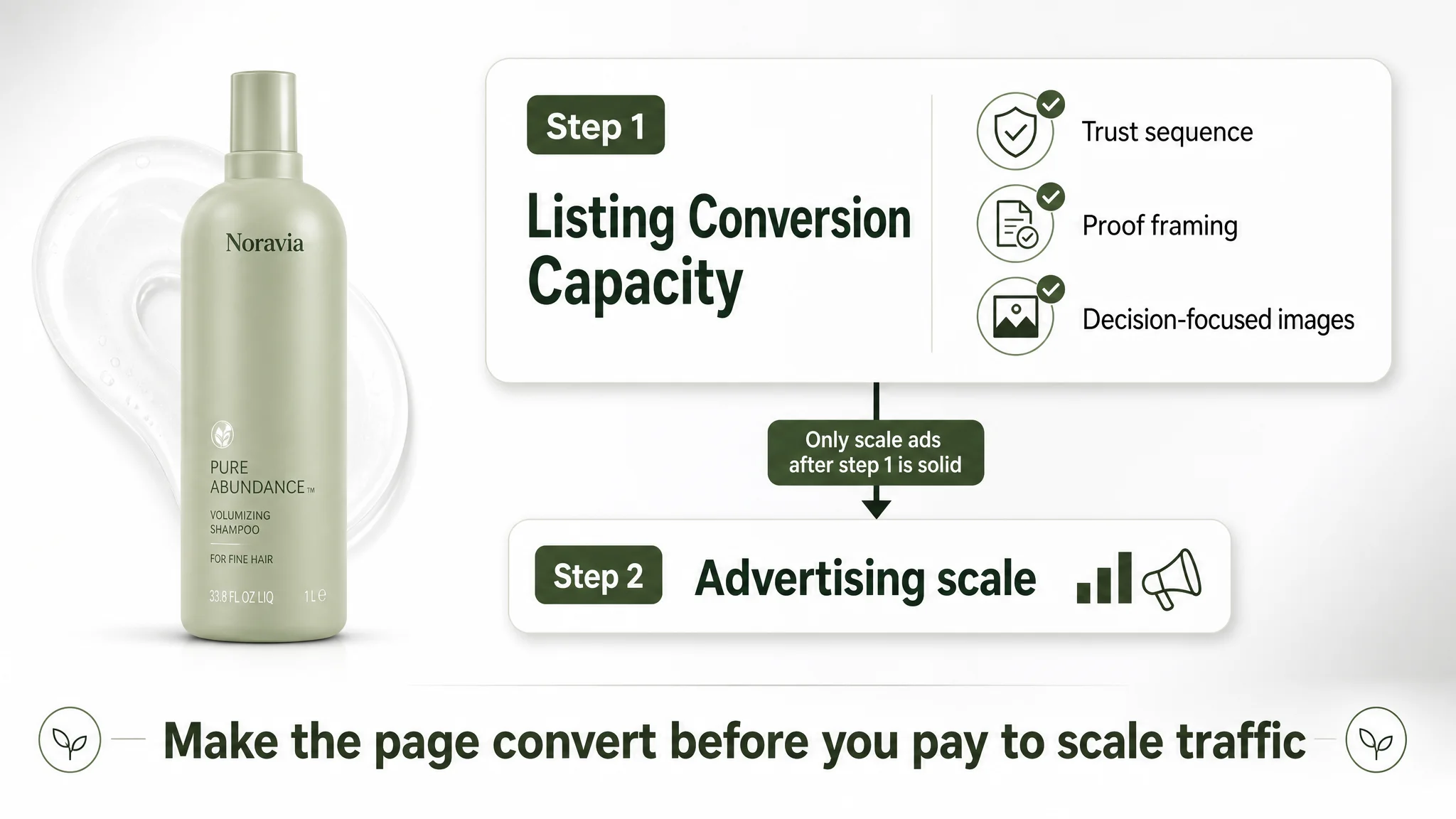
An established Amazon haircare seller came to DeepBI with a familiar puzzle: their volumizing shampoo Listing looked more “premium” than a key competitor, scored higher overall in our benchmark model, and even held a better review rating. Yet advertising felt harder and harder to scale. Ad spend could bring traffic, but the product page was not converting that traffic into enough orders.
The team’s initial instinct was to push the same direction harder: keep polishing the aesthetics, emphasize the brand story, and lean on their 4X volume claims in both ads and imagery. They assumed the problem was mainly advertising execution and bid strategy. But DeepBI’s Listing diagnostics told a different story: the real constraint was not traffic volume or campaign structure; it was the way the Amazon product page sequenced trust, safety, and proof.
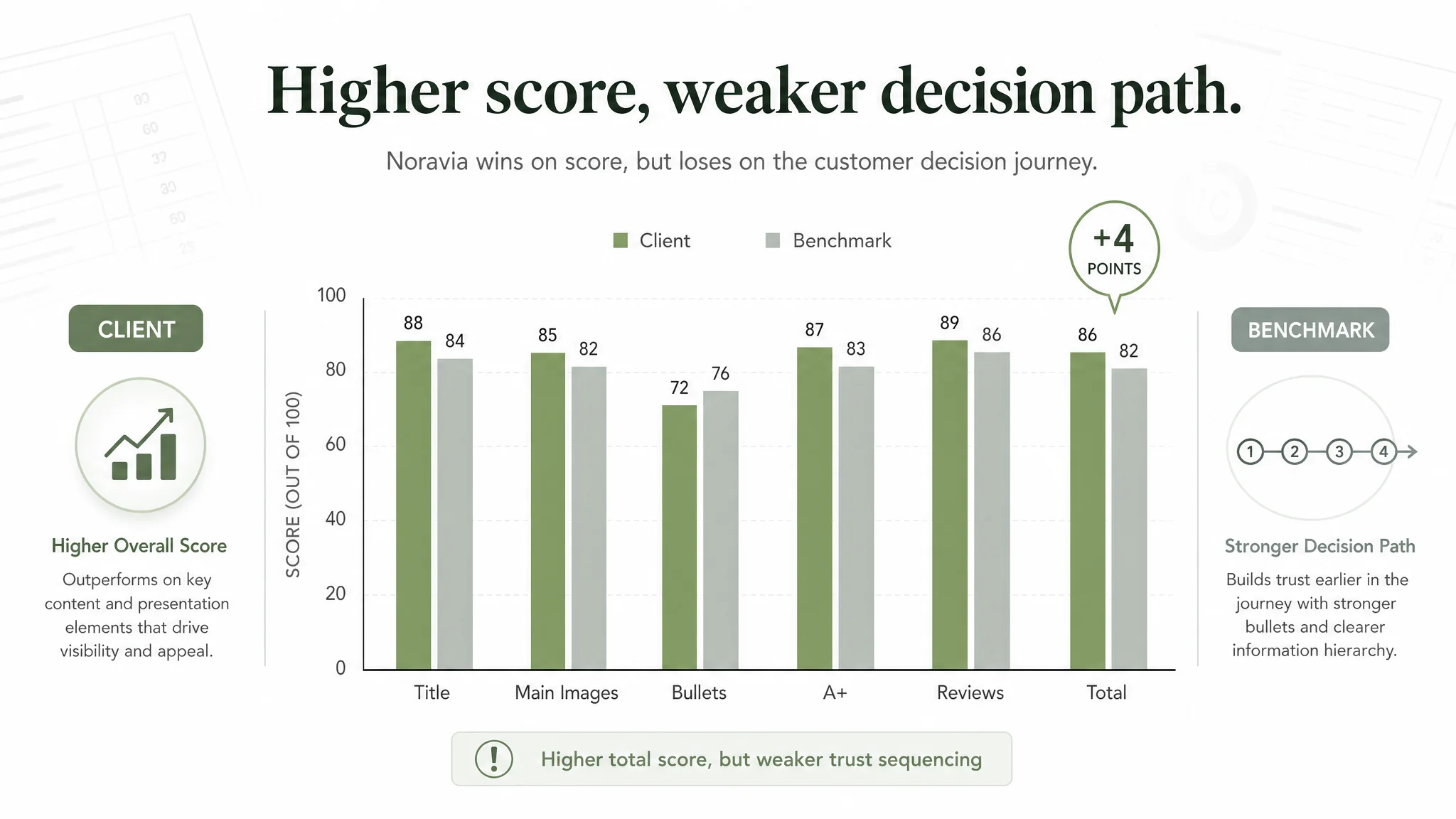
By comparing their Amazon Listing against a category-leading volumizing shampoo page, DeepBI found that while the brand had higher visual quality and a slightly higher total Listing score (83 vs. 78), the persuasion logic was inverted. Bold performance claims and abstract brand visuals were taking up the most valuable real estate, while the content that actually neutralizes buyer anxiety—safety, inclusions, verified claims, suitability for use—was buried or fragmented. Optimizing bids on top of that only meant paying more to send traffic into the same leak.
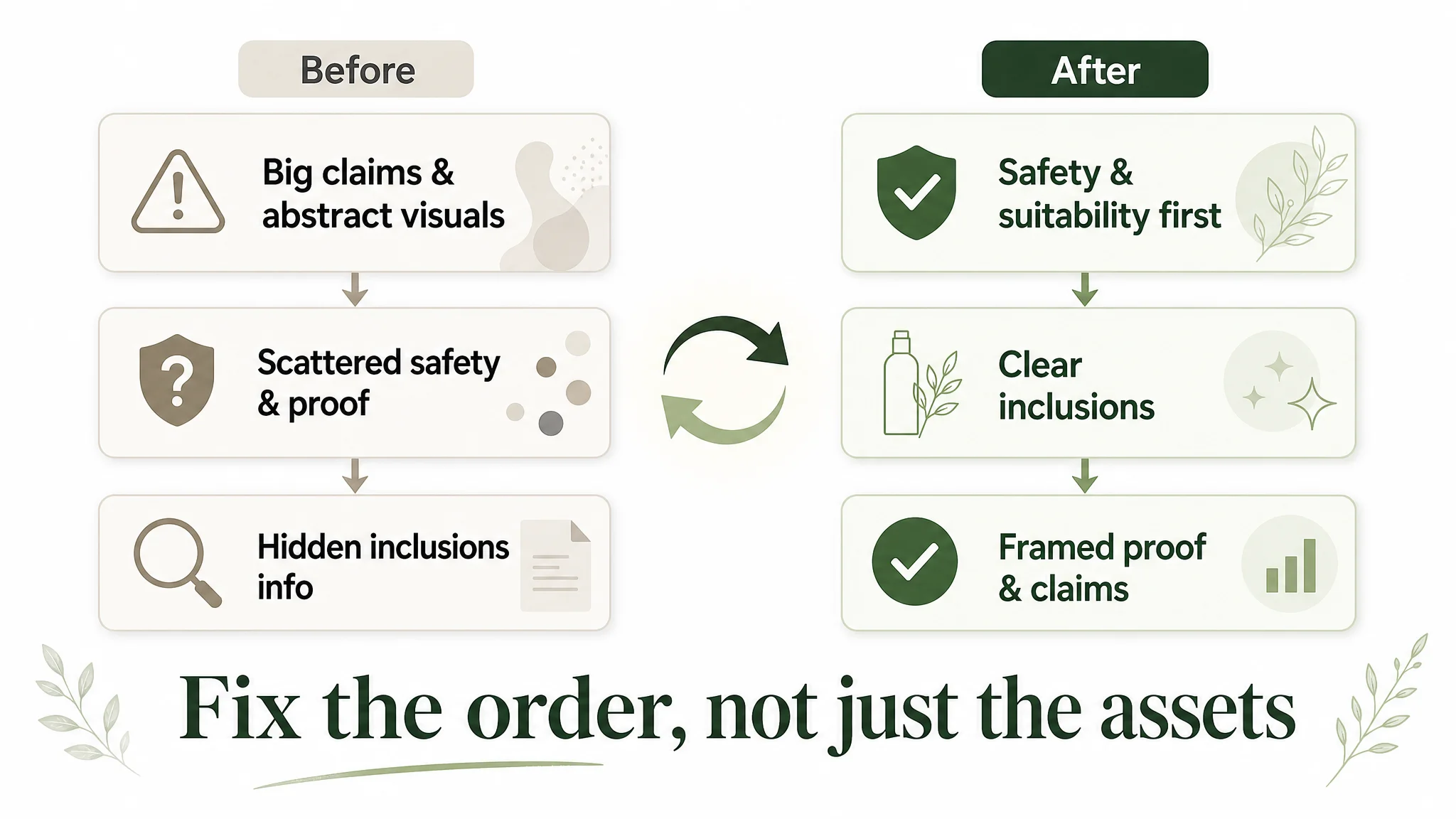
This case shows how shifting from “make it look better” to “rebuild the decision path” changed the outcome. By reordering main images, tightening the title, refocusing bullet points, and restructuring A+ content around trust and verified performance, the page started to actually deserve the ad traffic it received. For Amazon sellers, the key lesson is direct: when ad costs climb and ACOS won’t move, it’s often the Listing’s conversion logic—not the advertising knobs—that needs to be rebuilt first.
The Page Looked Strong on Paper, but Ads Were Hitting a Conversion Ceiling
On pure scoring, this Amazon Listing did not look like a problem child:
- Total Listing score: 83/100 vs. competitor’s 78/100
- Title: 15/20 vs. competitor’s 13/20
- Main images: 26/30 vs. competitor’s 24/30
- Bullets: 8/10 vs. competitor’s 9/10
- A+ / detail: 21/25 vs. competitor’s 20/25
- Reviews: 4.5 stars, 170 reviews vs. 4.2 stars, 312 reviews
On the surface, this is the kind of page most teams would be proud of: high-end imagery, strong brand positioning, quantified claims (4X more volume, 3X more shine, 85% less breakage), and healthier star ratings than a benchmark competitor.
Yet, in campaign data, the seller was seeing:
- Ad traffic that didn’t translate into proportional order growth
- Difficulty pushing ACOS down despite structural tuning
- A sense that “we’re doing the right things, but something’s still off”
The operating anxiety was classic Amazon:
“Our images and A+ clearly look better than the competitor. Why do we still struggle to make ad spend efficient?”
From the seller’s perspective, the bottleneck had to be on the advertising side—keywords, bids, or campaign setup. From DeepBI’s perspective, the symptoms pointed to a Listing that was consuming traffic instead of converting it.
The Original Misdiagnosis: Treating a Trust Gap as an Ads Problem
The customer’s internal explanation was straightforward:
- “Our visuals are already premium; we just need more visibility.”
- “If we push harder on 4X volume in ads and images, CVR should catch up.”
- “The competitor sells more mainly because of their review volume and ad dominance.”
This led to a specific optimization pattern:
- Focus time and budget on ad structure, keyword coverage, and budget allocation
- Incrementally enhance already high-aesthetic imagery
- Continue promoting aggressive performance claims in early positions
The underlying assumption: more exposure + stronger claims = higher conversion.
DeepBI’s data-led Listing audit surfaced a different hypothesis:
- The Listing wasn’t missing power; it was missing order.
- The page was not answering basic buyer questions in the right sequence:
- “Is this safe for my hair, especially if it’s colored or treated?”
- “What exactly am I getting in this purchase?”
- “How do I know this 4X volume claim is real?”
- Some visuals and texts were unintentionally introducing distrust:
- Accessories and products shown that were not actually included
- Styled results that clearly depended on other, unprovided products
- Strong claims without a clearly visible “proof” frame
In other words, the team was asking ads to fix what was fundamentally a trust and clarity leak on the product page.
“Advertising does not only amplify advantages. It can also amplify a page’s existing defects.”
What DeepBI’s Scoring Exposed: A Conversion Problem Hiding Behind a High Score
DeepBI’s Listing scoring is built to compare against a real benchmark Listing in the same Amazon category. In this case, the benchmark was another US marketplace volumizing shampoo for fine/flat hair.
Even though the target Listing scored higher overall, the pattern inside the score mattered more than the total:
- Title & SEO: Wider long-tail coverage (“Shampoo for Fine Hair”, “Volumizing Shampoo”) and richer ingredient/value wording than the competitor. Good from a traffic and relevance perspective.
- Main images: Visually stronger and more on-brand, but:
- Competitor images used every frame to answer a decision question: results, quantified proof, safety, usage, bundle logic.
- Client images mixed abstract aesthetics with unverified or confusing cues: accessories not in the package, styling results that depended on missing products, complex routines.
- Bullet points: More technical (peptides, aroma technology, extraction methods) vs. competitor’s heavy emphasis on:
- Quantified results (“increases volume by 195%”)
- Clear, buyer-language outcomes (fullness for 72 hours)
- Safety and suitability (color-safe, sulfate-free)
- A+ content:
- Client’s A+ excelled in visual quality and structured regimen logic (cleanse–care–protect–style).
- Competitor’s A+ was weaker visually but more systematic in trust-building:
- Clinical validation module
- Component transparency
- Clear, simple performance framing
- Reviews:
- Higher star rating but fewer total reviews vs. the benchmark
- Lower visible negative-review rate, which is an advantage—but not enough to offset page-level trust gaps
The key insight: this Listing did not lack assets; it lacked a coherent decision journey.
The Real Constraint: Listing Conversion Capacity, Not Ad Targeting
When DeepBI overlaid Listing scores with the seller’s campaign behavior, the real constraint became clear.
- The seller was already driving meaningful traffic.
- The Listing had above-average visual and structural assets.
- The remaining friction was in how those assets were ordered and framed.
Three specific issues limited conversion:
1. Claims came before safety and clarity
- The first impressions (main image + top A+ module) leaned heavily on “4X more volume”.
- For a shampoo that also deep-cleanses buildup, many buyers first want to know:
- “Will this strip my hair?”
- “Is it sulfate-free?”
- “Is it safe for color-treated, fine, or damaged hair?”
The competitor addressed “clean, safe, suitable” early and directly. The client Listing tried to win immediately with a big performance promise, which for a skeptical Amazon buyer can trigger doubt rather than desire.
1. Visuals blurred what is included vs. what is implied
- Secondary images showed:
- Blowout results clearly dependent on styling products not included in the purchase.
- Tools and sprays that were not part of the bundled SKU.
- For performance claims, text sometimes referenced results achieved with broader line usage, not the shampoo alone.
This weakens trust in two ways:
- It raises the question: “Will I get this result with only the shampoo?”
- It complicates the purchase decision: “What exactly am I buying here?”
1. Proof lacked an obvious anchor
- The Listing had strong quantified claims: 4X volume, 3X shine, 85% less breakage.
- But they were presented more as marketing text than as clearly labeled proof nodes (e.g., “clinically tested”, “third-party lab tested”).
The competitor, although less precise in methodology, visibly framed results as “proven” and tied them to clear imaging and modules. The client’s footnote-style proof felt buried; the buyer needed to work to believe it.
From a business perspective, the risk was straightforward:
Before fixing ads, this Listing needed to rebuild its trust sequence and proof framing, or ad spend would keep feeding a page that buyers emotionally “paused” on.
Why DeepBI Did Not Recommend “More Ads” First
Looking at the score pattern and content logic, DeepBI made a clear judgment on decision order:
1. Fix the page’s ability to convert incremental traffic
2. Then scale ad spend into a stronger, lower-risk Listing
The reasons:
- Ads were already doing their job: exposure and clicks were coming; the missing link was conversion at the product-page level.
- The Listing’s visual choices were creating avoidable distrust:
- Showing accessories and styled outcomes not included
- Letting complex routines overshadow the core shampoo benefit
- Safety, clarity, and proven outcomes were under-leveraged:
- The brand had genuine strengths—vegan, B Corp, cruelty-free, botanical-based—yet these were not leading the trust conversation.
Continuing to push ads without repairing this would:
- Increase spend against the same conversion rate
- Mask the root problem under “ad performance volatility”
- Make ACOS harder to control and LTV harder to realize
So the priority shifted from campaign refinement to Listing conversion reconstruction.

Reframing the Title: From “Rich But Messy” to “Outcome-First and Search-Strong”
The original title already did a good job at:
- Covering high-value keywords for fine and flat hair
- Highlighting 4X volume and botanical ingredients
- Embedding sensory notes like jasmine and peppermint
But it suffered from:
- Overuse of symbols (like “*”) that can create compliance friction and visual noise
- Slight redundancy and length that diluted the core message
DeepBI’s recommended direction:
- Keep the structure of Brand + Volumizing Shampoo for Fine Hair + Outcome + Ingredient + Sensory.
- Make the outcome and fit explicit early: “Volumizing Shampoo for Fine Hair” and “Lifts Flat Hair & Removes Product Build-Up”.
- Integrate the hero ingredient (“amaranth extract”) as a proof of expertise, not as an isolated technical note.
- Remove nonstandard symbols and compress aroma description to a clean, tasteful phrase at the end.
Resulting logic:
- The title still wins on SEO and professionalism.
- It now mirrors buyer decision logic:
1. Is this for my hair type?
2. Will it solve my flat hair and buildup issues?
3. Is it gentle enough to use regularly?
4. What makes it special (ingredient + aroma)?
Bullet Points: From Technical Features to Buyer Decision Logic
The original bullets leaned into:
- Ingredient sourcing
- Technical extraction (peptides, distilled sizes)
- Aroma composition
- Brand values and certifications
- Basic usage
The competitor’s bullets, by contrast, tracked buyer logic more closely:
1. What does it do to my hair (volume, texture, feel)?
2. Can I trust the results (numbers, lab backing)?
3. What does it smell like and feel like?
4. Is it safe for my hair (sulfate-free, color-safe)?
5. How exactly should I use it, and with what?
DeepBI’s recommended restructure:
1. Lead with visible outcomes tied to cleansing
New direction: Combine “deep cleansing” and “volumizing for fine hair” in the first bullet, using simple language:
- Removes product buildup and excess oil
- Soft gel lather
- Clean, light, refreshed feel for fine hair
This answers the immediate concern: “Will this both clean and lift my hair without weighing it down?”
2. Turn technology into a relatable result
New direction: Translate peptide/ingredient technology into:
- Even plumping of each hair strand
- Reduced surface friction
- Natural movement and touchable fullness
Instead of “here is the tech,” it becomes “here is what the tech feels like on your head.”
3. Make aroma a premium experience, not a side fact
New direction: Position the proprietary aroma as a sensory benefit:
- A refined, botanical scent experience
- Elevates daily washing to a salon-like moment
This keeps brand differentiation while staying within the decision logic: result → trust → experience.
4. Consolidate safety and ethics into a trust pillar
New direction: Group vegan, B Corp, cruelty-free and “only the good stuff” into a single bullet:
- Ethical credentials
- Gentle, responsible formula
- Soft “clean beauty” positioning without over-claiming
This directly parallels the competitor’s “sulfate-free, gluten-free, color-safe” bullet, but with the brand’s own trust assets.
5. Use “How to Use” to both guide and cross-sell without undermining the shampoo
New direction: Provide clear, simple instructions, then suggest (not imply necessity) that optimal results come when paired with the matching conditioner.
Crucially, the wording must avoid implying that the shampoo alone is ineffective—otherwise, confidence drops.

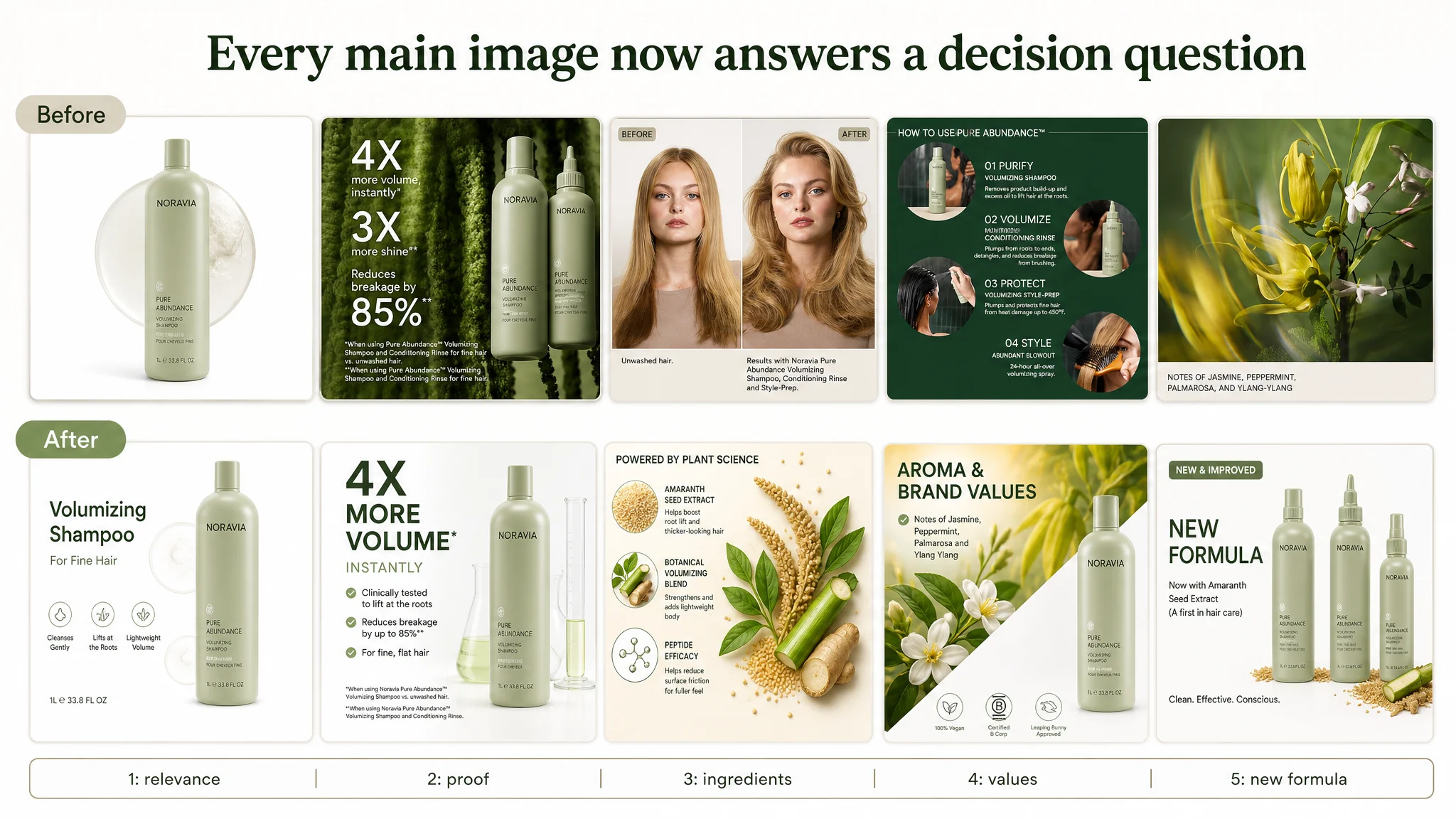
Main Images: From Brand Aesthetic to Decision-Focused Visuals
DeepBI’s visual analysis found an important asymmetry:
- The client had higher aesthetic quality and brand cohesion.
- The competitor had better decision-role coverage per image.
To convert ad-driven clicks into add-to-cart, each of the top 5 images needed to do a job.
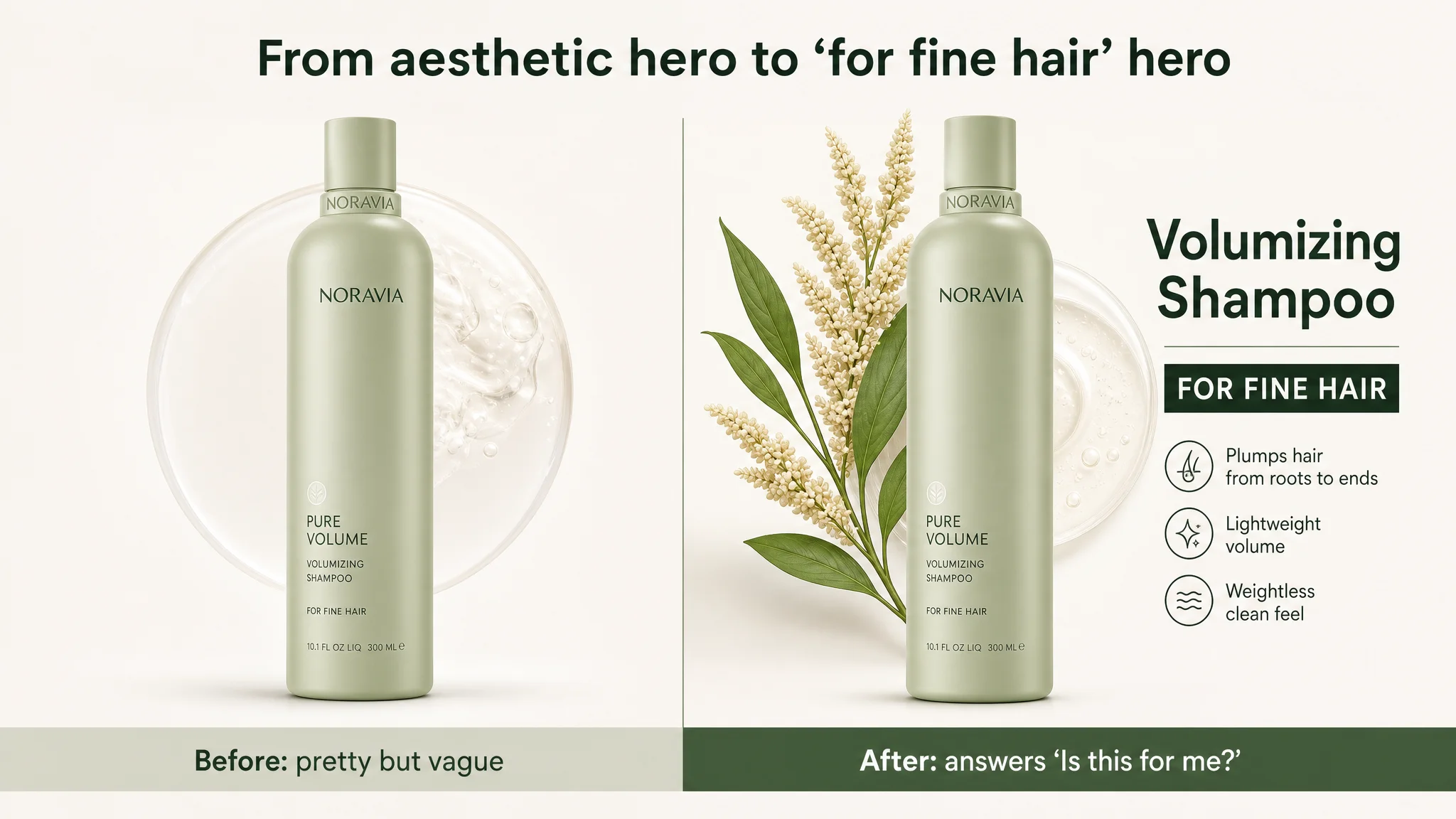
Image 1: Make “Is this for me?” answerable in one glance
Issue: Current hero image emphasized brand and category with an abstract background. It looked premium but said little about:
- Hair type fit (fine, flat)
- Key outcomes (volume, lift, buildup removal)
Direction: Keep the brand-centric composition but overlay a clean, legible promise:
- Volumizing shampoo for fine/flat hair
- Removes product buildup and excess oil
This makes the first thumbnail serve both brand and instant relevance.
Image 2: Turn 4X claims into a “data card,” not marketing noise
Issue: The current 4X volume messaging felt promotional, layered over multiple unprovided accessories (sprays, brushes).
Direction:
- Remove all accessories not included in the SKU.
- Present a clean performance card:
- 4X more volume (with a clear “vs. unwashed hair when using shampoo + conditioner” context)
- Clarify the testing baseline in small but legible text.
This mirrors the competitor’s data card logic, but with the client’s more precise claims—and avoids compliance risk from over-styled before/after illusions.
Image 3: Replace “styled blowout outcome” with ingredient and benefit clarity
Issue: A full blowout result clearly dependent on additional styling products introduced:
- Unrealistic expectations for shampoo alone
- Confusion about what is included in the purchase
Direction:
- Focus this image on:
- Amaranth seed extract
- How it plumps hair and reduces friction
- Natural movement and volume illustration
This reframes the image from “aspirational but potentially misleading” to “concrete and product-specific.”
Image 4: Simplify usage and shift from complex routine to brand values
Issue:
- Current usage sequence implied a multi-step, styled routine using products not included in the listing.
- Step visuals made it feel like the shampoo alone would be insufficient.
Direction:
- Remove complex styling steps and third-party tools.
- Use this slot to communicate:
- Aroma profile
- Vegan, B Corp, cruelty-free credentials
This creates an emotional and rational trust node instead of an intimidating regimen.
Image 5: Use the slot to answer “Is this the latest formula?”
Issue: The existing fifth image was aesthetically pleasing but non-essential to conversion.
Direction:
- Replace with a clear “New Formula” card (if applicable).
- Briefly explain the upgraded botanical blend and volumizing benefits.
This directly addresses the subtle but real question many returning buyers have: “Is this the updated product I heard about?”
A+ Detail Page: Reordering the Persuasion Flow Around Trust
Both Listings used A+ content, but the strategies diverged:
- Client: high-impact visuals, rich brand storytelling, a complete “cleanse–care–protect–style” regimen logic.
- Competitor: more basic visuals, but a tighter chain of:
- Ingredient benefits
- “Proven results” framing
- Safety and suitability reassurance
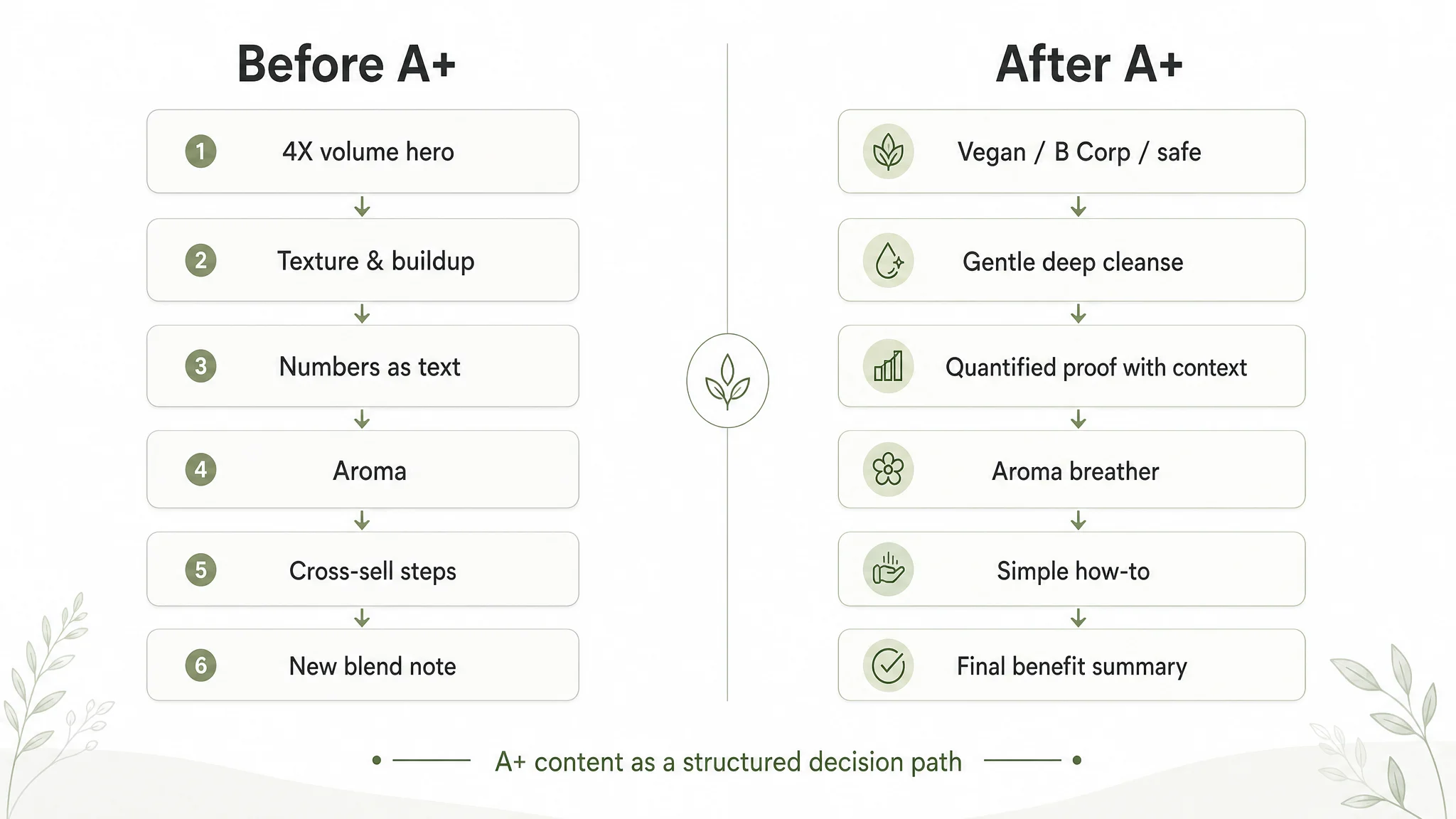
DeepBI’s advice focused on content priority, not more content.
Start with safety and mildness, not volume
Current pattern:
- Lead with “4X volume” as the first impression in A+.
Risk:
- For fine, often fragile hair, top-of-page bold claims can trigger skepticism before basic safety is addressed.
New priority:
1. Open with a concise trust block:
- 100% vegan
- Certified B Corp
- Cruelty-free
- Gentle cleansing: removes buildup without stripping moisture
1. Then transition into quantified performance:
- 4X more volume
- 3X more shine
- 85% less breakage
This sequence reassures first, then sells.
Clarify “deep cleanse without damage”
Issue:
- The current A+ explained texture and build-up removal but did not explicitly calm fears about dryness and damage.
Direction:
- Explicitly state that:
- The shampoo balances cleansing and volumizing.
- It’s designed for fine hair, which is often easily weighed down or damaged.
This directly addresses a key decision barrier for this category.
Strengthen proof framing for quantified claims
Issue:
- Numbers existed but looked like marketing text, not tested outcomes.
Direction:
- Introduce a simple framing element:
- “Based on [internal/clinical/consumer] testing when used with [line]”
- Clearly tie numbers to a testing context.
Even without adding lab logos, this moves claims closer to the competitor’s “proven results” framing while staying within truth and compliance boundaries.
Use aroma as a “breather,” not a primary conversion lever
Issue:
- Aroma module is a strength, but placed too high in the rational decision chain, it competes for attention with performance proof.
Direction:
- Keep the aroma story but position it as:
- A mid or late module
- A visual and emotional relief after the main performance and trust points
Lower the priority of non-critical announcements and add a summary node
Issue:
- The “new blend” announcement stood at too high a level in the flow.
- There was no final summary/reassurance block to close the argument.
Direction:
- Demote “new and improved” to supporting status.
- Add a final short module summarizing:
- Shampoo for fine hair
- Removes buildup and excess oil
- Delivers 4X more volume
This gives buyers a last, clean recap before they decide.
How Conversion Logic Repair Makes Ad Traffic Useful Again
DeepBI did not introduce new, invented claims or change the product’s DNA. The shift was in logic and sequencing:
- From “aesthetic-first” to “decision-first” images
- From “brand and tech narrative” to “buyer outcome and reassurance” bullets
- From “volume claim first” to “safety and proof first” A+ content
Once this new structure is in place, the implications for Amazon advertising are direct:
- CTR can benefit from:
- A main image that clearly signals “for fine/flat hair, lifts and cleanses” at thumbnail size.
- A cleaned-up title that surfaces the right terms and outcomes early.
- CVR can begin to recover because:
- Early doubts about safety and suitability are addressed upfront.
- Quantified claims are framed as tested, not just promotional.
- Confusing visuals (unprovided accessories, over-styled outcomes) are removed, reducing perceived overpromising.
- ACOS becomes more controllable:
- The same or slightly increased ad spend now lands on a page with higher conversion capacity.
- Ads stop amplifying distrust and start amplifying a coherent sales story.
“The real problem was not that ads failed to bring traffic. It was that the page could not convert the traffic.”
What Other Amazon Sellers Can Take Away
Several patterns from this volumizing shampoo case apply beyond beauty:
1. A higher Listing score does not guarantee better conversion.
The question is not “Is my page good?” but “Is my page better than my benchmark at the points that decide a sale?”
1. Trust and safety often need to precede performance claims.
Especially in categories linked to body, skin, or hair, buyers will not “hear” your 4X promise until they believe your product won’t harm them.
1. Every main image slot must answer a real decision question.
Aesthetic harmony is not enough. Ask, for each image:
- What decision barrier does this image help remove?
1. Avoid showing what you don’t sell.
Tools, accessories, or full routines that are not part of the SKU can make results feel unattainable and undermine confidence in the core product.
1. A+ is not a gallery; it’s a decision path.
Lead with:
- Who this is for
- Why it’s safe
- How well it works (with clear context)
Then add:
- Aroma, brand story, and announcements as supporting layers
Most importantly, this case illustrates why DeepBI insists on diagnosing Listing conversion before prescribing advertising scale. When the product page genuinely converts, ads are no longer a blunt instrument to force growth; they become an efficient lever on top of a sound commercial foundation.