

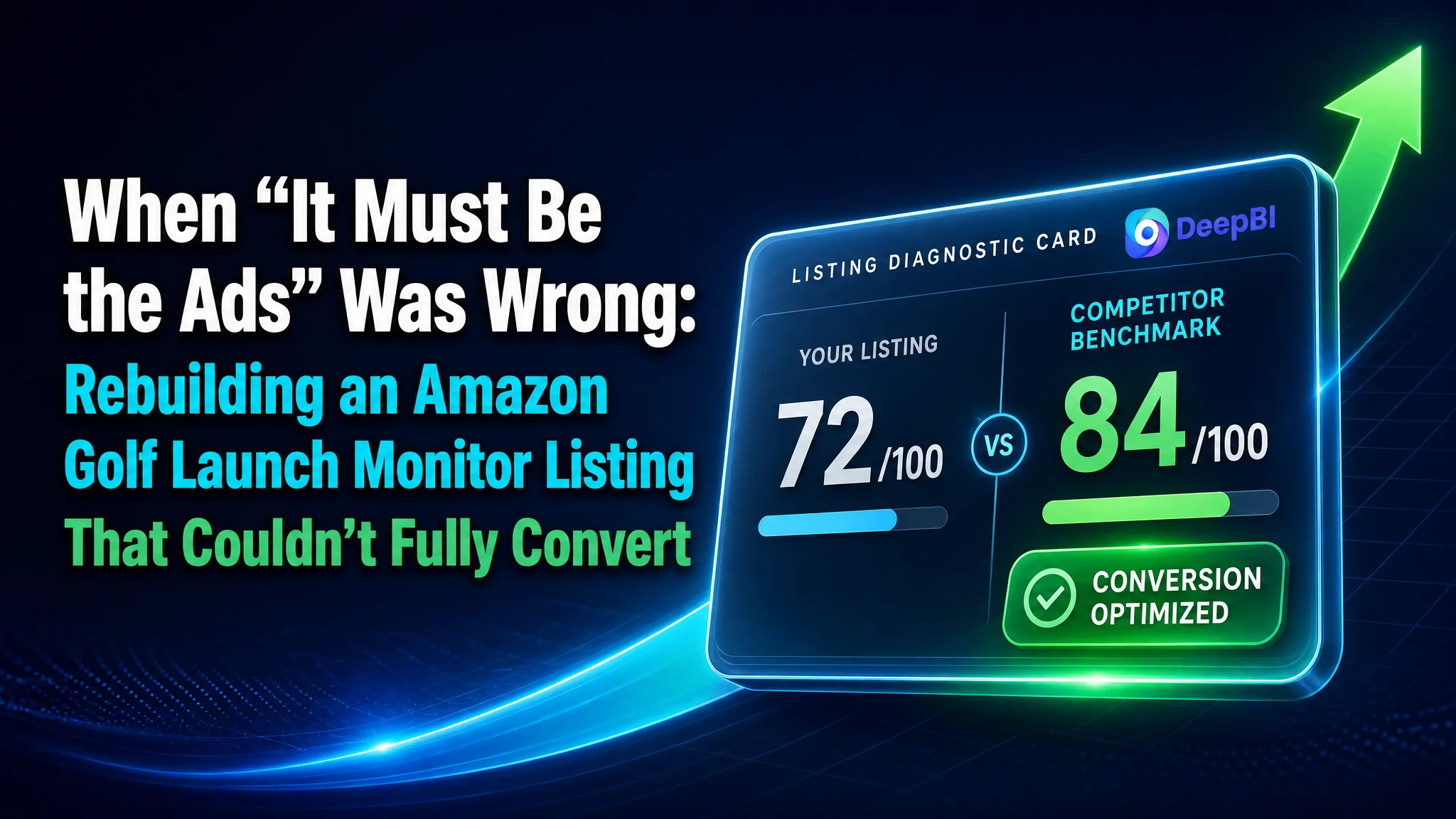
This case comes from an Amazon seller in the golf electronics category. On the surface, their portable launch monitor already had strong reviews, over a thousand ratings, and steady Amazon ads traffic. Yet ad costs were getting harder to control, and the team felt they were paying more and more for each additional order. Their first instinct was that bids, keywords, and campaign setups were not precise enough.
Once DeepBI put their Listing and a category‑leading competitor side by side, a different picture emerged. The real bottleneck was not in Amazon ads operations, but in the product page’s conversion logic: how the title framed the product, how the main image sequence handled risk and completeness, and how the A+ content addressed (or failed to address) hidden cost and trust concerns.
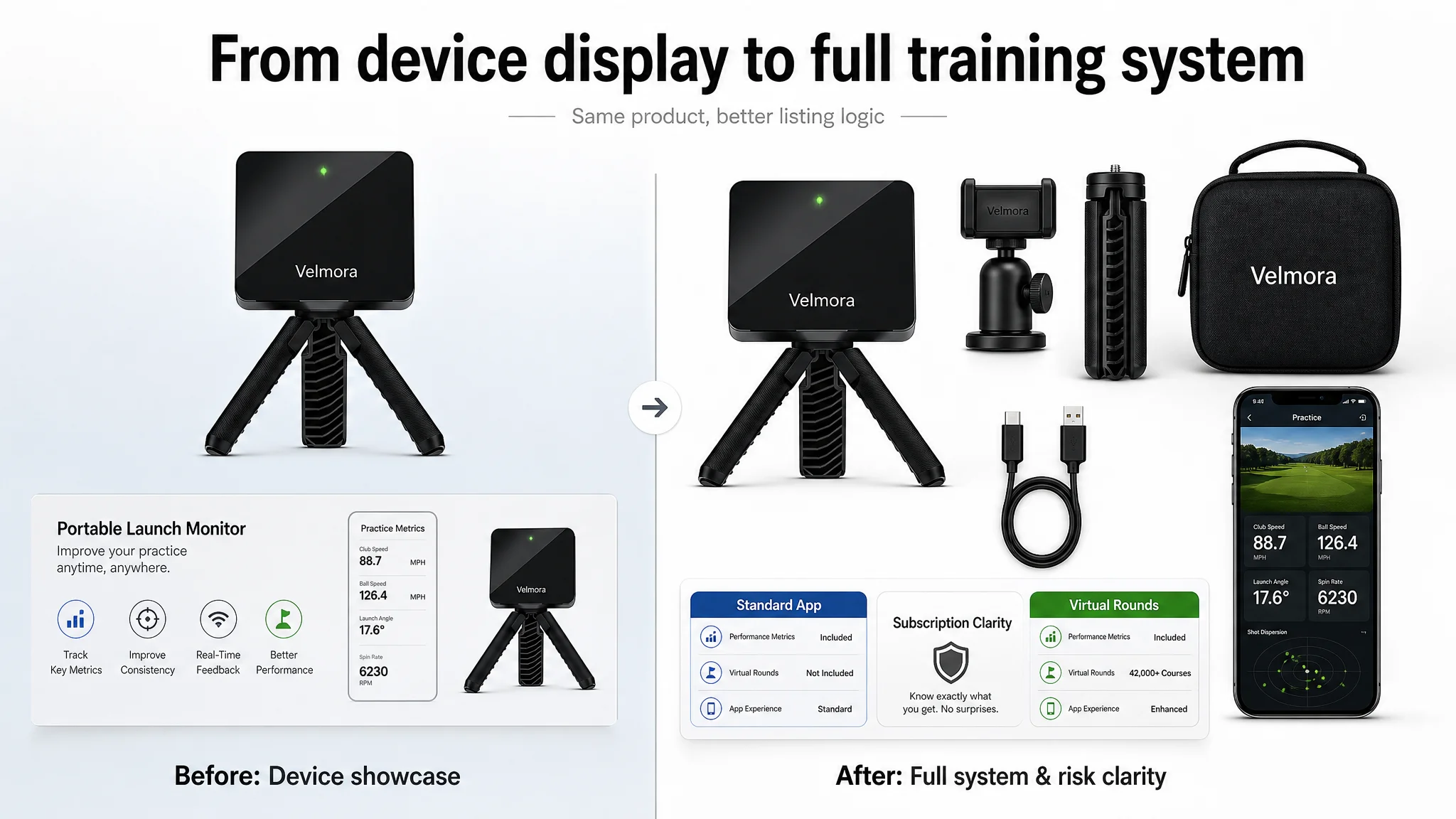
The optimization therefore did not start from “refine the campaigns.” It started from the Amazon Listing: restructuring the title to carry high‑intent keywords, redesigning the main image set around “complete system + risk reduction,” and rebuilding the A+ modules to clarify compatibility, subscription costs, and data accuracy. For other Amazon sellers, this case is a reminder that when ACOS feels stuck, the first place to re‑audit is often not your ad console, but whether your product page deserves the traffic it’s getting.
The Seller’s Reality: Strong Product, Rising Pressure
This Amazon seller operates a mid‑to‑high‑end portable golf launch monitor and simulator for the US marketplace.
On paper, the fundamentals looked good:
- Star rating: 4.2
- Review volume: 1,100+ reviews (significantly higher than the main competitor’s ~600+)
- Category: technical, high‑ticket product where trust and proof matter
- Amazon ads: already bringing in meaningful traffic
Yet the team felt growing pressure:
- ACOS was difficult to push down further.
- Scaling ad spend did not translate proportionally into additional orders.
- Competitors with fewer reviews were catching up in visibility and perceived professionalism.
Internally, the narrative became:
“Our product and rating are fine. If performance is not improving, there must be a problem with the ads.”
So they cycled through the usual ad‑side actions: keyword expansion, bid adjustments, campaign reorganizations. Results were at best incremental; the sense of “paying for traffic that doesn’t close” only grew stronger.
What the Seller Originally Misdiagnosed
The team’s working assumption was simple:
- High ACOS = advertising problem
- Solution = better targeting, better “creatives,” more granular campaigns
This led to a narrow view of the funnel: if the ads bring enough relevant golf traffic, the Listing “should” convert, especially with a 4.2 rating and strong review volume.
There were several underlying assumptions that turned out to be wrong:
1. “Good reviews = good page conversion.”
The team equated strong review volume with a page that is already optimized for conversion. They did not consider that a high‑trust product can still underperform if the story and risk handling on the page are weaker than competitors.
1. “If it’s a technical product, customers will read deeper.”
They believed golfers would patiently read bullet points and text to understand the value, so they underweighted the role of main images and A+ visuals in quickly verifying “Is this the full system?” and “What will this cost me long term?”
1. “Our feature list is comprehensive, so we’re fine.”
The seller focused on covering features, not on structuring a buying logic: what the product is, why its data is trustworthy, what’s included, what it costs to own and use.
With these assumptions, every time performance stalled, the reflex was to “fix the ads” again—without questioning whether the product page itself was the actual choke point.
What DeepBI Saw First: A Listing That Was Outplayed, Not a Product That Was Weak
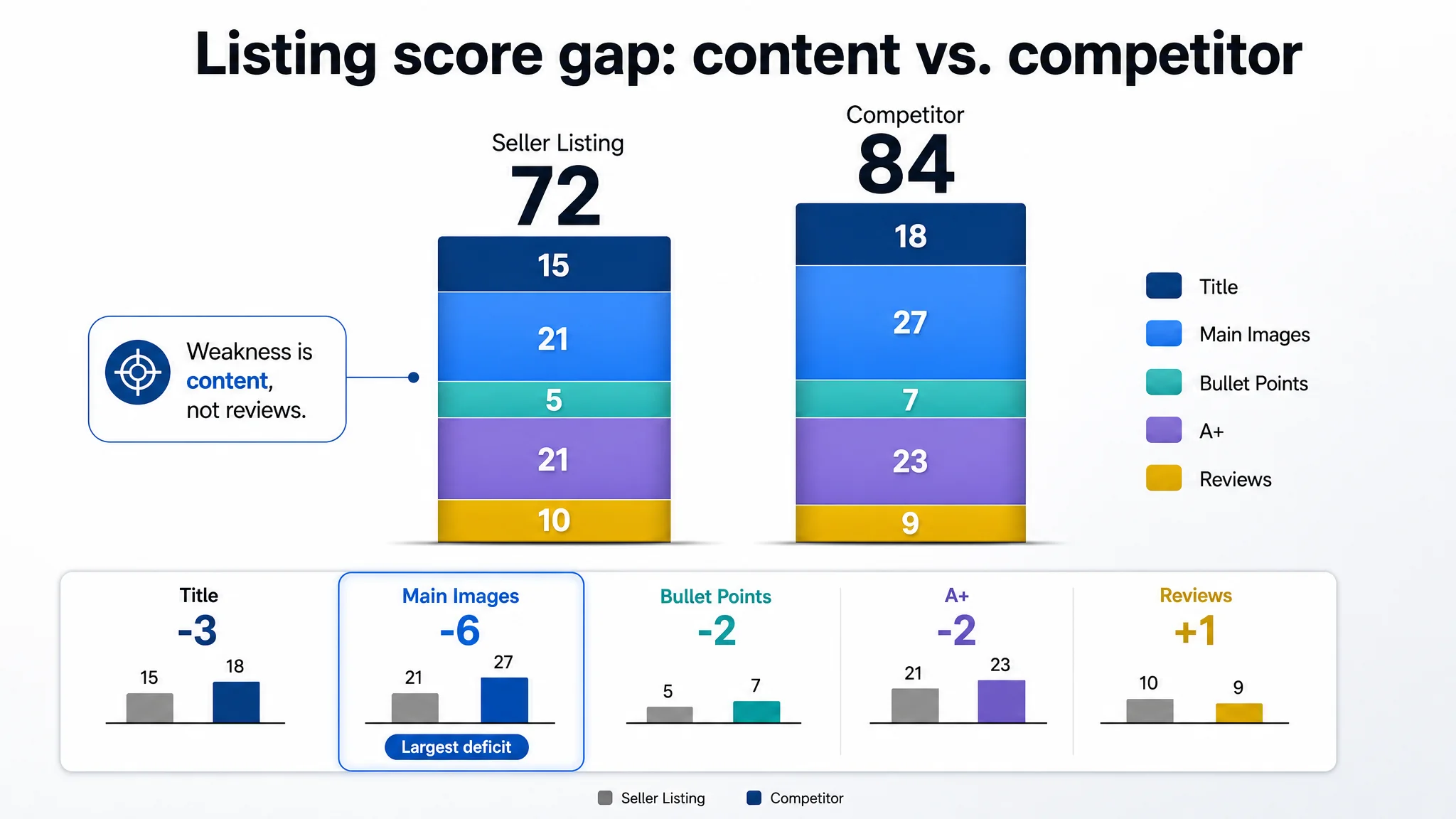
DeepBI’s Listing scoring put a hard number on the gap:
- Seller Listing: 72/100
- Benchmark competitor: 84/100
- Deficit: –12 points
The scores by dimension were revealing:
- Title: Seller: 15, Competitor: 18, Gap: -3
- Main Image Set: Seller: 21, Competitor: 27, Gap: -6
- Bullet Points: Seller: 5, Competitor: 7, Gap: -2
- A+ / Detail Page: Seller: 21, Competitor: 23, Gap: -2
- Reviews: Seller: 10, Competitor: 9, Gap: +1
In other words:
- The only area where the seller led was reviews.
- Nearly all conversion‑driving content layers—title, main images, bullets, A+—lagged behind the competitor.
- The largest single gap was main image logic (–6 points), which is directly tied to CTR and early trust.
This reframed the problem clearly:
The product had sufficient social proof, but the Listing was not converting traffic as efficiently as the competitor’s page. Ads were feeding a weaker conversion engine.
Amazon Ads Were Not Failing. The Page Was Consuming the Traffic.
The most striking contrast appeared in the top of the page: title and images visible right on the Amazon search results and above the fold.
Title: One Product, Two Different Identities
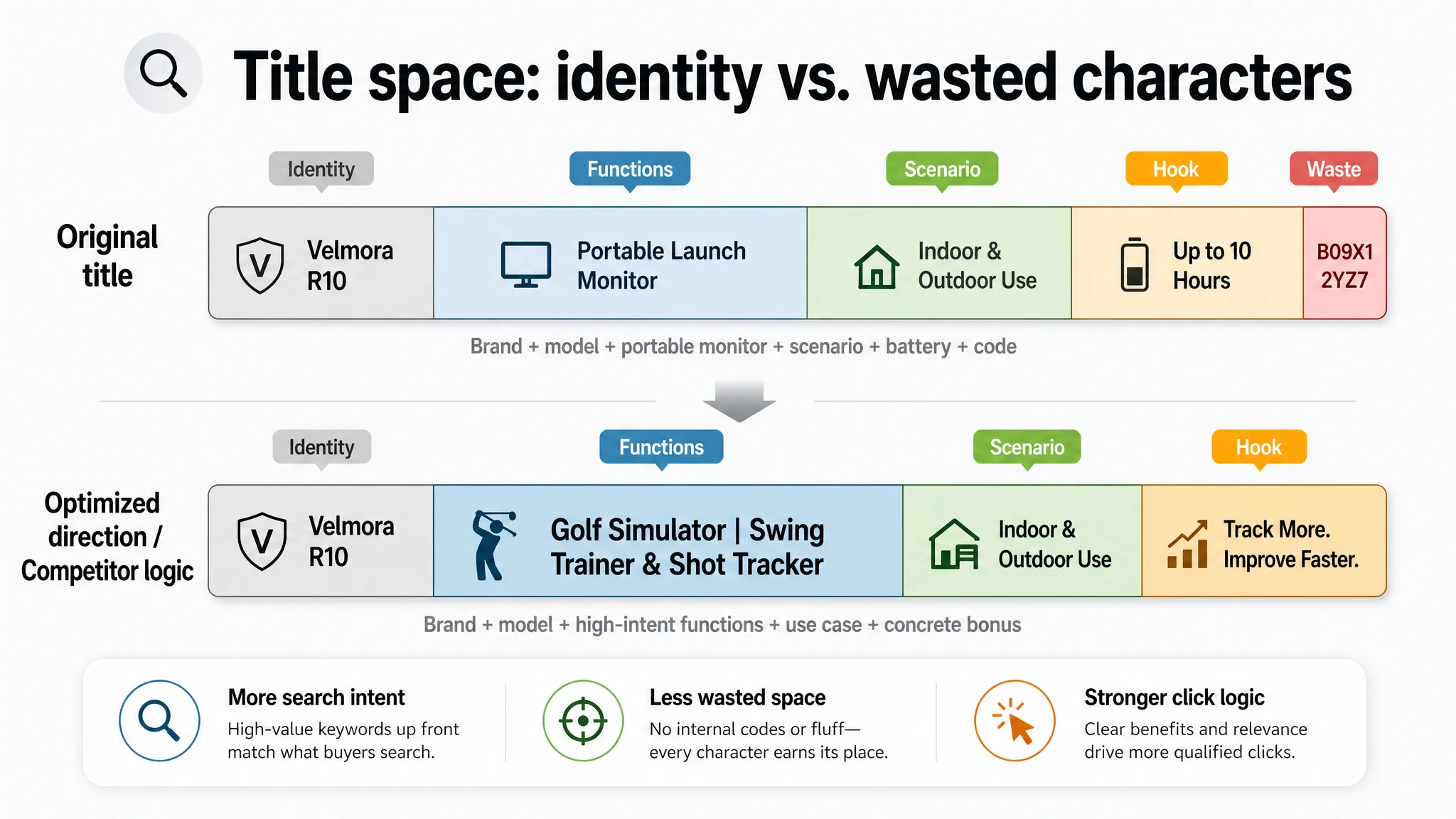
The seller’s original title followed a “standard” pattern for electronics:
- Brand + model + “Portable Golf Launch Monitor & Simulator” + scenario line + battery life + internal model code
It was structurally correct but strategically underpowered:
- The core identity and major functions were not compressed tightly enough.
- The emotional and functional outcome (“what this does for my game”) was weaker.
- The numeric hook (“Up to 10 Hours Battery Life”) was buried toward the end.
- It carried a model code that means nothing to most buyers, consuming valuable title real estate.
The competitor’s title, however, led with:
- Brand + model, immediately followed by “Launch Monitor Golf Simulator”.
- Parallel structure: “Swing Trainer & Shot Tracker.”
- Clear scenario: “for Home & Driving Range.”
- A concrete bonus: “(3 ProV1 Balls)” at the end.
This difference matters because, in Amazon search results:
- The competitor clearly positions itself as a complete system (launch monitor + simulator + swing trainer + shot tracker).
- It uses category language (“Golf Simulator,” “Swing Trainer,” “Shot Tracker”) that matches how buyers search and think.
- It hints at superior value with a specific gift, instead of generic promises.
So even before a click, the seller’s product feels like “a device,” while the competitor’s feels like “a full, tour‑level training solution.”
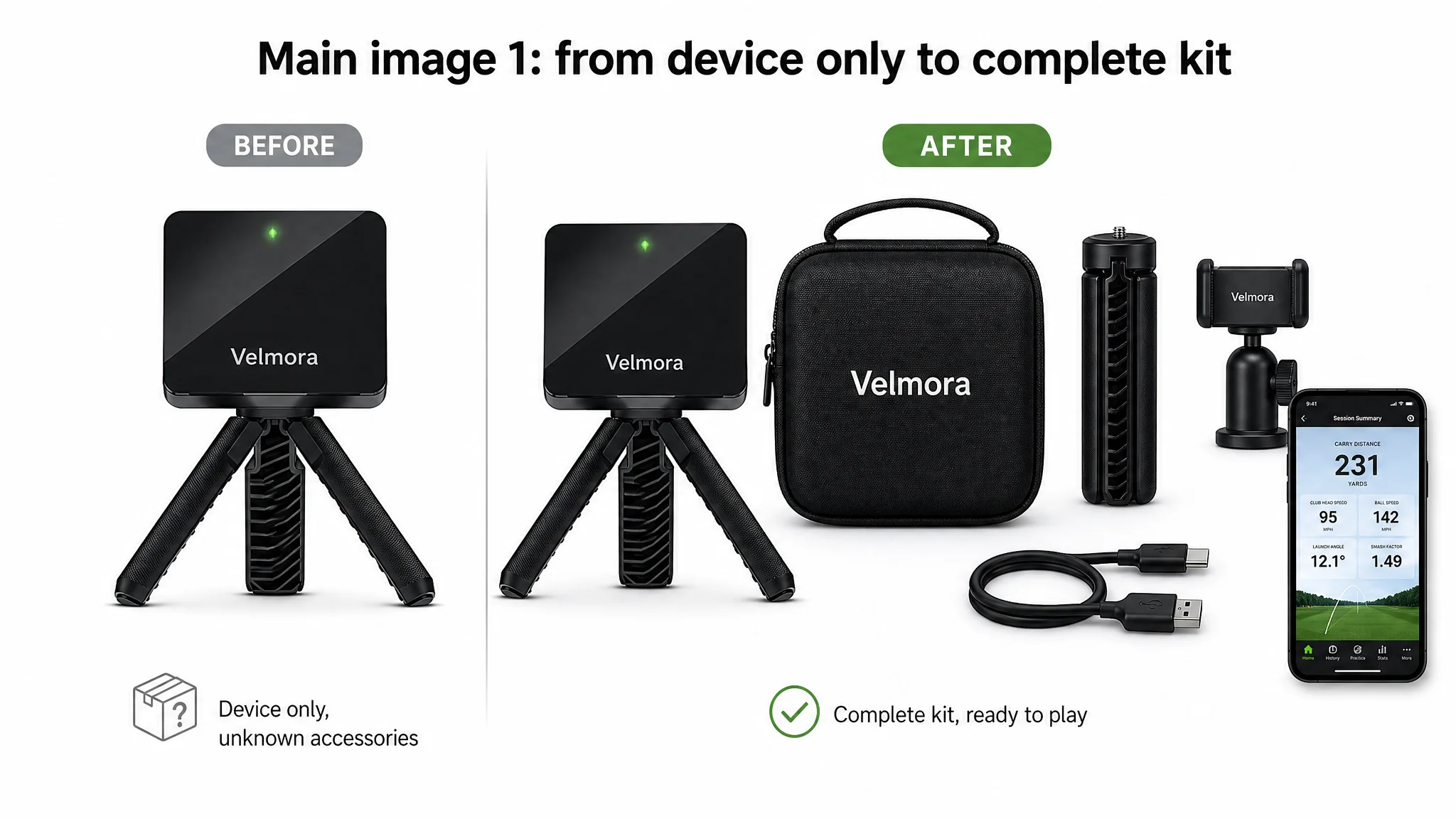
Main Images: From “Here’s the Device” to “Here’s the Whole System”
The image gap was even more decisive.
Seller main image set:
- Image 1–2: static product shots, minimal context, no “what’s in the box” overview.
- No clear visual confirmation of included accessories (tripod, phone mount, cables, case).
- Functional images rely heavily on generic app screenshots and text overlays.
- Simulation access is presented with a negative framing (“subscription required”), inviting cost anxiety.
Competitor main image set:
- Image 1: device + key accessories + multi‑screen “simulator” experience in one frame.
- Early images include a neatly organized case, clearly showing “this is a complete kit.”
- Visual modules call out high‑authority concepts: impact vision, spin rate, shot tracking, tour‑level accuracy.
- Subscription and premium access are framed as included trials, reducing perceived risk.
The consequence:
The seller’s main images confirm that the product exists, but do not prove it is a complete, risk‑controlled solution.
For a high‑ticket gadget, this is decisive. Users don’t want to wonder:
- “Do I get all the parts I need or do I have to buy more?”
- “Is this a serious tool or just an entry‑level gadget?”
- “Will I be hit with hidden subscription costs later?”
Because the page doesn’t answer these questions visually and early, more of the ads’ traffic leaks out before conversion.
The Real Constraint: Listing Conversion Capacity, Not Traffic Volume
Once the Listing vs. competitor gaps were quantified, it became obvious why “tuning ads” kept stalling:
- Review trust was sufficient. The seller even had a slight advantage in rating (4.2 vs. 4.1) and a strong advantage in review count (1100+ vs. 600+).
- Traffic quantity was not the core issue. Ads were already delivering visitors. The bottleneck was what happened after the click.
- The competitor’s page did three critical jobs better:
1. Positioning itself as an all‑in‑one “tour‑level” system, not just a device.
2. Visualizing technology and accuracy, not just asserting it in text.
3. Pre‑answering cost, compatibility, and value questions that can block a purchase.
From a business standpoint:
- Continuing to push more traffic into this Listing without fixing the page meant paying to amplify weaknesses—especially in a category where buyers are comparing 2–3 tabs directly.
“Advertising does not only amplify advantages. It can also amplify a page’s existing defects.”
That is why DeepBI treated Listing conversion capacity as the primary constraint to address—before any further ad scaling.
Why DeepBI Did Not Start With More Ad Optimizations
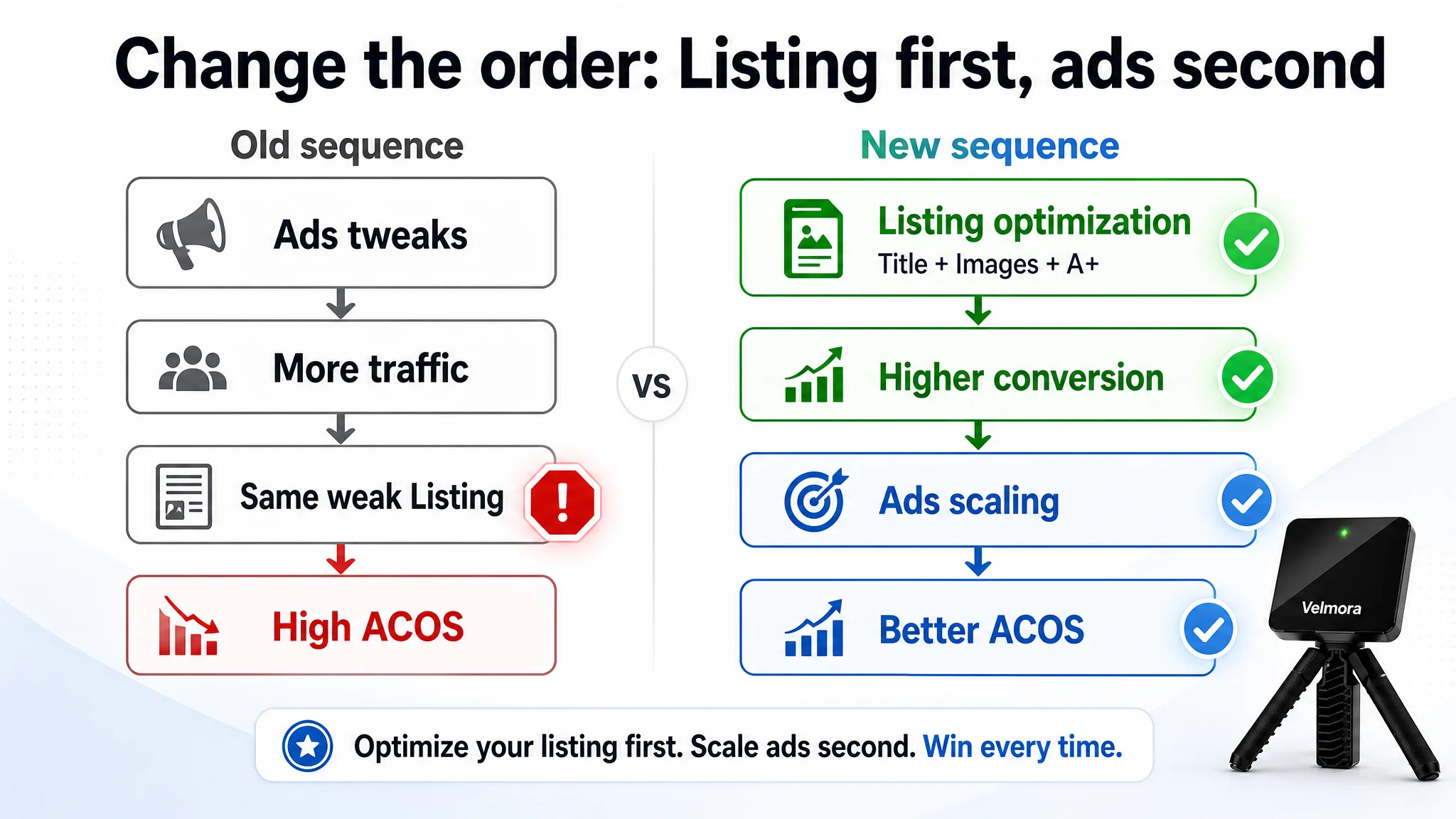
With ad costs already sensitive, the risk of the wrong sequence was clear:
- If you optimize ads first on a weak Listing:
- Each incremental click is more expensive.
- Conversion remains limited.
- ACOS drifts upward, not downward.
- You get the illusion that the “market is just expensive now,” hiding the page’s role in the problem.
- If you optimize the Listing first:
- You increase the “value per click” of existing traffic.
- You improve baseline CVR for both paid and organic traffic.
- Later ad optimizations start from a stronger base and become more responsive.
In this case, the priority stack was:
1. Rebuild the title to match buyer search logic and clearly define the product’s identity.
2. Reframe the main image sequence from “visual display” to “full system + risk reduction verification.”
3. Deepen the bullet points and A+ content to prove accuracy, clarify costs, and show real use scenarios.
4. Only after that: return to ads, using the improved Listing to justify scaling traffic again.
How the Listing Needed to Change
1. Title: From Generic Descriptor to High‑Intent, Structured Identity
DeepBI recommended a title that:
- Keeps brand and model in front (critical for branded search).
- Integrates category‑defining phrases: “Golf Launch Monitor & Simulator,” “Swing Trainer & Shot Tracker.”
- Clearly covers core scenarios: home, indoors, driving range.
- Surfaces a high‑value numeric benefit: “Up to 10 Hours Battery Life.”
- Removes non‑value‑adding internal model codes.
Suggested direction:
Brand Model Portable Golf Launch Monitor & Simulator, Swing Trainer & Shot Tracker for Home, Indoors or Driving Range, Up to 10 Hours Battery Life
Business logic:
- Capture more relevant searches by aligning with terms buyers already use.
- Signal completeness (monitor + simulator + trainer + tracker) directly in the title.
- Put a concrete, credible benefit (10‑hour battery life) in a spot where it can impact clicks.
2. Bullet Points: From Feature Listing to Decision Logic
Original bullets leaned toward:
- Functional statements (“tracks data,” “records swings,” “virtual courses”).
- Fragmented structure (separate bullets for accessory notes and battery life).
- Limited emphasis on accuracy tolerances, pro‑level positioning, and subscription value.
DeepBI’s restructuring logic:
- Each bullet starts with an uppercase “promise” phrase, followed by structured evidence.
- Merge scattered points (e.g., battery, accessories) into a coherent story about professional, convenient use.
Example directions:
1. PRO‑LEVEL TRACKING ACCURACY
2. COMPLETE PERFORMANCE METRICS
3. AUTOMATED SWING ANALYSIS
4. 42,000+ VIRTUAL COURSES & GLOBAL COMMUNITY
5. EXTENDED BATTERY LIFE & EASY SETUP
This transforms bullets from “we have features” into “this is how you train like a pro, know your data, and actually enjoy using it.”
3. Main Images: From Static Shots to a “Full System + Risk Reduction” Sequence
DeepBI’s assessment of the seller’s current sequence:
- Image 1 – “Basic existence confirmation”: device on white background, minimal persuasive power.
- Image 2 – Redundant angle, missing the chance to visualize portability and kit completeness.
- Image 3 – Text‑heavy scene shot; does not reduce concrete risks (cost, completeness).
- Image 4 – Functional screenshot, but low emphasis on key metrics.
- Image 5 – Simulation view with “subscription required” framed as a downside.
The re‑architecture:
1. Image 1: “What’s in the Box” Master Shot
2. Image 2: Portability & Protection
3. Image 3: Financial & Subscription Transparency
4. Image 4: Metric‑Driven Performance Screen
5. Image 5: Simulation + Video Analysis
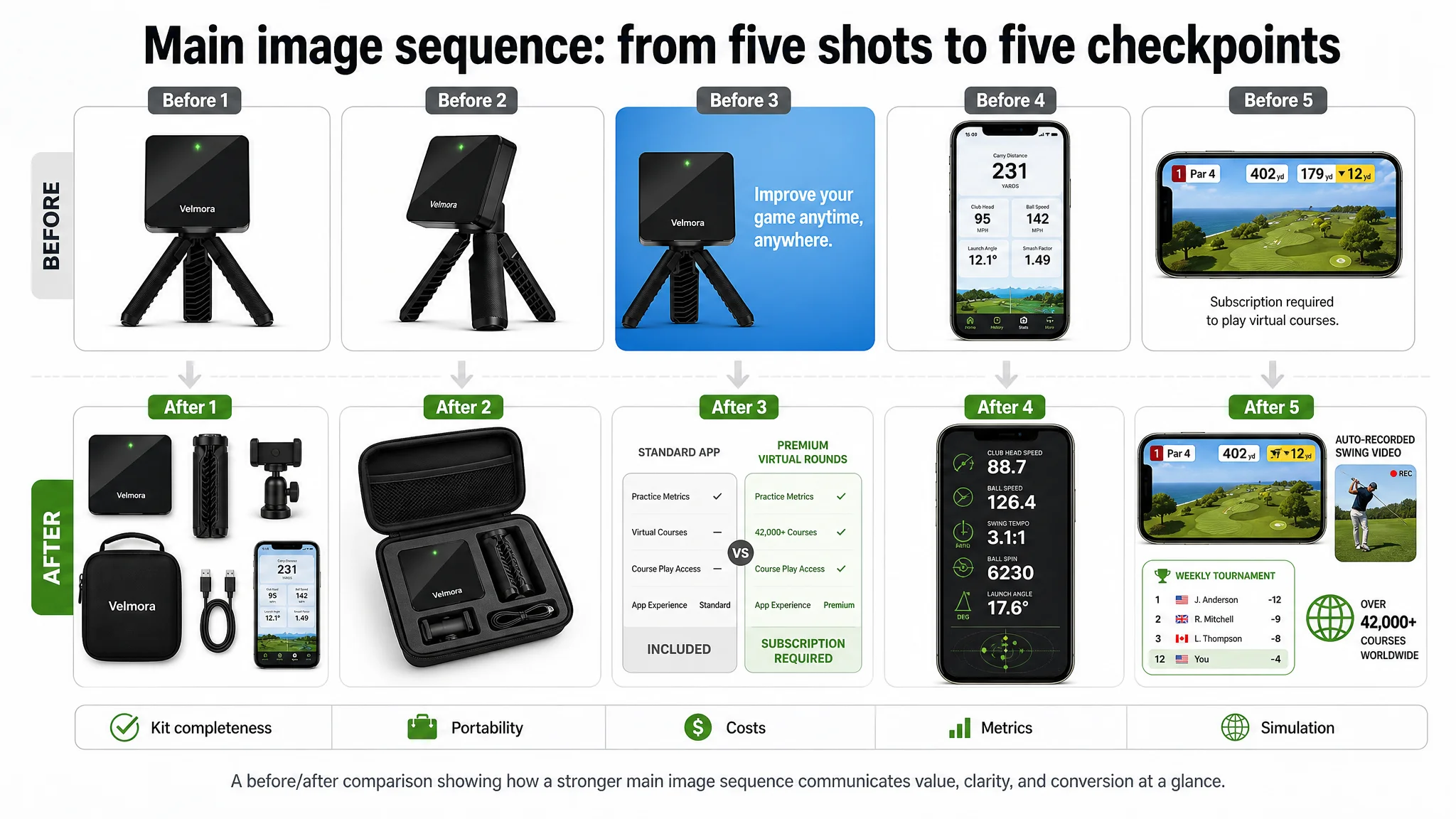
Overall, the sequence shifts from “five pictures of a gadget” to “five checkpoints that confirm completeness, portability, cost clarity, performance metrics, and long‑term value.”
4. A+ Content: From Aesthetic Story to Proof and Cost Clarity
DeepBI split the existing A+ into functional modules and evaluated each:
- Module 1 – Aesthetic intro: nice visuals but low information density; missed the chance to prove compatibility and app ecosystem right away.
- Module 2 – High‑level capability summary: too checklist‑like, redundant with later content.
- Module 3 – Data tracking benefits: generic promises, no quantified tolerances, weak versus a competitor showing “tour‑level” precision.
- Module 4 – Swing recording: vague on how automatic recording and training modes tangibly help.
- Module 5 – Course variety: promotes 42,000+ courses but bypasses cost concerns.
- Module 6 – Third‑party simulator compatibility: states E6 Connect support without clarifying it is separately purchased.
- Module 7 – Missing entirely: no risk‑reduction / usability confirmation module.
Reframed A+ path:
1. Module 1: Compatibility & Setup Confirmation
2. Module 2: Data‑Driven Improvement, Not Just “Many Metrics”
3. Module 3: Accuracy Proof & Rational Trust
4. Module 4: How Automatic Video Analysis Works
5. Module 5: Simulation Lifecycle & Subscription Transparency
6. Module 6: Third‑Party Simulator Context
7. Module 7: Risk Reduction & Ownership Benefits
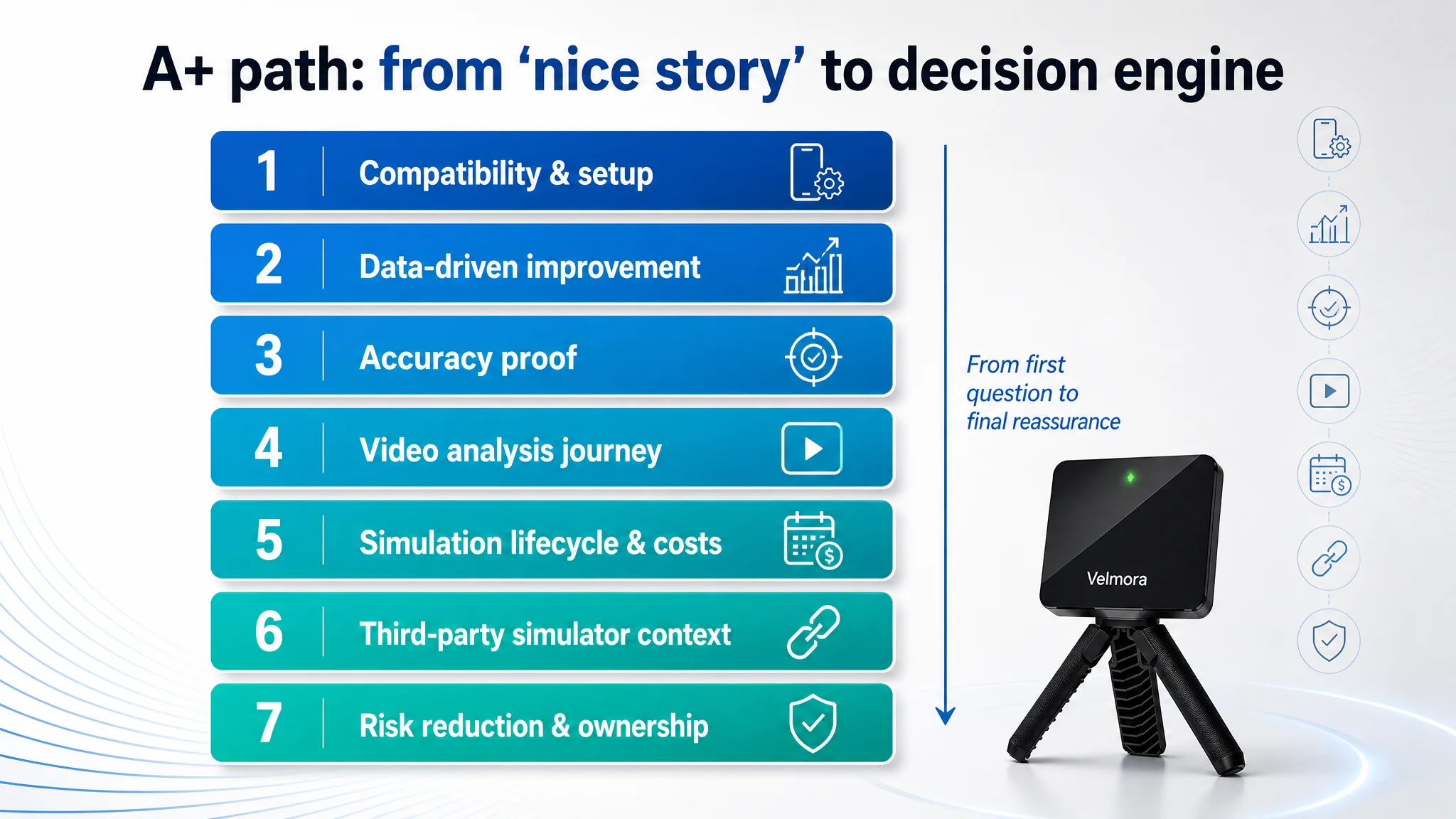
This A+ redesign does two critical jobs:
- It translates features into a believable improvement path for serious golfers.
- It removes friction around “hidden” costs and practical usage, which are common reasons to hesitate or abandon.
How the Page’s Sales Logic Started to Recover
Once the Listing shifts from “device showcase” to “full, transparent training ecosystem,” several things change in the funnel:
- CTR is more defensible.
- Early‑stage risk is reduced.
- Professional validation improves.
- Ownership feels less risky.
As a result, each ad click has a better chance of converting, and organic traffic landing on the page experiences fewer invisible blockers.
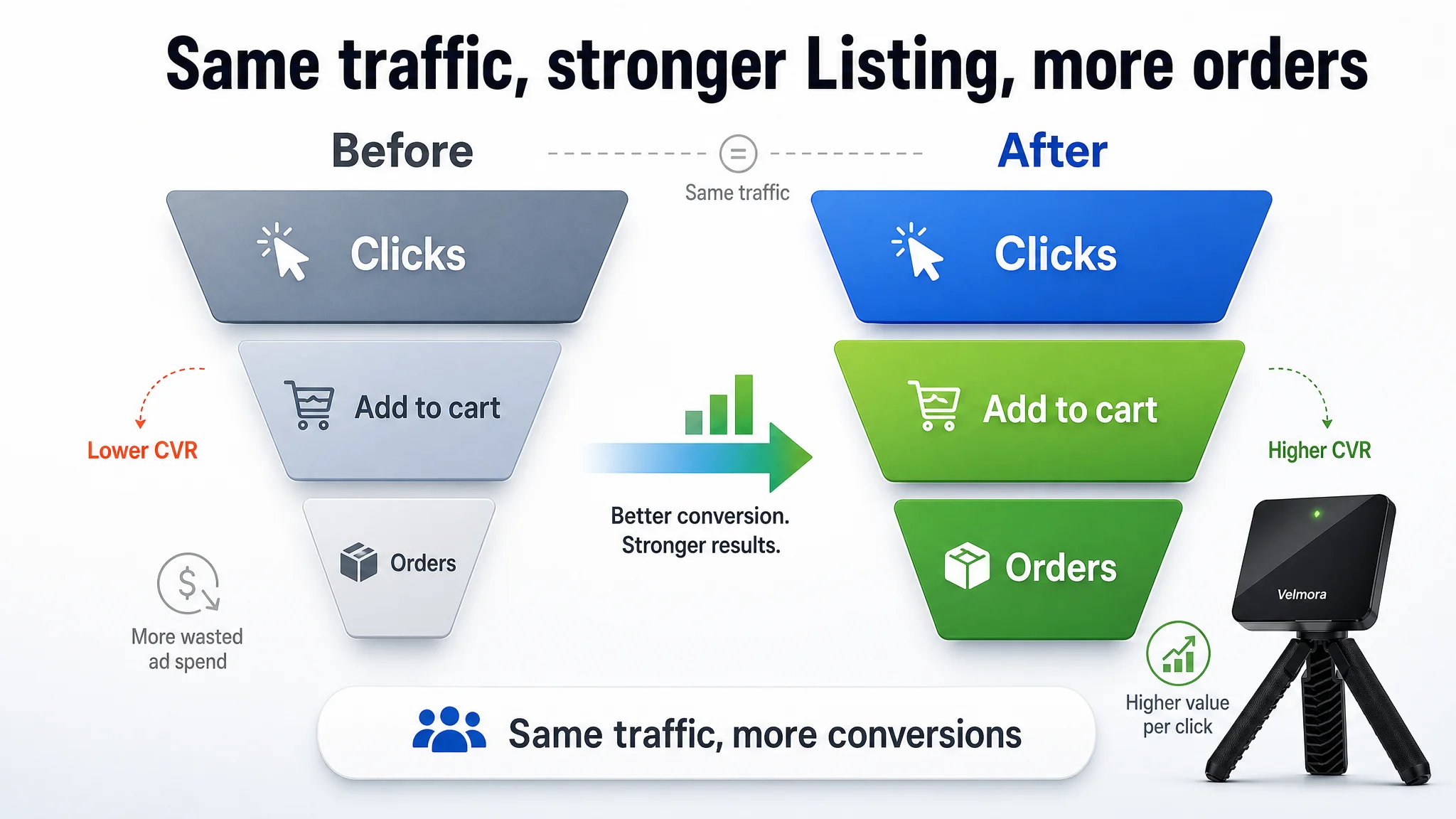
How Ad Traffic Became Useful Again
DeepBI’s perspective is that advertising should amplify strengths, not force a weak page to absorb more clicks.
In this case, once the Listing is re‑engineered:
- Existing ad spend becomes more productive.
- Organic and paid traffic start to converge in behavior.
- Future ad optimization becomes rational.
The seller moves from “we’re blindly pushing more into ads” to “we’re feeding a well‑designed Listing and reading the data correctly.”
What Changed in the Seller’s Understanding
The most valuable outcome was not just the content changes, but the mental model shift:
1. Amazon ads are not a substitute for a strong Listing.
2. Review quantity is not the same as conversion readiness.
3. Listing elements must work as a system, not a checklist.
4. Before scaling ads, ask: does this page deserve more traffic?
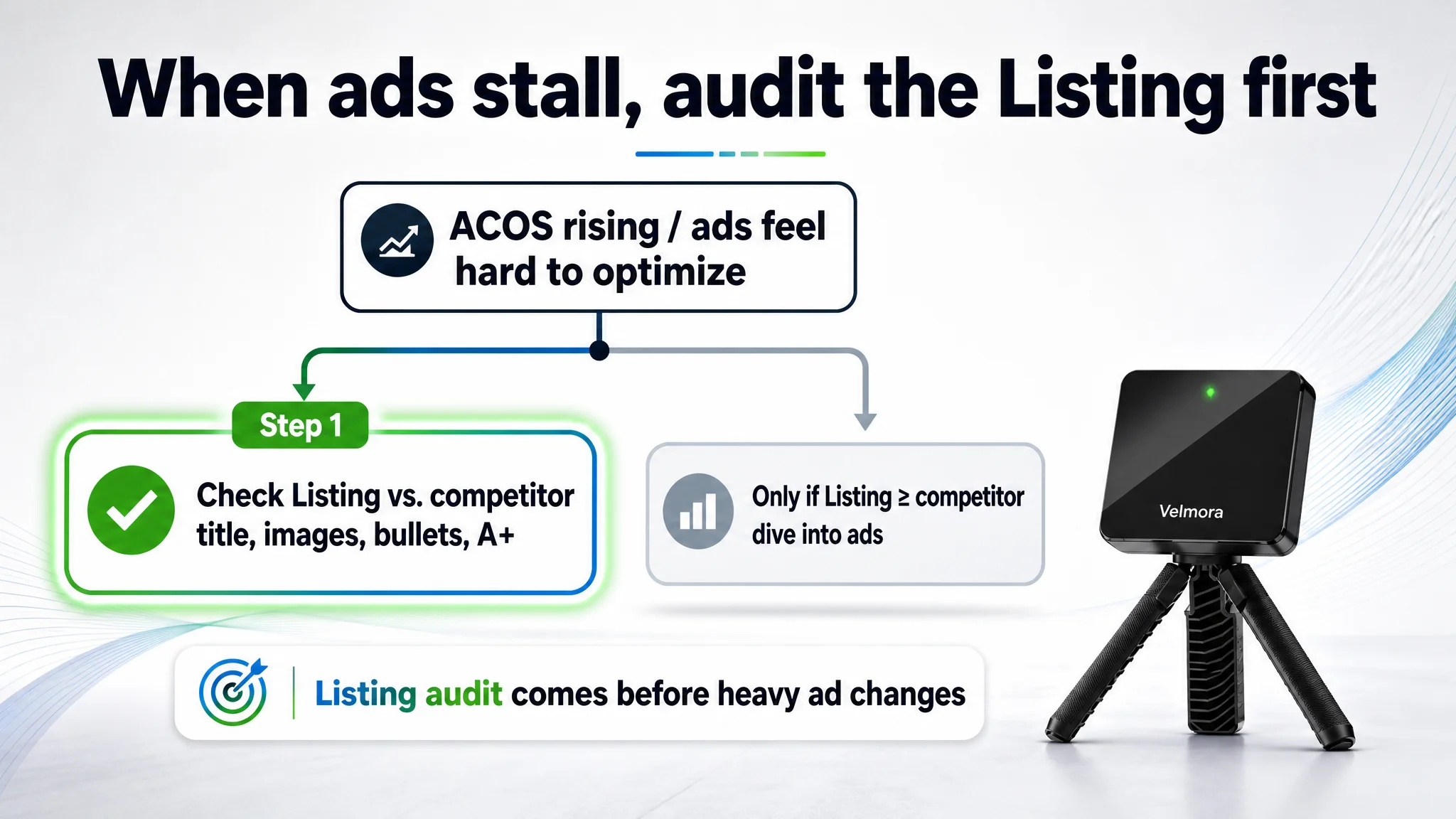
For other Amazon sellers—especially in high‑consideration categories like electronics, sports tech, and premium accessories—the lesson is direct:
- If ads feel “harder and harder to optimize,” and you instinctively blame keywords and bids, pause.
- Put your Listing head‑to‑head against your true benchmark competitor.
- Identify whether your page is actually converting traffic as well as it could.
Often, the turning point is not a new campaign tactic, but a better judgment of where the real bottleneck lives.