

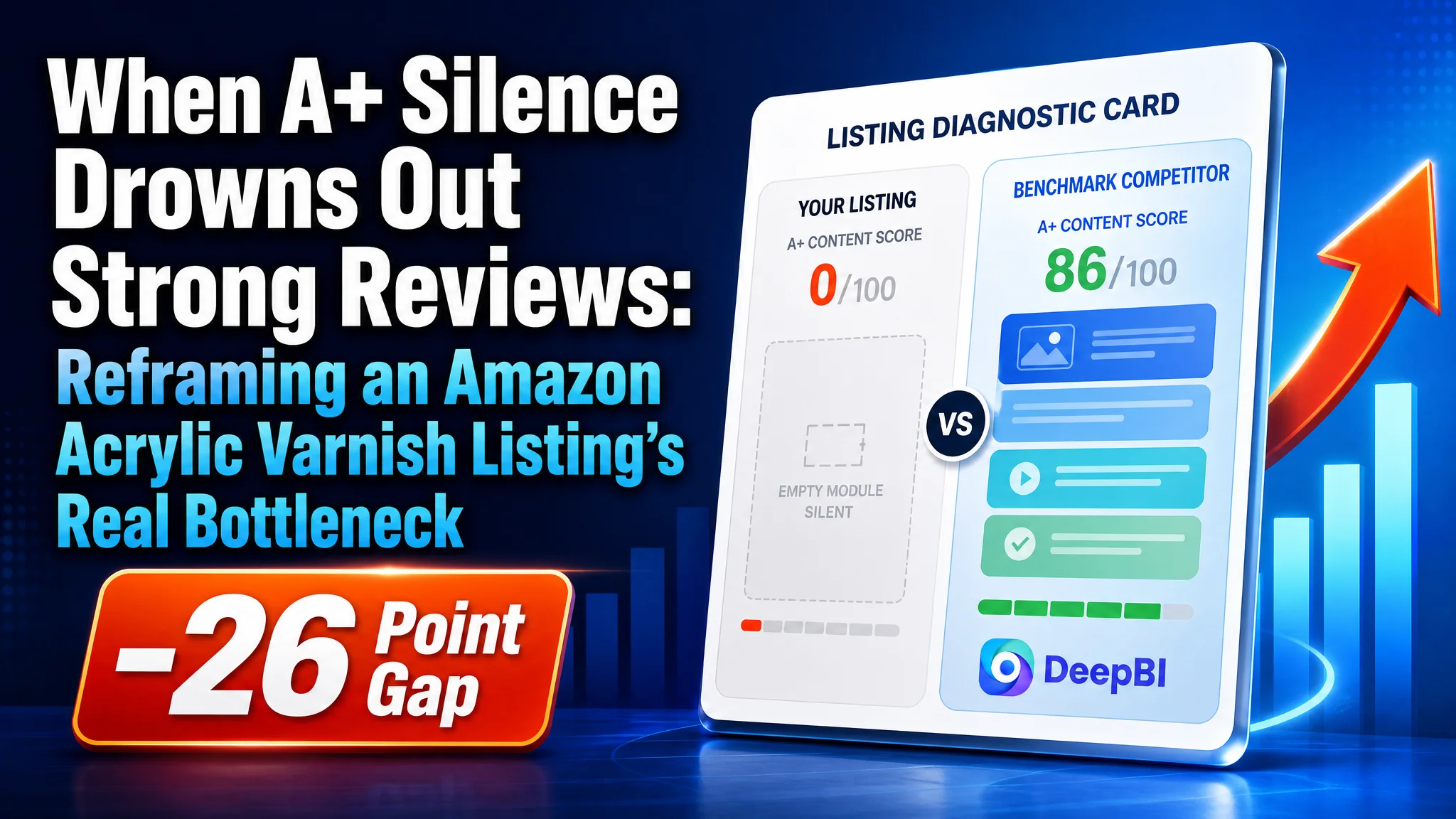
This case comes from an Amazon seller in the art-supplies category, selling an acrylic gloss varnish on the US marketplace. On the surface, their situation didn’t look bad: reviews were solid, the main images were not obviously weaker than competitors, and ads were already bringing in traffic. The team concluded that “ACOS is high because ads aren’t tuned well enough” and kept iterating bids, keywords, and campaign structure.
DeepBI’s diagnosis pointed in a different direction. When the Listing was scored against a category-leading competitor, the overall score lagged by 26 points—almost entirely because the Amazon product page had no A+ content at all, while the benchmark Listing used a full set of high-impact modules to walk buyers through protection, gloss effect, application, and safety. Ads were not the core problem; the Listing’s conversion capacity was.
The later optimization pivoted away from “keep fixing ads” and toward rebuilding the sales logic of the page: retuning the title to clarify the product’s role, reorganizing bullet points into a problem–solution–result path, restructuring the main-image sequence into a progressive persuasion funnel, and designing a complete A+ story around anti-yellowing protection, ease of use, and multi-surface versatility. For other Amazon sellers, the case is a reminder that strong reviews and “decent” creatives do not compensate for a missing decision path on the product page—and that ad performance will not stabilize until Listing conversion is structurally repaired.
Amazon Ads Were Not Failing. The Page Was Consuming the Traffic.
From the seller’s perspective, the pain point appeared straightforward: advertising costs on this Amazon varnish Listing were hard to control, and ACOS refused to come down.
They were already doing “what experienced Amazon sellers do”:
- Aggressively testing ad keywords related to acrylic varnish, clear sealer, gloss finish.
- Adjusting bids and budgets to chase volume while trying to protect profitability.
- Comparing click-through rates and assuming the main-image set was “good enough” because it didn’t look obviously worse than peers.
Because reviews looked healthy—4.3 stars with 279 total ratings, far more than the competitor’s volume—the team subconsciously ruled out the product page as the core issue. In their mental model, a Listing with stronger social proof should convert similarly or better, so they treated ads as the main lever.
DeepBI’s scoring made one thing obvious: this Listing did not have a traffic problem.
It had a conversion infrastructure problem. And every additional dollar of ad spend was being poured into a page that lacked a coherent persuasion path.
“The real problem was not that ads failed to bring traffic. It was that the page could not convert the traffic.”
The Real Constraint Was Listing Conversion Capacity
DeepBI’s Listing scoring system compared this varnish Listing to a benchmark competitor in the same acrylic varnish niche on Amazon US.
The total score gap was stark:
- Target Listing: 58 / 100
- Benchmark Listing: 84 / 100
- Gap: –26 points
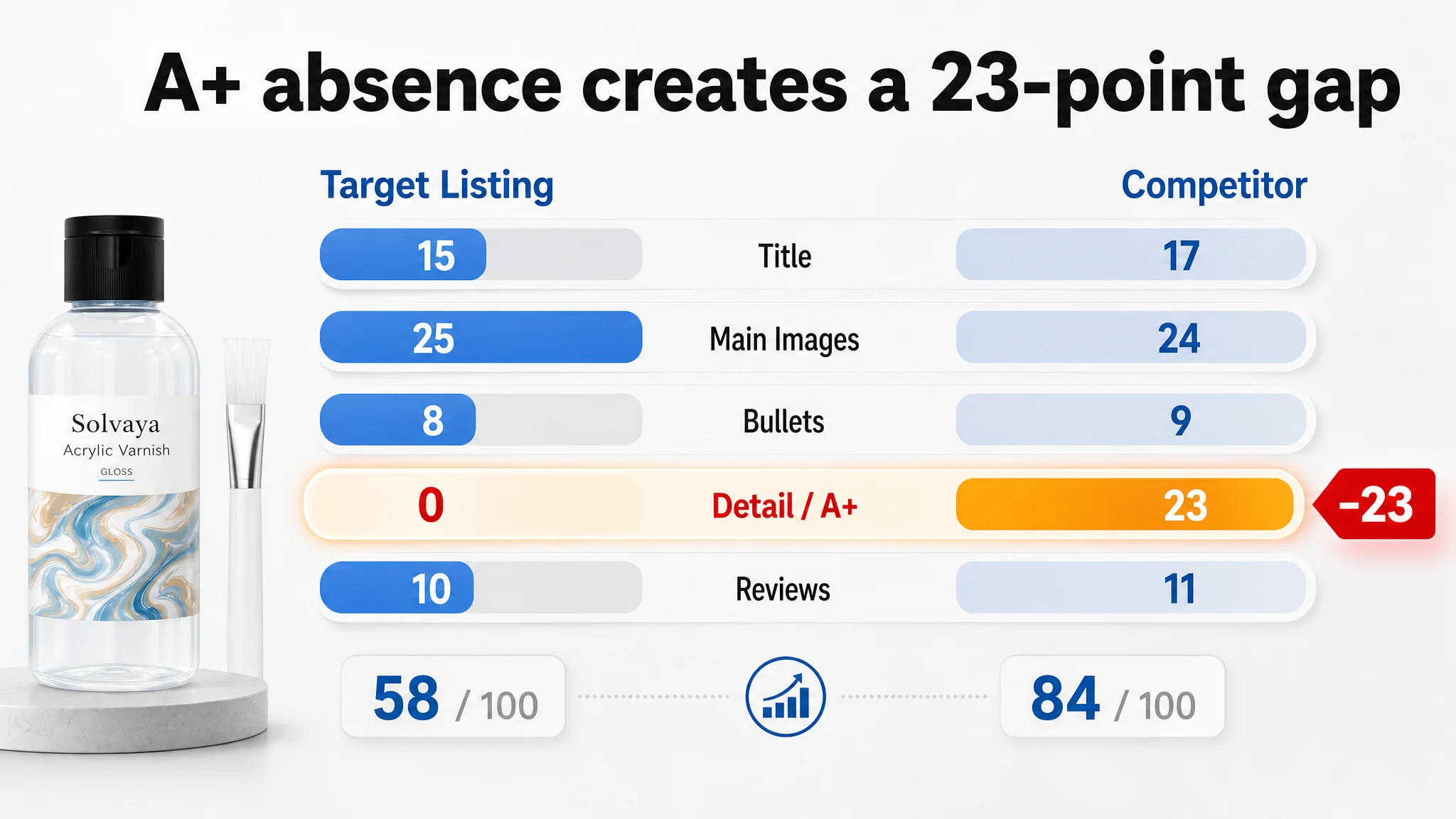
When we broke that down by dimension, a single weakness dominated:
- Title: Target: 15, Competitor: 17, Max: 20, Gap: –2
- Main Image Set: Target: 25, Competitor: 24, Max: 30, Gap: +1
- Bullet Points: Target: 8, Competitor: 9, Max: 10, Gap: –1
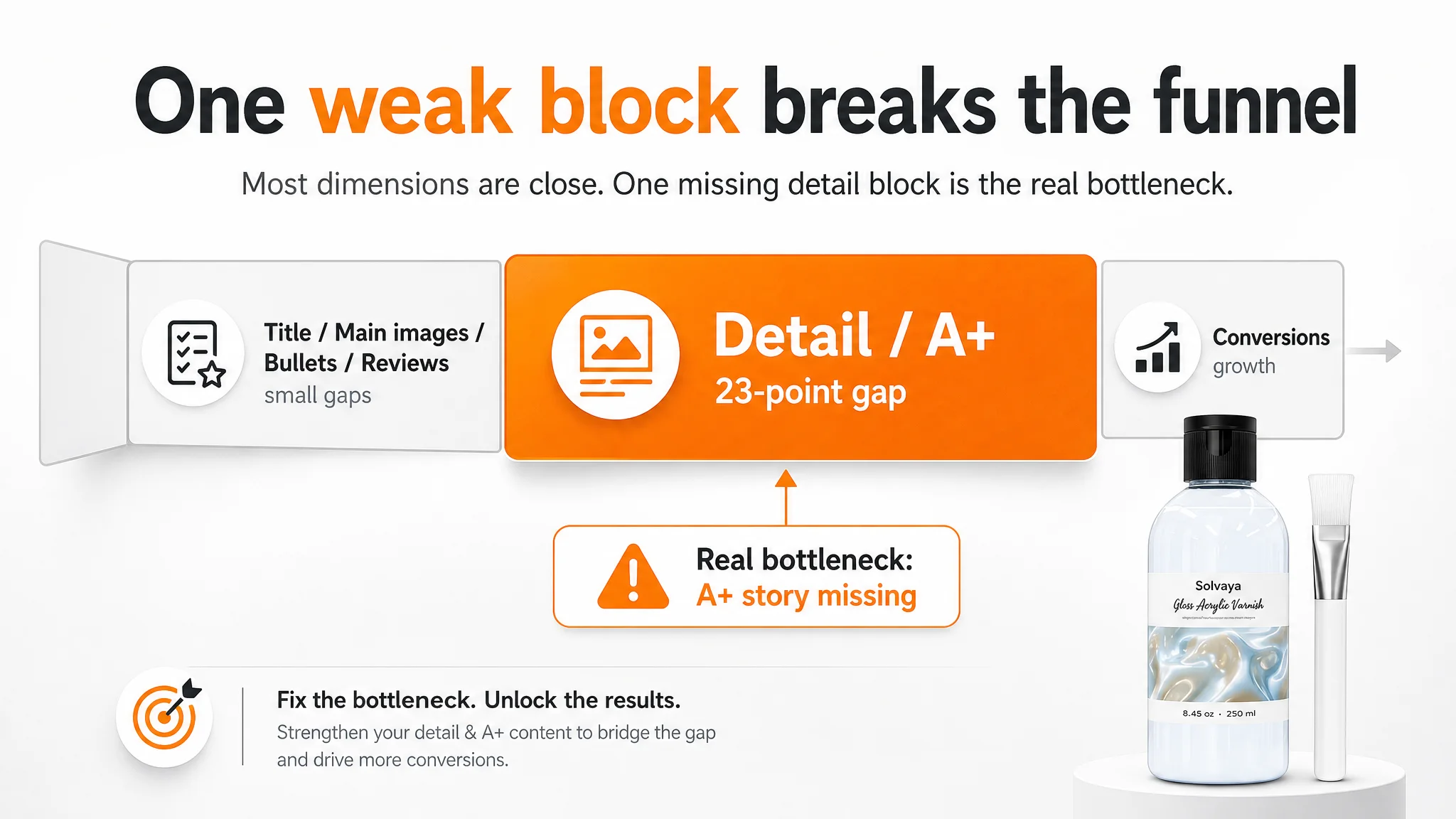
- Detail / A+: Target: 0, Competitor: 23, Max: 25, Gap: –23
- Reviews: Target: 10, Competitor: 11, Max: 15, Gap: –1
Title, main images, and bullet points were not perfect, but they were within a narrow band of the competitor. The detail/A+ dimension, however, was a complete zero.
The competitor’s Amazon product page deployed:
- A hero A+ banner with bundle visualization.
- Clear “before/after” comparison of yellowing and gloss.
- Icons for Anti-Dust, UV Resistant, Non-Yellowing, Non-Toxic.
- A module explaining the protective-film mechanism.
- Step-by-step application instructions with visuals.
- Multi-surface compatibility layouts.
- A final module summarizing benefits and reinforcing trust.
The target Listing: no A+ modules at all.
On an Amazon art-supplies product that promises protection over time, this absence is not a cosmetic issue. It means:
- No visual explanation of what the varnish is and how it works.
- No structured path from anxiety (“will my painting yellow or crack?”) to assurance (“this film blocks oxidation and UV”).
- No instruction visual to reduce fear of misapplication or brush marks.
- No visual proof that colors will truly “pop” after use.
In other words, the Amazon product page lacked the infrastructure to convert a cautious buyer who was not already fully convinced before clicking.
What the Seller Originally Misdiagnosed
With this structure missing, why did the seller still focus on ads?
Because the visible signals misled them:
- Reviews looked strong
4.3 stars vs. the competitor’s 4.4 is only a 0.1 difference. With 279 reviews vs. the competitor’s much smaller volume, they believed they held a trust advantage.
- Main images looked “good enough”
Score-wise, the target Listing even edged the competitor by 1 point on the main-image dimension. That reinforced the belief that “creative is not the real problem.”
- Ads showed clicks coming in
When traffic exists, it’s easy to think “our page is okay; ads just need more refinement.”
From there, the misdiagnosis took shape:
- “We just need to keep refining keyword coverage.”
- “We probably need better bid control or campaign structure.”
- “Maybe we should push more budget to protect ranking.”
The silent assumption: if reviews and main images look fine, Listing conversion is “good enough,” so the constraint must be in ad mechanics.
DeepBI’s data showed the opposite: ads were feeding a page where the final 30–40% of the decision funnel barely existed.
This Product Page Did Not Lack Trust Signals. It Lacked a Trust Story.
On Amazon, especially in categories like acrylic varnish, buyers rarely act on a single trust signal. They respond to a trust story:
- who this product is for,
- what it does to their artwork over time,
- why it is technically reliable,
- how they should use it correctly,
- and whether it is safe and manageable in their workflow.
The competitor’s A+ content built this narrative through six logical modules:
1. Scene-led banner
Sets context: for serious artwork protection, this is a professional solution.
1. Protection promise
Addresses fears: oxidation, yellowing, flaking, UV damage.
1. Effect validation
Shows before/after and high-gloss visual outcomes.
1. Process guidance
Reduces the risk of misuse and brush marks.
1. Versatility confirmation
Shows compatibility beyond canvas: wood, crafts, bottle art, DIY.
1. Safe and practical reassurance
Highlights non-toxic, quick-dry, manageable handling.
The target Listing had none of this visual storyline.
“Advertising does not only amplify advantages. It can also amplify a page’s existing defects.”
Every new visitor from Amazon ads arrived at a product that—beyond a few bullet points—did not visually answer core anxieties or expectations.
Why Traditional Ad Optimization Kept Failing
Once the core diagnostic was clear—that the Listing’s conversion infrastructure was weak—the ad patterns made sense.
When a Listing:
- has no A+ content,
- relies on bullets to carry the entire persuasion load,
- and depends on buyers reading text-heavy sections without visual anchoring,
then even well-structured campaigns will show:
- Stable or rising impressions as bids and budgets are increased.
- CTR that may be acceptable, thanks to a decent main image and title.
- CVR that refuses to move in line with spend, because final doubts are not resolved.
Traditional ad optimization tends to assume:
- tweak keyword scope → improve traffic relevance,
- refine bids → control cost per click,
- restructure campaigns → stabilize data.
These operations are valid—but only if the product page is already capable of converting incremental traffic.
In this case, DeepBI’s scoring told a different story: fixing bids on a 0/25 A+ dimension is misaligned effort. Until the Listing gained a credible A+ story and stronger bullet logic, ad-level experimentation would repeatedly hit the same wall.
How DeepBI Identified the Real Root Cause
The scoring report didn’t just output a low detail-page score. It showed where and why the gap mattered.
Title: Mostly Functional, but Not Structurally Sharp
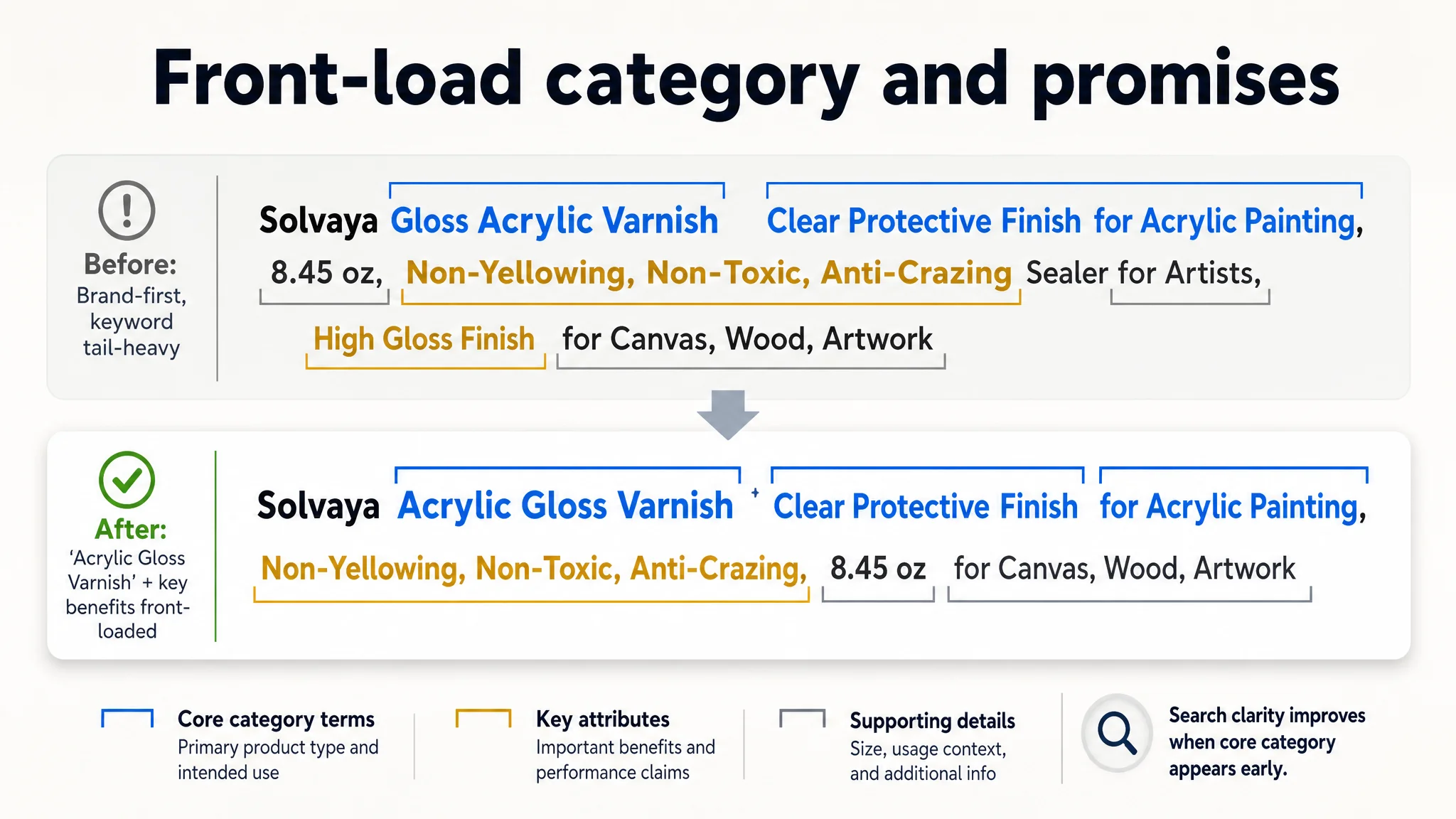
The existing title placed the brand name at the very start, pushing the core keyword “Gloss Varnish” away from the optimal position in the Amazon search logic. It also:
- mixed capacity, target users, and use cases,
- ended with a long tail of “Canvas Artwork, Acrylics Paint, Wood, High Gloss Finish” that felt more like keyword stacking than a clean promise.
The competitor’s title:
- kept core category terms (“Gloss Varnish for Acrylic Painting”, “Clear Acrylic Sealer”) tightly clustered in the front half,
- pushed protection and non-yellowing attributes earlier,
- maintained a more compact structure.
DeepBI’s recommendation was not to rewrite the title from scratch, but to rebalance:
Suggested direction: “Acrylic Gloss Varnish Clear Protective Finish for Acrylic Painting, 8.45oz Non-Yellowing, Non-Toxic, Anti-Crazing Sealer for Artists, High Gloss Finish for Canvas, Wood, Artwork”
The point was not wordsmithing; it was to ensure:
- core category and result terms (“Acrylic Gloss Varnish”, “Clear Protective Finish”) appear early,
- key attributes (non-yellowing, non-toxic, anti-crazing) are explicitly named,
- capacity and use cases support, rather than clutter, the primary promise.
Main Image Set: Strong Pieces, Weak Sequence Logic
Score-wise, the main images weren’t a disaster. But the persuasion sequence was under-optimized.
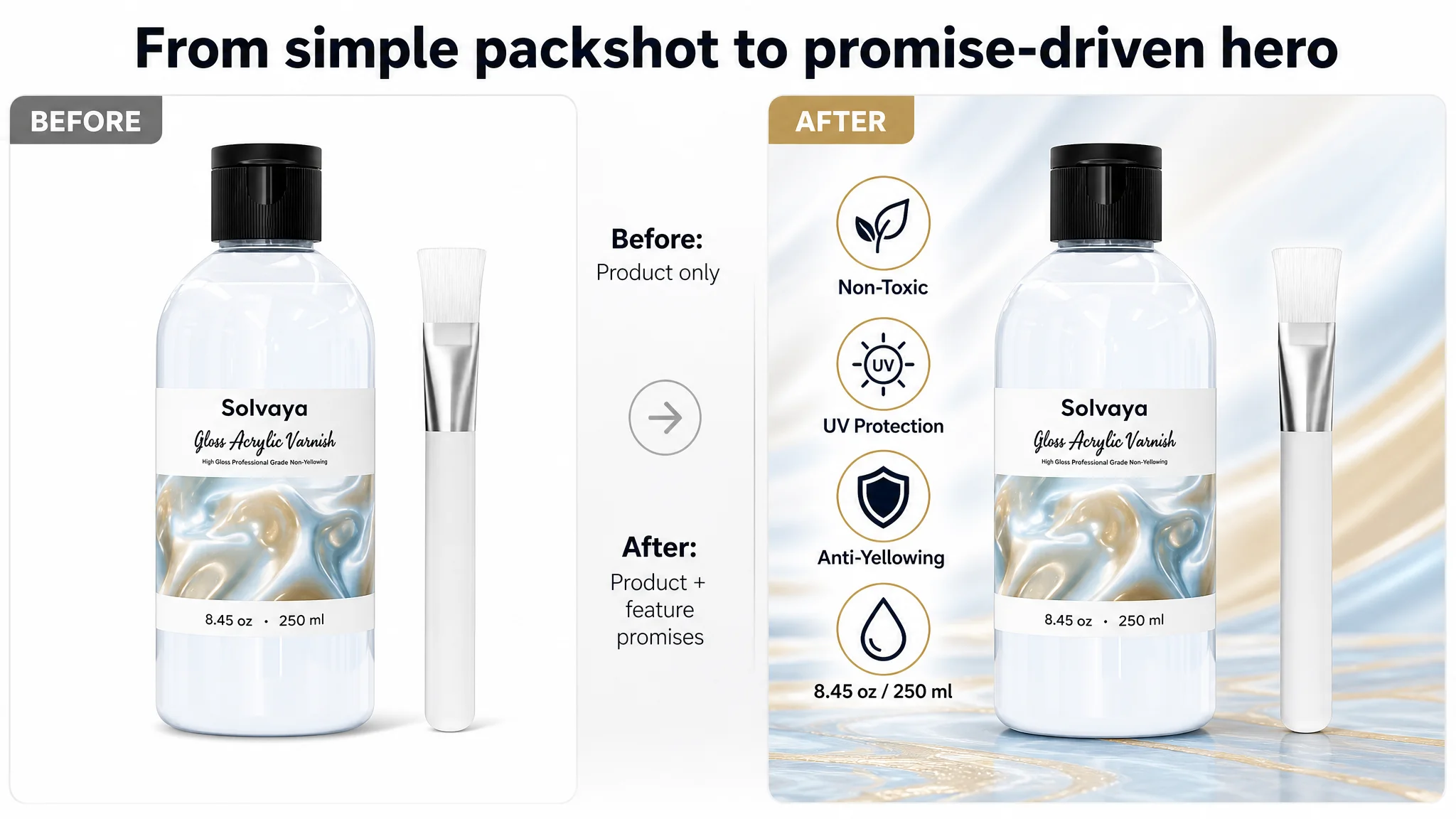
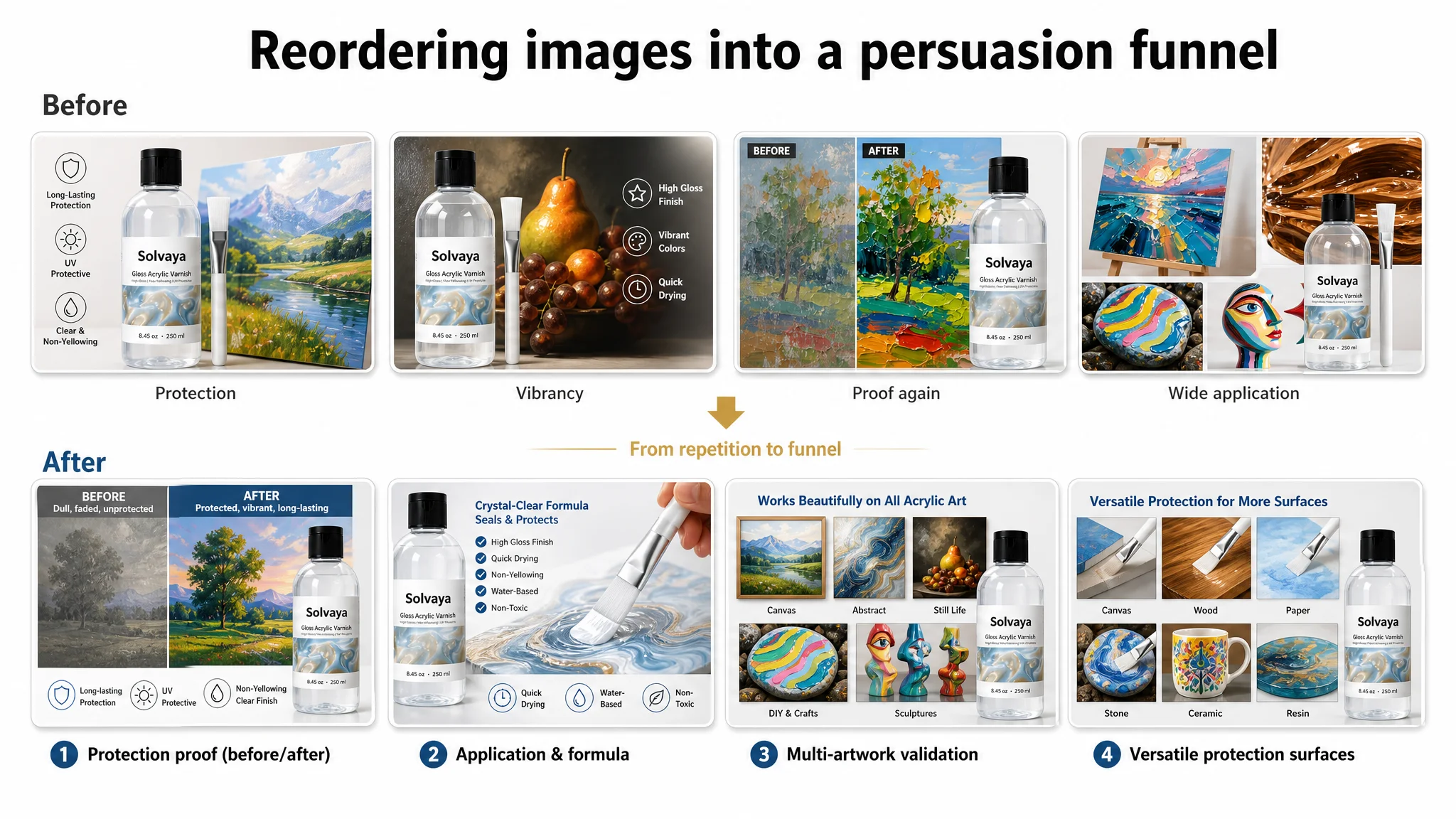
- Image 1 (hero)
Confirmed product, size, and brush accessory, but missed the chance to publish feature icons (Anti-Yellowing, UV Protection, Non-Toxic, 8.45oz). Competitor made those visible at thumbnail level.
- Image 2
A strong “with/without” contrast—it clearly showed fading/yellowing prevention and was worth keeping as-is.
- Image 3
Focused again on vibrancy, repeating the outcome rather than explaining the mechanism (clear protective shield, flexible non-tacky film) that technical buyers care about.
- Image 4
Another proof-like frame with ambiguous icons, overlapping Image 2 and 3 instead of adding new depth.
- Image 5
Visualized applicability (different surfaces), but didn’t tie each surface to a specific visible benefit (e.g., brilliant sheen + non-tacky flexibility on wood vs. canvas).
DeepBI’s judgment: the picture assets were not fundamentally lacking, but their roles overlapped, and the sequence didn’t form a progressive sales logic.
The recommendation was to:
- Let Image 1 clearly promise the basics with icons (non-yellowing, UV protection, non-toxic, large size).
- Keep Image 2 as a strong “before/after” trust anchor.
- Reassign Image 3 to explain application process and formula properties (clear, flexible, non-tacky surface, quick drying, ease with soft brush).
- Rebuild Image 4 as a multi-case validation node: multiple artworks and subjects, proving consistent results after browsing.
- Preserve Image 5 as the scenario reinforcement node, explicitly mapping each surface type to the core benefit.
Bullet Points: Information Without a Decision Path
The original bullet points were functional but lacked a problem–solution–result logic. The competitor:
- opened with robust protection logic (blocking oxidation, preventing flaking),
- tied gloss to visual impact (layered tones, intense vibrancy),
- reinforced safety and texture preservation,
- widened compatibility,
- and ended with clear, confidence-building usage instructions.
DeepBI’s recommendations recast each bullet with a defined role:
1. Advanced protection & sealing
Emphasize dust, UV, yellowing resistance, blocking oxygen oxidation, preventing flaking, and lifespan extension.
1. Vibrant high-gloss finish
Highlight no visible brush marks, tonal layering, and professional sheen.
1. Safe formula & texture preservation
Clarify non-toxic, water-based, flexible non-tacky finish, preserving brush strokes and texture.
1. Versatile multi-surface use
Expand to canvas, wood, bottle art, DIY, smooth and porous surfaces, and target students to pro artists.
1. Complete kit & easy application
Use the included soft brush as a differentiator; provide professional yet simple steps (shake, thin coats, one-direction strokes, 1–2 hours per coat, 24-hour cure).
Each bullet became part of a structured persuasion chain, not just a list of traits.
Detail Page / A+: A 23-Point Gap That Could Not Be Ignored
The biggest red flag remained:
- Competitor: 23 / 25 on detail/A+
- Target Listing: 0 / 25
DeepBI broke down what needed to be built, not just “that A+ was missing.”
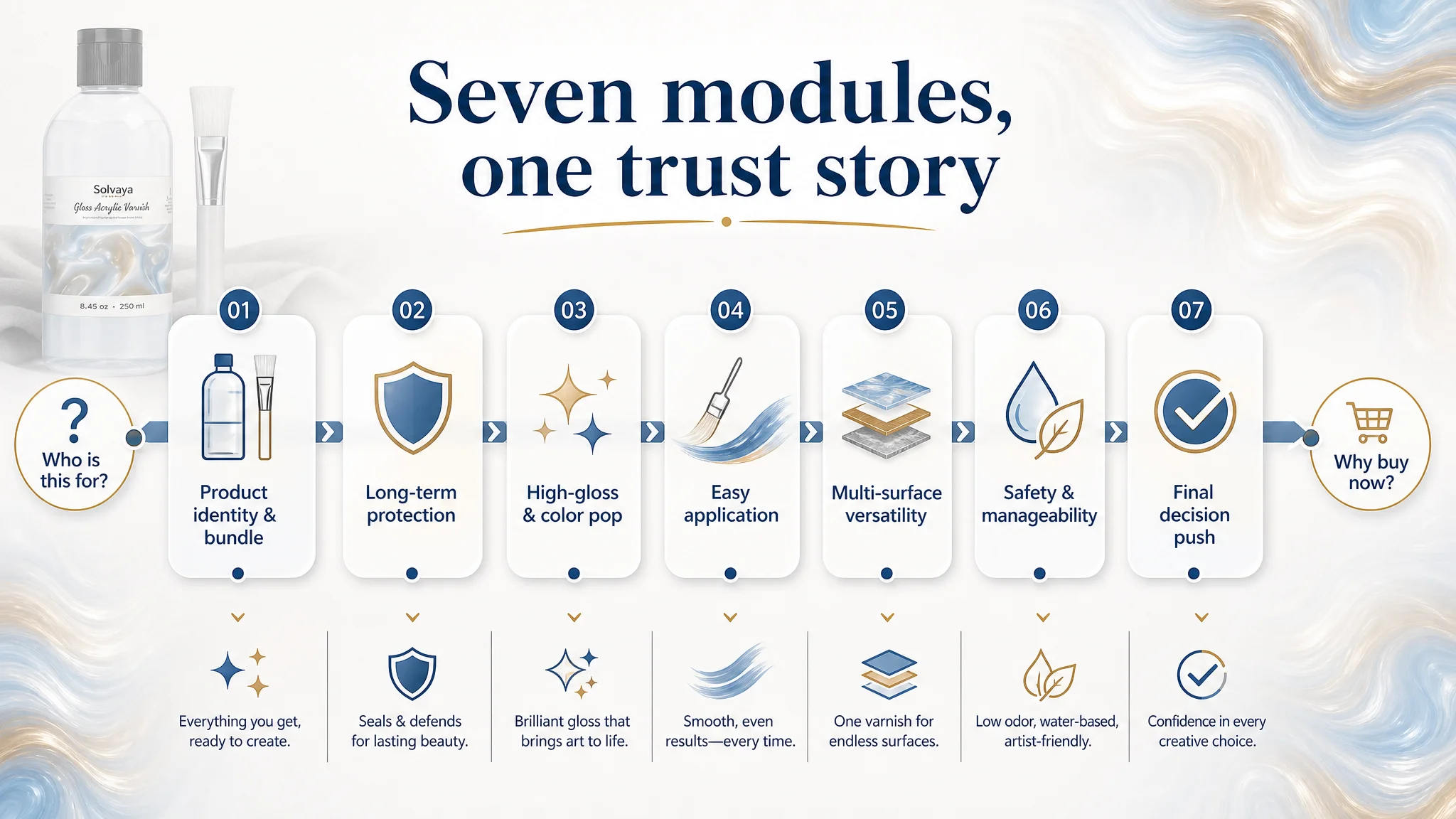
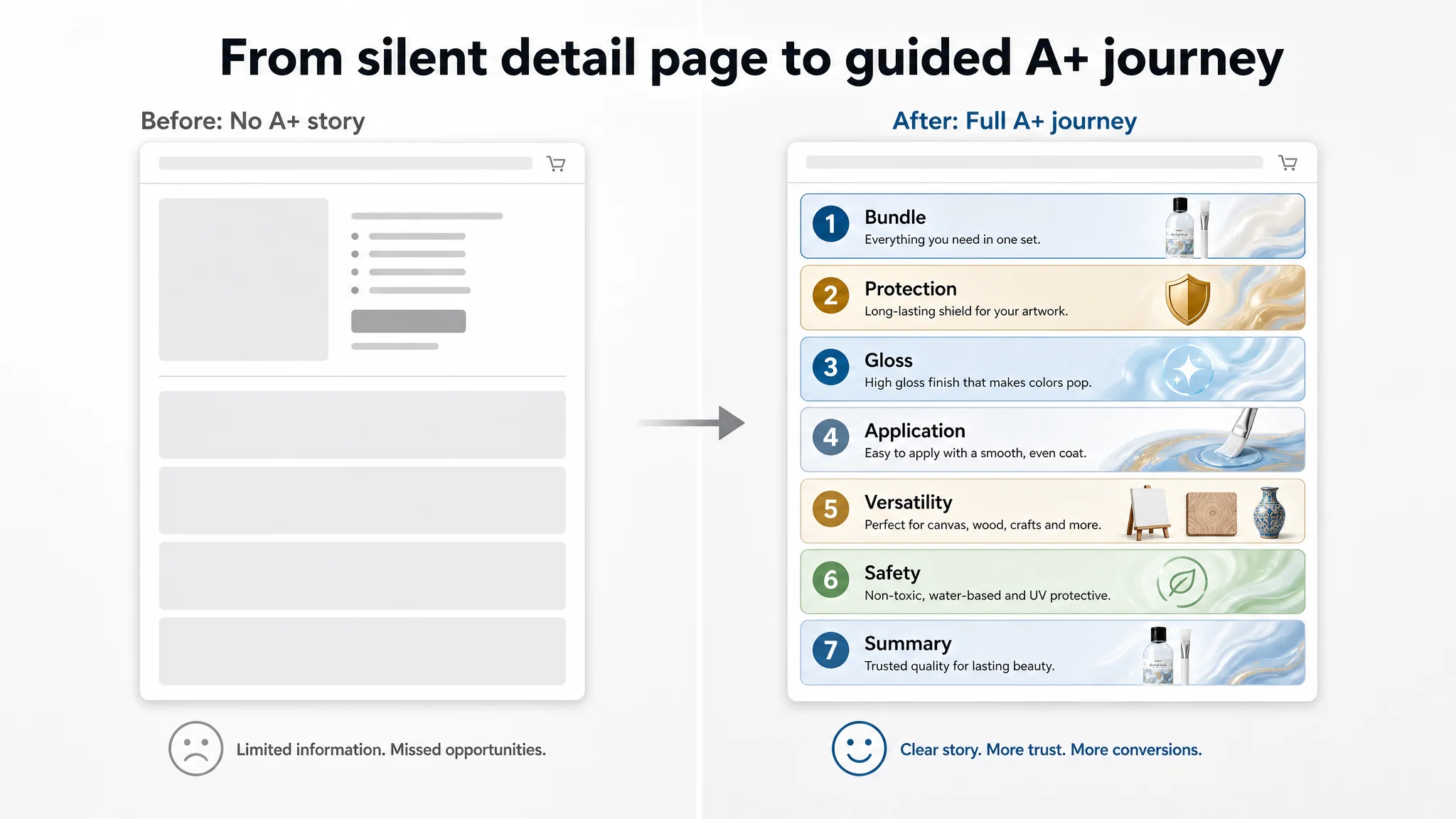
Seven modules were defined, each targeting a specific buyer question:
1. Module 1 – Define product identity & user suitability
2. Module 2 – Core anxiety: “Will my art be ruined over time?”
3. Module 3 – Aesthetic desire: “Will it make my colors pop?”
4. Module 4 – Process anxiety: “Is it hard to apply?”
5. Module 5 – Project versatility: “Can I use this on something else?”
6. Module 6 – Rational confidence: “Is it safe and manageable?”
7. Module 7 – Final decision push
This was not a cosmetic rebuild. It was a conversion architecture that had been missing entirely.
Why DeepBI Did Not Keep Tuning Ads First
With this evidence, the decision order became clear.
Continuing to adjust ads first would have:
- Pushed more traffic into a page that still lacked a trust story.
- Kept ACOS volatile because CVR would not recover meaningfully.
- Masked the structural weakness with short-term bid manipulations.
DeepBI’s judgment was that Listing conversion had to be repaired before further ad scaling:
- The biggest business risk was not that ads were inefficient per se, but that they were amplifying a low-conversion page.
- Every additional click would carry the same high probability of abandonment due to unresolved anxieties (longevity, gloss outcome, application complexity, safety).
The team’s operational focus shifted:
- First, re-architect the Listing: title, main images, bullet points, and A+ as a coordinated system.
- Then, relaunch or adjust ads with the expectation that each click now has a stronger chance of becoming an order.
Only once the page showed signs of improved conversion could ad experiments be trusted as a meaningful optimization path.
How the Page’s Sales Logic Started to Recover
After the direction shifted, the Listing’s transformation followed the decision path above, rather than a random set of changes.
The Title Started Communicating the Outcome, Not Just Attributes
The updated title structure made it easier for Amazon’s search and for buyers to immediately decode:
- Product category: acrylic gloss varnish, clear protective finish.
- Primary promises: non-yellowing, anti-crazing, high-gloss sealer.
- Intended users and surfaces: artists, canvas, wood, artwork.
- Rational anchor: 8.45oz capacity.
In the search results, this improved both keyword relevance and human readability, which feeds into click quality and pre-click expectation setting.
The Main-Image Sequence Became a Persuasion Funnel
Instead of five semi-overlapping frames, the new image plan followed a clear progression:
1. Hero – product + bundle + core icons (non-yellowing, UV resistant, non-toxic, large size).
2. Proof – “with/without” contrast for yellowing and fading.
3. Mechanism & process – application steps and formula behavior (clear, flexible, non-tacky, quick dry).
4. Validation – multiple artworks and subjects, consistent gloss and color richness.
5. Versatility – surfaces and project types, with visible sheen and non-tacky finish on each.
For buyers, the message evolved from “this is a varnish that makes things shiny” to “this is a proven protective system that is easy to use and works across projects.”
The Bullet Points Formed a Problem–Solution–Result Chain
Each bullet was re-written to:
- name the core concern (protection, gloss, safety, versatility, ease),
- explain how this varnish addresses it,
- and point to the outcome (lifespan extension, vibrancy, preserved texture, smooth workflow).
This increased the probability that even buyers scanning text lightly would still build a coherent understanding.
A+ Content Filled the Trust Gap
Most importantly, the A+ modules finally gave the page:
- a visual identity for the product and bundle,
- a logical path from anxiety to assurance,
- a proof-based showcase of results,
- and a clear, professional guide to avoid misuse.
Now, when ad traffic arrives, buyers can quickly:
- see what’s included,
- understand why their artwork will be safer and more vibrant,
- learn how to apply the varnish without fear,
- and confirm it fits their broader project needs.
How Ad Traffic Became Useful Again
Once the product page began to “carry its own weight,” the role of Amazon ads shifted:
- Clicks were no longer being wasted on a page that could not close the sale.
- ACOS could start to respond to optimizations because CVR was no longer constrained by a missing A+ story.
- Organic potential improved—Amazon’s ranking system is more willing to reward a Listing that reliably converts both paid and organic traffic.
Even without inventing specific post-optimization numbers, we can say the operational state changed:
- The Listing’s ability to convert traffic—both paid and organic—became structurally stronger.
- Ads started functioning as an amplifier of a working sales engine, rather than as a patch over an incomplete page.
- Dependence on aggressive bidding for every order could begin to ease as the page regained organic conversion capacity.
What the Customer’s Understanding Changed
By the end of this process, the seller’s mental model of Amazon operations had shifted in several important ways:
- Amazon ads cannot solve every conversion problem.
They can send the right people, but they cannot compensate for a page that doesn’t answer those people’s questions.
- Listing quality is the foundation of ad efficiency.
Title, main images, bullet points, and A+ must be aligned as one coherent argument—not four separate “tasks” owned by different people.
- Reviews are not a guarantee of conversion health.
Even with more reviews and similar star ratings, a Listing can still lose out if the competitor’s A+ story is stronger and more structured.
- Before scaling ads, the team must ask: “Does this page deserve more traffic?”
If the answer is no, or “not yet,” then the correct next step is not more bid logic but deeper Listing repair.
For other Amazon sellers, especially those in categories where trust, technical performance, and long-term results matter, this case is a reminder:
- It is possible to have traffic, strong reviews, and decent images—and still be leaking conversions.
- A missing or weak A+ story can quietly cap your CVR, no matter how hard you work on campaigns.
- DeepBI’s value in this scenario was not in “providing tools,” but in making a precise judgment: ads were not the core bottleneck; Listing conversion was.
Once that judgment became the new operating truth, the path forward—rebuilding the page’s sales logic and only then re-optimizing ads—became much clearer, and the Amazon business became more controllable.