

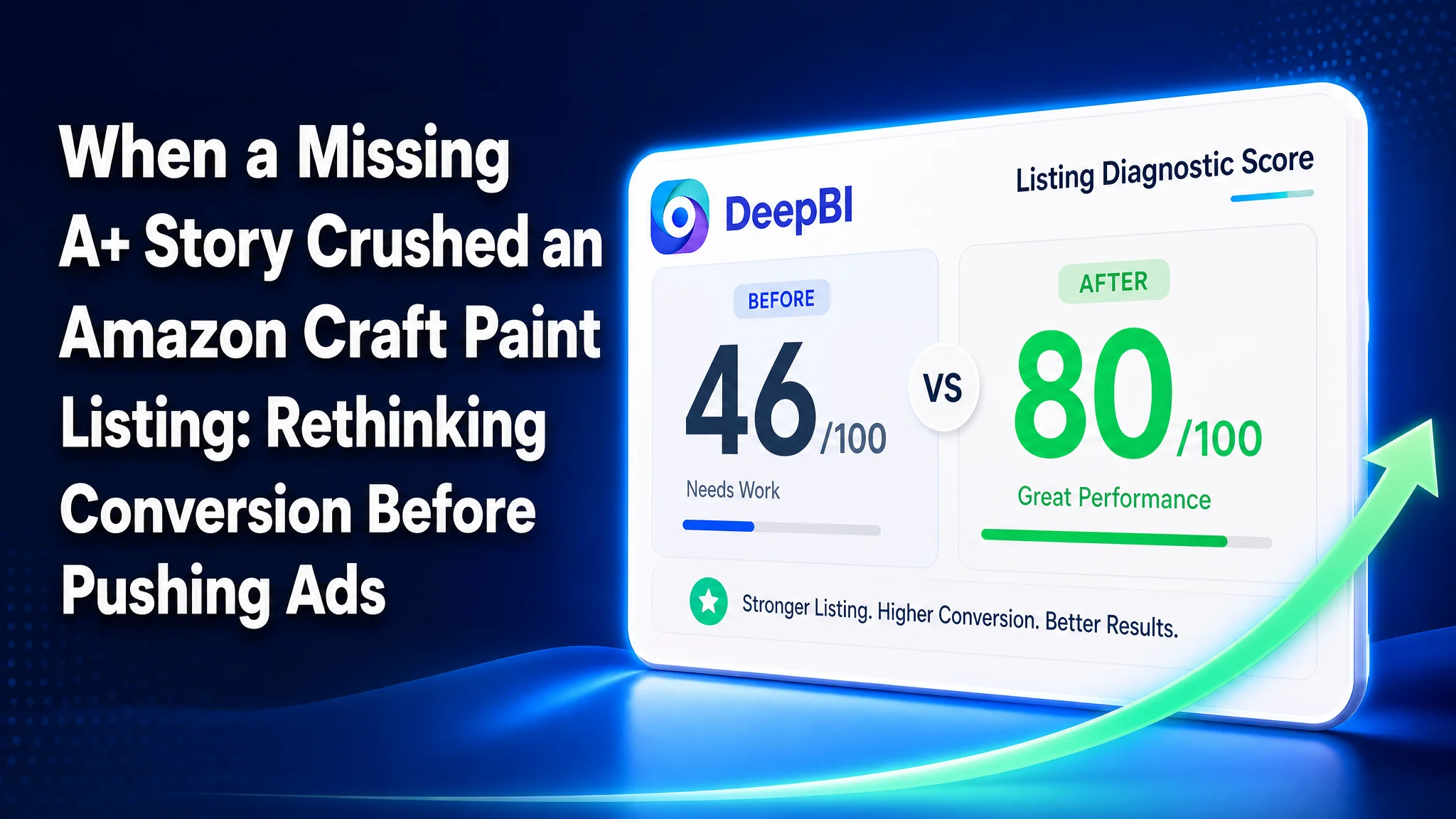
For this US Amazon seller in the acrylic craft-paint category, the immediate pressure came from rising advertising costs and weak sales. Traffic was not the real problem—what really hurt was that the product page could not convert visitors the way a leading competitor did. The seller initially believed the issue lay in keywords and images, and began adjusting titles and ads, assuming “more relevant traffic” would solve the problem.
Once DeepBI benchmarked the Listing against a category-leading Amazon competitor, a different picture emerged. The title and main images were not the worst part; the core leak was a near-empty product page: no A+ content, no visual proof of multi-surface use, almost no review base, and a confusing secondary image that misrepresented the product quantity and colors. Ads and keyword tweaks were simply sending more traffic into a page that was structurally unconvincing.
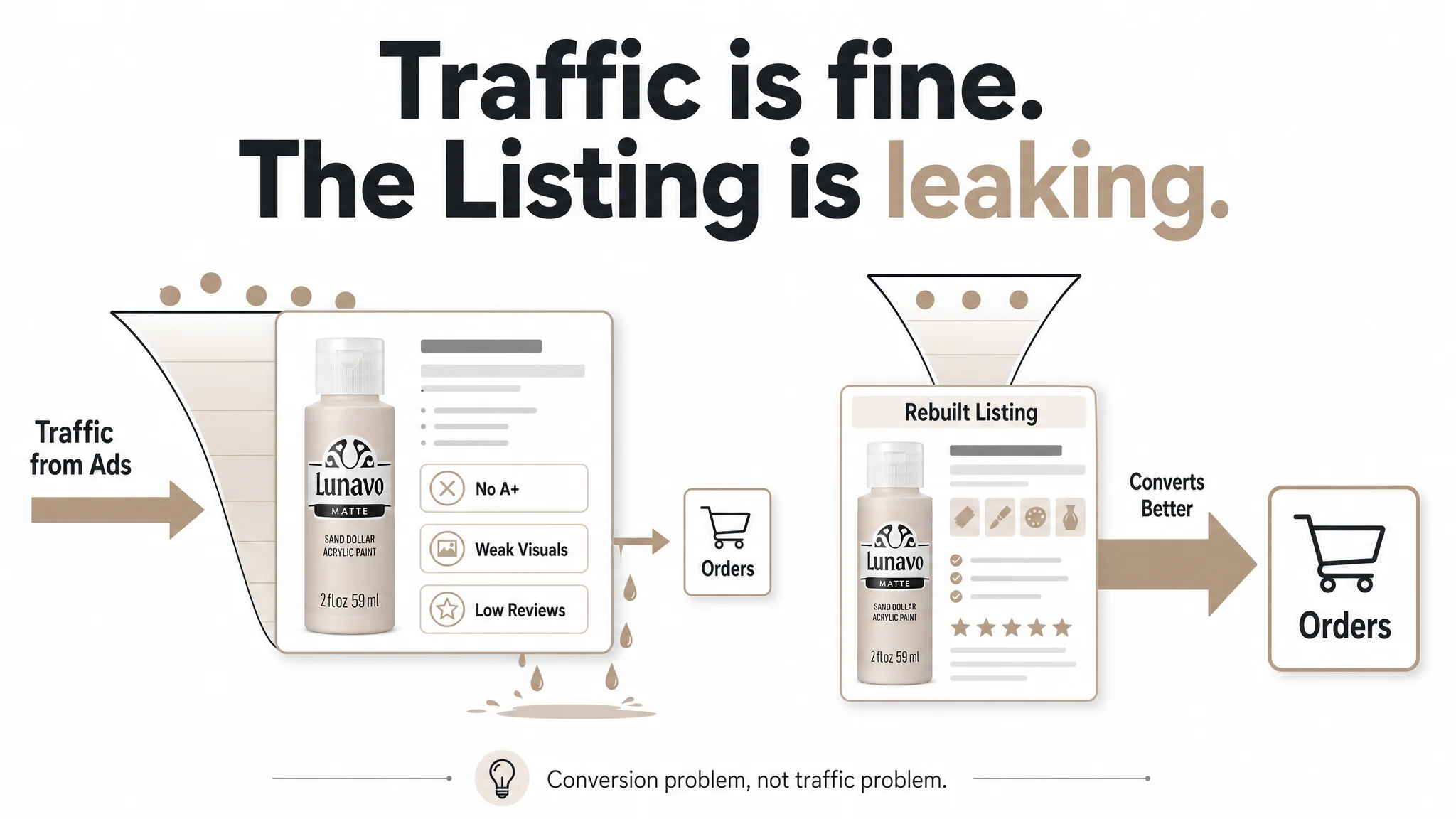
The later optimization therefore did not start with more ad tuning. It focused first on correcting misleading imagery, rebuilding bullet-point logic, and designing a complete A+ visual story around trust, multi-surface usage, and final project quality. Only once the product page could credibly handle traffic did ad traffic become worth scaling again. For other Amazon sellers, this case is a reminder: when ACOS feels uncontrollable, the constraint may not be bidding or targeting—it may be that the Amazon Listing itself has lost basic conversion capacity.
Amazon Ads Were Not Failing. The Page Was Consuming the Traffic.
From the seller’s perspective, the situation looked familiar: a niche color variant of a well-known acrylic craft paint, live on Amazon US, with ads running but orders lagging behind expectations.
The customer’s first instinct was typical:
- “Our keywords should be stronger.”
- “Maybe the title isn’t rich enough.”
- “We might need more images or a better main image.”
In other words, the team framed it as a traffic quality and ad optimization problem. They spent effort tuning titles toward more keywords like “Premium Matte Finish” and “DIY Arts and Crafts,” and tried to push ads harder, assuming better targeting would eventually move the needle.
Benchmarking against a category-leading competitor on Amazon told a different story:
- Total Listing score: 46 / 100
- Competitor Listing score: 80 / 100
- Gap: -34 points
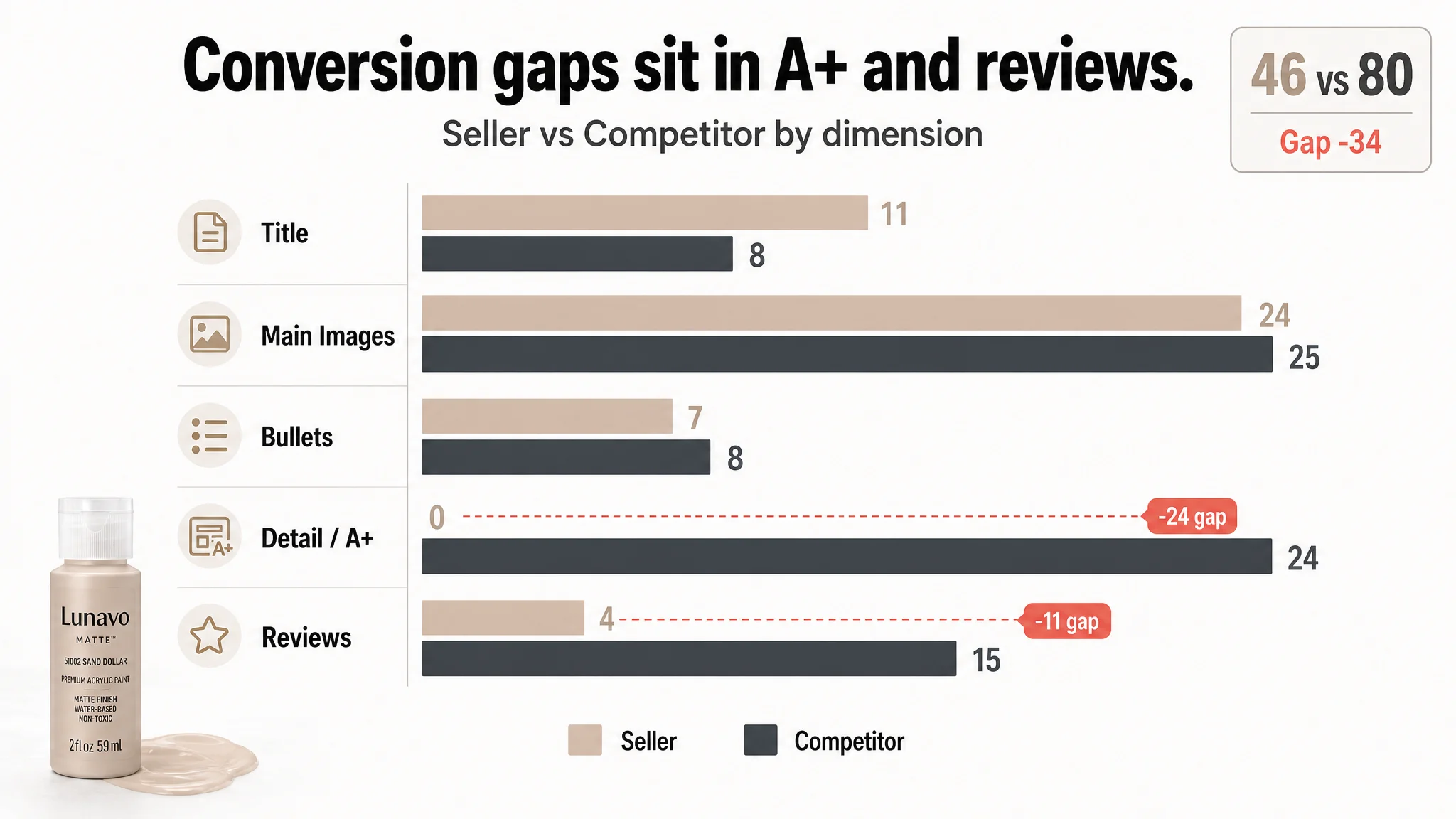
The largest gaps were not where the team expected:
- A+ / Detail page: 0 vs 24 (out of 25) → -24
- Reviews: 4 vs 15 (out of 15) → -11
Title and main images were not perfect, but they were not the primary bottleneck. The core issue was that the page lacked a full sales and trust story, especially compared with a mature Amazon competitor.
“The real problem was not that ads failed to bring traffic. It was that the page could not convert the traffic.”
In this context, pushing more ads would only magnify inefficiencies. Before DeepBI, the seller’s optimization sequence was inverted: they tried to fix performance from the ad side while the product page itself had structural conversion defects.
The Real Constraint Was Listing Conversion Capacity
When DeepBI decomposed the Listing by dimension—title, main image set, bullet points, detail/A+ content, and reviews—the pattern was clear.
Title: Acceptable, Not the Main Leak
On the title dimension, the seller actually outperformed the benchmark on raw scoring:
- Seller: 11 / 20
- Competitor: 8 / 20
The seller’s title:
- Covered more keywords (“Premium Matte Finish”, “DIY Arts and Crafts”)
- Mentioned concrete use cases
- Followed a relatively standard “brand + product + key feature + application + SKU” logic
The competitor’s title, though shorter and less information-dense, did one thing better: it brought “multi-surface” forward immediately after the brand—putting the core benefit up front.
DeepBI’s takeaway: the title could be sharpened for structure and compliance, but it was not the key reason the Listing was losing so badly.
Main Images: Competitive, But With a Hidden Trust Mine
Main image set scores were close:
- Seller: 24 / 30
- Competitor: 25 / 30
Visually, the seller’s images were not catastrophic. However, one image (Image 2) was a direct trust hazard:
- The product is a single 2 oz Sand Dollar paint bottle
- Image 2 shows six bottles in multiple colors (yellow, blue, red)
- For a shopper, that looks like a multi-pack or at least a multi-color offer
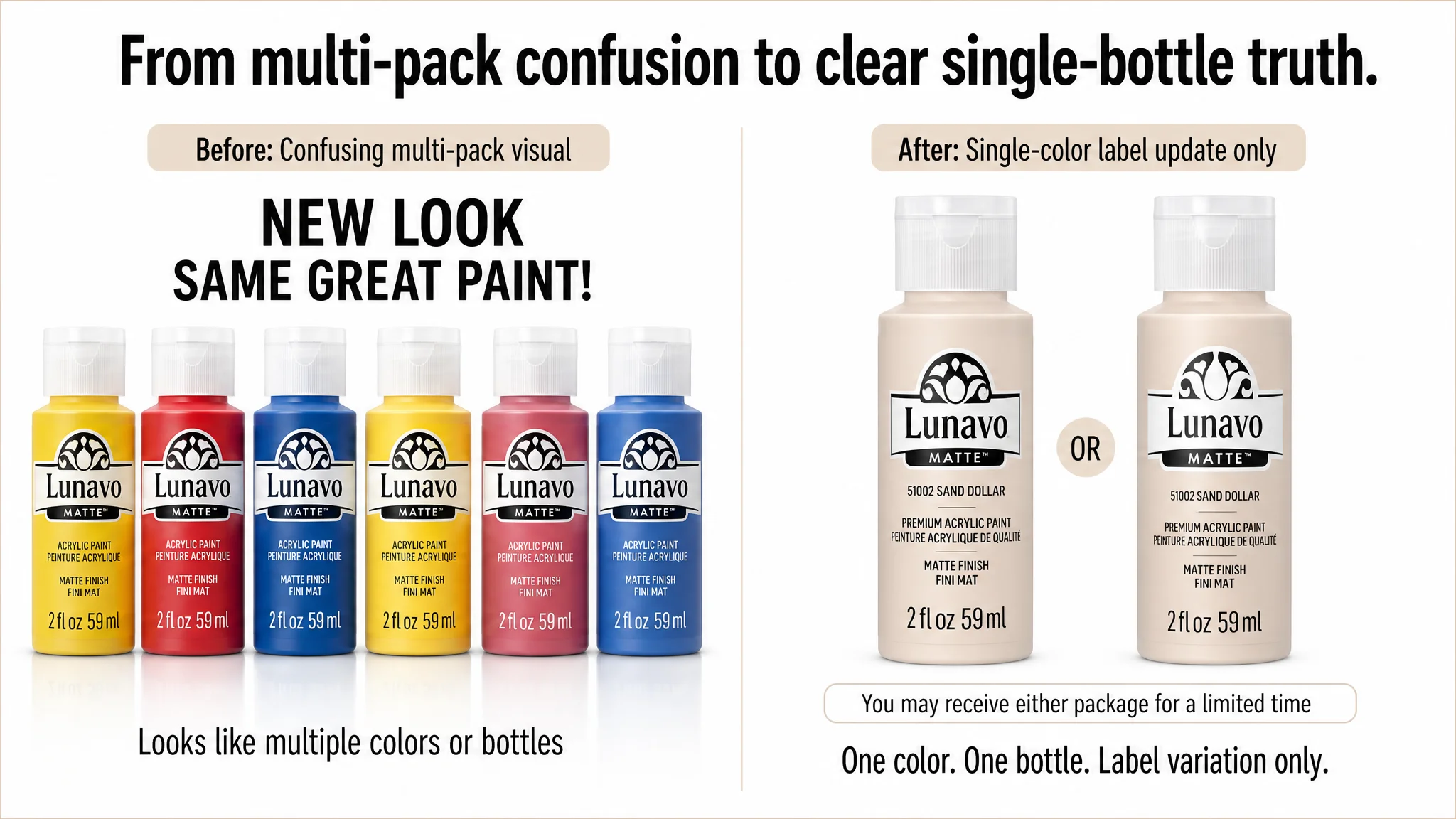
This created a hard expectation mismatch:
- Shoppers could believe they’re getting multiple colors or bottles
- The actual offer is one bottle, one color
That is not just a “design issue”; it is a conversion and review risk. Confusion at the image level leads to hesitation before purchase and frustration after delivery.
At the same time, the competitor used its image set to:
- Show vibrant projects on varied surfaces (wood birdhouse, terracotta, rocks)
- Display hand-in-action scenes to convey ease of use
- Build a fun, bold, bright emotional tone
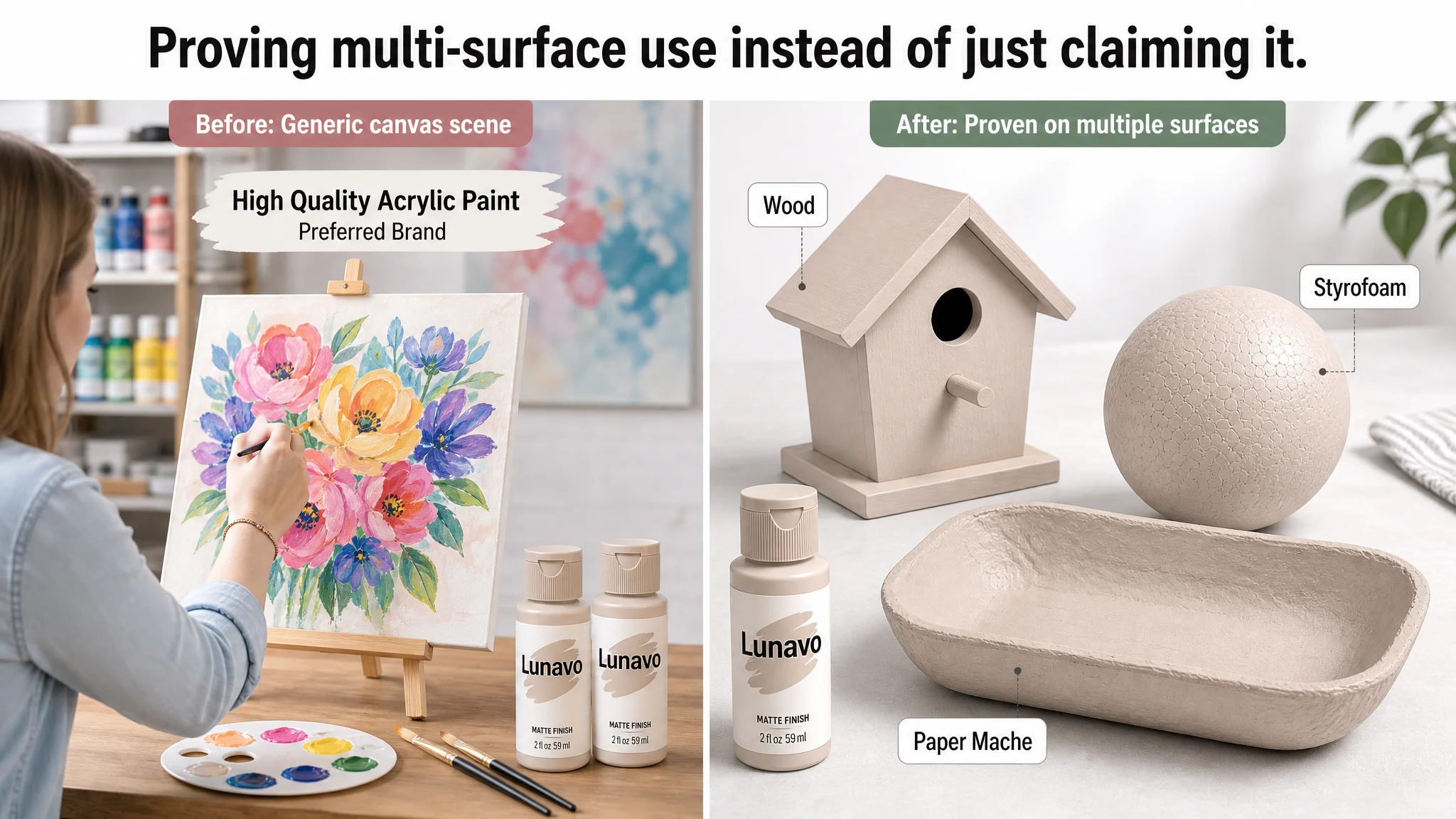
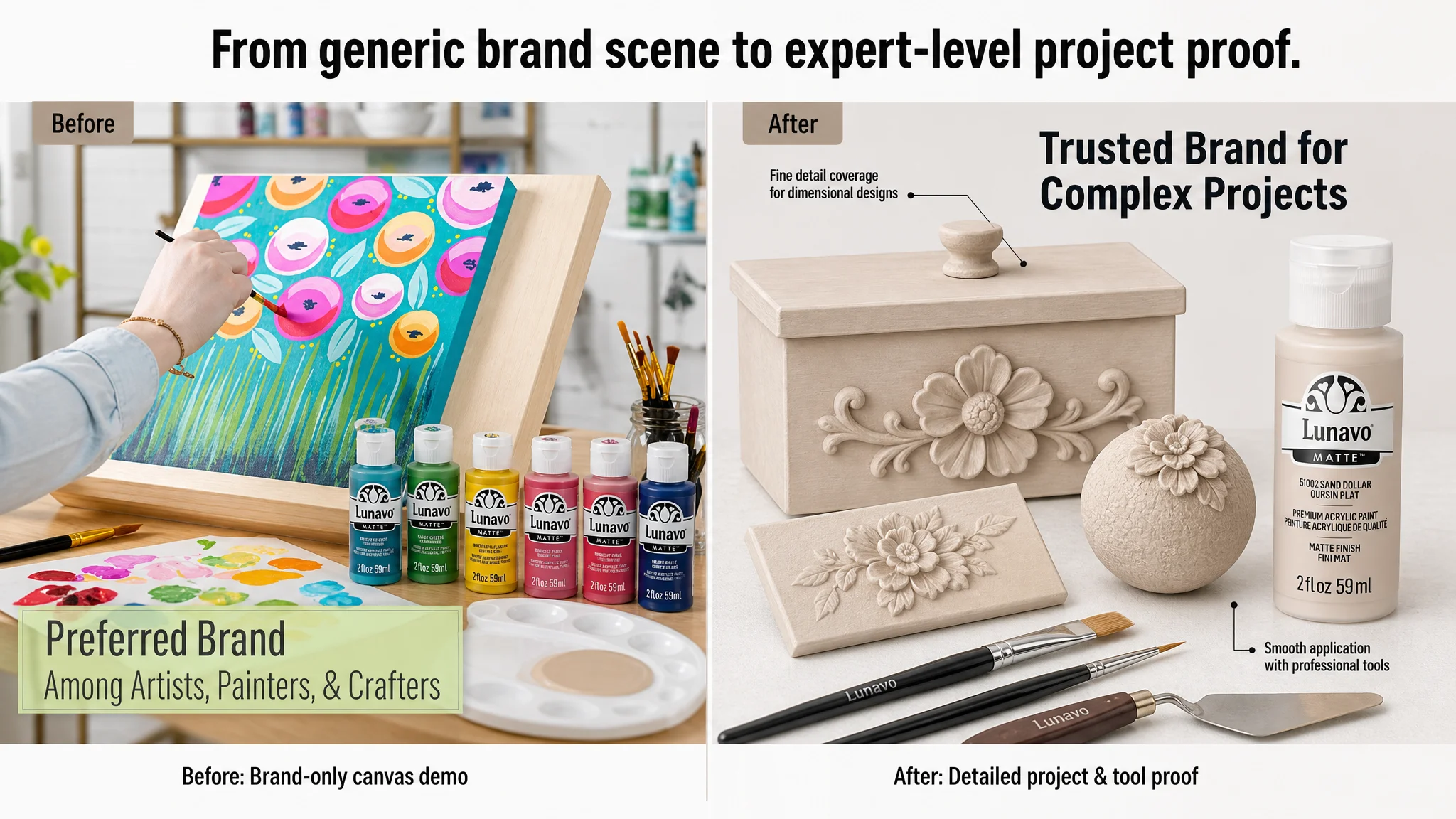
The seller’s images were more generic, repeating canvas-based scenarios and missing clear evidence of multi-surface application.
Bullet Points: Information Without a Clear Buying Logic
Score gap here was small:
- Seller: 7 / 10
- Competitor: 8 / 10
Both Listings had five bullet points, but the logic and ordering were different.
The competitor:
- Embedded durability and concrete promises (“dishwasher safe”, “indoor/outdoor”) directly into use-case bullets
- Highlighted a sensory benefit early (“FUN FINISH”, “smooth, creamy texture”, “satin finish”)
- Wove trust elements (manufacturing, brand reliability) into earlier bullets
The seller:
- Mentioned “BEAUTIFUL MATTE FINISH” but in a more static, less sensory way
- Listed multi-surface use but with fewer concrete material examples
- Pushed “QUALITY FORMULA” and “TRUSTED BRAND” to the end as an add-on instead of a central reason to believe
So although the bullet points contained decent information, the persuasion sequence was weaker. There was no tight “pain → solution → reassurance” path. Compared with the competitor, they felt more like a parameter list than a buying argument.
Detail Page / A+ Content: Where the Listing Actually Broke
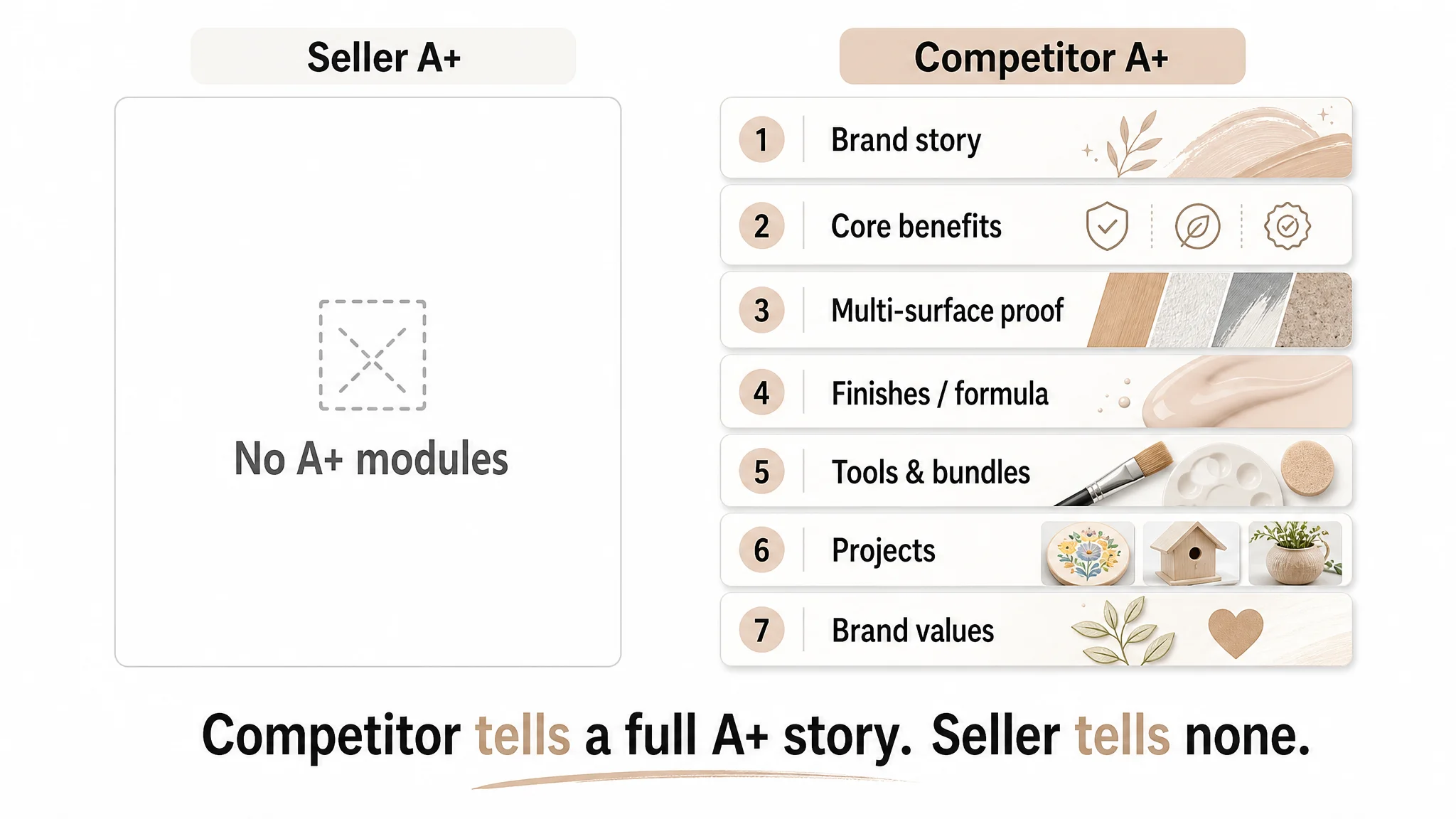
This is where the Listing simply stopped competing:
- Seller’s A+ / detail content score: 0 / 25
- Competitor: 24 / 25
Concrete difference:
- Seller: no A+ images, no structured modules, no visual narrative
- Competitor: a full A+ stack:
- Brand trust and history module
- Core product benefits module
- Multi-surface applications (rocks, wood, models, crafts)
- Finish/Formula explanation (matte/satin/gloss)
- Bundles and value-pack visuals (brushes, palettes)
- Creative project examples
- Brand values and social responsibility
This is more than a cosmetic gap. For a category like craft paint, A+ content does three jobs:
1. Confirms surface compatibility and safety
2. Shows finished project quality and aesthetics
3. Positions the brand as reliable and worth buying repeatedly
The seller’s page did none of that. Once a shopper scrolled past the basic images and bullets, there was no deep information—no reassurance on safety, no professional-level examples, no brand story. The conversion funnel effectively broke at the first scroll.
Reviews: Trust Deficit in Plain Sight
Review metrics:
- Seller:
- 3.5 stars
- 5 total ratings
- Only 2 reviews on the first page
- 50% of visible reviews ≤ 3 stars
- Competitor:
- 4.7 stars
- 14,663+ ratings
- 13 reviews on first page, all 4–5 stars
Here, the issue is not just the lower star rating; it is scale and consistency. Against a paint line with tens of thousands of happy buyers and a stable 4.7 rating, a 3.5-star, 5-review Listing with mixed feedback appears untested and risky.
In combination with a missing A+ story, this meant:
- Low perceived proof of quality
- No professional or project-level validation
- No brand depth to offset the low review count
This was the real limiting factor: low trust and incomplete information, not a missing keyword in the title.
Why DeepBI Did Not Recommend “Fix Ads First”
Given this forensic comparison, DeepBI’s judgment was straightforward:
1. The Listing did not deserve more traffic yet.
Without A+ content and with misleading imagery, every extra ad dollar was buying more exposure for a structurally weak page.
1. The conversion bottleneck was deeper than CTR.
Main images were not perfect, but not catastrophic; CTR could likely be nudged up. The larger risk lay in CVR and post-click trust.
1. Ads were amplifying the wrong outcome.
With low review volume, a broken A+ layer, and confusing imagery, ad traffic would either:
- Fail to convert, pushing ACOS up, or
- Convert and then generate disappointed reviews due to expectations mismatch.
“Advertising does not only amplify advantages. It can also amplify a page’s existing defects.”
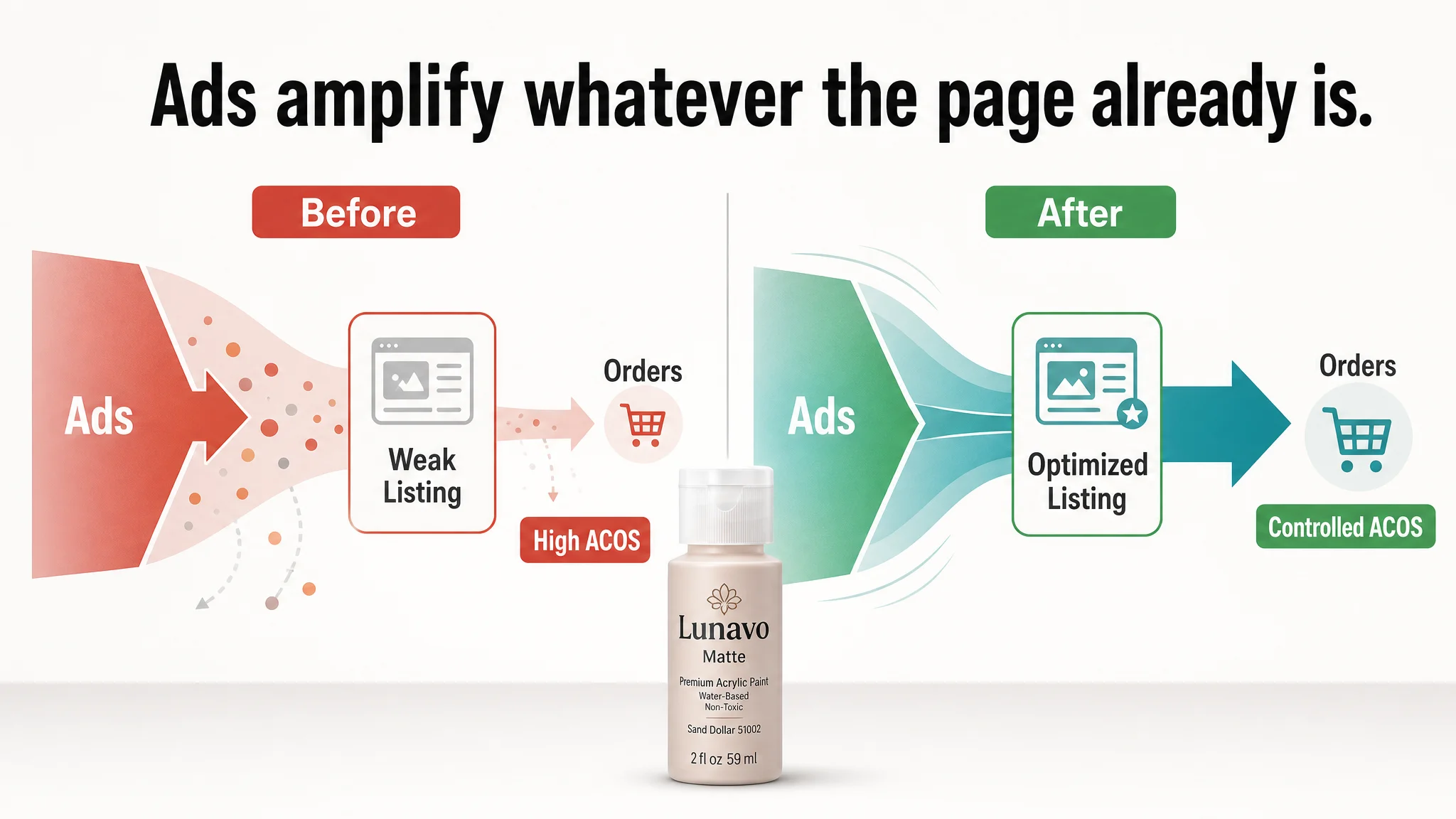
At this stage, traditional ad optimization levers—keyword selection, match types, bid adjustments—could not solve the structural trust deficit. DeepBI’s recommendation was to rebuild conversion capacity first, then revisit scaling ads once the page had a coherent sales narrative.
This Product Page Did Not Lack Traffic. It Lacked Trust.
The optimization path therefore started with what buyers see and believe, not with ad dashboards.
1. Repairing the Most Dangerous Visual: Image 2
The first non-negotiable step was to fix or remove the misleading second image:
- The Listing advertised one 2 oz Sand Dollar bottle
- Image 2 showed six bottles in multiple colors
DeepBI’s judgment:
- This is not a stylistic issue; it is a trust risk
- It can cause both pre-purchase confusion and post-purchase dissatisfaction
- It must show only:
- The single Sand Dollar bottle, and
- The two legitimate packaging variations for that one color, if needed
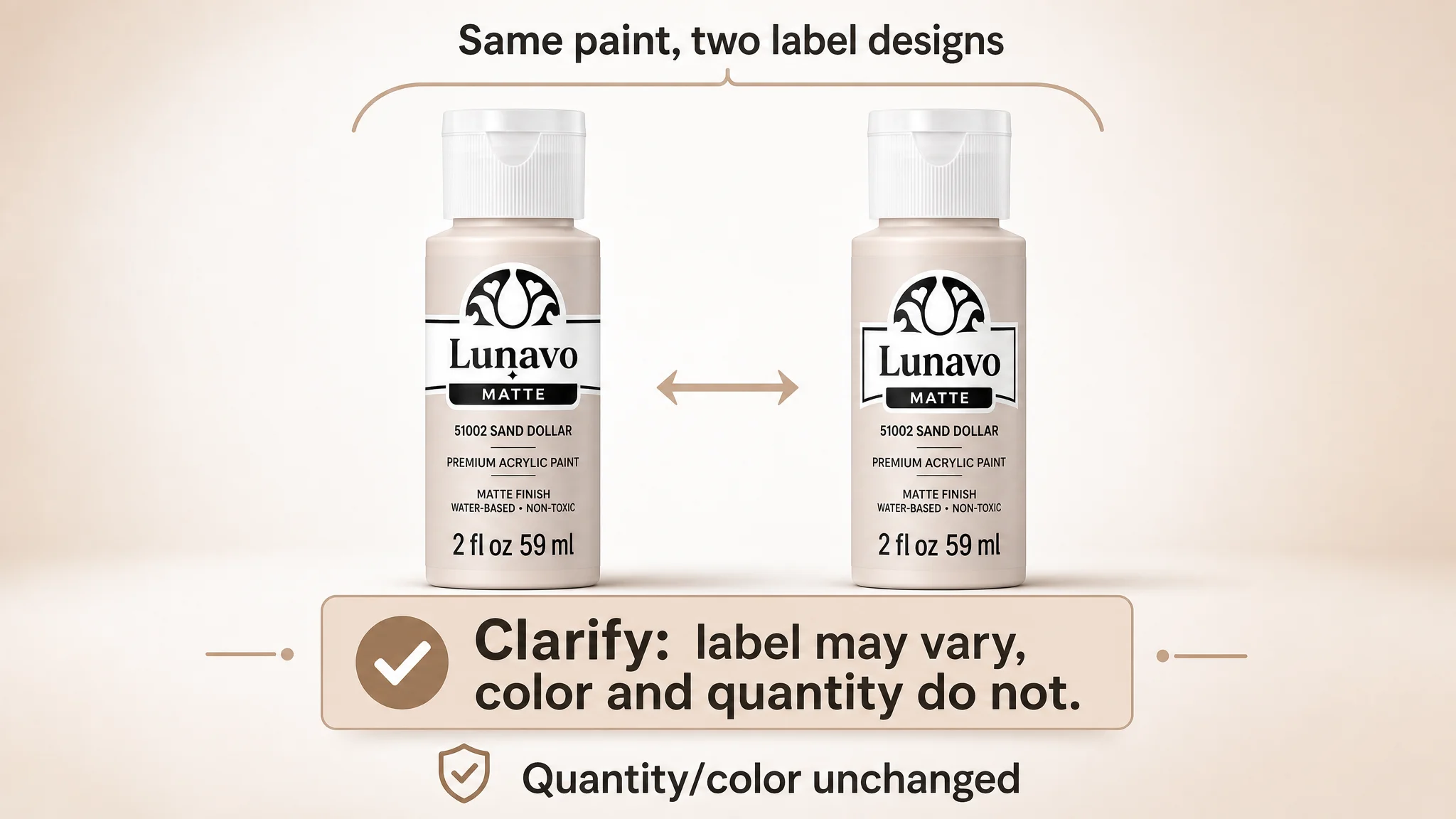
By aligning the imagery with the actual offer, the brand reduces future negative reviews and makes the rest of the trust-building work meaningful.
2. Repositioning Images to Prove “Multi-Surface” Instead of Just Saying It
The competitor did not just claim “multi-surface”; it showed paint on:
- Wood
- Birdhouses
- Rocks
- Other textured objects
The seller’s images stayed mostly on generic canvas scenes, repeated across multiple slots.
DeepBI’s direction:
- Image 4: Move away from generic canvases and show the paint on diverse, clearly visible materials that the bullets explicitly mention: wood, paper mache, etc.
- Image 5: Use this slot to show a more complex craft project with tools (brushes, stencils) to position the paint as capable of detailed, professional work, not just simple strokes.
The logic:
- If you claim “multi-surface”, Amazon shoppers want visual proof, not just text.
- If you claim “premium matte finish”, they want to see finished objects that look distinctly matte and high-quality.
3. Rewriting Bullet Points as a Buying Path, Not a Data List
DeepBI’s bullet-point suggestions focused on creating a stronger decision flow:
- BP #1 – Versatile & artist-quality
Start by framing the paint as rich, creamy, and suitable for basecoating, stenciling, and more—anchoring the product as a professional tool, not just generic craft paint.
- BP #2 – Stunning matte finish
Describe the texture and result in sensory terms: smooth, creamy consistency, quick-drying, non-reflective, elegant look. This lets buyers imagine the outcome on their projects.
- BP #3 – Use on multiple surfaces
Explicitly list common materials (wood, paper, canvas, Styrofoam, paper mache) and position the paint as a “must-have” for versatile indoor DIY décor.
- BP #4 – Safe & easy clean up
Combine water-based, non-toxic reassurance with easy soap-and-water cleanup to reduce risk perception for home and family use.
- BP #5 – Trusted brand & American made
Merge brand credibility with “made in USA” into one concise reassurance, so trust is not hidden at the bottom as an afterthought.
This reordering and rewriting does not invent new claims; it restructures existing truths into a coherent persuasion ladder.
Before Ads Could Work Again, the Page Had to Convert
The largest shift came in how the detail page (A+) was re-imagined. Instead of treating A+ as “nice to have”, DeepBI treated it as the place where Amazon craft-paint buyers finish deciding.
A+ Needed to Do Seven Specific Jobs
DeepBI mapped the A+ content into seven concrete conversion roles:
1. Initial brand trust and legitimacy
- Clearly position the paint line as a professional-grade crafting staple
- Visually associate the bottle with a recognizable, long-standing brand family
1. Visual proof of multi-surface utility
- Show a clean, finished project spanning multiple materials (wood, terracotta, plastic)
- Demonstrate coverage and adhesion without extra technical claims
1. Finished project aesthetics and quality reassurance
- Highlight an elaborate, fully finished decorative item
- Make the matte finish and overall look feel aspirational
1. Application precision and detail performance
- Use close-up shots of stenciling or fine brushwork
- Prove that the creamy consistency enables clean lines and detailed patterns
1. Variant clarity and purpose
- Explain what makes the “Sand Dollar 2 oz Matte” variant special in the range
- Make choosing this single bottle feel like a deliberate, informed choice
1. Project simplicity and post-craft convenience
- Emphasize easy cleanup and reduced mess
- Present crafting as less intimidating for casual or new crafters
1. Manufacturing heritage and brand history
- Close with the brand’s US manufacturing base and years of production
- Turn longevity into a concrete reason to trust the formula
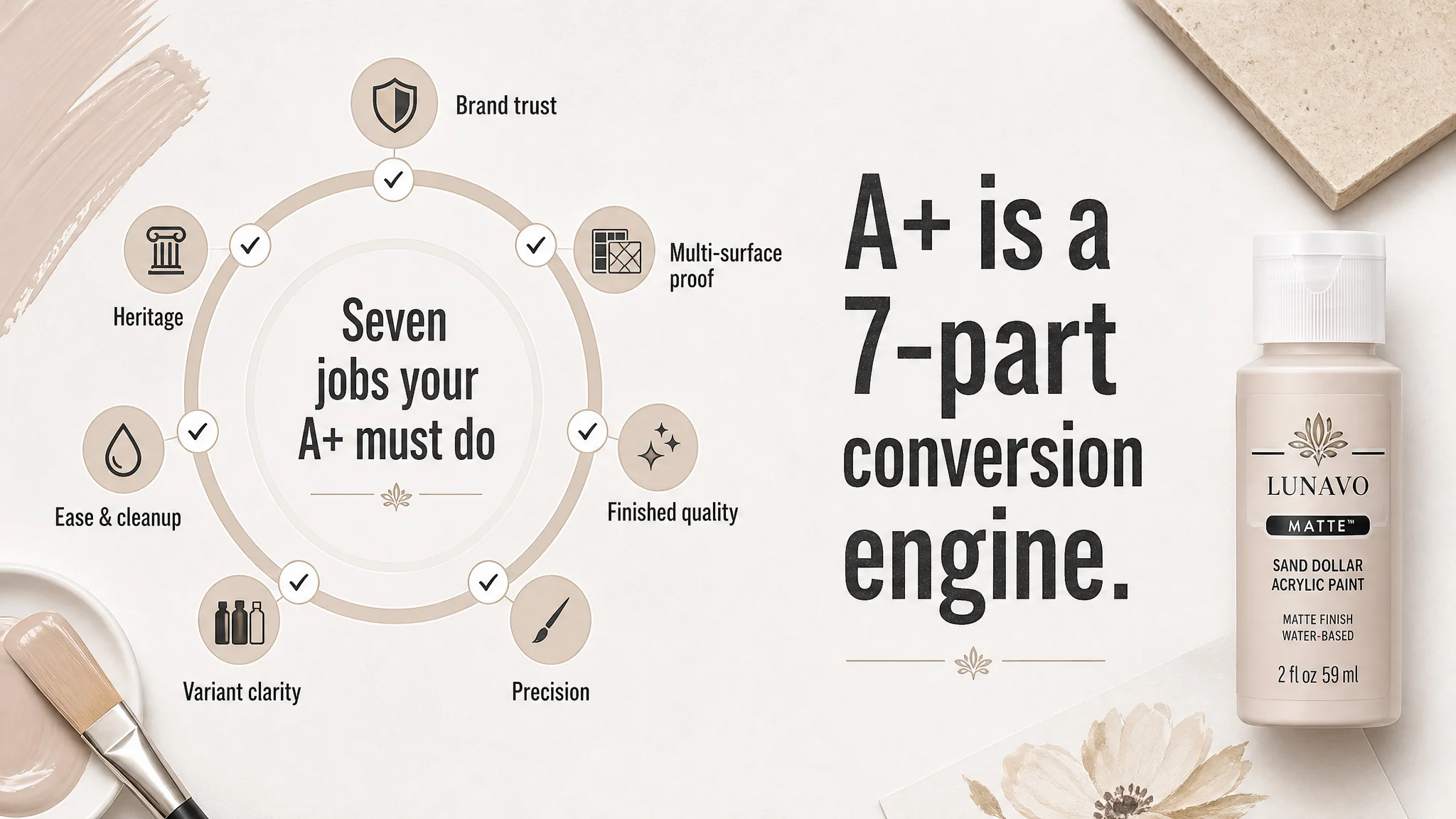
Instead of copying the competitor’s content, the strategy was to match or exceed the depth of reassurance while staying within the product’s real attributes and visual DNA.
How Ad Traffic Became Useful Again
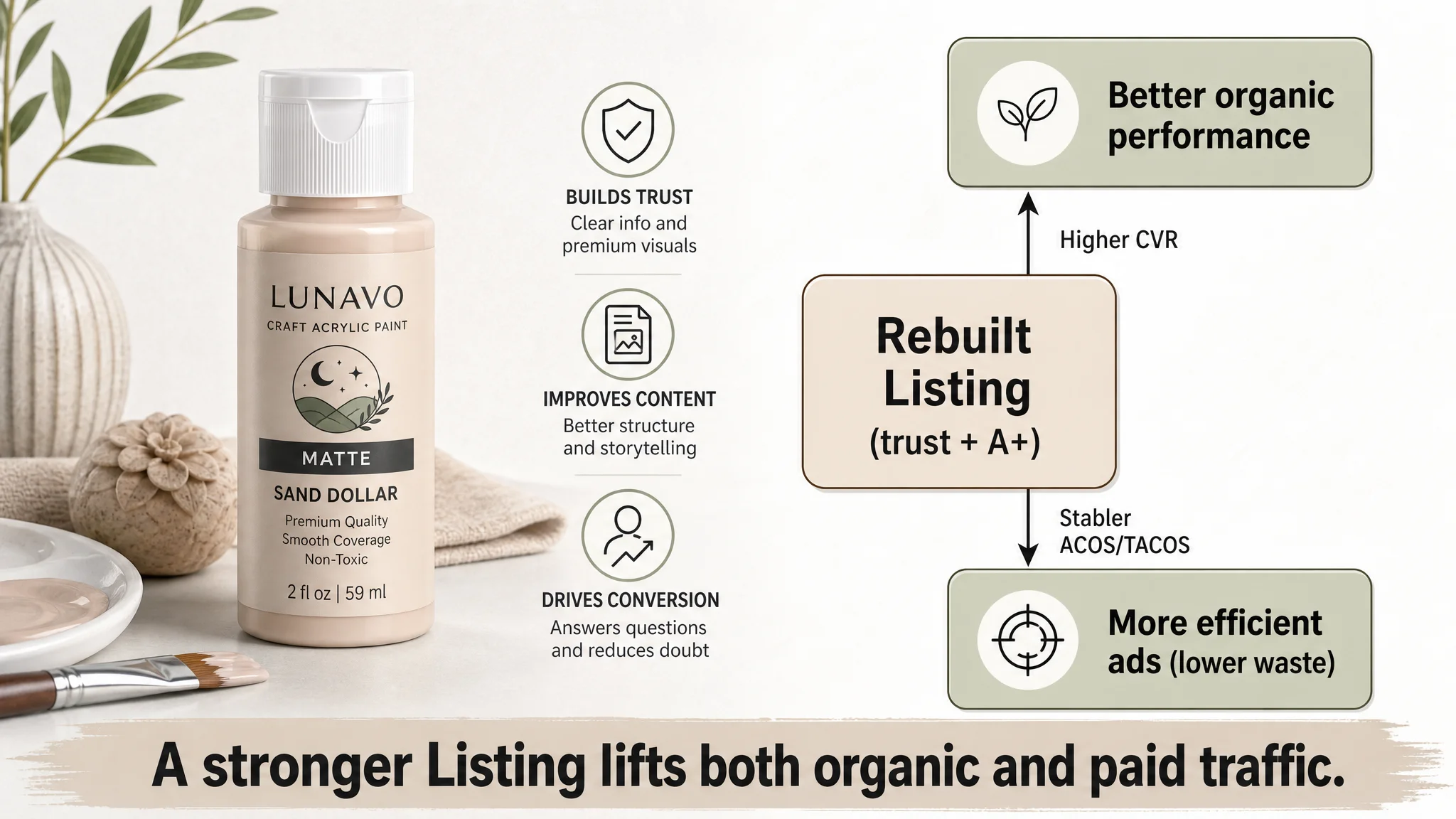
Once these changes are implemented, the operating state of the Listing changes in three important ways, even before quoting specific numbers:
1. The page begins to rebuild basic conversion capacity.
- Misleading visuals are removed, reducing the risk of negative reviews
- Bullet points and A+ content give a professional, coherent impression
- Buyers can see clear evidence of multi-surface usage and finished quality
1. Ad spend stops being pure leakage.
- Each paid click now lands on a page that has a realistic chance to convert
- CPC can still be high, but wasted clicks and post-purchase disappointment are reduced
1. Organic traffic has something to work with.
- As the page earns more positive interactions and fewer returns/complaints, it is better positioned to sustain or grow organic visibility
- The Listing is no longer entirely dependent on “pushing harder” with ads to maintain volume
Even without fabricating data, the structural effect is clear: a fixed page makes both organic and paid traffic economically viable. Without that, even the best ad manager cannot stabilize ACOS or TACOS over time.
What This Amazon Craft-Paint Case Teaches Other Sellers
Several lessons from this case generalize across categories:
- High ACOS is not always an ad problem.
When a Listing scores 0/25 on A+ and has almost no reviews, the constraint is conversion, not CPC.
- Listing quality is the foundation of ad efficiency.
Ads can expose the page to more people; they cannot fix missing trust elements or contradictory images.
- A credible A+ story is not optional in trust-driven categories.
In categories like craft supplies, where buyers want proof of results, surface compatibility, and brand reliability, A+ is part of the sales engine, not decoration.
- Misleading visuals are ACOS bombs.
Images that confuse quantity, color, or format will hurt both CVR and long-term review health.
- Before scaling ads, ask if the page deserves traffic.
If a competitor clearly outperforms you on reviews, A+ depth, and visual proof, tuning bids first is usually the wrong sequence.
DeepBI’s value in this case was not in proposing prettier images or richer wording. It was in reframing the problem: from “we need better ads and more keywords” to “this Amazon Listing cannot yet convert the traffic we’re buying.” Once that judgment was made, the path forward—repairing trust, proving multi-surface use, and building a real A+ narrative—became commercially obvious.