


This Amazon seller came to DeepBI with a familiar contradiction: they were running Amazon ads for a premium liquid hand soap, the brand looked high-end, A+ content was polished, reviews were healthy—yet the Listing kept underperforming against a major category competitor. The team’s instinct was to keep fine‑tuning ads and hoping ACOS would come down with better bidding and keyword work.
Once we put their hand soap Listing through DeepBI’s Amazon Listing scoring and competitor benchmarking, a different picture emerged. The page was not “generally fine with minor tweaks needed”; it had a specific conversion bottleneck in how the title, main images, and bullet-point story worked together to guide decisions. The A+ content was actually stronger than the benchmark, but upstream decision nodes—search results, thumbnail view, and first screen—were not giving shoppers enough reason to click and buy.
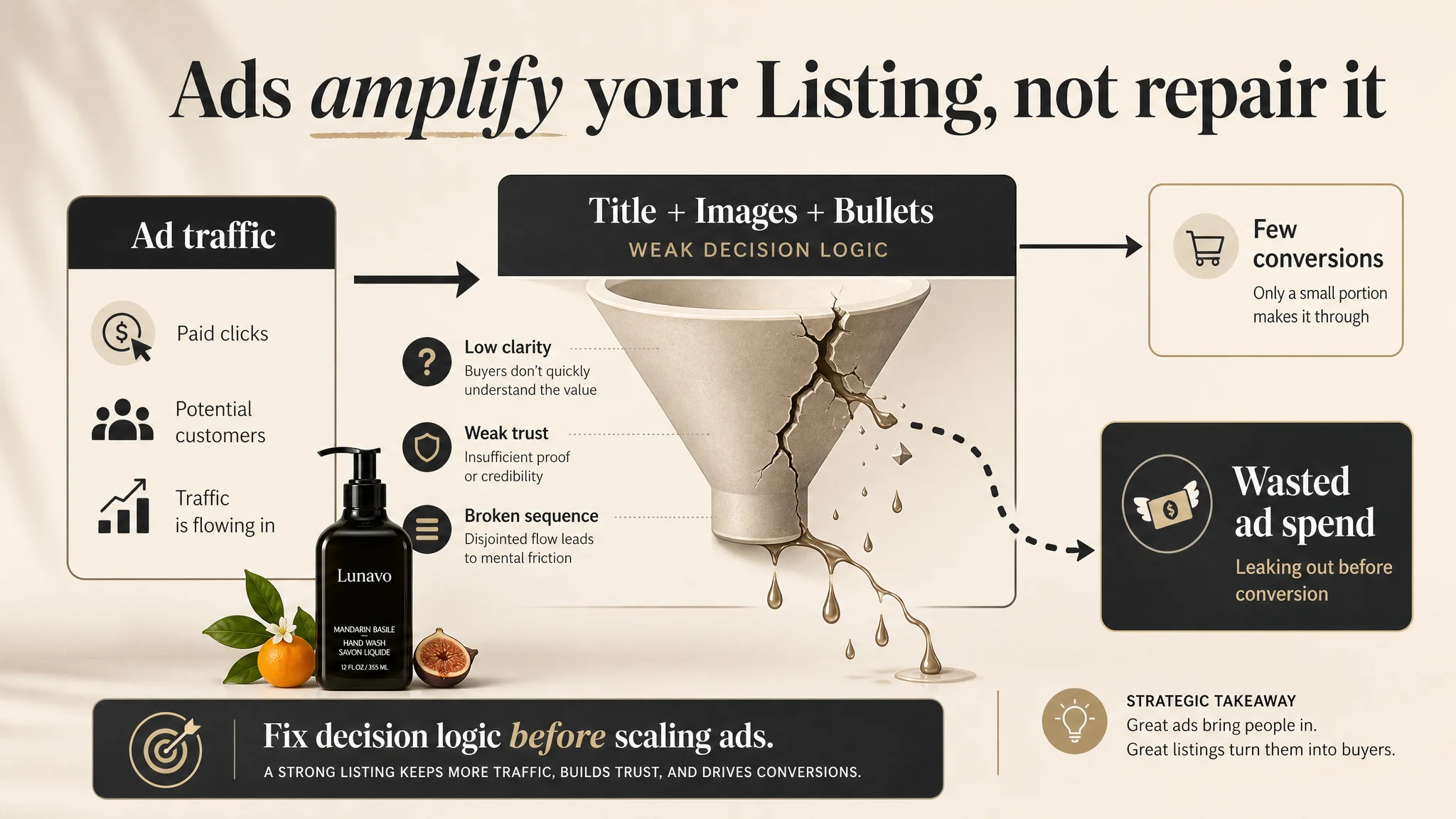
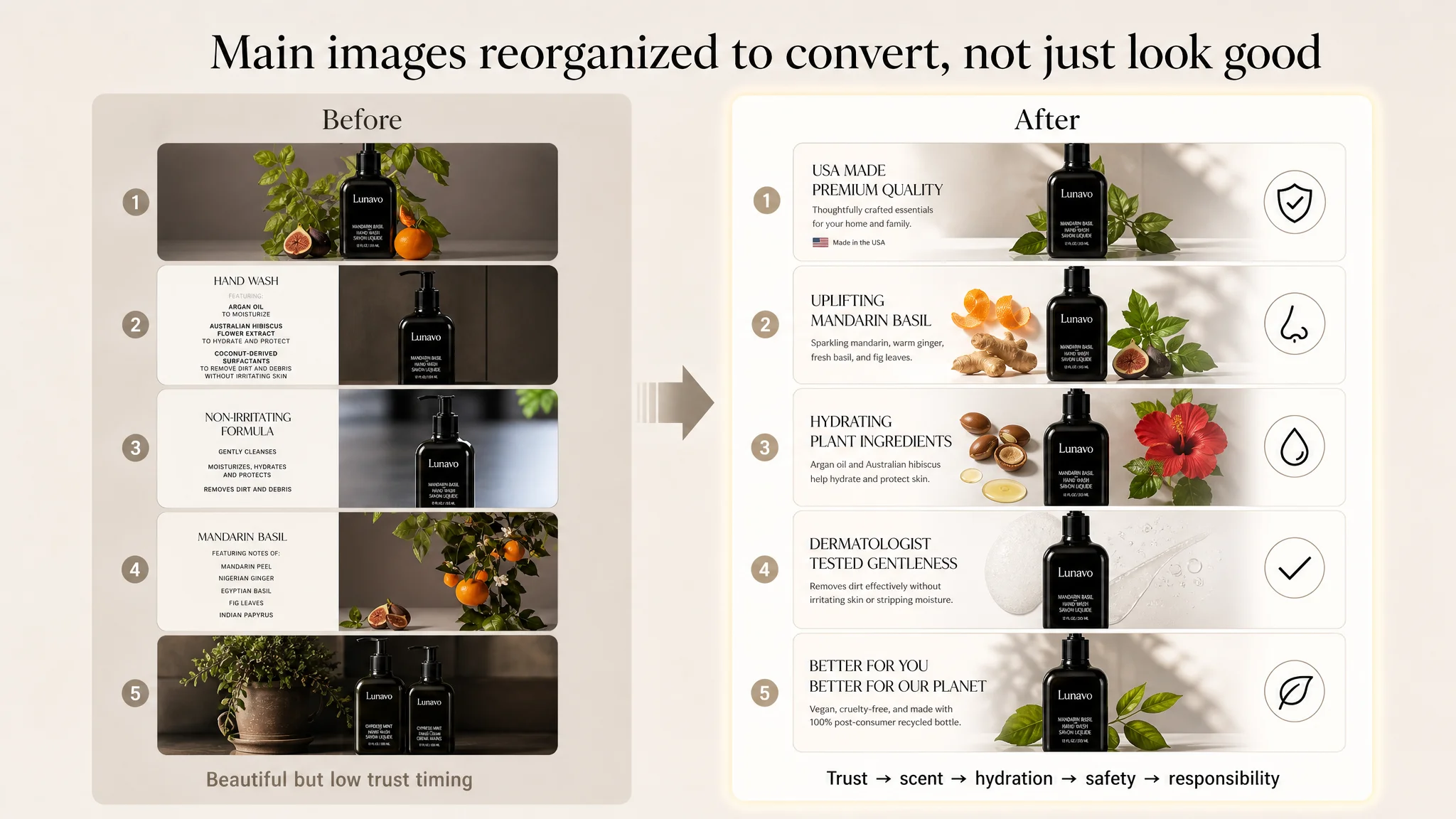
The optimization therefore did not start with ads at all. It focused on rebuilding the decision logic from title to images to bullets: clarifying the product category and usage scenarios in the title, reordering images around “trust → scent → hydration → safety → responsibility,” and tightening bullets into a clear “hydration, scent, clean formula, sustainability, brand authority” ladder. After this, the Listing could actually convert the traffic ads were paying for, instead of consuming it.
For other Amazon sellers, this case is a reminder that high aesthetic and strong A+ content do not guarantee conversion. When ACOS feels stubborn or you’re tempted to blame ads, it may be the Listing’s decision structure—especially title and image sequence—that is quietly capping both ad efficiency and organic growth.
What the Seller Saw on Amazon—and Why They Blamed Ads First
This was a US‑market Amazon seller in premium home and personal care, focusing on a liquid hand soap positioned as “clean” and design‑driven. They had already invested heavily in:
- A cohesive brand aesthetic (muted “home decor” color palette, styled product shots)
- Full A+ coverage across their hand wash and related home‑care SKUs
- A review profile that, on the surface, looked stronger than the main competitor
On paper, the page looked like it should convert:
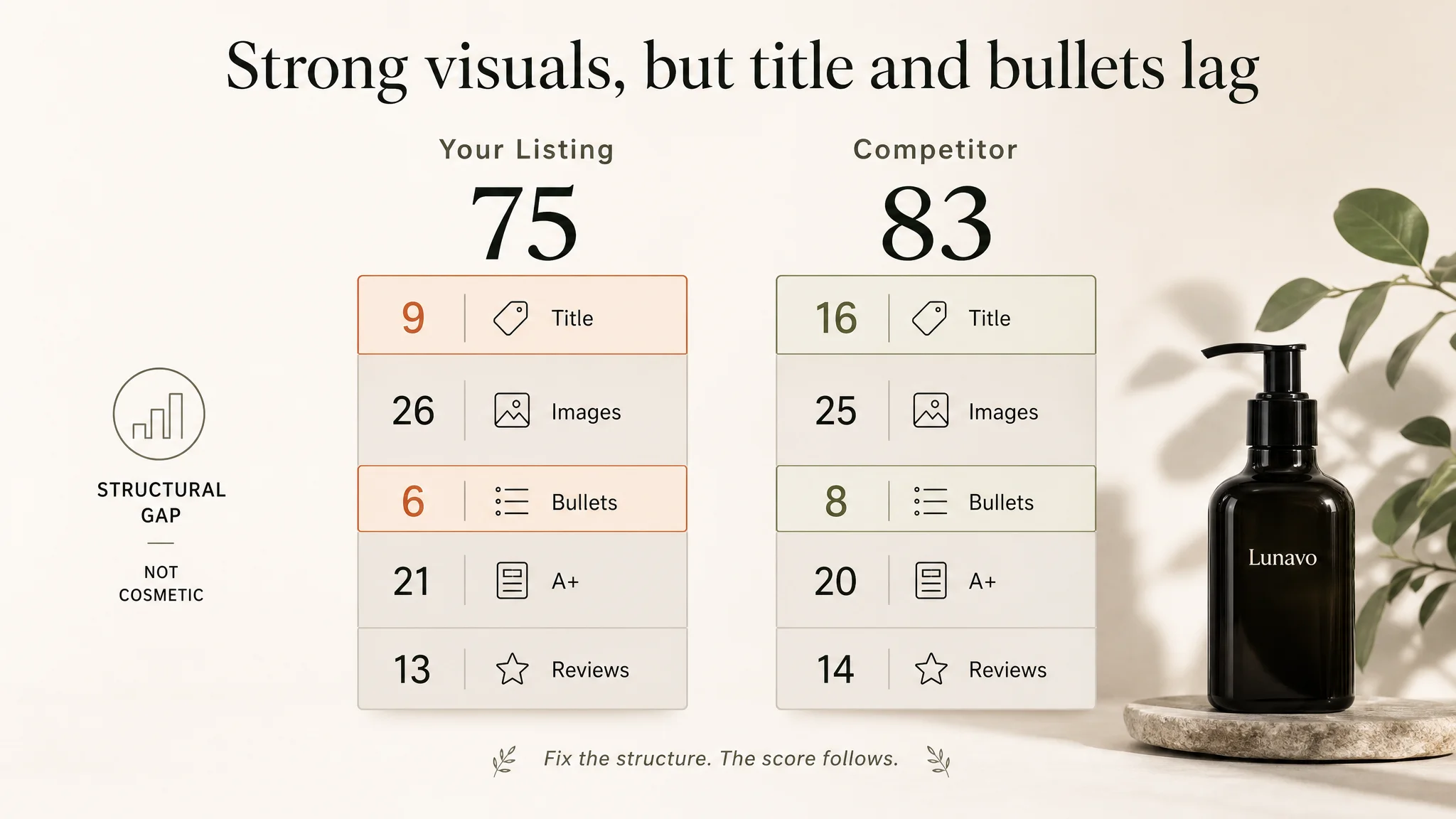
- Listing total score: 75/100
- Benchmark competitor score: 83/100 (gap: −8)
By dimension:
- Title: 9 vs benchmark 16 (−7)
- Main image set: 26 vs 25 (+1)
- Bullet points: 6 vs 8 (−2)
- A+ detail: 21 vs 20 (+1)
- Reviews: 13 vs 14 (−1)
From their vantage point, the numbers that stood out were:
- Main images “not worse than” the competitor (slightly higher score)
- A+ detail slightly ahead of the benchmark
- Star rating: 4.5 vs competitor’s 4.3
- Lower visible negative‑review share on page 1
So the internal conclusion was: “Our Listing is good. If performance is weak, it must be an ads problem. We need better campaigns, tighter keywords, stronger creatives.”
That diagnosis felt intuitive. It was also wrong.
“The real issue was not that Amazon ads failed to bring traffic. It was that the product page could not convert the traffic it already had, at the exact moments where decisions are made.”
Why Traditional Amazon Ad Optimization Started Failing
Like many advanced sellers, this team already knew how to:
- Expand and refine keyword coverage
- Split campaigns by match type and intent
- Adjust bids to control ACOS
- Test different ad creatives
Yet even as they tuned keywords and bids, the core outcomes did not move in line with effort. Traffic was possible to buy; profitable orders were not keeping pace.
The underlying problem: they treated ads as the lever for conversion, not as the amplifier of an already‑effective Listing.
From DeepBI’s perspective, that is a dangerous pattern:
- When your page has a conversion leak, more ads only amplify the leak.
- When the wrong information is front‑loaded (title, first image, first two bullets), no bid strategy can fix the trust and relevance gap.
So instead of starting with ad structures, we asked a simpler question:
“If we gave this Listing 2–3x more traffic tomorrow, would that traffic convert at a level that makes sense in this category?”
The scoring breakdown—especially the −7 gap in title and the weaker bullet logic—suggested the answer was no.
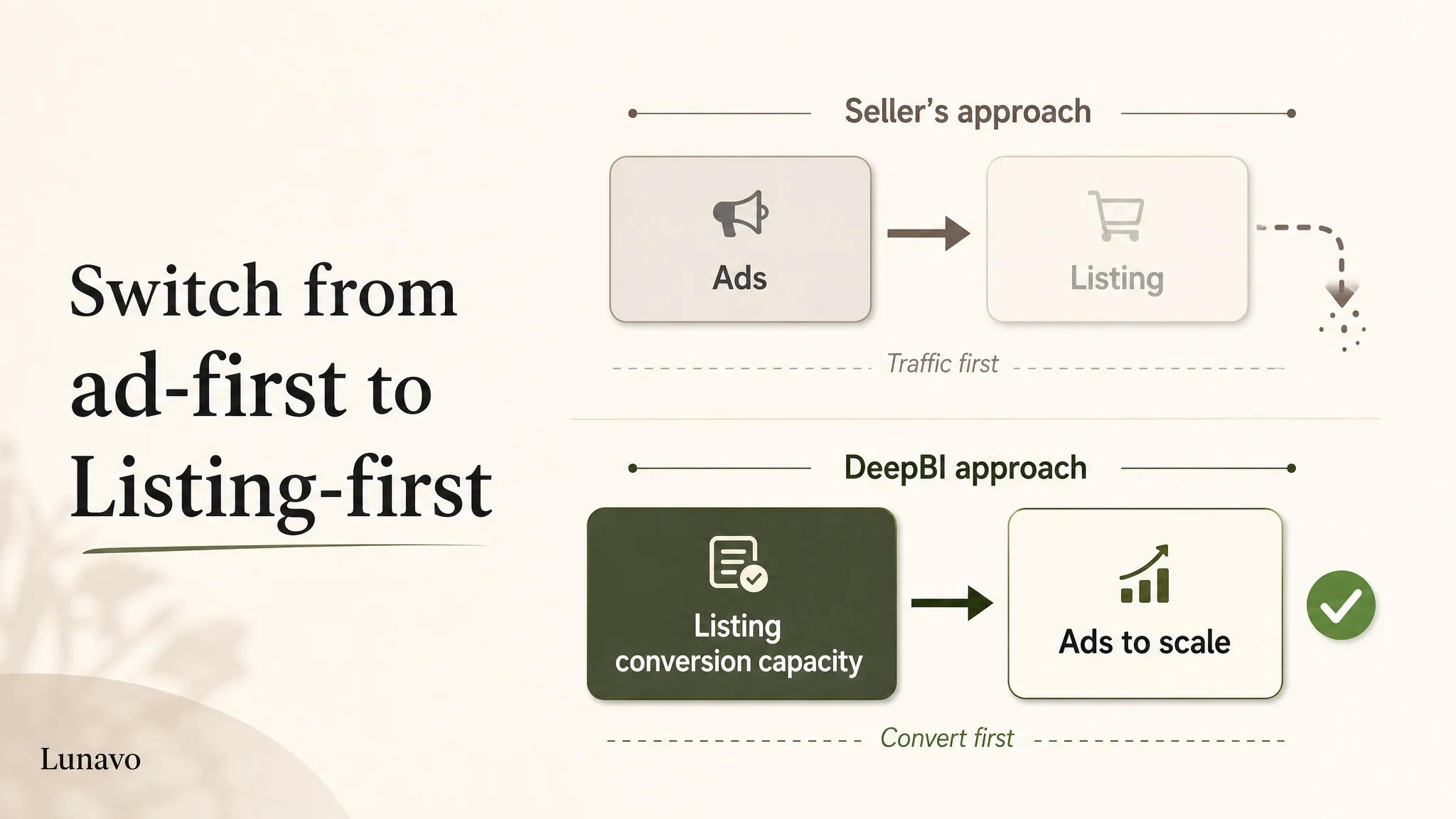
The Real Constraint: Listing Conversion Capacity, Not Traffic Volume
DeepBI’s Listing score comparison made something very clear: this Listing’s bottleneck was not “visual quality” or “brand feel”; it was decision logic at the title and bullet level.
Title: The Page Didn’t Clearly Say What It Was
The benchmark competitor’s title followed a mature Amazon pattern:
Brand + core category + usage scenes + trust proof + capacity
For example (paraphrased):
“Premium Orange Blossom Hand Soap – Liquid Soap for Kitchen and Bathroom – French Tradition, Natural Hand Wash (97% Ingredients), Gentle & Moisturizing, 16.9 fl oz”
Key behaviors:
- Explicitly calls out “Liquid Soap for Kitchen and Bathroom”
- Uses measurable trust elements: “97% Ingredients,” capacity “16.9 fl oz”
- Leverages “French Savon de Marseille” as a heritage signal
- Balances keyword coverage with readability and promise
By contrast, the target Listing’s title:
- Relied heavily on abstract, functional phrases rather than a clear category (“hand wash liquid soap” was not strongly foregrounded)
- Underused concrete numbers (capacity was not as clearly surfaced)
- Missed simple, high‑intent scene anchors like “for kitchen and bathroom”
- Did not use any origin / craft / authority phrase to justify the premium
Score gap: 9 vs 16. That seven‑point difference is not cosmetic. On Amazon, it means:
- Search relevancy is weaker on core generic terms.
- Even when impressions are won, the title doesn’t immediately frame “what this is” and “why it’s trustworthy,” which hurts CTR and pre‑click filtering.
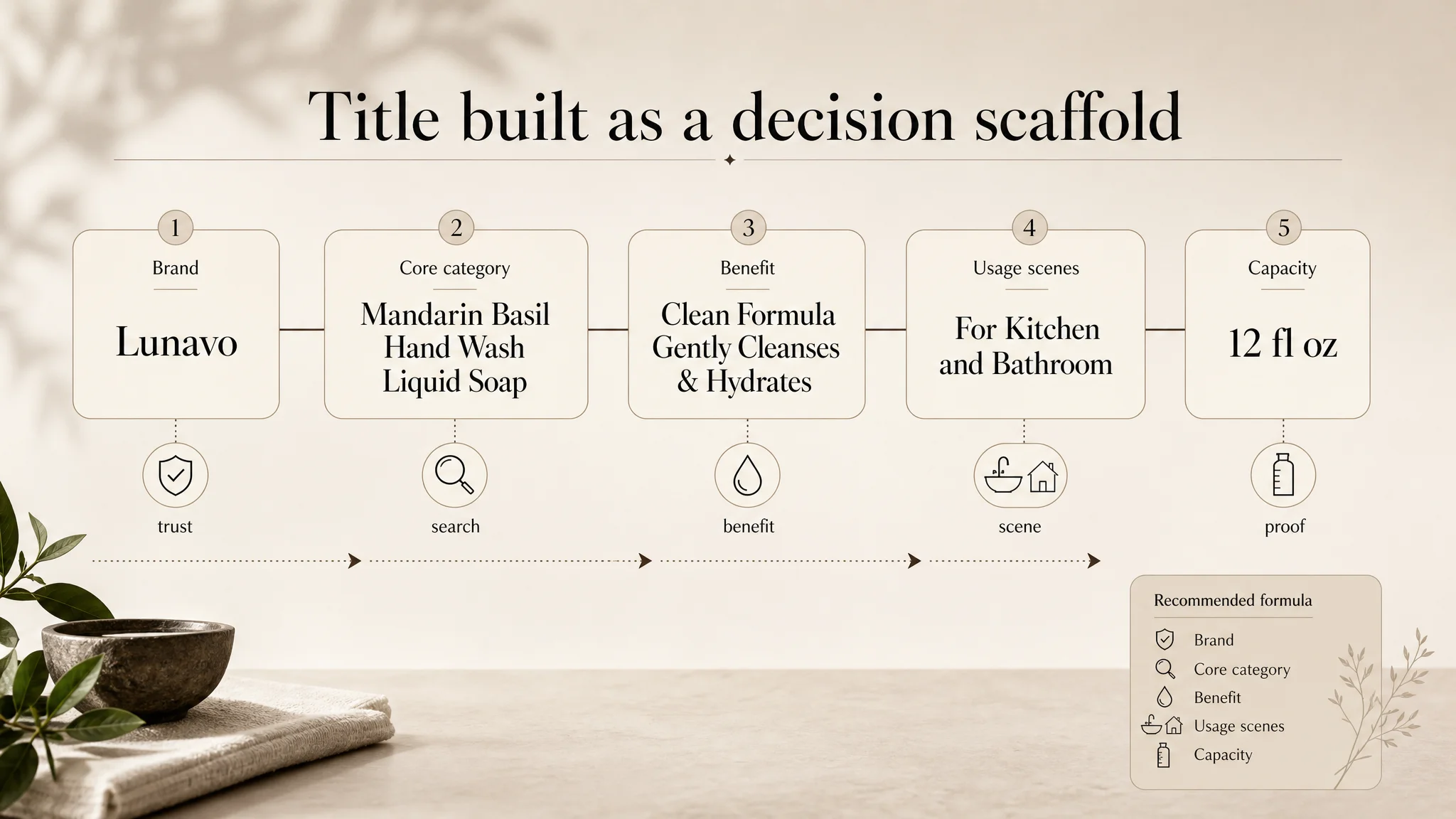
DeepBI’s recommendation condensed this into a new title logic:
Brand + Mandarin Basil Hand Wash Liquid Soap + clean formula & hydration + use scenes + capacity
Suggested direction:
“[Brand] Mandarin Basil Hand Wash Liquid Soap – Clean Formula Gently Cleanses & Hydrates – Natural Moisturizing Hand Soap for Kitchen and Bathroom, 12 fl oz”
Here the change was not “stuff more keywords”; it was making the category, scenes, and benefit hierarchy explicit, in line with how top Amazon buyers search and scan.
Bullets: Information Existed, but Buying Logic Was Fragmented
On paper, both the seller and the competitor covered similar areas in their bullet points:
- Moisturizing / gentle cleansing
- Scent description
- Natural / safe ingredients
- Sustainability and packaging
- A touch of brand story
But structurally, the competitor did one thing better: they kept bullets tightly anchored to product‑level proof, in an order that matched buyer fears and desires. Roughly:
1. Core function + usage scenes
2. Craft / origin
3. Natural ingredients / safety
4. Eco design
5. Scent and “luxury at your sink”
The target Listing, by contrast, drifted in the fifth bullet into a broader brand story and values. The result:
- The conversion narrative broke right when buyers needed a final, rational reason to say yes.
- Data and concrete claims (“97% natural ingredients,” specific craft phrases) were less prominent, which reduced rational trust.
DeepBI’s rewrite condensed the bullets into a clear five‑step argument:
1. Hydrating & nourishing hand wash
- Gently cleanses without stripping moisture
- Argan oil + hibiscus extract → “rich, silky lather” and soft hands
- Explicitly named kitchen and bathroom usage
1. A luxurious sensory escape
- Signature Mandarin Basil scent
- Sparkling mandarin, green basil, ripe fig
- “Transforms a simple task into a vibrant walk through a lush herb garden”
1. Clean, plant‑based formula
- Coconut‑derived surfactants
- pH‑balanced, safe for all skin types
- Removes dirt without irritation
1. Sustainable & eco‑conscious design
- 100% post‑consumer recycled bottle
- Reusable pump
- Frames sustainability as both ethical and aesthetically “sleek”
1. Proudly crafted, with clear standards
- Founder and “crafted in the USA” trust cues
- 100% vegan & cruelty‑free
- “Professional‑grade beauty standards for your most lived‑in spaces”
The point was not to add more words. It was to stop the logic from drifting and to load each bullet with one clear job in the decision sequence.
A Surprising Finding: The A+ Content Was Not the Weak Link
DeepBI’s A+ comparison showed the opposite of what many sellers expect:
- The target Listing’s A+ actually scored slightly higher than the competitor’s (21 vs 20).
- Visually, the seller had:
- A consistent, high‑end aesthetic (low‑saturation, interior‑friendly palette)
- Full ecosystem coverage (hand wash, dish soap, surface cleaner, room spray, candle, deodorizer)
- Deep integration of sustainability (PCR bottles, upcycled ingredients, plant extracts) across modules, not as isolated badges
The competitor’s A+:
- Presented a stronger story of heritage and craft (traditional French soap)
- Did a good job at summarizing core product benefits and refills
- But stayed narrower (single SKU focus) and more “catalog‑like”
So the seller’s original feeling—“our A+ is strong”—was not wrong.
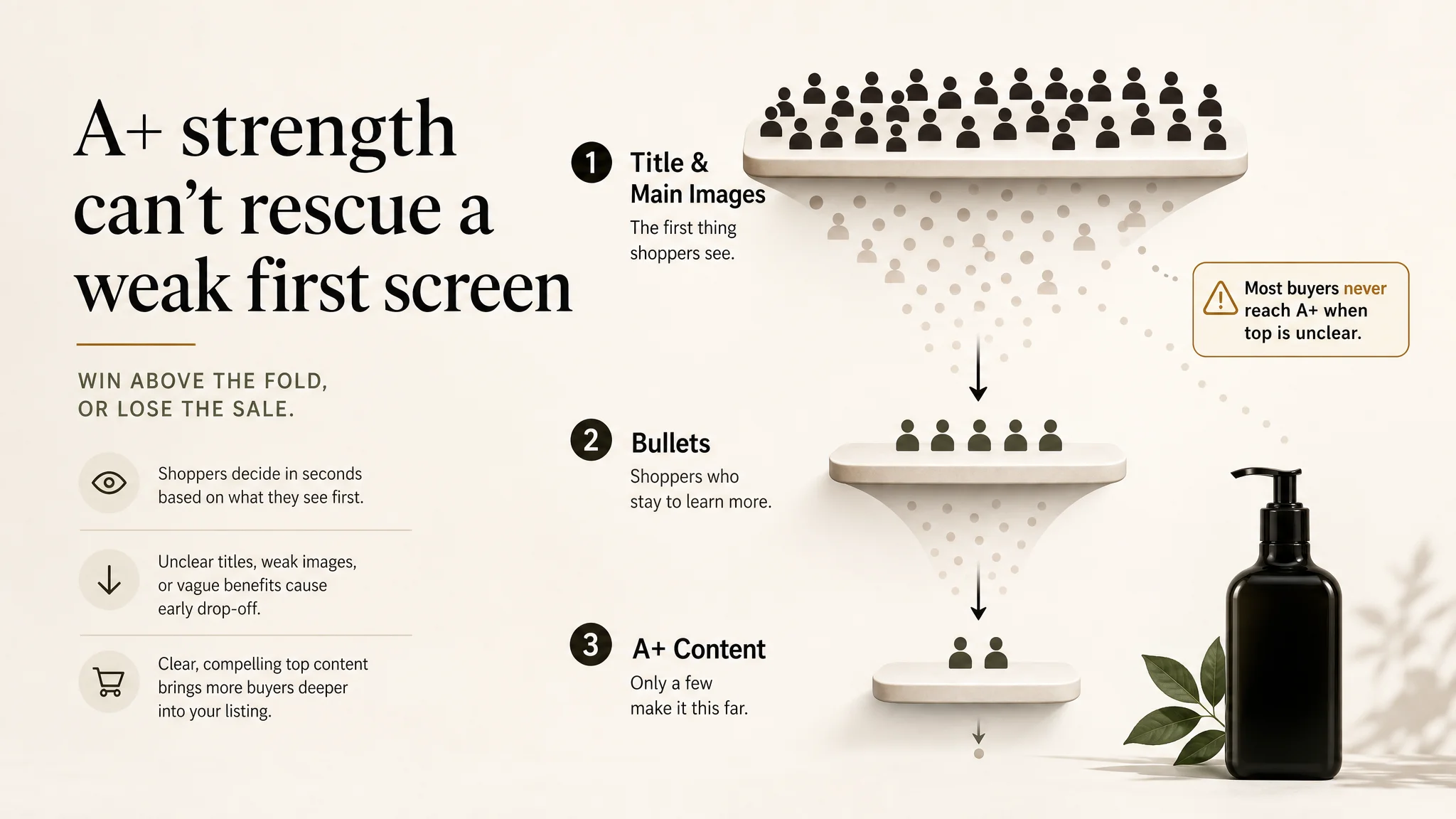
What was wrong was the assumption that a strong, immersive A+ could compensate for missing trust and clarity in the first 5–10 seconds of the buyer journey.
From DeepBI’s view, this changed the priority order:
- Do not spend more budget redesigning the entire A+.
- Reorder and reframe the top modules to front‑load credibility and hydration safety.
- Fix the title, images, and bullets first, because that’s where most buyers bounce before they ever engage with the lower A+ modules.
Where the Page Actually Leaked: Image Sequence and Trust Timing
On scoring, the main image set looked “competitive” (26 vs 25). But score parity can hide sequencing issues.
DeepBI’s image‑level diagnosis flagged a structural problem: the Listing was showing the right ingredients and benefits, but in the wrong order and at the wrong depth.
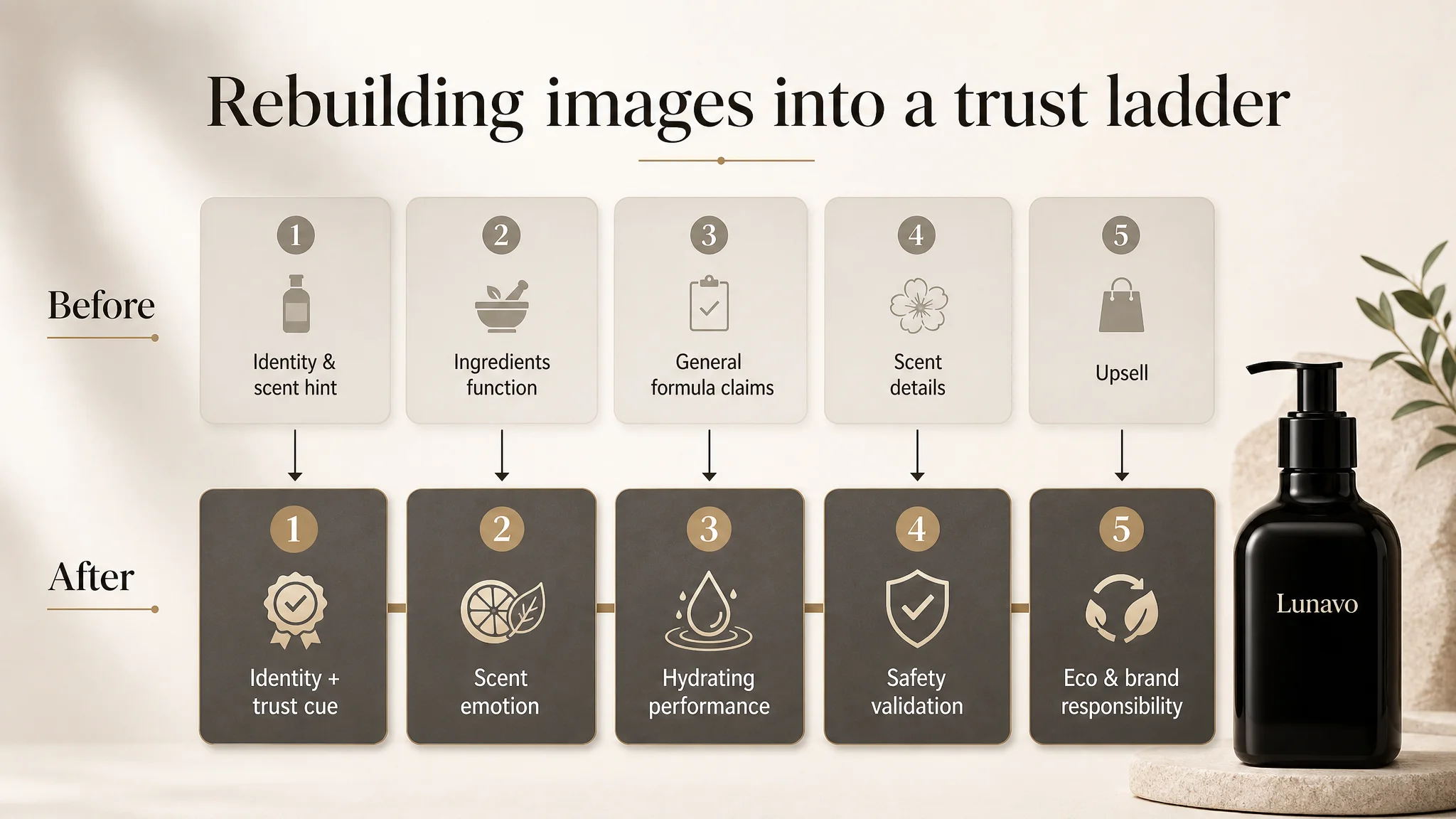
Image 1: Identity Without Minimum Trust
- Current role: identity + basic scent communication.
- Problem: No immediate trust anchors like origin, “crafted in [country]”, or clean‑formula authority.
On Amazon search results, a premium hand soap thumbnail competes in a sea of similar bottles. Without a fast trust hook, click‑through relies purely on aesthetic preference.
Suggested refocus for Image 1:
- Keep the brand identity and bottle, but add one hard trust cue:
- “Designed & assembled in the USA”
- “100% vegan & cruelty‑free”
- Or a subtle but legible “clean formula” badge
- The goal: clear category + premium + trustworthy within three seconds.
Image 2: Function Before Emotion
- Current role: functional validation of ingredients.
- Problem: Too rational, too early. Scent is a core decision driver in hand soap; leaving its full story for later images wastes top‑of‑funnel persuasion power.
DeepBI’s judgment: early in the image sequence, buyers want to know:
- “Will this smell amazing at my sink?”
- “Does it fit my kitchen/bathroom vibe?”
So Image 2 was reoriented to:
- Dive deep into the scent profile:
- Notes of “sparkling mandarin, fresh green basil, ripe fig”
- “Uplifting, vibrant walk in the herb garden”
- Use lifestyle cues (sink, hands, light) to frame the scent as an emotional upgrade, not just fragrance text.
Image 3: Repetition Without Progress
- Current role: general formula performance claims, similar format to current Image 2.
- Problem: Repeats “what it does,” but not “why it’s safe, gentle, and better.”
DeepBI treated this as a wasted persuasion node. At this point in the scroll, buyers need:
- Assurance: Will this dry my hands?
- Proof: What is in here that protects my skin?
So the repositioned Image 3:
- Focuses on gentle, hydrating performance:
- “Cleanses hands without stripping away moisture”
- “Helps to moisturize, hydrate, and protect”
- Connects those promises to specific ingredients:
- Argan oil, hibiscus flower extract, coconut‑derived surfactants
- Visual emphasis on texture and lather, not just bottle shots.
Image 4: Scent Details Too Late, Safety Too Late
- Current role: deep scent details.
- Problem: Scent confirmation is arriving too late. By Image 4, serious buyers need risk reduction, not just more flavor notes.
DeepBI’s shift:
- Turn this slot into third‑party and safety validation:
- “Dermatologist‑tested ingredients”
- Reinforce “gentle, hydrating, non‑stripping”
- Visualize it with trust icons, soft skin imagery, and testing language.
Image 5: Upsell Before Trust
- Current role: routine suggestion / cross‑sell.
- Problem: The Listing is asking for a basket before it has fully closed the case for a single bottle.
The inputs revealed stronger possible content:
- 100% post‑consumer recycled materials
- Founder‑led brand story
- “Home should be a sanctuary” philosophy
DeepBI’s adjustment:
- Replace upsell with authenticity and responsibility:
- Eco‑friendly aspects
- Founder statement
- Final rational reason to choose this brand over cheaper options
“Advertising does not only amplify advantages. It can also amplify a page’s existing defects. Here, the defect was not missing images, but images in the wrong order, telling the wrong story at the wrong time.”
Why DeepBI Did Not Recommend “Fix A+ First”
Given that the A+ already scored slightly higher than the competitor, DeepBI’s priority was not a full redesign, but a re‑ordering of persuasion steps:
What the A+ Was Doing
- Module 1: Broad brand intro and aspiration.
- Modules 2–6: Mixed feature dumps and ingredient deep dives.
- Module 7: Cross‑selling to other products and category extensions.
This made for a beautiful, immersive brand world—but it did not answer the first three questions a cautious Amazon buyer has about a premium hand soap:
1. Is this a credible, safe, and genuinely “clean” formula?
2. Will it dry or irritate my skin?
3. Is the scent worth paying more for?
What DeepBI Recommended Instead
Rebuild the A+ spine around a clearer “trust before storytelling” structure:
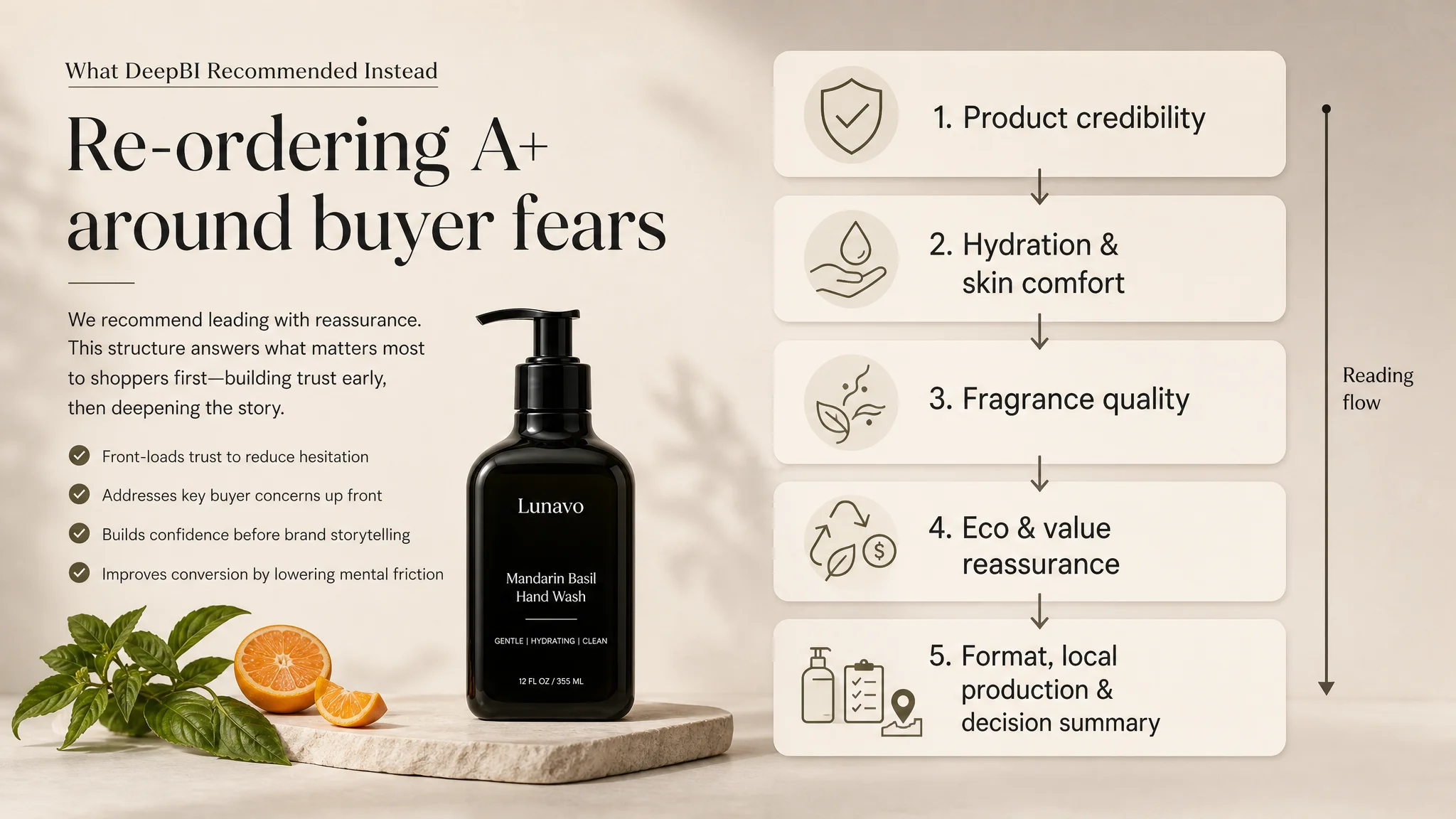
- Module 1: Product credibility, not brand abstraction
- Shift from airy brand language to “what makes this formula credible”
- Call out:
- 100% vegan & cruelty‑free
- Coconut‑derived surfactants, argan oil, hibiscus extract
- Designed & assembled in the USA
- Module 2: Directly resolve the dry/irritated skin fear
- Focus only on the moisturizing mechanism:
- “Gently cleanses without stripping”
- “Rich lather that leaves hands soft and comfortable”
- Strip out other “nice‑to‑have” features from this module to avoid dilution.
- Module 3: Rational trust in fragrance quality
- Move detailed scent description earlier:
- Notes, perfumer curation, how it transforms the sink experience
- Frame scent as crafted and intentional, not an afterthought.
- Module 4: Ecological and cost reassurance
- Mirror competitor’s refill/eco logic, but with the seller’s strengths:
- 100% PCR bottle, reusable pump
- Reduced single‑use plastic, long‑lasting bottle
- Module 6: Format and local production confirmation
- Make it explicit that this is a liquid soap hand wash
- Reinforce “designed & assembled in the USA” as a quality anchor.
- Remove Module 7 cross‑sell
- Instead of distracting buyers with multiple products, convert that space into:
- A decision‑support summary
- Or integrate the brand story earlier in support of trust, not after it.
This was a deliberate decision rule: do not widen the funnel (ads, cross‑sell) before the core Listing can reliably convert a single SKU.
How Ad Traffic Became Useful Again
After these shifts, the Listing didn’t suddenly become “perfect.” But its behavior in the Amazon funnel changed:
- Title now clearly stated category, scenes, and hydration promise, increasing its relevance and clickability in search results.
- Main image sequence created a predictable trust ladder:
- Identity + trust
→ scent emotion → hydration proof → safety validation → eco and brand authenticity
- Bullet points formed a compact, emotionally and rationally coherent case, rather than a mix of product features plus a detached brand story.
- A+ modules front‑loaded credibility and skin safety and integrated scent and sustainability earlier, while removing decision‑paralyzing cross‑sell clutter.
From an operations standpoint, this shifted the risk profile:
- Each paid click now landed on a page more likely to address the buyer’s top concerns in the first scroll.
- Ads were no longer “forced to carry” conversion on their own; the page itself had regained conversion capacity.
- The seller could re‑enter ad optimization with a more stable Listing foundation:
- ACOS now had room to move down, because the CVR ceiling was higher.
- Organic traffic had a better chance to convert, reducing longer‑term dependence on ads.
Even without inventing specific metrics, the operational reality changed: ads became a scaling lever again, not a band‑aid.
What This Case Changes in the Seller’s Understanding
Before working with DeepBI, the team believed:
- “Our brand and A+ look premium, so the Listing is not the main issue.”
- “Reviews are solid; if we push harder on ads and creatives, orders should follow.”
- “If a competitor is bigger, it’s mostly because of their review count.”
After this diagnosis and restructuring, their understanding shifted:
- Title and first images are not just for aesthetics—they are the primary conversion infrastructure for both organic and ad traffic.
- A+ beauty cannot compensate for weak decision logic above the fold. If the first seconds of the page don’t establish trust and clear category fit, buyers never engage deeply with lower modules.
- Ads do not fix Listing conversion; they stress‑test it. When a Listing has hidden leaks, ad spend amplifies the waste.
- Brand story and cross‑sell belong after trust is earned, not before.
For other Amazon sellers, the practical takeaway is simple but non‑trivial:
- When Amazon ad performance stalls, do not only look at bids, keywords, or budgets.
- Put your Listing into a disciplined, competitor‑anchored scoring lens.
- Ask whether your title, main images, bullets, and A+ are arranged as a single, coherent decision journey—from trust to emotion to proof to responsibility.
- Only after that structure holds should you push harder on ads.
In this hand soap case, DeepBI’s value was not in “generating nicer images” or “fancier copy.” It was in reframing the problem: from “we need better ads” to “our Amazon Listing is not yet ready to convert the traffic we are buying.” Once that judgment was made, every subsequent change—title, images, bullets, and A+ order—became commercially meaningful, and Amazon ads could finally work with the Listing instead of against it.