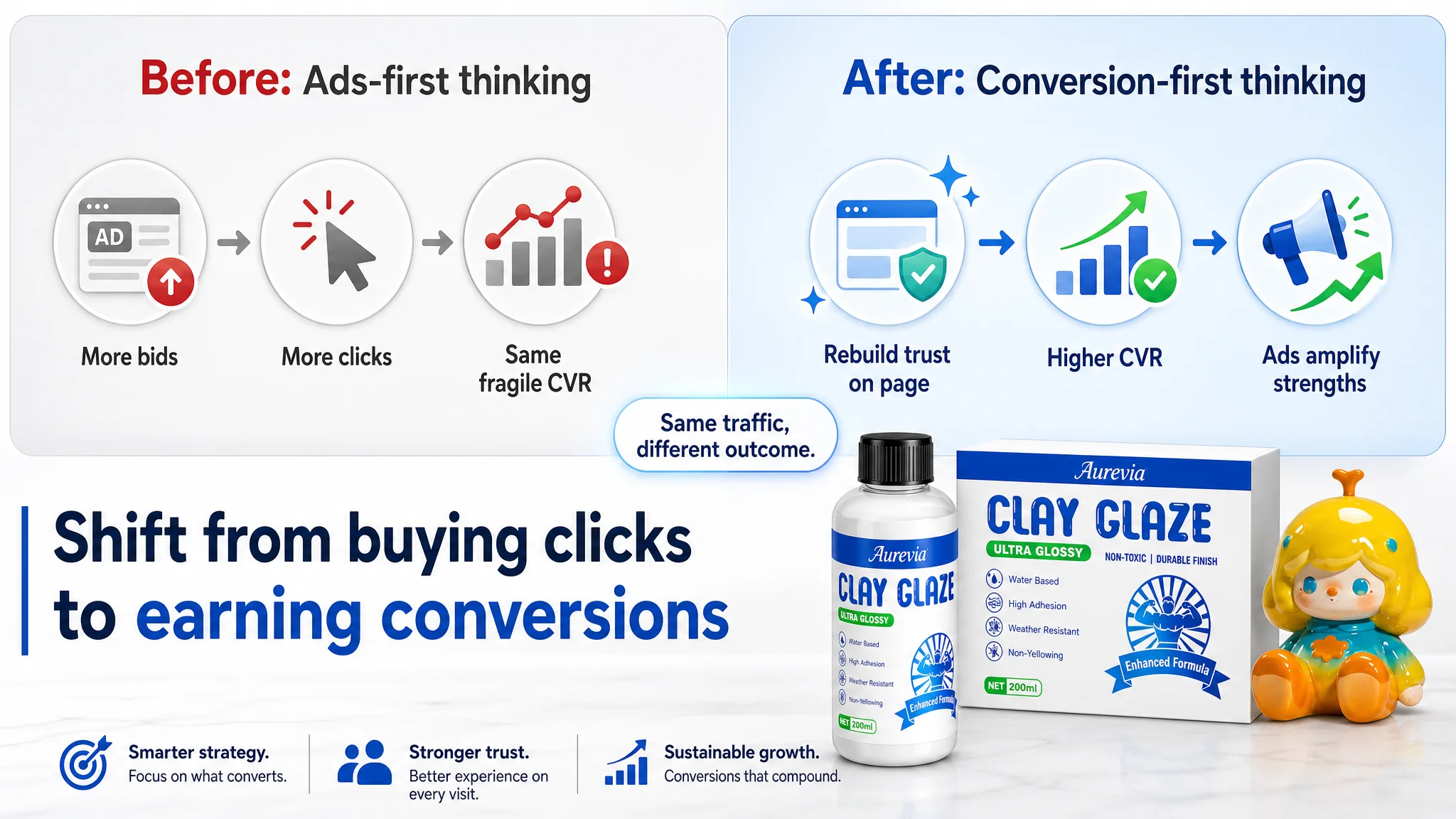
This case comes from an Amazon seller in the US arts-and-crafts category, selling an air-dry clay glaze and varnish. The team was under pressure from rising Amazon ad costs and a fragile conversion rate: traffic was coming in, but orders did not grow as expected. Internally, the discussion kept circling around “we need better ads” and “we’re not bidding aggressively enough.”
DeepBI’s diagnosis showed a different story. Against a benchmark Amazon Listing for a comparable air-dry clay varnish, the seller’s title, bullet points, and A+ content were already competitive—or slightly better. The real gap was not in copy or structure, but in how the main image set and review layer built (or failed to build) trust. Ads were feeding traffic into a page that looked less proven and less convincing than a key competitor, especially on mobile.
Once the problem was reframed as a Listing-conversion and trust issue—not an advertising or keyword issue—the optimization path changed completely. Instead of squeezing bids and restructuring campaigns, the focus shifted to main-image storytelling, earlier visual proof of durability, clearer multi-surface usage, and a more mature trust signal to offset weaker review volume. For other Amazon sellers, the lesson is simple but uncomfortable: when ad performance stalls, the real constraint may be your product page’s ability to convert, not your ability to buy traffic.
The Amazon Listing Looked “Fine” on Paper—but Still Lost the Sale
From a pure scoring standpoint, this Listing did not look like a problem child.
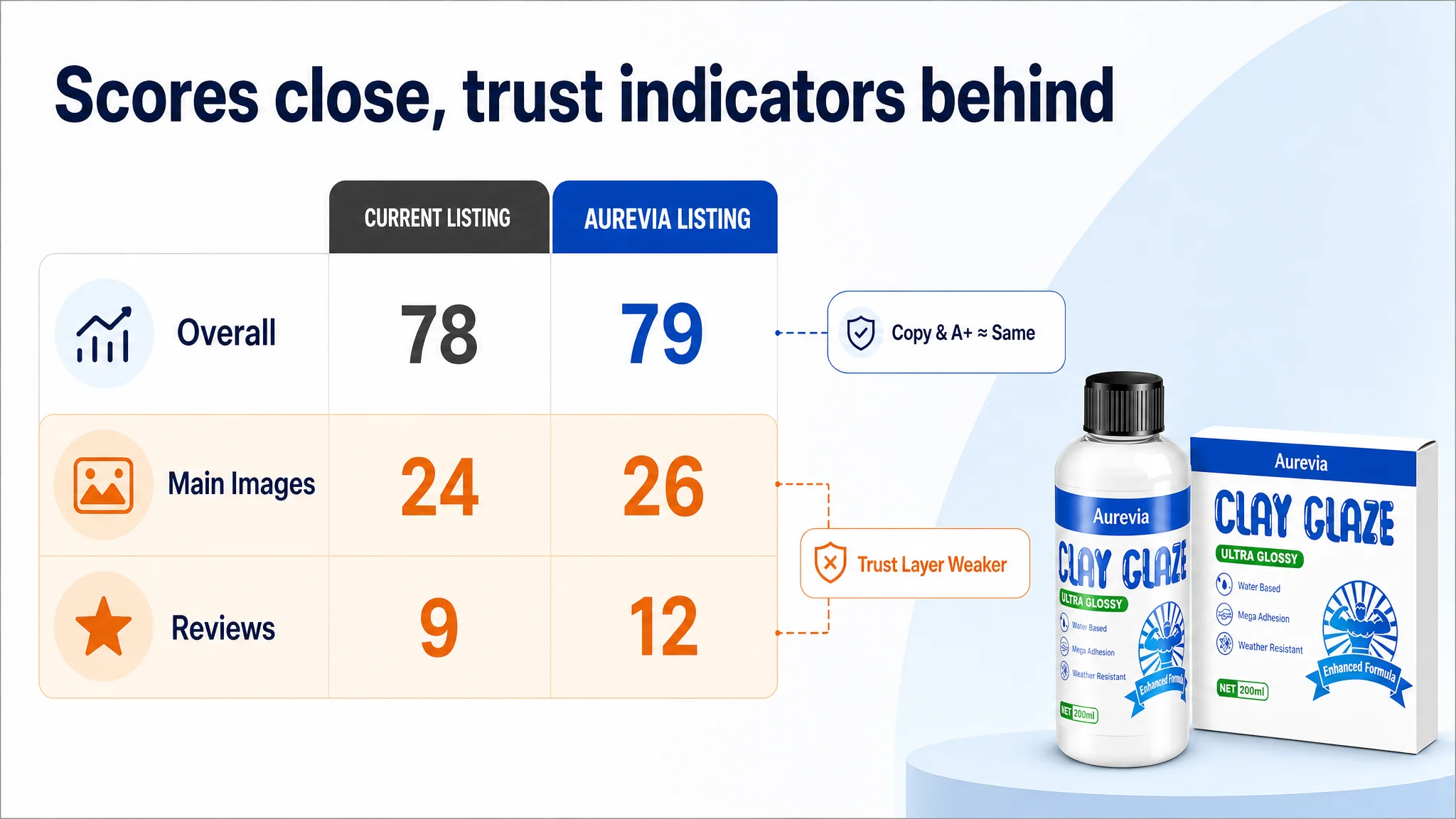
DeepBI’s Listing score put the product at 78/100, with the benchmark competitor at 79/100—only a 1-point difference. Title, bullet points, and A+ structure were not obvious weaknesses:
- Title: slightly better than the benchmark (16 vs 14 out of 20)
- Bullet points: slightly better (8 vs 7 out of 10)
- Detail/A+ content: slightly better (21 vs 20 out of 25)
- Main images: slightly weaker (24 vs 26 out of 30)
- Reviews: clearly weaker (9 vs 12 out of 15)
On the surface, this looked like a Listing that “just needs more traffic”:
- The title already front-loaded “Air Dry Clay Glaze” and related keywords.
- Bullet points followed a clear logic: upgrade message → protection → scenes → safety → steps.
- A+ content used strong before/after visuals and full-funnel storytelling.
The team’s natural conclusion: “If our page scores are close to the benchmark, then ACOS pressure must be an ads problem. We need better targeting, better bids, and maybe new creatives for Sponsored Products.”
That misdiagnosis is what kept them stuck.
“The real problem was not that ads failed to bring traffic. It was that the page could not convert the traffic with the same trust level as the benchmark.”
Where the Misdiagnosis Started: Blaming Amazon Ads for a Trust Gap
The seller’s operating pressure was very familiar:
- Amazon ad costs were rising.
- Previous bid tactics stopped working.
- Orders did not grow in proportion to impressions and clicks.
- There was anxiety about “wasting” traffic.
Under this pressure, it is easy to default to an advertising answer:
- Adjust bids.
- Refine match types.
- Add more keywords.
- Rotate creatives.
But DeepBI’s scoring and benchmark comparison showed a different pattern:
- Title and bullets were not the bottleneck.
- A+ content was structurally sound.
- The biggest measurable gap was in reviews and visual trust.
Specifically:
- Review score: 4.4 vs competitor’s 4.6
- Review count: 28 vs competitor’s 281
- Home-page negative-review rate: ~30% vs competitor’s ~13%
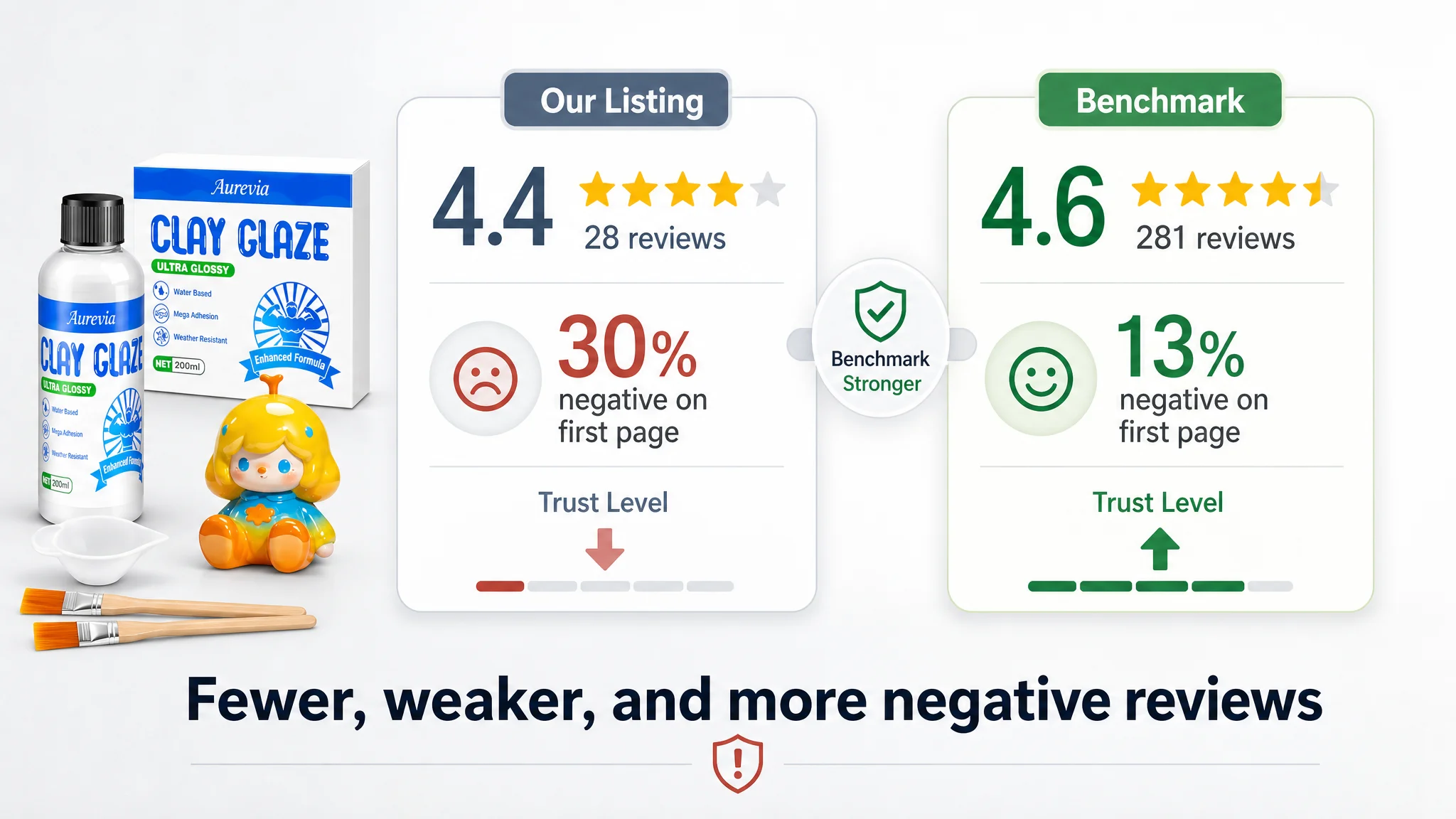
In other words, even before reading the page, buyers were seeing:
- A product with far fewer reviews
- Slightly lower rating
- More visible negative feedback
Combined with main images that delayed hard visual proof and delayed safety reassurance, the Listing was asking the shopper to “take a chance” where the benchmark listing was saying, “This is already proven.”
If ads continued to send traffic at the same rate, the page would keep losing the comparison battle at the decision moment.
Amazon Ads Were Not Failing. The Page Was Consuming the Traffic.
From DeepBI’s perspective, the key question was not “how do we get more clicks,” but:
“Given the traffic we already have, where is the shopper’s confidence collapsing?”
Two areas stood out:
1. Main-image logic on the Amazon search results and detail page
2. Review maturity and perceived risk
The main image sequence delayed proof and clarity
On Amazon, the first 3–4 images often decide whether:
- The shopper clicks into the detail page at all.
- The shopper keeps scrolling or bounces.
- The shopper believes the product can deliver the claim.
DeepBI’s comparative analysis showed:
- The benchmark’s first images immediately introduced:
- Long-term durability proof (e.g., “one-year” type tests)
- Clear, explicit benefits on the bottle labels
- Multi-surface usage in a visually unified way
- The seller’s images:
- Used icons and abstract feature callouts instead of concrete evidence.
- Repeated similar protection claims across multiple images without widening the story.
- Only later showed a strong before/after comparison.
- Pushed explicit safety reassurance to the last image.
The result: the Listing looked more “marketing” than “proven.”
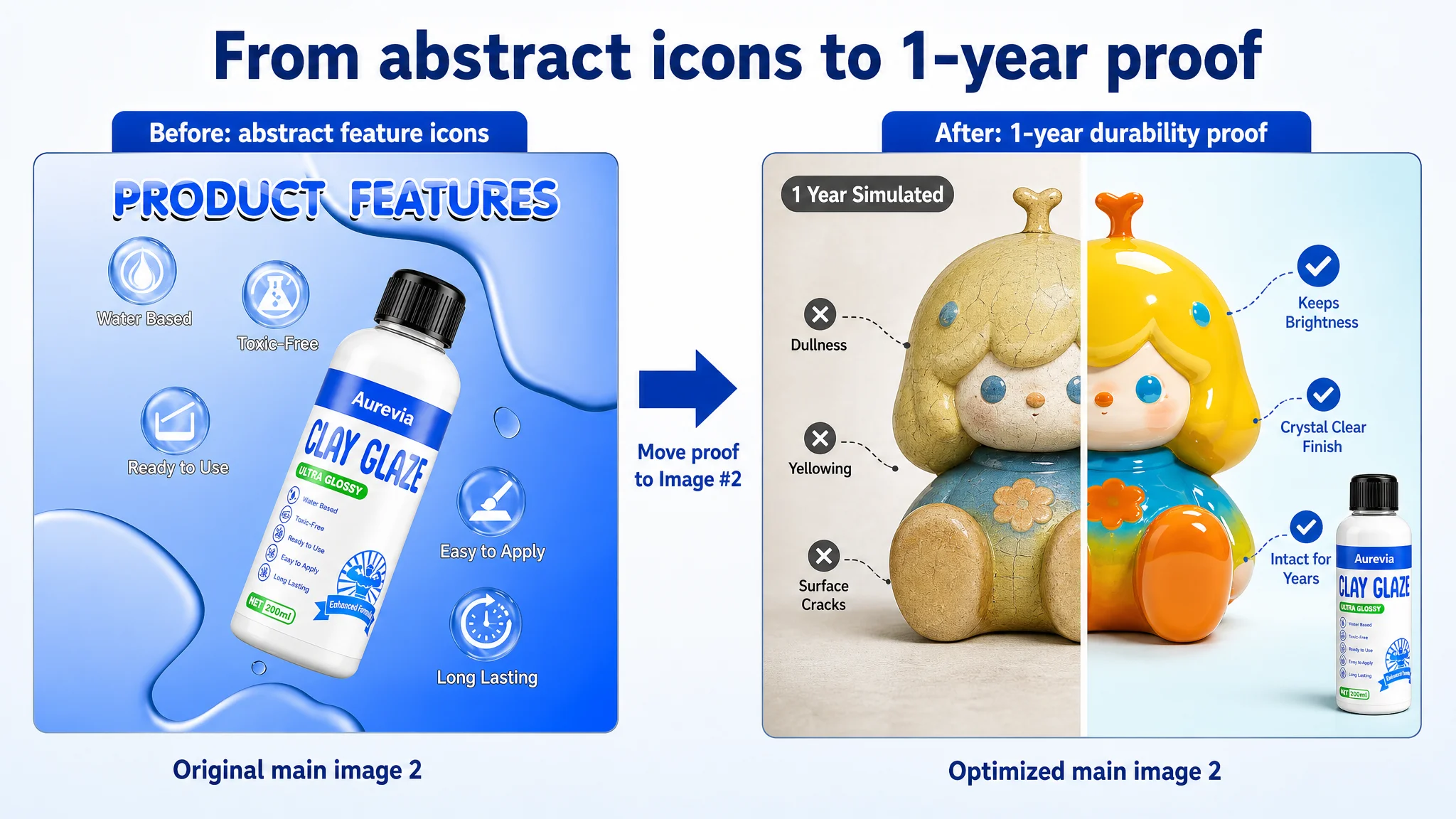
In a category where shoppers worry about:
- Cracks
- Yellowing
- Losing gloss over time
- Whether it works on their specific material
- Safety and non-toxicity
the lack of early visual proof and early safety statements forced buyers to “wait” for reassurance. Many never waited that long.
The review layer amplified the visual trust deficit
Even a well-structured A+ cannot fully compensate for:
- Low review volume
- Slightly lower rating
- High proportion of visible negative reviews
Compared to a benchmark with 10x the review count and better review distribution, this Listing carried a trust penalty before the shopper even started reading the bullets or A+.
From DeepBI’s judgment, that meant:
- Every ad click was worth less than on the benchmark Listing.
- At the same CPC, the competitor effectively had a higher “conversion leverage” per click.
- More ad spend on this Listing, without fixing trust, would widen the efficiency gap, not close it.
The Real Constraint Was Listing Conversion Capacity
When DeepBI overlaid the Listing scores with the competitive context, one conclusion was clear:
The Listing did not lack information. It lacked prioritized evidence.
- The title already front-loaded “Air Dry Clay Glaze Varnish Waterproof” and merged “sealant” into the structure.
- Bullets already covered:
- High gloss and upgraded formula
- Waterproof, anti-scratch, anti-yellowing protection
- Multi-surface usage (ceramics, wood, plaster, acrylic)
- Professional 3-step application
- Safety and non-toxic claims
- A+ already touched:
- High gloss, high adhesion
- Protective film benefits
- Multi-material compatibility
- Safety
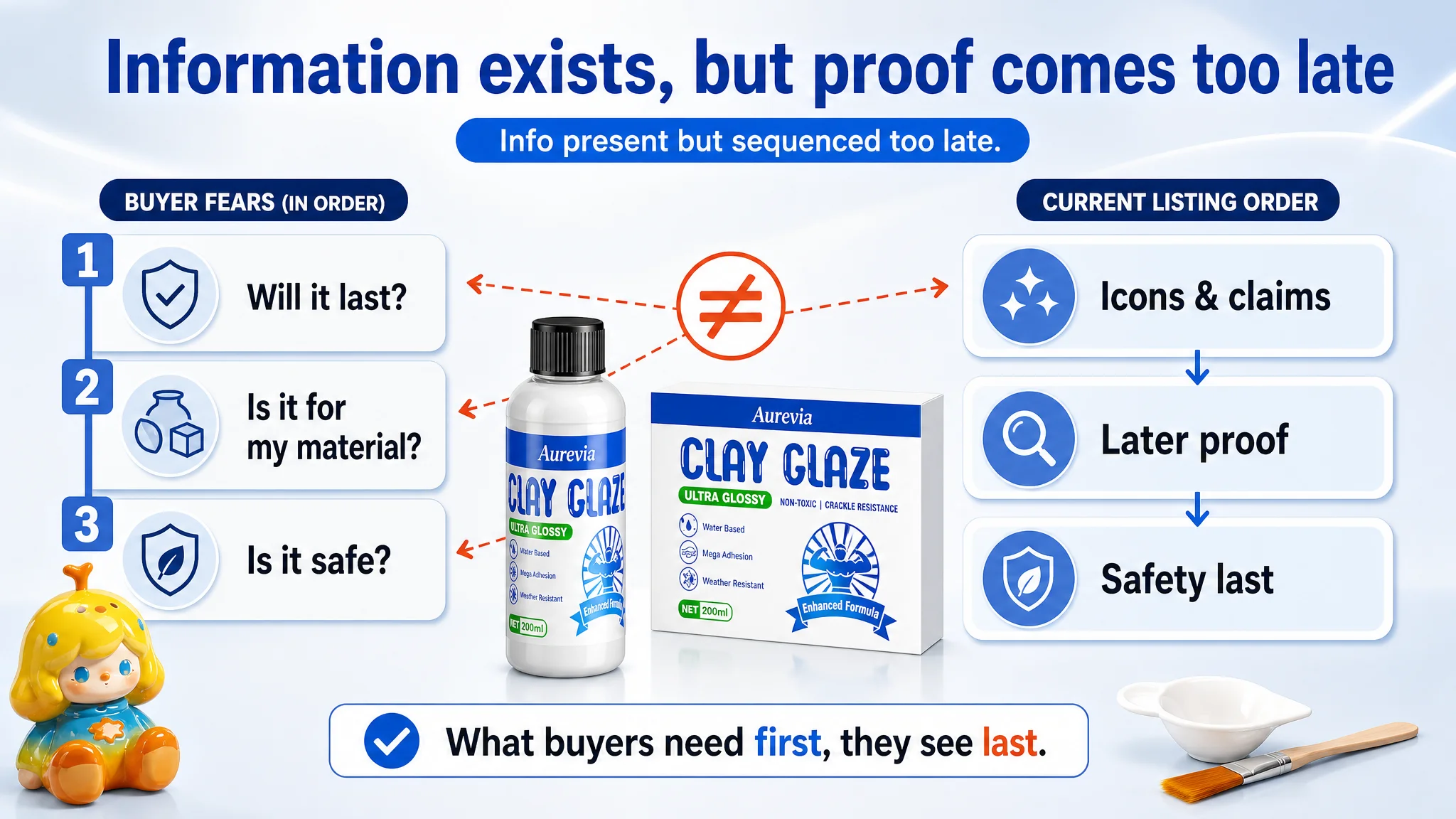
Yet conversion remained fragile, because:
- The order of information did not match the buyer’s fears.
- The proof was coming too late in the journey.
- The trust gap from reviews was not being aggressively offset by visuals.
“Advertising does not only amplify advantages. It can also amplify a page’s existing defects.”
This is why DeepBI treated Listing conversion capacity as the first-order constraint:
- Fixing ads without fixing the Listing would:
- Increase spend.
- Stabilize impressions.
- But leave CVR and ACOS under the same pressure.
Why DeepBI Did Not Recommend “More Ads First”
From a business perspective, there were two possible paths:
1. Keep focusing on ads and campaign tuning
Try to “buy through” the conversion problem:
- More traffic.
- More experiments.
- More creative variations.
1. Stabilize the Listing’s ability to convert current traffic
Before scaling traffic, fix:
- Main-image trust logic.
- Visual proof order.
- Safety reassurance timing.
- Perceived compatibility and ease of use.
DeepBI judged that path (2) had to come first.
The biggest risk: ads amplifying a low-trust page
If the team had continued on path (1):
- Ads would drive more visitors into a page where:
- The competitor visibly felt more proven.
- The strongest proof was hidden later in the gallery.
- Safety and ease-of-use were not foregrounded.
- The Listing’s ACOS would remain volatile.
- Organic rank would struggle, as paid traffic did not translate into enough stable orders.
In short, the risk was:
- Higher TACOS with no sustainable improvement in organic positioning.
- Growing dependence on ads to hold even the current sales level.
By contrast, improving Listing conversion first would:
- Make every future ad click worth more.
- Reduce the required spend to reach the same number of orders.
- Give organic traffic a stronger conversion baseline.
This Product Page Did Not Lack Traffic. It Lacked Trust.
The optimization logic that followed was not about adding “more content.” It was about reordering and reframing what was already there.
1. Reframing the title: outcome-focused, not ingredient-focused
The recommended title structure:
Air Dry Clay Glaze Varnish Waterproof - 6.8oz High Gloss Transparent Sealant for Pottery, Polymer Clay, Wood & Acrylic Painting, Anti-Scratch & Prevents Cracking
Key shifts:
- Core keywords first: “Air Dry Clay Glaze Varnish Waterproof” signals both function and outcome.
- Result language: “High Gloss Transparent Sealant,” “Anti-Scratch & Prevents Cracking” address the real fear: “Will my work fail?”
- Structured usage: Pottery, polymer clay, wood, acrylic painting grouped logically, not as a scattered list.
This was less about chasing the algorithm, more about ensuring the shopper immediately understands what problem the product solves.
2. Rebuilding bullet points as a decision path
The new bullet logic turned each point into a complete micro-argument:
1. High Gloss Mirror Finish - New Version
- Leads with version upgrade and professional-level finish.
- Communicates: this is not just a clear coat; it is an upgraded solution.
1. Durable Protection: Waterproof & Anti-Scratch
- Combines waterproof, anti-scratch, anti-yellowing, and anti-cracking.
- Turns scattered features into one clear outcome: long-term protection.
1. Versatile Multi-Surface Use
- Extends beyond clay: ceramics, wood, plaster, acrylic.
- Adds emotional value: a thoughtful gift for hobbyists.
1. Professional 3-Step Application
- Simplifies the process into a clear, realistic three-step method.
- Reduces fear of complexity and failure.
1. Safe, Non-Toxic & Usage Note
- Brings safety reassurance and compliance in a single, concise statement.
- Explicitly sets boundaries (no food/dishwasher) to avoid future regret.
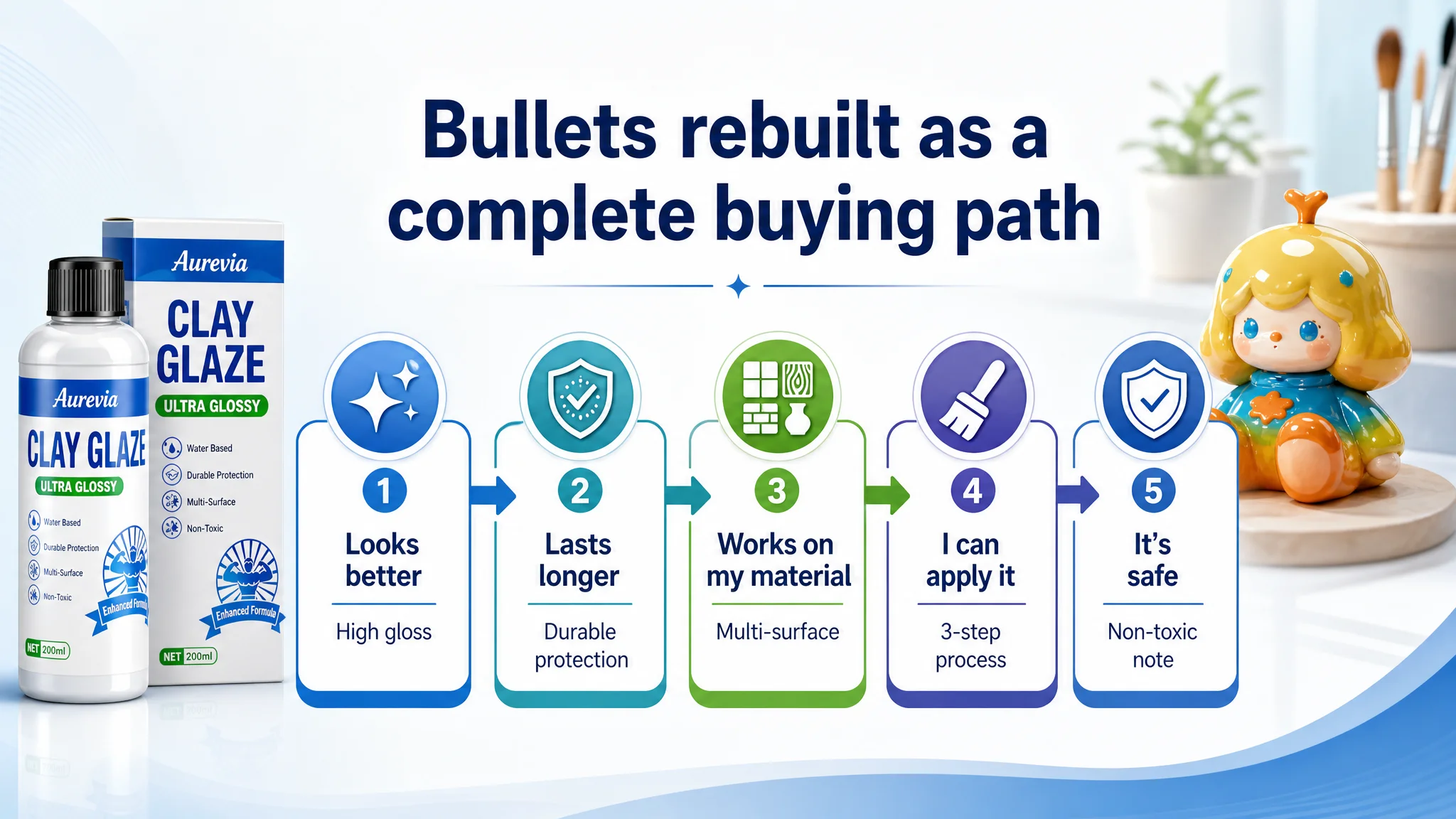
Instead of a list of attributes, the bullets now form a buying story:
- It looks better.
- It lasts longer.
- It works on my material.
- I can actually apply it.
- It’s safe for my household.
Main Images: From Repeating Claims to Front-Loaded Proof
DeepBI’s analysis of the main-image set led to one central judgment:
“Visual proof of durability and compatibility must appear before repeated abstract claims.”
Early images: show, don’t tell
The revised priorities:
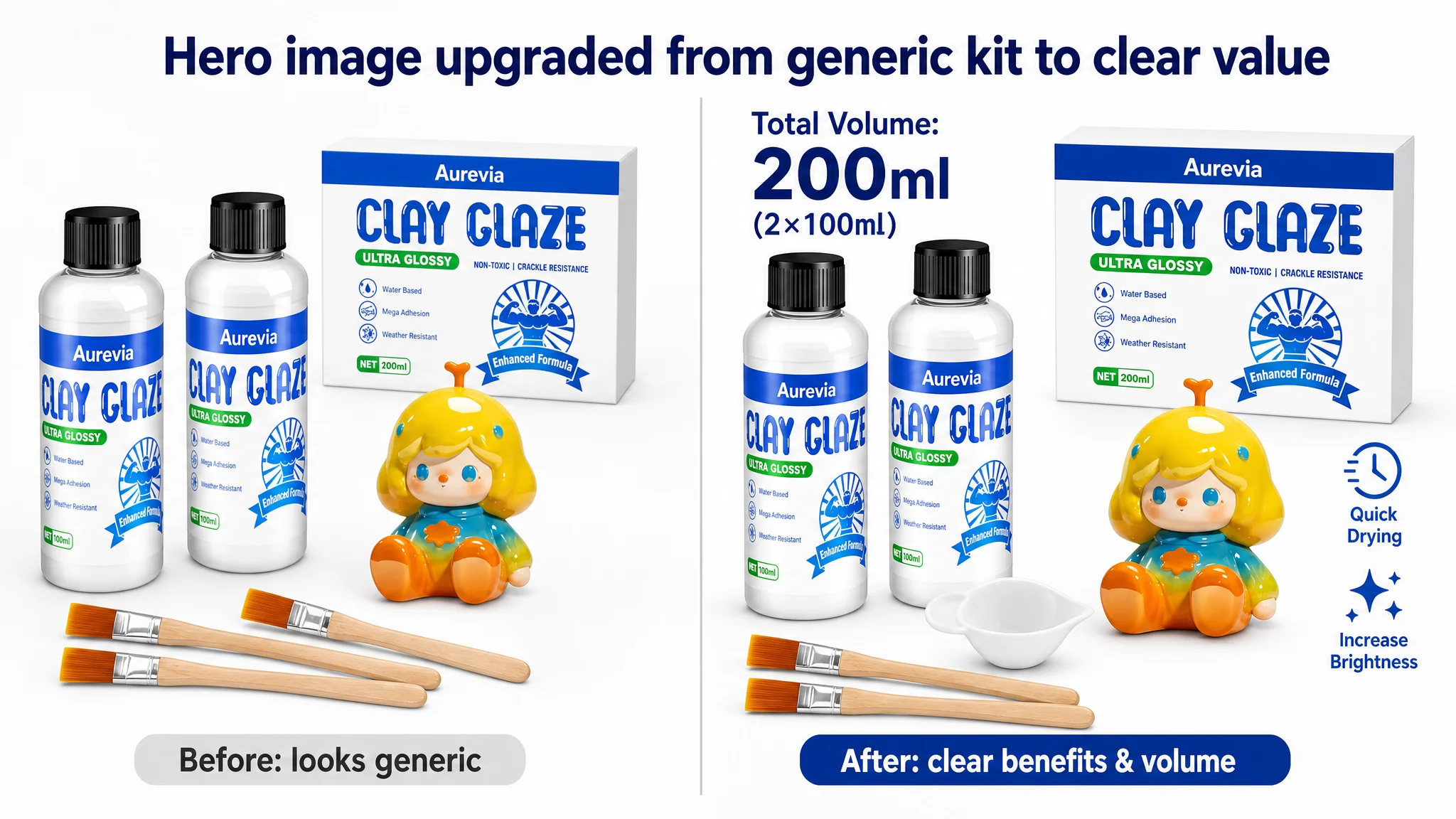
1. First image (hero)
- Keep clear product identification: Air Dry Clay Glaze, 2×100ml, high gloss.
- Add concise callouts: “Increase Brightness,” “Quick Drying,” “Waterproof.”
- Make volume and “New Version” status unmissable.
1. Second image: long-term proof
- Replace icon-heavy, abstract claims with:
- A clear time-referenced comparison (e.g., after prolonged use/exposure).
- Direct visual evidence of gloss retention, anti-cracking, and anti-yellowing.
- Address the core fear: “Will this glaze still look good in a year?”
1. Third image: multi-surface versatility
- Swap redundant feature reinforcement for:
- Clay, wood, plaster, acrylic surfaces shown side-by-side.
- Close-up gloss proof on each material.
- Give a visual answer to “Will it work on my material?”
1. Fourth image: focused failure-mode prevention
- Use comparison approach to:
- Show anti-cracking and anti-yellowing on a particularly challenging object.
- Reinforce that the glaze doesn’t just prevent dullness; it prevents all major failure modes.
1. Fifth image: safety + ease-of-use summarized
- Combine:
- Safety message (“Non-toxic,” “Meets strict safety standards”).
- Simple 3-step application logic.
- “Professional results for all ages” positioning.
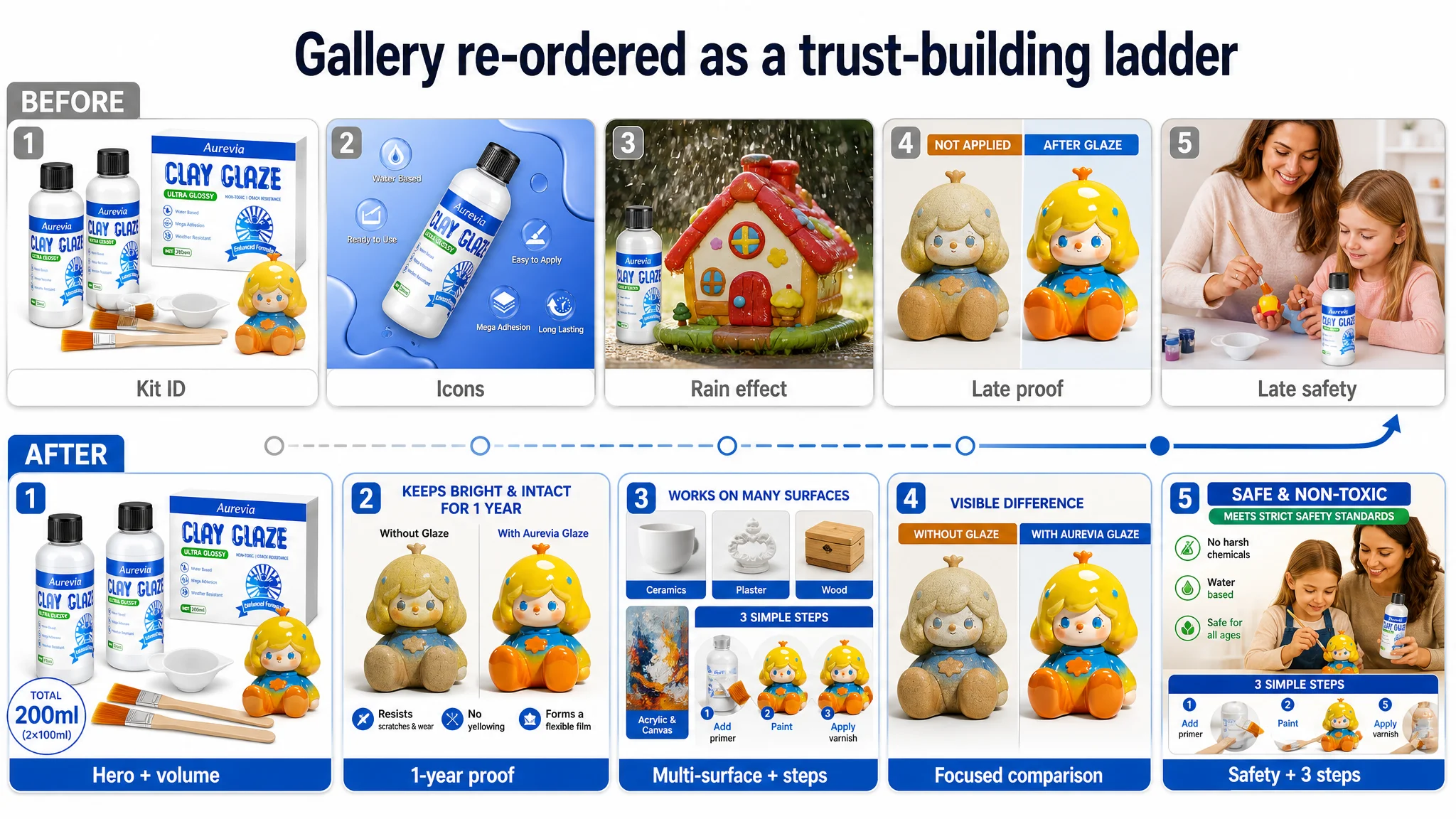
This sequence turns the image gallery into a trust-building ladder, not a loop of repeated claims.
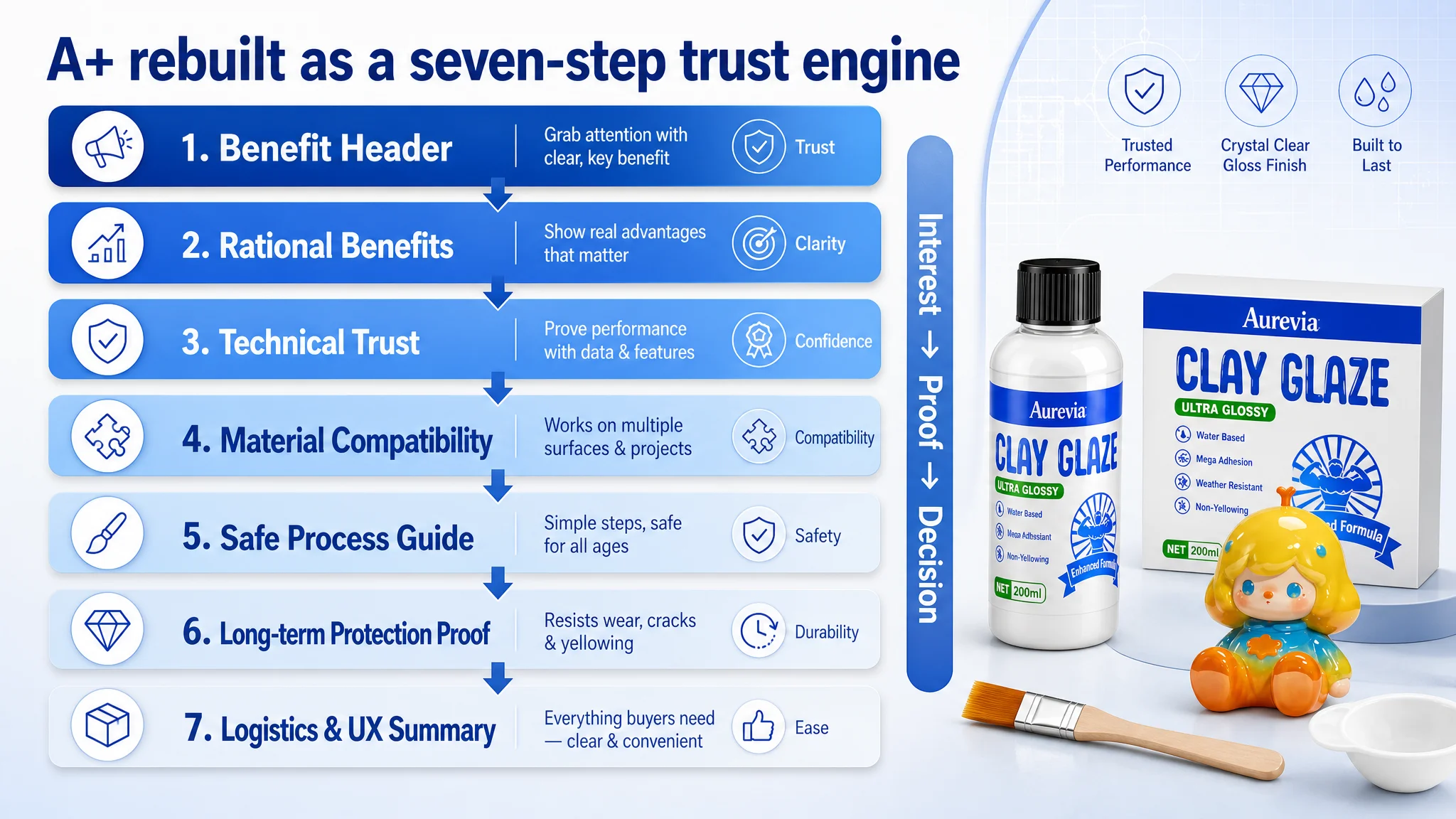
A+ Content: Turning Dense Information into a Structured Trust Engine
The A+ page had strong ingredients, but their roles were not clearly differentiated. DeepBI’s recommendations reorganized the content into a more defined funnel.
1. Benefit reinforcement header (Module 1)
- Use the top module to:
- Reconfirm “New Version 2×100ml Transparent Air Dry Clay Glaze.”
- Summarize high-level benefits as icons: Waterproof, Crack-Resistant, Anti-Scratch, High Gloss.
- Goal: Immediately deepen interest beyond “just gloss.”
2. Rational benefit breakdown (Module 2)
- Transform a single-benefit module into:
- Visual: mirror gloss, dimensionality.
- Protection: scratches, yellowing, cracks.
- Practicality: waterproof, easy maintenance.
- Goal: Give a reasoned argument for why this glaze is a better protective film.
3. Technical trust module (Module 3)
- Explain, in simple language:
- How the upgraded formula improves flow and degassing.
- How it reduces bubbles, brush marks, and application defects.
- Goal: Remove fear of application failure, not only long-term failure.
4. Material compatibility hub (Module 4)
- Consolidate:
- Clear grid or list of compatible materials.
- Short notes on any special handling if needed.
- Goal: Help buyers instantly decide: “Is this for my project?”
5. Safe application & process guide (Module 5)
- Present:
- The professional 3-step process with matching visuals.
- Safety boundaries (no food or dishwasher).
- Goal: Set realistic expectations and avoid regret from misuse.
6. Long-term protection validation (Module 6)
- Bring back:
- Before/after visuals focused on color preservation and surface protection.
- Maintenance guidance to reduce perceived risk.
- Goal: Confirm that protection is not just theoretical, but visible and durable.
7. Logistics & UX summary (Module 7)
- Close with:
- “Ready to Use,” “Easy to Apply,” “2×100ml for multiple projects.”
- Safety reassurance.
- Goal: Leave the shopper with a clear mental picture of value, ease, and safety.
How the Page’s Sales Logic Started to Recover
After these changes, the Listing did not suddenly become perfect—but its logic became coherent:
- Search page:
- Main image and title immediately communicated waterproof, high-gloss protection that prevents cracks and scratches.
- The product looked like an upgraded, professional solution, not a generic clear coat.
- Detail page:
- Visual proof of long-term durability appeared early.
- Multi-surface usage was visually obvious.
- Safety and non-toxicity were no longer buried at the end.
- Application steps were clear and realistic.
- Review context:
- While the review count could not be changed overnight, the Listing now did more work to counterbalance the trust disadvantage:
- Stronger evidence.
- Clearer process.
- Explicit safety boundaries.
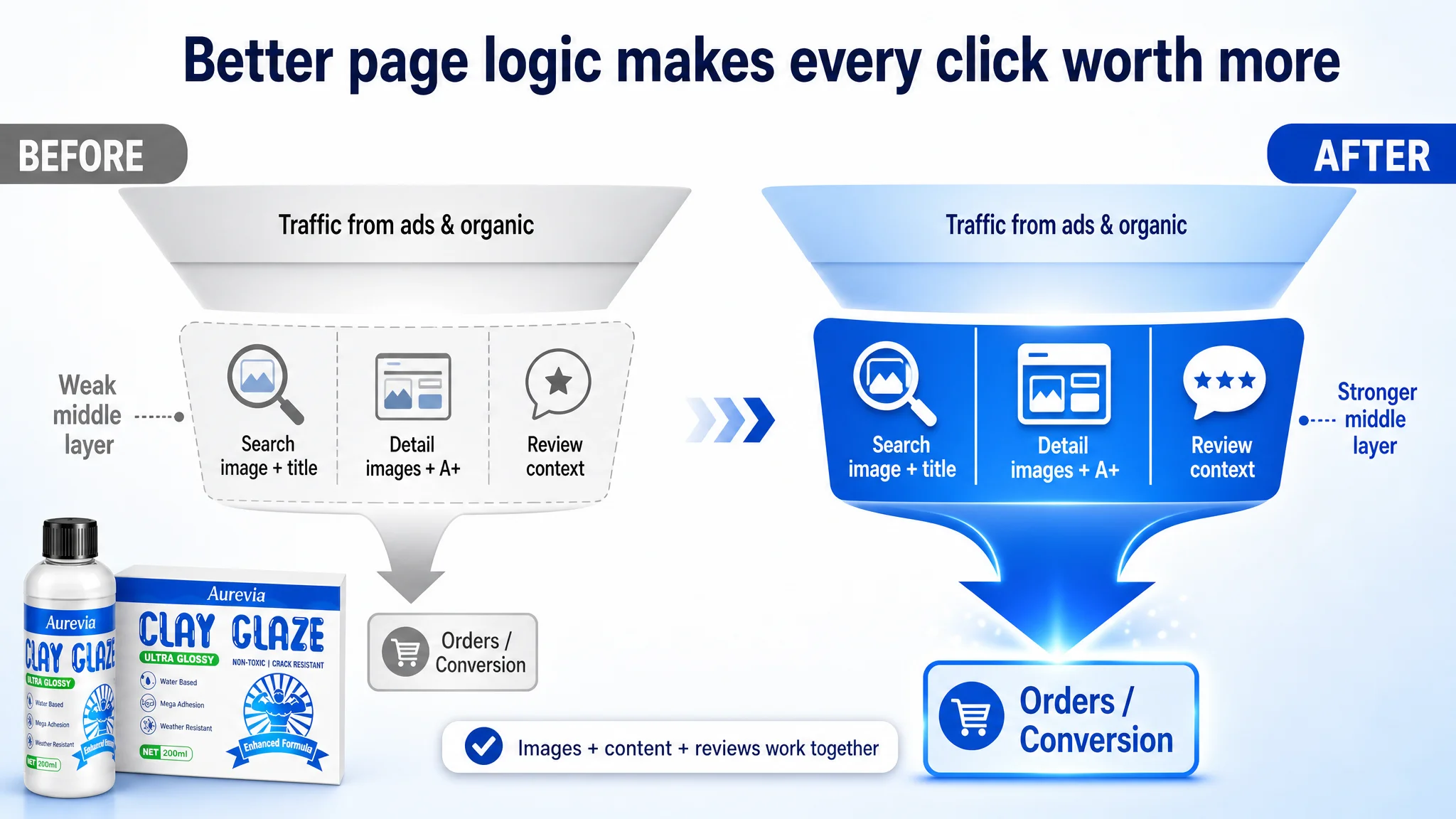
DeepBI’s role was not to “beautify” the page, but to:
- Identify that the bottleneck was trust and proof, not keywords or copy volume.
- Reorder existing strengths into a more persuasive sequence.
- Prevent the team from burning more budget on ads while the page still leaked conversion.
What Other Amazon Sellers Can Take Away
This case is not unique to air-dry clay glaze. It is a pattern many Amazon sellers face:
- Ads become more expensive and harder to optimize.
- Listing scores look “good enough.”
- The instinct is to blame campaigns, keywords, or CPC.
Yet when you break down the Listing against a true benchmark:
- The biggest gap may sit in visual proof, trust sequencing, and review maturity, not in ad configuration.
- The page might be “busy” but not convincing.
- Ads may be amplifying a trust gap rather than a competitive edge.
Key questions to ask before you push more ad spend:
- Does my first image and title make the core outcome unmistakable?
- Does the gallery show hard proof of durability, compatibility, and safety—early?
- Are my bullets a decision path, or just an attribute list?
- Is my A+ acting as a structured trust engine, or just design decoration?
- How does my review layer compare in volume and distribution to a real benchmark?
For this Amazon seller, the turning point was accepting that ads were not the main problem. The problem was a Listing that could not convert traffic as confidently as the benchmark, especially under a review disadvantage.
Once the Listing’s conversion logic was rebuilt around evidence, trust, and clear outcomes, ad traffic started to become useful again—not because bids were magically better, but because the page finally deserved the traffic it was buying.