

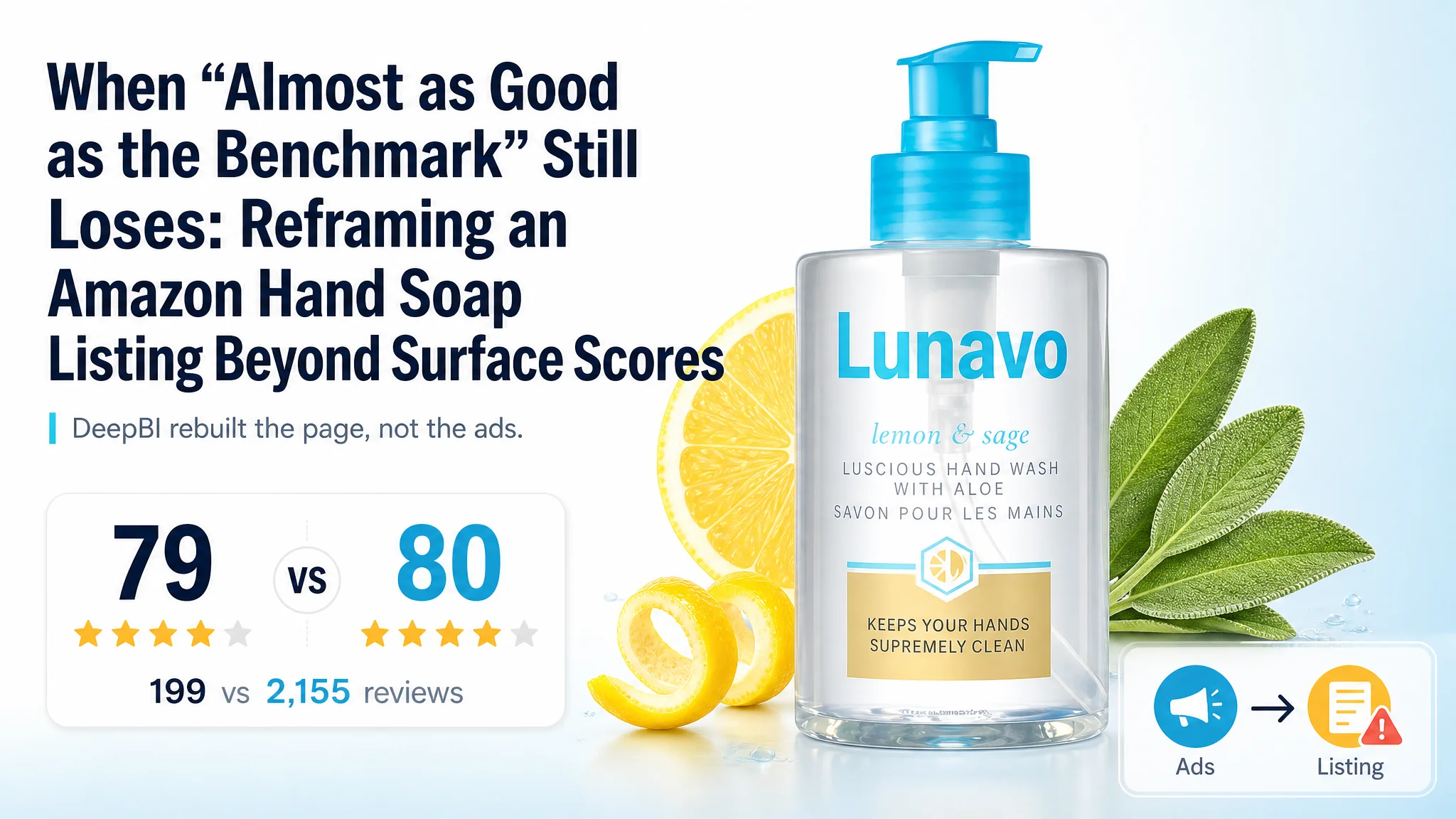
This Amazon seller in the personal care category thought they were in a good place: their liquid hand soap Listing scored 79/100, almost identical to a benchmark competitor at 80/100. Titles, main images, A+ modules—all looked “decent” on paper. Yet as Amazon ad costs rose, the Listing struggled to convert traffic as efficiently as expected, especially under competitive keywords. The team’s instinct was to keep tuning Amazon ads and expand keywords, believing the issue was exposure, not the product page.
DeepBI’s diagnosis told a different story. Under the similar total scores, the benchmark competition wasn’t winning because it was prettier; it was winning because its page structured trust, value, and self‑care identity more tightly. The customer’s Listing was strong on ingredient proof and hydration claims, but weak in early-stage trust signals, emotional positioning, and value framing—all critical for converting both paid and organic visitors on Amazon.
 The optimization therefore did not start with more ad tweaks. It started with reframing the Listing: reordering images to surface safety and trust earlier, restructuring bullet points around “self‑care + clean beauty” decision logic, and reshaping A+ content to lead with home context and authority rather than pure ingredient density. For other Amazon sellers, the lesson is straightforward but uncomfortable: when your Listing “almost matches” a leading competitor on paper yet ad efficiency stalls, the real bottleneck is often the conversion logic of the page, not the settings of the ads.
Amazon Ads Were Not Failing. The Page Was Consuming the Traffic.
From the seller’s perspective, the initial situation looked manageable.
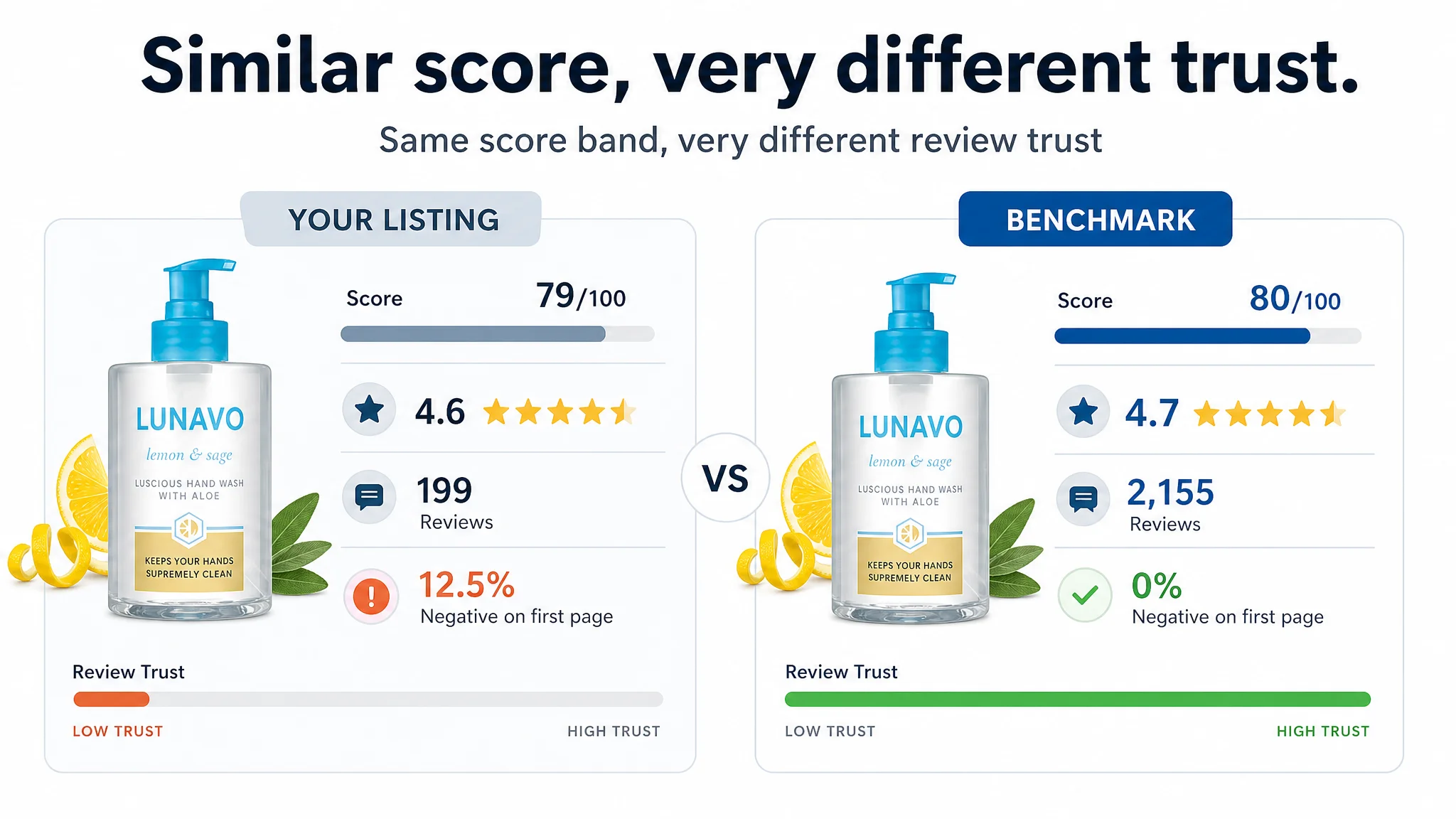
- Overall Listing score: 79/100
- Benchmark Listing score: 80/100
At a glance, there was no obvious disaster. Title slightly better, A+ richer, images high quality. The seller assumed:
“We’re already close to the category leader. If we just push more Amazon ads and refine bids/keywords, volume and ROAS should gradually improve.”
Operationally, this led to a familiar pattern:
- Expanding keyword coverage around “hand soap”, “hand wash”, “hydrating”, “aloe”, etc.
- Adjusting bids to hold ACOS in a tolerable band.
- Expecting incremental gains from ad optimization alone.
But the real signals in the Listing data were pointing elsewhere:
- Review gap was massive, not marginal:
- Target Listing: 4.6 stars, 199 total reviews
- Benchmark: 4.7 stars, 2,155 reviews
- Trust perception was weaker: fewer reviews, more visible negatives on the first page (12.5% three-star and below vs. 0% for the benchmark).
In other words, every click the ads brought had to work harder to overcome a visible trust gap and a less mature brand narrative. Ads were doing their job—delivering traffic—but the product page was not structurally optimized to convert that traffic under competitive pressure.
“The real problem was not that ads failed to bring traffic. It was that the page could not convert the traffic.”
The Seller’s Misdiagnosis: “We Just Need More Exposure”
The seller’s internal narrative focused on traffic and visibility:
- Listing score was close to the benchmark.
- Title looked strong and keyword-rich.
- A+ modules were visually polished and ingredient-heavy.
So the working assumption became:
- “Our fundamentals are fine; we just need more eyeballs.”
- “If we keep optimizing ads, conversion will follow.”
That led to three typical blind spots:
1. Overestimating the impact of a strong title alone
Their title did outperform the benchmark on keyword coverage and functional descriptors (e.g., “Hydrating”, “Refreshing”, “Gently Cleanses Without Drying”). This reinforced the belief that search and click problems were under control.
1. Undervaluing early trust-building elements
High-quality visuals existed, but critical trust modules (safety, clean formula, authority) appeared later in the image sequence and A+. Decision-crucial reassurance was being delivered too late.
1. Ignoring the emotional and value narrative
The page leaned heavily on ingredients and hydration benefits, while the benchmark elevated the product into a “self‑care / aromatherapy” ritual and reinforced clean, safe credentials. The seller saw this as “nice-to-have branding”, not as conversion infrastructure.
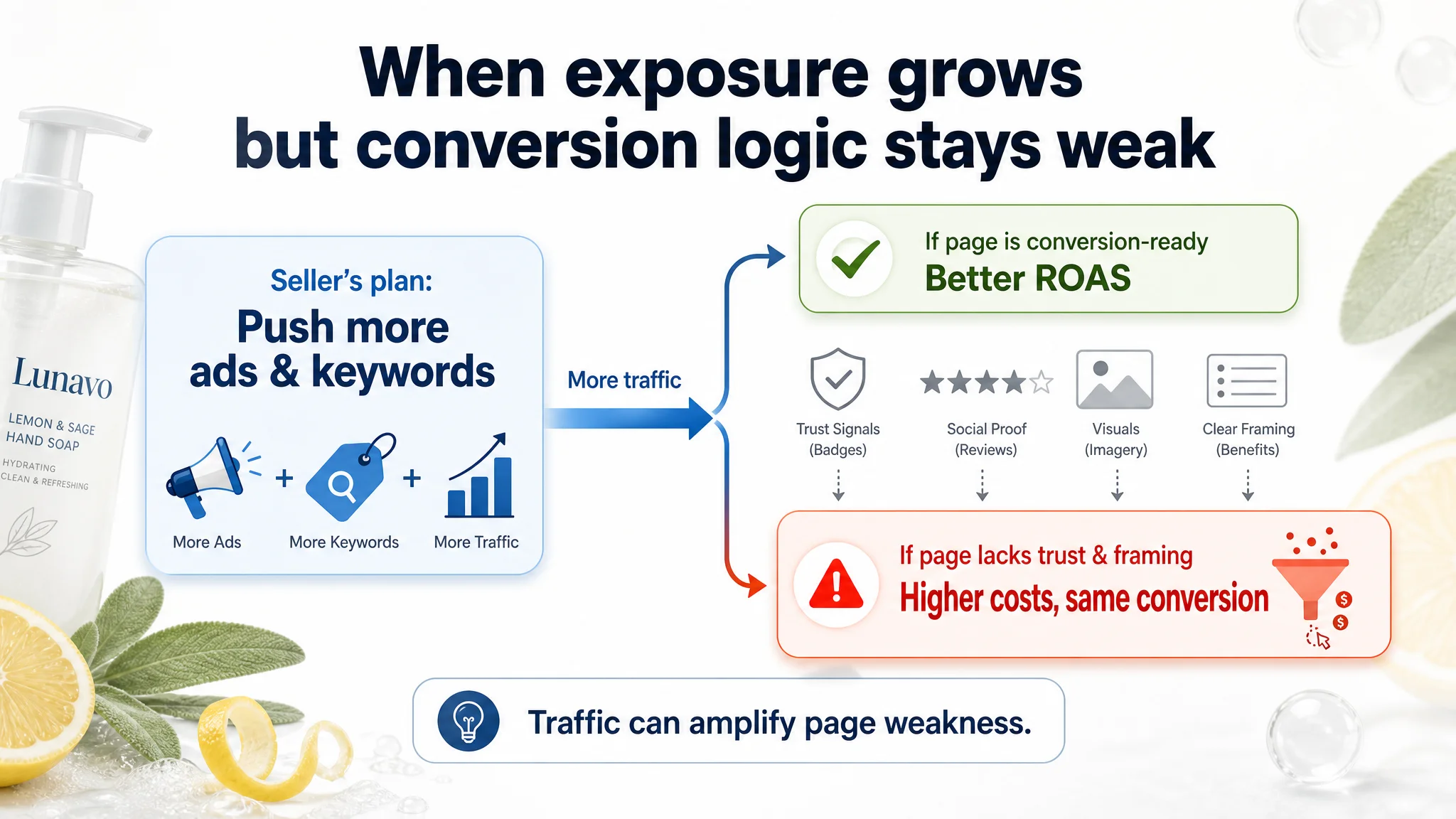 As ad costs tightened, tuning campaigns on top of this misdiagnosis only amplified the underlying issue: traffic was being pushed into a page that hadn’t fully resolved trust, value, and self‑care logic.
The Real Constraint Was Listing Conversion Capacity
Looking beyond the aggregate 79 vs. 80 score, DeepBI’s Listing-level diagnosis surfaced a different picture: not a broken Listing, but a Listing with misaligned conversion priorities.
1. Title: Strong, But Not the Bottleneck
- Target Listing title:
- More complete keyword coverage: “Hand Soap” and “Hand Wash” pushed forward.
- Includes functional descriptors: “Hydrating”, “Refreshing”, “Gently Cleanses Without Drying”.
- Highlights key ingredients: “Aloe”, “Coconut Oil & Vitamin B5”.
- Benchmark title:
- Slightly simpler, structured as “brand + product + size/pack + core positioning”.
- Very clear on pack value: “Pack of 3”.
- Core positioning: “Organic Plant-Based” with “Pure Essential Oils”.
DeepBI’s judgment: The target Listing did not lose because of the title. It may even have slightly better search coverage and functional appeal. The structural weakness lay elsewhere.
2. Main Images: Quality Present, Decision Logic Mis-Ordered
The image set itself was not poor:
- Hero shot with full-frame product and natural ingredients (aloe, lemon, sage).
- Ingredient proof visuals.
- Hydration and texture imagery.
- Icons around “clean & gentle” formula and skin benefits.
The issues were:
- Critical trust image appears too late
The strongest credibility frame—dermatologist tested, clean & cruelty-free, paraben/sulfate-free—was buried as Image 4. By that point, many visitors had already formed a tentative opinion or bounced.
- Early images repeat similar messages
Image 1 and 2 both lean on hydration/texture, creating redundancy instead of moving the buyer through distinct decision steps (what is it → why this scent → is it safe → does it feel premium → is it good value).
- Texture-only image wastes a key slot
Image 3 focuses on abstract texture on a non-specific background, detached from hands or product context. It doesn’t answer any new question (“What exactly does this lemon sage scent feel like?” “Is this formula safe for my sensitive skin?”).
Meanwhile, the benchmark uses image sequencing to:
- Surface brand ideology and aromatherapy positioning early.
- Highlight multi-pack value explicitly.
- Reassure on organic, clean formula quickly.
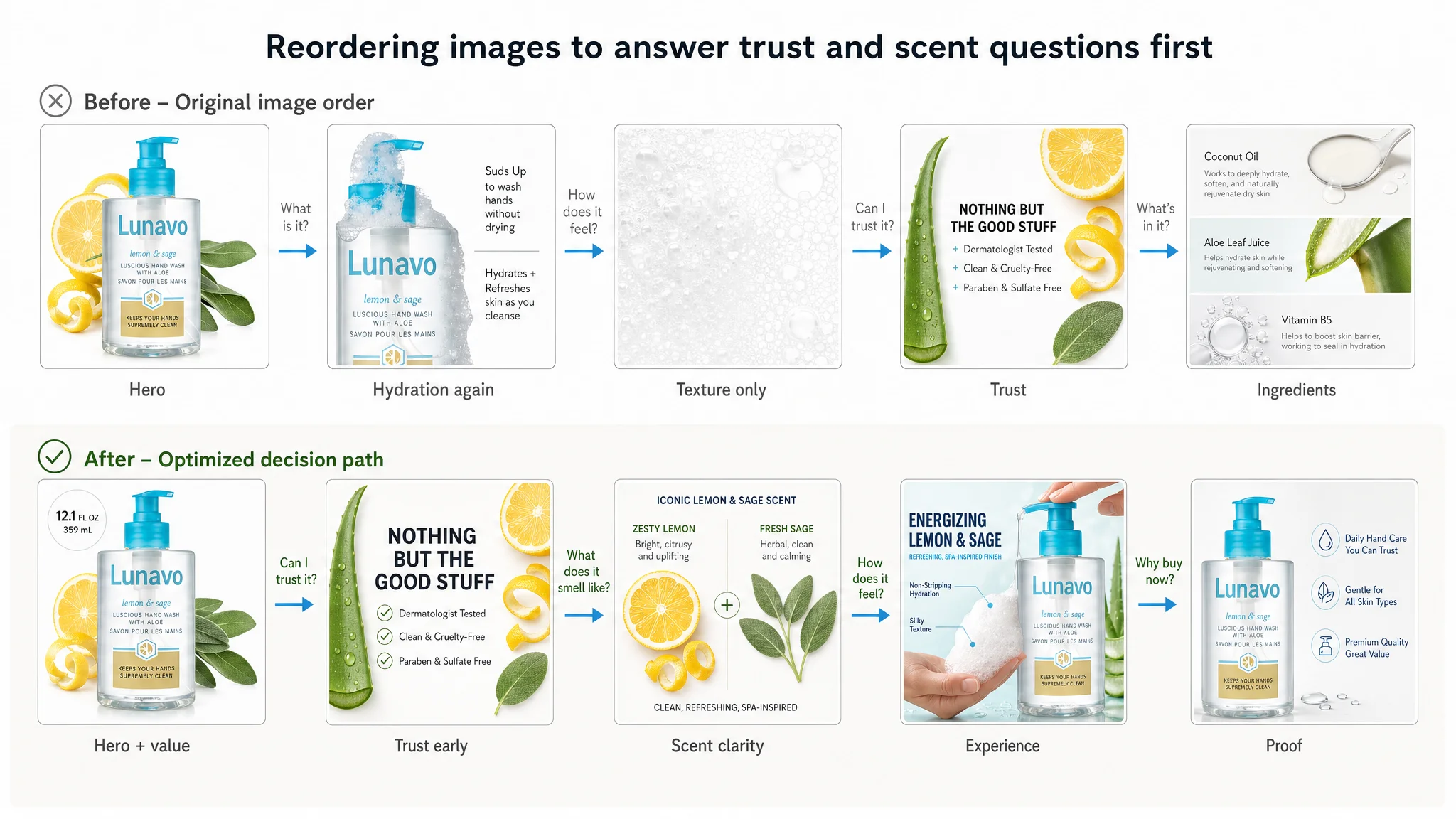 DeepBI’s view: the target’s image quality was fine, but decisional sequencing was off. Trust and scent clarity, two pivotal conversion levers in this category, were not occupying early, high-impact positions.
3. Bullet Points: Information Exists, Buying Logic Doesn’t
The bullet score gap seems small (7 vs. 8), but the structural difference is large.
Benchmark bullets prioritize:
- Quantity and value (“Contains (3) 12 Ounce Bottles…”).
- Organic / clean list (“triclosan free, synthetic fragrance free, cruelty-free, paraben-free, sulfate-free…”).
- Botanical extracts + aromatherapy benefit combined.
- Brand purpose: “meditative moments of self‑care” through aromatherapy.
Original target bullets emphasize:
- Scent description and sensory feel.
- Usage experience and effect promises.
- Ingredients and benefits in separated points.
- Basic how-to-use instructions.
DeepBI’s diagnosis:
- The target bullets describe the product; the benchmark bullets negotiate the buying decision.
- Trust, value, and identity (“clean beauty”, “self‑care ritual”) are established early by the benchmark, while the target’s bullets remain at the level of generic promises and usage.
4. A+ Detail Page: Strong Ingredient Story, Weak Trust Front-Loading
On A+ content, the target Listing actually outperforms in some respects:
- Clear “ingredient–benefit” mapping (coconut oil, aloe, vitamin B5, hydration/softness, barrier support).
- Professional, clean visuals with consistent natural imagery.
- A structured “2-step routine” connecting hand soap with hand cream (for cross-sell potential).
The constraints:
- Scene is not front-loaded
Early A+ modules lead with hydration and ingredients, not with a tangible home context (kitchen sink, bathroom scene) that would immediately answer “How will this look and work in my space?”
- Authority and certification are not used as a hard trust anchor
The benchmark uses brand ideology and organic claims; the target has the substance to do so (clean formula, dermatologist tested) but doesn’t convert it into a dedicated “trust module” at the A+ level.
- Routine module dilutes single-product focus
Introducing a non-included hand cream as “step 2” in a routine risks distracting and slightly confusing buyers whose current decision is about one SKU: this hand wash. Under intense ad pressure, any cognitive friction in the decision path becomes expensive.
Add to this the review gap and more visible negative reviews on the first page, and a clear pattern emerges: the Listing was technically strong, but structurally weaker at building trust and self‑care value fast enough. Conversion capacity—not ad configuration—was the real constraint.
Why DeepBI Did Not Keep Tuning the Ads First
Given this picture, DeepBI’s judgment was explicit: repair the Listing’s conversion logic before pumping more traffic into it.
Ads Were Already Doing Their Job
Nothing in the Listing audit suggested a discovery problem:
- Title was discoverable and competitive.
- Visual baseline was high enough not to depress clicks purely on aesthetics.
- Ad efforts were already pushing traffic into the page.
Under these conditions, continuing to:
- Add more keywords,
- Raise bids, or
- Restructure campaigns,
would mainly increase the cost of sending buyers into an only-partially-optimized decision experience.
“Advertising does not only amplify advantages. It can also amplify a page’s existing defects.”
The Biggest Risk: Paying to Amplify Conversion Defects
For this hand soap Listing, the most expensive risk was:
- Amplifying a trust gap (fewer reviews, more visible negatives, late-appearing safety assurances).
- Amplifying a value gap (no early multi-pack/value framing in title or images).
- Under-leveraging a self‑care narrative while the benchmark already positioned itself as aromatherapy and self‑care.
These weaknesses do not sit in Amazon Ads Manager; they sit inside the Listing.
DeepBI’s ordering of priorities:
1. Rebuild the Listing decision path so that each image and bullet moves the buyer one step closer to “yes.”
2. Then re-evaluate ad scale, knowing that each click now lands on a page designed to convert more efficiently.
This Product Page Did Not Lack Traffic. It Lacked Trust and Framing.
With the root cause clarified, optimization attention shifted from “How do we get more clicks?” to “What happens in the first 15 seconds after a click?”
Main Images: From Redundant Hydration to Stepwise Decision Support
DeepBI’s analysis translated into a new sequencing logic:
1. Image 1: Hero + basic benefit + volume
- Keep the high-quality hero product + natural ingredients visual.
- Add clear on-image text for:
- “12.14 fl oz”
- “Hydrating Hand Soap”
- “Powered by skin-loving ingredients”
- “Iconic Lemon & Sage Scent”
- Goal: immediate product identification + scent expectation + rational size/value recognition.
1. Image 2: Scent & experience, not just “hydrating” again
- Replace a generic hydration message with an emotional, energizing feel:
- “Refreshing, feel-good finish”
- “Energizing & uplifting lemon sage”
- Use design elements that evoke a bright, spa-like citrus experience.
- Goal: show why this scent is worth choosing over generic hand soap scents.
1. Image 3: Full scent breakdown to reduce hesitation
- Turn the texture-only image into a “scent breakdown visual”: lemon, sage illustrated and labeled.
- Pair with a short text line: “Bright citrus blend with crisp lemon and herbal sage.”
- Goal: help buyers who are on the fence about scent understand exactly what they are buying.
1. Image 4: Trust and safety pulled forward
- Move the dermatologist tested / clean formula icons into early position (Image 2 or 3 in the final sequence).
- Use clear, minimal text:
- “Dermatologist Tested”
- “Paraben & Sulfate Free”
- “Clean & Cruelty-Free”
- Goal: compress trust-building into the early decision window.
1. Image 5: Deep ingredient proof, but demoted in hierarchy
- Keep the detailed ingredients chart only after earlier scent and safety concerns are addressed.
- Or integrate small ingredient callouts into previous images instead of dedicating a full slot.
- Goal: avoid spending a high-opportunity image slot on technical details before basic “Why this?” is answered.
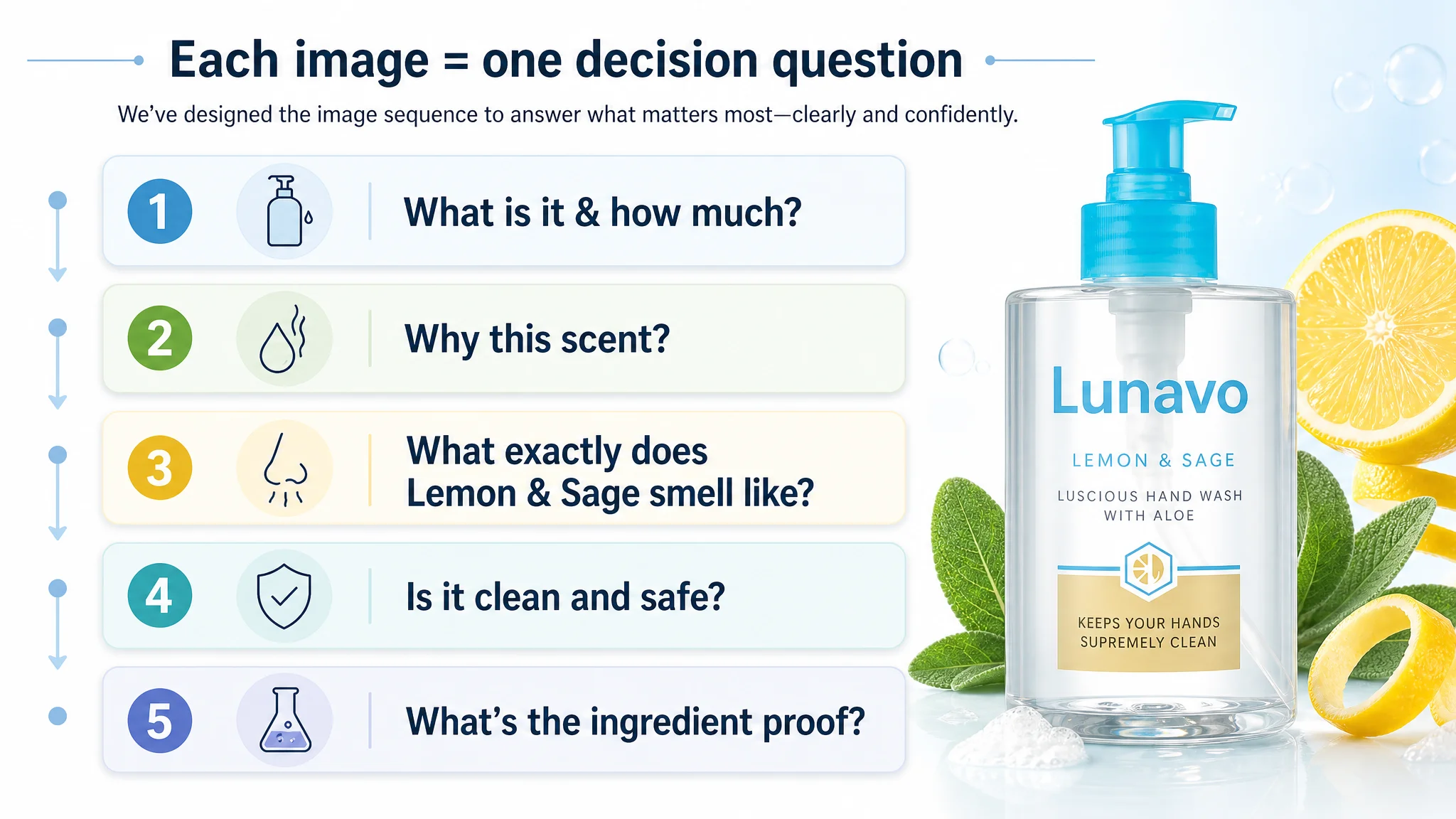 The key change is not visual style but what questions each image answers, and in what order.
Bullet Points: From Describing Features to Guiding a Self‑Care Purchase
DeepBI’s restructuring of bullet logic was anchored on three themes:
- Self‑care experience.
- Clean, gentle formula.
- Rational reassurance.
Bullet 1: Positioning as a Spa-Inspired Experience
From a generic sensory opener to:
SPA-INSPIRED REVITALIZATION: Transform your daily hand washing into a luxurious spa-like retreat. Hydrating hand soap infused with a bright Lemon & Sage scent that cleanses while leaving your senses refreshed, clean, and energized.
Purpose: frame the product as more than “just soap”, matching the benchmark’s aromatherapy narrative while keeping the brand’s own scent identity.
Bullet 2: Make Aromatherapy Concrete
AROMATHERAPY IN EVERY WASH: A crisp, citrusy pick-me-up designed to be uplifting and awakening, turning routine hand washing into a small moment of self-care.
Purpose: close the gap where the benchmark ties scent to mood and emotional benefit.
Bullet 3: Depth on Ingredients and Barrier Support
NUTRIENT-RICH MOISTURE BARRIER: Aloe leaf juice, coconut oil, and vitamin B5 deliver gentle cleansing with rich, creamy suds that wash away impurities without stripping, leaving hands soft, smooth, and deeply hydrated.
Purpose: leverage the target’s genuine ingredient advantage and connect it clearly to barrier protection.
Bullet 4: Clean Formula as Trust Backbone
CLEAN & GENTLE FORMULA: Sulfate-free, paraben-free, and cruelty-free for a high-quality cleanse without harsh chemicals—suitable even for sensitive skin.
Purpose: mirror the benchmark’s “free from” list in a way that is truthful for this product, addressing a core Amazon buyer concern.
Bullet 5: Daily Self‑Care Context
ELEVATED DAILY SELF-CARE: From kitchen sink to bathroom, each use delivers a feel-good finish and professional-grade quality that makes every wash an indulgent ritual.
Purpose: ensure the final bullet isn’t wasted on basic “how to use”, but on confirming lifestyle integration and emotional payoff.
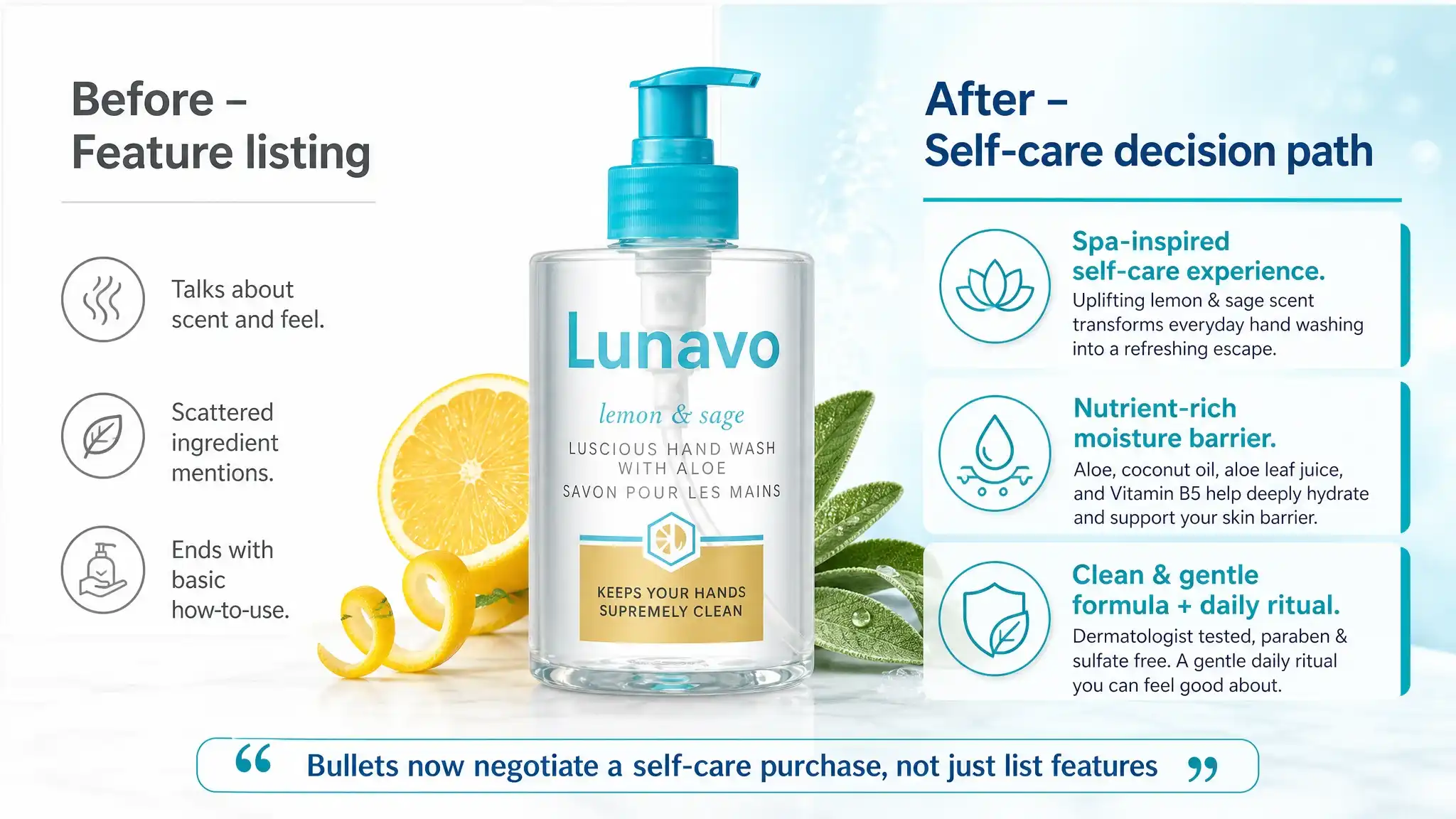 The outcome is a bullet set that no longer “just lists features” but systematically addresses:
- Why it feels good.
- Why it is safe.
- Why it is worth a premium.
- How it fits into daily life.
A+ Content: From Dense Ingredient Story to Trust-First Flow
A+ was already a relative strength. DeepBI’s adjustments targeted order and focus rather than redesign for its own sake.
1. Lead With Home Context and Usability
- Move a pump-in-use or sink-side image into the first A+ module.
- Emphasize:
- “12.14 fl oz pump bottle”
- Fits easily in kitchen and bathroom.
- Simple, mess-free usage.
Purpose: answer “How will this look and work at home?” immediately after main images.
2. Chain Ingredient Proof to Gentle Cleansing
- Retain the ingredient modules (aloe, coconut oil, vitamin B5).
- Tie them explicitly to concerns triggered by competitor claims:
- “Helps support skin’s moisture barrier.”
- “Washes without leaving hands feeling tight or dry.”
Purpose: use A+ to systematically offset the risk of “stripping cleansers” implied by some competitor positioning.
3. Create a Dedicated “Safety Valve” Module
- A focused block on sensitive skin reassurance:
- Formulated for all skin types.
- Dermatologist tested if substantiated.
- Clear, simple visuals rather than lather repetition.
Purpose: build a decisive trust anchor for buyers who are more cautious.
4. Reframe Scent as Energizing, Not Just “Nice”
- Use the A+ scent module to go beyond poetry:
- “Energizing citrus notes for a bright start to your day.”
- “Uplifting every time you wash.”
Purpose: make scent a daily functional benefit (mood and energy), not only an abstract description.
5. Simplify Routine, Avoid Cross-Product Confusion
- Replace the two-step routine that introduces a separate hand cream product.
- Focus instead on:
- “20 seconds of lather.”
- “Daily use for softer-feeling hands.”
Purpose: anchor the buyer’s mental picture on this specific SKU, reducing distraction during a high-stakes decision moment.
6–7. Add Trust & Value Confirmation Modules
If certifications (e.g., cruelty-free) are real and verifiable:
- Reserve a dedicated A+ trust module.
- Add a final module summarizing volume/usage value, potentially comparing 12.14 fl oz to typical household usage patterns.
Purpose: give buyers a rational reason to finalize the purchase after the emotional and sensory drivers.
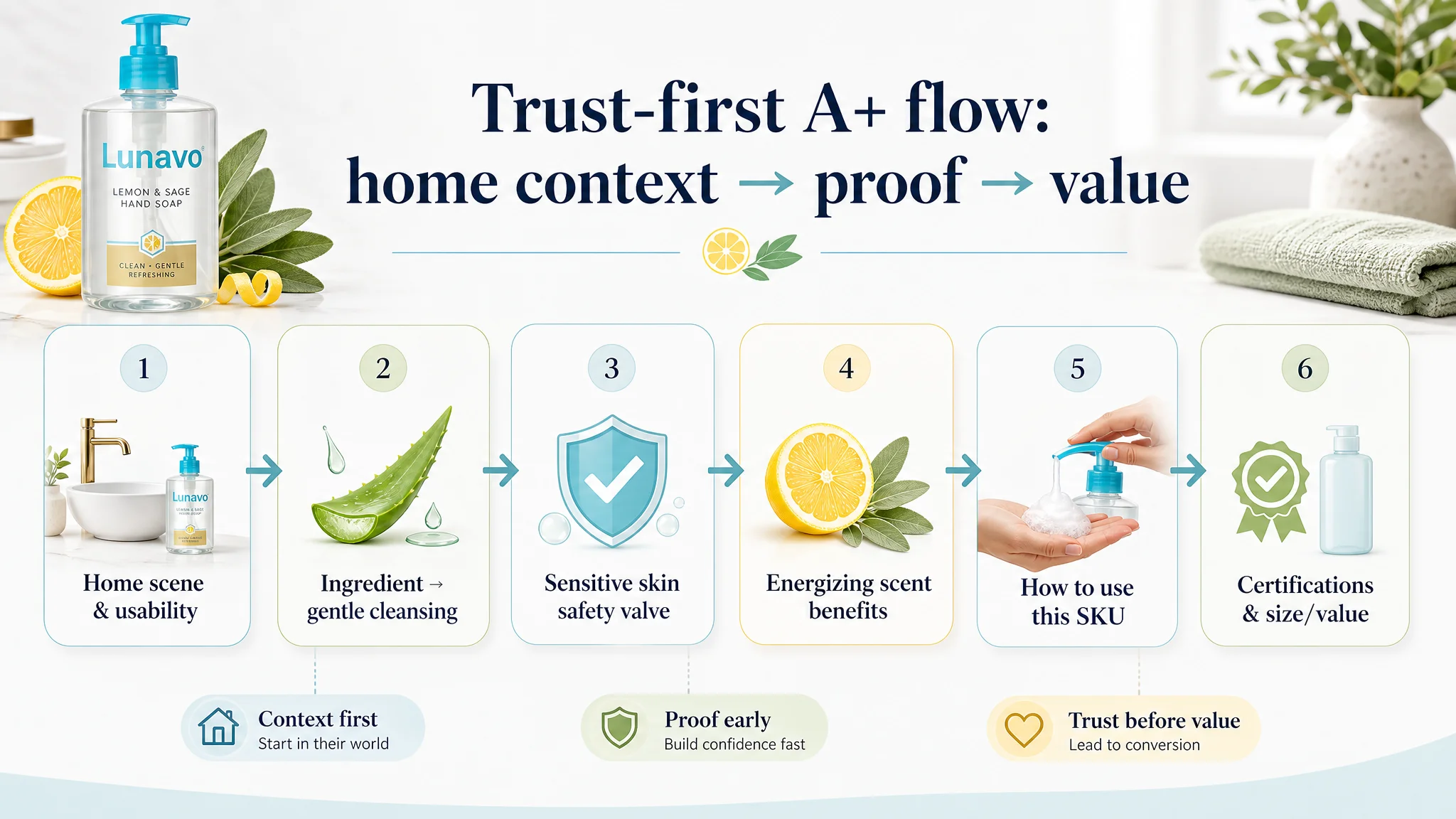 How the Page’s Sales Logic Started to Recover
After this reframing, the Listing’s job changed:
- Before:
- Overweight on ingredients and hydration.
- Late or underdeveloped on trust and clean formula proof.
- Scent and self‑care story partially present, but not anchored in a clear narrative.
- After:
- Images sequenced by decision steps: what it is → why this scent → is it safe → how it feels → proof.
- Bullets aligned around a “clean, spa-inspired self‑care” purchase logic.
- A+ content front-loaded with home context and rational reassurance, not only ingredient density.
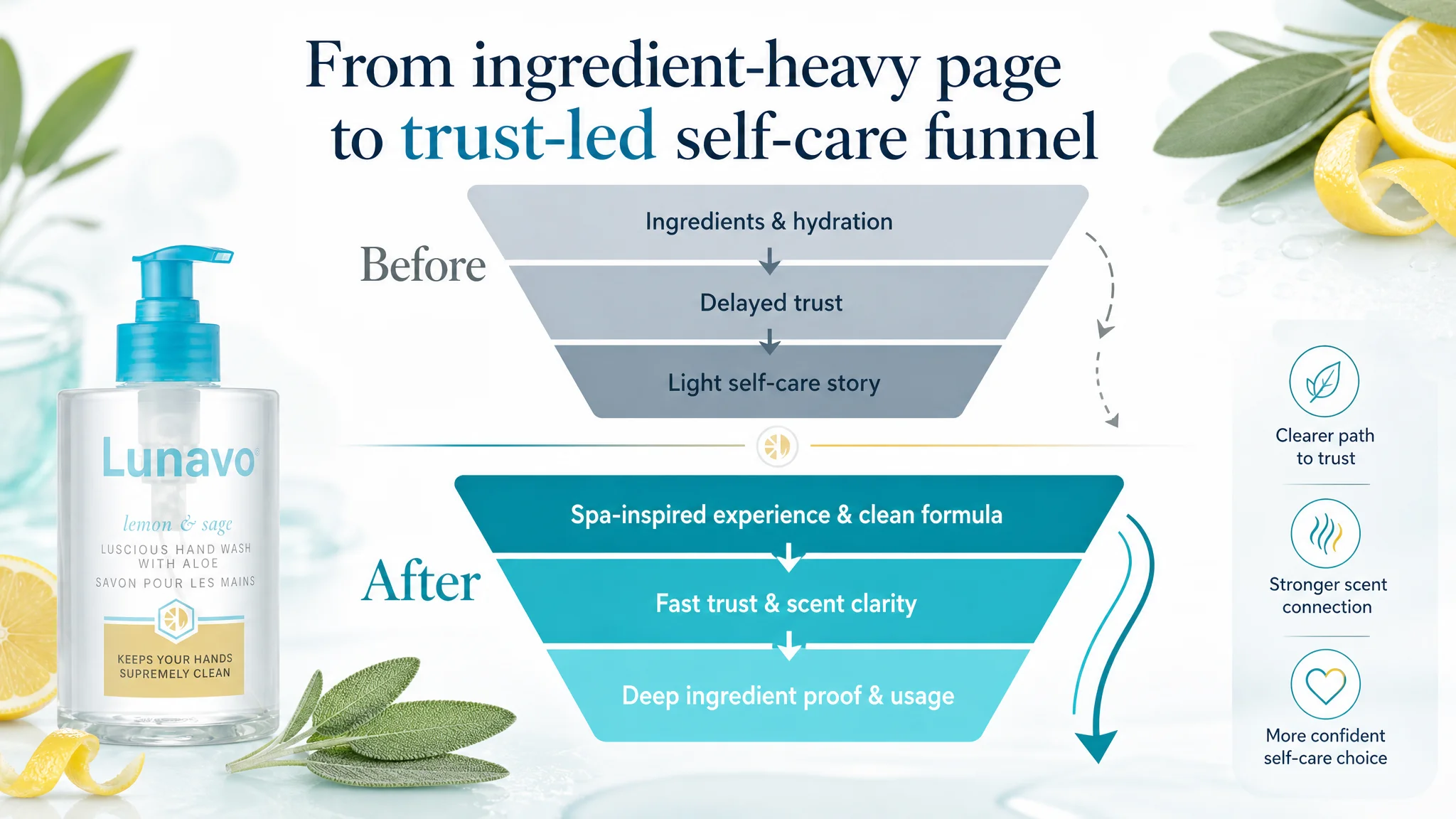 In this state, landed ad clicks are no longer forced to “work against the page.” Instead, the page supports every click with a more coherent journey from curiosity to confidence.
While specific CVR, ACOS, and TACOS numbers are not disclosed, the operational expectation shifts meaningfully:
- ACOS has room to gradually move down, because each paid click encounters fewer trust and clarity obstacles.
- Organic order share has a chance to recover, as the Listing is now structured to convert non‑ad traffic more reliably.
- Advertising dependence can start to decrease, because page-level conversion capacity is strengthened.
What This Changed for the Seller’s Understanding
The most important change was not visual; it was conceptual.
1. “High Listing score” is not enough.
Being close to a benchmark on an aggregate score does not guarantee comparable conversion. Where the score is gained or lost matters more than the final number.
1. Amazon ads cannot repair a trust story.
If the perceived trust and clean formula story are weaker than the benchmark, no amount of bid tuning can fully offset that within a reasonable ACOS.
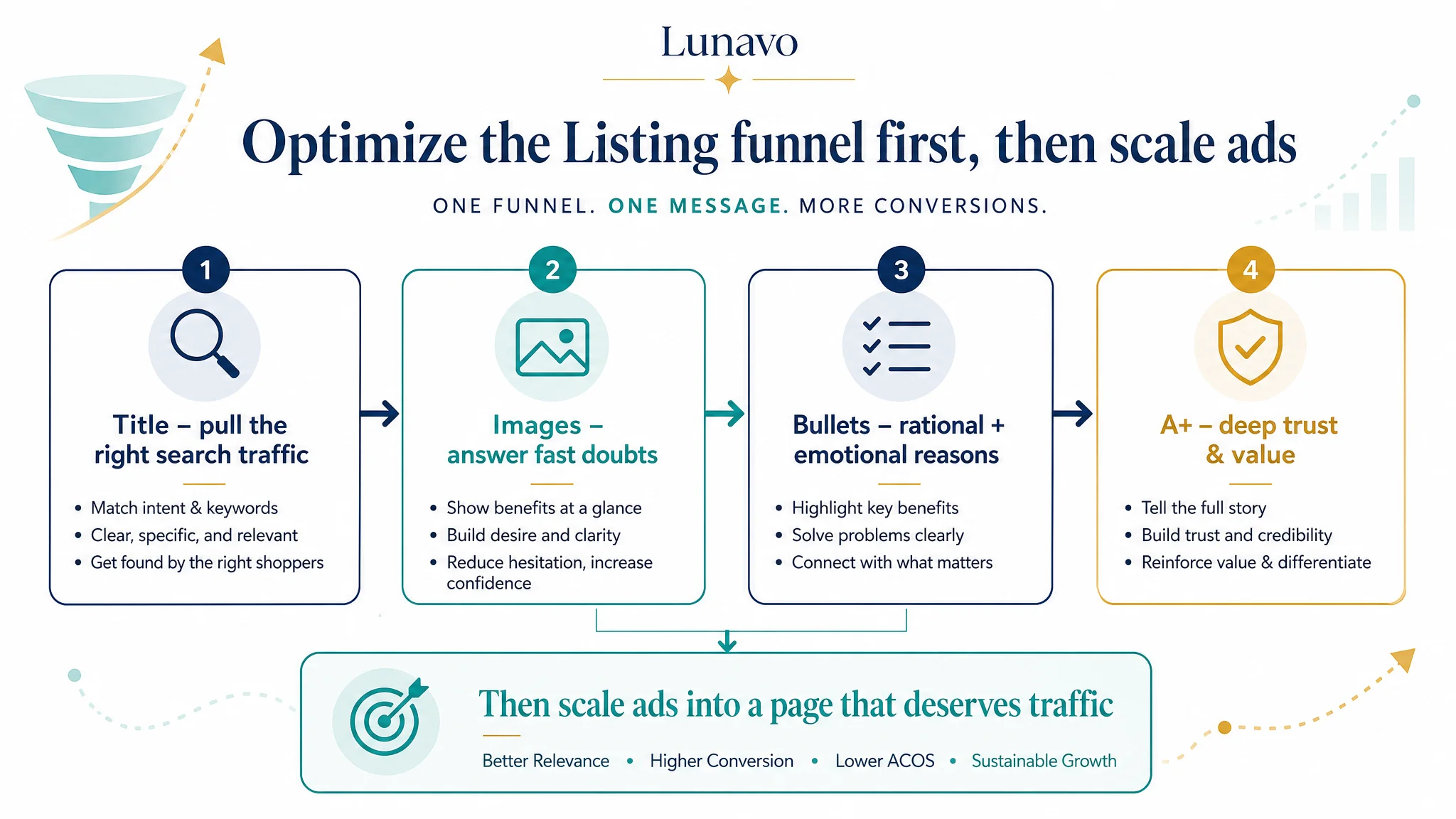
1. Title, images, bullets, and A+ must act as one funnel.
- Title pulls relevant searchers into the Listing.
- Images answer fast questions and remove gut-level doubts.
- Bullets negotiate rational and emotional reasons to buy.
- A+ deepens trust and makes the choice feel safe and rewarding.
1. Before scaling ads, ask: “Does this page deserve more traffic?”
DeepBI’s diagnostic logic insisted on this order. Only once the Listing had a coherent sales narrative—spa-like experience, clean & gentle, home-fit, rational value—did more traffic make sense.
 For other Amazon sellers, this hand soap case is a common pattern in disguise: when ads feel increasingly “expensive” and a Listing appears “almost as good as the category leader”, it is often not the ads that are failing. It is the invisible conversion logic of the page—trust, value framing, and emotional positioning—that needs to be rebuilt first.