

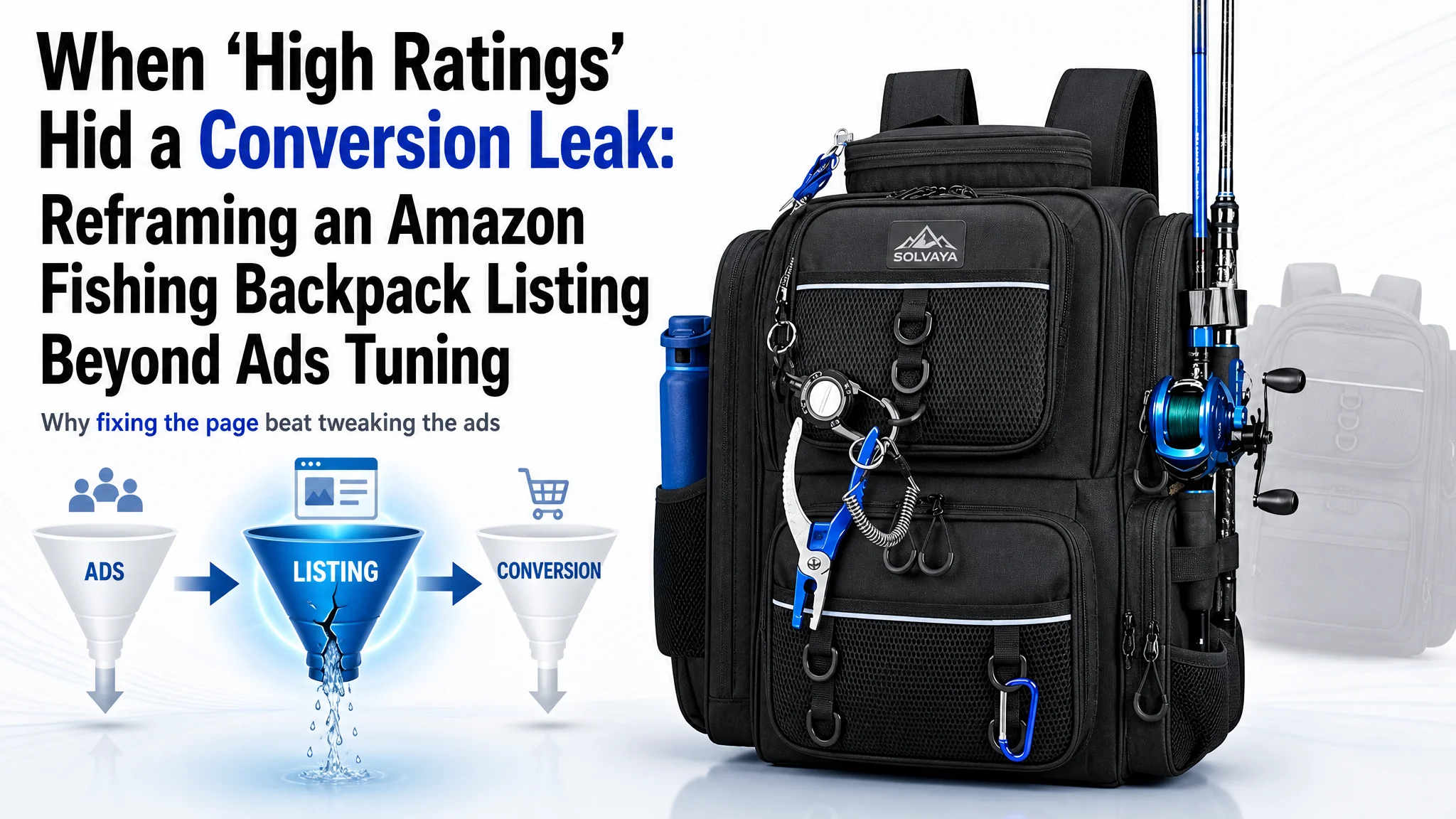
This case comes from an Amazon seller in the fishing-gear category on the US marketplace. On paper, the product-page metrics looked safe: a 4.6‑star rating with over 400 reviews, solid A+ content, and a functional image set. Yet advertising was becoming harder to control. Traffic was coming in, but ACOS was stubborn and CVR was not behaving like a page with this level of social proof. The seller’s first instinct was to keep “fixing the ads”.
They assumed the problem was an advertising issue: bids, keyword mix, or campaign structure. But when DeepBI compared their Amazon Listing against a top benchmark backpack in the same fishing-tackle segment, the pattern was clear: ads were not the weak link. The real constraint was how the title and image sequence translated traffic into a buying decision. The Listing was respectable, but it was losing the argument at the point where shoppers decide whether to click and whether to trust the page enough to add to cart.
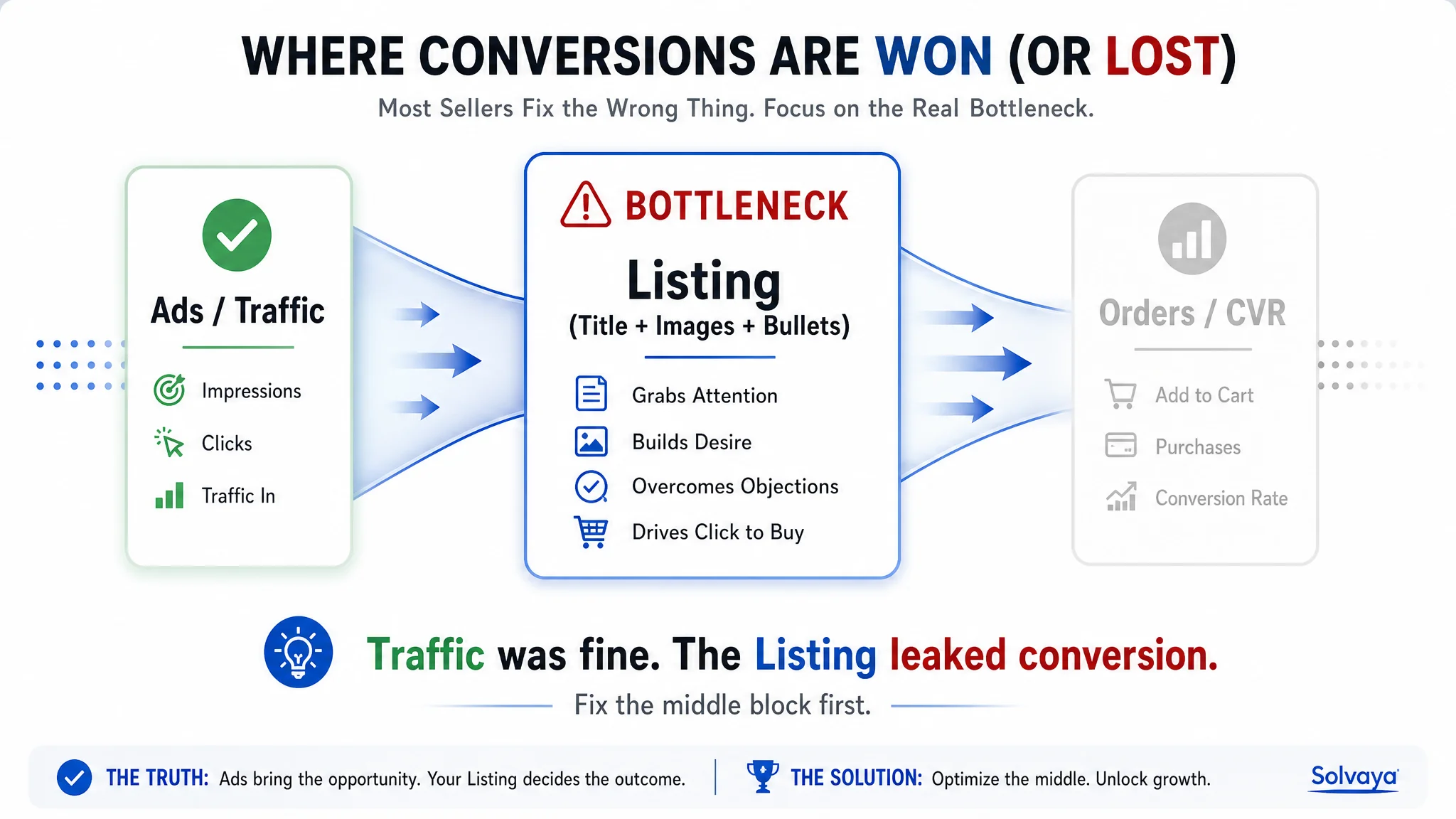
DeepBI’s diagnosis shifted the entire optimization order. Instead of continuing to iterate on Amazon ads, the work focused on one thing first: increasing the Listing’s conversion capacity by restructuring the title around search intent, reordering the main images around buyer pain points, and turning bullets and A+ from “feature lists” into a clear proof path. Once the product page could carry its weight, ad traffic became useful again instead of being consumed by a half-convincing page.
For Amazon sellers, the lesson is blunt: good ratings and decent visuals do not guarantee that your page is actually competitive in your real search landscape. When ACOS resists every bid change, it’s often not an ad problem. It’s that the Listing can’t convert the traffic you’re already paying for.
This Amazon Listing Did Not Lack Praise. It Lacked Prioritized Decision Logic.
On the surface, this fishing tackle backpack Listing looked healthy:
- 4.6 stars with 441 reviews
- No obvious negative reviews on the first page
- A fully built A+ with multiple modules and clear visuals
Against that backdrop, the seller read their ad pressure as a campaign issue. Their thinking was:
- “The page is already good enough; the rating proves it.”
- “If ACOS is high, we must not be bidding or targeting correctly.”
- “Let’s keep adjusting keywords, bids, and campaign types to squeeze out more efficiency.”
The problem: every ad tweak was working against an invisible ceiling. DeepBI’s Listing score put the product at 73/100 versus a category benchmark at 82/100. Not terrible, but in a mature Amazon category, a 9‑point gap is enough to separate a Listing that just “participates” from one that systematically wins.
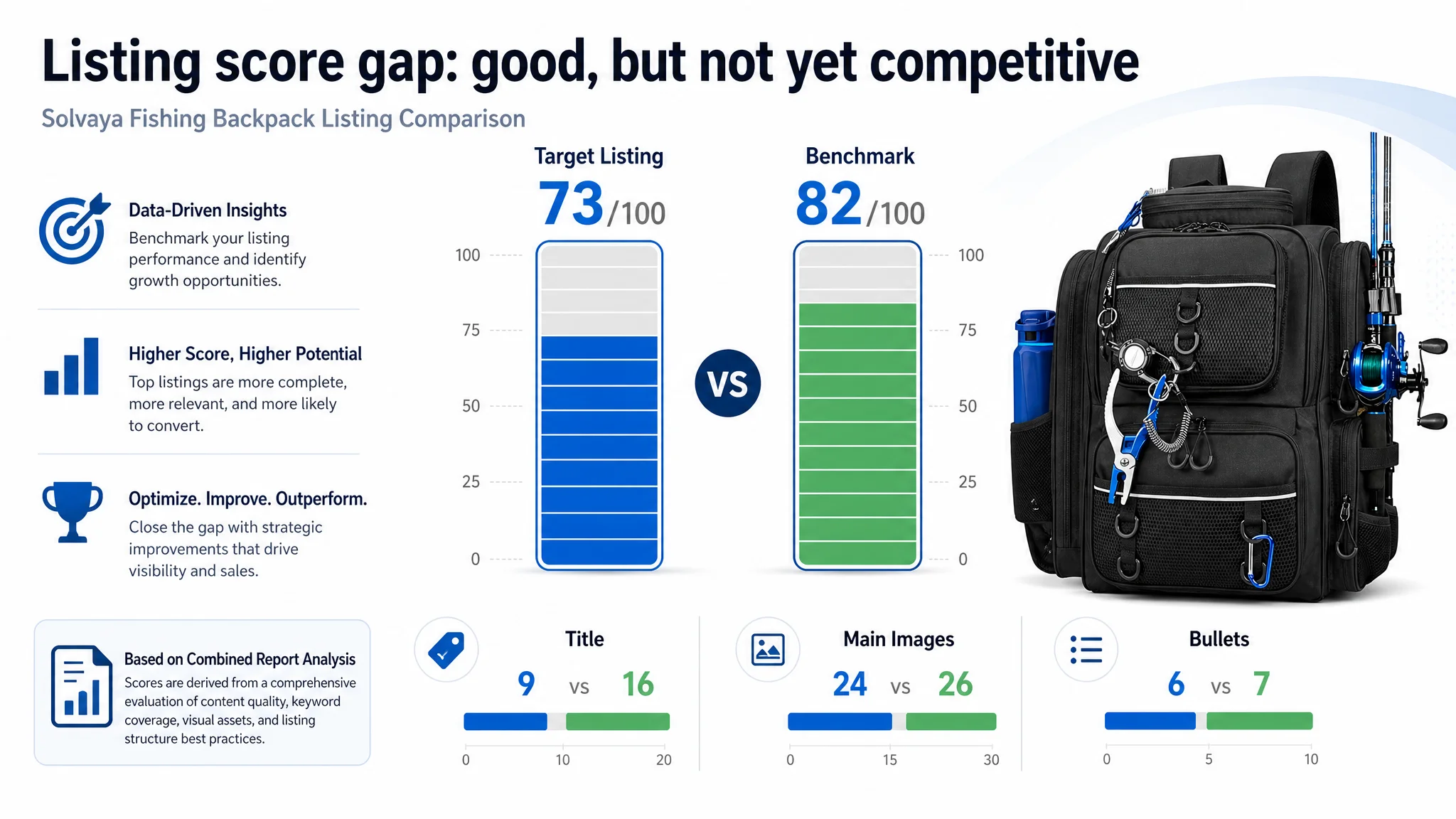
The gap was not in reviews or A+. It was in the front line of decision-making:
- Title: 9 vs. 16 (out of 20)
- Main images: 24 vs. 26 (out of 30)
- Bullets: 6 vs. 7 (out of 10)
In other words, the Listing was leaking conversion before shoppers even started seriously reading the page.
“The real problem was not that ads failed to bring traffic. It was that the page could not convert the traffic.”
From a business perspective, this meant every extra dollar in ads was being poured into a page that was slightly misaligned with how buyers searched, clicked, and decided in this niche.
The Original Misdiagnosis: “Ads First, Page Later”
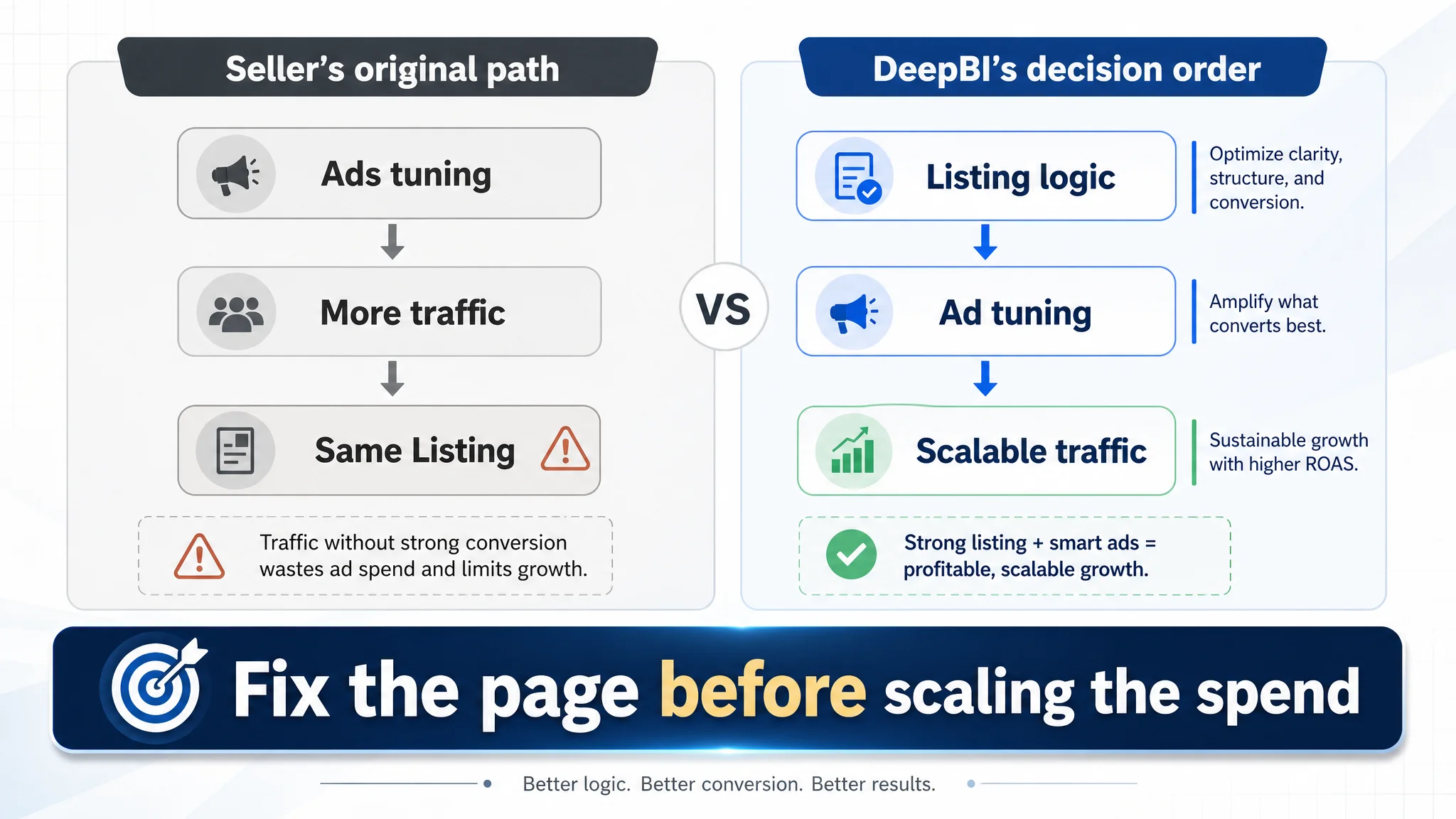
The seller’s optimization path before DeepBI followed a familiar pattern:
- Ads performance started to feel less controllable.
- They responded by fine‑tuning bids, segmenting campaigns, and widening keyword coverage.
- Because the Listing looked fine and had strong reviews, they assumed page conversion was not the main issue.
This misdiagnosis had three concrete consequences:
1. Ad spend was used to fight a page‑level problem.
Instead of raising CVR, ad changes were just reshuffling traffic while the same page bottlenecks persisted.
1. Listing defects were amplified by ads.
Weak title weight and suboptimal image sequencing meant each paid visit had a lower probability of turning into an order than the benchmark allowed.
1. Operational risk increased quietly.
As ad cost pressure rose, their organic resilience did not improve, because the Listing fundamentals were not being upgraded.
DeepBI had to first answer a simple question using competitive Listing data: “Does this page deserve more traffic yet?” The numbers said no.
DeepBI’s Judgment: The Constraint Was Listing Conversion Capacity
DeepBI’s Listing scoring and benchmark comparison made one central judgment: the core restraint was not impressions or clicks, but the page’s ability to carry traffic through to purchase.
Several signals converged:
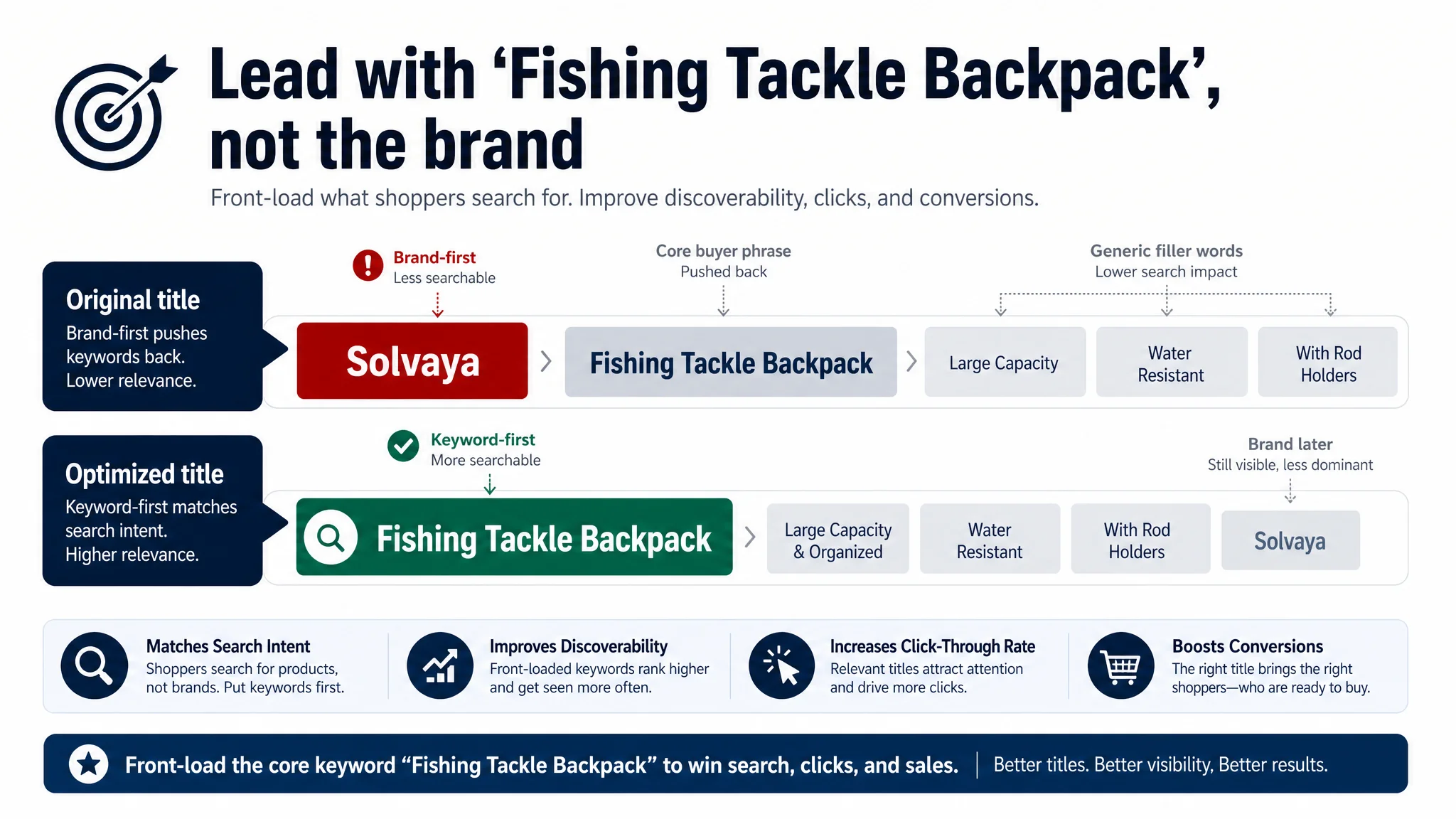
1. Title: Search Intent and Relevance Were Under-Leveraged
- The benchmark led with the core intent phrase “Fishing Tackle Backpack” and immediately layered “Lightweight” and “Protective Rain Cover”.
- The target Listing opened with the brand name, pushing the core keyword back and diluting search relevance.
- Key benefits were vague: “Strong Materials” versus the competitor’s “Lightweight” and “Protective Rain Cover” — concrete, felt advantages in this category.
- The benchmark spoke to a broader search envelope with “Rod & Gear Holder” instead of just “Rod Holders”, capturing more “gear”‑oriented queries.
In Amazon search, this is not a cosmetic issue. It is how the algorithm decides relevance and how buyers scan results.
From DeepBI’s view, continuing to push ads into a title that does not lead with the buyer’s language is structurally inefficient.
2. Main Images: The Sequence Was Not Aligned With Buyer Resistance
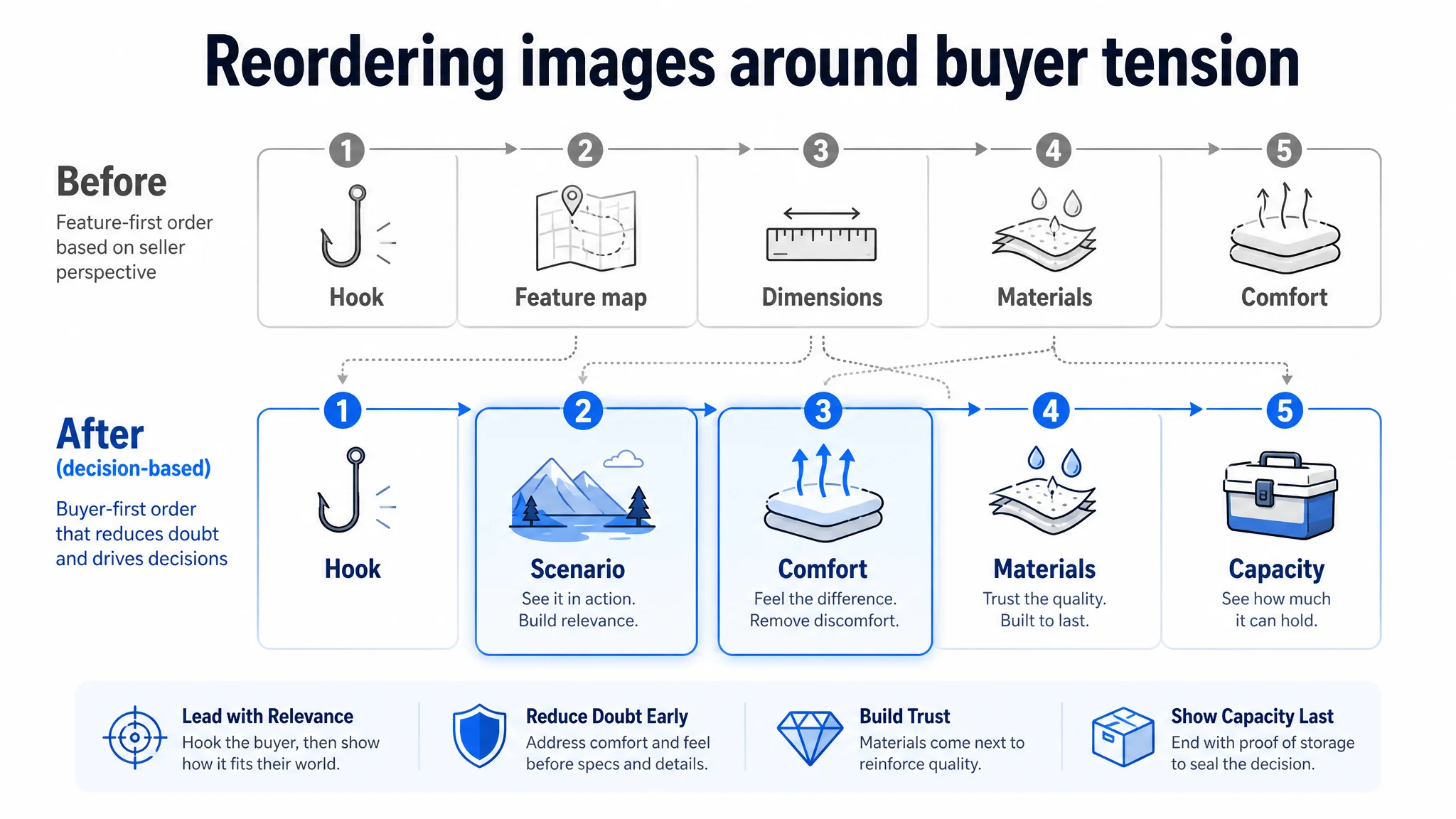
The image quality itself was not bad, but the order and role of each image did not match how shoppers evaluate a fishing backpack:
- Image 1: Clear white‑background product with rods and pliers – a functional hook. This was fine.
- Image 2: Detailed feature map of pockets and layout – information‑dense, but deployed too early.
- Image 3: Dimensions and compartment layout – again, detailed, but not addressing emotional or physical pain points yet.
- Image 5: Comfort and back padding – a major pain‑point reducer, placed too late.
The benchmark, in contrast:
- Used early images to confirm outdoor usage scenarios and comfort.
- Visually dramatized breathability and ergonomics.
- Showed a highly specific capacity map with tackle boxes inside, giving an immediate, intuitive “this fits my gear” confirmation.
The result: the competitor spent the second and third images eliminating tension (comfort, real-world use), while this Listing was still largely explaining features.
3. Bullets: Features Listed, But Not Turned Into a Buying Logic
DeepBI’s comparison of the bullet points surfaced a subtle but important gap:
- The benchmark opened each bullet with a strong, thematic label: “Versatile Bag”, “Resilient & MOLLE System”, “Comfortable Backpack System”.
- Each point then tied design to concrete outcomes: “well‑ventilated carrying”, “effectively reducing fatigue”, “15L of built‑in storage capacity”.
- The target Listing’s bullets mostly listed functions and materials, with overlapping content between first and fifth bullets and fewer specific, felt outcomes.
This meant that even buyers who scrolled down and tried to read carefully were not being walked through a clean sequence: What does this bag let me do, and how does it solve my real fishing‑trip problems?
Why DeepBI Refused to Keep Tuning Ads First
Given this diagnostic picture, DeepBI made a deliberate call: do not solve a Listing problem with ad tools.
The reasoning:
1. Ad levers cannot fix search-weight and messaging misalignment.
If the title underplays “Fishing Tackle Backpack” and concrete benefits, more aggressive bidding only buys you more expensive impressions against competitors who express category intent better in their titles.
1. Current image sequencing was consuming trust instead of compounding it.
Early images are the real “ad landing page”. If pain‑point reassurance (comfort, breathability, real capacity) arrives late, buyers drop off or click back to competitors.
1. Bullets were not just under-optimized — they were structurally redundant.
Without tightening the narrative from generic features to “pain point → design → specific outcome”, improving traffic quality offers limited relief.
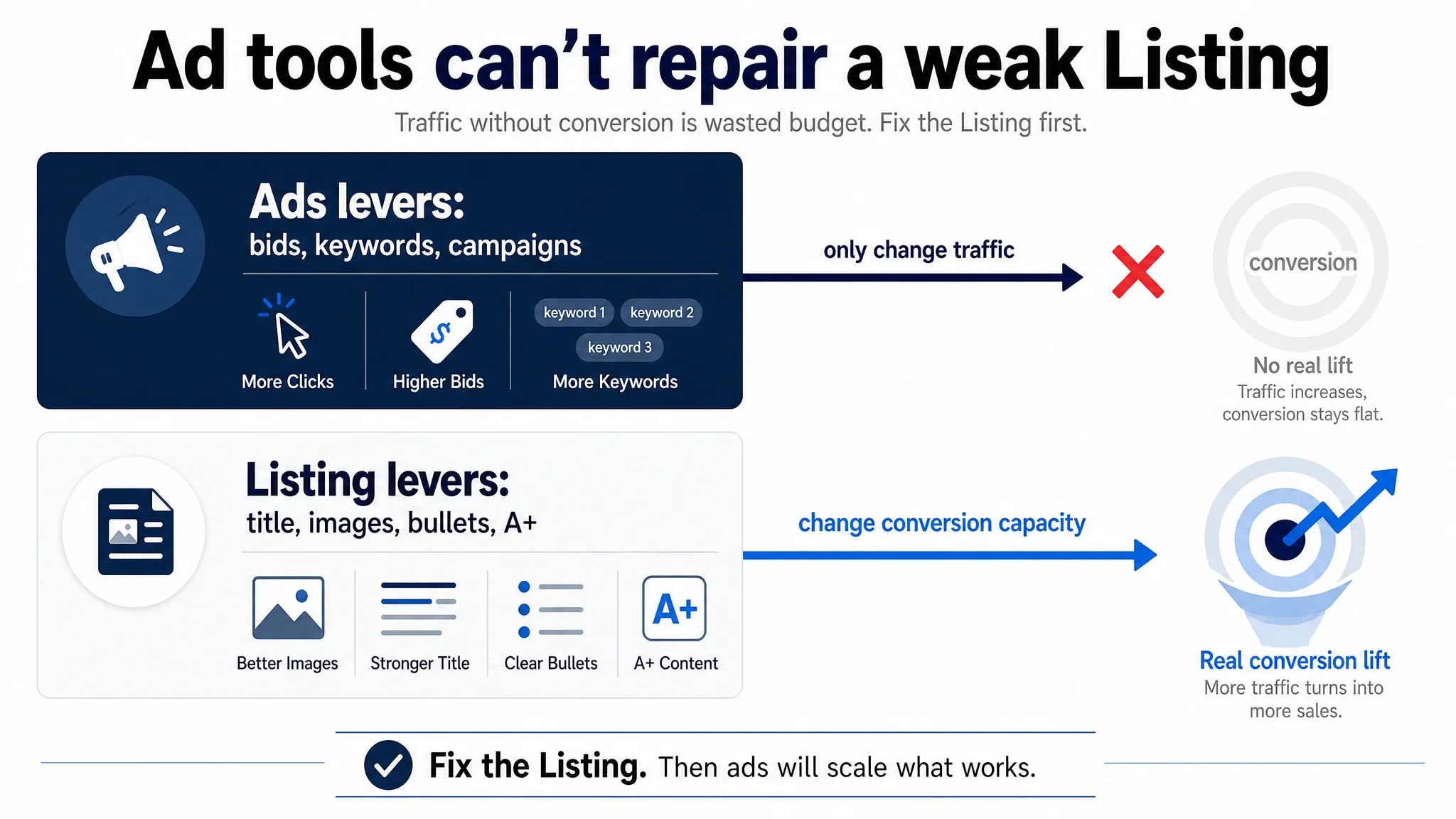
The biggest business risk at this point was continuing to push traffic into a page that was not yet built to win the head‑to‑head Listing competition. For the seller, that would translate into:
- Persistent ACOS pressure
- Slow improvement in organic rank
- Rising dependence on ads to hold position in a competitive category
DeepBI’s view of decision order was:
1. Repair the Listing’s conversion logic and trust signals.
2. Then re‑evaluate ad performance once the page can fully benefit from traffic.
Rebuilding the Page: From Feature Listing to Conversion Path
The actual optimization was not about making the page “prettier”. It was about reordering how the Amazon Listing tells its story, in line with the benchmark but tailored to the product’s real attributes.
1. Title: Re-Center Around Buyer Search and Clarity
The optimized title direction:
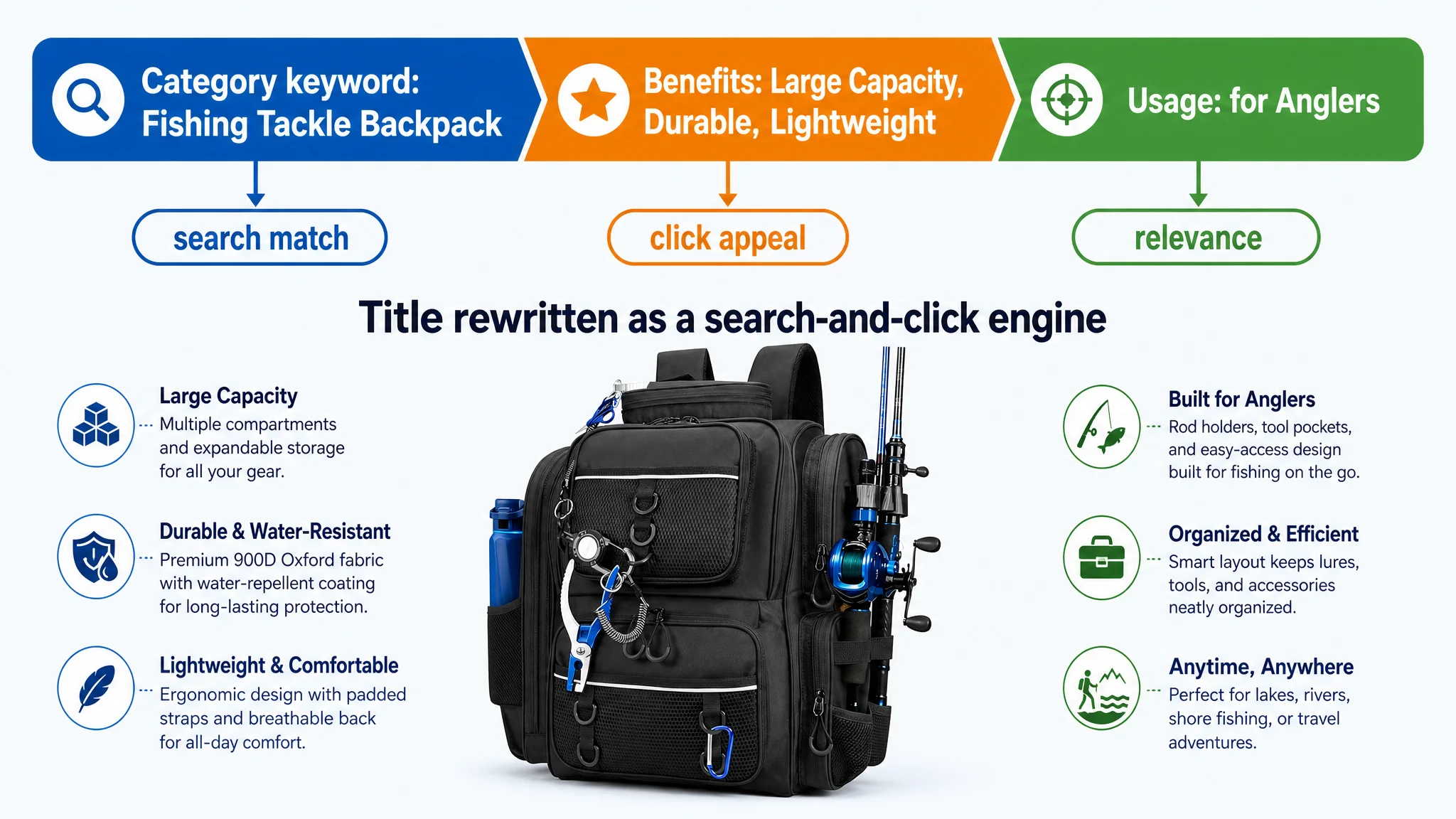
Fishing Tackle Backpack with Rod Holders and Tackle Storage, Large Capacity Durable Fishing Bag, Lightweight Fishing Gear Backpack for Anglers
Key shifts in logic:
- Core keyword front‑loading: “Fishing Tackle Backpack” and “Tackle Storage” moved into the first third of the title to align with search behavior and A9 expectations.
- Concrete benefit language: “Large Capacity” and “Durable” replace vague “Strong Materials”.
- Professional but readable structure: category + key benefits + usage context (“for Anglers”) rather than brand-first + scattered functions.
This was not copywriting for style. It was a structural fix to help the Listing compete fairly in the search-results environment where buyers actually make their first judgment.
2. Main Images: Change the Sequence, Not Just the Design
DeepBI’s diagnosis of each main image focused on what role it should play in the decision funnel, then adjusted order accordingly:
- Image 1 – Hook: Keep current white‑background product shot confirming type and rod‑holder function.
- Image 2 – Scenario Confirmation: Move an existing outdoor scene image up to this slot, mirroring the competitor’s approach so buyers immediately see “this is made for real fishing trips”.
- Image 3 – Pain Point Relief (Comfort): Promote the visual showing breathable back padding and comfort—previously buried—into the third position. This pushes “will this hurt after a day of carrying gear?” to the front of the conversation.
- Image 4 – Material Proof: Keep the durability/waterproof visual in place to consolidate trust about material and weather resistance.
- Image 5 – Capacity Confirmation: Repurpose the compartment image into a more concrete “gear loaded” visualization, showing tackle boxes and typical equipment inside (within what the product truly supports). This mimics the benchmark’s “capacity mapping” effect without fabricating specifics.
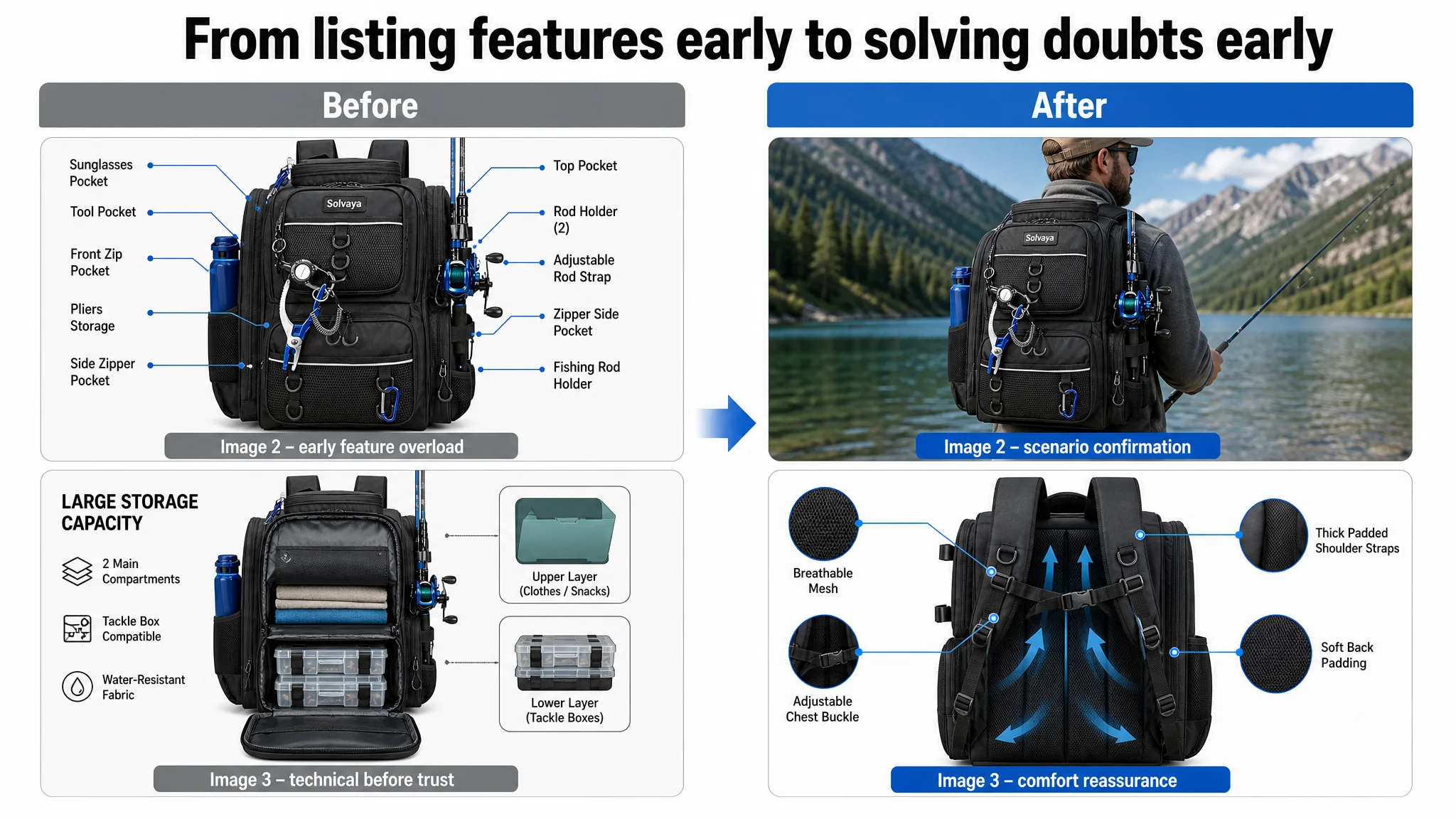
The key insight: image order is a business decision, not just a design aesthetic. Early images now answer: “Is this for my use case?”, “Will it be comfortable?”, “Will it actually fit my gear?”
3. Bullets: Turn Dispersed Features Into Focused Proof Points
DeepBI’s bullet optimization reframed each point around a single theme, mirroring how the benchmark used bullets as mini “chapters” of the sales story.
For example:
- From “material and waterproof explanation” → “Resilient & Waterproof Construction”
Emphasizing high‑density Oxford fabric, PVC coating, and a reinforced bottom with protective feet, framed as durability and easy cleaning after a day on the water.
- From diffuse storage talk → “Versatile Tackle Storage & External Fixtures”
Explicitly tying rod holders, plier slots, bottle bags, and D‑rings to quick access and organized gear.
- From generic compartment description → “Adjustable 14‑Compartment Organization”
Naming the 14 separate rooms and their role in dry/wet separation and tool segmentation.
- From scattered comfort mentions → “Ergonomic Comfort & Hidden Strap System”
Linking breathable back padding, fatigue reduction, and a stow‑away strap system that allows switching between backpack and carry‑all modes.
- From scattered size notes → “Professional Size & Heavy-Duty Performance”
Consolidating dimensions and the professional-use position (multiple tackle boxes, personal items, SBS zippers).
This rework did not invent new features. It simply reorganized existing strengths into an argument buyers can follow.
A+ Detail Page: Moving From Atmosphere to Evidence First
DeepBI’s analysis found that, ironically, the target Listing’s A+ was already stronger than the benchmark in some respects:
- It told a more complete multi-scenario story (forest, lakeside, sea/boat).
- It visualized 6 pocket types, adjustable dividers, and multiple capacity specs with clear diagrams.
But the sequence of modules was suboptimal from a conversion standpoint.
Originally:
- Early modules leaned heavily on aspirational scenery, with functional proof and material verification arriving later.
- Buyers saw “nice vibe” before “solid product”.
The benchmark, in contrast, used early A+ real estate to:
- Prove MOLLE systems, waterproof fabrics, and hardware.
- Highlight capacity and attachments up front.
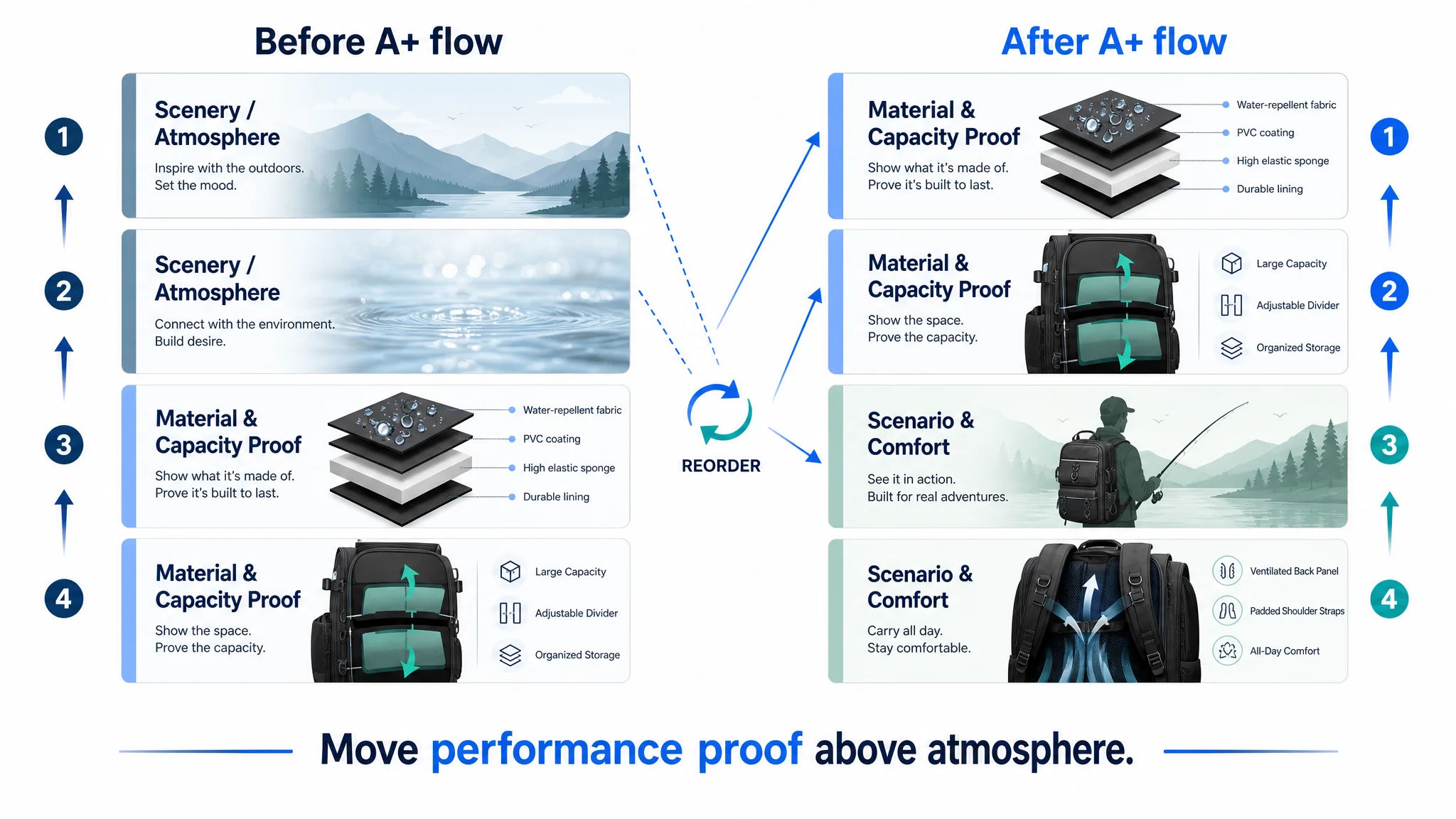
DeepBI’s optimization path:
1. Push performance proof forward.
Reorder modules so material durability, waterproof coating, and external attachment stability appear before broad scenic imagery.
1. Use existing visuals as concrete evidence, not just decoration.
- Zoom in on specific pockets with real items (sunglasses, pliers, bottles) to prove fit and security, not just existence.
- Use the existing cross-section and dual-level partition visuals as a “professional organization” proof node.
1. Turn size diagrams into compatibility guides.
Instead of expecting buyers to mentally map dimensions to their tackle boxes, explicitly state which standard box sizes fit which bag variant, where that is factually supported.
1. Finish with comfort risk reduction.
Keep the ergonomic and hidden-strap visuals as a closing reassurance, but clarify in text that this addresses long-duration carrying of heavy gear — the real regret risk in this category.
The principle: “Performance proof before atmosphere.” Emotion still matters, but only after the page has credibly answered “Will this hold up and actually fit my gear?”
What Changed Once the Page Logic Recovered
The case did not revolve around publishing dramatic percentage gains or invented numbers. The important changes were in operating state and risk profile:
- The Listing started to regain its own conversion capacity.
By aligning title, main images, bullets, and A+ with benchmark-level decision logic, the product page no longer relied purely on ratings to convert.
- Ad traffic became meaningful again.
When the page’s front-line content improved, each paid click had a higher chance of converting. Tuning bids and keywords now had something to work with, instead of fighting a structural handicap.
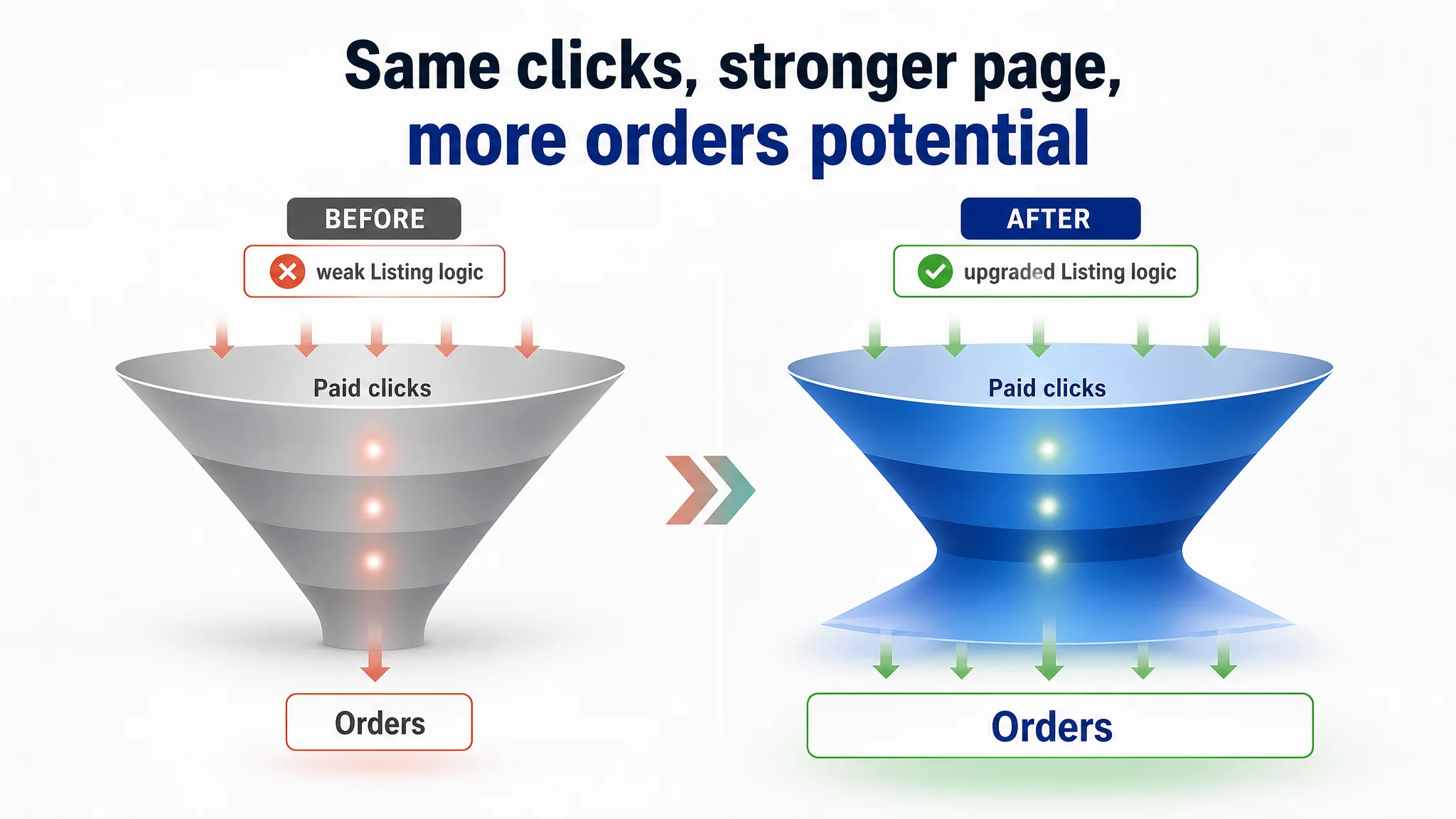
- Advertising dependence became more controllable.
With a more competitive Listing, organic traffic had a better chance of converting and compounding over time, decreasing the need to over‑subsidize the ASIN with ads.
- The seller’s understanding of the problem changed.
The team shifted from “our ads are not optimized enough” to “our Listing was not fully built to convert the traffic we already had”. This reframed how they prioritized future work.
“Advertising does not only amplify advantages. It can also amplify a page’s existing defects.”
Takeaways for Amazon Sellers
For other Amazon sellers, especially in competitive outdoor and gear categories, this case highlights several practical judgments:
1. High ratings are not a guarantee of a conversion‑competitive Listing.
A 4.6–4.7‑star page can still be structurally weaker than a benchmark in how it titles, sequences images, and tells its story.
1. If ACOS resists all ad tuning, suspect the Listing first.
Before investing further into campaigns, ask whether your title, main image set, bullets, and A+ are at or above the standard of the real benchmark in your exact niche.
1. Title and image order are business levers, not decoration.
The way you front‑load keywords and the order in which you show scenario, comfort, capacity, and material proof directly shapes CTR and CVR.
1. A+ should lead with proof, then emotion.
Scenic imagery has value, but not before you have proven durability, capacity, and usability in a concrete, visual way.
1. DeepBI’s value was judgment, not just suggestions.
The key contribution in this case was not generating new copy or pictures, but correctly identifying that the root cause was Listing conversion capacity—and refusing to let the seller stay trapped in endless ad tweaking.
For Amazon operations teams under ad-cost pressure, the deeper message is clear: before scaling traffic, judge whether your Listing truly deserves more traffic. Only then do ad optimizations translate into sustainable, controllable growth.