

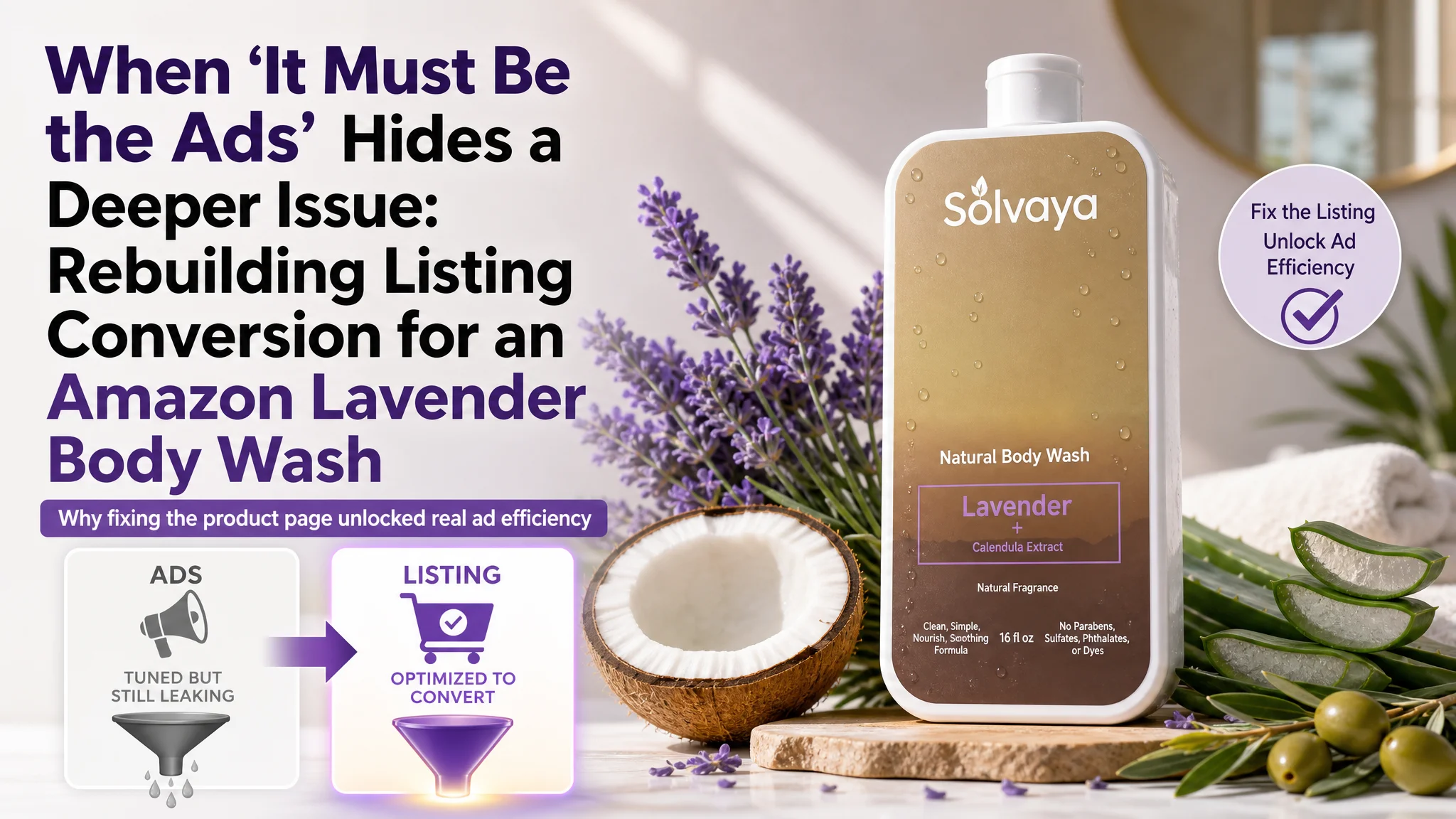
This case comes from a US Amazon seller in personal care who felt their lavender body wash “should be selling better” given stable traffic and healthy reviews. The team’s first instinct was to blame Amazon ads—tuning bids, keywords, and budgets—because ACOS was under pressure and every extra click felt expensive.
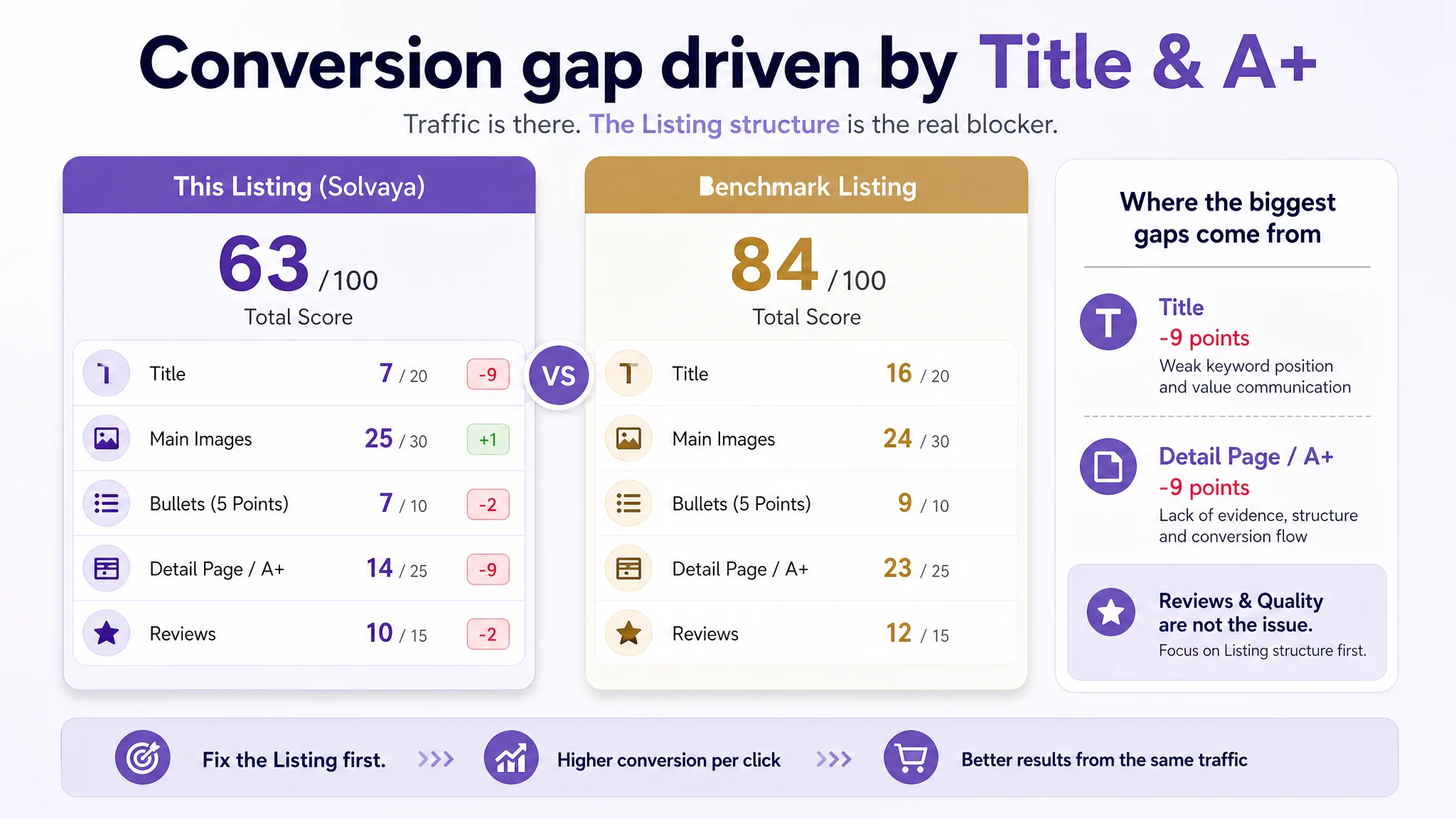
DeepBI’s diagnosis showed a different picture. Against a directly comparable benchmark body wash Listing, the target Amazon Listing scored 63/100 versus 84/100. The gap didn’t come from reviews or product quality; it came from how the Amazon product page itself was built to convert: a weak title, vague bullet points, and an A+ section that looked “natural” but didn’t actually move a shopper from interest to purchase.
Once the problem was reframed as a Listing-conversion issue instead of an advertising issue, the optimization path changed. Rather than forcing more traffic into the same page, the work shifted to rewriting the Amazon title around real search behavior, rebuilding bullets around pain points and results, and redesigning main images and A+ content so “gentle, natural, pH-balanced” became visual, credible reasons to buy.
For Amazon sellers, the takeaway is clear: when ads feel increasingly hard to optimize, it is often the product page conversion capacity that is quietly capping performance. Fixing the Listing first made the seller’s ad traffic useful again and reduced the risk of pouring budget into a page that cannot fully convert.
The Situation: Traffic Exists, but the Listing Cannot Compete
This Amazon seller is in a crowded US category: lavender body wash / shower gel positioned as “natural, gentle, pH-balanced”.
From the seller’s perspective:
- Reviews were fine: 4.4 stars with 129 ratings.
- The product was aligned with market trends: natural extracts, no harsh additives, gentle for sensitive skin.
- A+ content existed, and images showed plants and “natural” visuals.
Yet, against a leading benchmark in the same subcategory, DeepBI’s Listing scoring showed:
- Total score: 63 vs. benchmark’s 84 (–21 points)
- Title: 7 vs. 16 (–9)
- Main images: 25 vs. 24 (+1)
- Bullet points: 7 vs. 9 (–2)
- Detail page / A+: 14 vs. 23 (–9)
- Reviews: 10 vs. 12 (–2, mainly volume gap)
So the gap was not that the product was bad, or that it had terrible reviews.
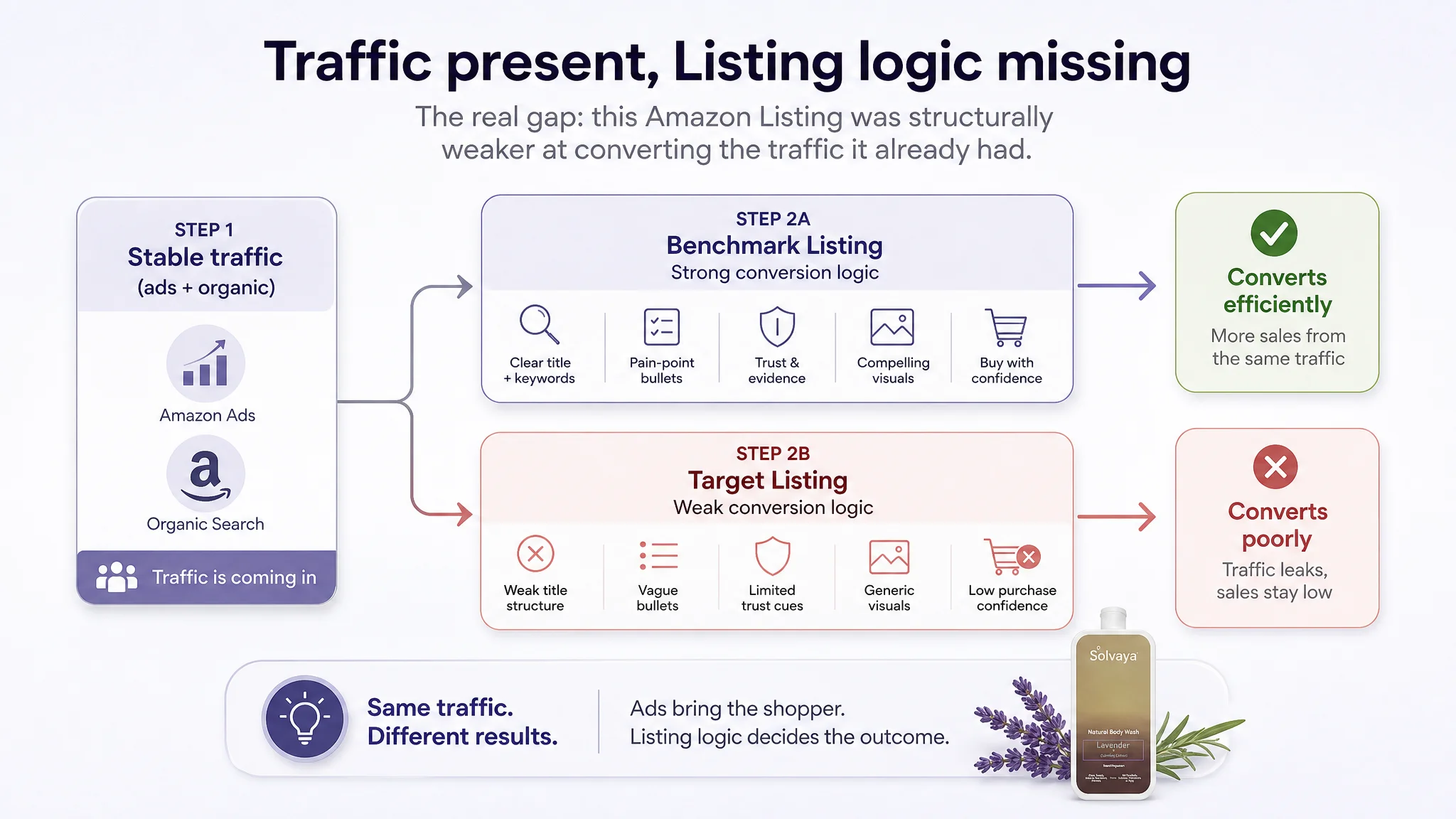
The real gap: this Amazon Listing was structurally weaker at converting the traffic it already had.
“The real problem was not that ads failed to bring traffic. It was that the page could not convert the traffic.”
The Original Misdiagnosis: “ACOS Is High, So Ads Must Be the Problem”
Before the deep Listing diagnosis, the seller’s thinking was typical:
- ACOS was uncomfortable.
- Every click felt expensive.
- Competitors seemed to bid aggressively in the same search terms.
The mental model became:
“Our ads are inefficient → We must optimize campaigns more → We probably need better ad creatives.”
So the team repeatedly:
- Tweaked bids and match types.
- Expanded and then trimmed keywords.
- Adjusted budgets and dayparting.
But the underlying pattern didn’t change: the funnel leaked at the product page, not in the ad account.
Traditional ad optimization kept hitting a ceiling because the Amazon Listing itself didn’t give shoppers enough reasons to choose this body wash over the benchmark. Ads were amplifying a weak page, not a strong one.
DeepBI’s Diagnosis: Listing Conversion Was the Real Constraint
A 21‑Point Gap Driven by Title and A+ Content
The scoring breakdown was blunt:
- Title: –9 vs. benchmark
- Detail page / A+: –9 vs. benchmark
These two dimensions alone accounted for most of the 21‑point gap.
Main images were not catastrophic; they even scored slightly higher in the numeric model. Reviews were comparable in rating. That made DeepBI’s judgment clear:
At this stage, the core constraint was Listing conversion capacity, not traffic generation.
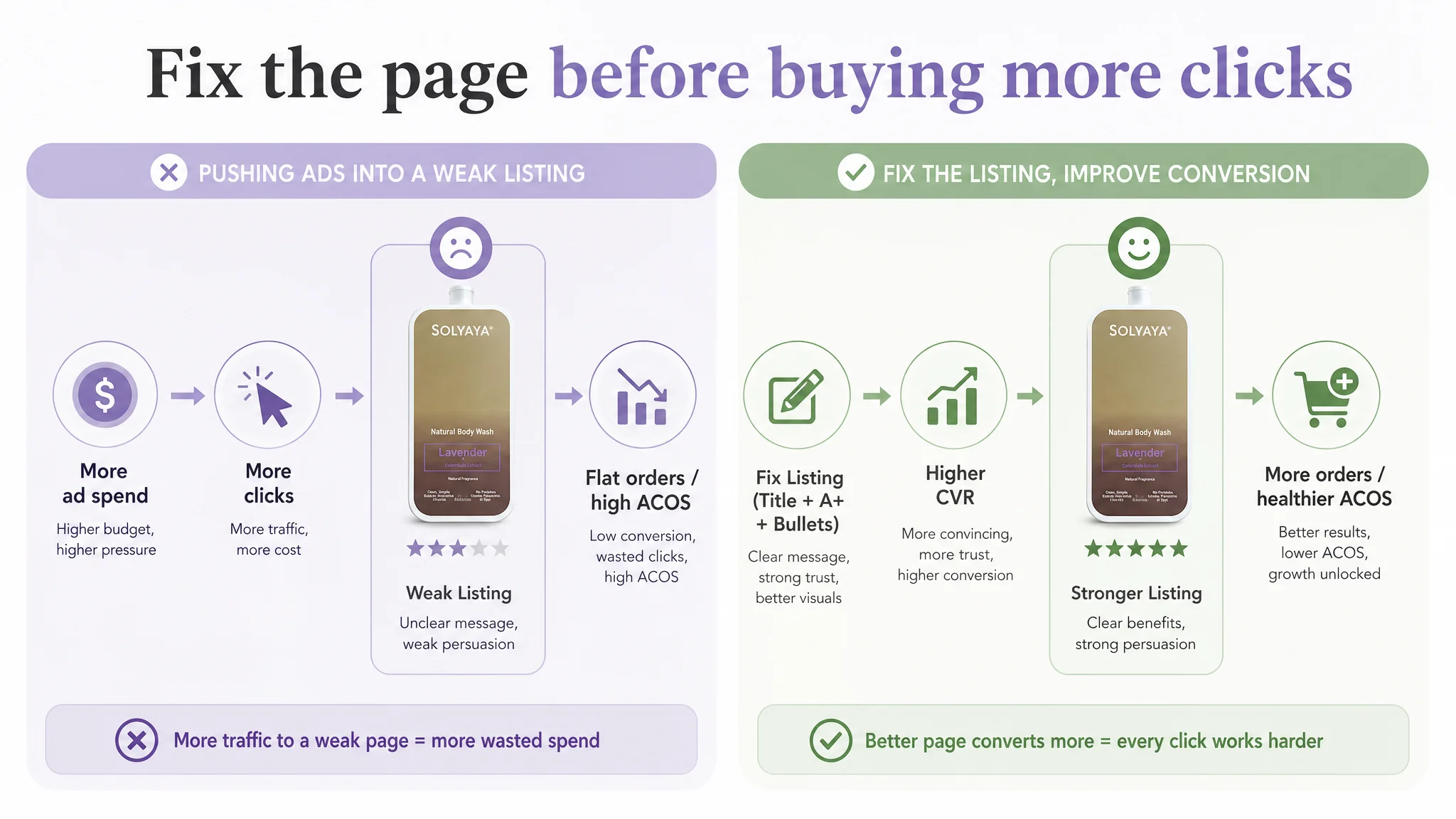
Continuing to squeeze the ad system without repairing the product page would:
- Keep ACOS under pressure
- Waste paid clicks on a page that does not fully persuade
- Erode trust in “ads” when the bottleneck was actually the page logic
The Title: From “Ingredient List” to Conversion Engine
What DeepBI Saw
The original title behaved more like a product label than an Amazon Listing:
- Structure was loose, not following a clear brand + core keyword + result/benefit pattern.
- The core keyword “Body Wash” sat deeper in the title, lowering its search weight.
- Sell points such as “pH balanced” and “gentle formula” were abstract and generic.
- There were no concrete outcome phrases or data points (e.g., “oil control”, “16.9 fl oz”).
- Keyword coverage was narrow; it didn’t pull in related searches like “shower gel” or “cleanser”.
By contrast, the benchmark title:
- Front‑loaded the keyword: “Lavender Body Wash” directly after the brand.
- Tied it to usage and skin type: “Shower Gel”, “Cleanser”, “Oil Control”, “Oily & Sensitive Skin”.
- Used specific words and numbers: “Tea Tree Oil”, “16.9 fl oz”.
- Talked in terms of results and target users, not internal formula language.
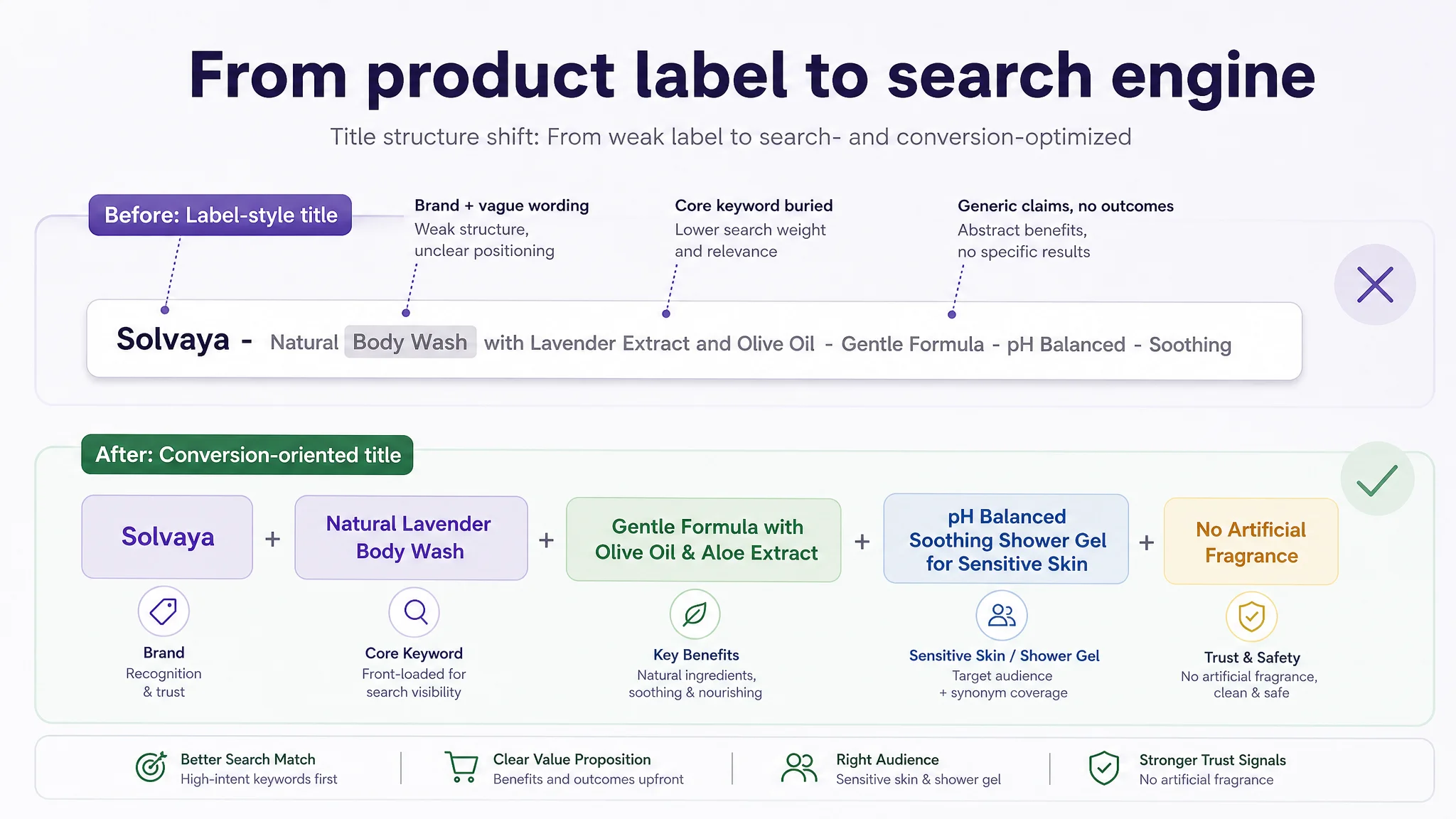
How the Title Had to Change
DeepBI’s recommendation restructured the title around Amazon search behavior and buyer decision logic:
Proposed direction: Brand + Natural Lavender Body Wash – Gentle Formula with Olive Oil & Aloe Extract, pH‑Balanced Soothing Shower Gel for Sensitive Skin, No Artificial Fragrance, Nourishing Body Cleanser
Key shifts in logic:
- Keyword front‑loading: Move “Natural Lavender Body Wash” into the golden position to raise search weight and relevance.
- Audience & synonym integration: Explicitly mention “Sensitive Skin” and add “Shower Gel” to catch additional query variations.
- Outcome-focused language: Keep pH and “gentle” but anchor them in soothing, nourishing, and “no artificial fragrance” to signal safety and sensory experience.
This is not just wordsmithing. On Amazon, the title decides:
- Whether you show up in the right searches.
- Whether the shopper’s first quick scan on mobile answers: “Is this for me?” and “What does it do?”.
Without that, no amount of bid tuning can fix the page.
The Bullets: Information Without Buying Logic
How the Bullets Were Underperforming
On paper, the seller’s five points looked “fine”:
- Core ingredients described
- pH and gentleness mentioned
- Natural origin and fragrances listed
- Some usage scenarios included
But next to the benchmark, the differences were obvious.
Benchmark approach:
- Starts with a unique visual hook (“real flower petals in every drop”), creating an immediate memory and reason to choose.
- Ties every ingredient to specific skin problems and outcomes (“soothe inflamed skin”, “unclog pores”, “oil control for oily & sensitive skin”).
- Uses numbers and certifications (“~455 petals”, “GMPC certified”, explicit “no” list) to create trust.
Target Listing approach:
- Leads with generic ingredient lists (“natural”, “safe”) that don’t create a sharp reason to buy.
- Talks about gentleness but not what it actually solves.
- Uses very broad wording (“nourishing”, “natural”, “safe”) without proof or data.
In DeepBI’s view, the bullets had information but no persuasive path.
“The bullet points had information, but not a buying logic.”
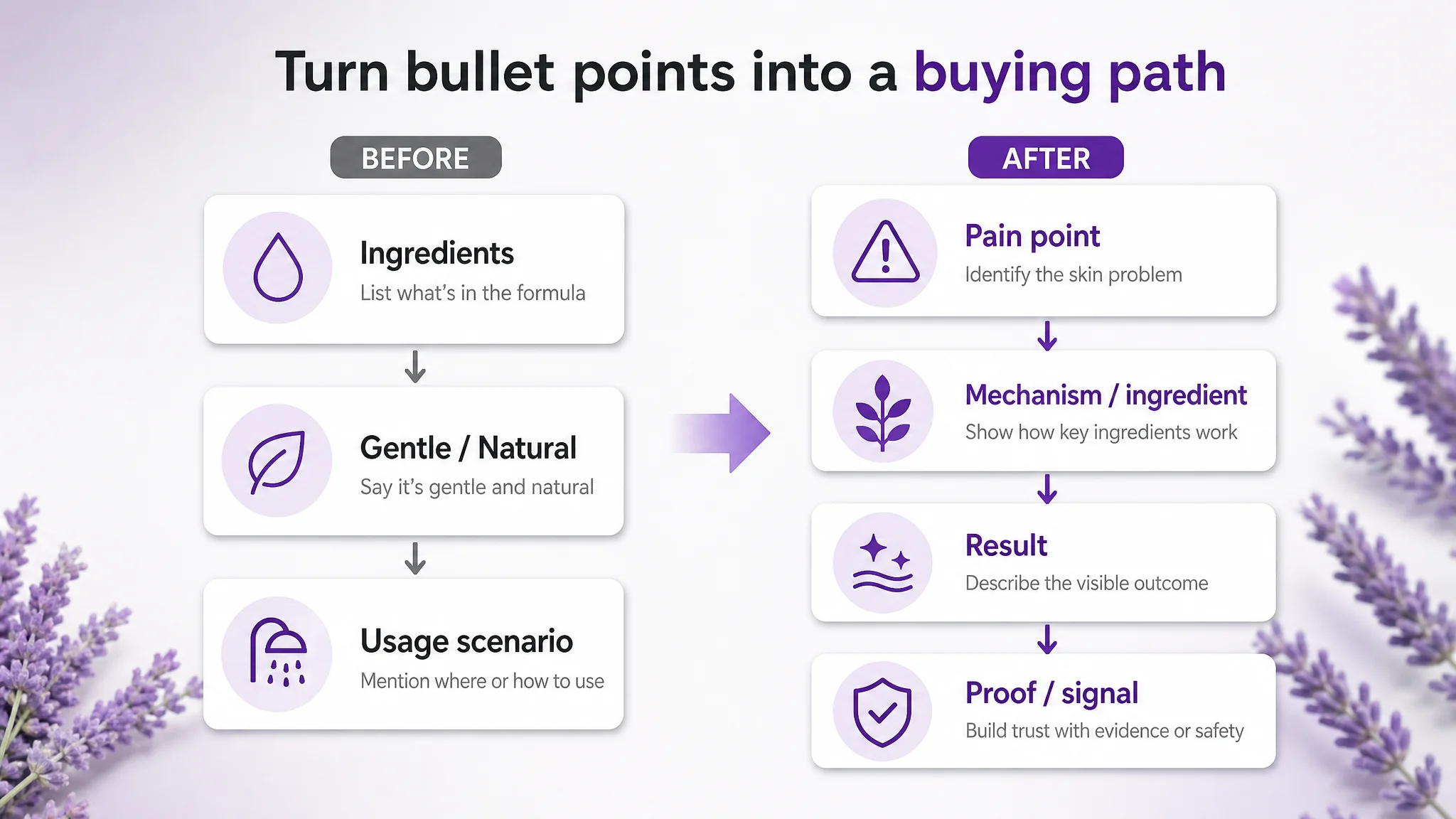
The Reframe: Pain Point → Mechanism → Result → Proof
DeepBI recommended rebuilding bullets along a more commercial logic. Examples:
1. From ingredient listing to “botanical luxury”
- Elevate olive oil and aloe from generic “natural ingredients” to sensory experience + benefit: spa‑like lather, rejuvenating feel.
- Give shoppers a reason to associate the product with “premium self‑care”, not just “another natural wash”.
1. From “gentle formula” to pore and oil control
- Explicitly state that tea tree and rosemary help unclog pores and rebalance oil—concrete problems sensitive and combination skin buyers care about.
- Keep pH‑balance as the mechanism that enables deep clean without stripping moisture.
1. From “nourishing” to post‑shower texture
- Tie olive oil and lavender extract to “silky‑smooth finish”, “velvety soft skin”, and visible texture improvement.
- The buyer must be able to pre‑feel how their skin will be after use.
1. From “natural fragrance” to structured aroma story
- Position the scent as a therapeutic, plant‑oil‑based fragrance with long‑lasting but gentle presence.
- This puts it closer to a “spa” and “relaxation” proposition than a generic “lavender smell”.
1. From generic safety to trust signals
- Emphasize ingredient transparency and alignment with credible “clean beauty” standards (e.g., EWG non‑toxic ingredients, GMPC compliance) where applicable.
- Present this as a benefit: safe for all skin types, worry‑free for family use.
Underneath the copy, the strategic shift is:
- Stop “listing what’s inside”.
- Start solving very specific worries: irritation, oiliness, pore clogging, long‑term dryness, synthetic perfumes, unknown chemicals.
This is the level at which CVR moves—not by adding adjectives, but by tightening the logic from pain point to solution to proof.
Main Images: Visually Adequate, but Not Building a Reason to Click
Numeric scoring put main images slightly ahead of the benchmark. Yet, DeepBI’s visual analysis surfaced several hidden issues that affect CTR and later conversion.
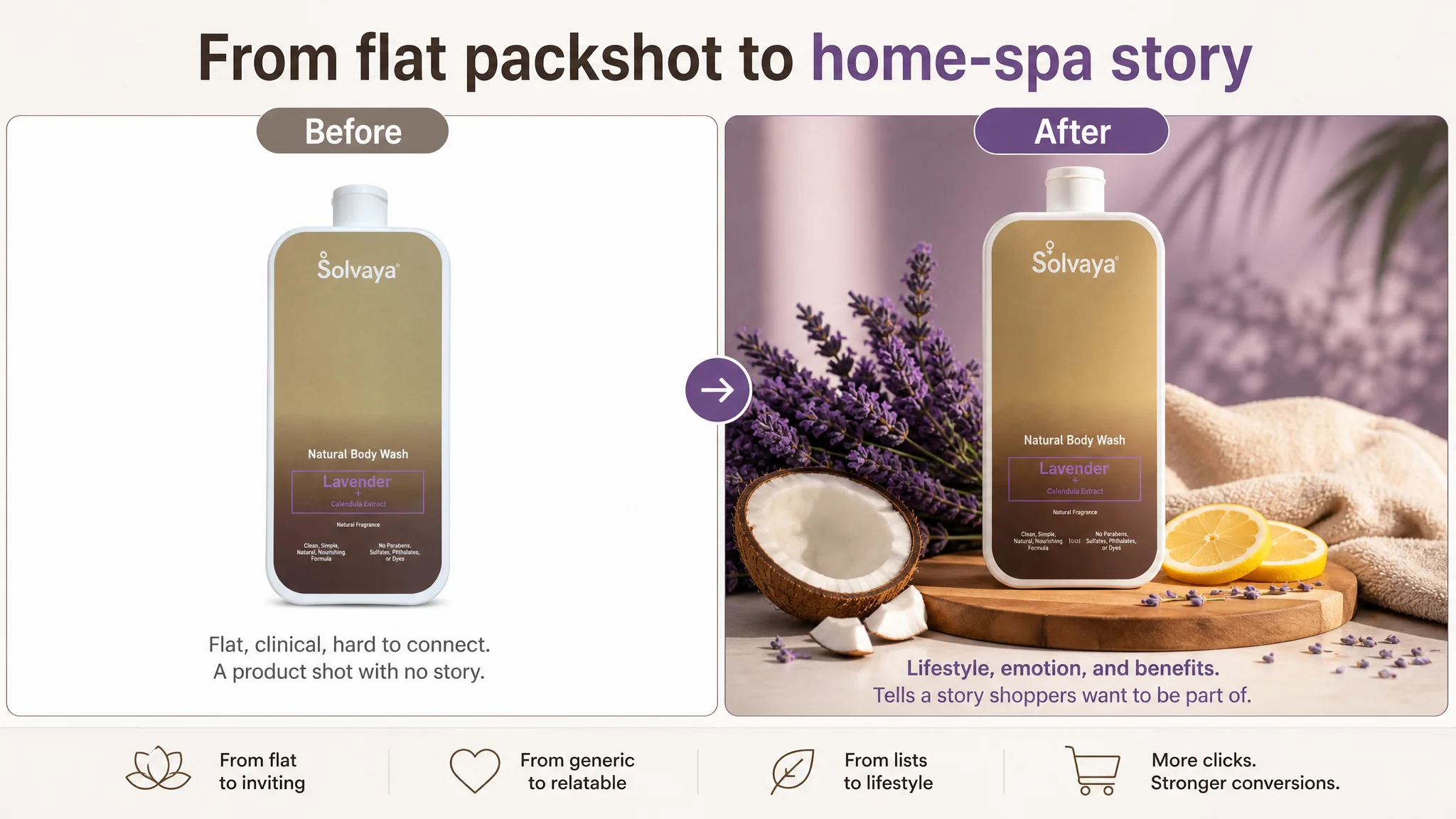
1. Lack of Emotional and Lifestyle Context
The existing primary images:
- Were product‑centric but flat.
- Lacked “breathable” bathroom or spa context.
- Showed ingredients, but not how the product feels in real use.
For a lavender body wash, where fragrance and self‑care are the core value, this is a missed opportunity. The benchmark leaned on visible petals and spa‑like visuals to immediately stand out in the search grid.
DeepBI’s direction:
- Anchor the visual style in “modern minimalist naturalism”: clean, bright, air‑filled scenes.
- Use 45‑degree angles, soft side lighting, and subtle shadows to increase 3D presence.
- Introduce real lavender bundles, cut coconut, wood textures, and bathroom elements (towels, tiles) to trigger a “home spa” association.
2. Poor Mobile Readability of Information‑Dense Images
Some images carried text and ingredient explanations, but:
- Layout and typography were not optimized for mobile scanning.
- Important information risked being too small or dense on a phone screen.
DeepBI’s suggestions:
- For each image, define one core message and make that message legible on small screens.
- Use bold titles + short benefit lines instead of long paragraphs.
- Place key text away from busy backgrounds.
3. Missing Visualization of Science and Trust
The benchmark communicated “science” visually:
- Lab‑like setups
- Clear visual metaphors for pH and skin barrier
- Measured, data‑backed claims in the images
The target Listing only showed ingredients as decorative icons or static crops.
DeepBI’s approach:
- Use laboratory glassware + fresh lavender in images to signal controlled extraction and purity without inventing fake lab claims.
- Visualize pH balance with a pH scale graphic in photos, highlighting the 5.5 region as “skin‑friendly”.
- Show foam and water beads on skin in macro shots to make “cleansing + moisturizing” feel real.
In Amazon search results, buyers often don’t read text first. The main image must:
- Grab attention.
- Suggest the emotional and functional promise in 0.5 seconds.
Without that, clicks go to the competitor—even if your product is objectively good.
A+ Detail Page: Natural, but Not Persuasive
How the A+ Layout Fell Behind
The seller’s A+ used:
- Product hero image
- Fragrance imagery
- Four plant ingredient close‑ups
- Usage scene photos
On its own, this feels “complete”. But the benchmark A+ used additional high‑leverage blocks:
- Core ingredient visualization tied directly to quantified benefits
- Clear lists of skin‑feel improvements
- User testimony or data (“X% felt less irritation”, etc.)
- Fragrance structure (top/mid/base notes)
- pH explanation linked to skin health
DeepBI’s scoring penalized the target Listing because:
- There was no quantified evidence (no % improvements, no “tested on sensitive skin” visualized).
- The flow did not build a “ingredient → mechanism → result” storyline.
- Target audience pain points (sensitive skin, oil‑prone skin) were not visually or structurally highlighted.
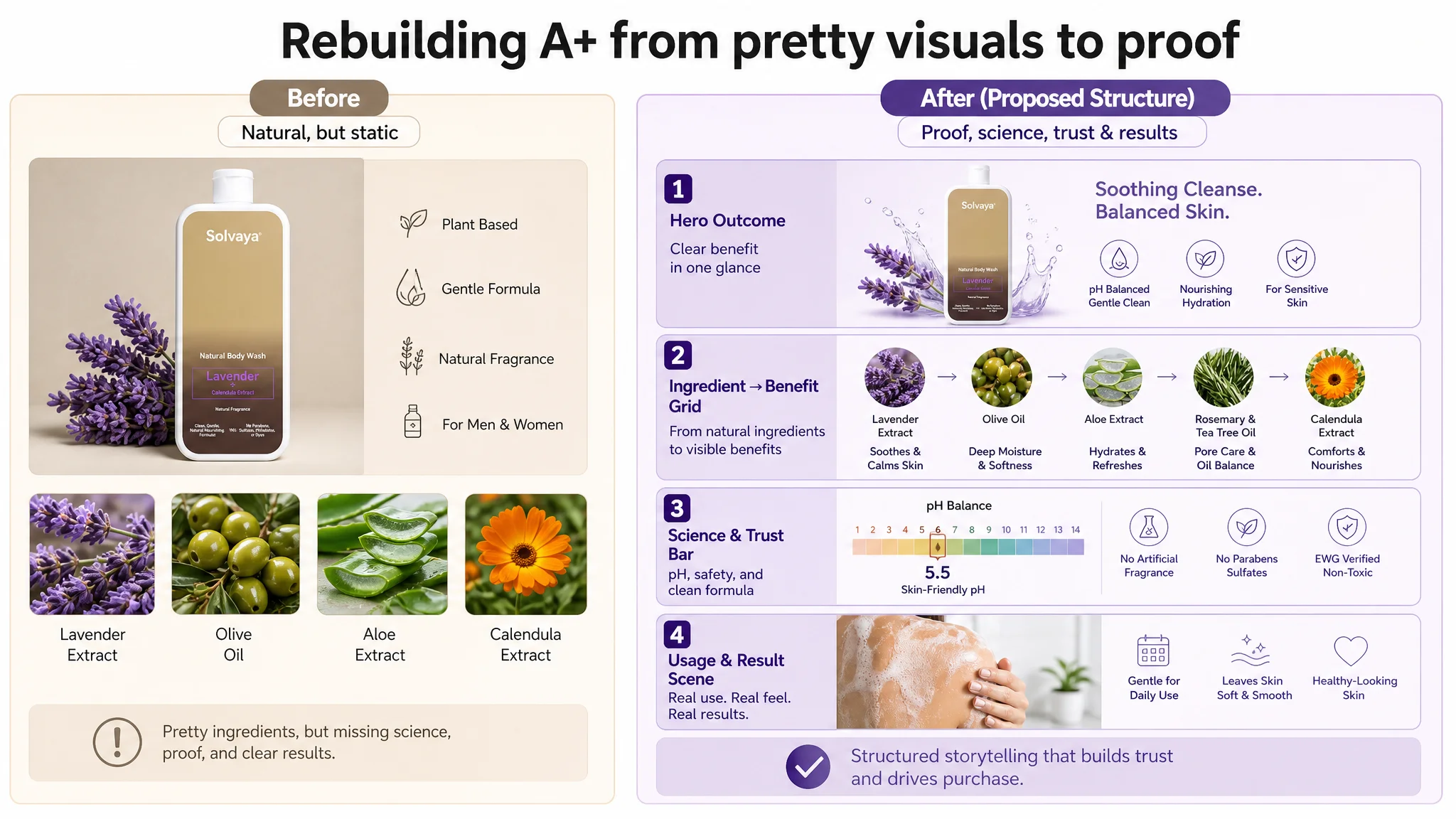
Why This Matters for Conversion
For a category where “gentle”, “natural”, and “safe” are overused, shoppers are skeptical.
They look for:
- Specific claims
- Numbers, certifications, and visible tests
- Realistic usage scenes showing texture and after‑wash skin state
Without these, the buyer has to “trust the words”. With them, the buyer can trust what they see, which shortens decision time and improves CVR.
The Rebuild Logic
DeepBI proposed restructuring A+ around four core modules:
1. Clean opening hero
- Bright bathroom scene, white marble, natural light, water droplets.
- Product centered, short heading that states the main outcome (e.g., “pH‑Balanced Lavender Care for Sensitive Skin”).
1. Ingredient → benefit grid
- Top‑down grid layout with real aloe slices, olive branches, calendula, lavender around the bottle.
- Each ingredient linked with a short benefit title (soothing, deep hydration, barrier support).
1. Trust and science visualization
- Horizontal pH scale (1–14) with 5.5 highlighted as “pH 5.5 balanced formula”.
- Short, clean text explaining why this matters for sensitive skin.
- Where legitimate, mention and visualize compliance or recognized standards (e.g., EWG non‑toxic ingredients, GMPC compliance) as supporting signals, not as invented certifications.
1. Usage and result scene
- Skin macro shot with foam and water droplets on a shoulder or arm.
- Three vertically stacked benefit keywords (e.g., “Soothing · Hydrating · Non‑Irritating”).
This sequence is designed to:
- First, reassure (clean scene, clear promise)
- Then, explain (ingredients and their roles)
- Then, prove (visual science and safety)
- Finally, let the buyer visually feel the after‑wash effect
Before pushing more ad spend, this page had to be capable of closing the sale.
Why DeepBI Did Not Recommend “Ads First”
Given the data and the benchmark comparison, DeepBI’s decision logic was:
1. The Listing’s core score (63 vs. 84) showed a structural weakness.
2. The weakest dimensions—title and detail page—directly control search relevance and persuasion depth.
3. Reviews and main images were not the primary bottleneck; the problem was how the story was told and proven.
4. Pushing more ad traffic into a structurally weak Listing would:
- Raise spend without reliably improving orders
- Distort ACOS and TACOS
- Mask the real issue for another quarter
“Advertising does not only amplify advantages. It can also amplify a page’s existing defects.”
Therefore, DeepBI prioritized:
- Rebuilding title and bullets for search and message clarity.
- Re‑architecting A+ content for trust, science visualization, and target‑skin focus.
- Upgrading main images to tell a stronger story in the search grid.
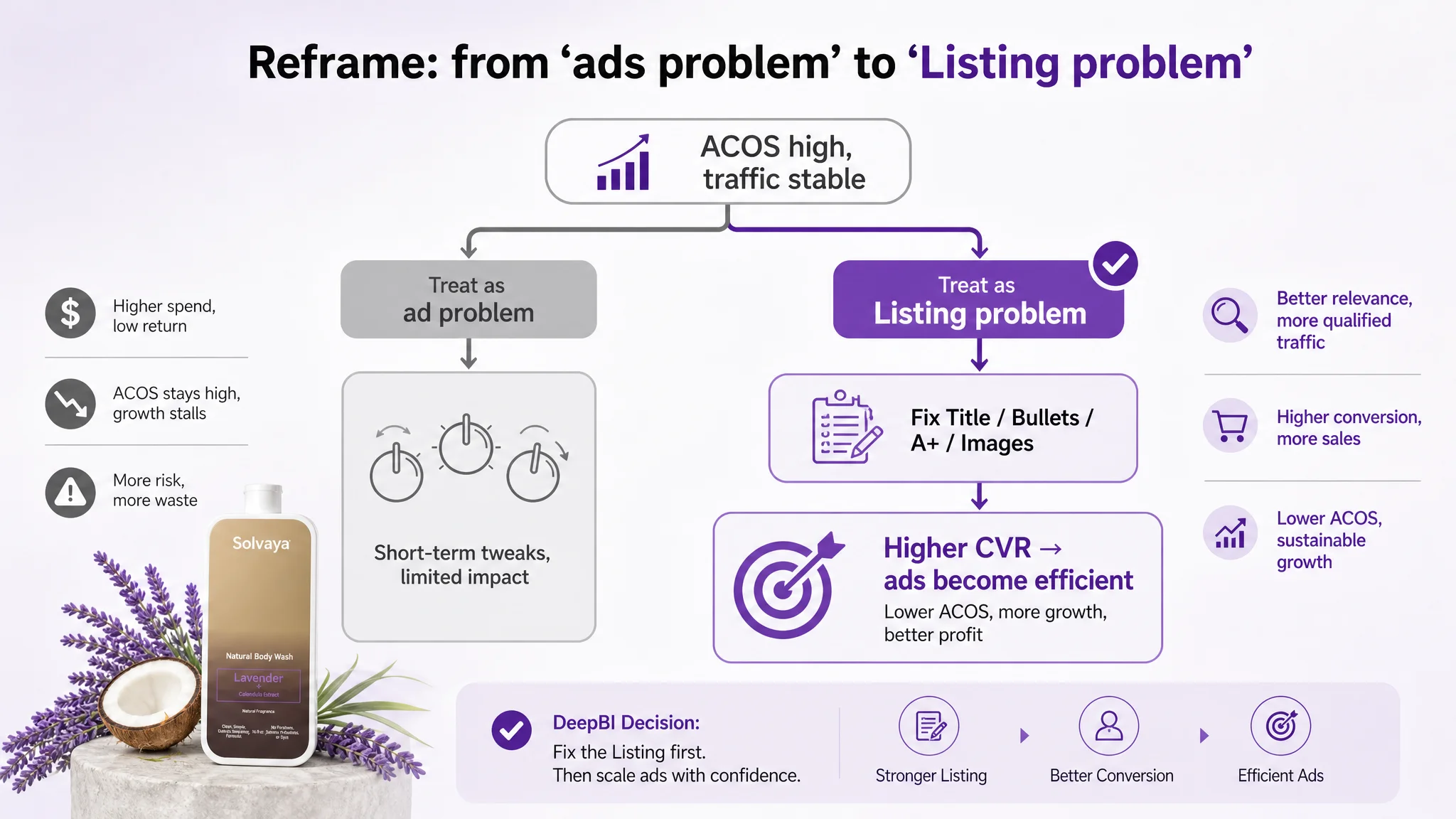
Only once the page could reasonably convert organic visitors would increased ad traffic make commercial sense.
What Changed After the Reframe (Even Without Invented Numbers)
The case material doesn’t provide hard performance numbers post‑optimization, so we won’t fabricate them. What we can say is how the operating state and risk profile changed once the seller shifted from “ads problem” to “Listing problem”:
- The Amazon product page gained a clearer conversion logic from search to A+.
- The title started working as a traffic and qualification asset, not just a label.
- Bullets spoke directly to skin problems and outcomes, not just ingredients.
- A+ content began to visualize pH, safety, and after‑use skin feel, reducing reliance on generic claims.
- Main images better aligned with category expectations (spa, fragrance, self‑care) and made the product more competitive at the thumbnail level.
As a result:
- Each click—organic or paid—landed on a page with a higher chance to convert.
- Ads no longer had to “carry” a weak page; they could amplify a stronger story.
- The seller’s dependence on constant ad tweaking decreased, because the Listing itself regained the ability to convert.
Even without exact metrics, the core business risk clearly dropped: the brand was less exposed to a situation where rising CPC meets a stagnant, under‑performing page.
What Other Amazon Sellers Can Take from This Case
Several lessons from this lavender body wash case apply across categories:
1. Do not let ACOS alone define the problem.
If traffic is there but orders are not, inspect whether your Listing can truly convert—especially versus a real benchmark in your exact use case.
1. Title and A+ are not cosmetic.
A 9‑point gap in title and a 9‑point gap in A+ essentially defined this Listing’s ceiling. Get these wrong, and ad discipline will not save you.
1. Generic “natural” and “gentle” language is no longer enough.
Buyers expect pain‑point‑specific solutions, visible mechanisms, and some form of evidence—numbers, visuals, or recognized standards.
1. Ads amplify the current state of your Listing.
If the page is strong, ads compound growth. If the page is weak, ads compound waste.
1. Before increasing ad spend, ask: “Does this page deserve more traffic?”
DeepBI’s value in this case was not generating more ideas, but improving the seller’s judgment about what to fix first.
For many Amazon sellers, the biggest unlock is not a new campaign structure. It is the realization that Listing conversion is the foundation of all ad efficiency—and that sometimes, the most urgent advertising problem is actually a product‑page problem in disguise.