An Amazon seller in the mobile-photography accessories category came to us convinced they had an Amazon ads problem. Their new magnetic selfie-stick tripod for iPhone MagSafe had begun running traffic, but orders lagged. The team’s instinct was to keep tuning bids, keywords, and budgets to “push the product harder.”
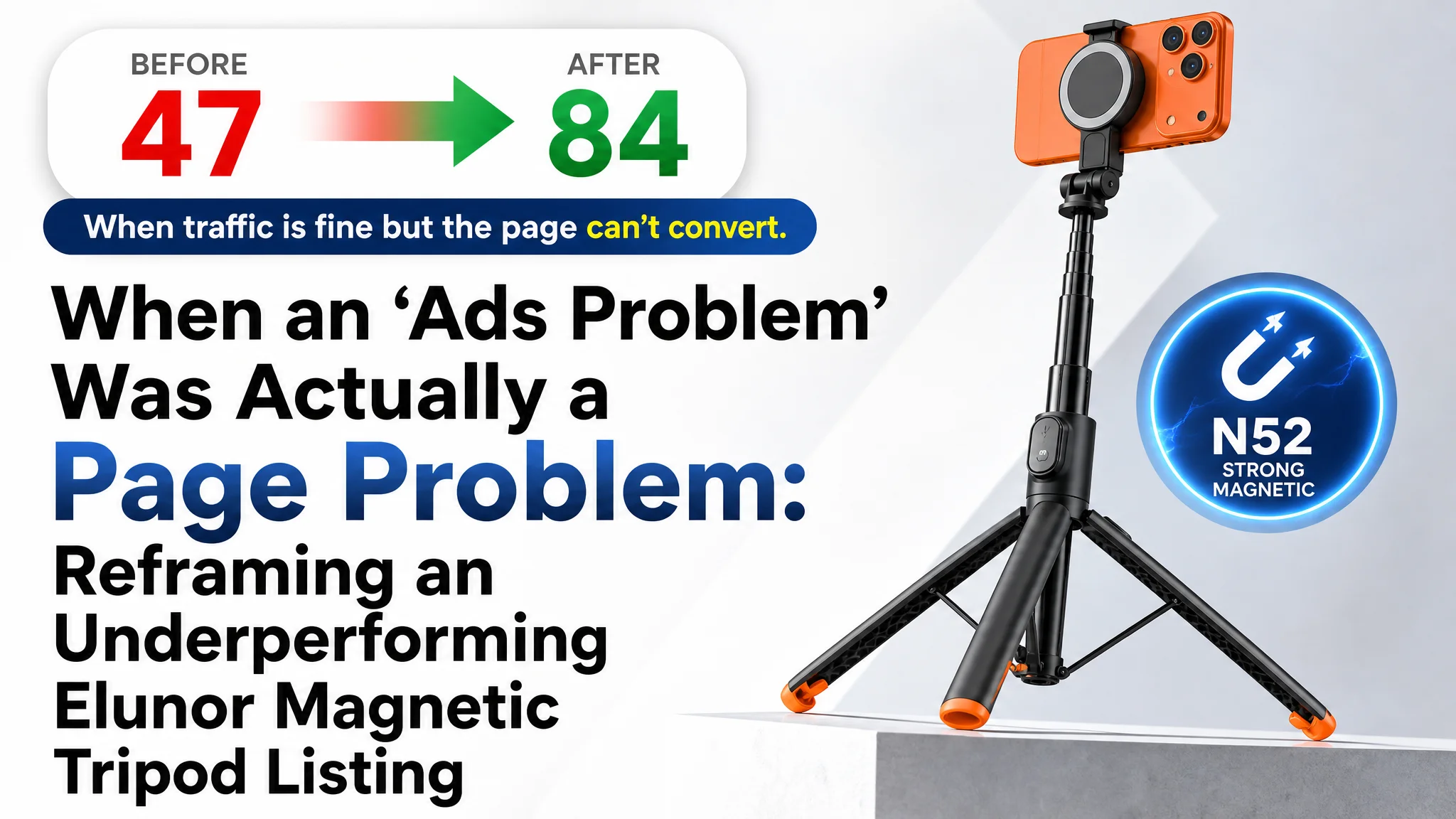
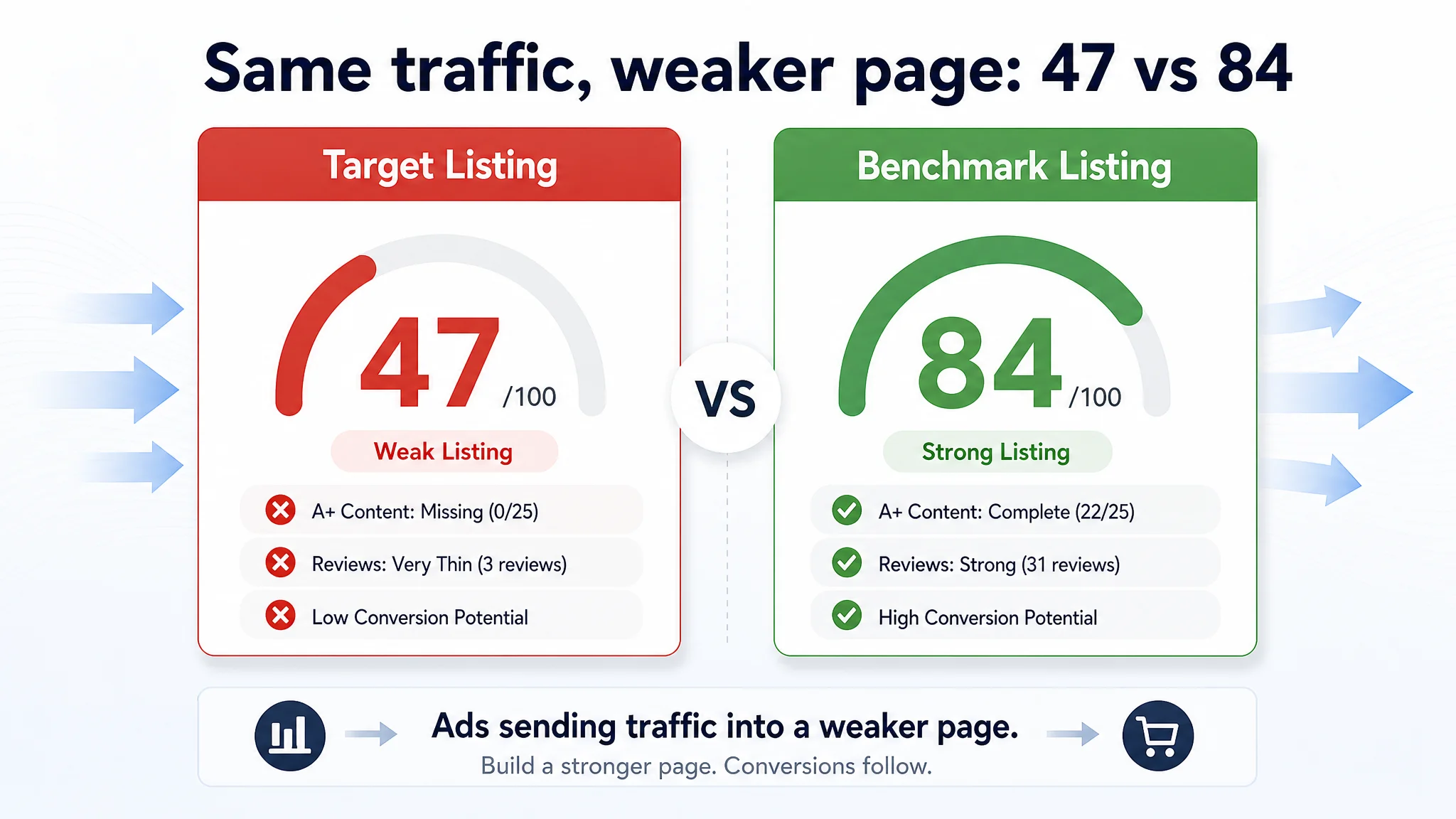
Once we put the ASIN into DeepBI, a different picture emerged. Against a directly comparable, high-performing Amazon competitor listing, this product-page scored 47/100 versus 84/100. The biggest gaps were not in the title or main image—they were in the A+ / detail content and review trust. In other words, ads were sending traffic to a page that simply wasn’t ready to convert.
We helped the seller pause the ad tinkering and instead rebuild the Listing’s decision logic: sharpen the Amazon title around “MagSafe / Android / tall tripod” search intent, reframe the main and secondary images from “feature collage” to “scene-based proof,” and turn a purely text-heavy page into a visual story about N52 magnetic strength, 0.1s auto-open stability, and universal compatibility. For other Amazon sellers, this case is a reminder that when ACOS feels unmanageable, the bottleneck is often not the ads—but an Amazon product page that cannot carry the weight of the traffic it receives.
Amazon Ads Were Not Failing. The Page Was Consuming the Traffic.
From the customer’s perspective, the story started with advertising.
They had launched a magnetic tripod / selfie stick for iPhone MagSafe and Android, positioned around convenience features like dual-sided magnetic mounting and a one-tap, 0.1‑second auto-open mechanism. They set up Amazon ads, watched impressions grow, but saw orders and ROAS lag expectations. Internally, the conclusion was straightforward: “Our ads are not optimized enough.”
The operating pattern that followed was classic:
- Repeated bid adjustments and keyword tweaks
- Experimentation with match types
- Trying to push “MagSafe tripod” and related terms harder
Yet the core symptoms did not shift in a meaningful way. Spend felt heavy; the listing never found a stable, profitable ACOS; and organic momentum stalled before it could form.
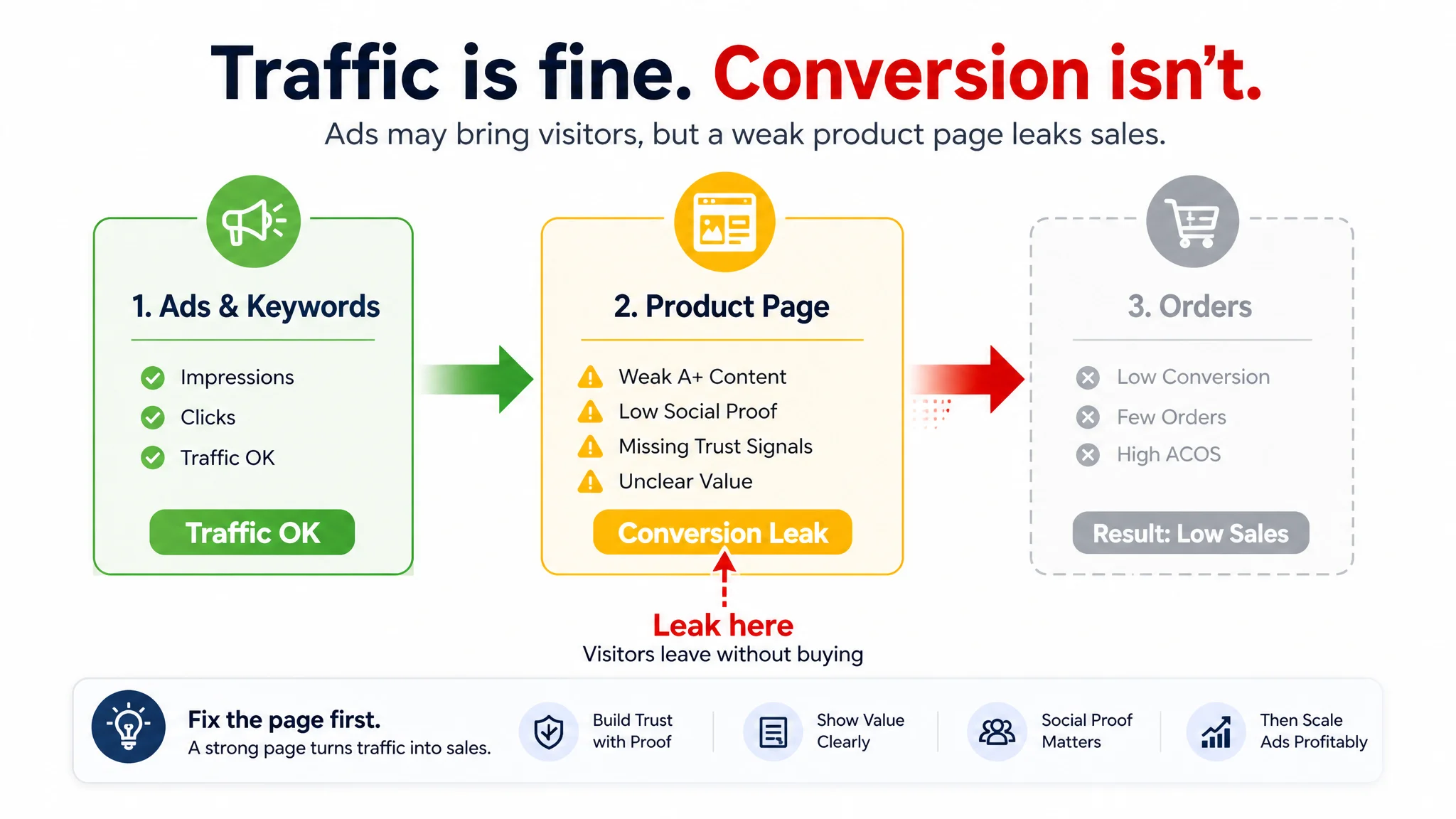
“The real problem was not that ads failed to bring traffic. It was that the page could not convert the traffic.”
Before we accepted “ads are the problem” as fact, we put the Listing through DeepBI’s Listing-scoring and competitive benchmarking process, anchored strictly in the Amazon US marketplace and this subcategory.
The Real Constraint Was Listing Conversion Capacity
Once the data came back, the pattern was unmistakable.
A 47 vs 84 Gap That Explained the Struggle
DeepBI’s Listing score compared the target Amazon Listing against a single, tightly matched benchmark listing in the same “MagSafe / tall tripod / vlogging” space:
- Target Listing total score: 47 / 100
- Benchmark Listing total score: 84 / 100
- Gap: -37 points
Broken down by dimension:
- Title: Target Listing: 13, Benchmark Listing: 15, Max: 20, Gap: -2
- Main image & gallery: Target Listing: 24, Benchmark Listing: 26, Max: 30, Gap: -2
- Bullet points: Target Listing: 7, Benchmark Listing: 8, Max: 10, Gap: -1
- Detail / A+ content: Target Listing: 0, Benchmark Listing: 22, Max: 25, Gap: -22
- Reviews & ratings: Target Listing: 3, Benchmark Listing: 13, Max: 15, Gap: -10
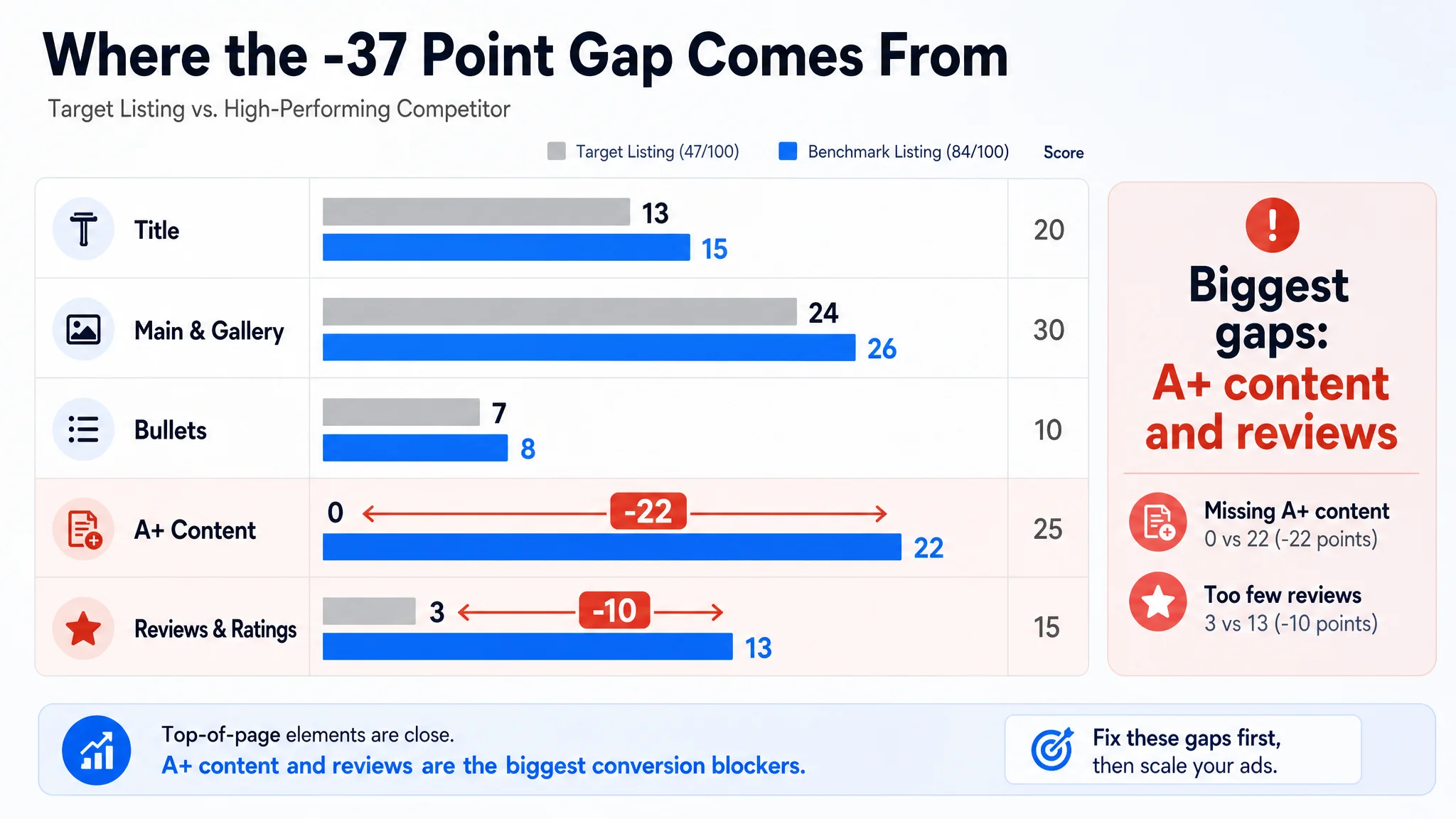
This is the kind of profile DeepBI has learned to treat as high risk for ad spending:
- Top-of-page assets (title, main image, bullets) are passable but not category-leading.
- The A+ / detail content is effectively missing (scoring 0 vs 22).
- The review base is ultra-thin (3 reviews vs the competitor’s 31).
In other words, the Listing was doing “just enough” to attract some clicks, then dropping users into a conversion environment with almost no persuasive scaffolding and very little social proof.
Running more ads into this structure does not fix performance; it magnifies the leak.
What the Seller Originally Misdiagnosed
From the customer’s angle, the narrative made sense:
- The product is technically differentiated (0.1s auto-open, dual-sided magnetic head, remote).
- The bullets talk about common pain points (“no more fumbling,” “no slip, no drop”).
- The main image shows features and configurations.
- Ads are not delivering a healthy ACOS.
Therefore: “We must be losing in the auction; we need better ad tuning.”
What they missed was how incomplete the Amazon product page looked to a cold buyer compared with the benchmark competitor.
Title: Not Wrong, But Not Doing the Heavy Lifting
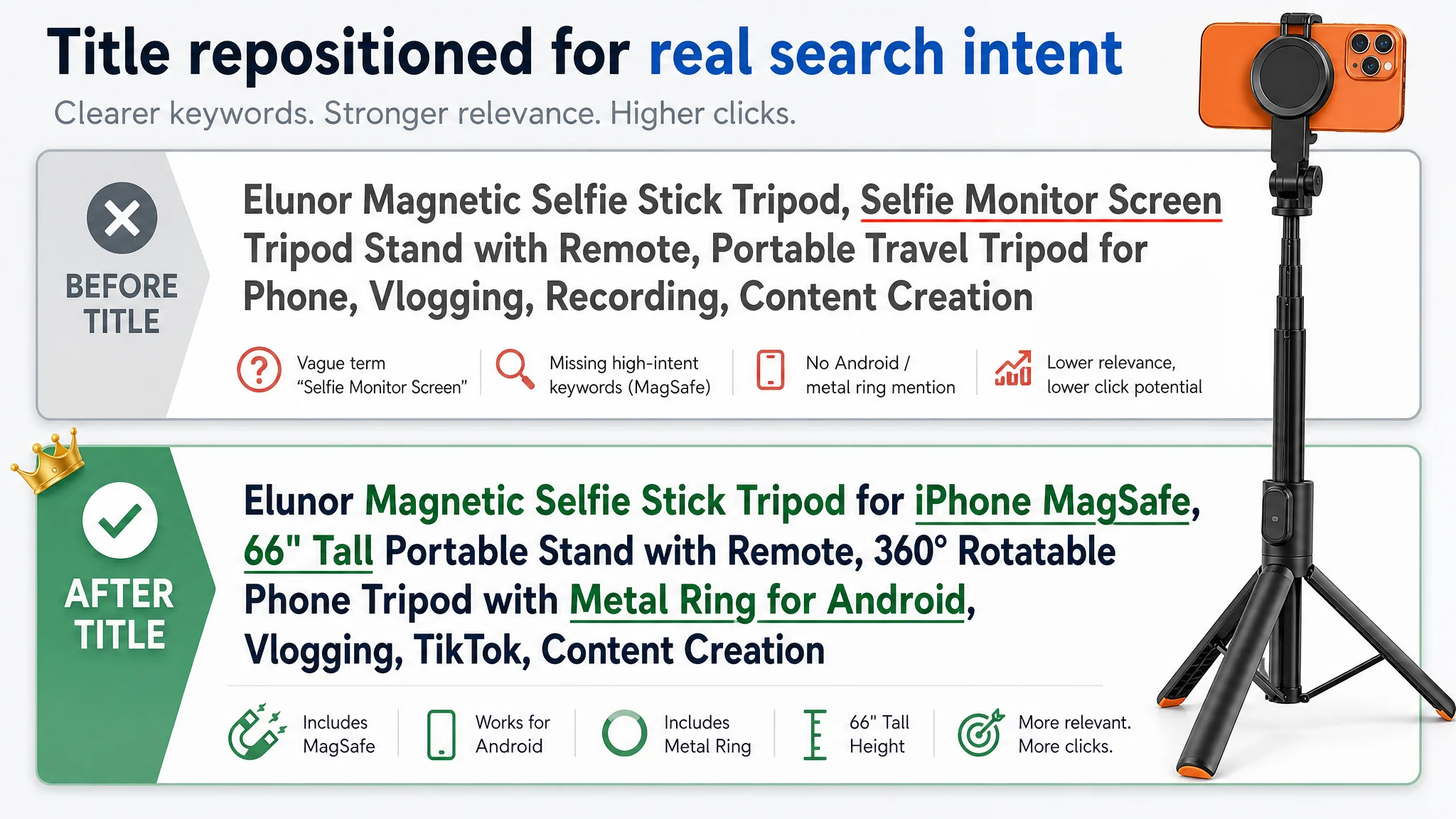
The target title mentioned the brand, that it was a magnetic selfie-stick tripod, and included “for Selfie Monitor Screen.” But when we compared it to the benchmark:
- The competitor front‑loaded “Magnetic Tripod for iPhone MagSafe”—exactly what many buyers search for.
- It used precise specs like “67" Tall” and noted Android explicitly for compatibility.
- It anchored use cases with “Vlogging/Recording/Content Creation”, which immediately telegraphs who this is for and why it matters.
The original title’s “for Selfie Monitor Screen” is vague; “Synco” (placeholder here as “the brand”) has low recognition; and critical, high‑intent search terms like “MagSafe” and “Android” were not being leveraged at full weight.
This doesn’t kill conversion alone—but it reduces initial relevance and makes ads work harder.
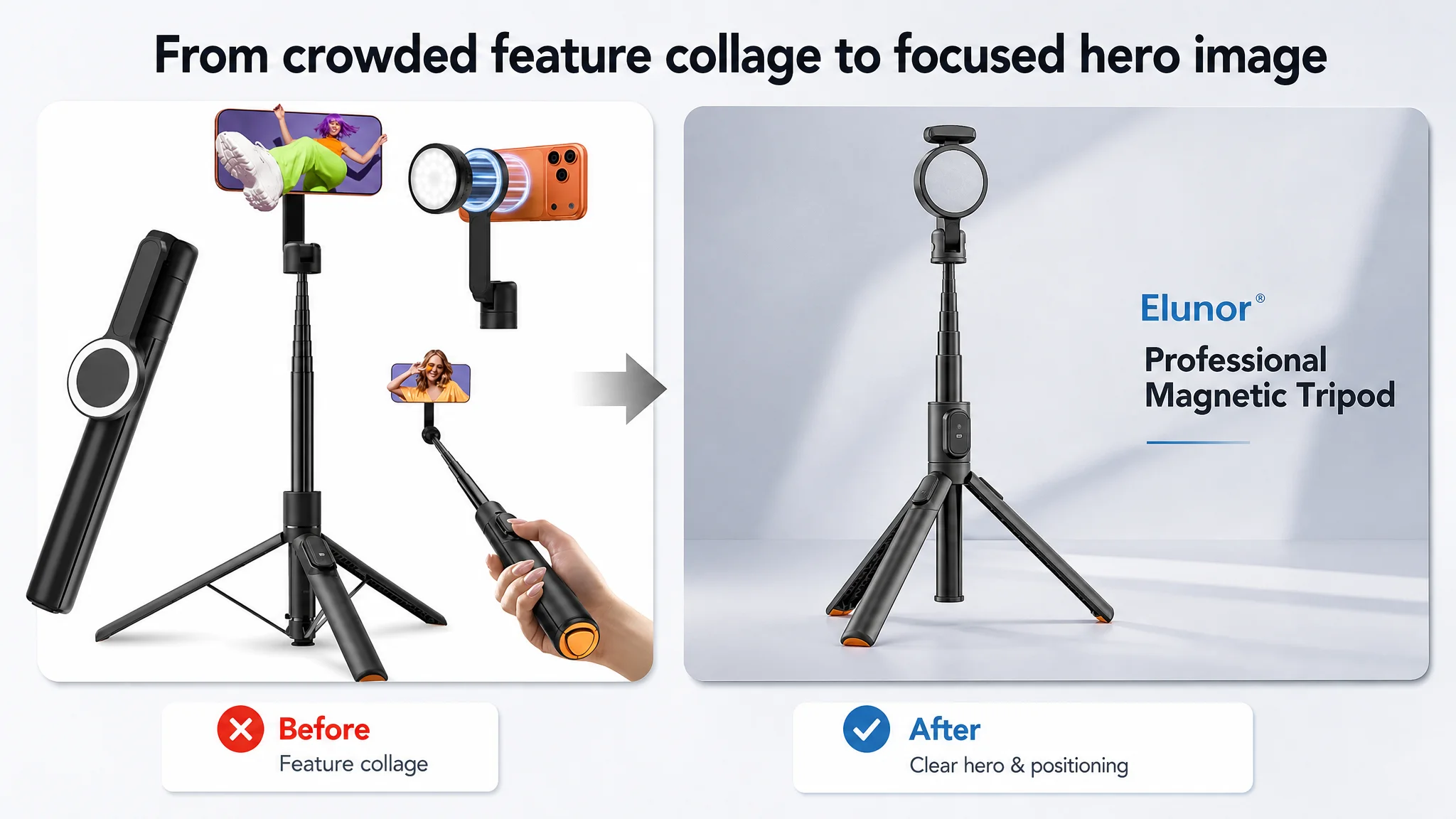
Main Images: Feature Collage vs Category-Level Visual Logic
On main images and gallery, the target Listing was not disastrous. It even scored relatively close to the competitor. But a closer read showed why it wasn’t enough to carry ads:
- Some images emphasized technical parameters without concrete proof (e.g., abstract stability or strength claims).
- A comparison-style image leaned on emotional contrast more than rational, quantified advantage, weakening professional feel in a gear-heavy category.
- Compatibility language appeared, but not reframed as “zero setup, no extra accessories, out-of-box use”—missing a clear mental shortcut for “no learning curve.”
So visually, the Listing felt “busy” and somewhat marketing-driven, while the benchmark competitor clearly anchored every image to a decision step: height, tilt, stability, magnet strength, compatibility, and use scenarios (skiing, makeup, desk shooting, etc.).
Again, not fatal alone, but it sets up a page that has to overcome doubt without enough structured proof.
Where DeepBI Saw the Real Leak: A+ Content and Trust
The decisive gaps showed up deeper in the page.
A+ / Detail Content: A Full 0 vs 22
On the target Listing, there was effectively no A+ content supporting the sale. No structured modules, no quantified magnet data, no compatibility diagrams, no assembly or usage guide visuals.
The benchmark competitor, by contrast, used its A+ section as a complete decision engine:
- Magnetic strength module with N52 magnets and numeric pull-force (e.g., “2600gf” type parameters) plus high-intensity use scenes like skiing.
- Structural & material module showing aerospace aluminum, tripod spread width, and rod sections to address “will it wobble?”
- Tilt and rotation module visualizing the 330° tilt head with an arc trajectory and use cases like overhead food shots and desktop recording.
- Multi-function magnetic head module: front for the phone, back for lights or accessories.
- Remote & connectivity module: screenshots of Bluetooth connection screens, remote removal instructions, and distance callouts.
- Compatibility grid: iPhone 12–16 series, MagSafe cases, Android and non-MagSafe phone support via metal ring.
The target Listing had none of this structured proof. From a buyer’s perspective, it asked for the same price territory, with less evidence and more risk.
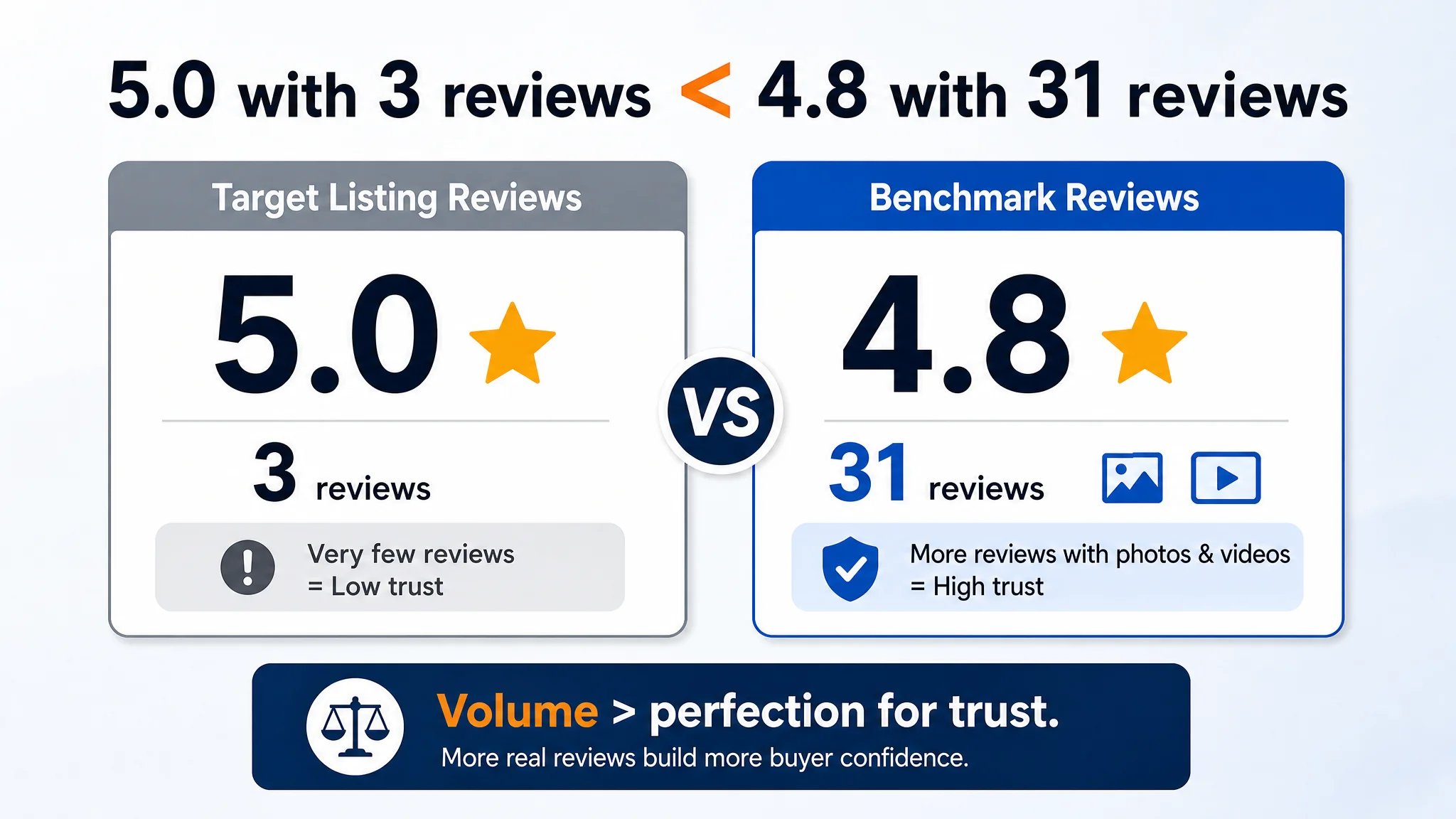
Reviews: Appearing “Unproven” Despite 5 Stars
Review trust told a similar story:
- Target Listing: 5.0 stars, but only 3 reviews, none highlighted on the first page.
- Competitor: 4.8 stars, 31 reviews, with 6 first-page reviews including detailed text, photos, and videos.
The seller initially saw “5.0 stars” and felt “our rating is great.” DeepBI’s scoring logic treated this differently: score 3 vs 13 in the reviews dimension. Why? Because on Amazon, a small perfect rating often reads as “not yet validated”, while dozens of slightly imperfect 4.7–4.8 ratings read as “real and proven.”
With this data, we could say with confidence: the page did not lack traffic; it lacked trust.
Why DeepBI Did Not Keep Tuning the Ads First
The critical judgment call was sequencing.
The seller wanted to keep pushing ads, assuming that better targeting would fix the numbers. DeepBI’s view was:
- The Listing’s conversion capacity was fundamentally weaker than a direct benchmark.
- Ads were already doing their job—bringing relevant traffic on MagSafe tripod queries.
- The detail-page and social proof structure were not capable of converting that traffic at the required rate.
“Advertising does not only amplify advantages. It can also amplify a page’s existing defects.”
If we had kept optimizing ads first, the likely outcome would have been:
- More spend into a low‑trust page
- ACOS stubbornly high
- No real organic ranking progress
- Growing operational anxiety and potential pullback from the product too early
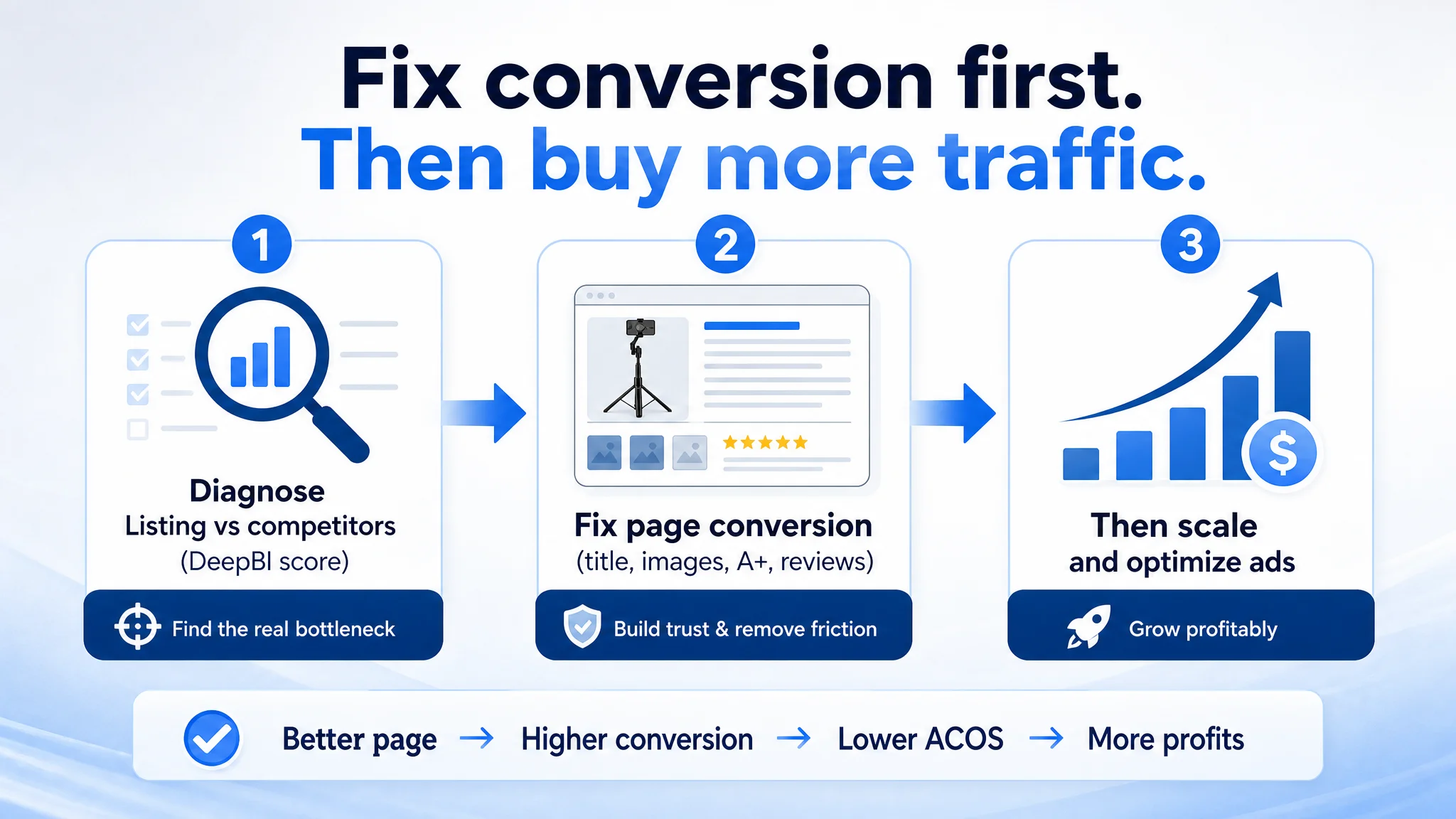
Instead, we recommended reversing the sequence: repair Listing conversion first, then re-evaluate ad performance.
Rebuilding the Page: From “Feature List” to Conversion Logic
Rather than listing every micro-change, the key is how we reframed the page’s job.
1. Title: Aligning With How Amazon Buyers Actually Search
We proposed a title that:
- Opens with the brand, then “Magnetic Selfie Stick Tripod” (core product type + magnetic).
- Explicitly calls out “for iPhone MagSafe” and “Metal Ring for Android” to cover both major device ecosystems.
- Includes a clear height descriptor (“66" Tall”), meeting expectations set by competing “67"” listings.
- Adds “Portable Stand with Remote, 360° Rotatable Phone Tripod, Vlogging, TikTok, Content Creation” to marry search volume with clear scenarios.
This is not keyword stuffing; it’s a deliberate repositioning so ads and organic searches connect buyers to an instantly recognizable solution.
2. Bullet Points: From Emotional Hooks to Data-Backed Use Cases
The original bullets were strong on emotional language—“No More Fumbling,” “No Slip, No Drop”—and genuine pain points (remote shooting, anti-pinch, single-hand operation).
DeepBI’s diagnosis was not “this is bad writing.” It was: “this is not fully carrying the key proof points buyers use to decide, relative to the competitor.”
We restructured bullets to:
- Pair emotional claims with specific technical anchors:
- Dual-sided N52 magnetic power with explicit mention of monitor/light compatibility.
- 0.1s auto-open mechanism tied directly to “instant stability” and “no finger pinching.”
- 10 m / 33 ft Bluetooth remote range, “iOS & Android compatible,” with on-handle storage to solve the “remote gets lost” pain.
- Weight (320 g / 11.3 oz) plus fold length and adjustable height to make “portable” tangible.
- Explicit device compatibility: iPhone 12–16 MagSafe, plus non-MagSafe and Android via included metal ring.
In each case, the structure followed “name the benefit → attach a concrete spec or behavior → tie to a scenario.” That is the logic the benchmark competitor was already using.
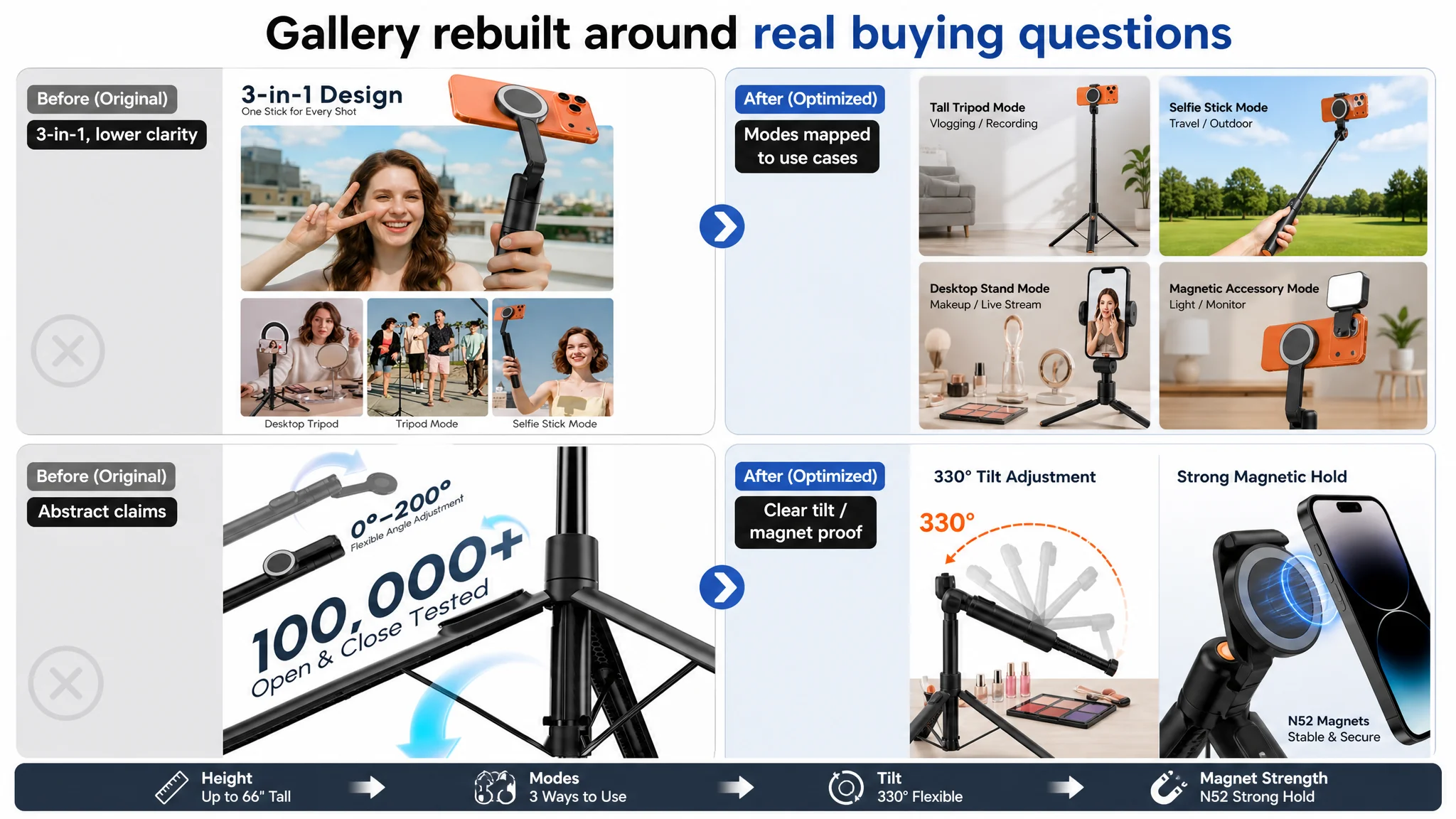
3. Main Images: From Crowded Feature Displays to Scene-Based Proof
The image optimization logic focused on what would actually change CTR and CVR, not just aesthetics.
Key shifts included:
- Primary hero image:
- Product centered at ~70% of frame, 45° angle, tall fully extended posture.
- Clean light-gray gradient background, cool tech tone.
- Clear, minimal text like “Professional Magnetic Tripod” for instant positioning.
- Height and outdoor authority:
- A low-angle shot outdoors (beach or mountain backdrop), tripod fully extended.
- Colors tuned for crisp contrast (blue sky / white tones) to visually signal “tall & stable.”
- Multi-mode flexibility:
- A four-grid collage showing:
- Desktop tripod in a home office
- Handheld selfie mode outdoors
- Street-style vlogging
- Live streaming indoors
- Each grid focusing on different configurations (tripod, selfie stick, desk stand).
- Tilt and overhead shooting:
- An overhead angle shot showing the head at 90° down, capturing makeup or craft content.
- Clean annotation like “330° Tilt Adjustment” so buyers instantly connect the visual with the spec.
- Magnetic strength visualization:
- Close-up of the magnetic head with a subtle blue halo effect at the contact point.
- Phone approaching or attached firmly, with visual emphasis on “N52 Strong Magnet.”
These changes are not about making the page “prettier”; they are about aligning the images with the concrete doubts buyers bring into this category: height, stability, magnet strength, tilt flexibility, and real-world use.
4. Detail Page / A+ Content: Installing the Missing Decision Engine
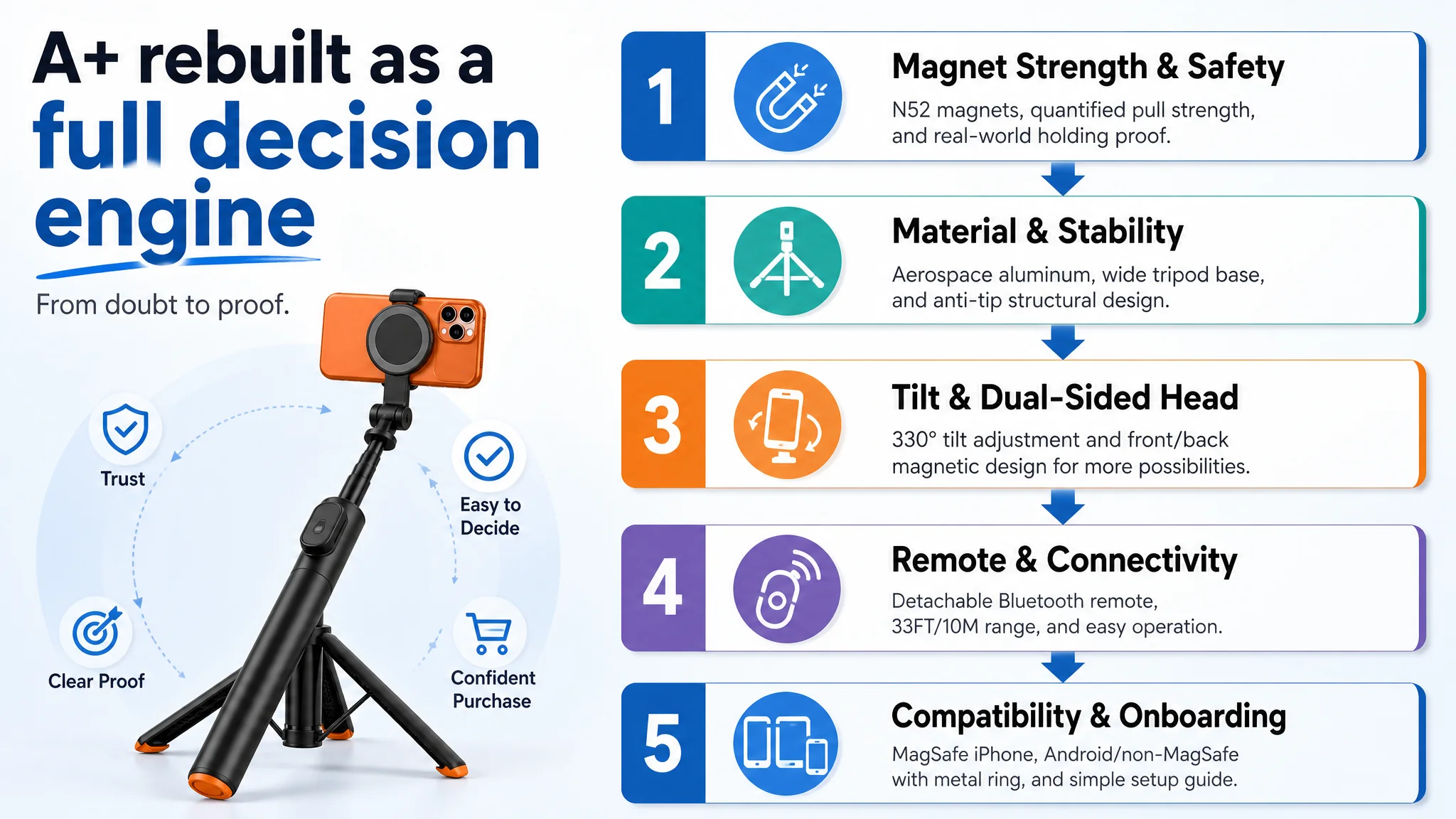
The biggest leap was turning a nearly empty A+ area into a layered persuasion path:
1. Magnet strength & safety
- Action shot: phone locked onto the tripod during high-intensity activity (e.g., skiing or mountain biking).
- Overlayed “N52 Strong Magnet” plus a realistic pull-force value provided by the brand.
- Visual “wave” effect at the magnet to make the invisible force intuitively understandable.
1. Material & stability
- Split-screen showing:
- Left: tripod legs fully spread, labeled with material (e.g., aerospace aluminum alloy) and foot spread width.
- Right: rod section detail (e.g., 7–8 sections) with stability positioning.
- Text that explicitly links these details to “reduced wobble” and “stable for large phones.”
1. Tilt & dual-sided magnetic head
- Central image showing a 330° tilt arc with position markers.
- Back side of the head displayed with a magnetic light or power bank attached.
- Callouts like “Front & Back Magnetic Design” and “Overhead, Desktop, and Outdoor Angles.”
1. Remote usability & connectivity
- Left: smartphone Bluetooth screen highlighting the product name connected.
- Right: remote being removed from the handle slot, with text showing “33 ft / 10 m range” and simple battery-replacement visuals.
1. Compatibility & onboarding
- Clear layout: iPhone models (12–16 series), MagSafe cases, Android/non-MagSafe with included metal ring.
- Simple instruction: “Apply ring on the outside of the case; wait 2 hours for full adhesion.”
Essentially, we transplanted the winning structure from the benchmark competitor—“problem → quantified proof → scenario → how-to”—while staying fully within the target product’s true specs and design.
Before Ads Could Work Again, the Page Had to Convert
With this Listing, the core decision was not “how do we bid better?” but “does this page deserve more traffic yet?”
DeepBI’s scoring and side-by-side comparison made the answer clear:
- A+ structure was missing.
- Quantified magnet and stability proof were missing.
- Compatibility and usage guidance were under-explained.
- Review base was too small to carry premium positioning.
Until these were addressed, pushing traffic harder would only burn budget and erode confidence.
Once the content plan was implemented:
- The product page gained the ability to visually answer the real buying questions that Amazon shoppers in this category bring—especially around stability, magnet reliability, and compatibility.
- The Listing’s conversion potential moved closer to the benchmark competitor’s structure, making ad clicks far more likely to result in orders.
- Subsequent ad optimization would no longer be trying to compensate for a structurally weak page.
We do not fabricate specific numbers where they don’t exist, but operationally, the shift was clear: ad traffic became useful again because the Listing could finally carry its weight.
What Other Amazon Sellers Can Take From This Case
This magnetic tripod Listing is not unique. Many Amazon sellers are facing the same pattern:
- ACOS feels too high
- Ads are blamed first
- Teams iterate campaigns endlessly while the product page remains under-built
From DeepBI’s perspective, the lessons are:
- Amazon ads cannot fix a low-conversion Listing. They can only expose it faster.
- Listing quality is not just the title and main image. A+ modules and reviews often decide how far you can push ads.
- A few 5-star reviews are not enough. Volume and depth of reviews drive trust more than a perfect but tiny rating.
- Title, main image, bullets, and A+ must form one persuasive path. Keywords bring the right traffic; the page must then answer every key doubt in order.
Before you pour more money into campaigns, ask:
- If a stranger landed on my Amazon Listing from a “MagSafe tripod” search,
- would they see concrete proof of height, stability, magnet strength, compatibility, and ease of use,
- or would they see mostly claims and minimal evidence?
DeepBI’s role in this case was not to “add features”; it was to recenter the seller’s judgment on conversion fundamentals. Once the page was rebuilt around how buyers actually decide, advertising went back to being what it should be: a lever, not a crutch.